
























Table of Contents
Categories
Most Popular


When every channel is running its own clock, customers hop.
An average customer hops 9 channels to talk to a brand, and 78% start a transaction on one and finish on another. If you can’t keep up, it contributes to losing a customer.
You need to be present across multiple channels to engage customers. Most importantly, the customer should feel like a continuous experience, no matter which channel they land. The best omnichannel customer engagement platforms make it possible.
There are 12 platforms below that you can explore and decide what fits your pace, current system, and the broader stack.
What Is an Omnichannel Customer Engagement Platform?
An omnichannel customer engagement platform is a single system that runs your email, SMS, push, in-app, web, WhatsApp, and emerging channels off a shared customer profile. One source of truth. One set of decisions. One customer experience across every channel.
The simplest test of whether a tool is truly omnichannel: if your email engine and your push engine can both fire the same offer at the same person within an hour without either knowing about the other, what you have is multichannel, not omnichannel. Shared identity, shared context, and frequency capping that lives above the channel. Those three together draw the line.
Who Needs One Most
Four kinds of businesses depend on this stack the most. Mobile-first apps, where in-app and push notifications carry retention. E-commerce teams fighting Baymard’s 70.22% cart abandonment. Banks, fintechs, and insurtechs are running long-term lifecycle processes across KYC, alerts, and education flows. And travel, hospitality, and QSR brands are chasing repeat visits across seasonal peaks.
If your team sits in any of these, the platform choice is less about features and more about fit. The 12 platforms below cover the field, graded on channel coverage, AI depth, data layer, industry fit, total cost of ownership, and compliance.
The 12 Best Omnichannel Customer Engagement Platforms
Each of the 12 platforms gets graded on dimensions that are critical to execute omnichannel engagement strategies at scale.
1. CleverTap
Best for: Mobile-first apps, fintechs, e-commerce, travel, and QSR brands in India, SEA, MENA, LatAm, and EU that need deep AI personalization, native WhatsApp and RCS, and a real-time data layer underneath every campaign.
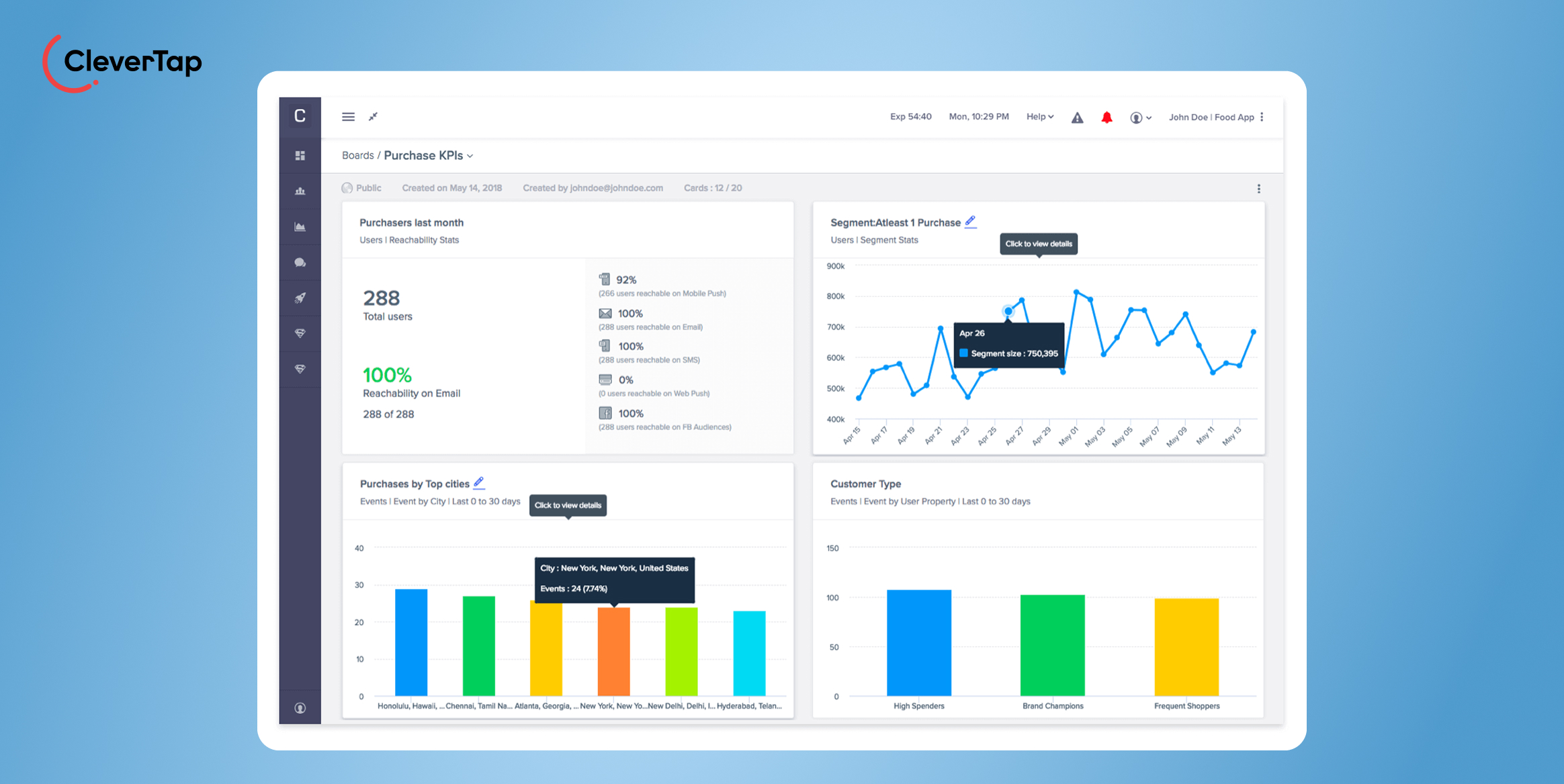
CleverTap is the customer engagement and retention platform purpose-built for the moment when your customer base lives inside the app, the inbox, and the messaging window all at once. The reason buyers come and stay is architectural. CleverTap is engineered top-to-bottom for omnichannel orchestration, not retrofitted from a single-channel ESP or a CRM with messaging glued on.
The Data Layer: TesseractDB
Most platforms slow down the moment you ask them to query a year of behavioral history across millions of users. TesseractDB™ is CleverTap’s proprietary database, designed to store long-tail behavioral data on every user and serve it in real time. That matters because customer segmentation, journey decisions, and AI predictions only get as smart as the data they can see in the moment a campaign fires.
TesseractDB™ lets the platform query against live behavioral state instead of a yesterday snapshot, which is what real-time personalization with sub-200ms decisioning actually requires in production.
The Intelligence Layer: Clever.AI
Clever.AI bundles three types of AI into a single suite, each tied to a specific job in the marketing workflow.
- Predictions Agent scores every user on churn risk, conversion likelihood, and customer lifetime value, then feeds those scores directly into journey logic.
- Segment Builder Agent turns a plain-English instruction like “users who browsed a category twice last week but never bought” into a live, real-time segment you can target.
- Send Time Optimizer Agent picks the personal best send time for every user, based on their engagement history, not a campaign-wide rule.
- Generative AI writes subject lines, push copy, and message variants directly inside the campaign builder, not in a separate tab.
- Agentic AI takes an outcome goal, like “reactivate dormant high-value users,” and runs the campaign end-to-end across audience, content, channel, and timing.
The Orchestration Layer: Lifecycle Optimizer
Lifecycle Optimizer is where marketing teams build the journeys customers actually walk through. Multi-step, branched, and triggered by live behavior across push, email, in-app, SMS, WhatsApp Business, and RCS, with shared frequency capping enforced across every channel in the journey.
The customer sees one brand, not five, and the platform listens to what they did on each step before deciding the next.
The orchestration layer also gives teams a visual way to build and optimize omnichannel customer journeys across the lifecycle, instead of managing each channel as a separate campaign system. Journeys can adapt in real time based on engagement patterns, behavioral triggers, channel interaction, and customer intent as it shifts across touchpoints.
CleverTap is ISO 27001, SOC 2 Type II, GDPR, CCPA, and HIPAA compliant, plus AWS Partner status. For fintech, banking, healthcare, and EU buyers, that posture clears most of the procurement floor without weeks of vendor security review.
The Proof Sits in the Customer Outcomes
Below is an overview of what customers observe post onboarding CleverTap as their omnichannel customer engagement platform.
- A leading UAE e-commerce brand moved off generic broadcast notifications to personalized journey-based triggers across cart, wishlist, search, and browse-abandonment flows, and recorded a 400% boost in conversions. Same channels as the day before, same audience. Different orchestration.
- Shawarmer, the Saudi Arabian QSR brand, used RFM segment-based campaigns to deliver a 9% uplift in overall sales, 36% recovery of the at-risk customer segment, and 27% reactivation of dormant users, with zero paid media spend. The campaign ran entirely on owned channels, which is exactly what a true omnichannel platform is supposed to make routine.
- Ayopop, the Indonesian bill-payment fintech, cut 90-day churn by 15% by combining segmentation, behavioral targeting, and lifecycle messaging across push, email, and in-app.
- yufin, an SMB-focused digital-payments app, doubled the revenue share of its high-value customer segment using behavior-driven journeys and Linked Content. Beblue, the Brazilian cashback fintech, scaled engagement to over 2 million users across push, email, in-app, and SMS without spammy fatigue, freeing roughly 20 hours a week of manual marketing operations in the process.
Where CleverTap Shines
Mobile-first brands with high DAU targets get the most out of CleverTap, especially in markets where WhatsApp and RCS carry the customer relationship. Fintechs and insurtechs benefit from the compliance posture and the granular lifecycle journeys. E-commerce, travel, and QSR teams use the data layer to recover carts, reactivate dormant users, and run RFM-driven retention without leaning on paid media.
If your team is shortlisting platforms for 2026, and the customer relationship lives on mobile, push, WhatsApp, and RCS, CleverTap should be on the shortlist.
See how CleverTap brings omnichannel engagement, AI, and lifecycle orchestration together.
2. Braze
Braze grew up as the platform for lifecycle marketing teams who had outgrown their email service provider and wanted a real cross-channel system. The buyer profile is consistent: a scaling consumer brand, often app-led, with enough engineering budget to integrate, instrument, and tune.
Below are some key features of Braze.
- Canvas Flow for journey orchestration across push, email, in-app, SMS, WhatsApp, and content cards
- Connected Content for personalization from external APIs
- Current data export to warehouses and lakes
- Liquid templating language for granular dynamic content
Where it shines is in lifecycle programs for scaling brands. However, it stretches thin at a smaller scale and outside e-commerce. One SMB Director flagged that Braze’s cost model, based on data consumption, disincentivized core use cases that rely heavily on data.
Related reads: Top 12 Braze Competitors & Alternatives
3. MoEngage
MoEngage shines in multichannel campaign management for mid-market mobile teams, with requirements of user journey, analytics, and data insights. Buyers choose it as the pragmatic middle option when Braze feels heavy, and a point tool feels light.
Below are some key features of the platform.
- Cross-channel orchestration across push, email, in-app, SMS, WhatsApp, and on-site
- Sherpa AI for send-time and channel optimization
- Native analytics with funnel and cohort views
- Segmentation on behavioral and demographic attributes
MoEngage is suitable for mid-market B2C app companies in growth mode, particularly in Asia and EMEA, that want a balanced push/in-app/email stack without a Braze-scale commitment.
Also read: Top 16 MoEngage Competitors & Alternatives
4. Insider One
The design philosophy is “one panel, every channel,” and Insider has spent the last few years adding generative AI surfaces (Sirius AI) on top of a personalization engine that came up in e-commerce. The platform leans toward retail and digital storefront teams that want web, app, email, SMS, and WhatsApp managed in a single console, with AI handling channel-time decisioning.
Below are some key features of the platform.
- Web, app, email, SMS, push, and WhatsApp orchestration from one interface
- Sirius AI generative agents for content and journey suggestions
- Built-in CDP with cross-device identity resolution
- Personalization for web and app discovery surfaces
Where it shines is for retail and travel teams that want an AI-forward console and a strong personalization layer on the website itself, not just outbound messaging.
It stretches thin in technical depth for engineering-heavy buyers and the maturity of newer AI surfaces relative to the established orchestration engine. Buyers should pressure-test the agentic feature roadmap against actual production use cases before signing.
Related: Top 12 Insider Competitors & Alternatives
5. Klaviyo
Klaviyo is the platform Shopify operators recommend to other Shopify operators. The product wraps email and SMS around the e-commerce data model so tightly that for a small or mid-sized online store, the choice is often Klaviyo or “build it yourself.”
Below are some key features of the platform.
- Email and SMS as primary channels with deep Shopify and BigCommerce integrations
- Klaviyo AI for predictive analytics, including predicted CLV and churn risk
- Segmentation against the e-commerce data model out of the box
- Flows builder for triggered, conditional sequences
However, Klaviyo stretches thin is at the multi-channel scale and in cost.
6. Netcore Cloud
Netcore comes out of India’s email infrastructure heritage and has expanded into a full omnichannel stack that handles email, push, in-app, WhatsApp, SMS, and on-site personalization. The pitch lands well in markets where email deliverability and WhatsApp depth both matter, which is most of South Asia, the Middle East, and parts of Africa.
Its key features include:
- Email deliverability infrastructure with managed sender reputation
- Cross-channel orchestration across push, in-app, WhatsApp, SMS, and web
- On-site personalization, including product recommendations
- App engagement suite with funnel and cohort analytics
Where it shines is in regions where WhatsApp is the dominant retention channel and email infrastructure is non-negotiable, offering a credible alternative for buyers who want a single vendor for both.
However, you might want to test the depth of native mobile push features against mobile-first specialists.
You might like to read: Top 12 Netcore Alternatives for Secure and Scalable Customer Engagement
7. WebEngage
WebEngage was built for a very specific tradeoff: give mid-market and emerging-enterprise teams a journey designer that does not require a data engineer to operate, and price it below the global mobile-first specialists.
Below are some of its key features:
- Cross-channel campaigns across email, push, in-app, SMS, WhatsApp, and on-site
- Journey designer with visual branching
- Catalog-based personalization for recommendations
- Hyper-personalization rules engine
If you’re considering WebEngage, it would be good to test its AI maturity and integrations with popularly adopted CDPs and warehouses.
Read more: CleverTap vs. WebEngage: Choosing the Right Customer Engagement Platform
8. Iterable
Iterable’s design center is the product-led growth team. Where Braze sells lifecycle to consumer brands, and Klaviyo sells flows to e-commerce stores, Iterable sells journey orchestration to SaaS, media, and product-led companies that need to coordinate marketing and product messaging on one timeline.
Key features:
- Studio journey orchestration across email, push, SMS, in-app, web, and embedded
- AI Optimization Suite for send-time, channel, and content
- Catalog and template management for content reuse
- Real-time event ingestion and triggers
- Brand Affinity for affinity-driven personalization
- Embedded messaging surfaces for in-product use cases
Where it stretches thin is in deep mobile-first scenarios and in regions where WhatsApp dominates retention, where mobile-specialist competitors have a clearer feature-set match.
Related: Top 14 Iterable Competitors and Alternatives
9. OneSignal
OneSignal made its name as the push notification provider that every developer could integrate in an afternoon. Over the last few years, it has expanded into a full multichannel platform with email, SMS, in-app, and journey orchestration.
The buyer profile starts smaller and skews technical, with self-service onboarding rather than a customer-success motion as the front door.
OneSignal delivers the following features:
- Mobile and web push as core channels with strong delivery infrastructure
- Email, SMS, in-app messaging, and live activities
- Journeys for visual workflow design
- A/B testing on push and notification content
- Segmentation against user properties and behavioral events
- Free tier and developer-first API documentation
Where it shines is for engineering-led teams that want production-grade push and a credible multichannel layer without enterprise procurement, with the free tier acting as a genuine on-ramp for small teams.
Also read: Top 15 OneSignal Alternatives and Competitors
10. Customer.io
Customer.io built its reputation on event-driven messaging for SaaS and product-led teams. The mental model is closer to “if-this-then-that for customer communication” than to a traditional marketing automation suite.
Below are some key features of the platform.
- Event-driven workflows across email, push, SMS, in-app, and webhooks
- Liquid templating for granular personalization
- Visual workflow builder with branching and delay logic
- Segmentation against ingested events and attributes
- Data Pipelines for warehouse and CDP integration
- Transactional API for product-triggered messaging
Where it stretches thin is in its depth of reporting. It’s arguably also lighter than enterprise-grade competitors.
Continue reading: Customer.io Competitors & Alternatives: Top 10 Tools Compared
11. Agentforce Marketing (Salesforce Marketing Cloud)
The Salesforce option always sits on the shortlist when the rest of the revenue stack already runs on Salesforce. Agentforce Marketing is the rebranded surface that wraps Marketing Cloud’s email, mobile, journey, and personalization modules with agentic AI on top. The pitch is depth, breadth, and CRM-attached data inside an enterprise-grade stack.
Key features:
- Marketing Cloud Engagement for email, mobile, and journey orchestration
- Agentforce for agentic AI surfaces inside marketing workflows
- Data Cloud as the CDP layer attached to Sales and Service Cloud
- Pardot/Marketing Cloud Account Engagement for B2B journeys
Where it shines is inside large enterprises already standardized on Salesforce, where the integration into Sales and Service Cloud and the breadth of compliance and procurement readiness justify the spend.
Read more: Top 12 Salesforce Marketing Cloud Competitors For Reliable Customer Engagement
12. Bloomreach
Bloomreach blends content commerce and customer engagement under one roof. The platform’s history lies in e-commerce search and merchandising, and the engagement engine grew alongside it, with a clear focus on retail and digital storefront workflows
Below are some key features of the platform.
- Engagement module across email, SMS, push, web, and ads
- Loomi AI for predictive segmentation and content optimization
- Built-in CDP for first-party customer data
- Discovery for site search and product personalization
Where it shines is for mid-market and enterprise retailers seeking commerce search, on-site personalization, and outbound messaging from a single vendor with a shared catalog and customer data layer. The bundled fit is what gives the platform its premium over pure messaging-first competitors.
How to Choose the Right Omnichannel Customer Engagement Platform
Most platform decisions go wrong before the first demo deck loads. Teams that get it right work through six steps in order.
1. Define Your Primary Engagement Channels
Begin with where the customer actually is. An app-first brand needs a different shortlist than a web-first one. A brand serving India looks at different vendors than one serving the US.
Regional reach changes the math entirely. Dhruv Toshniwal, co-founder of The Pant Project, put a sharp number on it: “WhatsApp is used by 850 million people in India and opened on average almost 900 times a month by each user.” For brands in India, SEA, MENA, or LatAm, WhatsApp isn’t a future bet. It’s how customers already prefer to be reached.
Channels shape the shortlist. Data quality shapes whether the shortlist works.
2. Assess Your Data Infrastructure
Most platform failures trace back to data, not features.
Three honest questions help.
- Do you already run a CDP, or does the new platform need to bring one?
- How clean is your event tracking today?
- What identity resolution exists across email, mobile, and web?
The answers decide whether you buy a full-stack platform or a best-of-breed orchestrator on top of your existing CDP.
Once the data is real, the platform choice sharpens by industry.
3. Match the Platform to Your Industry
Different industries have different expectations from the solution of their choice.
Fintech and banking lean on KYC nudges, transaction alerts, fraud notices, and education flows, plus compliance that survives audit. E-commerce and retail battle Baymard’s 70.22% cart abandonment. The right platform recovers carts across push, email, WhatsApp, and SMS as one campaign.
Travel and hospitality work on long cycles, so dormant-user reactivation matters more than weekly nurture.
Industry sets the channel mix. AI decides how fast the engagement improves.
4. Evaluate AI and Automation Depth
AI in this category now means three different things, and serious buyers ask about each one separately. Predictive AI scores users on churn, intent, and LTV. Generative AI writes the message. Agentic AI takes a goal and runs the campaign.
Forrester’s Q1 2025 CMO Pulse Survey found that 90% of B2C marketing executives plan to grow AI investment over the next year. The investment is rising, but so is the gap between “we have AI” and “we have AI you can use.”
Three direct questions cut through the demo:
- Which predictive models are native versus partner-built?
- Where does the generative content live, inside the journey or outside it?
- Can the AI take an outcome goal and run with it, or does it only score and recommend?
These will help you assess the AI capabilities of the vendor.
5. Verify Compliance and Security Posture
For fintech, banking, healthcare, and EU brands, compliance is a yes-or-no question. The minimum stack is GDPR, SOC 2, ISO 27001, and HIPAA, where relevant. CCPA covers California consumers. Data residency in your customer’s region is treated as a separate line item in regulated industries.
The list of controls to confirm runs through role-based access, audit logs, encryption in transit and at rest, regional data residency, and end-to-end consent management. Get every claim in writing from the vendor’s trust center before contracts move.
How CleverTap Fits In
CleverTap is built for mobile-first brands where WhatsApp, RCS, push, and in-app carry the customer relationship. The architecture choices reflect that focus.
TesseractDB stores long-tail behavioral data on every user and serves it in real time, so segments and triggers do not sample or stale out. Clever.AI bundles predictive, generative, and agentic AI into a single suite, with agents such as Predictions Agent, Segment Builder Agent, and Send Time Optimizer Agent taking on specific tasks. Lifecycle Optimizer coordinates push, email, in-app, SMS, WhatsApp, and RCS with shared frequency capping across the lot.
Beblue in Brazil scaled engagement to 2 million users without fatigue, freeing about 20 hours a week of marketing operations with CleverTap. If your team is shortlisting platforms for 2026, and your customers live on mobile, WhatsApp, and RCS, CleverTap is worth a closer look.
See what Clever.AI can do for your numbers. Book a demo.
Deliver Live 1:1 Personalization That Drives Higher Lifetime Value
Customer loyalty is built when engagement keeps pace with changing needs and behavior. With CleverTap’s AI-native Customer Retention Management Platform, powered by CleverAI™, you set the goals and guardrails while past context, live intent, and AI decisioning deliver Live 1:1 Personalization. Each outcome informs the next decision, helping curb churn, and maximize customer lifetime value.

Agnishwar Banerjee 
Leads content and digital marketing.Expert in SaaS sales, marketing and GTM strategies.
Free Customer Engagement Guides
Join our newsletter for actionable tips and proven strategies to grow your business and engage your customers.