






















Table of Contents
Categories
Most Popular


The churn numbers on your OKRs aren’t exactly a sign of failing retention strategies; it’s a byproduct of diminishing engagement and value that customers fail to perceive over time.
Most customer retention strategies fail quietly.
Across 469 brands in 12 industries, 21% saw their customer experience scores decline in 2025, while only 6% improved. A single bad product or service experience can be a cause of it. For 52% of consumers in PwC’s 2025 survey, it was exactly the cause.
To solve this, technology does help. But the customer retention technology needs to be equipped with systems that pinpoint exactly where retention fell off. When you go shopping, you’ll come across engagement platforms, CDPs, marketing automation suites, and whatnot.
This article aims to provide clarity on what you need for a customer retention platform in 2026. Before we list anything, it helps to understand what buyers are actually shopping for.
Why Retention Matters for B2C Brands in 2026
There is a perception gap inside most B2C companies.
While most executives believe customer loyalty is improving, consumers often disagree. At the same time, customer expectations continue to evolve faster than brands can adapt. That makes retention increasingly dependent on how well brands respond to customer behavior in real time and continue delivering value after acquisition.
Personalization plays a major role here. Done well, it makes customers 2.3x more likely to confidently complete purchases. Done poorly, it does real damage. Gartner’s 2025 research found that 53% of customers reported negative experiences from personalization, making them significantly less likely to buy again.
The takeaway is simple: retention depends on relevance. Customers stay longer when interactions feel timely, useful, and personalized to their needs.
That is why B2C brands need retention platforms that can unify customer context, automate journeys, and personalize engagement at scale.
What to Look For in a Customer Retention Platform
Use these seven criteria as your evaluation lens for the rest of this article. Score each platform against them.
- Unified Customer Profiles Built From Behavior: Can the platform stitch app, web, and offline events into one record in real time? Unified profiles make it possible to personalize campaigns using a customer’s complete history instead of disconnected channel data.
- Live, Behavior-Based Segmentation: Do segments update instantly as users act? Real-time segmentation is critical for churn, cart abandonment, and reactivation campaigns.
- True Omnichannel Orchestration: Push, email, SMS, WhatsApp, in-app, and web campaigns should work together inside one journey, not separate silos.
- Lifecycle Journey Automation: Look for a visual journey builder, branching logic, trigger-based campaigns, that marketers can launch without engineering dependency.
- AI Personalization at Scale: Features like churn prediction, send-time optimization, channel-of-choice prediction, and intent-based segmentation should help personalize engagement automatically.
- Analytics that close the loop. Funnels, cohorts, retention curves, and campaign attribution to revenue, not just opens and clicks.
- Experimentation capabilities. Built-in A/B testing, holdout groups, and multivariate testing on creative and journey logic.
Top 10 Best Customer Retention Platforms for B2C Brands in 2026
With those criteria in hand, here are the 10 customer retention platforms worth your shortlist.
1. CleverTap: Best All-in-One Engagement Platform for B2C Lifecycle Teams
CleverTap is an all-in-one customer engagement and retention platform built for B2C brands running mobile-first lifecycles.
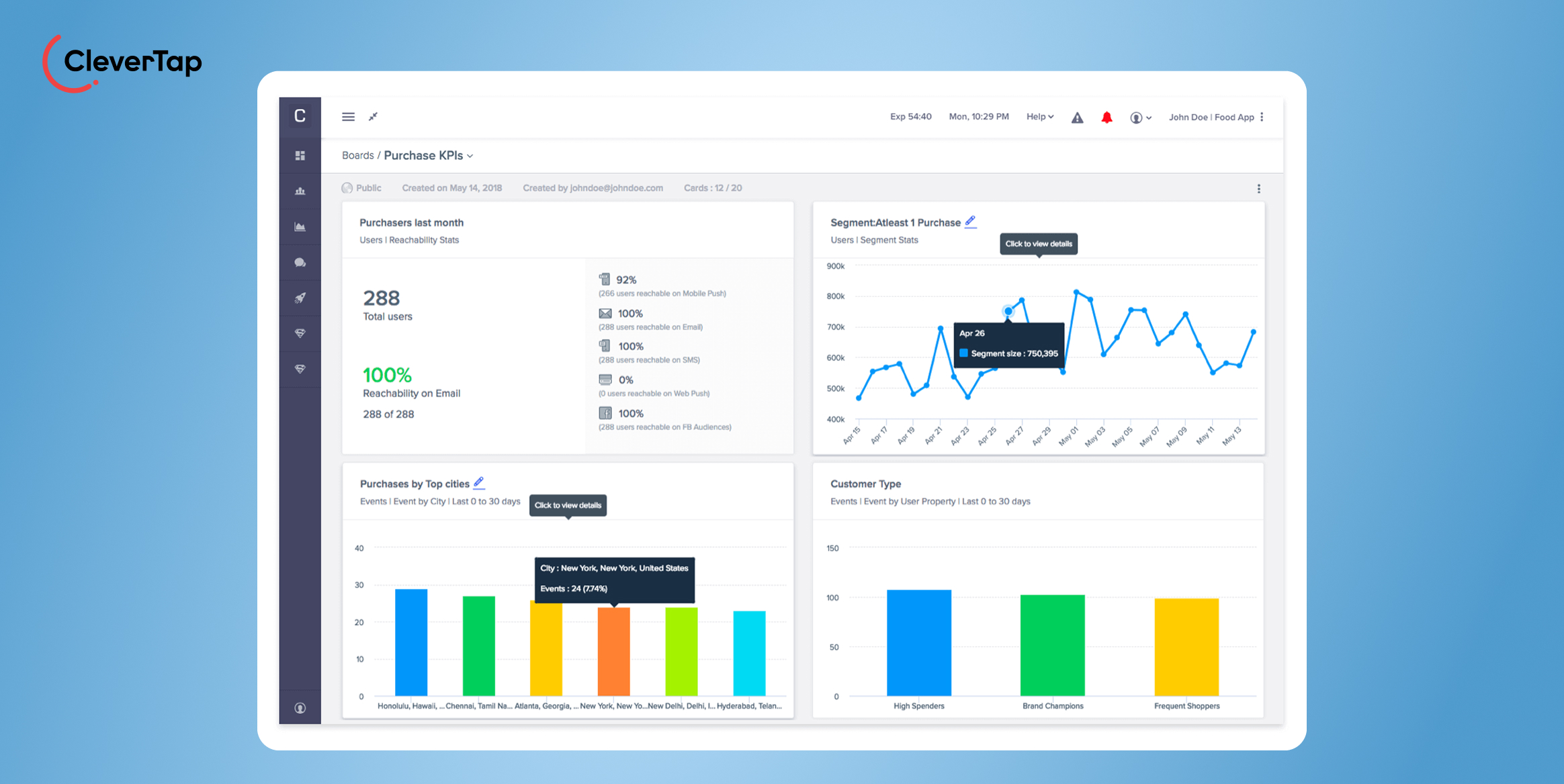
More than 2,000 brands benefit from CleverTap, including Jio, Zomato, ESPN Cricinfo, Premier League, AirAsia, TD Bank, and Paytm. It is a 2026 Gartner Magic Quadrant Leader for Personalization Engines.
A commissioned Forrester Total Economic Impact study put real numbers to the business case for a composite customer (commissioned by CleverTap). The headline figures: 561% three-year ROI, $8.1M in benefits against $1.2M in costs, and up to a 30% improvement in customer retention worth $5.5M.
Build Living User Profiles That Power Every Campaign
Every retention campaign begins with the profile. CleverTap stitches mobile, web, and offline events into one record in real time using SDKs and APIs. Data flows in from any source. It flows back out for BI and CRM enrichment. Every action a user has taken, from sessions to products viewed to transactions to support tickets, sits in one place.
A campaign is only as good as the profile it targets. CleverTap’s TesseractDB processes billions of data points sub-second, so segments and journeys fire on live data, not yesterday’s refresh.
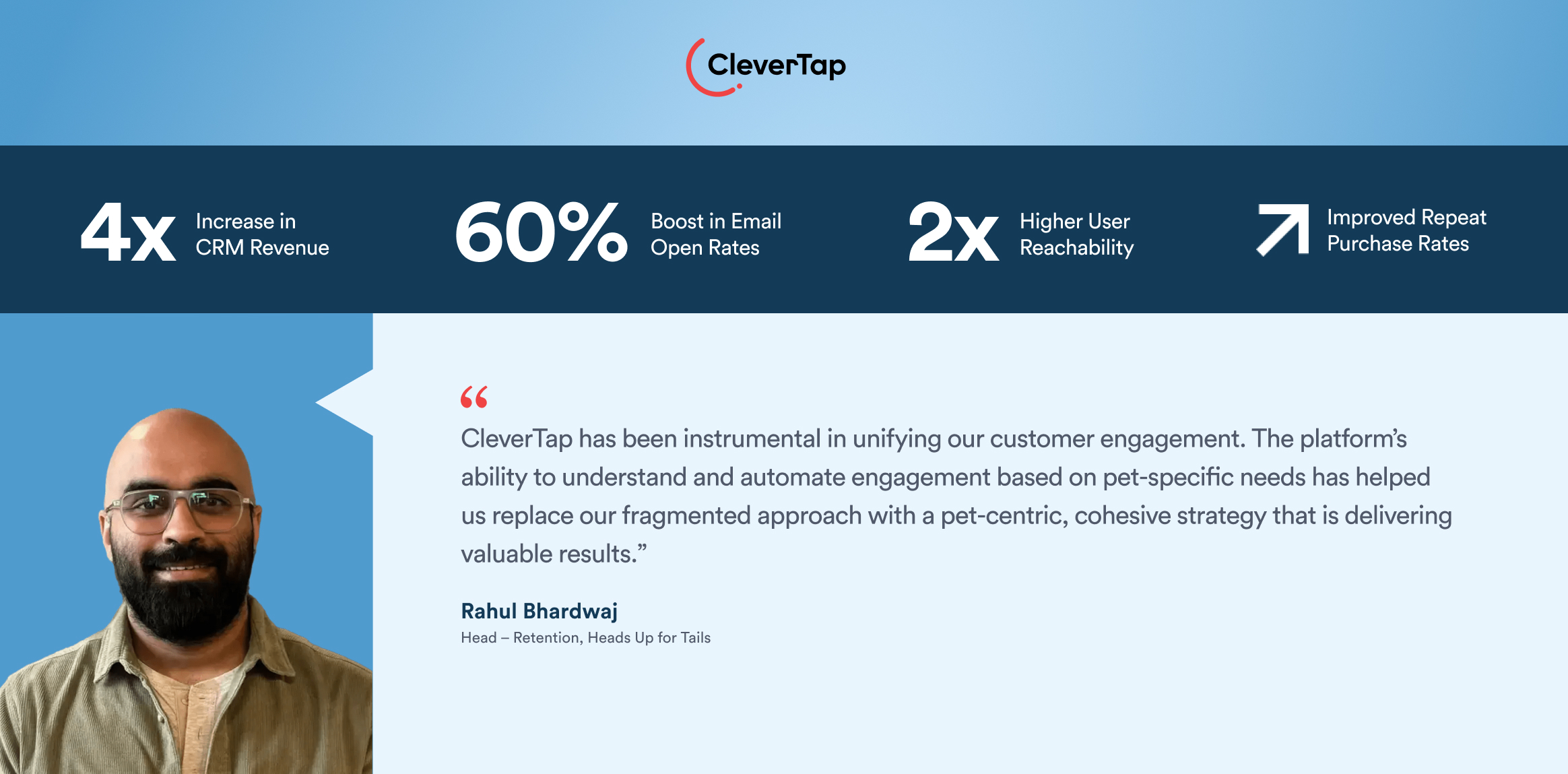
Heads Up For Tails (HUFT), India’s leading pet care e-commerce brand, built profiles around pet attributes rather than just owner data. The result was a 4x lift in CRM revenue through pet-centric automated journeys.
Segment Users in Real Time as Their Behavior Changes
Profiles power segments, and CleverTap lets marketers build them in three ways. First, on behavior: events performed or not, recency, frequency, and monetary value. Second, on attributes: device, location, plan tier, and custom properties. Third, through AI-powered Intent-Based segments that surface users predicted to convert next. Segments expand and shrink as users qualify and disqualify.
A “cart abandoner” who left the app 30 seconds ago is not the same person as one who left 24 hours ago. Both deserve a message. They do not deserve the same one.
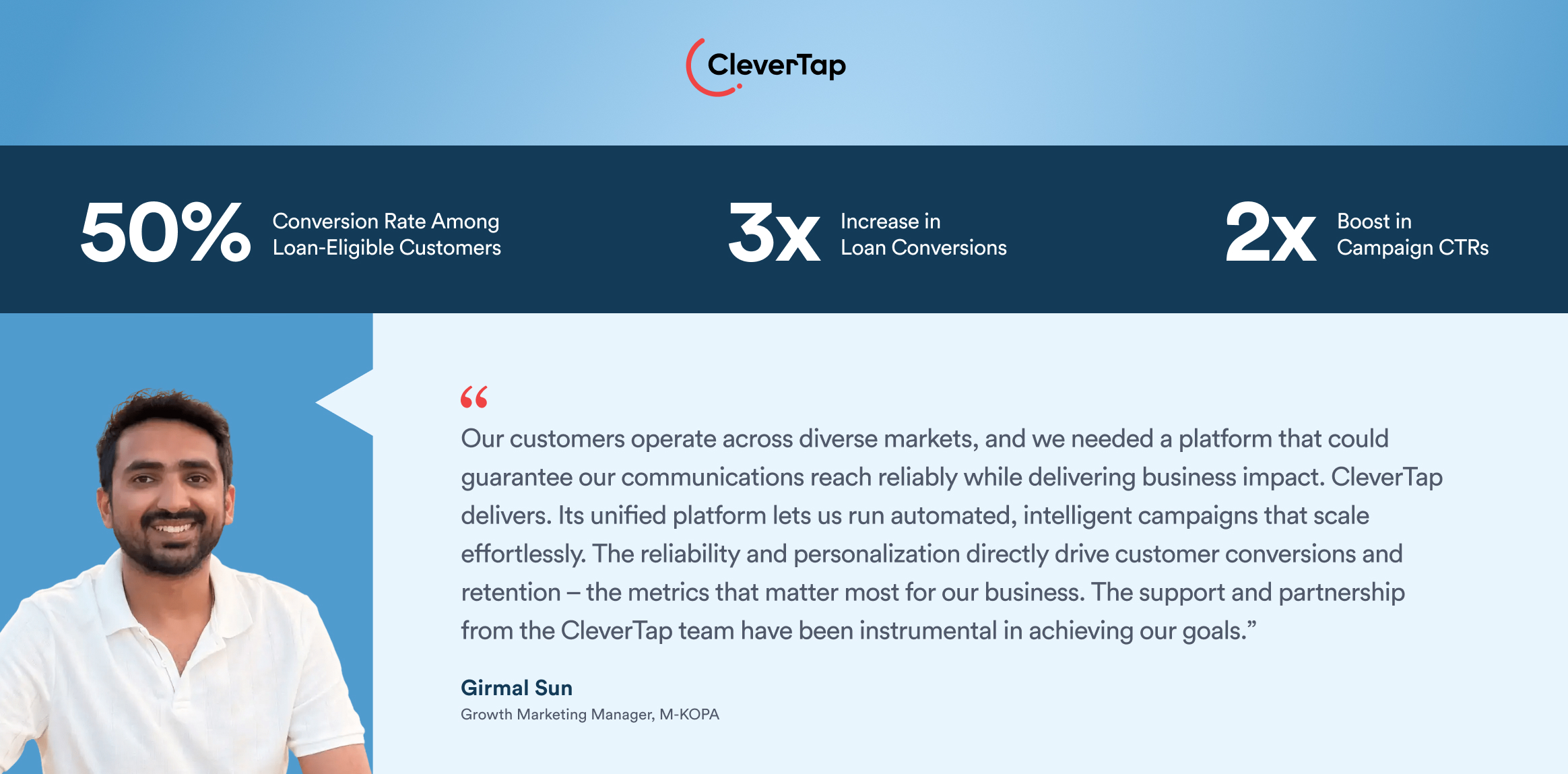
M-KOPA, a fintech operator across Africa, used real-time segmentation to route messaging between loan-eligible and at-risk customers. The result: a 3x increase in loan conversions and a 60% reduction in campaign execution time.
Run Lifecycle Journeys Across 12+ Channels Without Engineering Tickets
B2C retention lives in journeys, not standalone campaigns. CleverTap gives marketers a visual canvas with branching logic, triggered on events such as sign-up, first purchase, 14-day inactivity, or refund issued. Push, in-app, email, SMS, WhatsApp, web push, RCS, and voice all orchestrate inside the same journey. A/B tests run on creative, channel, and timing without leaving the canvas. Most changes ship the same day, not the next sprint.
A media app’s onboarding journey can look like this:
- Day 0: Sign-up triggers a welcome push and a welcome email.
- Day 1, no first content played: An in-app message with personalized recommendations.
- Day 3, still no play: A WhatsApp message with trending content for their demographic.
- Day 5, played but didn’t return: A push with a “continue watching” deep link.
- Day 7, active: Branch into the freemium-to-paid journey.
- Day 7, inactive: Branch into the reactivation journey.
All of it runs on one canvas, with no code, and marketer-driven variant testing at every step.
Use AI to Predict Churn, Pick the Right Channel, and Send at the Right Moment
Personalization for millions of users cannot be hand-rolled. The platforms that win let AI handle the parts that do not scale humanly: timing, channel choice, and intent detection.
CleverTap’s CleverAI™ layer adds churn prediction onto segments to surface at-risk users seven or more days before they go dark. Purchase-likelihood scoring finds upsell-ready users. Best Time picks the moment of contact for each individual user. RFM-based automated segmentation classifies users from “champions” to “hibernating” without anyone having to hand-build rules.
Tie Every Campaign Back to Retention and Revenue
Most retention platforms can run campaigns. Far fewer tell you which campaign moved retention. CleverTap’s customer data and analytics platform is built around the metrics retention marketers actually report on. Funnels track install to sign-up to first purchase to repeat, with drop-off broken down by segment.
Cohort retention curves show how lifecycle changes affect Day-7, Day-30, and Day-90 retention. Campaign performance maps to revenue, not just opens and clicks.
Tata CLiQ Luxury used RFM segmentation and multi-channel orchestration to run roughly 300 campaigns a day. They achieved a 159% boost in revenue and a 150% average lift in CTR.
Real B2C retention use cases:
CleverTap powers several other B2C retention use cases in different industries, for example:
- E-commerce, APLAZO (BNPL/Fintech-Ecom, LATAM): Real-time intent signals plus dynamic catalog templates drove a 60% incremental lift in completed purchases through abandoned cart journeys, while collapsing 10+ weekly templates into one for a 94% reduction in operational workload.
- Fintech, Vodafone: Re-engagement campaigns hit a 23.7% CTR with conversions doubled. CleverTap helped identify a two-minute “golden window” of opportunity post-abandonment that legacy tools could not act on fast enough.
- Media and streaming, ZEE5 Global: AI content recommendations in push and in-app, paired with Best Time decisions on send timing, delivered the 60% CTR uplift cited above. A model for global, culturally specific content campaigns.
Why CleverTap Works for B2C Retention-Focused Teams
Three reasons keep coming up in customer reviews and the Forrester study. Lifecycle marketing across mobile-first journeys runs in real time. Most lifecycle changes ship same-day, not next sprint. The Forrester TEI study showed up to a 50% CTR improvement and a 35% conversion rate improvement, worth $2.3M in benefits. It also reported 8 FTE hours saved daily for the composite customer (Forrester TEI Study).
If your retention motion already lives on push, in-app, and WhatsApp, the fastest way to see what changes is to watch CleverTap run on data shaped like yours.
See how CleverTap helps B2C brands improve retention with real-time personalization and lifecycle automation.
2. Braze
Braze positions itself as an enterprise-grade B2C engagement platform built for brands sending high message volumes. It fits large enterprises with developer support and complex multi-channel orchestration. Channels include push, email, SMS, in-app, WhatsApp, and web. Canvas Flow is its signature journey builder.
A senior Braze practitioner with 12 platform certifications captured the trade-off honestly on Capterra. Braze “empowers non-technical teams to move quickly, but reporting depth, testing capabilities, and scaling complex logic across campaigns can be areas of friction. You often have to lean on external tooling to go beyond tactical execution and into strategic insight”.
3. MoEngage
MoEngage markets itself as an insights-led engagement platform with strong APAC and North American mid-market presence. The pitch lands well with B2C brands that want marketer-friendly journey orchestration without heavy developer dependency.
Channels include push, email, SMS, WhatsApp, in-app, and web push. Sherpa AI handles journey optimization.
Watch out for the learning curve. G2 reviewers cite clarity issues during setup and limited personalization options. The dashboard and reporting reportedly lack clear insights, and teams ask for more customizable reporting and better A/B testing.
4. Salesforce Marketing Cloud
Salesforce Marketing Cloud (SFMC) is an enterprise marketing platform for organizations standardized on Salesforce. It fits large enterprises already running Salesforce CRM that want a lifecycle on the same data backbone. Strongest on email. Less mobile-first. Journey Builder is the orchestration layer, integrated with Salesforce CRM and Data Cloud.
G2 reviewers describe SFMC as overly complex for everyday marketing tasks, with a steep learning curve specifically around AMPscript, SQL, and data extensions. Marketers often need technical or developer support to fully use the platform.
The defection signal here is louder than usual. A long-time Salesforce customer wrote on Trustpilot in May 2026 that “I’ve been a long-time client of Salesforce for nearly a decade and I’m at my limit with them… I’d rather take 6 months transitioning everything to a new provider than deal with this kind of treatment”. They cited the year-over-year removal of features once included for free.
5. Iterable
Iterable is a cross-channel marketing platform built around growth marketers. It fits mid-market to enterprise B2C brands that prioritize email, SMS, and push as core channels.
Standout features include AI Optimization (Brand Affinity, Send Time), a marketer-accessible interface, and geolocation features.
Watch out for reporting consistency. G2 reviewers flag inconsistent numbers compared to other tools, which makes attribution hard to act on with confidence. The experimentation framework reportedly feels disconnected from how lifecycle marketers conceptually structure tests, including holdouts, variable isolation, and journey-level testing.
6. HubSpot Marketing Hub
HubSpot Marketing Hub is an all-in-one CRM with marketing, service, and content hubs. Its heritage is inbound and B2B. It fits B2C brands with significant B2B touchpoints, content-led lifecycles, or smaller marketing teams that want one tool for everything.
Channels include email, SMS (add-on), live chat, and ads. The standout is ease of use and a marketer-friendly UI tied to strong content and CRM integration.
Watch out for the ceiling. G2 reviewers also flag a steep learning curve, with the volume of options making list-building feel overwhelming.
7. Insider
Insider is an AI-led personalization and engagement platform with a strong e-commerce focus. It fits ecommerce brands that prioritize on-site personalization and product recommendations. Channels include web personalization, email, SMS, push, WhatsApp, and on-site messaging. Predictive segmentation and a retail recommendation engine are the standouts.
Watch out for the learning curve, particularly for advanced functionality. G2 reviewers note that some solutions still require support from Insider’s developers, so not every campaign idea can be realized through the tool itself. Onboarding and setup are described as time-consuming, which delays full platform adoption.
8. WebEngage
WebEngage is a mid-market full-stack engagement platform with a strong India presence. It fits mid-market B2C brands wanting MoEngage-like capability at a lower contract value. Channels include email, SMS, push, in-app, web push, and WhatsApp. The standouts are a dedicated CDP for event pipeline management and a modern UI.
On Gartner Peer Insights, reviewers cite issues with segmentation and data cleansing, with inaccuracies appearing in data display. Some segmentation operations and sends have been reported to take up to hours to complete.
9. Amplitude
Amplitude is a product analytics platform that doubles as a retention insights engine. It fits product-led growth teams that want to understand retention before activating it. It is not a messaging platform, so it integrates with engagement tools rather than replacing them.
Standout strengths include behavioral cohorting, retention curves, and funnel analysis. However, some advanced features for Guides and Surveys might be available only in enterprise tiers.
10. Mixpanel
Mixpanel is an event analytics platform for product and growth teams. It fits product teams who want funnel and cohort analysis before designing retention campaigns. Like Amplitude, it is not a messaging platform, so it integrates with engagement tools. Funnel visualization and A/B testing on product changes are the standouts.
Watch out for the steep initial learning curve. If events are not planned and named properly from day one, data becomes confusing later. Costs increase quickly as data volume grows, especially for high-traffic systems. Teams have to be careful about what they track. G2 reviewers also note that complex analyses and advanced A/B test setups do not scale well without ongoing effort.
Frequently Asked Questions
1. What is a customer retention platform?
A customer retention platform is software that helps B2C brands keep users engaged and reduce churn. The core jobs are unified profiles, behavior-based segmentation, lifecycle journey automation, and cross-channel messaging. A CRM manages pre-sale data. A retention platform focuses on post-sign-up behavior.
2. Which retention platform is best for e-commerce?
E-commerce brands typically go with CleverTap. The right pick depends on what you prioritize in your retention strategies.
3. How is CleverTap different from Braze and MoEngage?
All three are leading B2C engagement platforms. CleverTap leads in real-time mobile speed. Product Growth Intelligence describes it as “the king of raw speed” for sub-5-second event-to-action triggers.
4. Is AI personalization safe to use with customer data?
Done right, yes. Customers exposed to active personalization are 1.8x more likely to pay a premium, but 93% say a brand will lose their trust if their data is mishandled. The platform you pick must give marketers control over data and personalization rules, not just automate them.
5. Do I need both a retention platform and a product analytics tool like Mixpanel or Amplitude?
It depends on team structure. Product Growth Intelligence puts it well: a platform with deep native analytics like CleverTap can replace Mixpanel for many B2C lifecycle teams. If you have a separate product team running complex product queries, keeping analytics and engagement separate makes sense.
Retain Customers With CleverTap
In B2C, retention is the line between sustainable growth and burning acquisition spend. The “best” platform is the one that ships the four lifecycle jobs (activation, engagement, reactivation, and monetization) across your channel mix without becoming an operational tax.
Some teams will combine product analytics with engagement (CleverTap). That stack is valid. Others will want all four jobs unified in one place. For those teams, the Forrester TEI study found a 561% three-year ROI and up to 30% retention improvement for CleverTap’s composite customer.
If your B2C lifecycle runs on mobile-first journeys, real-time data, and AI personalization across four or more channels, CleverTap is built for the work you do every day.
Book a tailored demo and bring the first journey you want to fix.
Deliver Live 1:1 Personalization That Drives Higher Lifetime Value
Customer loyalty is built when engagement keeps pace with changing needs and behavior. With CleverTap’s AI-native Customer Retention Management Platform, powered by CleverAI™, you set the goals and guardrails while past context, live intent, and AI decisioning deliver Live 1:1 Personalization. Each outcome informs the next decision, helping curb churn, and maximize customer lifetime value.

Sagar Hatekar 
Leads product managementExpert in Marketing Analytics & Engagement platforms.
Free Customer Engagement Guides
Join our newsletter for actionable tips and proven strategies to grow your business and engage your customers.