












































Table of Contents
Categories
Most Popular


Summer has traditionally been one of the busiest periods for the travel industry. In 2026, travelers are still eager to explore new destinations, reconnect with experiences, and make up for years of deferred travel aspirations.
The top travel and navigation apps generated approximately 5 billion downloads globally in 2025, suggesting strong travel interest worldwide. The challenge for travel apps, however, is to convert this travel intent into travel confidence.
Today’s travelers need not only flexibility, transparency, and highly personalized experiences but also reassurance before they commit to a booking. As a result, travel apps have evolved from booking platforms into trust-building platforms.
This blog explores the key trends shaping traveler behavior in Summer 2026 and the engagement strategies travel apps should deploy to drive bookings, retention, and loyalty.
Summer 2026: Key Trends, Engagement Strategies, and Campaign Ideas for Travel Apps
Summer 2026 presents a unique opportunity for travel brands. While demand remains strong and consumers still want to travel, the decision-making process has flipped. Travelers are spending more time researching, comparing options, monitoring prices, and evaluating risks before booking.
Here’s a look at these emerging travel trends and what marketers must do to boost conversions and customer lifetime value (CLV).
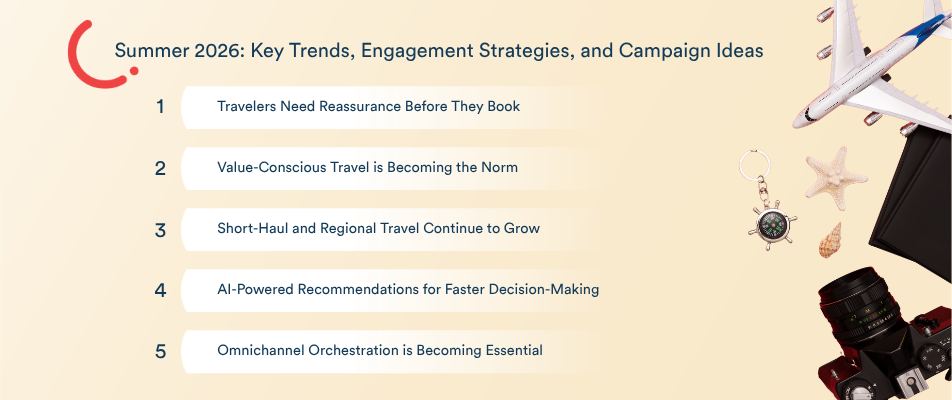
Trend 1: Travelers Need Reassurance Before They Book
Travelers are increasingly concerned about disruptions, cancellations, route changes, and safety issues. Before committing to a booking, they want answers to questions such as:
- Is this route operating normally?
- Can I cancel if circumstances change?
- Are other travelers having positive experiences?
Travel apps that proactively address these concerns can significantly reduce hesitation, accelerate bookings, and improve conversion rates.
Engagement Strategy
- Send critical information such as flight status notifications, airport alerts, route disruption advisories, weather updates, and entry requirement notifications in real time.
- Trigger campaigns based on search abandonment, fare watch activity, wishlist inactivity, incomplete bookings, and itineraries.
- Highlight verified reviews, traveler photos, popular destinations, trending experiences, and real traveler testimonials.
Example
To users who viewed flights but didn’t book, send a personalized message across a channel mix of push, email, and in-app notifications, saying, “Flying to Paris this summer? Here’s the latest route update, flexible booking options, and traveler reviews to help you book with confidence.”
Trend 2: Value-Conscious Travel is Becoming the Norm
Higher transportation and accommodation costs are making travelers more price sensitive. Instead of looking for the cheapest option, travelers are increasingly looking for the best value. They are comparing prices across platforms, monitoring fare fluctuations, waiting for deals, and looking for bundled savings.
Real-time pricing alerts and personalized offers are becoming critical engagement tools.
Engagement Strategy
Personalized communication and recommendations drive higher engagement and conversion rates. Segment users based on travel intent:
- Dreamers: Destination inspiration, travel guides
- Planners: Fare tracking, hotel comparisons
- Bookers: Time-sensitive offers, booking incentives
- Loyal Travellers: Premium perks, exclusive rewards
Example
For users monitoring destinations or fares, set push notifications that get triggered when the price drops by 10% or more. For example, “Good news! Flights to Bali are now 12% cheaper than last week. Book now before prices rise again.”
Trend 3: Short-Haul and Regional Travel Continue to Grow
As uncertainty, budget constraints, and other factors impact long-haul travel, many consumers are opting for domestic vacations, weekend getaways, regional destinations, and last-minute trips. Travel apps should adjust discovery experiences to surface relevant local and regional options.
Engagement Strategy
- Promote nearby destinations, weekend getaways, and short-haul packages based on the user’s location, past searches, and travel preferences.
- Use geo-targeted campaigns to highlight driveable destinations, regional experiences, and last-minute deals.
- Create curated collections such as “Weekend Escapes,” “Trips Under 3 Hours,” or “Last-Minute Summer Getaways.”
Example
For users who haven’t booked in the last 90 days, leverage push and in-app notifications for personalized communication on themes such as beach escapes, mountain retreats, family-friendly trips, and budget getaways. For example, “Need a break? Discover 3 weekend getaways within 2 hours of your city.”
Trend 4: AI-Powered Recommendations for Faster Decision-Making
Consumers increasingly expect travel apps to understand their preferences. They want truly individualized destination recommendations, dynamic itineraries, intelligent travel suggestions, and context-aware offers. Generic engagement strategies are rapidly losing effectiveness.
Engagement Strategy
- Use behavioral data to recommend destinations, hotels, activities, and packages based on each user’s preferences, budget, booking history, and browsing behavior.
- Deliver AI-powered itinerary suggestions that combine flights, stays, activities, weather, local events, and travel duration.
- Personalize communication by travel stage – inspiration, planning, booking, pre-trip, in-trip, and post-trip.
- Use predictive segmentation to identify users most likely to book, abandon, churn, or respond to a specific offer.
Example
For active users with browsing history, leverage AI capabilities to uncover insights such as past bookings, search history, budget preference, and travel duration, to provide personalized travel recommendations, like “Based on your recent searches, we’ve found 5 destinations you’ll love this summer.”
Trend 5: Omnichannel Orchestration is Becoming Essential
Today’s travelers don’t plan, book, and manage their trips through a single channel. A traveler might discover a destination through an email campaign, browse options in your app, ask questions through a chatbot, receive a fare-drop notification on WhatsApp, and complete the booking on mobile.
As travel journeys become increasingly fragmented, brands must orchestrate experiences across channels to ensure travelers receive the right message on the right channel at the right time.
WhatsApp is also evolving beyond a messaging channel. Increasingly, travelers are using WhatsApp as a travel concierge, relying on AI-powered chatbots to discover destinations, compare options, receive recommendations, manage bookings, and access customer support throughout their journey.
For travel brands, this presents an opportunity to create seamless, conversational experiences that reduce friction and keep travelers engaged across every touchpoint.
Engagement Strategy
- Build cross-channel journeys spanning push notifications, email, SMS, WhatsApp, in-app messages, and web experiences.
- Use channel affinity and engagement data to determine where users are most likely to respond.
- Trigger contextual messages based on traveler behavior, location, booking stage, and intent.
- Enable AI-powered WhatsApp assistants to answer travel queries, recommend destinations, share offers, and support booking decisions.
- Maintain a consistent experience across channels so travelers can seamlessly continue their journey regardless of where they engage.
Example
For users who have searched for destinations but have not booked, plan tailored journeys across channels:
- Email: Destination inspiration and personalized recommendations.
- Push Notification: Fare-drop alert for a searched destination.
- WhatsApp: AI-powered travel assistant answers questions about pricing, weather, visa requirements, and local attractions.
- In-App Message: Limited-time offer when the user returns to the app.
- WhatsApp Follow-Up: Booking reminder with a direct booking link.
Summer 2026: Go-Live-Tomorrow Checklist for Travel App Marketers
| Engagement Strategy | Checklist Item |
| Build Traveler Confidence | Set up real-time alerts for flight status changes, weather disruptions, route changes, and entry requirements. Surface reviews, ratings, traveler photos, and testimonials at key decision points. Create journeys for users who searched but didn’t book, abandoned itineraries, or stopped tracking fares. |
| Personalize for Value-Conscious Travelers | Segment users into Dreamers, Planners, Bookers, and Loyal Travelers. Launch fare-drop alerts and personalized offers for high-intent users. |
| Capitalize on Regional Travel Demand | Create destination collections such as “Weekend Escapes,” “Trips Under 3 Hours,” and “Last-Minute Getaways.” Enable geo-targeted campaigns based on location, travel history, and browsing behavior. |
| Leverage AI for Hyper-Personalization | Use behavioral data to personalize destination recommendations, itineraries, and offers. Identify audiences most likely to book, abandon, churn, or engage with an offer. |
| Orchestrate Across Channels | Map customer journeys across email, push, in-app, SMS, web, and WhatsApp. Ensure each audience receives communications through their preferred channels. Deploy a WhatsApp travel assistant to answer questions, share recommendations, and support booking decisions. |
| Measure What Matters | Define success metrics before launch: Build Confidence: Review engagement rate, notification CTR Increase Consideration: Destination page views, session frequency Drive Bookings: Booking conversion rate Recover Lost Demand: Re-engagement rate, conversion recovery rate Improve Retention: 30-day retention rate, repeat booking rate Grow Loyalty: Customer lifetime value, loyalty participation rate |
How CleverTap Can Help
Building traveler confidence, delivering personalized experiences, and orchestrating seamless journeys requires a platform that can unify customer data, intelligence, and engagement.
With CleverTap, travel apps can:
- Segment travelers with precision to identify and engage high-intent travelers, at-risk users, frequent travelers, and dormant audiences with tailored campaigns.
- Personalize every traveler interaction with individualized destination recommendations, offers, and content based on traveler preferences, browsing behavior, booking history, and intent across every stage of the travel journey.
- Orchestrate omnichannel journeys across push notifications, email, in-app messages, web messaging, SMS, and WhatsApp.
- Leverage CleverAI agents to generate personalized messages, determine the next best action, message, offer, or channel for every traveler, predict which users are most likely to book, abandon, churn, or respond to an offer, and more.
- Unify customer data to build a comprehensive view of every traveler and track the complete customer journey from acquisition to repeat bookings.
- Measure campaign performance, retention, conversions, and customer lifetime value through real-time analytics and reporting.
- Drive long-term loyalty by creating personalized loyalty journeys, milestone-based rewards, referral campaigns, and retention programs.
The travel apps that succeed in 2026 and beyond won’t simply help users discover destinations but help them feel confident enough to book.
By delivering timely updates, relevant personalization, authentic social proof, intelligent re-engagement, and meaningful loyalty experiences, travel brands can transform uncertainty into trust and trust into long-term growth.
Want to explore how CleverTap can help you elevate your customer engagement strategy?
Deliver Live 1:1 Personalization That Drives Higher Lifetime Value
Customer loyalty is built when engagement keeps pace with changing needs and behavior. With CleverTap’s AI-native Customer Retention Management Platform, powered by CleverAI™, you set the goals and guardrails while past context, live intent, and AI decisioning deliver Live 1:1 Personalization. Each outcome informs the next decision, helping curb churn, and maximize customer lifetime value.

Shravan Kavattur 
Content researcher for marketing tech, engagement & trends
Free Customer Engagement Guides
Join our newsletter for actionable tips and proven strategies to grow your business and engage your customers.