









































![Mobile Customer Engagement: The Complete Guide [+ 10 Proven Strategies]](https://clevertap.com/wp-content/uploads/2026/06/Mobile-customer-engagement-Guide-768x323.jpg)

Table of Contents
Categories
Most Popular


Mobile devices have become the primary channel through which customers discover, engage with, and buy from brands. Over 64% of website traffic comes from mobile devices, and Americans now spend over 5 hours per day on their phones
It is clear that businesses can no longer treat mobile engagement as a secondary strategy. Customers increasingly rely on mobile apps, websites, messaging, and notifications for everything from product discovery to customer support.
A strong mobile customer engagement strategy helps brands deliver timely, relevant, and personalized experiences that keep users active, improve retention, and increase customer lifetime value. When done well, it strengthens customer relationships and creates more opportunities for conversion and loyalty.
In this guide, we’ll explore what mobile customer engagement is, why it matters for modern businesses, how to build an effective engagement strategy, and 10 proven tactics to boost app user engagement.
What Is Mobile Customer Engagement?
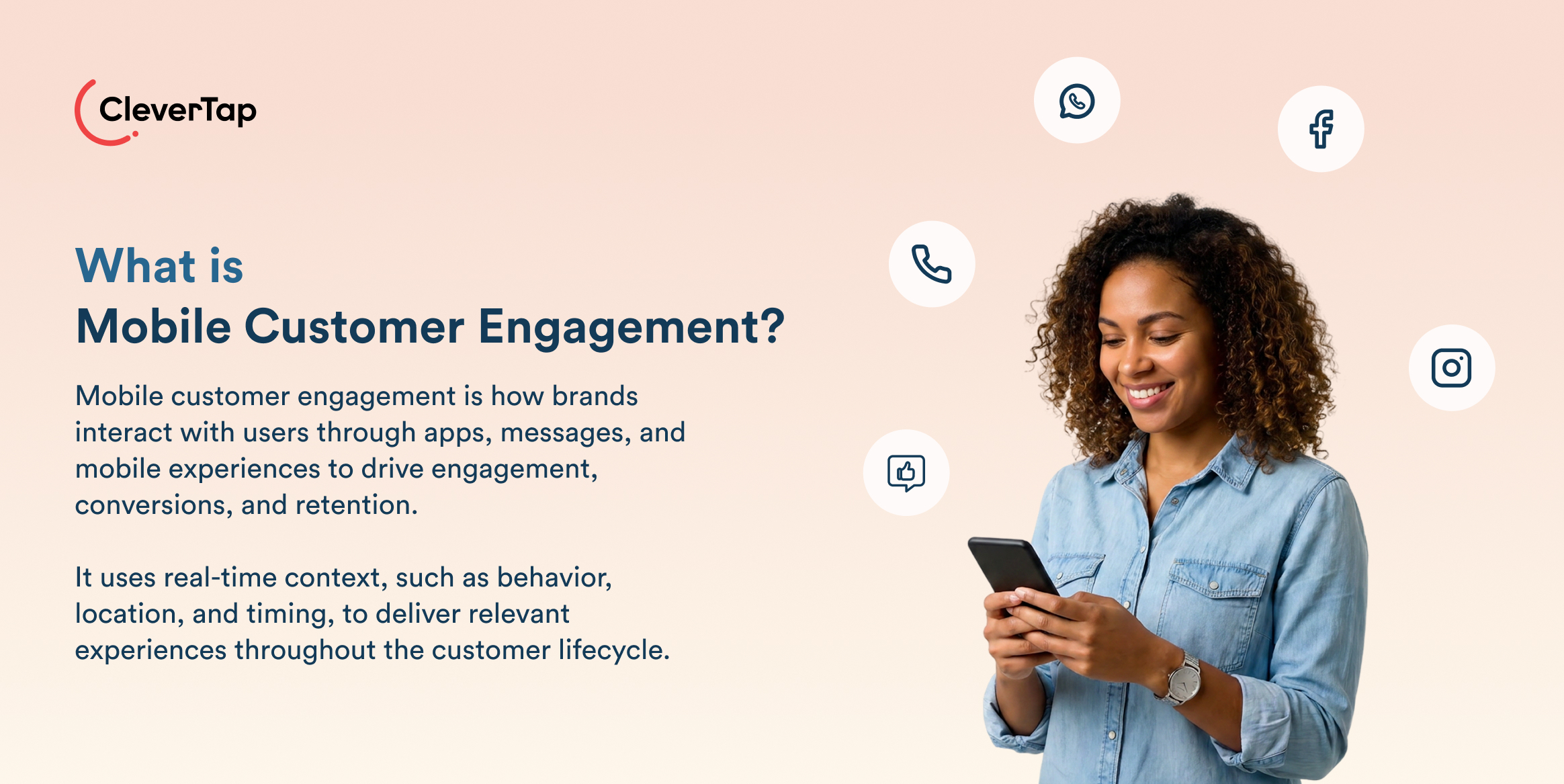
Mobile customer engagement refers to the ongoing interactions between a brand and its users through mobile apps, messaging channels, and mobile experiences. It focuses on delivering relevant information, useful features, and personalized communications that encourage users to take meaningful actions and remain active over time.
Mobile vs. Web Engagement
Mobile engagement differs significantly from web engagement because user behavior is more immediate and context-driven. Mobile users often interact with apps in short sessions while commuting, shopping, traveling, or completing specific tasks. As a result, every interaction must be fast, relevant, and tailored to the user’s current situation.
Factors such as location, device activity, time of day, and past behavior play a larger role in shaping mobile experiences. Unlike web visitors who may spend time browsing multiple pages, mobile users typically expect quick access to information and seamless task completion.
Key Engagement Moments
Successful mobile engagement spans the entire customer lifecycle. Important touchpoints include onboarding new users, encouraging feature adoption during in-app sessions, maintaining relationships after a purchase or transaction, and re-engaging inactive users before they churn. Delivering the right message at each stage helps keep users connected and increases the likelihood of long-term loyalty.
Also read: How to Use AI for Customer Engagement: Strategies and Practical Use Cases
How to Build a Mobile Customer Engagement Strategy in 5 Steps
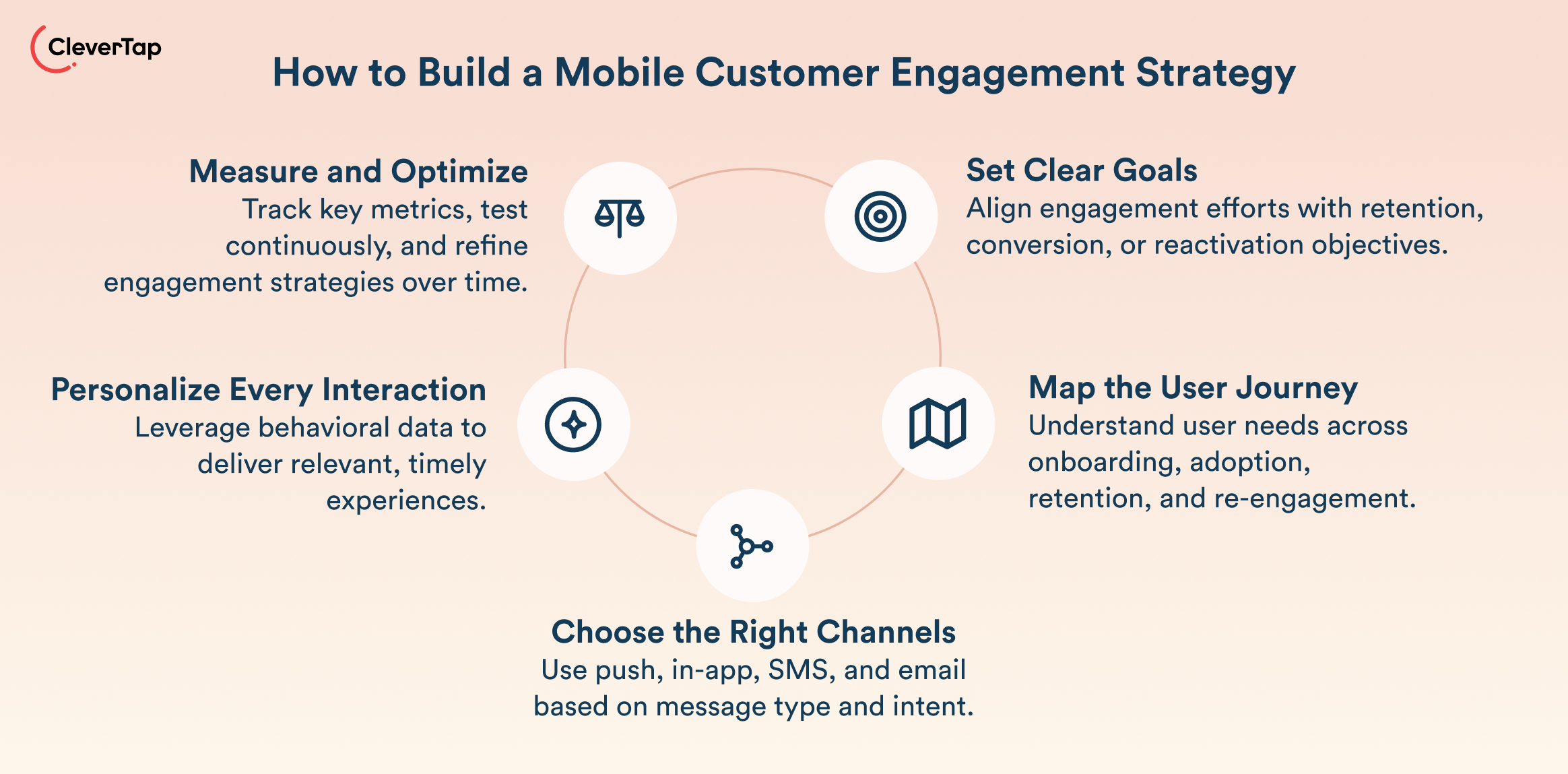
A successful mobile customer engagement strategy requires understanding user behavior, delivering relevant experiences, and continuously optimizing interactions to support business growth. Here’s a five-step framework to build an effective strategy.
Step 1: Define Engagement Goals Tied to Business Outcomes
Start by identifying the business results you want engagement efforts to drive. Common objectives include improving retention, increasing conversions, and reactivating dormant users. For example, you may aim to improve 30-day retention, encourage more users to complete purchases, or bring inactive customers back to the app. Clear goals help align campaigns with measurable outcomes rather than focusing on surface-level metrics.
Step 2: Map User Intent Across the App Lifecycle
Different users have different expectations depending on where they are in their journey. New users need guidance and education, while returning users look for convenience and ongoing value. Power users often respond well to exclusive benefits, and at-risk users may need reminders or incentives to return. Understanding these needs allows you to create experiences that feel relevant at every stage.
Step 3: Choose Your Engagement Channels
Select channels based on the type of message and the action you want users to take. Push notifications work well for timely updates and reminders. In-app messages are ideal for feature discovery and contextual guidance. SMS can be effective for urgent communications, while email is better suited for detailed content, offers, and nurture campaigns. Using each channel strategically helps prevent message fatigue.
Step 4: Personalize Based on Behavioral Data
User actions provide valuable insights into preferences and intent. Create audience segments based on browsing behavior, purchase history, engagement frequency, or RFM (Recency, Frequency, Monetary) analysis. Trigger communications based on specific actions, such as abandoned carts, feature usage, or inactivity, to make every interaction more relevant.
Step 5: Measure, Test, and Iterate
Engagement strategies should evolve with customer behavior. Establish a KPI framework that tracks metrics such as retention, conversion rates, session frequency, and churn. Regularly test messaging, timing, offers, and user journeys to identify what performs best. Continuous measurement and optimization help improve results over time and maximize the impact of your engagement efforts.
Explore: 15 Best Customer Engagement Platforms for Smarter Lifecycle Marketing
10 Proven Mobile Customer Engagement Strategies
Mentioned below are 10 tried and tested mobile customer engagement strategies that yield results.
Strategy 1. Simplify Onboarding to Deliver Value in the First Session
The first few minutes often determine whether a user returns or abandons an app. An effective onboarding experience helps users quickly understand the app’s value and complete a meaningful action. 90% of users churn if they cannot perceive the value within the first week of signing up.
Use interactive walkthroughs, progressive disclosure, and lightweight personalization to guide users without overwhelming them. Reducing friction during sign-up and showcasing the core benefit early can significantly improve activation and retention.
Example: Duolingo’s simple 3-step onboarding allows users to select a language, set their pace, and start learning within minutes instead of forcing them through a lengthy setup process.
Strategy 2. Send Behavioral Push Notifications
Generic push campaigns rarely resonate because they ignore user intent. Behavioral push notifications are triggered by actions such as browsing a product, abandoning a cart, or becoming inactive. These messages are more relevant and timely, making users more likely to engage.
Even basic personalization improves push notification open rates by 9%. Focus on personalization, send-time optimization, and frequency controls to avoid notification fatigue.
Example: RentoMojo used CleverTap to significantly improve push notification reach, deliverability, and engagement within the same audience by 36%.

Related reads: 25 Effective Push Notification Strategies to Engage and Retain Users
Strategy 3. Use In-App Messaging to Guide and Educate
In-app messages allow brands to communicate with users while they are actively engaged. Tooltips work well for feature discovery, banners are ideal for promotions, and modals can highlight important announcements.
Because these messages appear within the user journey, they feel more contextual than push notifications. The key is to provide guidance without disrupting the experience. Research from Leanplum (a CleverTap company) shows that personalized in-app messages can boost response rates by 800 times compared to generic notifications.
Example: Spotify frequently introduces new features through contextual prompts, helping users discover functionality they may have otherwise missed.
Strategy 4. Personalize the App UI Based on User Behavior
Users are more likely to engage with experiences tailored to their interests and habits. Dynamic home screens, personalized recommendations, and location-aware content make apps feel more relevant and useful.
Businesses can leverage browsing history, purchase behavior, and engagement patterns to customize what users see each time they open the app. Companies that grow faster drive 40 percent more of their revenue from personalization than their slower-growing counterparts.
Example: Amazon exemplifies this approach by continuously adapting its storefront, recommendations, and offers based on individual customer preferences.
Strategy 5. Implement a Loyalty and Gamification Layer
Deloitte found that 72% of consumers are more likely to spend with brands that offer effective loyalty programs. However, instead of relying only on traditional loyalty points, brands can use interactive mechanics such as spin-the-wheel campaigns, scratch cards, quizzes, streaks, milestone rewards, and surprise incentives to encourage repeat engagement.
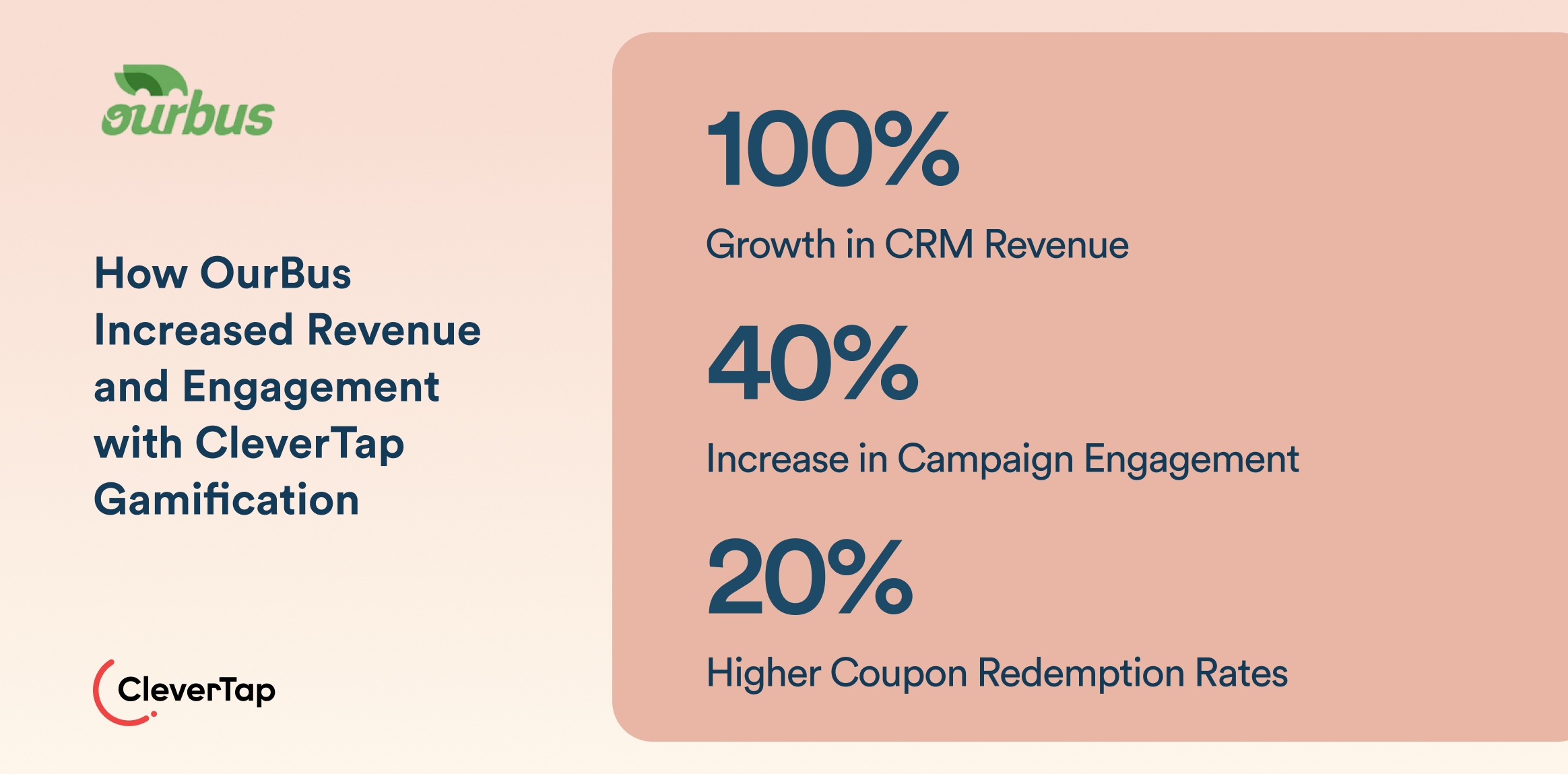
Example: OurBus used CleverTap’s In-App HTML campaigns to launch gamified experiences. The strategy resulted in a 40% increase in campaign engagement, a 20% increase in coupon redemption rates, and a 100% increase in CRM-driven revenue.
Strategy 6. Leverage Deep Linking for Seamless Re-Engagement
Deep links help users pick up exactly where they left off by directing them to a specific screen within the app instead of the homepage. This reduces friction and increases the likelihood of conversion. To implement this strategy, use deep links across email, SMS, push notifications, and social ads.
Example: Myntra uses push notifications, cart abandonment emails, and sales reminders via ads on Meta to take users directly back to that product page or their cart, making it easier to complete the purchase.
Strategy 7. Offer Mobile-Exclusive Perks and Content
Giving users access to benefits that are only available through the app creates a stronger reason to install and return. 65% of consumers will remain loyal to companies if they offer more personalized experiences.
Mobile-exclusive discounts, early access to collections, and app-only features help reinforce the value of the app while driving repeat engagement.
Example: ASOS promotes app-exclusive features such as visual search, AI-powered product discovery, and mobile-first shopping experiences, encouraging customers to engage through the app rather than the website.
Strategy 8. Make Customer Support Frictionless In-App
When users encounter an issue, they expect help without disrupting their experience. 66% of app users report significant frustration when they have to exit an app to get help or face long response times after reaching out.
Integrating live chat, self-service knowledge bases, and automated support tools directly within the app enables faster issue resolution and reduces the risk of churn. Businesses should make support easy to access and provide seamless escalation to human agents when needed.
Example: Zomato allows users to access order support, refunds, and live chat directly within the app, allowing them to resolve issues without switching channels.
Strategy 9. Use Lifecycle Email and SMS to Complement In-App Channels
Mobile engagement works best when channels operate together rather than independently. Email and SMS can re-engage users who may not respond to push notifications or who have become inactive.
Coordinated lifecycle marketing campaigns help maintain consistent communication across onboarding, activation, retention, and reactivation stages.
Example: Apna expanded its engagement strategy with personalized email campaigns powered by CleverTap, helping increase user engagement with a 30% year-on-year growth and extend its reach beyond in-app communications.

Strategy 10. Apply AI-Powered Personalization and Predictive Engagement
As user bases grow, delivering individualized experiences manually becomes increasingly difficult. Predictive engagement helps brands identify users who are likely to churn, recommend relevant content, and determine the best time to communicate. These capabilities enable more proactive engagement strategies that improve retention and conversion rates.
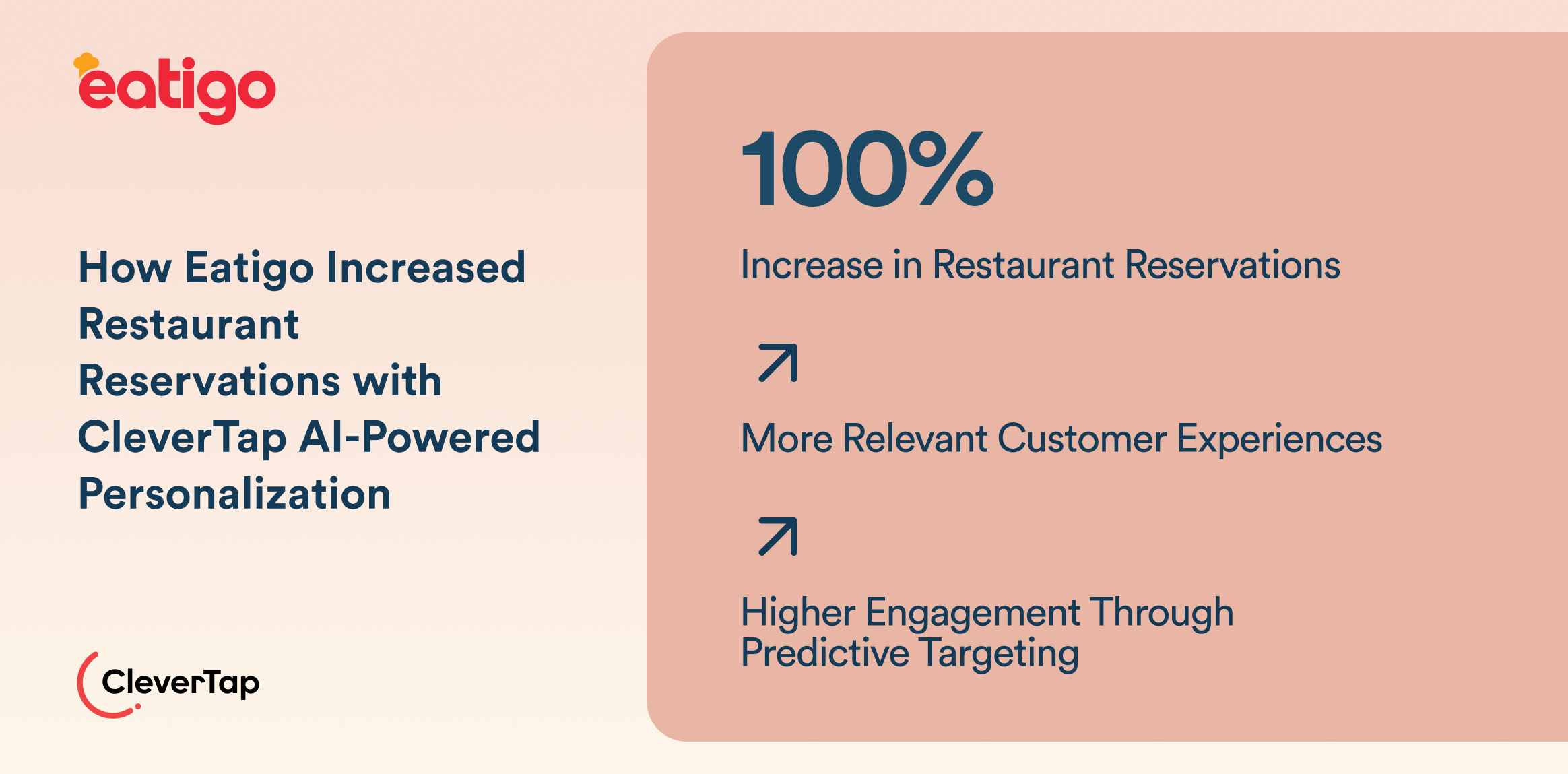
Example: Eatigo used CleverTap’s AI-powered engagement capabilities to deliver personalized experiences and increase restaurant reservations by 100%, demonstrating how predictive insights can drive measurable business outcomes.
How to Measure Mobile Customer Engagement
A strong mobile customer engagement measurement framework combines engagement, retention, and revenue metrics to provide a complete picture of app performance.

Engagement KPIs to Track
Start with activity-based metrics that reveal user behavior.
- The DAU/MAU ratio measures app stickiness and shows how frequently users return.
DAU/MAU Ratio (%) = (Daily Active Users ÷ Monthly Active Users) × 100
A ratio above 20% is generally considered healthy for most mobile apps.
- Session length and screens per session help assess how deeply users engage with the experience.
Average Session Length = Total Time Spent in App ÷ Total Sessions
The feature adoption rate shows whether users are discovering and using new functionality. Push notification click-through rates and in-app conversion rates indicate how effectively your campaigns drive action.
- Screens per Session = Total Screen Views ÷ Total Sessions
- Feature Adoption Rate (%) = (Users Who Used Feature ÷ Total Active Users) × 100
- Push Notification CTR = (Notification Clicks ÷ Notifications Delivered) × 100
- In-App Conversion Rate = (Users Completing Desired Action ÷ Total Users Exposed) × 100
Retention Metrics
Retention is one of the strongest indicators of long-term engagement. Track Day 1, Day 7, and Day 30 retention rates to understand how successfully users move from initial adoption to habitual usage.
Retention Rate (%) = (Users Active on Day X ÷ Users Acquired on Day 0) × 100
Cohort-based churn analysis helps identify where users drop off and which acquisition channels bring in the most valuable customers. Industry research shows that average app retention often declines from around 25–28% on Day 1 to below 10% by Day 30.
Churn Rate (%) = (Users Lost During Period ÷ Users at Start of Period) × 100
Revenue Metrics
Revenue-focused metrics connect engagement efforts to business impact.
- ARPU (Average Revenue Per User) = Total Revenue ÷ Total Active Users
- Customer lifetime value (LTV) = ARPU × Average Customer Lifespan
- Repeat purchase rate = (Customers with More Than One Purchase ÷ Total Customers) × 100
Industry benchmarks
These benchmarks provide useful context, but performance expectations should always be evaluated against your app category, audience, and business model.
| Industry | Benchmark 30-Day User Retention Rate |
| Shopping | 5.6% |
| Marketplaces | 8.7% |
| Digital Banking | 11.6% |
| Finance | 5.8% |
| Digital Health | 4.0% |
| Gaming | 2.3% |
| Social Media | 3.9% |
| Entertainment | 3.8% |
| Productivity | 4.1% |
| Utilities | 3.4% |
| Travel | 3.9% |
How CleverTap Helps With Mobile Customer Engagement
Businesses need a platform that can unify customer data, automate personalized interactions, and measure performance across channels. The robust customer engagement and retention platform CleverTap brings these capabilities together in a single platform, helping brands create connected experiences throughout the customer lifecycle.
- Build a unified customer view: CleverTap consolidates behavioral, transactional, and demographic data into a single customer profile, giving teams a complete understanding of how users interact with their app.
- Create highly targeted audience segments: Businesses can segment users based on actions, engagement levels, purchase history, location, lifecycle stage, and more, enabling more relevant campaigns.
- Orchestrate omnichannel customer journeys: Design automated engagement flows across push notifications, in-app messages, email, SMS, and WhatsApp. For example, an abandoned-cart journey can trigger a push notification, followed by an email reminder and a personalized in-app message when the user returns.
- Deliver real-time personalization: Use customer behavior and preferences to personalize messaging, content, recommendations, and user experiences at scale.
- Drive feature adoption with in-app engagement: Launch contextual tooltips, banners, surveys, gamified experiences, and onboarding flows to guide users toward meaningful actions within the app.
- Support loyalty and retention initiatives: Run reward programs, engagement campaigns, referral initiatives, and gamified experiences that encourage repeat interactions and long-term customer loyalty.
- Optimize campaign performance through experimentation: Test different messages, channels, creatives, and customer journeys to identify what resonates most with specific audience segments.
- Leverage predictive insights: CleverAI™ helps identify users who may be at risk of churning, predicts customer intent, recommends next-best actions, and optimizes campaign timing for improved engagement.
- Measure engagement from a single dashboard: Track key metrics such as retention, conversions, feature adoption, campaign performance, customer lifetime value, and churn across all channels.
- Scale engagement without increasing complexity: With automated journeys, real-time segmentation, and cross-channel orchestration, teams can deliver personalized experiences to millions of users without relying on manual processes.
Brands across industries use CleverTap to improve retention, increase conversions, strengthen customer loyalty, and create more meaningful mobile experiences. By combining customer data, automation, personalization, analytics, and experimentation in one platform, CleverTap helps businesses execute and scale the mobile engagement strategies covered in this guide.
Drive higher retention, engagement, and revenue with CleverTap’s AI-powered customer engagement platform. Book a demo. .

Sagar Hatekar 
Leads product managementExpert in Marketing Analytics & Engagement platforms.
Free Customer Engagement Guides
Join our newsletter for actionable tips and proven strategies to grow your business and engage your customers.