























Table of Contents
Categories
Most Popular


When teams choose the wrong customer engagement platform, it harms not just the team but also customers, who endure a poor experience. This doesn’t show up quickly. But appears when retention stays flat, and leadership starts asking the hard questions.
As a product marketer, that’s a tough place to be. This guide is designed to help you avoid making the wrong choice.
Inside, you will find 15 customer engagement platforms, a buyer’s framework, and a red-flag list to run before signing anything.
What Is a Customer Engagement Platform?
A customer engagement platform (CEP) is software that unifies customer data and delivers personalized messages across channels in real time. Between your data layer and your channels sits the CEP, deciding what to send, to whom, and when.
Why does any of this matter now? Customer expectations have outrun most martech stacks. According to Twilio Segment’s 2024 State of Personalization report, 89% of business decision-makers see personalization as critical to success over the next three years. A larger reshuffle is also coming: 82% expect their industry to shift from reactive to predictive personalization.
A customer engagement platform lets you handle that aspect effectively, among other things, such as RFM segmentation and cohort analysis.
What CEP is not
A CEP is not a CRM. It is not a CDP. It is not a marketing automation platform either, even though it borrows ideas from all three. The next section sharpens those lines.
How a Customer Engagement Platform Differs From a CRM, CDP, and MAP
Putting the four side by side is the fastest way to see where each belongs.
| Category | What It Stores or Does | Primary User | Timing Model |
| CRM | Stores customer and pipeline data | Sales, support | On-demand lookup |
| CDP | Unifies first-party data into one profile | Data, marketing ops | Batch or streaming |
| MAP | Runs scheduled, campaign-centric flows | Marketing | Mostly batch |
| CEP | Activates data into real-time, multi-channel journeys | Lifecycle, growth, product marketing | Real time |
Marketing orchestration CEPs (like CleverTap) solve one problem. Support-and-service-desk CEPs (Intercom, Freshdesk) solve a different one. Same category name, different jobs to be done. If retention, conversion, and lifecycle messaging are your goals, the marketing-led group is the one to look at.
Core Capabilities to Expect in 2026
Five capabilities make the cut for a modern customer engagement platform.
- Channel Breadth: Includes push, email, SMS, in-app, WhatsApp, and RCS, orchestrated from one place.
- Real-Time Behavioral Triggers: Fires within seconds of a user action rather than overnight in a batch job.
- AI-powered Segmentation and Personalization: Helps a user adapt as user behavior shifts week to week.
- Journey Orchestration: Handles branching, delays, and channel fallback without engineering tickets.
- Native Analytics and Revenue Attribution: The impact of every campaign shows up without a separate BI tool.
Top 15 Customer Engagement Platforms
Channel coverage, real-time depth, AI capability, and total cost of ownership shaped every ranking below. For each platform, you will see what it does and its key features.
1. CleverTap
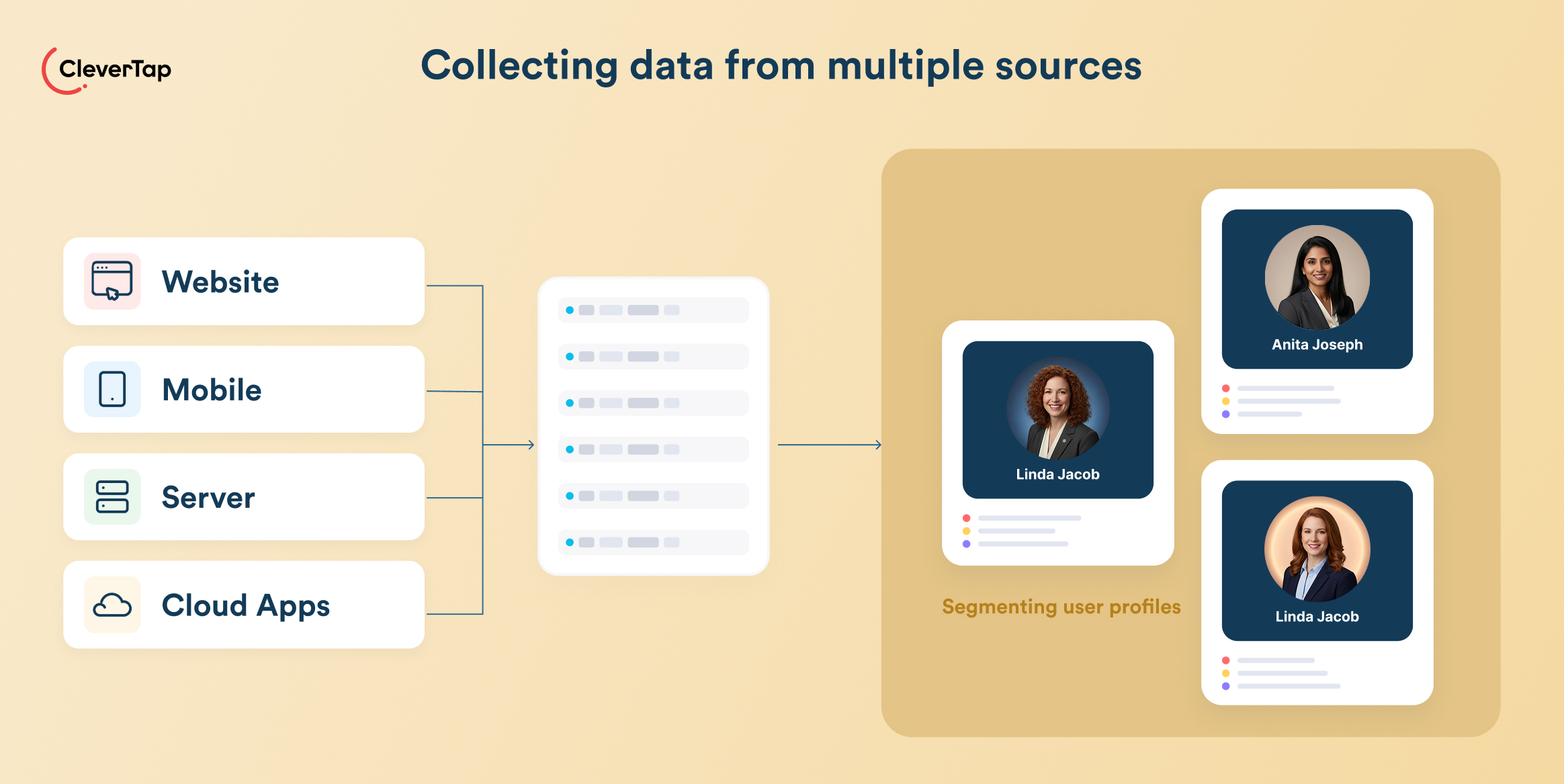
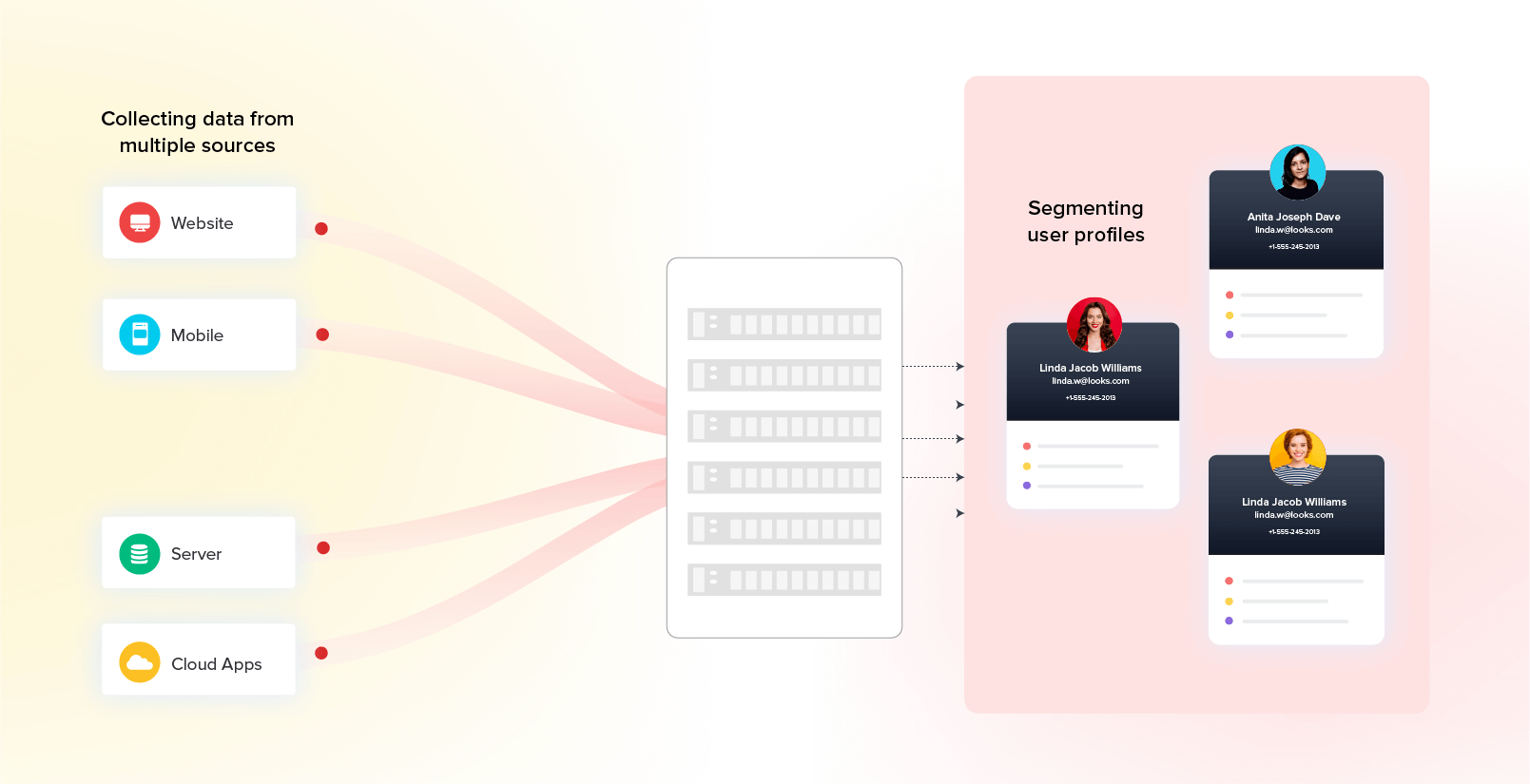
Built for mobile-first brands in retail, fintech, e-commerce, gaming, and media, CleverTap is an all-in-one customer engagement platform. Behavioral data, segmentation, journeys, and channel delivery sit within a single system, which means marketing, product, and growth teams work off the same data without stitching together tools.
Best for: Mid-market to enterprise brands with high-velocity, mobile-led customer bases. The fit is sharpest in BFSI, ecommerce, on-demand services, OTT, and gaming, where speed and volume both decide the outcome.
Key features:
- TesseractDB™ is a purpose-built database that stores and queries behavioral data in real time at scale, so segmentation and triggers do not lag.
- CleverAI™, the agentic AI layer, runs as a set of named agents that own distinct jobs: the Predictions Agent for likelihood scoring on intent, churn, and conversion; the Segment Builder Agent for natural-language segment creation; the Send Time Optimizer Agent for per-user timing; and the Generative Content Agent for AI-written copy and creative.
- A visual journey builder called Lifecycle Optimizer handles multi-step, multi-channel flows with branching, delays, and control groups built in.
- Native channel coverage spans push, email, SMS, in-app, WhatsApp, RCS, and web, with a single orchestration layer across all of them.
- Predictive segmentation is based on intent score, likelihood to buy, and likelihood to churn, so teams can reach users before behavior becomes a problem.
- Native analytics, funnels, cohorts, and revenue attribution show campaign impact in the same product, which removes the need for a separate BI tool.
Why CleverTap stands out:
Reviewers consistently flag the rare combination of easy daily use and deep behavioral analytics inside one product. On G2, customer support and onboarding draw repeat praise, especially in long-term renewal reviews.
Segmentation and triggers genuinely run in seconds rather than minutes, which matters most for cart recovery, transaction nudges, and live ops.
Proof in the field:
- APLAZO, a Mexican BNPL fintech, recovered 60% more abandoned carts and cut operational work by 94% using CleverTap Journeys, with control-group measurement to prove true incrementality. The headline was not just the lift; it was knowing the lift was real.
- Across Southeast Asia, the QSR brand Sushi King sustained 50% retention and a 41% higher return rate by running a behavior-led re-engagement journey on CleverTap personalization.
- M-KOPA, a financial inclusion platform serving African markets, tripled loan conversions and cut campaign execution time by 60%, turning campaign building from a multi-day exercise into a same-day one.
- For Indonesian P2P lender Akseleran, the team lifted Month-1 retention by 14% by using funnels to spot non-transacting users in the first month and recovering them with targeted campaigns.
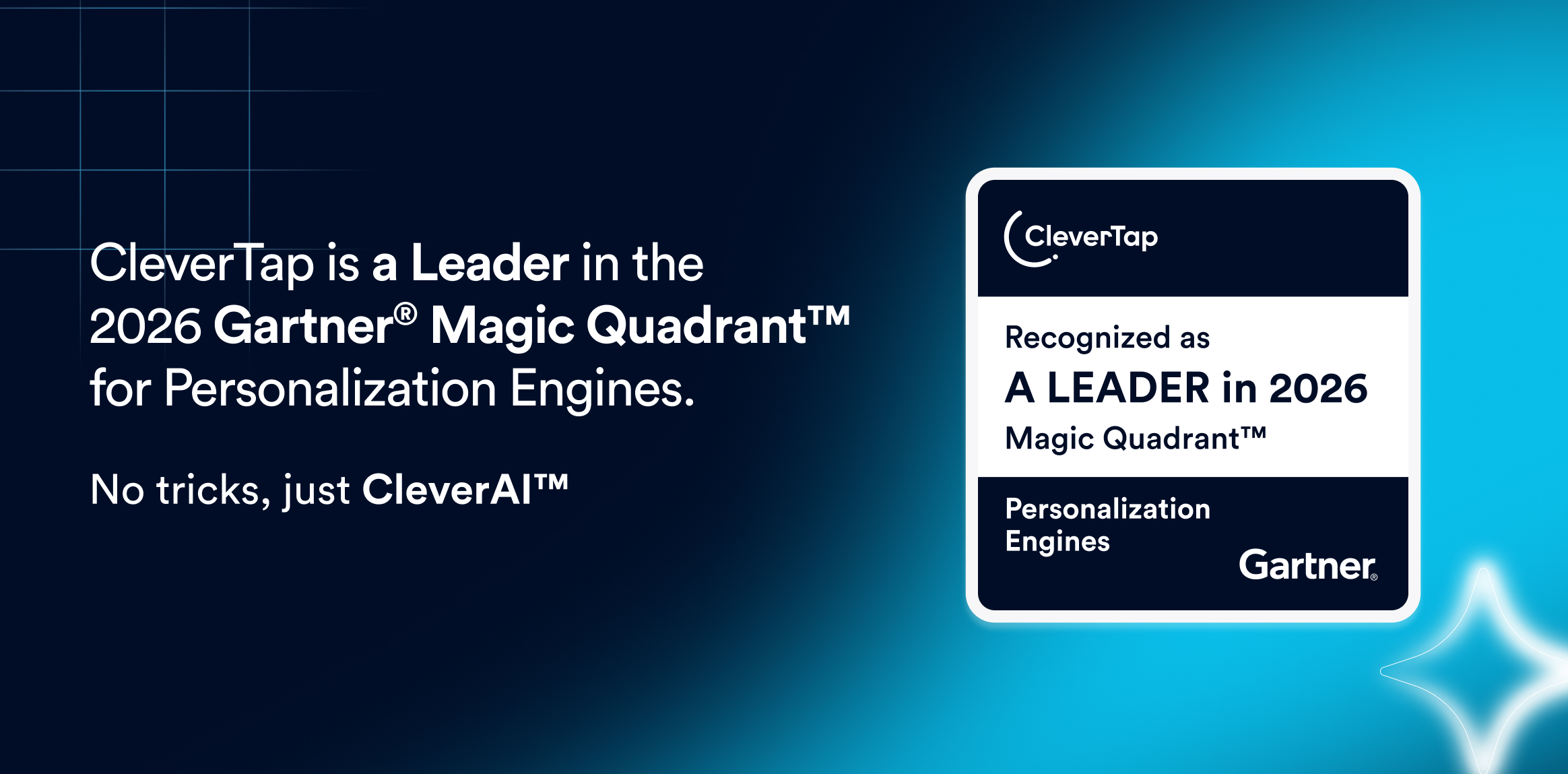
CleverTap was named a Leader in the 2026 Gartner Magic Quadrant for Multichannel Marketing Hubs. That recognition is a useful context; the retention numbers in the case studies above are what carry the weight.
Want to see how this plays against your own funnel? Book a CleverTap demo and walk through your data with the team.
That sets the bar. Each of the remaining 14 platforms is reviewed against the same four questions: channel coverage, real-time depth, AI capability, and total cost of ownership.
See how CleverTap helps brands drive retention with AI-powered customer engagement.
2. Braze
Built on an event-driven architecture, Braze is a marketing orchestration platform with an API-first approach across push, email, in-app, and SMS.
Key features: Under the hood, Braze is built for engineering teams that want to control delivery themselves.
- Event-driven data ingestion through APIs and SDKs.
- Canvas Flow, a visual journey builder for multi-step lifecycle campaigns.
- Cross-channel messaging across push, email, in-app, SMS, and webhook.
- Liquid templating for personalization at the message level.
- A large partner ecosystem covering CDPs, attribution, and data warehouses.
It gives deep control over the API and SDK and a mature canvas for journey design. Large partner ecosystem.
3. Netcore Cloud
Netcore Cloud bundles email, push, SMS, and on-site personalization into one customer engagement and experience suite.
Key features: The suite leans heavily on its email roots, with the other channels added over time.
- Email delivery infrastructure with reputation management built in.
- Push, SMS, and in-app messaging from one console.
- On-site personalization through Smartech for web journeys.
- AI-driven product recommendations for e-commerce catalogs.
- Visual journey builder for multi-channel lifecycle flows.
Netcore Cloud presents a strong heritage in email deliverability with decent in-app messaging.
4. Insider
Insider is an omnichannel engagement platform built around strong on-site personalization, web push, and AI-led recommendations.
Key features: Most of Insider’s depth sits in the web and on-site experience layer.
- Web personalization with on-site overlays, banners, and recommendations.
- Web push and browser-based messaging.
- AI-led predictive segmentation across intent and lifecycle stages.
- Mobile app messaging, including push and in-app.
You get a decent depth of web personalization, predictive segmentation, and broad channel coverage.
5. MoEngage
Push, email, SMS, and in-app messaging all live inside MoEngage, alongside an insights layer for marketers.
Key features: Underneath the marketing layer, MoEngage pairs delivery with a basic analytics surface.
- Push, email, SMS, in-app, and web messaging from one console.
- Sherpa AI for send-time and channel optimization.
- Native analytics, including funnels, cohorts, and uninstall tracking.
- A visual journey builder called Flows for lifecycle automation.
- Real-time segmentation based on user behavior and attributes.
You get a faster time-to-launch, decent native analytics, and AI-driven recommendations. I recommend speaking with a customer on a long-term tenancy who has experienced high data volumes and segment complexities.
6. Customer.io
Customer.io is an event-driven messaging platform with strong workflow logic, email, push, and SMS.
Key features: Most of the product is shaped by what developers want from an event-driven tool.
- A drag-and-drop workflow builder with deep branching logic.
- Event-triggered messaging across email, SMS, push, and webhooks.
- Liquid templating for granular personalization inside messages.
- Segment-of-one targeting from custom attributes and events.
- Open API and webhook architecture for custom data flows.
It gives a flexible workflow builder and a developer-friendly API.
7. Klaviyo
Klaviyo is an email and SMS marketing platform built deeply into Shopify, with strong segmentation and e-commerce templates.
Key features: Everything in the product is shaped by the Shopify-first heritage.
- Native two-way integration with Shopify, BigCommerce, and Magento.
- Email and SMS marketing with pre-built e-commerce templates.
- Predictive analytics for CLV, churn risk, and next-order date.
- Pre-built segments and flows for cart abandonment, browse, and post-purchase.
- A/B testing on subject lines, content, and send timing.
It delivers class-leading Shopify integration with strong out-of-the-box e-commerce reports and a quick ramp.
8. WebEngage
A full-stack customer engagement and retention platform, WebEngage covers multi-channel orchestration end-to-end.
Key features: Most of the strength sits in the journey designer and the channel breadth around it.
- A visual journey designer for multi-step lifecycle flows.
- Push, email, SMS, in-app, web push, and WhatsApp messaging.
- Behavior-based segmentation across user attributes and events.
- Native funnels, cohorts, and uninstall analytics.
- Personalization engine for on-site and in-app content.
9. Bloomreach
Bloomreach pairs a customer data platform with email, web personalization, and AI-led recommendations.
Key features: The platform’s center of gravity is the CDP, with engagement layered above it.
- Customer data platform with unified profiles and unlimited attributes.
- Email, SMS, push, and in-app messaging from one console.
- Loomi AI for product recommendations and content personalization.
- Web personalization with on-site experiments and overlays.
- Discovery search and merchandising for e-commerce catalogs.
10. Agentforce Marketing (Salesforce)
Agentforce Marketing is Salesforce’s renamed marketing cloud offering, tightly integrated with its CRM.
Key features: Most of the value comes from how deeply the product hooks into the rest of the Salesforce stack.
- Native connection to Salesforce CRM, Sales Cloud, and Service Cloud.
- Journey Builder for multi-channel campaign orchestration.
- Einstein AI for send-time, content, and channel recommendations.
- Email Studio, Mobile Studio, and Advertising Studio for channel delivery.
- Data Cloud integration for unified customer profiles.
It gives you deep CRM integration with enterprise-grade governance.
11. Iterable
Iterable is a cross-channel engagement platform with email, push, SMS, in-app, and visual. journey builder. The platform tries to balance enterprise depth with a marketer-friendly interface. Below are some of its key features:
- A visual canvas (Journeys) for cross-channel lifecycle automation.
- Email, push, SMS, in-app, and direct-mail messaging in one console.
- AI Optimization Suite for send-time and channel selection.
- Catalog-based personalization for e-commerce and content recommendations.
- Brand Affinity for engagement scoring across the lifecycle.
Many practitioners call the canvas user-friendly, and its segmentation decent.
12. Airship
Push was where Airship started, and the platform now stretches into app messaging, SMS, web, and journey orchestration.
Mobile push is still where the product is strongest, with the rest of the stack built around it.
- Push notifications with rich media, deep links, and live activities.
- In-app messaging, message center, and feature flagging.
- Native App Store Connect integration for App Clips and App Tracking.
- A journey orchestration layer (Journeys) across push, email, and SMS.
- AXP, the experience platform layer for no-code experiments.
It delivers strong mobile SDK depth and decent in-app messaging.
13. Adobe Experience Cloud
Adobe Experience Cloud is a sprawling marketing and experience suite that includes Journey Optimizer, Campaign, and Real-Time CDP. The Experience Cloud is less a product and more a stack of products that work together.
- Adobe Journey Optimizer for real-time, cross-channel journeys.
- Adobe Campaign for email, push, and SMS execution at scale.
- Adobe Real-Time CDP for unified customer profiles.
- Adobe Analytics for cross-channel measurement and attribution.
- Adobe Target for on-site personalization and experimentation.
With Adobe Experience Cloud, you get deep enterprise governance with a strong integration across Adobe products.
14. OneSignal
OneSignal is a push notification and messaging platform with strong free and entry tiers. The product stays close to its push roots, with channel additions layered around it.
- Mobile push notifications for iOS, Android, and Huawei.
- Web push for browser-based re-engagement.
- In-app messaging and SMS as secondary channels.
- Email through a separate paid tier.
- A/B testing, intelligent delivery, and journey automation on higher plans.
It’s easy to set up and delivers a broad SDK support.
15. HubSpot
HubSpot is an all-in-one CRM, marketing, sales, and service platform with email, forms, and basic automation. The product treats the CRM as the source of truth, with marketing tools layered on top.
- Built-in CRM with contact, deal, and lifecycle tracking.
- Email marketing with drag-and-drop templates and automation.
- Forms, landing pages, and live chat for lead capture.
- Workflow automation across marketing, sales, and service.
- Native reporting dashboards for funnel and campaign performance.
Offers a tight CRM-to-marketing integration with decent documentation.
How to Choose the Right Customer Engagement Platform: A Buyer’s Framework
A useful customer engagement platform fits your team, your channels, and your data, in that order. The six steps below are the ones experienced operators say they wish they had run before signing the first contract.
1. Define Primary Engagement Channels
Start with the top three channels that actually move your business by revenue or retention impact. If push and in-app are your top two, then a push-light platform is the wrong call no matter how strong its email is. Channel-first is the rule.
2. Assess Real-Time Data Needs
Does your business depend on acting within seconds of a behavior? BNPL approvals, gaming events, fraud alerts, and cart recovery all live in that bucket. For those, a batch-based platform will quietly cost you revenue.
Ask each vendor to walk through what happens from event firing to message delivery, in seconds. If the number is in minutes, it is a batch system wearing a real-time wrapper.
3. Evaluate AI and Personalization Maturity
AI in this category does four jobs: predicting intent, building segments, picking the right channel and time, and writing creative.
Which of these is actually running in production today, not which appear in the demo? That is the question that separates a mature platform from a refreshed pitch deck. The bar keeps rising every quarter.
4. Consider Integration Complexity
Map your CDP, CRM, data warehouse, and product analytics stack on a single page. Then ask the vendor what is native, what is partner-built, and what is custom. Most CEP rollouts hide their cost in that layer, not in the license fee.
5. Calculate Total Cost of Ownership Beyond Licensing
License is one line. Implementation, agency support, dev hours, channel add-ons like WhatsApp, RCS, and SMS, plus analytics tooling, make up the rest. Multiply the license figure by 1.5 to 2.5x for a realistic year-one number, and verify the result with reference customers in your size band.
6. Ask These Questions in Every Demo
A demo without a question list is a sales pitch. Bring this one to every call.
- How fast does an event reach a campaign trigger, in seconds, end-to-end?
- What is your native AI doing in production today, not on the roadmap?
- How is data unified across channels, and where is the source of truth?
- What does the journey builder do when a channel fails or a user is unreachable?
- How are control groups handled for true incrementality?
- What is the customer support SLA after onboarding, in writing?
- What are the top three reasons customers churn from your platform?
- What is the total first-year cost, including implementation and add-on channels?
Frameworks help you ask the right questions. What follows is how the wrong answer usually sounds.
Red Flags to Watch When Evaluating Customer Engagement Platforms
Some warning signs surface only after the contract is signed. Spotting them earlier is what the list below is for.
- Vague real-time claims that hide batch jobs under the hood. If the vendor cannot give you an event-to-trigger time in seconds, assume minutes.
- Limited mobile SDK documentation. A weak public SDK doc usually means a weak internal one too.
- No native analytics, with a hard dependency on third-party BI tools for anything beyond basic reports.
- Poor customer support SLAs after onboarding. Ask the vendor to share named response times, not adjectives.
- Over-reliance on agency services to make the platform useful. If the demo only works because services do the lifting, then the product is the services.
Spotting these is easier when the platform itself is built to prevent them.
Which Customer Engagement Platform Should You Choose?
There is no single best customer engagement platform. There is a best fit for your channels, your verticals, and your scale.
For mid-market or enterprise mobile-first brands in BFSI, fintech, e-commerce, OTT, or gaming, where real-time triggers, predictive AI, and integrated analytics drive retention and revenue, CleverTap is built for that pattern. APLAZO, M-KOPA, Sushi King, and Akseleran all trace the same arc in different markets: behavior captured in real time, segmented predictively, acted on through a journey, and measured against a control group.
TesseractDB™ powers the real-time behavioral data layer. CleverAI™ agents handle prediction, segmentation, timing, and content. Lifecycle Optimizer carries the journey design. And the platform’s native channels span push and email, SMS, in-app, WhatsApp, and RCS, all within one system. The system keeps learning from every interaction, so your engagement improves without adding tools or headcount.
See what CleverTap can do for your numbers. Book a demo.
If you found this helpful, check out:
5 Marketing Analytics Tool Features Every Mobile Marketer Needs
21 Must-Know Mobile Game Analytics Tools, Metrics & Resources
Top 21 AI Email Marketing Tools to Boost Engagement & Conversions
Top 14 Push Notification Platforms to Boost User Engagement
Top 10 Email Marketing Platforms to Boost Your Campaigns
Deliver Live 1:1 Personalization That Drives Higher Lifetime Value
Customer loyalty is built when engagement keeps pace with changing needs and behavior. With CleverTap’s AI-native Customer Retention Management Platform, powered by CleverAI™, you set the goals and guardrails while past context, live intent, and AI decisioning deliver Live 1:1 Personalization. Each outcome informs the next decision, helping curb churn, and maximize customer lifetime value.

Agnishwar Banerjee 
Leads content and digital marketing.Expert in SaaS sales, marketing and GTM strategies.
Free Customer Engagement Guides
Join our newsletter for actionable tips and proven strategies to grow your business and engage your customers.