



































Table of Contents
Categories
Most Popular


Increasing customer retention by just 5% can boost profits by up to 95%—yet 63% of brands remain stuck in the “developing” stage of engagement maturity. For growth and lifecycle marketers, the frustration rarely comes from a lack of effort.
It comes from the spray-and-pray trap of generic, calendar-based blasts that feel more like noise than value. The data also backs this up, with 23% of consumers saying irrelevant marketing actively erodes their loyalty.
The difference between brands that win on retention and those that don’t isn’t channel count or send frequency. It’s orchestration, moving from isolated touchpoints to a coordinated, behavior-led journey that meets customers where they are, when it matters.
This guide gives you a repeatable framework to bridge the gap between activity and outcomes. These are 15 high-impact tactics organized across the full customer lifecycle, each with the KPIs you need to measure what’s actually working.
What Is a Customer Engagement Strategy? (And Why Most Companies Get It Wrong)
Many brands confuse “activity” with “engagement,” assuming that a high volume of outgoing messages equates to a connected customer base. A truly effective customer engagement strategy is about whether the outreach means something to the person receiving it.
To build a strategy that moves the needle on retention and revenue, you need to understand exactly what you’re trying to influence and where most marketers get it wrong.
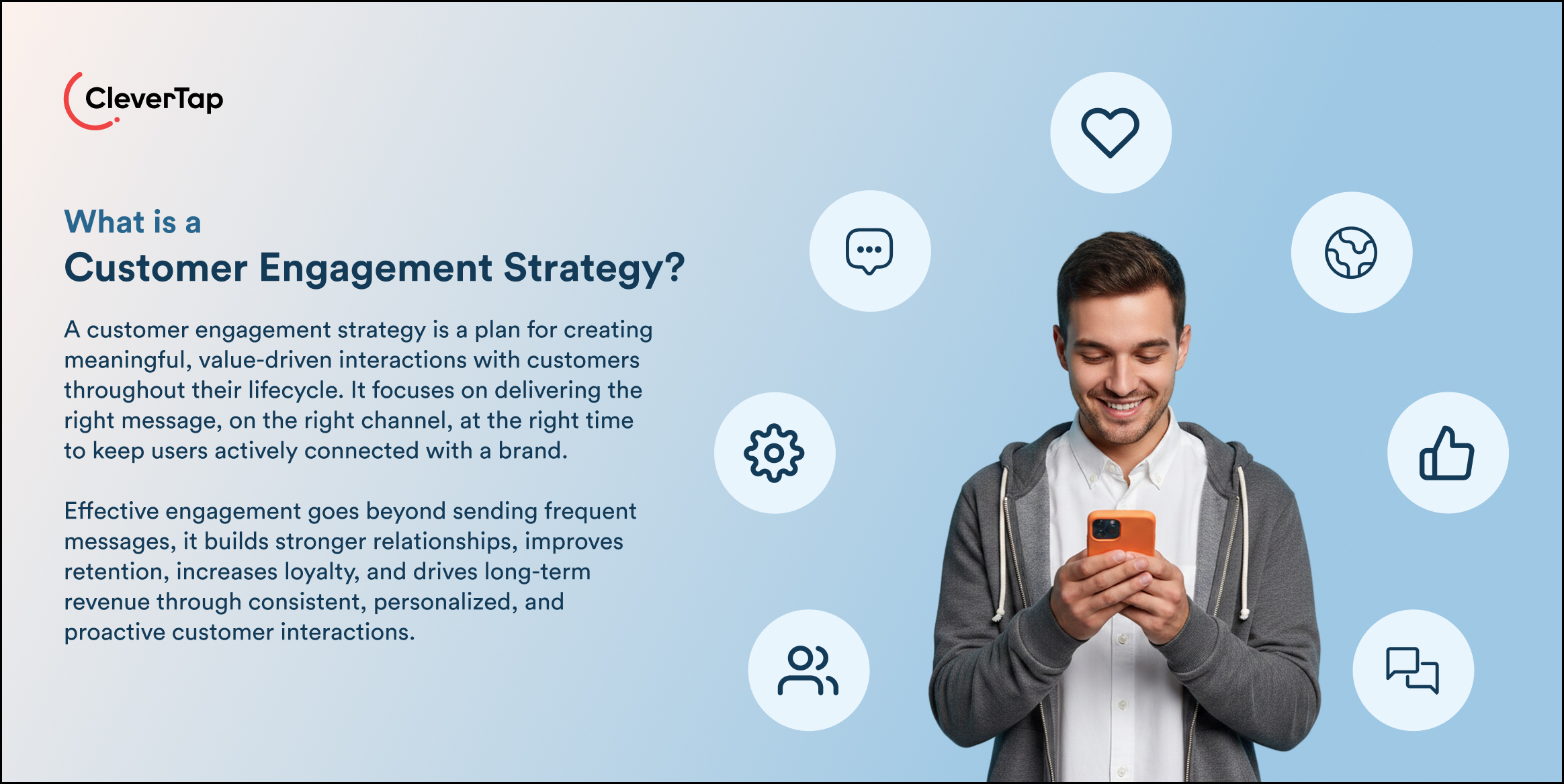
Customer Engagement Strategy Defined
A customer engagement strategy is a structured plan to build and maintain meaningful, value-driven interactions with your users across their entire lifecycle. Unlike reactive customer service, engagement is proactive, delivering the right message, on the right channel, at the exact moment a user needs it to move forward in their journey.
That said, engagement is one of three closely related concepts that marketers routinely conflate:
- Customer Satisfaction: A sentiment that measures how a user feels about a specific interaction, such as a support ticket, a purchase, or an onboarding call. You can have a satisfied customer who never opens your app again.
- Customer Loyalty: The long-term emotional bond that makes a customer choose your brand over competitors, repeatedly.
- Customer Engagement: The ongoing series of active touchpoints, like opening a push notification, completing a KYC flow, or sharing a referral link, that builds satisfaction over time and converts it into loyalty. Customer engagement is the engine that drives satisfaction and loyalty.
Also read: 8 Clever Customer Engagement Examples From Top Brands
Why Generic Engagement Tactics Fail
If engagement is the engine of growth, then why do so many brands stall themselves? The problem actually lies in their application without the help of a behavioral roadmap. When engagement efforts fail to produce ROI, it usually comes down to one of three silent killers:
- The Spray-and-Pray Problem: Sending the same message to every user at the same time. A “Weekend Sale” blast looks very different to a brand-new user versus a five-year VIP, and treating them identically just creates noise and not value. High-volume, low-relevance messaging is the fastest route to uninstalls and unsubscribes.
- Engagement Without Measurement: Optimizing for opens instead of outcomes. If you’re not tracking time-to-first-value, feature adoption, or LTV impact, you’re measuring activity—not progress.
- One-Size-Fits-All Logic: Deploying retention tactics on users who haven’t activated yet. A referral program that works brilliantly for a six-month customer can overwhelm someone still figuring out your core product. The right tactic at the wrong stage does more damage than no tactic at all.
The Customer Engagement Lifecycle Framework
Every interaction in your engagement strategy should serve a logical purpose in deepening the customer relationship, and that only happens when tactics are mapped to the stage the user is actually in.
The 15 strategies in this guide are organized across four lifecycle stages:
- Awareness & Acquisition: Make the first touchpoint feel built for this specific user and not just a generic welcome.
- Activation & Habit Formation: Reduce friction and get users to their “Aha Moment” before the novelty wears off.
- Retention & Deepening Relationships: Use behavioral signals and predictive data to keep users engaged and get ahead of churn.
- Growth, Advocacy & Expansion: Turn your most loyal users into a self-sustaining referral and expansion engine.
15 Customer Engagement Strategies by Lifecycle Stage
The customer lifetime value compounds when every tactic you deploy matches where the user actually is in their relationship with your brand. The 15 strategies below are organized across four stages to help you move from random, fragmented blasts to a coordinated, behavior-led journey.
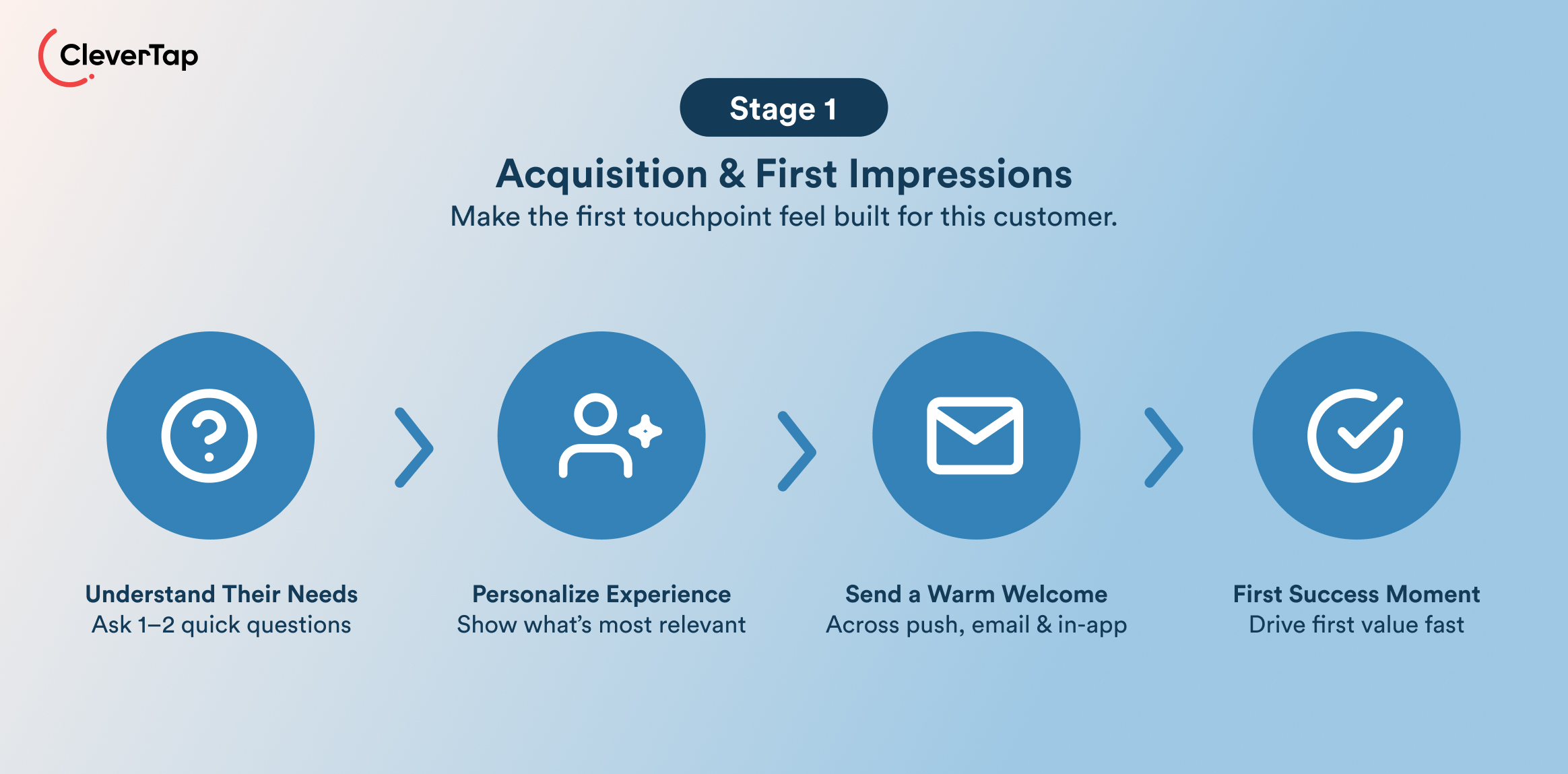
Stage 1: Acquisition & First Impressions
Goal: Make the first touchpoint feel built for this specific customer.
The first session is the most volatile moment in the customer journey. Within seconds, a user decides whether your product is a solution or a distraction. Your objective is to eliminate generality and replace it with immediate, personalized relevance, giving proof that your product understands why they showed up.
Strategy 1: Personalize Onboarding From the First App Open or Visit
The Strategy: Adaptive onboarding flows
Generic onboarding walkthroughs underperform, and they actively create friction. Instead of a simple, generic tour, you should deploy flows that adapt dynamically based on acquisition source or declared intent.
The mechanism is simple: ask one or two targeted questions during sign-up to identify the user’s primary goal, then tailor the walkthrough to the specific feature that solves it.
This zero-party data approach cuts time-to-first-value and materially improves the likelihood of a second session.
- Best For: Mobile Apps, Fintech, Insurtech
- Vertical Angles: Adaptive app flows / KYC-aware bank onboarding / policy-type-specific insurance onboarding
- KPI: Onboarding completion rate, Day-1 retention, time-to-first-value
Strategy 2: Use Behavioral Segmentation From Day One (Not Demographics)
The Strategy: Intent-based clustering
Demographic data tells you who a user is, while behavioral data tells you why they’re there, and that’s the variable that actually predicts engagement.
From the first session, track intent signals, such as category clicks, time spent on a pricing page, or specific search terms. Use these signals to place users into behavioral segments immediately, so your first 24-hour messaging is relevant rather than generic.
Waiting weeks to accumulate data before segmenting is one of the most common and costly activation mistakes.
- Best For: E-commerce, Retail, Mobile Apps, Banking
- Vertical Angles: Category-affinity segmentation for e-commerce/loan intent signals for banking / unified in-store + in-app profiles for retail
- KPI: Segment-to-conversion rate, CTR on segmented vs. broadcast campaigns
Learn more about what is behavioral segmentation and six effective strategies you can implement.
Strategy 3: Run Intelligent Welcome Campaigns Across Push, In-App, and Email
The Strategy: Multi-channel orchestration
A welcome journey should be an orchestration, not a bombardment. Rather than an isolated email sequence, build a laddered journey that deploys the right channel based on the user’s current state and progress.
Cobbles, a community engagement platform, put this into practice by treating the first seven days as the make-or-break window for habit formation.
Using CleverTap, Cobbles built a welcome journey of 6 emails and 6 push notifications across the first week, each touchpoint providing guided navigation of a specific app feature based on where the user was in their journey, not on a fixed calendar schedule. The result was a retention rate that outperformed the industry benchmark.
- Best For: Mobile Apps, E-commerce, Travel & Hospitality
- Vertical Angles: First-booking incentive for travel / high-intent cart capture for e-commerce / Day 1 → Day 3 → Day 5 re-engagement ladder for apps
- KPI: Welcome sequence CTR, day-3 and day-7 retention lift vs. control
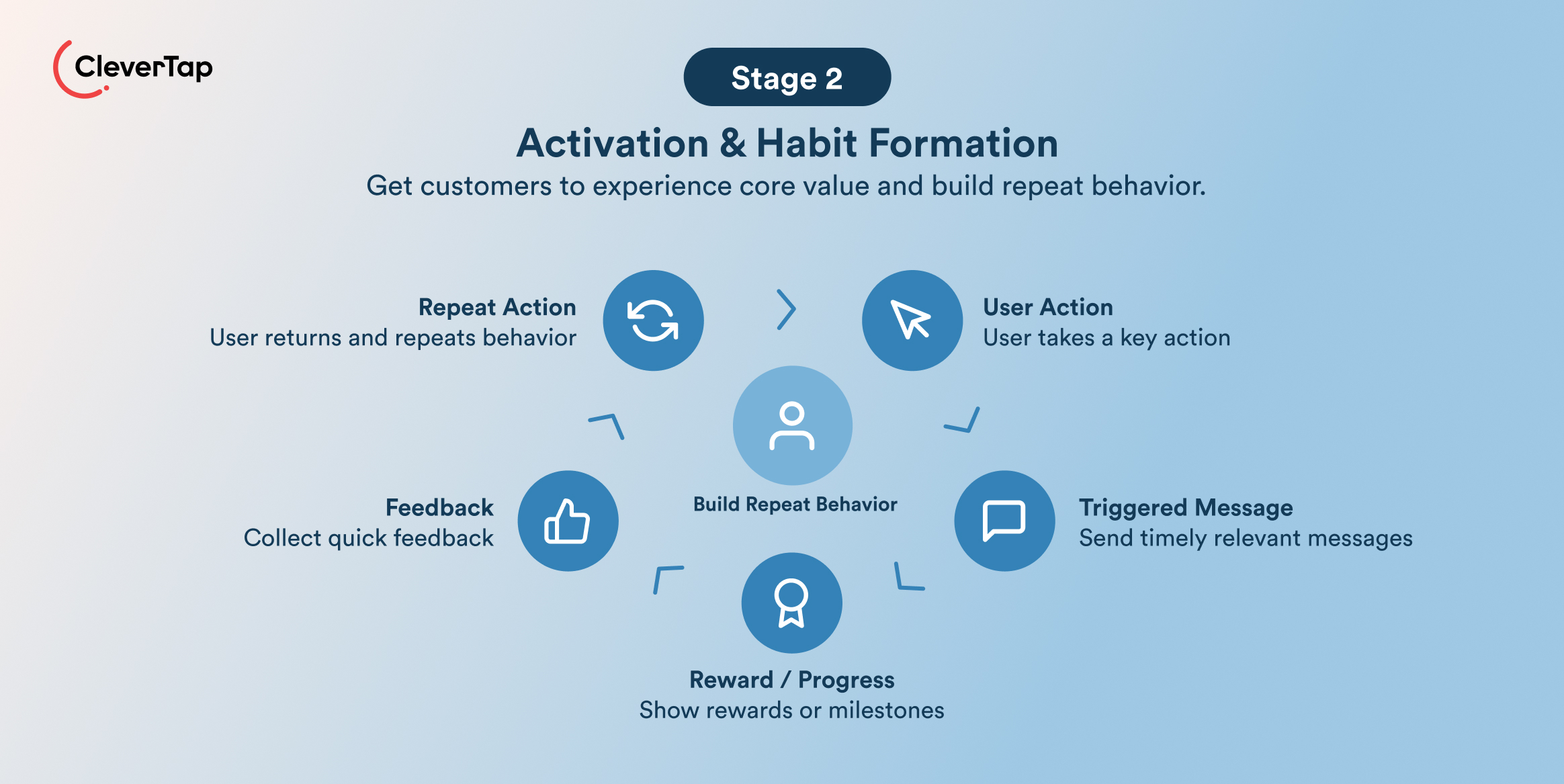
Stage 2: Activation & Habit Formation
Goal: Get customers to experience core product value before the novelty wears off.
The gap between a user’s first login and their first meaningful interaction is the churn danger zone. Activation is all about momentum, and every touchpoint in this stage should be designed to move users toward one habit that reinforces your product’s core before the initial curiosity fades.
Strategy 4: Engineer the “Aha Moment” Into Your Activation Flow
The Strategy: Milestone acceleration
The “Aha Moment” is the specific instance where a user first experiences the unique value of your product. For example, in a fintech app, it’s the first successful automated saving, or in a fitness app, it’s the first logged workout.
Identify this high-correlation milestone through cohort analysis, then strip away every non-essential screen or field that sits between the user and that moment. The faster you get a user there, the more likely they are to come back.
- Best For: Mobile Apps, Fintech, Insurtech
- Vertical Angles: First transfer or savings milestone for fintech / first successful claim for insurance / first logged workout for fitness apps
- KPI: Time-to-aha-moment, correlation with 30-day retention
Strategy 5: Deploy Behavior-Triggered Messaging (Not Calendar-Based Blasts)
The Strategy: Contextual real-time triggers
Calendar-based blasts are disruptive because they ignore context. Behavior-triggered messaging works because it responds to what the user is actually doing—their digital body language.
A user who browses a high-interest investment fund but doesn’t commit is telling you something. An automated push sent two hours later with a quick-start guide reads as helpful, not intrusive. That distinction between responding to behavior versus broadcasting on a schedule is what separates engagement from noise.
- Best For: All verticals
- Vertical Angles: Cart abandonment push for e-commerce/investment tab browsing trigger for banking/post-trip re-engagement for travel/renewal reminder ladder for insurtech
- KPI: Triggered campaign conversion rate vs. broadcast, dormant user re-engagement rate
Strategy 6: Build Feedback Loops That Close Before Customers Churn
The Strategy: Transactional micro-surveys
Annual NPS surveys are autopsy reports, and by the time you read the results, the patient has already left.
High-impact engagement requires feedback loops that close in real time, at the exact moment a user has an opinion worth capturing, for example, immediately after a flight booking, a successful claim payout, or a delivered order.
More importantly, that feedback should trigger action. A 1-star post-delivery rating should trigger an automated service recovery workflow, like an apology, credit, or resolution, before the user closes the app.
- Best For: E-commerce, Banking, Travel & Hospitality, Insurtech
- Vertical Angles: Post-checkout CSAT for travel / post-transaction rating for banking / post-delivery review prompt for e-commerce / post-claim survey for insurtech
- KPI: Survey response rate, NPS by cohort, low-score trigger activation rate
Strategy 7: Gamify Key In-App Actions to Build Habitual Engagement
The Strategy: Psychological reward systems
Gamification works because it maps game-design mechanics, like streaks, progress bars, badges, and leaderboards, onto the exact behaviors you want to reinforce. The psychology is straightforward: people complete what they’ve started, and they return for rewards they’ve earned.
MobilityWare, a leader in the mobile gaming space, put this to the test on their evergreen titles. Using CleverTap to deploy Dynamic Game Events and milestone-based rewards, they turned routine gameplay into time-sensitive habit loops. rewarding specific in-game actions with challenges that brought users back on their own schedule, not the brand’s. The result was a measurable climb in both session length and return rates, contributing to revenue increases of as much as 50%.
- Best For: Mobile Apps, E-commerce, Retail, Fintech
- Vertical Angles: Savings streak badges for fintech/points progress bar for retail loyalty/profile completion bar for e-commerce
- KPI: Feature adoption rate, session frequency, gamified action completion rate
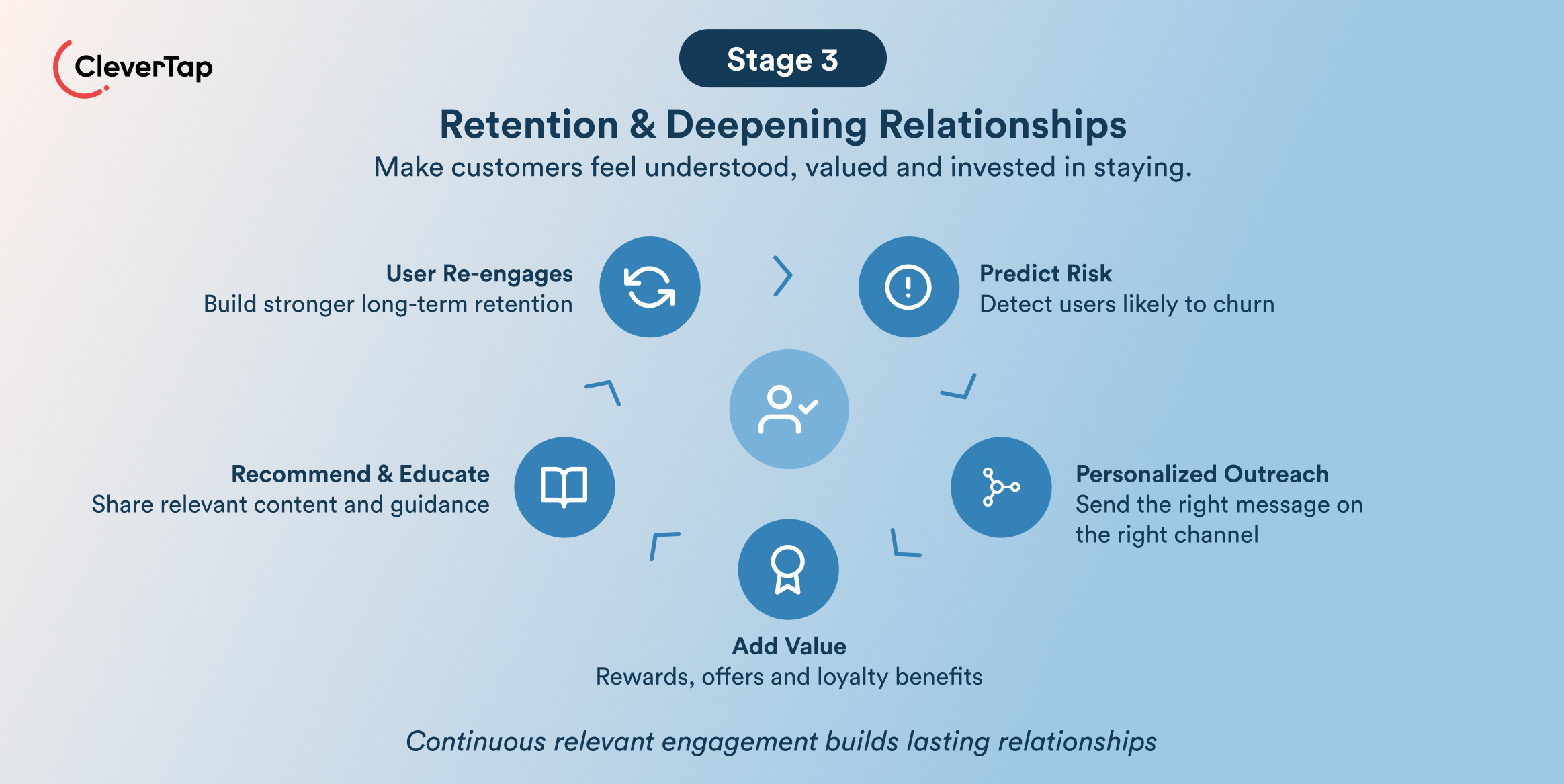
Stage 3: Retention & Deepening Relationships
Goal: Make customers feel understood, valued, and progressively more invested in staying.
Retention is the byproduct of relevance, and once a user has formed a habit, your challenge shifts from “teaching” them the app to “anticipating” their needs. At this stage, engagement must move beyond generic nudges and into the realm of predictive intelligence and seamless omnichannel continuity.
Strategy 8: Prevent Churn With Predictive Engagement (Before Users Drift)
The Strategy: Churn propensity modeling
Most retention efforts fail because they’re reactive. By the time a “We Miss You” email lands in someone’s inbox, they’ve likely already moved on. Predictive engagement uses machine learning to identify at-risk behavioral signatures, like a 40% drop in session frequency, a three-day gap in habitual logins, and intervenes before the drift becomes a decision.
Circles.Life, a digital telco operating in hyper-competitive markets, put this into practice via CleverTap’s predictive customer intelligence. By automating personalized re-engagement journeys for at-risk users, they achieved a 10% reduction in churn while simultaneously driving 100% GMV growth for new product lines like Circles Zerofy.
The shift from analyzing what a user did to predicting what they’re likely to do next is what separates retention strategies that scale from those that merely react.
- Best For: Mobile Apps, Banking, Fintech, Insurtech, Subscription e-commerce
- Vertical Angles: App inactivity win-back push/investment feature re-nudge for banking/mid-policy silence campaign for insurtech/lapsed buyer re-engagement for e-commerce
- KPI: At-risk cohort retention rate vs. control, win-back conversion rate
Strategy 9: Build an Omnichannel Journey That Feels Like One Conversation
The Strategy: Contextual continuity
Omnichannel is not the same as multi-channel. Multi-channel means being present on multiple platforms, while omnichannel means being present on multiple platforms with a full context of what happened on every other one.
A user who starts a loan application on a desktop and abandons it shouldn’t receive a generic follow-up email, but they should receive a push notification that deep-links them back to the exact step where they stopped.
That continuity eliminates the cognitive load of switching devices and keeps the customer journey frictionless across push, email, SMS, and in-app.
- Best For: E-commerce · Retail · Banking · Travel & Hospitality
- Vertical Angles: In-store → in-app continuity for retail/desktop loan application resumed via app push for banking/web flight search, followed by in-app price alert for travel
- KPI: Cross-channel engagement rate, journey completion rate
Read in detail: Omnichannel vs Multichannel: What’s the Difference?
Strategy 10: Build a Loyalty Program That Rewards Behavior, Not Just Spend
The Strategy: Non-transactional incentives
Spend-based loyalty programs systematically ignore your most frequently engaged users who haven’t yet become high-value purchasers.
To deepen relationships at this stage, reward engagement milestones, like a product review, a completed destination wishlist, or a 30-day savings goal reached. When you go beyond a points-per-purchase model, it incentivizes the specific behaviors that build long-term habituation and turns engaged users into organic advocates before you ever need to run a formal referral program.
- Best For: E-commerce, Retail, Travel & Hospitality, Fintech
- Vertical Angles: Review/referral/wishlist rewards for e-commerce/destination planning rewards for travel/goal completion rewards for fintech/cashback tiers with in-app visualization for banking
- KPI: Loyalty participation rate, LTV of members vs. non-members, redemption rate
Related reads: 11 Powerful Benefits of Customer Loyalty Programs
Strategy 11: Deliver Lifecycle-Stage Content That Educates, Not Just Promotes
The Strategy: The content-to-commerce bridge
Engagement erodes when every touchpoint feels like a sales pitch.
Strategic retention requires delivering content that matches where the user actually is in their product maturity and not where you want them to be commercially. For a fintech user, that means graduating from “How to Deposit” guides during onboarding to “Advanced Portfolio Diversification” content once they’ve reached the retention stage.
When your brand consistently delivers value without an immediate ask, it builds the kind of authority that makes upsell and cross-sell feel like a natural next step rather than an interruption.
- Best For: Fintech, Banking, Insurtech, Mobile Apps
- Vertical Angles: Investing 101 series for fintech/claims explainer in-app stories for insurtech / personalized financial tips based on transaction patterns for banking
- KPI: Content consumption rate by lifecycle segment, feature adoption lift post-content delivery
Strategy 12: Re-Engage Dormant Users With Hyper-Relevant Win-Back Campaigns
The Strategy: Recency-Frequency-Monetary (RFM) Reactivation
Generic win-back messages get ignored because they’re built around the brand’s need to recover a user, not the user’s reason for leaving. Effective reactivation starts with RFM analysis to identify who lapsed, when, and what they valued most, and to build outreach around that behavioral context.
A lapsed user who consistently purchased premium skincare doesn’t need a site-wide 10% discount. They need a personalized alert about a new launch in that category, or a refill reminder timed to their previous purchase cycle. That specificity is the difference between a high-ROI win-back campaign and wasted spend.
- Best For: Mobile Apps, E-commerce, Fintech, Travel
- Vertical Angles: New feature highlight for lapsed app users / browsing-history-based email for e-commerce / market-moment hook for fintech/peak travel-planning timing for travel
- KPI: Win-back rate, re-engagement open/push rate, revenue recovered from dormant cohort
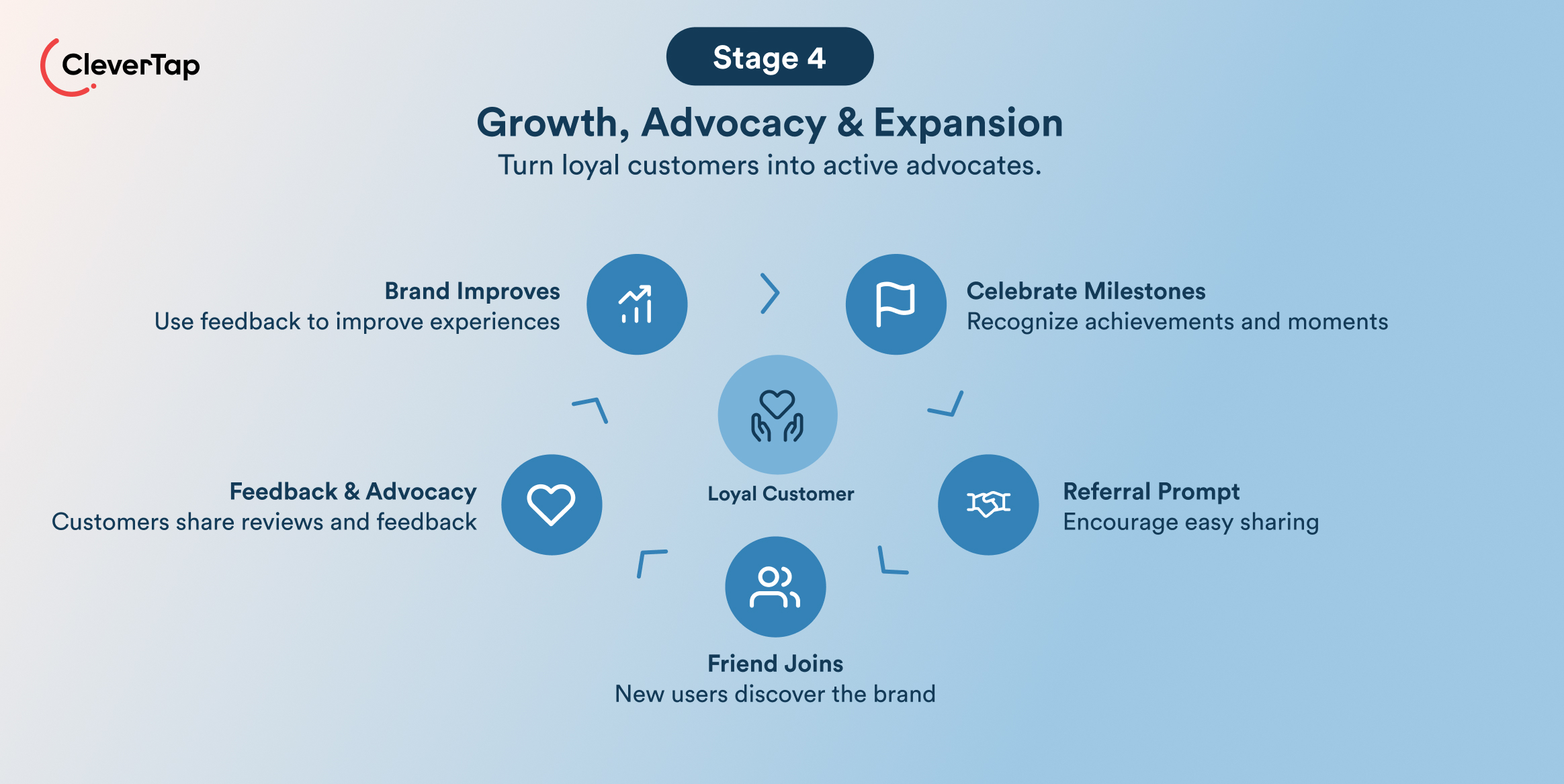
Stage 4: Growth, Advocacy & Expansion
Goal: Turn loyal customers into active advocates and expand their product relationship.
At this final stage, the objective shifts from individual retention to collective growth. You’re no longer just engaging a user but transforming them into a volunteer marketer. That transition requires moving beyond passive satisfaction to active advocacy. It requires friction-free referral mechanics, milestone celebrations that build emotional investment, and a feedback loop that proves to users their voice actually shapes your product.
Strategy 13: Build In-App Referral Programs That Scale Word-of-Mouth
The Strategy: The low-friction viral loop
Most referral programs fail not because of weak incentives, but because of weak execution, like necessary settings being buried in a menu, requiring too many steps, or asking at the wrong moment. To scale word-of-mouth, the referral flow needs to be treated as a primary product feature, not an afterthought.
This requires two things working together: Incentive Alignment, ensuring both the referrer and referee feel they’re winning, and Friction Removal, using deep-linked share flows with pre-filled messages and one-tap invites via SMS or WhatsApp. E
Equally important is timing; you need to catch the user at their peak moment of satisfaction, immediately after a successful delivery, a high-yield investment return, or a completed booking, and surface the referral prompt at exactly that moment.
- Best For: Mobile Apps, Fintech, E-commerce, Travel
- Vertical Angles: Friend invites with real-time KYC status tracking for fintech / post-delivery moment referral triggers for e-commerce/group trip invite mechanics for travel
- KPI: Referral participation rate, referred user activation rate, LTV of referred users vs. organic users
Strategy 14: Use Customer Milestones and Life Events as Engagement Triggers
The Strategy: The Endowed Progress Effect
Engagement erodes fastest when a brand feels purely transactional. Milestone triggers, like a first-year anniversary summary, a 100th-order celebration, or a savings goal reached, reframe the relationship from vendor-customer to something more like a partnership with a shared history.
The psychological mechanism here is the endowed progress effect: users feel a deeper sense of commitment to a platform when they have a documented record of achievement within it. That history creates emotional switching costs that no competitor discount can easily overcome, because a competitor who doesn’t know your history can’t replicate what you’ve built together.
- Best For: Banking, Fintech, Insurtech, Travel, E-commerce
- Vertical Angles: 1-year banking anniversary summary / “protected year” pre-renewal celebration for insurtech / first savings goal hit for fintech / post-trip milestone share for travel
- KPI: Milestone campaign open rate, renewal rate lift, repeat purchase rate post-milestone
Strategy 15: Build a Voice-of-Customer (VOC) Engine That Fuels Engagement Loops
The Strategy: Closing the feedback-action loop
Most brands treat customer feedback as a quarterly report. A sophisticated engagement strategy treats it as a segmentation trigger that fires the moment sentiment is captured.
A true VOC engine automates what happens next based on the score provided. A low NPS response shouldn’t end with a “thanks for your feedback” screen, but it should automatically move that user into a service recovery journey: personalized outreach, a support ticket, or a simplified re-onboarding flow, depending on the friction point identified.
A high NPS response shouldn’t be filed away either. Promoters should be immediately routed into an advocacy flow: a referral prompt, an invite to an exclusive beta group, or an early-access offer that rewards their loyalty tangibly.
Both pathways matter equally. The brands that close this loop and make it visible to the user that their feedback triggered a real response are the ones that convert satisfied customers into vocal advocates.
- Best For: All verticals, especially banking, fintech, insurtech, and mobile apps
- Vertical Angles: Low NPS after loan flow triggers simplified onboarding nudge for banking / post-claim survey score triggers referral or recovery campaign for insurtech / post-stay survey routes customers into VIP or service-recovery flows for travel.
- KPI: VOC response rate, NPS segmentation accuracy, revenue from negative-experience cohort recovery
Discover 15 best customer engagement platforms for smarter lifecycle marketing.
How to Build Your Customer Engagement Strategy (Step-by-Step)
Building a high-performance engagement strategy is about doing the right things in the right order. Use this five-step framework to move from random acts of marketing to a coordinated, measurable engagement engine.
Step 1: Audit Your Current Engagement Touchpoints
Before you can improve customer engagement, you need to know exactly where you’re losing it. Conduct a friction audit across your entire lifecycle:
- Map the Journey: List every automated email, push notification, and in-app message currently live across all channels
- Identify the Silence: Where do users go dark? A 4-day gap between signup and the first meaningful nudge is a churn risk hiding in plain sight
- Check for Consistency: Does your brand voice in a welcome email match the tone of a payment-failed SMS? Inconsistency at key touchpoints erodes trust faster than most brands realize
Step 2: Define Your Engagement Goals by Customer Stage
You cannot improve what you don’t measure. Assign one North Star Metric to each customer lifecycle stage so every tactic has a clear, accountable purpose.
| Lifecycle Stage | Primary Goal | Key Metric (KPI) |
| Acquisition | Successful Setup | Onboarding Completion Rate |
| Activation | Value Realization | Time-to-Aha-Moment |
| Retention | Habit Formation | Daily/Weekly Active Users (DAU/WAU) |
| Expansion | Revenue Growth | Upsell/Cross-sell Conversion Rate |
| Advocacy | Word-of-Mouth | Referral Participation Rate |
Step 3: Choose 3–5 Strategies to Prioritize First (Use the Effort-Impact Matrix)
Don’t attempt to implement all 15 strategies simultaneously. Use the Effort-Impact Matrix to filter your shortlist. It is where you plot each strategy by the technical resource required against the potential lift in retention or revenue:
- Quick Wins (High Impact, Low Effort): Start here. Fixing a broken welcome sequence or adding a personalized recommendation block to an existing email often falls into this quadrant
- Big Bets (High Impact, High Effort): These are your quarterly priorities, building a predictive churn model or a full gamification engine. Plan the resource allocation before committing
- Fill-Ins (Low Impact, Low Effort): Execute only when your team has genuine spare capacity
- Thankless Tasks (Low Impact, High Effort): Deprioritize or eliminate these entirely
Step 4: Assign Ownership and Build Your Engagement Calendar
Strategy without accountability is just a wishlist. For every prioritized tactic, assign a DRI, a Directly Responsible Individual, who owns both execution and the outcome metric.
- Build the Drumbeat: Create an engagement calendar that deliberately spaces different types of outreach. A user receiving a promotional blast, a lifecycle nudge, and a feedback survey on the same day isn’t being engaged, they’re being overwhelmed
- Define the Stack: Align your product, marketing, and data teams on who owns the trigger logic and who owns the creative, ambiguity here is where most engagement programs quietly break down
How CleverTap Runs Your Customer Engagement Strategy at Scale
Running an engagement strategy for a few thousand users is manageable. Most brands hit a ceiling when running it for 10 million, where they need to time, personalize, and make every message contextually relevant.
This is where CleverAI™ shifts your strategy from a manually managed plan to a self-optimizing system. Rather than forcing marketers to segment every cohort by hand, CleverAI™ deploys specialized decision agents, including the Send-Time Agent and Persona Agent, that analyze individual user behavior in real time and match the right message to the right moment at scale. The result is personalization that operates at a speed and granularity no manual workflow can replicate.
This capability is exactly what Eatigo, a leader in restaurant reservations, needed to solve the challenge of high-volume relevance. By leveraging CleverTap’s automated recommendation engine to trigger intent-based offers, they moved away from generic broadcasts and into personalized loops that adapt dynamically to user behavior, driving an increase in reservation conversions. It’s proof that with the right infrastructure, you can scale your reach without losing the one-on-one feel that drives long-term loyalty.
Convert engagement into lasting customer loyalty with CleverTap’s real-time personalization engine.

Sagar Hatekar 
Leads product managementExpert in Marketing Analytics & Engagement platforms.
Free Customer Engagement Guides
Join our newsletter for actionable tips and proven strategies to grow your business and engage your customers.