
















































Table of Contents
Categories
Most Popular


Sustainable growth is no longer just about filling the acquisition funnel. Long-term revenue growth depends on existing customers generating more value over time than the revenue lost to churn, and net revenue retention (NRR) helps measure that balance.
Net revenue retention measures the percentage of recurring revenue you hold onto from existing customers over a given period. It accounts for expansion, upgrades, downgrades, and cancellations. Where acquisition metrics tell you how well you’re growing, your net revenue retention rate tells you something more valuable, and that is whether customers are actually staying, spending more, and finding long-term value in your product.
This guide breaks down the net revenue retention formula, walks through a step-by-step net revenue retention calculation, covers realistic benchmarks, and outlines actionable strategies to consistently improve your net retention rate.
What Is Net Revenue Retention (NRR)?
Net revenue retention (NRR), frequently referred to as the net retention rate, is a metric that measures the percentage of recurring revenue retained from existing customers over a specific period, factoring in upgrades, downgrades, and cancellations. It shows a company’s ability to retain its current customers and grow their spending over time.
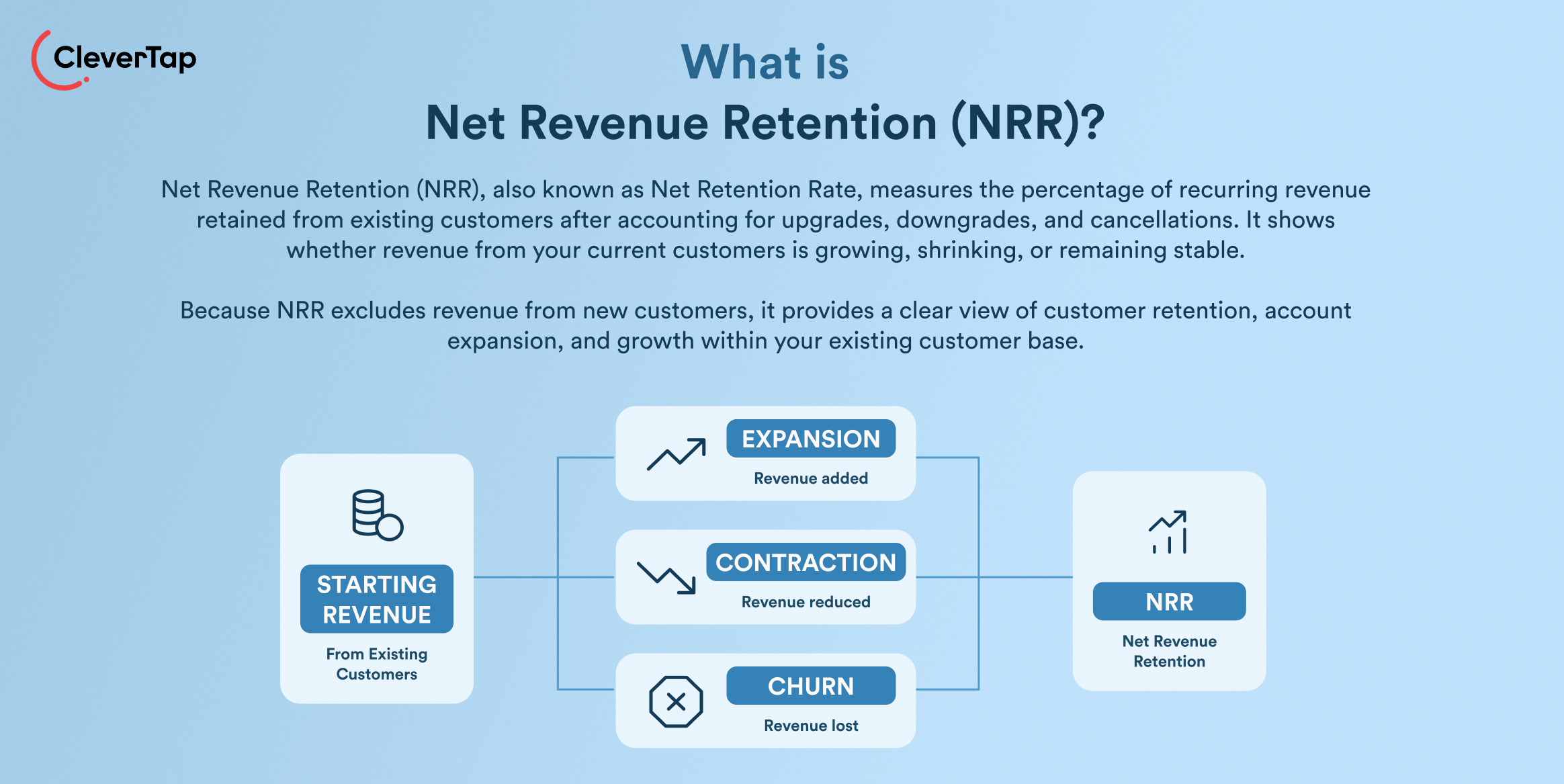
What makes NRR particularly valuable is that it isolates the performance of your existing customer cohort, intentionally excluding revenue from newly acquired users. This makes it a reliable indicator of organic growth potential, driven by three variables:
- Expansion Revenue: Upsells, cross-sells, and plan upgrades
- Churned Revenue: Account cancellations and complete customer loss
- Contraction Revenue: Plan downgrades, reduced usage, and service tier drops.
These three variables determine whether your business can scale on the strength of its existing customer relationships alone.
Why Net Revenue Retention Matters
Tracking your net revenue retention rate matters because it cuts through vanity metrics to show the true health of your existing customer relationships. Top-line acquisition numbers can mask systemic retention issues, while on the other hand, NRR surfaces what’s actually happening beneath them.
For growth leaders and revenue managers, here’s why NRR deserves a permanent place in your reporting:
- Shows Growth Without New Customers: Proves your product can expand value organically without heavy sales spend
- Indicates Product and Customer Value: Demonstrates that users find long-term utility and deepen engagement over time
- Reflects Revenue Stability: Signals predictable, reliable revenue streams that hold up against market shifts
- Key Metric for Subscription Businesses: Serves as the primary health indicator for compound growth in recurring revenue models
A strong net retention rate means every dime spent on acquisition actually compounds, rather than simply replacing what you’re losing out the back door.
Net Revenue Retention Formula
To calculate net revenue retention, you need to isolate your revenue variables over a specific time window; it can be monthly or annually. The formula weighs your expanding accounts against lost or downgraded ones to give you a precise picture of organic revenue movement.
Here is the standard net revenue retention formula:
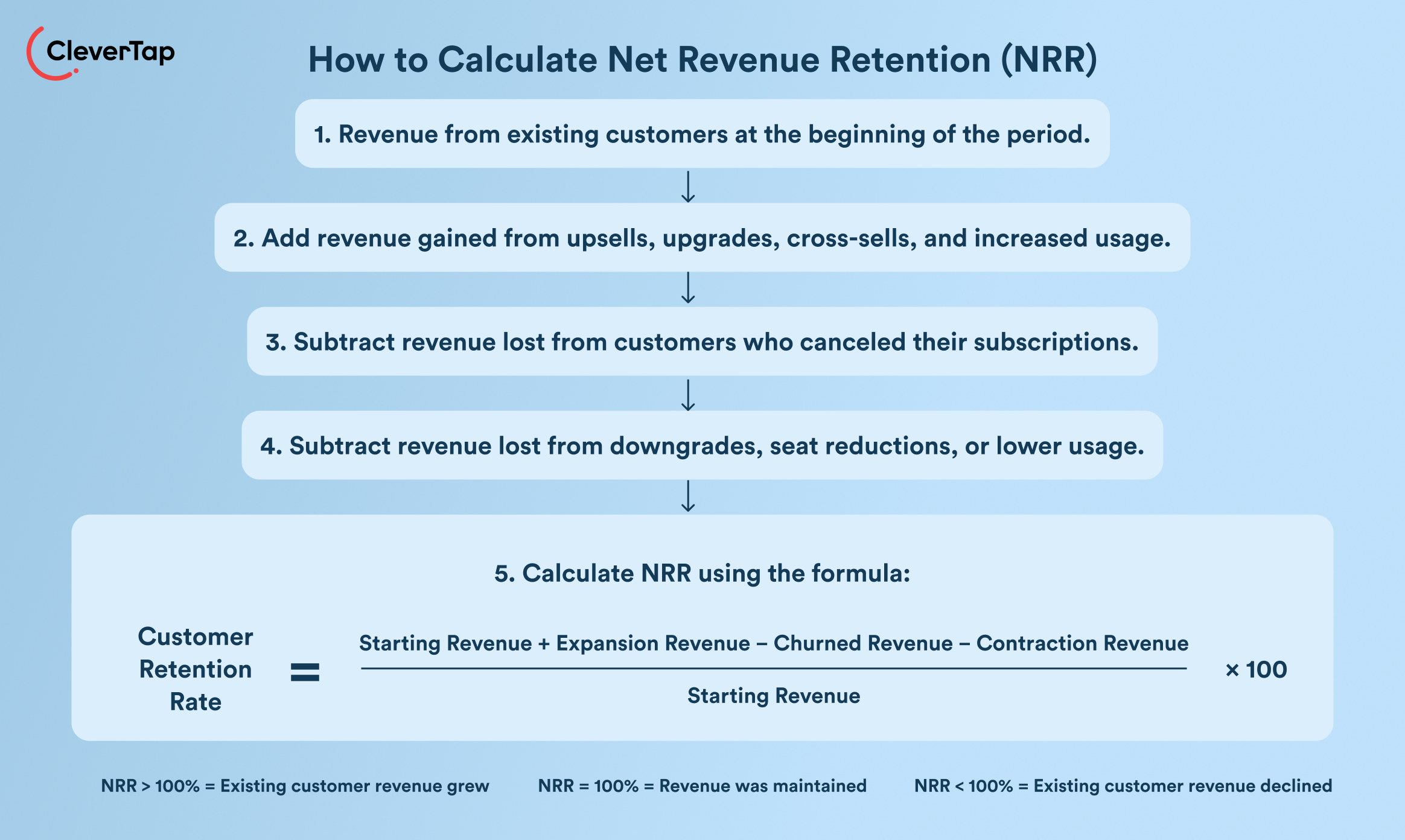
NRR = [(Starting Revenue + Expansion Revenue − Churned Revenue − Contraction Revenue) / Starting Revenue] × 100
Here is what each variable means:
- Starting Revenue: Total recurring revenue from existing customers at the start of the period
- Expansion Revenue: Additional revenue earned from those same customers via upsells or upgrades
- Churned Revenue: Revenue lost due to customers fully canceling their subscriptions or services
- Contraction Revenue: Revenue lost from customers who downgraded tiers without canceling entirely
How to Calculate Net Revenue Retention (Step-by-Step)
An accurate net revenue retention calculation requires a systematic approach to auditing your recurring revenue. Walking through each variable in order helps growth and finance teams avoid double-counting or miscategorizing customer cohorts, and here are the five steps to calculate your net retention rate:
Step 1: Identify Starting Revenue
Isolate the total MRR or ARR generated exclusively by your existing customer base at the start of your chosen time period. Do not include revenue from any new customers acquired during this window.
Step 2: Add Expansion Revenue
Tally all additional revenue generated from that same customer pool through upsells, seat expansions, or plan upgrades during the period.
Step 3: Subtract Churned Revenue
Identify and subtract the total recurring revenue lost from customers in that cohort who fully canceled their accounts or contracts.
Step 4: Subtract Contraction Revenue
Calculate and subtract the total revenue reduction from customers who downgraded to a lower tier or reduced their usage without canceling.
Step 5: Calculate the Percentage
Divide your net revenue figure by your starting revenue, then multiply by 100. The result is your net dollar retention rate as a percentage.
Related reads: 14 Customer Retention Metrics & KPIs to Measure Retention (With Formulas)
Net Revenue Retention Example
Here’s how the variables come together in a real net dollar retention calculation. Let’s take a marketing agency tracking a fixed cohort of existing accounts over a single month:
- Starting Revenue: $100,000 in recurring revenue at the start of the month
- Expansion Revenue: $15,000 from upgrades, expansions, and feature add-ons
- Churned Revenue: $6,000 from complete account cancellations within the cohort
- Contraction Revenue: $4,000 from customers who downgraded to lower pricing tiers
Plugging these into the net retention rate formula:
NRR = [($100,000 + $15,000 − $6,000 − $4,000) / $100,000] × 100
= ($105,000 / $100,000) × 100
= 105%
Net Revenue Retention vs Gross Revenue Retention
Both metrics audit your existing customer base, but they answer different strategic questions. Gross Revenue Retention (GRR) is your baseline safety check, which tells you how well you’re protecting current revenue.
NRR, on the other hand, is your growth indicator, and it tells you how effectively you’re compounding that revenue over time.
One important thing to be aware of as a marketer is that you should not rely on NRR alone. Because the net revenue retention calculation includes expansion revenue, strong upsell performance from a handful of high-value accounts can sometimes mask a serious churn problem. Using both metrics together ensures expansion momentum isn’t hiding a fundamentally broken retention foundation.
| Strategic Focus | Net Revenue Retention | Gross Revenue Retention |
| Formula Cap | Can exceed 100% by factoring in expansion revenue | Capped at 100%; excludes expansion entirely |
| Core Indicator | Organic revenue growth: measures how effectively existing customer revenue expands over time | Baseline product health: measures customer satisfaction and product-market fit |
| Primary Use Case | Evaluating organic growth and presenting health metrics to investors | Identifying systemic product friction and tracking baseline churn |
When you use these two together, they give growth teams a complete picture, confirming the customer foundation is stable before pushing expansion tactics to drive NRR above 100%.
What Is a Good Net Revenue Retention Rate?
What qualifies as a strong net revenue retention rate depends on your business model and target market, but these benchmarks help frame your performance:
- Below 90%—Declining Organic Revenue: Indicates systemic product friction, poor onboarding, or contraction that consistently outpaces expansion
- 90% to 100%—Stable Baseline Retention: Signals steady performance, meaning you’re retaining core customers but lacking meaningful upsell or expansion velocity
- 100% and Above—Strong Compounding Growth: Your existing cohorts are expanding fast enough to fully offset churn, a clear sign of net-positive retention health
The right target varies by business model and customer behavior. Businesses with strong upsell, cross-sell, or expansion opportunities often aim for NRR above 120%, reflecting their ability to grow revenue from existing customers. For businesses with naturally higher customer turnover, an NRR between 100% and 105% still reflects strong retention performance and sustainable long-term growth.
Common Mistakes When Calculating NRR
An inaccurate net revenue retention calculation can skew growth projections and misguide strategy. Here are four pitfalls to avoid:
- Including New Customers: Blending new acquisition data into your existing cohort artificially inflates your NRR. The calculation must only include accounts that were active at the start of the tracking period.
- Ignoring Contraction: Many teams focus on cancellations while letting downgrades, reduced seat counts, or tier drops go untracked. This creates a falsely optimistic picture of revenue stability.
- Mixing Revenue vs. Customer Metrics: Confusing dollar retention with customer count retention is a common blind spot. It’s entirely possible to lose customers while maintaining a high NRR if your remaining accounts are expanding.
- Choosing the Wrong Time Period: Weekly tracking introduces noise from billing cycles and seasonal spikes. Standardized monthly or annual periods provide the cleaner trends needed for accurate forecasting.
How to Improve Net Revenue Retention
Improving your net revenue retention rate means shifting focus from acquisition to systematic account expansion. Here are five ways to move your NRR past the 100% threshold:

1. Improve Onboarding
The faster a customer reaches their first moment of value, the less likely they are to churn. A structured, friction-free onboarding sequence ensures users adopt core features early and embed your product into their daily workflows.
2. Increase Product Usage
Low-engagement products are more vulnerable to churn when customers reassess their priorities and spending. Track active usage metrics and run targeted in-app campaigns to guide users toward features that solve their most pressing operational challenges.
3. Drive Upsells
Expansion is the engine of NRR growth. Map clear upgrade paths through usage-based pricing tiers, premium add-ons, or complementary products that align naturally with your customers’ growth.
4. Reduce Churn Signals Early
Don’t wait for a cancellation notice to intervene. Build automated alerts that flag early warning signs, like a sudden drop in login frequency, unresolved support tickets, or declining feature adoption, so your team can act before it’s too late.
5. Use Behavioral Segmentation
Use behavioral segmentation to group customers by how they actually interact with your product. Analyzing the patterns of your highest-expansion accounts lets you replicate that journey for at-risk segments and lift your overall net dollar retention rate.
Net revenue retention is ultimately influenced by customer behavior. Customers who adopt more features, engage more frequently, make repeat purchases, and remain active for longer contribute more revenue over time. Improving NRR therefore requires businesses to reduce churn, increase engagement, encourage expansion, and strengthen long-term customer relationships. This is where customer engagement platforms like CleverTap can help.
How CleverTap Helps Drive the Behaviors That Improve Net Revenue Retention
Scaling your net revenue retention rate requires moving beyond generic campaigns and into real-time, behavior-driven engagement. Here’s how revenue teams use CleverTap across five core areas to systematically grow account value:
Behavioral Segmentation
Dynamically group accounts based on real-time actions, purchase intent, and feature adoption, rather than static demographic lists. Fintech marketplace Yufin used CleverTap’s behavioral segmentation to isolate and target their highest-value user groups with tailored incentives. This precise targeting allowed them to directly reach high-value cohorts, ultimately doubling revenue from that segment and proving that understanding specific usage journeys unlocks real expansion potential.
Lifecycle Journeys
Map automated communication flows that guide users from early onboarding through to long-term habit formation. Delivering the right message at the right moment prevents early drop-offs, steadily drives feature adoption, and naturally guides users toward milestone-based upgrades, without requiring ongoing manual intervention from marketing teams.
Omnichannel Engagement
Maintain consistent context across push notifications, in-app messages, SMS, and WhatsApp. Malaysian e-wallet Boost used CleverTap’s cohort analysis to build precise micro-segments, then paired in-app messages to drive product discovery among active users with targeted push notifications and emails to re-engage inactive ones, achieving a 5x increase in retention.
By keeping more users engaged over time, businesses create more opportunities for repeat purchases, product adoption, and long-term revenue growth, all of which contribute to stronger net revenue retention.
Predictive Churn Detection
Machine learning models continuously score each account’s likelihood to churn based on activity decay. When login frequency drops or feature usage declines, the platform flags it in real time, enabling timely retention campaigns before users disengage or stop transacting.
Retention Analytics
Cohort analysis and conversion funnels pinpoint exactly where users lose momentum inside your product. By identifying drop-off points at specific workflow steps, product teams can see precisely which features are causing friction and which are driving long-term engagement. This level of visibility allows teams to prioritize fixes that have the highest impact on revenue retention, rather than guessing. Over time, consistently closing these gaps protects your recurring revenue base and compounds into NRR improvement.
Turn customer engagement into long-term revenue growth with CleverTap.
Conclusion
Net revenue retention is one of the clearest indicators of whether your business is truly healthy or just busy. A strong NRR means your existing customers are finding more value over time, your product is delivering on its promise, and your revenue base is compounding without depending entirely on new acquisition.
Start by getting your calculation right. Isolate your existing cohort, account for every expansion, contraction, and churn event, and track it consistently over time. From there, the levers are clear: better onboarding, smarter segmentation, early churn intervention, and omnichannel engagement all move the number in the right direction.
If you’re ready to put these strategies into action, CleverTap gives you the tools to do it at scale.
FAQs
What Is Net Revenue Retention?
Net revenue retention (NRR) measures the percentage of recurring revenue your business retains and grows from your existing customer base over a set period. Unlike top-line revenue metrics, it shows whether your revenue compounds organically without depending on new customer acquisition.
How Do You Calculate NRR?
Take your starting recurring revenue from a fixed customer cohort, add expansion revenue from upsells and upgrades, then subtract contraction from downgrades and revenue lost from cancellations. Divide that final figure by your starting revenue and multiply by 100 to get your NRR percentage.
What Is a Good NRR?
For businesses that rely on repeat purchases, subscriptions, or ongoing customer engagement, an NRR of 100% or above is generally considered strong, meaning revenue from existing customers is growing fast enough to offset losses. Organizations with significant upsell and cross-sell opportunities often target NRR above 120% as a sign of exceptional customer value growth.
What Is the Difference Between NRR and Churn?
Churn only tracks what you lose: customers or revenue that cancels. NRR is a broader metric that weighs both losses and gains within your existing base. A business can have significant churn but still maintain a healthy NRR if expansion revenue from remaining accounts more than compensates for it.
Deliver Live 1:1 Personalization That Drives Higher Lifetime Value
Customer loyalty is built when engagement keeps pace with changing needs and behavior. With CleverTap’s AI-native Customer Retention Management Platform, powered by CleverAI™, you set the goals and guardrails while past context, live intent, and AI decisioning deliver Live 1:1 Personalization. Each outcome informs the next decision, helping curb churn, and maximize customer lifetime value.

Agnishwar Banerjee 
Leads content and digital marketing.Expert in SaaS sales, marketing and GTM strategies.
Free Customer Engagement Guides
Join our newsletter for actionable tips and proven strategies to grow your business and engage your customers.