




































Table of Contents
Categories
Most Popular


Customer retention is a measure of a business’s ability to keep existing customers and encourage repeat purchases. From a marketing perspective, it means building long-term relationships with customers to stay engaged with the brand. Focusing on retention is critical because retention of customers is far more cost‑effective than acquiring new ones.
Acquiring new users is significantly more expensive than retaining existing ones. Research shows that finding new customers costs 5–25X more than keeping existing ones, and that roughly 80% of a company’s value comes from existing buyers. High retention drives stable recurring revenue, increases lifetime value, and turns satisfied buyers into loyal advocates.
This article will define customer retention, explain why it matters for growth, provide an actionable framework and tactics to improve customer retention and growth, and explain lifecycle strategies and data-driven execution.
What Is Customer Retention?
Customer retention refers to how well a business keeps customers coming back. It is the ability to retain existing customers and continue generating revenue from them. In practice, retention of customers means achieving repeat engagement and sales by transforming a one-time buyer into a loyal customer.
For example, a retail site’s retention event might be a repeat purchase or a login, while a SaaS product’s retention event might be a user using a key feature again. In marketing, retention emphasizes customer loyalty and long-term value rather than just initial acquisition.
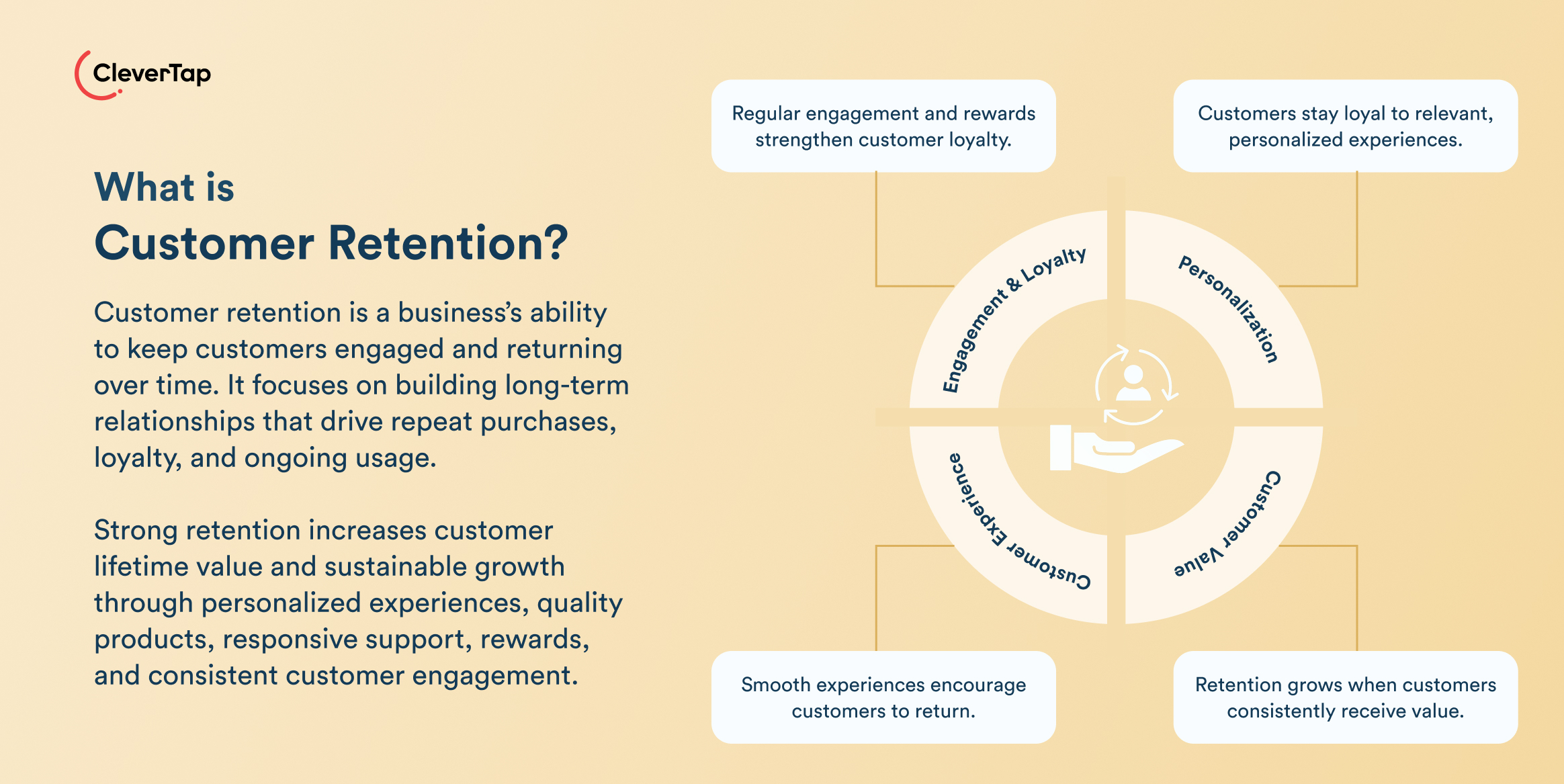
High retention builds enduring customer relationships and maximizes lifetime value. Indeed, studies indicate that most revenue growth comes from existing customers. They tend to spend more time, try new offerings, and refer others to your brand.
In contrast, high customer churn drags down growth. In a retention-focused approach, marketers aim to deliver continuous value through service, product quality, incentives, and personalization, so that customers stay active and engaged.
Why Customer Retention Is Critical for Business Growth
Retaining existing customers is a core driver of sustainable, profitable growth. Here’s why it matters:
- Retention is more cost-effective than acquisition: Acquiring a new customer can cost 5–25X more than retaining an existing one. Shifting budget from acquisition to retention often yields higher ROI.
- Loyal customers drive higher profitability: Existing customers typically require less persuasion, respond better to marketing, and convert at lower cost, making them more profitable to serve.
- Retention increases customer lifetime value (CLV): Retained customers buy more over time, take add-ons, and engage in repeat purchases. Even small improvements in retention can lead to a significant uplift in long-term revenue.
- Revenue becomes more predictable with retention: High retention supports stable recurring revenue, especially in subscription models. It also improves forecasting and reduces dependence on constant acquisition.
- Retained customers are more likely to refer others: Satisfied, long-term users often become brand advocates. They leave reviews, refer friends, and provide organic growth through word-of-mouth.
- Retention improves growth efficiency: According to BIA Advisory Services, over half of the annual revenue of small businesses comes from repeat customers rather than new customers. A repeat customer spends 67% more than a new one.
- Retention creates a virtuous growth loop: Loyal customers churn less, cost less to engage, and deliver more value, resulting in sustained business growth over time.
Customer Retention vs Customer Acquisition
Both retention of customers and acquiring new ones are essential for growth, but they serve different goals and deliver different returns. The table below contains the key differences.
| Aspect | Customer Acquisition | Customer Retention |
| Primary Goal | Attract new customers | Keep existing customers engaged and loyal |
| Typical Tactics | Paid ads, promotions, lead generation | Email, loyalty programs, support, reactivation |
| Cost | High, often 5X more than retention | Lower as re-engagement is more cost-efficient |
| ROI Timeline | Slower, upfront costs, delayed payoff | Faster, repeat sales generate quick returns |
| Best Use Case | Early-stage growth, new product launches | Mature brands aiming to increase LTV |
When to Focus on Each?
- Startups should focus on acquisition to build an initial customer base.
- Growing businesses should introduce retention strategies like onboarding flows, feedback loops, and loyalty offers.
- Established brands benefit most from retention, improving profit margins and long-term customer value.
Key Customer Retention Metrics You Need to Track
Measuring retention requires tracking specific metrics. Key ones include:
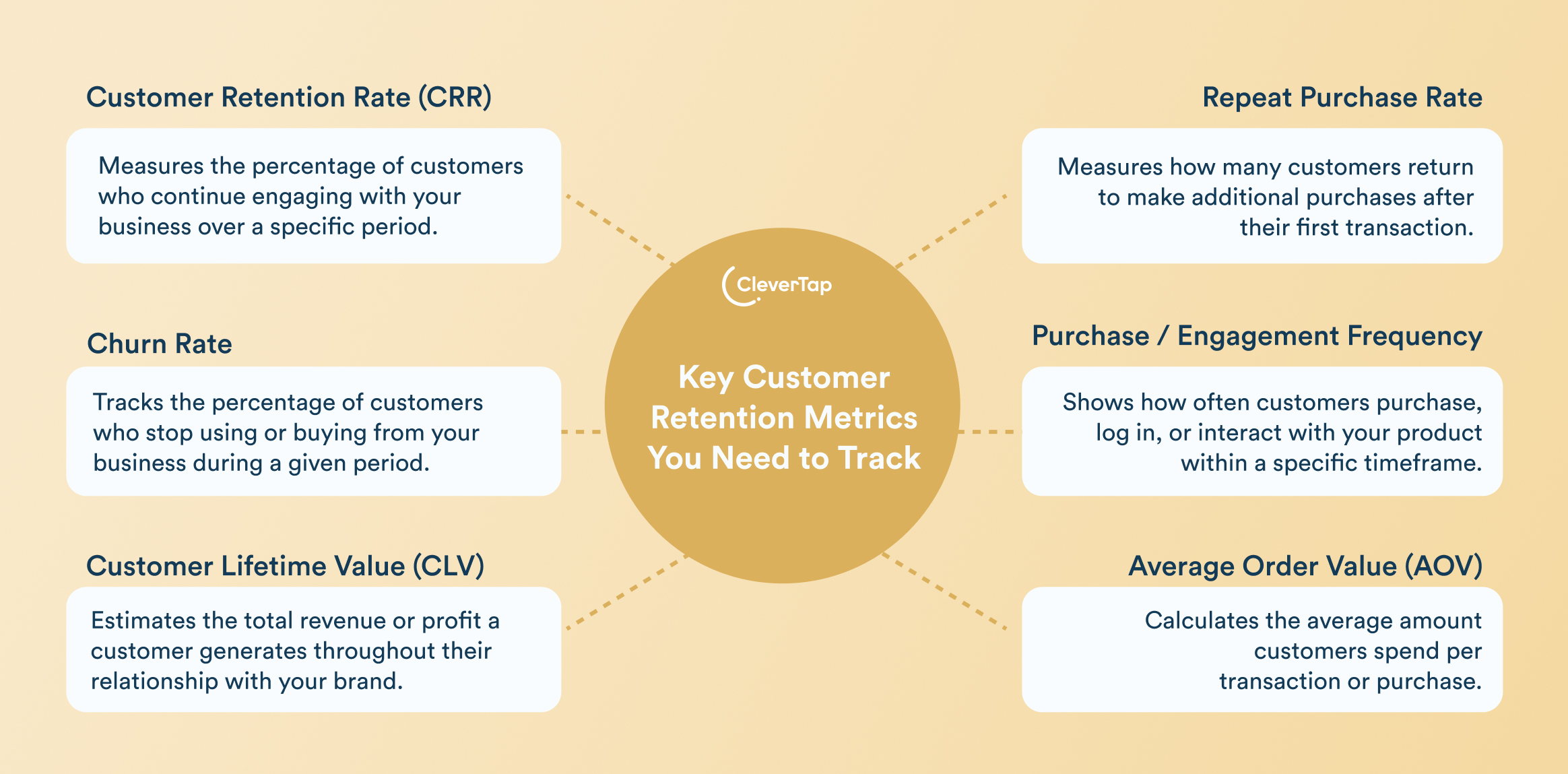
1. Customer Retention Rate (CRR): The percentage of customers who remain active over a period. It’s calculated as:
Customer Retention Rate = (Customers at the End of the Period – New Customers During the Period) ÷ (Customers at Start)×100
A high CRR means more buyers stick around. Tracking this shows if your initiatives are keeping customers engaged.
2. Churn Rate: The inverse of retention and is measured as the percentage of customers lost during a period. It highlights attrition.
Churn Rate = (Customers at Start of Period/Customers Lost During Period) X 100
For example, if 100 customers are at the start and 10 leave, churn = 10%. A rising churn rate signals problems with the product or service. Monitoring churn by segment can uncover friction points.
3. Customer Lifetime Value (CLV): The total profit a customer is expected to generate over their lifetime. CLV considers average order value, purchase frequency, and lifespan.
Customer Lifetime Value = Average Purchase Value X Purchase Frequency X Customer Lifespan
A higher CLV means your retention efforts are paying off, customers are spending more, and staying longer. CLV helps justify marketing spend and prioritize high-value segments.
4. Repeat Purchase Rate: The percentage of customers who make a second (or third) purchase. This metric is especially relevant for retail/e-commerce.
Repeat Purchase Rate = (Customers Who Purchased More Than Once/Total Customers) X 100
If 30% of first-time buyers come back to buy again, your repeat purchase rate is 30%. Tracking this shows how well you turn new buyers into repeat customers.
5. Purchase Frequency/ Engagement Frequency: How often an average customer buys or engages in a given period. In apps, this could be login frequency or session count. In retail, it’s the average number of orders per customer per year.
Purchase Frequency = Total Unique Customers/ Total Number of Orders
Higher frequency indicates stronger habits. For instance, a higher frequency means customers are buying more often, which usually correlates with better retention.
6. Average Order Value (AOV): It is calculated as the average spend per purchase.
Average Order Value (AOV) = Total Number of Orders/ Total Revenue
If retention efforts include upsells or bundles, AOV will rise. Increasing AOV and purchase frequency are direct levers for retention marketing.
How Customer Retention Works (End-to-End Framework)
A strong retention framework helps reduce churn and increase lifetime value. Here’s how to build one in five practical steps:
Step 1: Identify Your Retention Event
Define what action signals that a customer has received value, as this becomes your “retention event.” It could be a repeat purchase, a product use like generating a report, or a subscription renewal. For a media app, it might be reading an article; for a SaaS, logging in monthly. This standardizes what “retained” means and gives teams a clear goal to measure.
Step 2: Understand User Behavior and Usage Frequency
Analyze when and how often users perform the retention event. Use cohort analysis to identify drop-off points post-onboarding and understand natural usage patterns, be it weekly or monthly. This helps pinpoint when customers are at risk of churning.
Step 3: Segment Users Based on Actions
Create behavior-based segments, such as new users, at-risk users, or power users, using activity, demographics, or source. Advanced customer segmentation platforms like CleverTap enable dynamic segmentation that updates in real time, ensuring campaigns always target the right users.
Step 4: Trigger Personalized Engagement
Send timely, contextual messages tied to user behavior. For example, follow up on missed retention events or reward usage milestones. Win-back campaigns can be triggered automatically for high-risk segments via multi-channel journeys.
Step 5: Continuously Measure and Optimize
Retention is ongoing. Track retention rate, churn, and campaign impact over time. Use A/B testing to improve messaging, timing, and channels. Let data guide what works—and refine the strategy as user behavior evolves.
Understanding the Customer Retention Lifecycle
Retention efforts differ at each stage of the customer lifecycle. Understanding these stages is important for increasing customer retention. The key stages are:

1. Onboarding
At the very beginning, when a customer signs up or makes a first purchase, the goal is to quickly demonstrate value and integrate the customer. Effective onboarding might include welcome emails, guided product tours, or sign-up incentives. For example, SaaS products often send a push notification immediately after install, prompting users to finish setup, which dramatically cuts early churn. Likewise, loyalty experts recommend giving new users a bonus or an easy win early on to form good habits
2. Engagement
Once past onboarding, the focus shifts to building habits. This is the phase of regular usage and interaction. Engagement campaigns might include personalized content, drip emails, in-app notifications about new features, or community-building. The aim is to keep the product top-of-mind with meaningful touchpoints, so users form a routine around your brand.
3. Retention
At this point, users are consistently using your product. Here, retention means maintaining satisfaction and loyalty over the long term. Loyalty programs, premium features, and consistent communication come into play. Tailor rewards for long-term users (VIP perks, exclusive content) to deepen the relationship. Continually reinforce why the product matters, with updates, new use cases, or value-added content. Consistency is key: if you delivered on your promise so far, keep delivering or surprise them with new benefits.
4. Churn Risk
This stage is when engagement begins to wane. Churn analysis signals reduced logins, longer gaps between purchases, declining feature use, or service downgrades. Identifying at-risk customers early allows intervention. CleverTap’s analytics platform looks for patterns like login frequency drops or incomplete onboarding as early warnings of churn. Marketers can then send targeted interventions like special offers and personal outreach to these risk segments. The goal is to prevent them from leaving by turning reactive retention into proactive lifecycle management.
5. Reactivation
If a customer goes dormant or churns, reactivation campaigns aim to win them back. These might include surveys to understand why they left, time-limited discounts, or reminders of new features. Reactivation often requires a compelling incentive or new hook to reignite interest.
Each stage demands a different tactic. By mapping needs and interventions to each stage, you create a cohesive retention lifecycle, rather than random campaigns, ensuring customers get what they need when they need it.
Top 12 Proven Ways to Improve Customer Retention
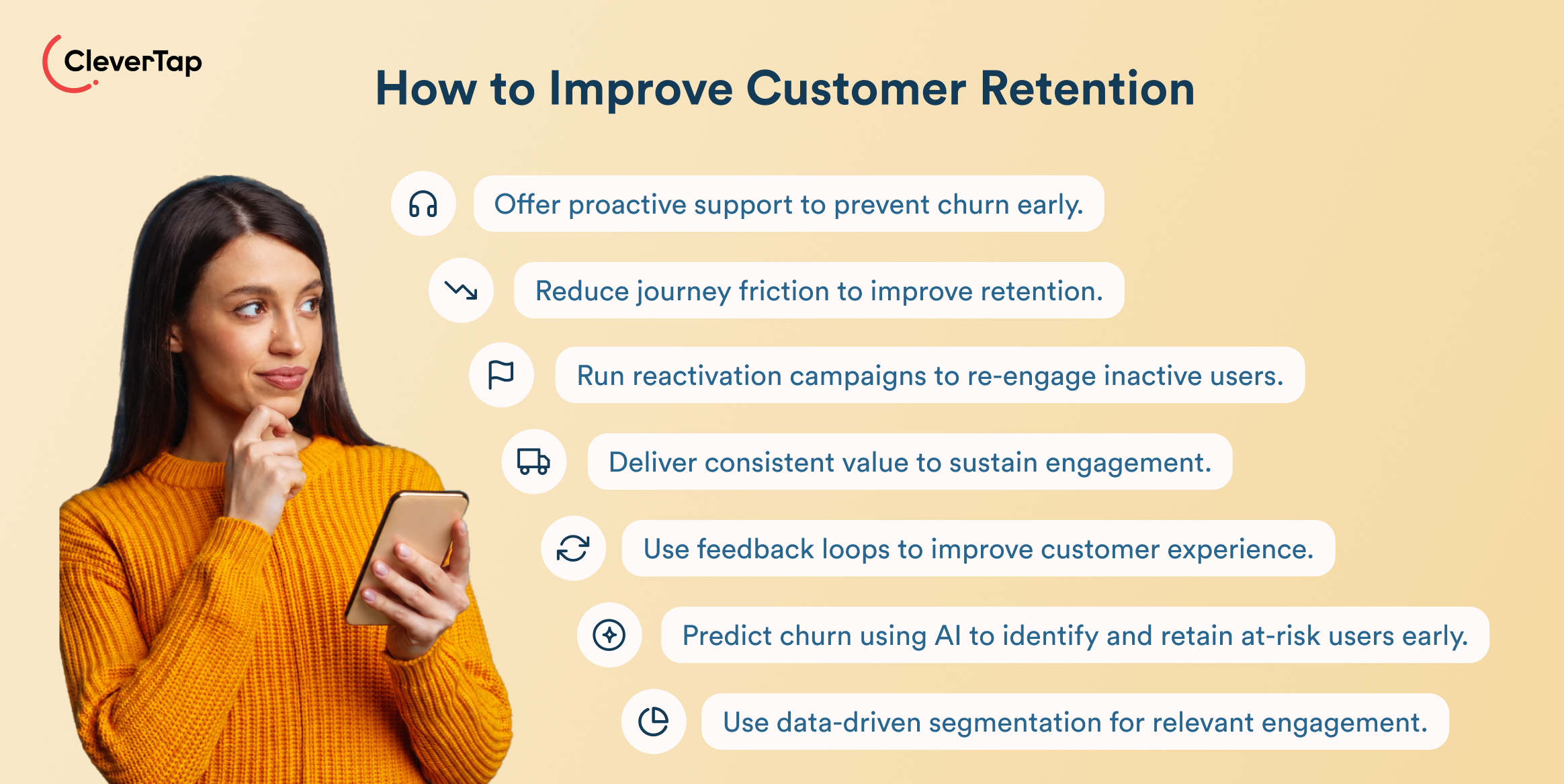
Retention is an ongoing strategy built on timely actions, behavioral insights, and personalized experiences. Below are 12 proven tactics that help businesses reduce churn, increase engagement, and drive long-term value from every customer.
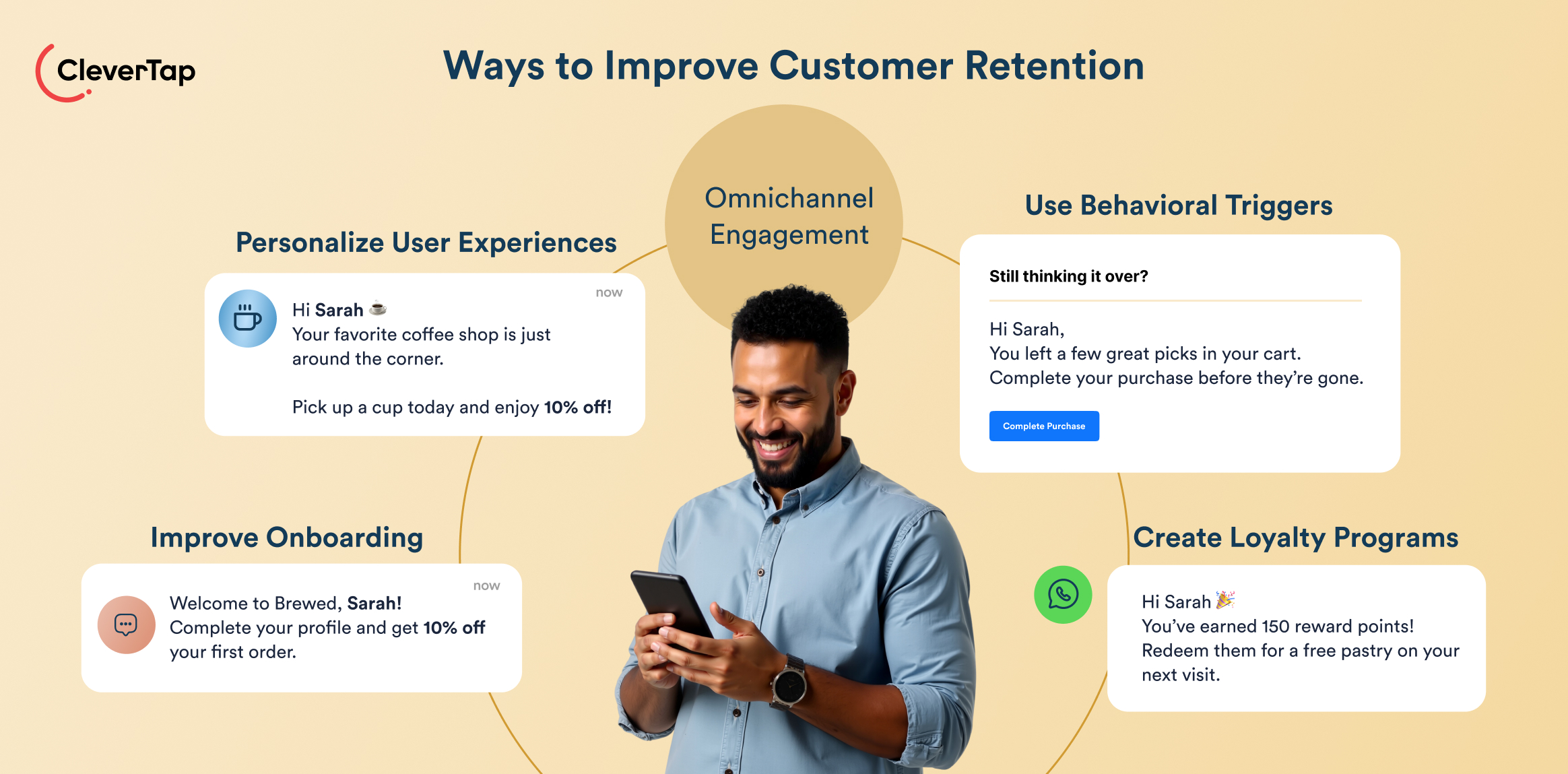
1. Personalize User Experiences
Go beyond basic segmentation by using real-time attributes like device type, usage history, location, and preferences. Dynamic content and audience traits let you tailor messages, offers, and even product recommendations. When users consistently receive relevant experiences, they feel valued and are far more likely to remain loyal, thus increasing customer retention.
Advanced personalization can also include predictive recommendations based on past behavior and lifecycle stage. For example, eCommerce brands can recommend complementary products, while SaaS businesses can suggest underused features relevant to a customer’s goals. Personalized journeys create emotional connection, improve satisfaction, and increase repeat engagement across channels.
2. Use Behavioral Triggers
Leverage event-based automation to send communications the moment a user performs or misses a key action. Examples include nudges after an incomplete sign-up, reminders for abandoned carts, or encouragement after a usage milestone. These timely interventions keep users engaged and reduce friction without manual follow-up.
Behavior-driven communication is highly effective because it responds to intent in real time. Instead of generic campaigns, businesses can deliver contextual experiences that feel natural and useful. The faster brands react to customer behavior, the greater the chance of preventing drop-offs and maintaining momentum in the customer journey.
3. Build Omnichannel Engagement
Coordinate user journeys across email, push notifications, SMS, WhatsApp, and in-app messages, all triggered by real-time behavior. Cross-channel orchestration ensures consistency while allowing each user to engage on their preferred platform. Unified messaging builds trust and familiarity and is a key ingredient for retention.
An omnichannel approach also prevents communication gaps between departments. Customers should receive a seamless experience regardless of whether they interact through support, marketing, or sales channels.
4. Improve Onboarding
Make first impressions count. Use progressive prompts, tutorials, and triggered walkthroughs based on user actions. If a user skips a step or gets stuck, follow up with contextual help or incentives. Personalized onboarding flows accelerate time-to-value, which strongly correlates with long-term retention.
Identifying where users drop off during setup or activation can reveal friction points that directly impact retention. A smooth onboarding experience increases confidence, encourages product adoption, and reduces early churn.
5. Create Loyalty Programs
Design rewards tied to key engagement behaviors, such as repeat purchases, referrals, or feature use. Use gamified tiers, status badges, and limited-time bonuses to drive repeated interaction. When customers are recognized and rewarded for their loyalty, they become brand advocates and return more often.
Rewards such as exclusive access, early product launches, personalized perks, and community recognition can deepen brand attachment. A well-designed loyalty strategy encourages long-term relationships rather than one-time transactions.
6. Offer Proactive Support
Use behavioral analytics and funnel drop-off data to detect issues before users raise tickets. Follow up with real-time messages when friction points arise, such as failed logins, payment issues, or inactivity. Proactive support builds confidence and prevents small issues from escalating into churn.
Customer support teams can also use AI-powered insights and CRM data to prioritize at-risk users. Fast response times, personalized resolutions, and consistent communication improve customer satisfaction and reinforce trust in the brand.
7. Use Data-Driven Segmentation
Create dynamic, self-updating segments based on lifecycle stage, usage frequency, churn risk, or high-value actions. By aligning outreach with user intent and engagement level, campaigns become more relevant, boosting conversions and long-term retention across all cohorts.
Instead of sending the same message to every customer, teams can deliver highly targeted campaigns that resonate with specific audience groups, improving both efficiency and retention outcomes.
8. Reduce Friction in Journeys
Use conversion funnels and session path analysis to pinpoint steps where users struggle or drop off. Automate follow-ups that re-route users to simplified flows, tutorials, or human help. The smoother the experience, the less likely customers are to abandon it.
Simplifying checkout flows, reducing unnecessary form fields, improving navigation, and optimizing mobile experiences help customers achieve their goals faster and with less frustration.
9. Run Reactivation Campaigns
Identify lapsed users based on inactivity windows, e.g., 14 or 30 days, and re-engage them through personalized, multichannel sequences. Highlight missed benefits or new features, and use urgency or incentives to drive return visits. Reactivation helps unlock unrealized customer value.
Effective reactivation campaigns often combine emotional messaging with practical value. Sharing success stories, feature updates, or personalized recommendations can remind users why they signed up in the first place and encourage them to reconnect with the product or service.
10. Deliver Consistent Value
Schedule lifecycle campaigns that highlight product improvements, useful features, or community wins. Reinforce value continuously and not just during onboarding. When users are reminded of why the product matters, they stay engaged and invested.
Educational content, webinars, newsletters, and customer success stories can further strengthen retention efforts.
11. Use Feedback Loops
Capture sentiment via surveys, feedback forms, or contextual polls after key milestones. Aggregate responses into dashboards to identify satisfaction gaps or feature demand. Acting on user feedback closes the loop, improving trust and retention.
Businesses that transparently acknowledge feedback and communicate product improvements build stronger relationships and demonstrate commitment to customer success.
12. Predict Churn Using AI
AI-driven retention strategies also help businesses prioritize resources more effectively. Instead of reacting after customers leave, teams can proactively focus on high-risk accounts, personalize interventions, and continuously improve retention performance through predictive analytics.
Apply machine learning models that score users based on declining behavior signals, such as reduced logins, engagement drops, or missed goals. Trigger automated retention journeys for high-risk segments, giving you a chance to intervene before churn happens.
Real-World Customer Retention Examples
Mentioned below are some real-world retention examples of retaining customers in marketing across four industries.
1. E-Commerce Repeat Purchase Flow
GlowRoad used behavioral analytics, RFM segmentation, and intent-based targeting to craft lifecycle campaigns that aligned with user transaction patterns. With real-time funnel insights and cohort tracking, they identified high-ROI moments and tailored engagement accordingly. As a result, GlowRoad achieved a 4X increase in repeat transactions and doubled month-1 retention rates, while also cutting early uninstalls by 10% despite rapid acquisition growth.
2. Fintech Reactivation Campaigns:
Wing Bank improved retention by implementing automated journeys and personalized messaging based on user behavior. Using real-time segmentation and analytics, they delivered targeted content aligned to loan eligibility and repayment patterns. This approach drove a 2X boost in engagement and click rates, 25% retention rate, and 6% rise in daily stickiness. Their success shows how behavior-driven engagement can meaningfully lift retention across cohorts.
3. Subscription Retention Loop
Parco, a mobility app, boosted Prime subscriptions by 28% and uplifted user satisfaction with a 17% rise in NPS. Using behavioral segmentation, funnels, and NPS feedback, the team reactivated dormant users and encouraged existing ones to subscribe. Multichannel journeys across email, in-app, and push were key to personalizing outreach. Parco’s data-driven approach ensured users received relevant prompts at the right moments, turning occasional users into loyal subscribers while improving retention and lifetime value.
4. Gaming Engagement Systems
Rummy Passion enhanced user retention using in-app personalization and real-time lifecycle campaigns. By analyzing behavior and tailoring engagement to user preferences using omnichannel campaigns and journeys, they improved onboarding and re-engagement flows. This strategy led to a 23% uplift in app stickiness and a 41% increase in Day-30 retention. The case highlights how personalized, timely interventions can significantly extend player lifecycles and reduce churn in competitive gaming environments.
The Role of AI in Customer Retention
AI is revolutionizing retention by turning guesswork into precision. With predictive analytics and automation, brands can now engage each user more intelligently, efficiently, and at scale.
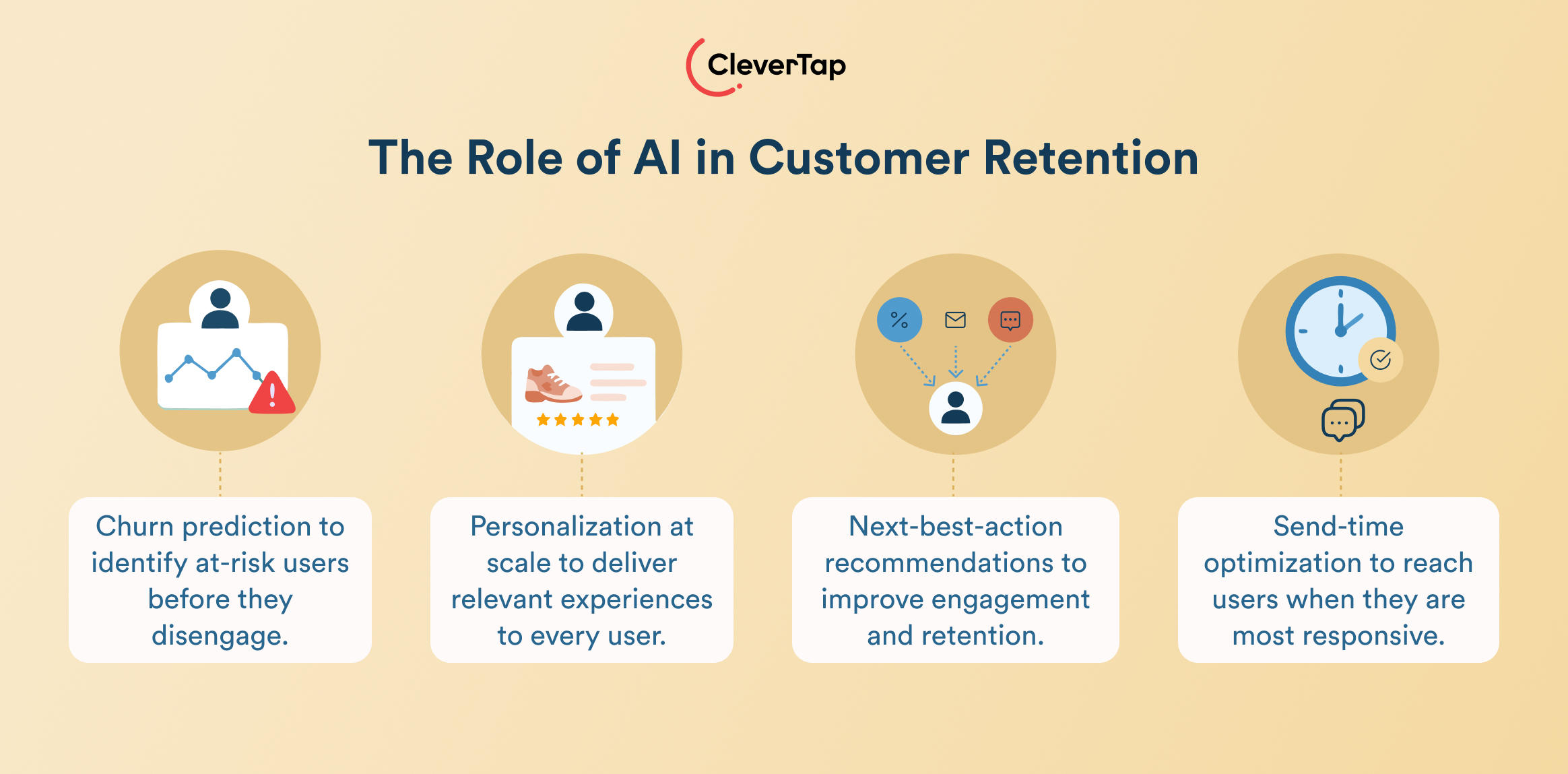
- Churn Prediction: Machine learning (ML) models scan historical and real-time behavior, like drop-offs in app usage or longer gaps between purchases, to flag users at risk of churning. With churn prediction, instead of reacting after a cancellation, brands can intervene early with personalized nudges.
- Personalization at Scale: AI powers dynamic personalization by analyzing browsing, purchase, and engagement patterns. Instead of static campaigns, users receive individually relevant messages, such as product recommendations, tutorials, or loyalty incentives.
- Next-Best-Action Recommendations: AI selects the optimal intervention for each user based on their behavior and predicted intent. For example, one user might respond better to a limited-time discount, another to a feature prompt or testimonial. As the system learns what drives retention, it continuously improves these decisions, making every message more effective.
- Send-Time Optimization: ML also determines when each user is most responsive, whether that’s 7 AM or 10 PM. By timing messages to individual engagement windows, marketers maximize open rates, click-throughs, and conversions.
Together, these AI-driven capabilities shift retention from manual and reactive to intelligent and proactive.
How CleverTap Helps Improve Customer Retention
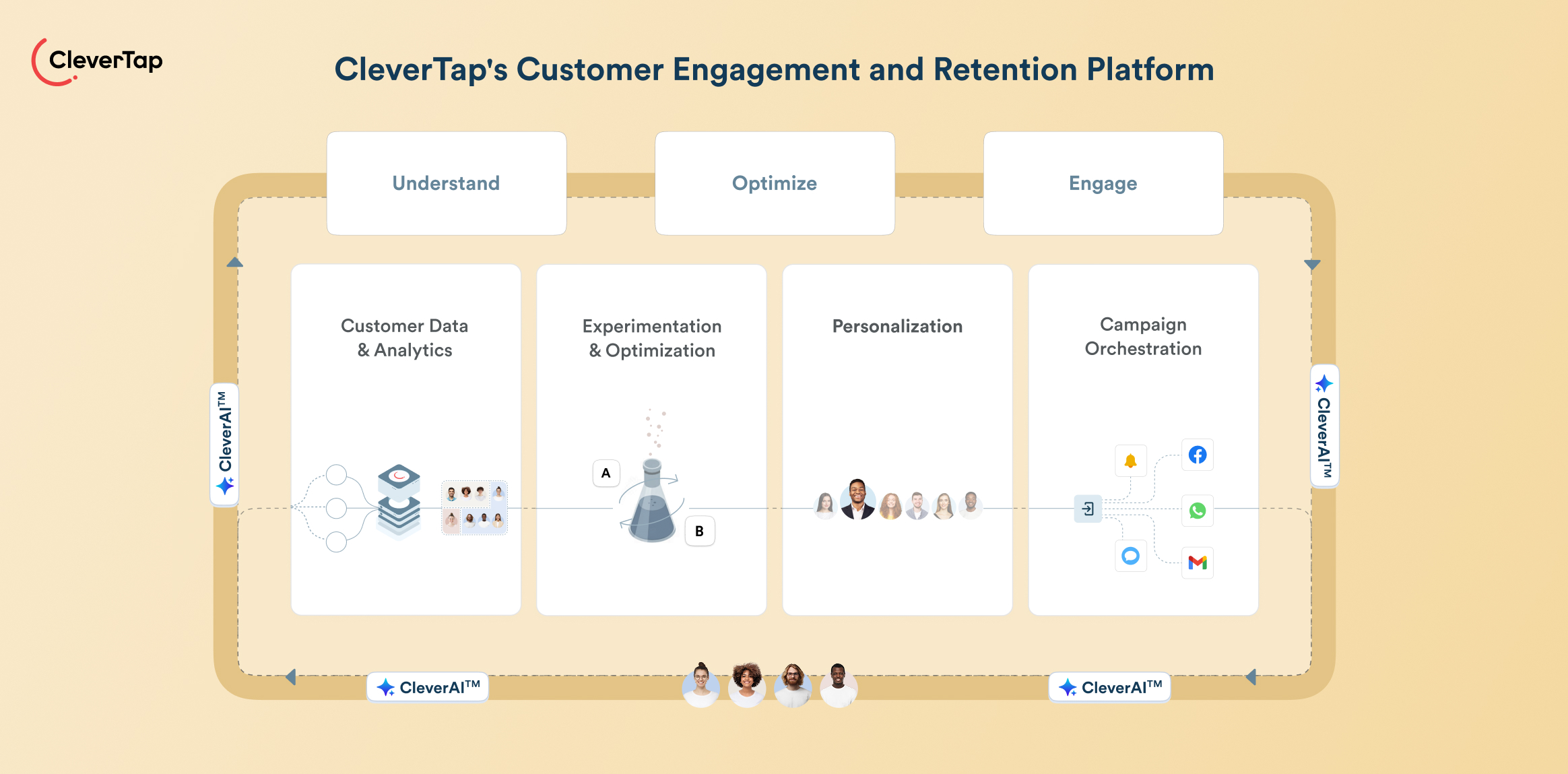
CleverTap is a customer engagement and retention platform that equips marketing teams with the tools to operationalize data-driven, personalized retention strategies at scale. Here’s how each core capability contributes to retaining customers in marketing:
1. Real-Time Behavioral Segmentation
CleverTap enables marketers to create dynamic user segments that update in real time based on user behavior. Whether it’s “added to cart but didn’t purchase” or “inactive for 7 days,” these live segments ensure campaigns target users at the exact moment of relevance. As user behavior shifts, CleverTap automatically moves them into or out of the right segment. This precision enables timely, hyper-targeted messaging that increases the likelihood of re-engagement.
2. Lifecycle Journey Orchestration
With a visual drag-and-drop interface, CleverTap’s Journeys tool lets teams design fully automated lifecycle flows across onboarding, engagement, or win-back stages. Campaigns can be triggered based on actions, time delays, or user properties. For example, a new user could receive a welcome push, then an email tutorial, followed by an in-app feature nudge. These journeys adapt to each user’s behavior, ensuring consistent and contextual engagement throughout the lifecycle.
3. Omnichannel Engagement
CleverTap unifies messaging across push, email, in-app, SMS, and WhatsApp, all from a single platform. This allows marketers to build seamless, multi-step campaigns. For instance, a user might receive an in-app prompt, followed by an email if inactive, and then a WhatsApp reminder. Consistent experiences across touchpoints reduce drop-offs and build brand familiarity.
4. AI-Driven Retention Optimization
CleverTap’s AI models detect churn signals, such as declining usage or missed milestones, and assign a churn risk score to each user. Based on this, users can be enrolled in tailored campaigns automatically. High-risk users receive win-back offers, while medium-risk users might get educational nudges.
5. Retention Analytics and Cohorts
The platform offers detailed retention tracking, cohort analysis, and KPI dashboards. Teams can monitor Day 1, 7, or 30 retention rates, compare performance across acquisition sources, and evaluate the impact of campaigns. This helps identify drop-off points, test what’s working, and continuously improve the strategy.
Use CleverTap to strengthen customer retention with real-time personalization and automation.
Retention Wins Long-Term Loyalty
Customer retention is a long-term growth strategy. Retained customers cost less, buy more, and fuel predictable revenue. But strong retention doesn’t happen by chance. It demands a structured approach of clearly defined goals, lifecycle-based campaigns, personalized engagement, and ongoing optimization. The strategies outlined in this article provide a practical framework to reduce churn and boost customer lifetime value.
With the right platform, retention becomes proactive and scalable. Teams that invest in real-time segmentation, AI-driven insights, and omnichannel messaging are better equipped to keep customers coming back. Start building a smarter retention engine and turn your existing users into your biggest growth asset. See how CleverTap can help you improve customer retention. Talk to us today!

Subharun Mukherjee 
Heads Cross-Functional Marketing.Expert in SaaS Product Marketing, CX & GTM strategies.
Free Customer Engagement Guides
Join our newsletter for actionable tips and proven strategies to grow your business and engage your customers.