









































Table of Contents
Categories
Most Popular


For some businesses, customer engagement is about social media likes and email clicks. For others, it’s about customer support, loyalty programs, or personalized experiences. The reality is that customer engagement goes far beyond marketing metrics. It’s about how customers interact with your brand at every stage of their journey, and whether those interactions make them want to stay connected.
Customers expect more than just a good product or service. They want timely communication, personalized experiences, and meaningful interactions across every channel. Brands that fail to engage customers consistently often struggle with low retention, declining loyalty, and missed revenue opportunities.
Customer engagement is the ongoing relationship between a business and its customers, built through every interaction, message, and experience. Strong engagement helps businesses create trust, improve customer satisfaction, and encourage repeat purchases over time.
In this blog, we’ll break down what customer engagement really means, why it matters for business growth, and how successful brands keep customers engaged. We’ll also look at practical examples and key benefits to help you understand how engagement drives long-term customer relationships.
What Is Customer Engagement?
Customer engagement is the process of building ongoing interactions between a brand and its customers across different touchpoints. These interactions can happen through email campaigns, mobile apps, websites, social media, customer support conversations, loyalty programs, or in-store experiences. The goal is to keep customers actively connected to the brand instead of limiting the relationship to a single purchase or transaction.
In marketing, customer engagement is measured by how customers respond to and interact with your brand. This includes actions such as opening emails, clicking on campaigns, using an app regularly, responding to messages, attending events, sharing content on social media, or reaching out to support teams. These behaviors help businesses understand customer interests, preferences, and intent.
Engagement data also plays a major role in improving marketing performance. Businesses use engagement metrics to optimize campaigns, segment audiences, and personalize communication. For example, customers who frequently interact with product recommendation emails may receive more personalized offers based on their browsing or purchase history. Similarly, inactive users can be targeted with re-engagement campaigns, discounts, or educational content to bring them back.
Instead of relying on broad, one-size-fits-all communication, customer engagement helps brands deliver more relevant experiences based on real customer behavior. This makes marketing more effective while also improving customer satisfaction and long-term loyalty.
Key Benefits of Customer Engagement
Mentioned below are some benefits of having an effective consumer engagement plan.
- Improves customer retention: Customers are more likely to stay with brands that consistently provide relevant communication and positive interactions. Strong engagement keeps customers connected throughout their journey, reducing chances of churn and increasing repeat purchases over time.
- Builds long-term loyalty: Regular and meaningful interactions help create trust and familiarity. Engaged customers are more likely to choose the same brand repeatedly instead of switching to competitors. They are also more likely to recommend the brand to friends, leave positive reviews, and advocate for the business on social media or community platforms.
- Drives revenue growth: Engaged customers tend to spend more frequently and explore additional products or services. Personalized campaigns, timely recommendations, and targeted offers often lead to higher conversion rates and stronger purchase behavior.
- Increases customer lifetime value (CLV): Engagement plays a major role in extending the customer relationship. Customers who interact regularly with a brand are more likely to remain active for longer periods, resulting in higher customer lifetime value. Better engagement creates a cycle where retention leads to repeat purchases, which ultimately improves overall business growth.
- Reduces acquisition costs: Retaining existing customers is 5-25X more cost-effective than constantly acquiring new ones. Businesses with strong engagement strategies can generate more value from their current customer base while reducing dependency on expensive acquisition campaigns.
The Business Case in Numbers: Why Customer Engagement Matters
Customer engagement directly impacts revenue, retention, and long-term profitability.
The Revenue Impact of Engaged Customers
According to Harvard Business Review, increasing customer retention by just 5% can increase profits by 25% to 95%, highlighting the long-term financial impact of maintaining strong customer relationships.
Existing customers also tend to spend significantly more than new buyers. Industry research shows that repeat customers spend 67% more over time compared to first-time customers.
Engagement also creates opportunities for upselling, cross-selling, referrals, and higher customer lifetime value (CLV), making it a key driver of sustainable revenue growth.
The Cost of Disengagement
According to PwC, 32% of customers would stop doing business with a brand they love after just one bad experience, while 59% would leave after several negative experiences. This highlights how quickly customer loyalty can decline when engagement and experience break down. PwC Customer Experience Report
The financial impact is equally significant. Customers switching companies because of poor customer experiences costs U.S. businesses an estimated $1.6 trillion annually.
Disengagement also increases acquisition costs. According to Harvard Business Review, acquiring a new customer can cost 5 to 25 times more than retaining an existing one. When engagement declines and customers churn, businesses not only lose future revenue but also spend additional resources replacing those customers.
The 5 Dimensions of Customer Engagement
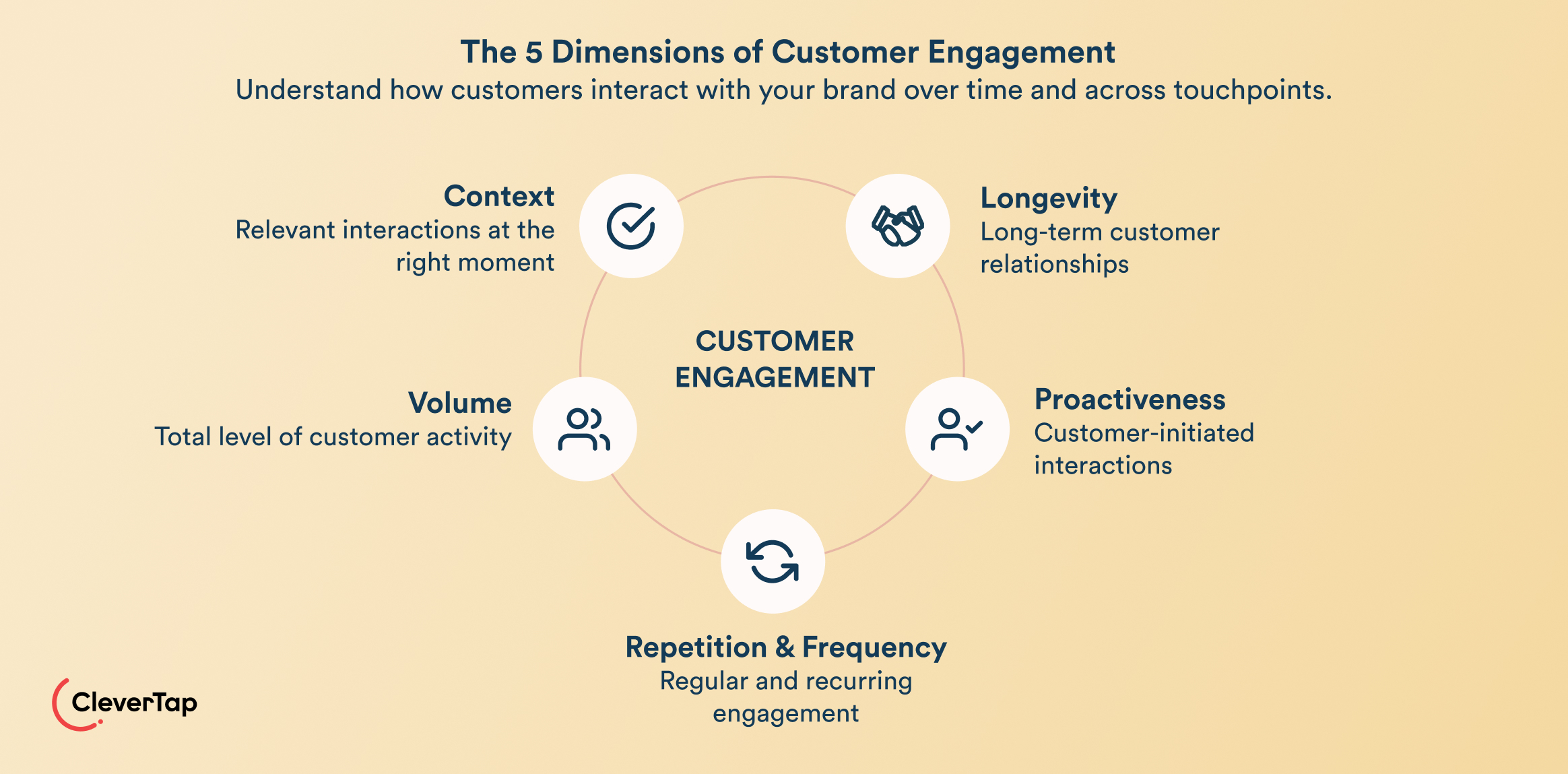
Client engagement is not measured through a single action or metric. Businesses evaluate customer engagement across multiple dimensions to understand how customers interact with their brand over time. These dimensions help identify engagement patterns, customer intent, and relationship strength.
1. Longevity: How Long the Relationship Lasts
Longevity measures the duration of the customer relationship. A customer who continues interacting with a brand for months or years is generally more engaged than someone who makes a one-time purchase and disappears. Long-term relationships often indicate customer satisfaction, trust, and consistent value delivery. Businesses typically track metrics like customer lifespan, repeat purchases, subscription duration, or renewal rates to measure longevity.
2. Proactiveness: Who Initiates the Interaction
This dimension focuses on whether customers engage on their own or only respond when prompted. Proactive customers voluntarily visit websites, open apps, browse products, leave reviews, or contact support without receiving reminders. This type of behavior signals a stronger interest and brand connection. On the other hand, engagement driven only through ads, promotional emails, or notifications may indicate lower customer involvement.
3. Repetition & Frequency: How Often Engagement Occurs
Frequency measures how regularly customers interact with the brand. Repeated actions such as frequent app usage, recurring purchases, or regular website visits show that customers continue finding value in the experience. Businesses often monitor daily active users, monthly purchases, or recurring interactions to understand engagement consistency.
4. Volume: The Total Amount of Interaction
Volume refers to the overall level of customer activity across channels. This includes the number of purchases, support conversations, content views, feature usage, email clicks, or social media interactions. Higher interaction volume often reflects stronger customer involvement and interest in the brand ecosystem.
5. Context: When and Where Engagement Happens
Context focuses on the situation surrounding customer interactions. Timing, channel, location, and customer behavior all influence engagement quality. For example, sending a reminder about an abandoned cart shortly after a customer leaves the website is more relevant than sending a generic promotion days later. Understanding context helps businesses deliver communication that feels timely and personalized.
What Does Customer Engagement Actually Look Like?
Customer engagement often shows up in small, everyday interactions that make the customer experience more relevant, convenient, or valuable. While the channels and tactics vary across industries, successful brands focus on creating moments that encourage customers to return, explore, and take action.
1. Netflix Recommendations
Netflix uses viewing history and content preferences to personalize each user’s homepage. Instead of asking customers to search endlessly, the platform surfaces shows and movies that align with their interests. Every recommendation creates an opportunity for discovery, making it easier for users to find something worth watching and spend more time on the platform.
2. Amazon Product Suggestions
Amazon keeps shoppers engaged by continuously introducing relevant products throughout the buying journey. Features such as “Frequently Bought Together,” “Customers Also Bought,” and personalized recommendations help customers discover new products based on their browsing and purchase behavior. These recommendations create additional engagement opportunities beyond the original purchase intent.
3. Fintech App Alerts: Wing Bank
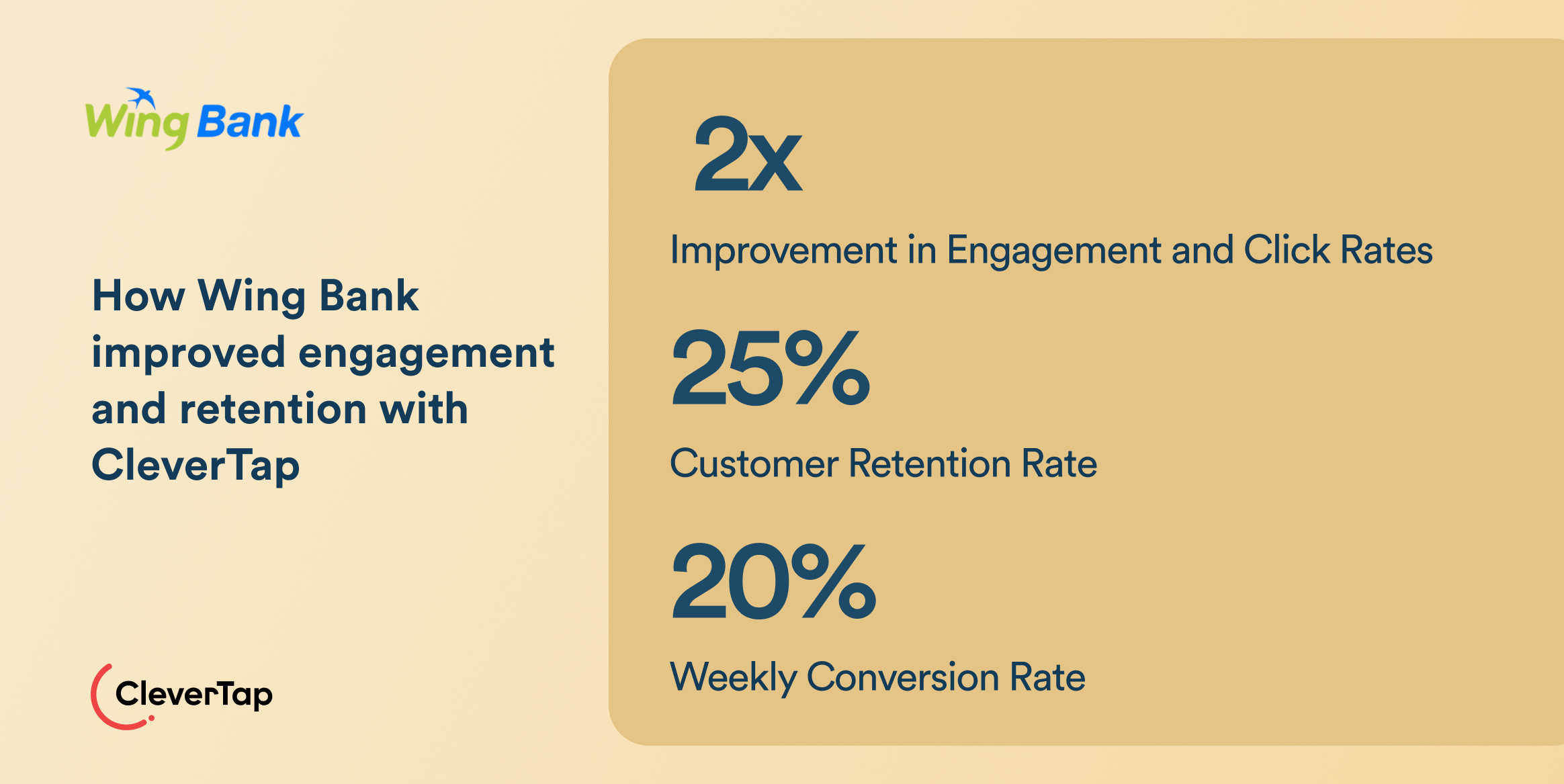
Digital banking platforms often use timely notifications to keep customers connected to their financial activities. Wing Bank, one of Cambodia’s leading digital banks, used CleverTap to deliver personalized communications and customer journeys across multiple touchpoints. By making customer interactions more relevant and timely, the bank achieved a 2X increase in engagement and improved retention by 25%, demonstrating how well-timed engagement can strengthen long-term customer relationships.
4. Blooming Wear’s Relevant Shopping Experience
Fashion retailer Blooming Wear used CleverTap’s personalization and omnichannel engagement capabilities to create more relevant shopping experiences across channels. By tailoring customer journeys based on behavior and preferences, the brand achieved a 25% increase in conversions while reducing friction throughout the purchase journey. This highlights how personalized engagement can directly influence business outcomes.

Customer Engagement Across Channels
Customer engagement is built through everyday interactions across multiple channels. Each channel offers customers a different way to connect with a brand, and together they provide a more complete view of customer interest and involvement.
1. Social Media Interactions
Social media creates opportunities for real-time engagement through comments, shares, mentions, and user-generated content (UGC). These interactions often indicate that customers are actively participating in conversations rather than simply consuming content. For example, a customer sharing an Instagram Reel featuring a product or commenting on a brand’s post contributes to brand visibility while strengthening engagement.
2. Email Open, Click, and Reply Behavior
Opening an email shows initial attention, clicking a link indicates intent, and replying to a message demonstrates a deeper level of interaction. For example, a customer who clicks through a product recommendation email and responds with a question is showing stronger engagement than someone who only opens the message.
3. In-App Activity and Feature Adoption
For SaaS businesses, engagement is often reflected in how customers use the product. Logging in regularly, exploring new features, completing onboarding tasks, or adopting advanced functionality are all positive indicators. For example, a user who actively uses a newly launched reporting dashboard is demonstrating engagement beyond basic product usage.
4. Review and Rating Submissions
Reviews and ratings provide direct customer feedback while helping other potential buyers make decisions. Whether positive or constructive, submitting a review shows that a customer is willing to invest time in sharing their experience. For example, a customer leaving a detailed product review after a purchase is actively contributing to the brand ecosystem.
5. Community Forum Participation
Online communities, discussion forums, and customer groups encourage customers to connect with both the brand and other users. Participation can include asking questions, sharing best practices, offering solutions, or discussing product updates. For example, a customer helping another user solve a product-related issue in a community forum such as Reddit demonstrates a high level of engagement and brand involvement.
How to Start Building a Customer Engagement Plan
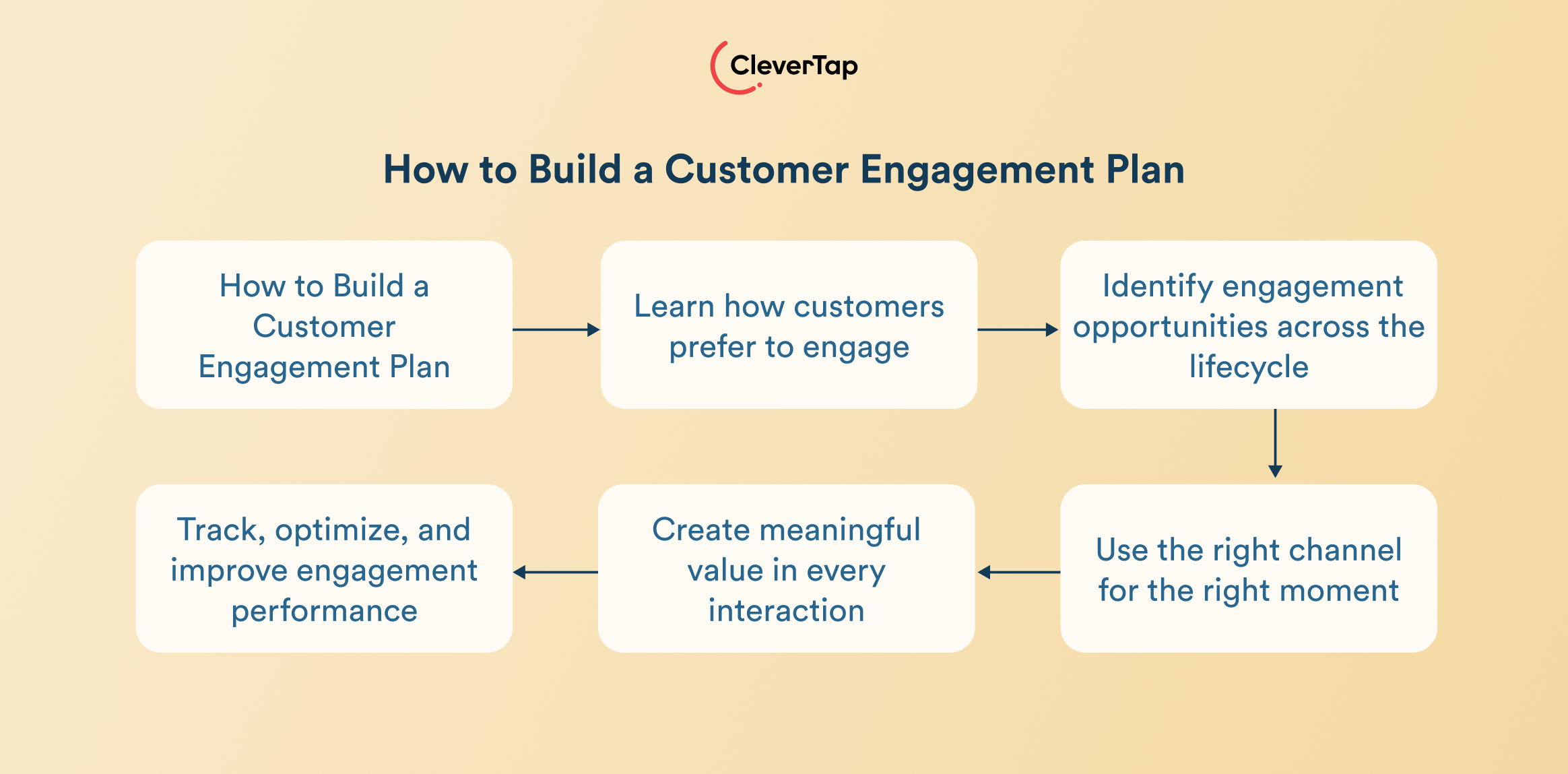
A successful customer engagement plan focuses on creating consistent and relevant interactions throughout the customer lifecycle. While every business approaches engagement differently, the foundation usually starts with a few key strategic steps.
1. Define Your Engagement Goals
Start by identifying the business outcomes you want engagement to support. This could include reducing churn, increasing customer lifetime value, improving repeat purchases, boosting product adoption, or encouraging customer advocacy. Clear goals help teams align engagement efforts with measurable KPIs such as retention rate, repeat purchase rate, or customer satisfaction scores.
2. Know Your Audience’s Engagement Preferences
Customers interact differently depending on their preferences and behavior. Some respond better to email newsletters, while others prefer in-app messages, SMS, or community channels. Segmenting audiences based on channel preference, communication frequency, and content interests helps businesses deliver more relevant experiences instead of generic campaigns.
3. Map Touchpoints Across the Customer Journey
Customer engagement should extend across the entire lifecycle, from Awareness and Onboarding to Active Use, Renewal, and Advocacy. Mapping customer touchpoints helps businesses identify where engagement opportunities exist at every stage. For example, onboarding may require tutorials and welcome messages, while advocacy stages may focus on referral programs or community participation.
4. Choose Your Engagement Channels
Different channels work better for different goals and customer stages. Email is commonly used for nurturing and educational communication, while in-app messaging works well for onboarding and product adoption. Community forums, social media groups, and loyalty programs are often effective for building advocacy and long-term relationships. The key is maintaining a connected omnichannel experience.
5. Create Value at Every Interaction
Customers are more likely to engage when every interaction provides value. Educational content, proactive support, personalized recommendations, rewards, and timely updates all help strengthen customer relationships. The focus should always be on helping customers solve problems or achieve better outcomes rather than constantly pushing promotions.
6. Measure, Score, and Optimize
Tracking engagement metrics helps businesses understand what is working and where improvements are needed. Metrics such as active users, click-through rates, retention, feature usage, and customer feedback provide useful insights for optimization.
AI-powered customer engagement platforms like CleverTap can help businesses analyze customer behavior, predict engagement patterns, automate segmentation, and personalize campaigns at scale, using the power of CleverAI™. Agentic AI systems can also automate decisions such as send-time optimization, campaign experimentation, and audience targeting, helping teams improve engagement more efficiently.
Customer Engagement vs. Related Concepts
Customer engagement is often discussed alongside customer experience, customer retention, and customer satisfaction. While these concepts are closely connected, they answer different business questions and are measured in different ways.
Customer Engagement vs. Customer Experience (CX)
The key difference is that customer experience (CX) focuses on how customers perceive their interactions with a brand, while customer engagement focuses on the actions customers take as a result of those experiences.
Customer experience is typically measured through customer feedback and perception-based metrics:
- Net Promoter Score (NPS) = % Promoters − % Detractors
- Customer Effort Score (CES) = Total CES Survey Score ÷ Total Number of Responses
Customer engagement, on the other hand, is measured through behavioral metrics such as active users, click-through rates, feature adoption, purchase frequency, and content interactions.
Customer Engagement vs. Customer Retention
Customer retention measures a company’s ability to keep customers over time, whereas customer engagement measures how actively customers interact with the brand during that period.
A customer may continue renewing a subscription without actively using the product. In this case, retention is high, but engagement is low. Conversely, a highly engaged customer may eventually leave due to budget changes or shifting priorities.
Retention Rate (%) = ((Customers at End of Period − New Customers Acquired) ÷ Customers at Start of Period) × 100
Engagement is typically tracked using metrics such as session frequency, repeat purchases, feature usage, and campaign interactions.
Customer Engagement vs. Customer Satisfaction
Customer satisfaction measures how customers feel about a product, service, or interaction. Customer engagement measures what customers do.
For example, a customer may report high satisfaction in a survey but rarely interact with the brand afterward. Likewise, frequent product usage does not automatically indicate satisfaction.
Customer Satisfaction Formula
CSAT (%) = (Number of Satisfied Customers ÷ Total Survey Responses) × 100
While satisfaction is measured through surveys and feedback scores, engagement is measured through behavioral actions such as website visits, app activity, purchases, and communication responses.
How CleverTap Helps Drive Customer Engagement With Its All-in-One Engagement Platform
CleverTap combines customer data, analytics, automation, personalization, and omnichannel messaging in a single platform, helping businesses create and scale engagement throughout the customer lifecycle.
- Unified Customer Data and Analytics: CleverTap brings together customer data from multiple touchpoints to provide a complete view of customer behavior and engagement trends. For example, using real-time uninstall data, Mobikwik scheduled campaigns for users who uninstalled and won back 23-25% of them.
- Audience Segmentation and Journey Automation: Businesses can create dynamic audience segments and automate customer journeys based on real-time behavior. BeBlue used advanced segmentation via CleverTap to drive a 96% increase in new active users.
- Omnichannel Engagement: CleverTap enables brands to engage customers across push notifications, in-app messaging, email, SMS, WhatsApp, and web channels from a single platform, creating a more consistent customer experience. BlueStone used CleverTap for its omnichannel retargeting campaigns and increased the average revenue per user.
- Personalization and Experimentation: Marketers can tailor campaigns to individual preferences and continuously test messaging, timing, and offers. Sushi King sustains 50% retention and a 41% higher return rate through CleverTap’s personalization capabilities.
- Rewards and Loyalty Programs: Built-in loyalty and gamification features help brands encourage repeat purchases and long-term customer participation. Fonos used CleverTap’s segmentation to convince high-value, at-risk customers to stay by offering them gainful, customized loyalty programs and saw a 6X increase in monthly average users.
- AI-Powered Engagement with CleverAI™: CleverAI™ uses predictive insights and Agentic AI capabilities to automate segmentation, campaign optimization, and personalization. Eatigo leverages the CleverAI™ recommendation engine to drive a 100X increase in reservations.
By combining analytics, automation, personalization, and AI-driven optimization, CleverTap helps businesses deliver more relevant customer experiences while improving retention, engagement, and revenue growth.
Learn how CleverTap helps businesses turn customer engagement into higher retention, loyalty, and revenue.
Start Building More Meaningful Customer Relationships
Customer engagement influences how customers discover products, make purchasing decisions, use services, and ultimately decide whether to stay loyal to a brand.
As customer expectations continue to evolve, businesses need to move beyond one-size-fits-all communication and focus on creating relevant, timely, and valuable interactions throughout the customer lifecycle. The brands that succeed are often the ones that understand customer behavior, recognize engagement opportunities, and respond with experiences that feel personalized rather than promotional.
The good news is that building customer engagement doesn’t require a complete transformation overnight. It starts with understanding how customers interact with your business today, identifying moments where engagement can be improved, and continuously refining those experiences over time. Small improvements in onboarding, personalization, communication, or loyalty initiatives can compound into meaningful gains in retention, customer lifetime value, and revenue.
Ultimately, customer engagement is an ongoing process of strengthening customer relationships through every interaction. Businesses that consistently invest in understanding and engaging their customers are better positioned to build loyalty, adapt to changing expectations, and create sustainable growth in an increasingly competitive market.

Agnishwar Banerjee 
Leads content and digital marketing.Expert in SaaS sales, marketing and GTM strategies.
Free Customer Engagement Guides
Join our newsletter for actionable tips and proven strategies to grow your business and engage your customers.