






































Table of Contents
Categories
Most Popular


As marketers, we love seeing a campaign perform. Nothing beats the feeling when we get to say, “The campaign looks like one of the quarter’s strongest.”
Response rates beat the benchmark. Conversions go up. Thousands of customers have redeemed the offer. The results slide practically writes itself: the campaign worked. But did it?
Imagine an e-commerce brand sends a 20% discount on the cart value to a shopper who was already about to check out. Or a streaming service offers a free month to a subscriber who was already planning to renew. Or a bank gives cashback to a customer who was going to use their credit card anyway.
The customer takes the offer and converts. The system counts it as a campaign-driven conversion.
But if they were going to convert anyway, did the incentive actually change anything?
The fact is that marketing did not drive these conversions. It paid for an outcome that was already likely to happen, claimed credit for it, and gave away margin in the process.
This exposes an important blind spot in how marketers have traditionally approached personalization. We have become very good at predicting who is likely to act, but not necessarily who marketing can influence.
That is the shift from propensity to uplift – and it changes how marketers target customers, allocate incentives, measure performance, and prove their contribution to the P&L.
From Propensity to Uplift
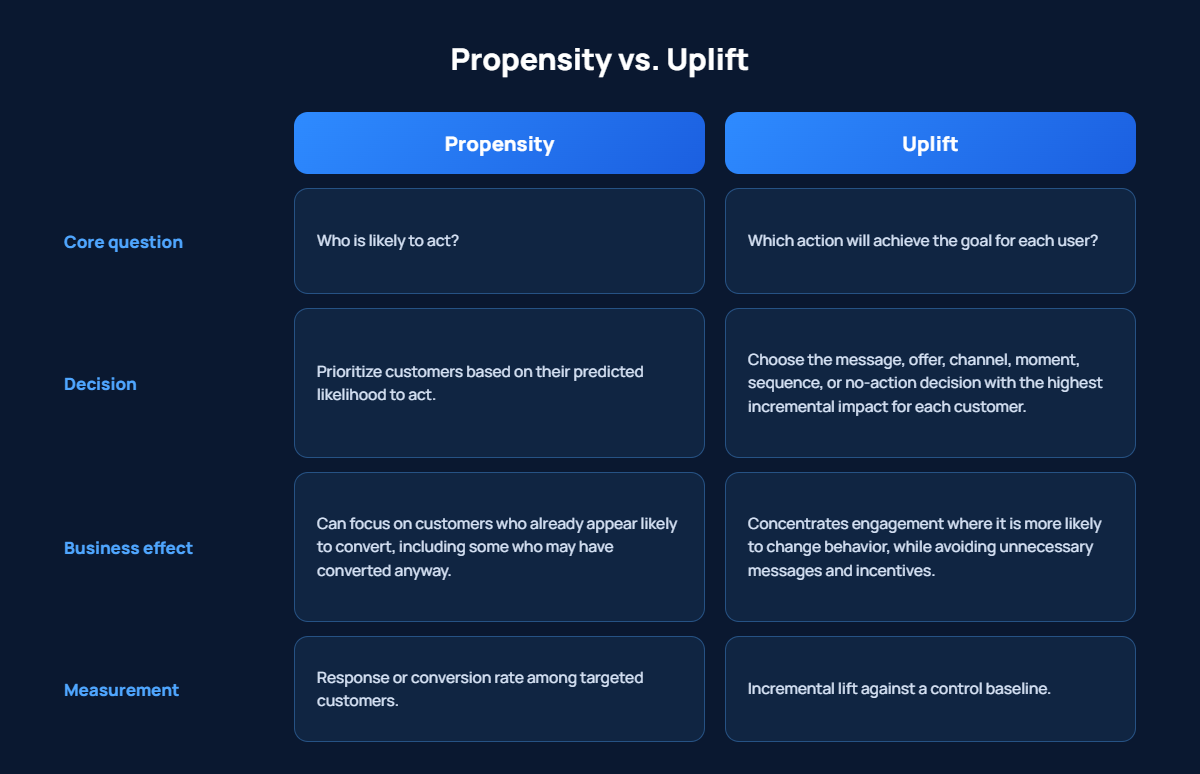
Most targeting today starts with propensity: Who is most likely to convert?
Propensity models help marketers identify customers who are more likely to purchase, renew, upgrade, or return based on their past behavior. That makes them extremely useful for prioritizing audiences and focusing marketing effort where conversion is more likely.
But there is one thing propensity cannot tell us: Did marketing actually change the customer’s decision?
Consider two subscribers who appear likely to renew. One has already decided to stay because they already love the service, while the other remains undecided and the right nudge could genuinely persuade them to stay. The same incentive may be unnecessary for the first and decisive for the second.
But this is where the propensity model falls short: it focuses only on the likelihood of renewal. A marketer may therefore offer incentives to both subscribers and count every subsequent renewal as a marketing success, making marketing performance look healthier than it really is.
The result is hidden inefficiency. Incentives go to customers who didn’t need them, messages reach people who required no persuasion, and margins quietly erode. Yet strong conversion and redemption rates can mask that cost, which may only become visible later in P&L statements or quarterly business reviews. The fundamental problem is that marketing is measuring what happened after an intervention, rather than what changed because of it.
Uplift overcomes this limitation by focusing on whether the intervention will change or influence customer behavior. Instead of asking “Who is most likely to convert?”, uplift asks: Which action, if any, will make this customer more likely to act than they otherwise would have?
It estimates the “incremental impact” of a marketing intervention, which could be an incentive, a recommendation, a different channel, a better moment – or no action at all.
This gives marketers a much more useful way to think about audiences. It essentially separates customers who are likely to act from customers whose decisions marketing can actually change. Some customers will act regardless of the marketing intervention. Some can be persuaded. Some are unlikely to respond to whatever you do. And for others, another message may actually make things worse.
Understanding the Incremental Impact
This raises an obvious question: How do we know whether marketing actually changed a customer’s behavior?
Ideally, this would require us to analyze two versions of the same customer: one who receives the marketing intervention and one who does not. We could then compare what happens.
Of course, that is impossible. So, we can use the next best thing: a randomized holdout group.
Before the campaign begins, a small group of eligible customers is randomly selected to receive no intervention, while the rest receive an AI-selected experience. We then compare the results. The difference shows us what marketing actually added beyond what customers were likely to do anyway.
Take 100,000 customers who are eligible for a campaign. Suppose 90,000 receive the AI-selected experience, while 10,000 randomly selected customers receive nothing. Because the groups were split randomly, their results give us a useful comparison.
Now let’s say 10% of customers who received the intervention convert, that is, 9,000 customers. At first glance, marketing could claim those conversions as a win. But then we look at the holdout group and find that 8% converted without receiving anything at all.
That changes the story.
The campaign didn’t create the full 10% conversion rate. Since 8% would likely have converted anyway, it results in an estimated 2 percentage points of incremental lift attributable to the intervention.
Applied to the 90,000 customers who received the intervention, we get:
Customers who converted after receiving the AI intervention (10% of 90,000): 9,000
Customers who would have converted anyway (8% of 90,000): 7,200
The difference (9,000 – 7,200): 1,800 is the additional conversion created by the intervention.
Those 2 percentage points are what matter. They represent the estimated incremental lift created by the intervention – the conversions marketing actually influenced.
For CMOs, this changes the ROI conversation. Instead of asking, “How many customers converted?” they can ask, “How many additional customers converted because of what we did – and was that incremental value worth what we spent to create it?”
That is a much stronger basis for deciding where to spend incentives, media, messaging, and marketing technology.
However, this tells us the average incremental impact across the group. It does not yet tell us which individual customers were actually influenced, or whether a different offer, message, channel, moment, or no action at all would have created more value for each of them.
That is the next step: moving from measuring uplift to using it to inform the decision itself.
Making Uplift Actionable Requires AI-Native, Live 1:1 Personalization
While a basic uplift model considers a “treatment versus no treatment” comparison, customer engagement presents a much larger decision space. For every customer, the platform needs to choose among different messages, offers, recommendations, experiences, channels, moments, or no action at all. Each option can have a different incremental impact on the same person.
The question becomes: which action is most likely to change the outcome for this person?
This is where the key opportunity lies – making incremental impact part of decisioning itself for every customer interaction. This is Live 1:1 Personalization. The objective is not simply to identify the action a customer is most likely to respond to. It is to determine which action is most likely to change that customer’s behavior toward the business goal, given what they are doing right now.
Consider a shopper who frequently responds to discounts and adds the last available item to their cart. A propensity model may recommend another discount because the shopper has historically redeemed them. Uplift decisioning may determine that the purchase is already likely, as it is the last available item, and choose no incentive, protecting margin without sacrificing the conversion.
Likewise, imagine a banking customer previously showed strong interest in credit cards. After a salary credit, however, they begin exploring home-loan pre-closure. A propensity model may continue prioritizing the card offer. Uplift decisioning compares which available action is most likely to influence the customer now, such as investment guidance, a pre-closure option, a different message, or no intervention, while respecting eligibility and policy guardrails.
In each case, the key question is not, “What will this customer probably do?” It is, “What difference will each possible action make compared with the alternatives?”
Answering that question in the moment requires an AI-native customer engagement platform where customer history, live intent, AI decisioning, content and offer choices, execution, and learning operate together on the same platform. Historical data provides the starting context. Live behavior determines the relevant action that matters the most right now. The decisioning engine ranks the available actions against the business goal, agentic orchestration executes the selected experience, and the outcome informs what happens next.
Uplift, therefore, cannot remain only a measurement exercise conducted after a campaign. It must become part of the decision itself, helping the platform optimize for incremental impact – one customer and one live moment at a time.
No Action Can Be the Best Action
This brings us to an important discussion around the best action. Traditionally, customer engagement platforms have been designed to send something: a message, offer, recommendation, or reminder. Uplift introduces an equally important option – the decision to take no action.
No action can preserve margin when a customer is already likely to buy. It can prevent fatigue when another message would reduce engagement. It can avoid an irrelevant cross-sell after a live signal changes the customer’s needs. It can also create a clean comparison that improves future decisions.
This does not mean engaging less as a blanket strategy. It means intervening where intervention has a positive expected impact. The standard moves from “Will this person convert?” to “Will this decision improve the outcome compared with the alternatives?”
The Marketer’s Role: Define the Outcome Before AI Optimizes It
In an AI-native customer engagement platform, AI optimizes what we ask it to optimize.
If the objective is improving response rate, the model has every reason to select customers most likely to respond, including those who need no intervention. If the objective is increasing gross conversion, it may favor aggressive discounts that increase orders while weakening contribution margin.
In both cases, the model may be performing exactly as intended. The problem is that the objective captures the visible result, but not necessarily the value created.
AI can determine how best to pursue an objective. Marketers remain responsible for ensuring that the objective represents value worth pursuing.
In other words, marketers must define success in terms of the business outcome the engagement should incrementally influence – as clearly and as accurately as possible. Depending on the use case, that could mean profitable conversion, incremental revenue, completed onboarding, sustained retention, or lower service costs.
But defining the right outcome is only half the marketer’s job. Marketers must also define the guardrails within which AI can pursue it. These establish what the system can and cannot do in its effort to drive incremental impact. This includes setting boundaries around incentive costs, contact frequency, customer eligibility, channel usage, customer experience, risk, and other business constraints. The outcome tells AI what success looks like while the guardrails define the acceptable ways to get there.
How CleverAI™ Turns Uplift Into Action
CleverAI™, the intelligence layer of our AI-native customer engagement platform, makes uplift part of the decision, not merely a metric reviewed after the campaign. Marketers define the business outcome and guardrails, while CleverAI™ combines long-range customer history with live intent to understand what matters for each customer now.
Its native decisioning engine evaluates and ranks the available messages, offers, recommendations, channels, experiences, and the option to take no action based on their expected incremental impact. Agentic orchestration then executes the selected action while the moment is still relevant.
Every outcome feeds the learning loop, with holdout comparisons helping distinguish behavior caused by the intervention from behavior that would have happened anyway. This allows CleverAI™ to continuously improve the decisions that create additional customer behavior, not simply predict it.
Want to see how this would look for your brand? Request a personalized demo today!
Measure the Difference Marketing Makes
Propensity will remain valuable because it helps marketers understand what customers are likely to do. But a conversion that happens after an intervention is not necessarily a conversion caused by it. Uplift introduces that missing distinction and shifts the focus from finding likely responders to creating incremental outcomes.
For marketers, this means defining the business result worth influencing, setting the boundaries within which AI can act, and measuring the effect against what would have happened otherwise. Sometimes the right intervention will be an offer, message, recommendation, or experience. Sometimes it will be no action at all. What matters is whether the decision changed the outcome enough to justify its cost.
As AI makes more customer-level decisions, the standard for success must rise with it. The question is no longer simply, “How many customers responded?” It is, “How many responded differently because marketing made the right decision?”

Subharun Mukherjee 
Heads Cross-Functional Marketing.Expert in SaaS Product Marketing, CX & GTM strategies.
Free Customer Engagement Guides
Join our newsletter for actionable tips and proven strategies to grow your business and engage your customers.