








































Table of Contents
Categories
Most Popular


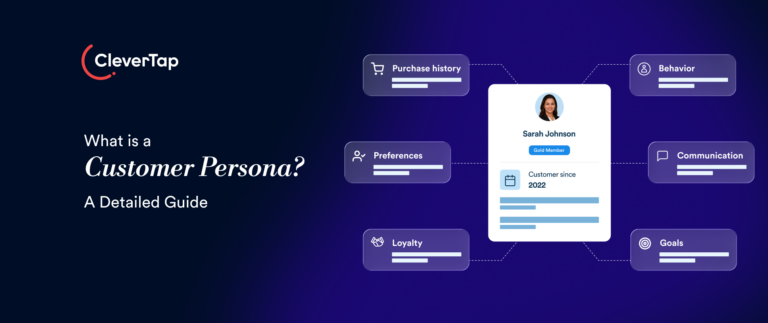
A modern customer persona is a semi-fictional representation of an ideal customer, built from first-party data, customer insights, and real-world behavior. For digital growth and retention marketers, it combines demographics such as age, location, and job title with psychographics, including motivations, pain points, and goals, as well as behavioral signals such as product usage and engagement.
But traditional personas can fall into the Static Persona Trap. Once created as a PDF from surveys and interviews, they can quickly become outdated as customer needs and behaviors change. Data-driven personas, by contrast, evolve with ongoing behavioral data, helping marketers deliver more relevant experiences across the customer lifecycle.
This guide explores what customer personas are, why they matter for growth and retention, and how to create them using a five-step, data-driven framework. It also covers real-world examples and shows how to activate personas across channels to drive more personalized customer engagement.
What Is a Customer Persona? Definition & Strategic Importance
A customer persona is a semi-fictional archetype of an ideal customer, built from real customer data, behavioral event streams, psychographics, and interaction patterns. Unlike a demographic profile based primarily on age or location, a modern customer persona captures how people engage with a product throughout their journey, including what they do, what motivates them, where they encounter friction, and what prompts them to act.
Customer personas differ from related persona types. A buyer persona focuses primarily on the person making or influencing a purchase, making it particularly useful for acquisition and sales. A UX persona represents a type of product user and helps teams design experiences around their needs and behaviors. A customer persona, in a lifecycle marketing context, goes further by connecting user characteristics and behaviors to ongoing engagement, retention, conversion, and reactivation opportunities.
Effective customer personas are built around five pillars:
- Demographics: Age, location, occupation, and other relevant characteristics.
- Behavioral Telemetry: Product usage signals such as sessions, feature adoption, engagement frequency, and drop-off points.
- Core Drivers & Pain Points: The goals, motivations, needs, and frustrations that shape behavior.
- Channel Preferences: The channels users prefer for communication, such as email, push notifications, SMS, or WhatsApp.
- Conversion Triggers: Behavioral events or conditions, such as cart abandonment, repeated product views, or sustained inactivity, that signal an opportunity to engage.
Together, these pillars transform fragmented customer data into actionable user profiles. In persona marketing, they help teams understand not only who their customers are, but also what they need, how they behave, and when to engage them across the lifecycle.
Why Customer Personas Matter for Marketing and Customer Engagement
Customer personas help marketing and product teams move beyond broad audience assumptions and make decisions around distinct customer needs, behaviors, and lifecycle goals. When personas are grounded in real customer data, they can improve how teams segment audiences, personalize experiences, and prioritize engagement opportunities.
Key benefits include:
More relevant personalization: Personas help marketers tailor messaging, offers, recommendations, and experiences around the needs and behaviors of different customer groups.
Better audience segmentation: Persona insights can inform more meaningful segments based on behaviors, preferences, motivations, and customer value rather than demographics alone.
Stronger lifecycle engagement: Understanding how different customer types behave across onboarding, activation, retention, and reactivation helps teams design more relevant journeys for each stage.
Smarter channel and messaging decisions: Channel preferences, engagement patterns, and customer motivations can guide where, when, and how marketers communicate.
Cross-functional alignment: Shared personas give marketing, product, customer experience, and other teams a common understanding of the customer groups they are trying to serve.
The value of a persona ultimately depends on whether it changes a meaningful business decision. If two personas receive the same experience, messaging, and journey despite their supposed differences, they may not need to exist as separate profiles.
The Shift: Static Demographic Templates vs. Dynamic Behavioral Personas
Traditional customer personas are static snapshots built from one-time surveys, interviews, and demographic assumptions. While useful as a starting point, they can quickly become outdated in fast-moving mobile and web environments. A customer’s demographics may remain unchanged, but their interests, product usage, engagement, and purchase intent can shift rapidly. A persona based on last year’s research may no longer reflect how that customer behaves today.
Dynamic behavioral personas address this limitation by incorporating live event streams into customer profiles. Each interaction, such as a login, product view, feature adoption, purchase, or period of inactivity, adds a behavioral signal. As new data arrives, the profile evolves, giving marketers a current view of customer intent and lifecycle stage. This enables more timely segmentation, personalization, and retention campaigns.
| Aspect | Static Personas | Dynamic Behavioral Personas |
| Data Source | Surveys and demographic research | Continuous event and usage data |
| Update Frequency | One-time or infrequent | Continuous, automated updates |
| Actionability | Broad, potentially outdated insights | Current, actionable behavioral signals |
| Retention ROI | Supports generalized engagement | Enables relevant, personalized engagement |
The result is a living customer profile that evolves with real behavior rather than remaining fixed in a static template.
How to Create a Customer Persona in 5 Data-Driven Steps
Creating a customer persona starts with combining what users do with what they say and turning those insights into segments your marketing team can activate. Follow these five steps to build personas that reflect real customer behavior.
1. Audit Quantitative Behavioral Telemetry
Start with your analytics engine, CDP, or product data to understand how customers actually use your product. Examine event logs, retention cohorts, feature usage patterns, session frequency, and funnel drop-offs. Look for recurring behaviors that distinguish one group from another, such as frequent feature adoption, repeated purchases, or abandoned carts. These signals provide the behavioral foundation for your customer personas.
2. Collect Qualitative Voice-of-Customer (VoC) Insights
Quantitative data shows what customers do, but qualitative research helps explain why. Use in-app micro-surveys, customer interviews, support tickets, CRM notes, reviews, and feedback to uncover customer goals, motivations, objections, and frustrations. For example, a segment with low feature adoption may reveal through support conversations that users find the feature difficult to discover. Combine these insights with behavioral data to create a more complete persona.
3. Identify and Validate Meaningful Customer Patterns
Use behavioral analysis, machine learning, or predictive models to identify recurring patterns in feature usage, purchase frequency, engagement, churn risk, or customer value. Then validate whether these groups also share meaningful needs or motivations and would benefit from a different marketing or product approach. Only turn a behavioral cluster into a persona when the distinction is significant enough to change how you engage that audience.
4. Map Channel Preferences & Active Hours
Identify where and when each persona is most likely to engage. Analyze responses across push notifications, WhatsApp, email, SMS, and in-app messaging, along with the times customers typically interact with your product. A mobile-first user who engages primarily in the evening may respond differently from a business user who is most active during working hours. Add these channel and timing preferences to each persona.
5. Operationalize Into Automated Trigger Rules
Turn each persona into actionable audience logic using conditions your lifecycle marketing platform can evaluate automatically. For example, a “Bargain Hunter” persona could be defined by frequent product views, price sensitivity, and purchase activity. When a user matches those conditions, trigger relevant price-drop alerts or promotional messages. This transforms customer personas from static profiles into dynamic segments that power personalized lifecycle marketing.
3 Concrete Customer Persona Examples for Lifecycle Engagement
Customer personas become most useful when they connect customer characteristics and motivations with observable behavior and a clear marketing response. The following examples show how marketers can translate customer insights into personas that inform lifecycle engagement.
Example 1: FinTech “Passive Saver”
Lifecycle Objective: Retention and deeper product adoption
Behavioral Profile: Opens the app approximately twice a week, maintains an idle cash balance, and rarely engages with active trading or investment features.
Goals: Wants to grow savings gradually without having to actively manage investments.
Pain Points: Finds investment decisions complex and may be uncomfortable with market volatility or higher-risk products.
Channel and Engagement Preferences: More likely to engage with educational in-app content and timely push notifications than frequent promotional messages.
Key Trigger: A growing idle balance combined with limited adoption of savings or investment features.
Recommended Engagement Strategy: Use in-app messages to introduce low-friction savings options such as recurring deposits, supported by educational push notifications that explain the benefits in simple terms. Messaging should emphasize consistency, control, and gradual progress rather than active trading.
Example 2: E-Commerce “Bargain Hunter”
Lifecycle Objective: Conversion and repeat purchases
Behavioral Profile: Frequently browses products, compares options, abandons carts, and regularly engages with promotional emails or notifications.
Goals: Wants preferred products or premium brands at the best available price.
Pain Points: Hesitates to purchase at full price and may postpone transactions while waiting for a discount.
Channel and Engagement Preferences: Responds well to time-sensitive promotional communication through push notifications, WhatsApp, SMS, or email.
Key Trigger: A price drop on a viewed or wish-listed product, repeated product views, or an abandoned cart.
Recommended Engagement Strategy: Trigger price-drop or back-in-stock alerts for relevant products. When the customer abandons a cart, follow up with personalized reminders or a relevant promotion while purchase intent is still high. Avoid indiscriminate discounts by using behavioral signals to determine when an incentive is actually needed.
Example 3: Media & Streaming “Binge Consumer”
Lifecycle Objective: Engagement and customer lifetime value
Behavioral Profile: Has long viewing sessions, completes series quickly, and tends to reduce app activity between major releases.
Goals: Wants a continuous stream of relevant content, particularly within preferred genres and themes.
Pain Points: May disengage when there is no obvious next title to watch or when recommendations feel generic.
Channel and Engagement Preferences: Responds well to personalized in-app recommendations and push notifications sent around established viewing periods.
Key Trigger: Completion of a series, declining session frequency, or availability of new content aligned with viewing history.
Recommended Engagement Strategy: Recommend relevant titles immediately after a customer completes a series and use personalized notifications to surface content based on genre affinity and previous viewing behavior. Time engagement around periods when the customer is historically most active to help sustain usage between flagship releases.
Persona Marketing: Activating Profiles Across Omnichannel Journeys
Creating customer personas is only the first step. Persona marketing turns these profiles into actionable audiences by connecting their behaviors, preferences, and needs to lifecycle campaigns across channels.
1. Map Personas to the Lifecycle Funnel
Assign each persona to the lifecycle stage where its characteristics are most relevant: Onboarding, Activation, Habit Formation, Retention, or Win-back. For example, a new-user persona can enter a welcome and onboarding journey designed to encourage its first key action. A highly engaged persona may receive habit-building campaigns, while an inactive persona can enter a reactivation journey with relevant incentives or content.
2. Personalize Dynamic Creative & Copy
Use persona attributes to dynamically adapt messaging tone, hero images, offers, and calls to action. A risk-conscious financial-services persona might receive messaging focused on security and stability, while an early-adopter persona could see new features or premium product benefits. Persona variables can populate templates across email, push notifications, and in-app messages without requiring separate campaigns for every audience.
3. Route Messages by Channel Preference
Let behavioral data determine where and when each persona receives a message. For desktop-heavy users who rarely engage with the app, suppress unnecessary push notifications and prioritize email. For mobile-first cohorts, route time-sensitive alerts through push notifications, SMS, or WhatsApp. Use historical engagement patterns to identify each persona’s active hours and optimize send times.
4. Keep Omnichannel Experiences Consistent
Persona marketing should not create disconnected channel experiences. Carry the same campaign objective, offer, and persona-relevant messaging across email, push, in-app, SMS, and WhatsApp. This creates a consistent journey while allowing the content and delivery channel to adapt to each customer’s behavior.
How CleverTap Helps Activate Customer Personas With Real-Time Engagement
Creating a useful customer persona requires more than documenting who a customer is likely to be. Marketers also need a way to identify the customers whose current behaviors and preferences match those persona characteristics and then translate those insights into relevant engagement.
CleverTap brings customer data, analytics, AI, segmentation, and omnichannel engagement into the same platform, helping marketers move from persona insights to executable customer journeys.
Build richer customer context with unified behavioral data: CleverTap can combine profile attributes with behavioral activity across digital touchpoints. TesseractDB™ provides a unified data layer for live events, profile state, historical behavior, and previous campaign interactions, giving marketers deeper context for understanding how customers behave over time.
Turn persona characteristics into actionable segments: Marketers can create segments using customer attributes, past behaviors, real-time actions, interests, and other engagement signals. This makes it possible to translate a broad persona such as a “Bargain Hunter” into actual audience rules based on behaviors such as repeated product views, cart abandonment, or price sensitivity.
Use AI to respond to changing customer behavior: CleverAI™ can continuously evaluate factors such as audience, timing, channel, journey path, recommendations, and predicted behavior. This helps marketers adapt engagement using current customer signals rather than relying entirely on decisions made when the original persona was created.
Personalize omnichannel journeys: Once customers are identified, marketers can engage them through channels such as push notifications, email, SMS, WhatsApp, and in-app messaging within automated Journeys. Capabilities such as IntelliChannel can also help route users through channels where they have shown stronger engagement
The distinction is important: a customer persona represents a meaningful customer archetype, while CleverTap helps marketers identify and respond to the real customers whose current attributes and behaviors align with that archetype. This allows persona strategy to influence actual segmentation, personalization, and lifecycle engagement rather than remaining confined to a static document.
Want to turn customer insights into personalized, data-driven engagement across the lifecycle?
Common Pitfalls in Customer Persona Creation and How to Avoid Them
Even well-designed customer personas can fail when they are built on assumptions or become too difficult to operationalize. Avoid these common mistakes when developing a data-driven persona strategy.
1. The Stereotype Trap
Avoid building personas around superficial demographic assumptions such as “tech-savvy Millennial” or “busy professional” without behavioral evidence. Demographics alone rarely explain how customers engage with a product. Instead, validate persona characteristics against event telemetry, including sessions, feature usage, purchase behavior, engagement frequency, and drop-off patterns. Supplement behavioral data with customer interviews and feedback to understand the motivations behind those actions. If a characteristic does not influence engagement, conversion, or retention, it may not belong in the persona.
2. Persona Overproliferation
Creating too many personas can fragment marketing execution and make it difficult to maintain genuinely different strategies for each audience. Start with a small set of high-impact personas that represent meaningful differences in customer behavior, needs, motivations, or value. For many teams, this may mean roughly 3 to 5 core personas, but there is no universal number. Create an additional persona only when the distinction changes an important marketing, product, or customer experience decision.
3. Ignoring Negative Personas
Not every user should be treated as an ideal customer. Define negative personas to identify users who may have low or zero lifetime value, consistently fail to convert, or generate disproportionately high support costs. Excluding these profiles from specific acquisition or retention campaigns can prevent wasted spend and reduce irrelevant messaging. Negative personas can also help teams establish clearer criteria for where personalization efforts create genuine business value.
Frequently Asked Questions (FAQs)
1. How many customer personas should a marketing team build?
There is no fixed number of customer personas every marketing team should build. Many teams can begin with roughly 3 to 5 core personas, but the right number depends on how many meaningfully different customer groups the business serves. Each persona should represent differences in behavior, needs, motivations, or customer value that lead to a distinct marketing or product action. If two personas would receive essentially the same experience, messaging, and journey, they may be better consolidated.
2. What is the main difference between a customer segment and a customer persona?
A customer segment is a broad, quantitative group defined by shared characteristics, such as iOS users in Europe or customers who purchased in the last 30 days. A customer persona adds behavioral and contextual depth to that group. It can include motivations, pain points, product usage patterns, channel preferences, and conversion triggers. Segments tell you who belongs to a group; personas help explain how and why they behave.
3. How often should customer personas be updated?
Dynamic customer personas should be continuously refreshed as new behavioral data enters your analytics or customer data platform. Automated rules can update attributes such as engagement, feature adoption, and churn risk in near real time. However, qualitative insights should also be reviewed periodically. Conduct quarterly audits of customer interviews, surveys, support feedback, and persona assumptions to ensure your profiles still reflect changing customer needs and behavior.
4. What information should a customer persona include?
A useful customer persona typically includes relevant demographic or firmographic characteristics, goals, motivations, pain points, behavioral patterns, product usage, channel preferences, purchase or conversion triggers, and lifecycle context. The exact fields should depend on what influences customer behavior in your business. Avoid adding information simply to make the persona appear more detailed if it does not affect a meaningful marketing or product decision.
5. What is the difference between a customer persona and a buyer persona?
A buyer persona focuses primarily on the people involved in evaluating or purchasing a product or service. It is particularly useful for acquisition, sales, messaging, and purchase decisions. A customer persona can cover a broader relationship after acquisition, including how customers use a product, engage across channels, adopt features, remain active, churn, or return. The two can overlap, but they serve different stages of the customer relationship.
6. What is the difference between a customer persona and an ideal customer profile?
An ideal customer profile, or ICP, describes the type of customer that is the best overall fit for a business. In B2B marketing, this is often defined at the company level using factors such as industry, company size, revenue, geography, or technology requirements. A persona represents a specific type of person or customer and adds more detail about behaviors, goals, motivations, and pain points. An ICP helps define which customers to pursue, while personas help teams understand how different people within or across those customers think and behave.
7. Can AI be used to create customer personas?
Yes. AI and machine learning can help marketers analyze large volumes of behavioral and customer data, identify recurring patterns, detect high-value or at-risk groups, and uncover relationships that may be difficult to identify manually. However, AI-generated clusters should not automatically be treated as customer personas. Marketers should validate them using qualitative research and determine whether each proposed persona represents meaningful differences in needs, motivations, or behaviors that require a different strategy.

Kiran Pius 
Leads Product Launches, Adoption, & Evangelism.Expert in cross-channel marketing strategies & platforms.
Free Customer Engagement Guides
Join our newsletter for actionable tips and proven strategies to grow your business and engage your customers.