




































Table of Contents
Categories
Most Popular


Personalization has always been a North Star for marketers. Towards that goal, we have gradually moved over the years from broad audiences and generic messaging to micro and even predictive segments and hyper-personalized content.
Yet, one thing has remained largely unchanged: personalization still happens within the perimeter of a campaign whose rules are defined in the past. This includes pre-planning the entire customer journey – who to target, what to send, when to send and where, and what happens next. AI may help optimize individual elements, but the underlying plan is still largely predetermined.
But life doesn’t follow a predetermined journey. A customer can become a different customer in the space of minutes, or even seconds. Someone browsing running shoes may complete the purchase and immediately shift to accessories, making the original conversion nudge irrelevant. A viewer may finish a series and start exploring an entirely different genre, changing what should be recommended next. A banking customer may move from routine spending to initiating a high-value transaction, creating a completely different need in that moment.
With every action, their relevance changes – and so can what the brand should do next. They need to go beyond pre-set content and campaign personalization to personalizing in the moment – for every customer, every interaction, every time. This is what we call Live 1:1 Personalization, made possible through an AI-native customer engagement platform.
This blog provides a deep dive into Live 1:1 Personalization, four underlying shifts in today’s AI era that are driving this new frontier of customer engagement, and how CleverAITM is making it possible.
Understanding Live 1:1 Personalization
Consider two fintech customers who completed KYC on the same afternoon. One funds their account within an hour and starts investing; the other returns to the app twice that week without taking the next step. They may belong to the same “KYC-complete, day one” segment, but their intent and needs are very different. A predefined onboarding campaign, however personalized, is likely to treat them the same – it will only see the segment, not the individuals making up the segment or their latest action.
Now imagine a loyal grocery shopper who has bought the same staples for years suddenly starts browsing baby products for the first time. A pre-configured journey will keep recommending the same staples and the same offers, failing to account for the shift in customer behavior in real time. In this case, the customer didn’t change, but their intent did – which changes what’s relevant to them in that moment.
Both these scenarios highlight that there is clearly a gap between what a customer needs and what a platform delivers with pre-decided campaign and journey rules.
Live 1:1 Personalization closes this gap. Instead of relying on segments or predefined journeys to determine what happens next, marketers set the business goal and guardrails, while an AI-native platform continuously evaluates each customer’s historical context and live intent. It then determines the next best action – message, offer, channel, experience, or even no action – and delivers it while the customer’s intent is still relevant.
Four Shifts Powering Live 1:1 Personalization
The shift – from personalizing campaigns and content to personalizing decisions for every customer interaction – requires us to look at customer engagement across four dimensions.
Shift 1: From Assisted to Autonomous
AI has made marketers more productive – and marketing more efficient. It can help build a segment, generate content and creatives, build a journey, or automate a recurring campaign. Each step reduces manual effort and time required from marketers, allowing them to do more. There’s no better time to be a marketer.
But as personalization becomes more granular – every customer, every interaction, every moment – brands need to think beyond just automation or efficiency gains from AI.
Live 1:1 Personalization introduces a fundamentally different requirement: the right action could be different for every customer – and could change every time a customer’s intent changes in real time.
One customer may need a reminder. Another may respond better to a recommendation. A third may need an incentive. Someone else may have already returned and should receive nothing at all. And each decision may involve a different message, offer, channel, timing, sequence, or experience.
No marketing team can manually configure every permutation and combination. And simply making the marketer faster at building more campaigns or automating repeatable tasks does not solve the problem. For personalization to truly become 1:1, the decisioning itself needs to be 1:1 and autonomous.
This is the shift from assisted to autonomous engagement, powered by AI. But delegating greater autonomy to AI requires building trust, and it’s a gradual process.
At the assisted end of the spectrum, AI can define the target audience, generate content, suggest best send times, and plot journeys, but a human reviews every decision before it reaches the customer.
Imagine an OTT brand trying to reduce subscriber churn. In an assisted model, AI might help the marketer identify at-risk customers, generate several win-back messages, and construct the journey faster. But the marketer still needs to review everything before it gets executed.
Gradually, as trust and maturity build, marketers no longer need to approve every decision – instead, they can approve groups of actions within predefined boundaries and rely on the platform to enforce them consistently. The marketer still determines what should happen, and AI helps make it happen faster.
Autonomous engagement goes a step further. Instead of waiting for the marketer to define every audience, branch, message, and next step, AI determines the next best action for each customer within the business goal, strategy, and guardrails the marketer has established. AI makes and executes decisions in real time without waiting for human approval.
That is essential for delivering Live 1:1 Personalization at scale. If a shopper abandons checkout, a subscriber starts showing churn signals, or a financial customer suddenly demonstrates new intent, the relevant window may last only minutes. Requiring human approval for every response would defeat the purpose of making the decision live.
With autonomous decisioning, the marketer defines the outcome, say “Improve retention while protecting offer cost and respecting frequency limits”, and AI then continuously determines whether an individual subscriber should receive a content recommendation, a renewal reminder, an incentive, a different channel experience, or no intervention at all – and reconsider that decision when the subscriber’s behavior changes.
That autonomy is what makes Live 1:1 Personalization operationally possible. AI can make and adapt millions of live 1:1 personalized decisions while the marketer remains in control of the outcome, strategy, and guardrails.
Shift 2: From Managing Campaigns to Achieving Outcomes
Marketers have been following the same operating model in growth marketing for years. This campaign-managed model requires them to determine – the segment, the message or offer, the channel, and the time – days or weeks before the person actually shows up.
The effort required to pull this off is enormous, which multiplies even further during peak periods like festival sales or renewal windows. Yet, the plan goes stale the moment it ships, as a plan made in advance for the average of a segment can not be relevant for every customer in the segment.
The outcome-managed model overcomes this limitation. Instead of configuring the who, when, what, and where in advance, they just need to define the business outcome, strategy, and guardrails, and let AI continuously and autonomously determine:
What is the next best action for each customer that moves us closer to the business goals?
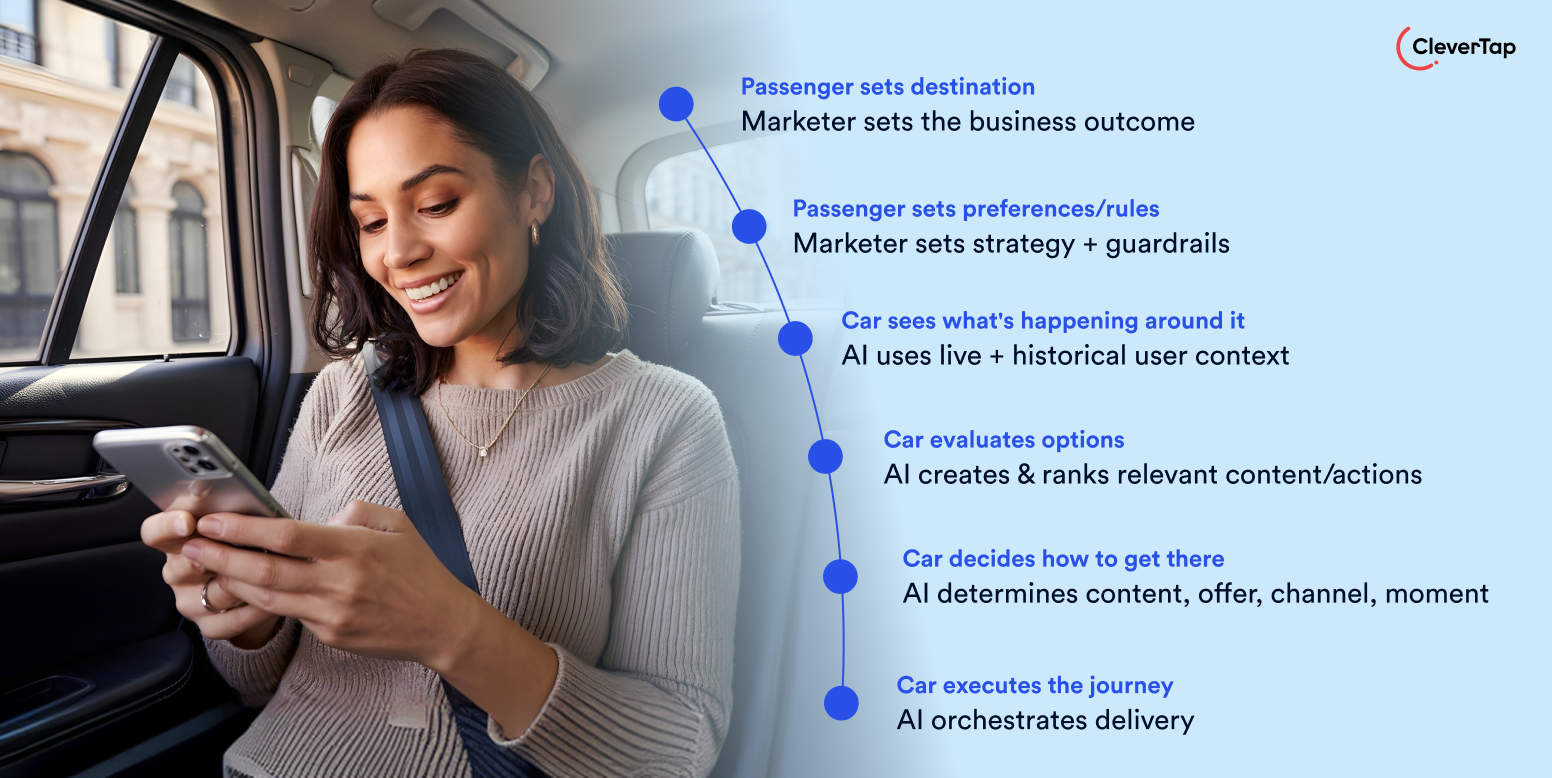
Think of it like a self-driving car. A passenger knows the destination, possible alternative routes to reach it, the traffic rules, and what happens along the way, like traffic congestion or accidents. However, they would not want to constantly tell the car what to do at every turn or adjust the route. Likewise, using the AI-native platform, the marketer sets the business goals and guardrails and lets the AI optimize the experience for every customer and drive them towards the best action that can help achieve the business goal.
Shift 3: From Context to Relevance
The state of personalization as it stands today is to use a customer’s context to add their name in the message, provide recommendations, and so on. It is a significant improvement from the previous mass-blast messages, but is it enough?
Context tells you what you know about a customer – their demographics, lifestyle, preferences, and more. Consider a banking customer whose credit card payment is due in three days. Based on what the bank knows, a payment reminder seems like a logical next step. But this morning, the customer paid the bill.
Sending the scheduled reminder anyway, even if it includes the customer’s name, exact due amount, and preferred channel, isn’t really personalization. It’s perfectly personalized irrelevance, which has a cost – an immediate skip, mute, or a quiet switch to a competitor’s app.
This exposes a fundamental limitation of context-based personalization designed in advance: the most relevant next action often cannot be decided in advance because the live signal that makes it relevant hasn’t happened yet.
This limitation shows up sharply in recovery moments, where the window to act is measured in minutes or even seconds, not days. Think of a goalkeeper or a tennis player returning a shot. The player continuously reads speed, trajectory, and position and adjusts their response in real time. A pre-planned response only works until reality changes. In the area of customer engagement, it could be a paused loan application, an unfinished OTT sign-up, a dropped mobile recharge.
This is a challenge that bolt-on systems face by their very design. When customer data moves through periodic batch syncs, the system can be late to recognize a behavior change. And by the time it does, the moment to influence the customer may have already passed.
Live 1:1 personalization overcomes this limitation by focusing not just on context but also “relevance”. Instead of working with the past context of an average of a segment until the next scheduled update, it continuously reassesses what is relevant now for every customer as new signals emerge live. As opposed to a batch-synced system, the always-on, AI-native platform continuously asks, “Does what I was about to do still match this person’s current moment?”
The customer paid the bill? Suppress the reminder. They immediately start exploring loan pre-closure? That’s a new signal – and a new decision to make.
Shift 4: From Propensity to Uplift
This shift is something that goes largely unnoticed but shows up most directly on the P&L. This is because a key metric – response rate – looks healthy the entire time, hiding what’s wrong underneath. Let’s dive in.
For personalization, marketers have a propensity mindset: Who is most likely to act? While it’s useful for targeting customers, it has an inherent blind spot – it includes even those people who were going to act anyway.
Consider a customer with a 95% likelihood of making a purchase or renewing their OTT subscription without any marketing intervention. Sending them a 20% discount may result in a conversion that looks like a campaign success. But if they would have purchased anyway, the campaign hasn’t really driven that conversion but has simply claimed credit for it while giving away margin.
This lost margin keeps compounding in the background for all those customers who received an unnecessary incentive – and shows up in the quarterly business review. While response rate, retention rate, and redemption rates look strong, what never gets asked is what the P&L statement would look like if incentives were spent intelligently on those who actually needed them.
This is where the uplift model asks a fundamentally different, and more valuable, question: Which action, if any, will actually change what this specific person does – while staying aligned with business goals?
It addresses two issues at once – one, instead of segment-level decision-making, it focuses on an individual, and two, it evaluates the best action that can nudge a user towards an intended action. The latter could be a message, an offer, a recommendation, an experience, or nothing at all – something which a propensity-based approach can never analyze. The marketer can, therefore, shift from predicting behavior to creating incremental behavior.
These four shifts fundamentally change how personalization works:
- Assisted to Autonomous changes how much decision-making AI can take on: From recommendations reviewed one by one by the marketer to live 1:1 personalization executed autonomously by AI within marketer-defined controls.
- Outcome-managed changes what the marketer manages: From defining every campaign element to defining the business outcome, strategy, and guardrails.
- Continuous relevance changes when the decision is made: Not days or weeks in advance, but as customer context and intent evolve in real time.
- Uplift changes what the decision optimizes for: Not simply likelihood to respond, but the incremental impact an action can create.
Together, they shift personalization from a photograph that becomes stale the moment it is taken to a live video – continuously deciding what should happen next for every customer, every interaction, to achieve the desired outcome. That’s Live 1:1 Personalization – not a feature change but a different unit of decision-making altogether. It’s no longer about “What’s the next best action?” but “What matters to this customer now, and can we act on it while it still matters?” The question shifts from what’s best next to what’s best now.
How CleverAITM Makes Live 1:1 Personalization Possible
CleverAI™, the intelligence layer of our AI-native customer engagement platform, brings the intelligence required for Live 1:1 Personalization into one continuously learning system. The core of it is native decisioning, which makes it an always-on system.
Marketers define the business goal, strategy, and guardrails, and CleverAI™ understands, creates, decides, orchestrates, and learns its way toward that goal for each customer:
- Richer, real-time customer context by combining live behavior with long-range history, profile attributes, campaign responses, and governed enterprise intelligence.
- Relevant choices at scale with AI capabilities that generate meaningful content and experience options.
- Specialized intelligence across recommendations, predictions, timing, channels, and sequences.
- Native, real-time decisioning that continuously ranks the most relevant message, offer, channel, moment, sequence, experience – or no action – for each customer against the marketer-defined goal.
- Orchestrating the next best action across campaigns, journeys, channels, product experiences, and rewards.
- Continuous learning from every outcome to improve the next decision as customer behavior and context evolve.
The result is live 1:1 personalization powered by a platform that continuously decides what should happen next, for whom, when, and whether anything should happen at all – all in line with the marketer’s business outcome.
Ready to move from personalized campaigns to Live 1:1 Personalization?

Subharun Mukherjee 
Heads Cross-Functional Marketing.Expert in SaaS Product Marketing, CX & GTM strategies.
Free Customer Engagement Guides
Join our newsletter for actionable tips and proven strategies to grow your business and engage your customers.