








































Table of Contents
Categories
Most Popular


Consumer brands don’t need more customers as much as they need their customers to stay longer.
If you measure, you’ll find that the cost of customer acquisition is much more than retention. Even after incurring that cost to acquire a customer, what is the point if they leave at the same rate they came in?
What fixes this leak is keeping a customer engaged. You might be doing that already and still seeing churn. Simply improvising a new tactic each time won’t give you a reliable way to maximize retention. It’s just blunt hit and trial.
You need a structured decisioning model that governs how a brand treats each customer across the lifecycle. This is what a customer engagement model delivers.
What Is a Customer Engagement Model?
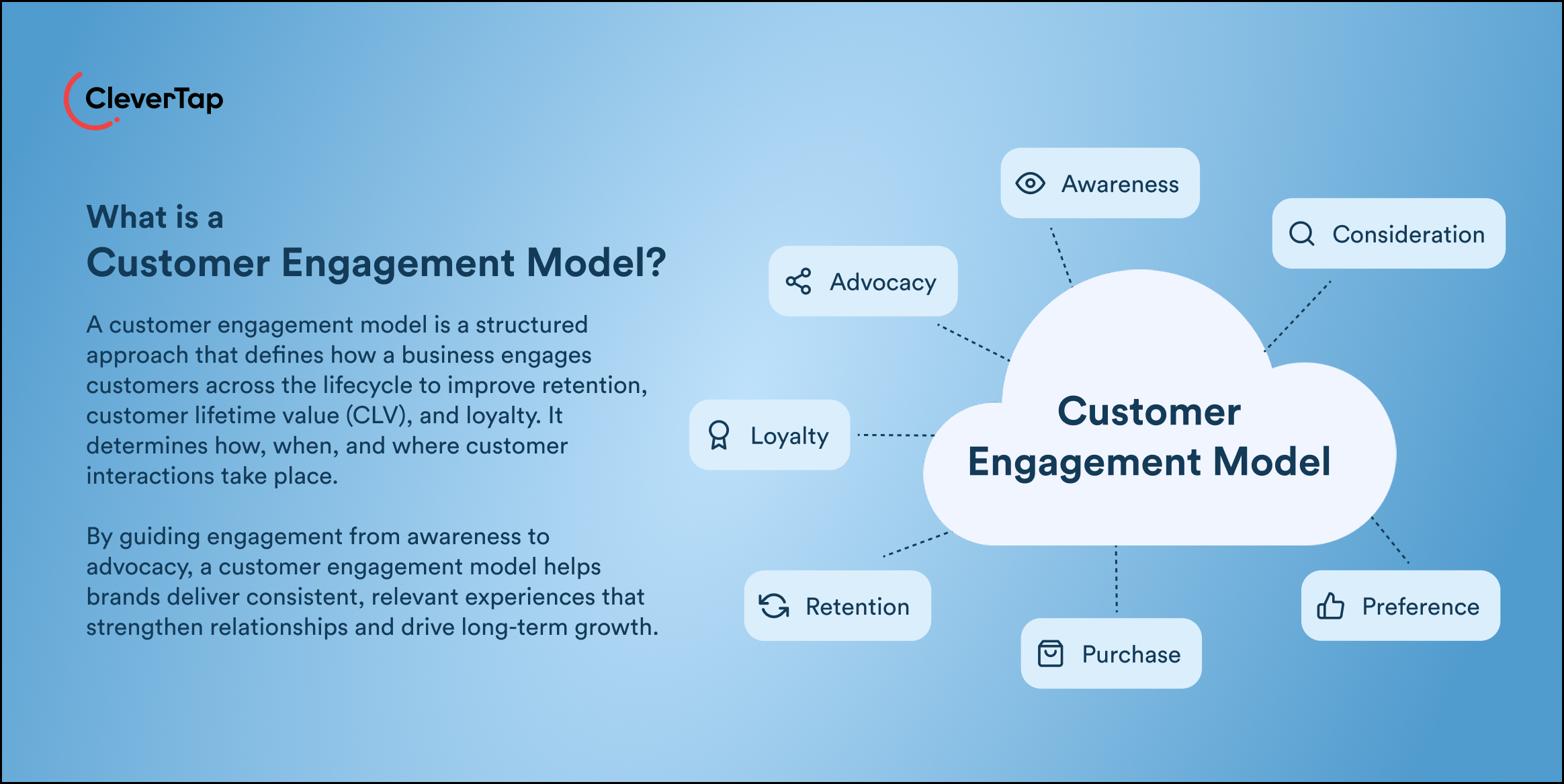
A customer engagement model is a structured approach to how a brand interacts with customers across the lifecycle to maximize retention, customer lifetime value (CLV), and advocacy. It’s the operating posture you take toward a customer or cohort: how much human attention they get, through which channels, triggered by what behavior, at what cost to serve.
The reason the term causes so much confusion is that “engagement” means two different things depending on who says it. To a growth or lifecycle marketer, engagement is the campaign work after acquisition: the email flows, the push sequences, the win-backs. Engagement equals activity. To a product leader, engagement is a usage metric: opens per day, sessions, and time on platform.
Engagement equals behavioral frequency that compounds into lifetime value.
The fix is to separate three terms that get treated as synonyms.
| Term | What it is |
|---|---|
| Engagement model | The structure of how you engage a cohort: level of human touch, channel mix, cost-to-serve. |
| Engagement framework | The named, repeatable scaffold that organizes the activity: the lifecycle map your model runs on. |
| Engagement strategy | The specific plan and tactics: the channels, offers, and cadences you execute inside a model and framework. |
5 Levels of Customer Engagement
You can’t pick a customer engagement model until you know where the customer stands. Engagement isn’t binary.
It’s a relationship depth that moves through five stages, and the right model depends on which stage a customer is in.
- Unaware: The person doesn’t know you exist. This is acquisition territory; nothing you do in-product reaches them.
- Aware: They have seen an ad, a friend’s recommendation, or an app-store listing. They know the name and have no relationship.
- Active: They have signed up, installed, or bought once. They’re using the product, but the habit is fragile. Most churn lives here.
- Invested: The product is part of their routine. Switching would now cost them something, whether data, habit, status, or history.
- Advocate: They recommend you and bring new customers through word of mouth, reviews, and referrals.
The level is the diagnosis; the model is the prescription. Pouring high-touch human attention onto an Aware tire-kicker wastes resources. Running a fragile active user through the same drip as a settled invested one is how you get silent churn.
Marriott describes this lifecycle thinking cleanly. SVP/GM Chris Norton frames the brand’s goal as being “additive to the customer journey as they travel from planning to inspiration to pre-arrival to being in the hotel and then dreaming about that next trip.” Each stage is a different relationship depth that calls for a different kind of engagement.
Also read: 15 Best Customer Engagement Platforms for Smarter Lifecycle Marketing
7 Types of Customer Engagement Models
High-touch, low-touch, and hybrid are the standards when it comes to customer engagement models. But they aren’t the whole map. Here are the seven models consumer brands actually run:
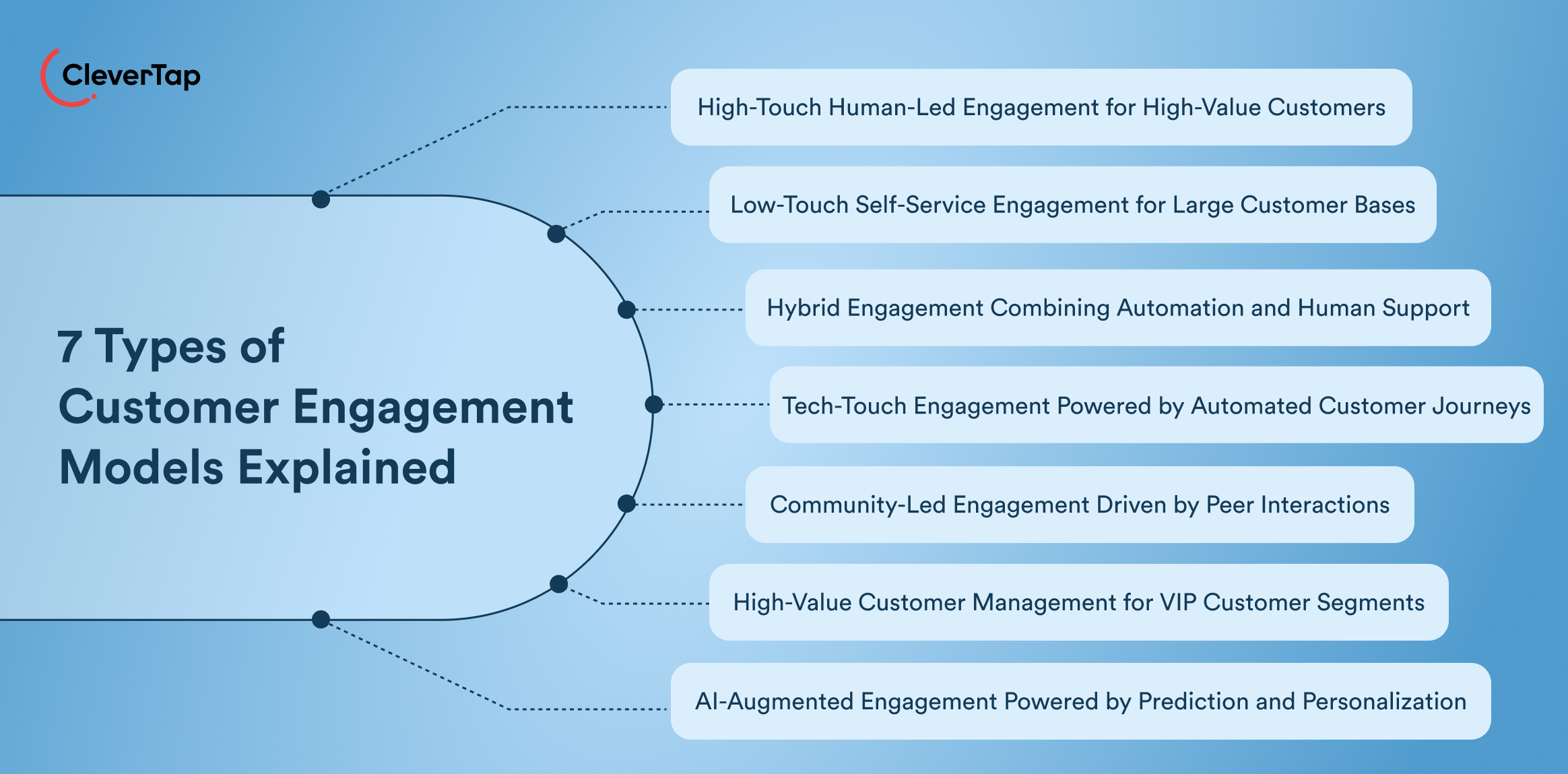
1. High-touch
It’s personalized, human-led engagement reserved for your highest-value customers.
A high-touch customer engagement model represents a personal one-on-one relationship with customized onboarding, regular guidance, and frequent check-ins. In consumer terms, think private-client banking, concierge travel tiers, or a personal stylist for a fashion brand’s top spenders.
It fits when value per user, complexity, or emotional stakes run high, because revenue per customer has to justify the human time. The trap is applying it to everyone. Treating every customer with that white-glove treatment is really expensive. And that’s no way to run a business unless you’re really charging for it.
High-touch should be a triage decision, not a default.
2. Low-touch
Low-touch engagement involves automation- and self-serve-led engagement for high-volume, lower-value-per-user bases. It fits large bases where per-customer revenue is modest, and the product is simple enough to learn alone. Most D2C, most mobile apps, and most freemium products use a low-touch model.
The trap is treating “low-touch” as “low-effort.” Done badly, this is where silent churn lives, because customers drift away without ever complaining.
3. Hybrid
It’s engagement that routes between human and automated touch by customer value or cohort. Automate the bases where per-customer revenue is modest, and reserve human attention for the moments and customers where it changes the outcome. The craft is in the routing logic.
For example, a neobank might run everyone through automated nudges, but flag a sudden drop in activity from a high-balance user for a human relationship manager to call.
4. Tech-touch / no-touch
It’s fully automated lifecycle messaging across push, email, in-app, and WhatsApp, with no human in the loop. The purest form of low-touch, suited to bases so large that human contact is economically impossible: a deals app with ten million monthly visitors, a free game with millions of players.
It works when it’s behavioral rather than blasted. Batch’s 2025 benchmark found contextual, behavior-triggered push opens at 14.4% versus 4.19% for generic batch-and-blast, roughly a 3.4x lift.
Did you know? DealsPlus, an e-commerce deals platform with 10M+ monthly visitors, used personalized, timed push to cut app uninstalls 30% and lift engagement 10%. That’s tech-touch, done with behavioral precision rather than volume.
5. Community-led
Peer-to-peer and brand-to-peer engagement built on belonging: forums, Discord servers, status-conferring loyalty tiers, post-purchase rituals. Engagement happens between customers, with the brand as host. It fits categories where identity matters, including gaming, beauty, fitness, and fandom-driven D2C.
The New York Post’s example fits best here. Their product lead confirmed that an in-app-only Nicki Minaj group chat became one of the biggest single-day drivers of downloads and new starts that we had, on an Arc XP expert panel.
6. High-value-customer (HVC) relationship management
A dedicated relationship layer for your most valuable consumer cohorts, the consumer-brand equivalent of named-account management without the B2B baggage. It’s high-touch, applied systematically to an identified segment rather than to individuals on an ad hoc basis. It fits when a small fraction of customers drives a large share of revenue: the whales in gaming, the high-balance customers in fintech, the VIP tier in retail.
However, there’s a possibility that your biggest spender might not want it. If they don’t have the time to hop on bi-weekly video meetings and you push too much, that might jeopardize the relationship. It’s advisable to look for such signals early rather than treating every high-value customer with the same processes.
7. AI-augmented
Engagement where AI handles customer insights like personalization, prediction, and conversation at a scale humans can’t match: predictive churn scoring, generative personalization, conversational interfaces.
It’s less a standalone model than a layer that supercharges the other six, and it fits anywhere you have rich behavioral data and a large base.
Engagement Frameworks vs. Models
Engagement frameworks aren’t exactly engagement models.
A framework isn’t a posture toward the customer; it’s the map of the lifecycle your model runs on. You don’t choose between high-touch and AARRR. You run a high-touch model along an AARRR map.
Five frameworks are worth knowing, one line each.
| Framework | What it is | When to use it | Strong fit for |
|---|---|---|---|
| AARRR (Pirate Metrics) | A growth funnel: Acquisition, Activation, Retention, Referral, Revenue. | When every team needs one shared, metric-driven scoreboard for the funnel. | D2C, gaming, fintech apps |
| RACE | Reach, Act, Convert, Engage: a planning scaffold for marketing activity. | When you’re organizing marketing specifically and want a planning view. | E-commerce, content-led brands |
| AIDA | Attention, Interest, Desire, Action: the classic awareness-to-purchase funnel. | When the problem is top-of-funnel and conversion, not post-purchase depth. | Awareness-stage campaigns |
| McKinsey Consumer Decision Journey | A loop, not a funnel: consideration, evaluation, purchase, then a post-purchase loyalty loop that feeds back into consideration. | When you want to model how loyal customers skip the funnel and re-buy. | Repeat-purchase consumer brands |
| LAER | Land, Adopt, Expand, Renew: a lifecycle frame focused on the post-acquisition relationship. | When most value comes after the first sale. | Subscription, membership models |
You can pick one framework as your shared lifecycle map, then choose the models you’ll run along it.
How to Choose the Right Customer Engagement Model
To choose the right customer engagement model, you need to run each cohort through four questions instead.
- What’s the value-per-user? The biggest input. High value can justify human attention; low value demands automation and scale. But value is the starting filter, not the whole answer.
- How complex is the product or decision? A self-evident product (a deals app, a casual game) can run almost entirely tech-touch. A high-stakes one (wealth, health, a considered purchase) needs more guidance regardless of the per-user economics. Complexity pulls toward high-touch; simplicity pulls toward low-touch.
- Is the product self-serve or configured? If customers reach value alone, lean low-touch and make that self-serve path genuinely good. If they need help to succeed, the touch has to come from somewhere, human or a well-designed automated equivalent.
- What’s your team’s capacity and budget? The honest constraint. A model you can’t staff, or fund is a fantasy, which is often why automation is the only way to engage a large base consistently.
Segment by need, not by spend
Here’s where the standard advice goes wrong. The instinct is to map spend straight to touch: big spenders get humans, everyone else gets automation. The best practitioners reject that.
Sometimes your smallest customers need the most help.
The fintech panel put it more sharply: “Brands that build real loyalty make hard choices about what problems they want to solve and what customers they want to serve. If you try to be the bank for everyone, you’re not going to end up with any loyal customers.” This is a critical situation to be in.
So the rule isn’t to spend to touch. It needs to touch, bounded by economics. Segment by where the customer is and what they need to move forward, then check that the model you have assigned is one you can afford at that scale.
PVcomBank shows the rule working. The digital bank faced drop-offs at high-stakes moments, eKYC verification, and savings-account setup, where the instinct might be to throw call-center staff at the problem. Instead, it replaced SMS with behavior-triggered push and in-app nudges at exactly those points.
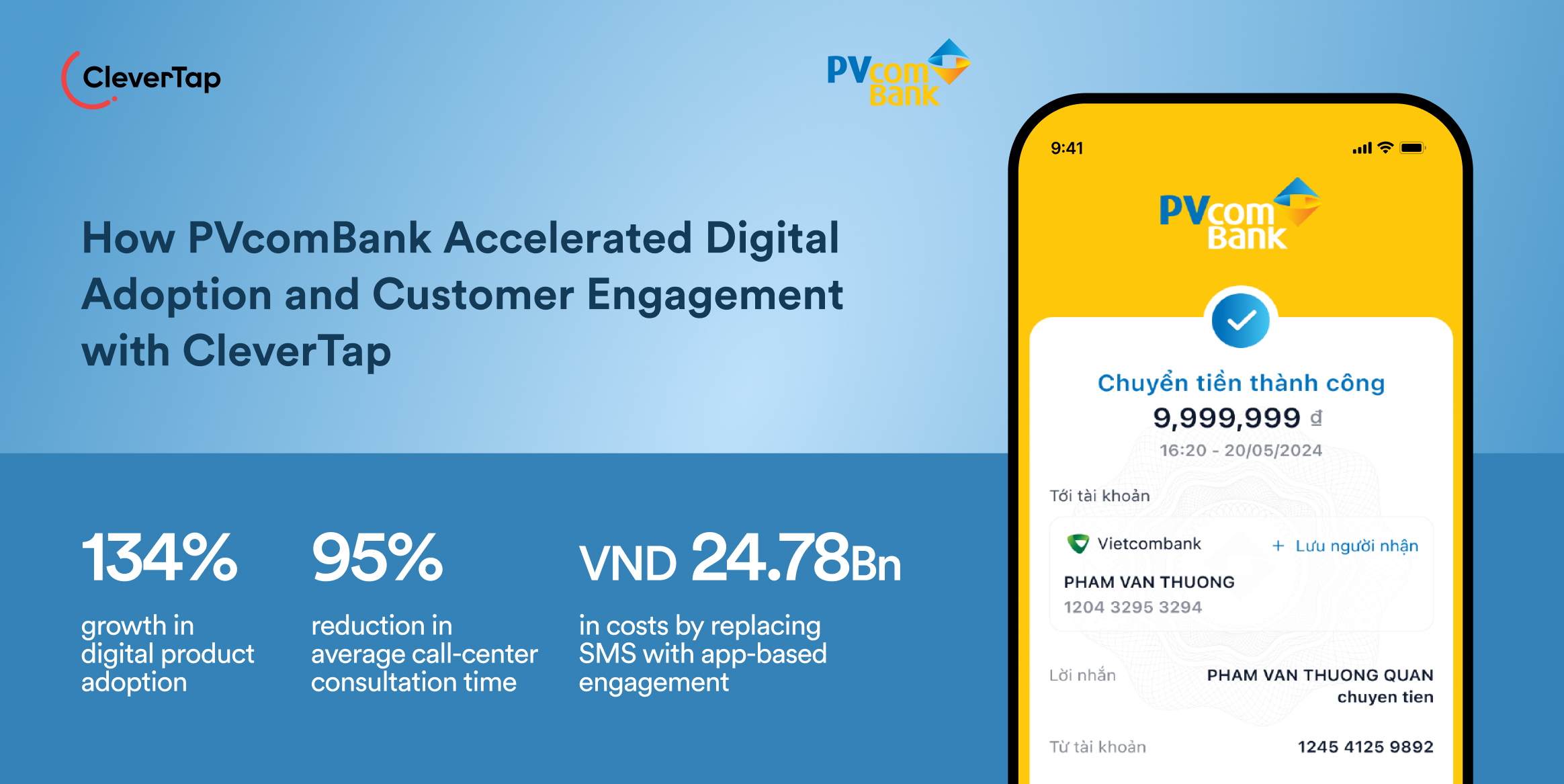
The reported result (via its engagement platform, CleverTap): 134% of its digital-product-adoption target, a 95% cut in average call-center consultation time, and 24.78 billion VND saved in marketing costs. Automation aimed precisely where a high-value cohort was leaking, beating both the blast and, at that scale, the human.
How to Build a Customer Engagement Framework Step by Step
You have chosen your models and your lifecycle map. Now you build it, and the order matters, because the most common failure is starting at the wrong end.
- Map The Lifecycle Stages. Draw the customer’s actual journey, Awareness to Acquisition to Onboarding to Retention to Advocacy, with the real drop-off points marked. You can’t engage a stage you haven’t named. The first- and zero-party data you collect here is the foundation. As one retail panel emphasized, “the ability to get that kind of first and zero party data from people is really important,” because everything downstream depends on knowing who sits where.
- Segment by Cohort: Group customers by where they are and what they need, not just what they have spent. RFM cohorts, lifecycle stage, behavioral segments. These segments decide which model each customer gets.
- Design Playbooks Per Cohort: For each cohort, define the model and the plays: what triggers a message, through which channel, with what content, and when to escalate to a human touch. This is where “model” becomes “strategy.”
- Set KPIs and a Health Score: Decide what “working” means before you ship, and build a health score from the signals that predict retention or churn for your business: usage frequency, recency, depth, and support friction. The score is what turns a low-touch model from fire-and-forget into something you can steer.
- Select tools last: Everyone wants to do this first, and doing so is the most expensive mistake in the sequence. The experts are unusually unanimous. “The biggest mistake that people make is they throw technology at problems,” says Falterusso. “It starts with people and then it’s processes and then it’s technology.”
Experience first, then process, then technology. The brands that get engagement right decide how they want to treat customers before they decide what to buy.
The Customer Engagement Maturity Model
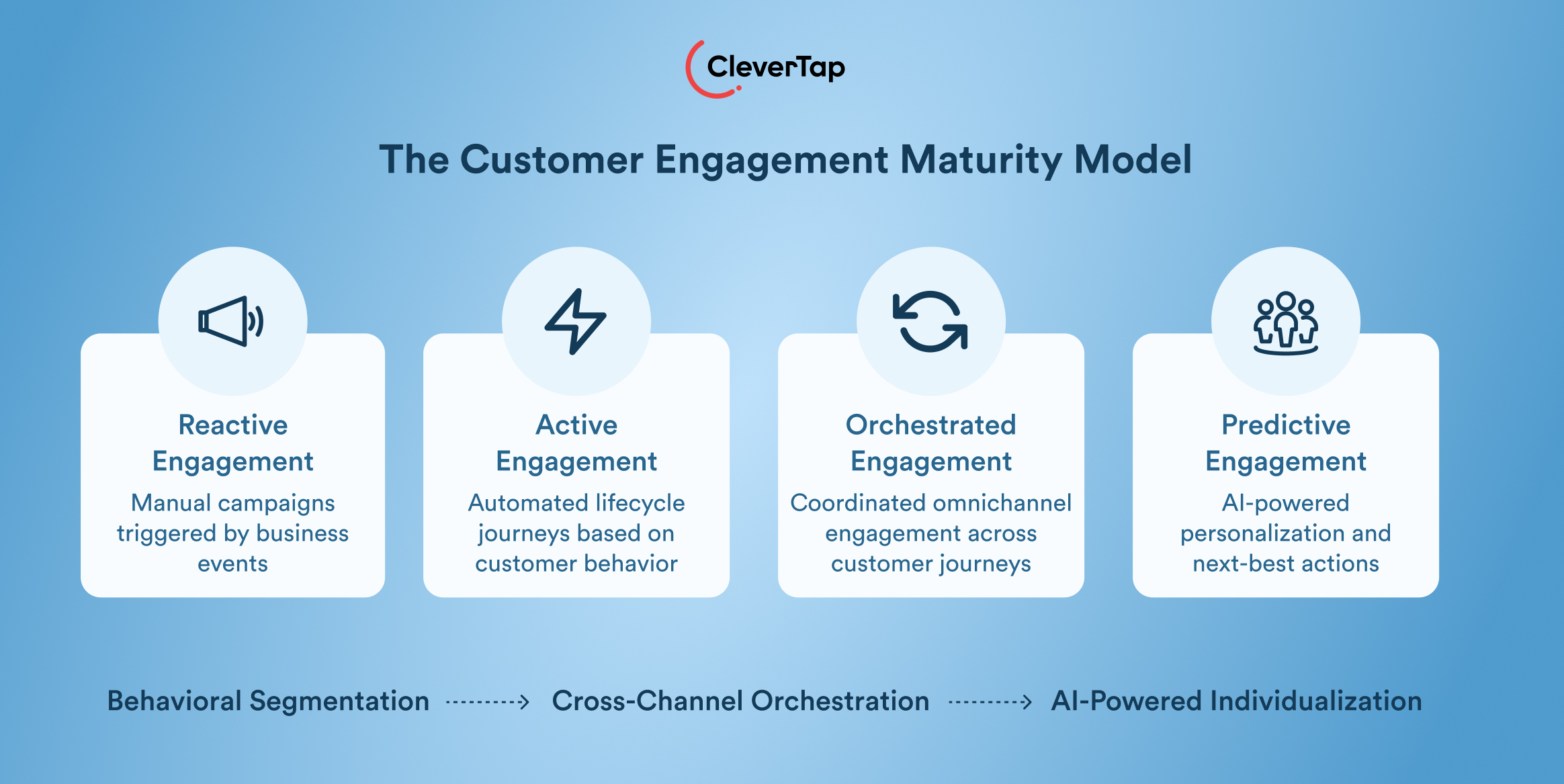
Everything so far has tracked the customer’s journey. This flips the mirror to your brand. The five levels describe how deep a customer’s relationship with you is. The maturity ladder describes how sophisticated your capability to engage them has become.
1. Reactive
You engage when something prompts you: a sale, a holiday, a churn scare. Campaigns are manual, batch-and-blast, and rebuilt each time. There’s no model, just activity. Behavioral segmentation advances you here: the moment you focus on what people actually do, you start climbing.
2. Active
You’ve segmented, and you run triggered lifecycle messaging: welcome flows, cart abandonment, win-backs. Engagement is automated and behavioral but single-channel or loosely coordinated, and you measure opens more than outcomes.
Cross-channel orchestration and a real health score advance you from here: when push, email, and in-app work as one coordinated journey, you reach the next rung.
3. Orchestrated
Engagement is coordinated across channels, routed by cohort, and steered by a health score that predicts churn before it happens. You run multiple models deliberately, tech-touch for the large customer base and HVC management for the valuable cohorts, escalating between them by need.
Prediction and individualization at scale advance you from here. It involves moving from “this cohort gets this journey” to “this person gets this next-best action,” which is the AI-augmented layer.
4. Predictive
Engagement is individualized and anticipatory. AI predicts churn, next-best action, and lifetime value for each customer, and the system adapts in real time. Low-touch feels high-touch because the personalization is good enough to pass for human attention.
This isn’t a race to Rung 4. A Rung-2 brand, running its tech-touch model brilliantly, will out-retain a Rung-3 brand that orchestrates badly. The point of the ladder is to know where you are, so the next investment is the right one rather than the most expensive one.
Common Mistakes to Avoid
Six failure modes recur, and most are variations of a single root error: treating engagement as something you do rather than a model you choose.
- Applying High-Touch to Everyone. The most expensive mistake is because it feels like good service. White-glove-for-all is a slow bleed.
- Building Playbooks but Never Measuring Health. Shipping automated journeys and never checking whether they work. A low-touch model without a health score runs blind.
- Treating the Model as Static. Customers move between levels, needs change, and channels decay. A model set once and never revisited drifts out of fit.
- Confusing Activity with Outcomes. The vanity-metrics trap. Opens, clicks, and even DAU can rise while retention and CLV stay flat. If your dashboard celebrates activity finance can’t trace to revenue, you’re measuring motion.
- Under-Investing in the Onboarding-to-Retention Transition. The Active level, that fragile window after signup, is where most churn happens and where the least design usually goes.
- Mistaking a Loyalty Program for Loyalty. A points scheme is not a relationship. It’s a retention tool. Big brand programs don’t hold people because of the points. They hold people because the points are the only way to get the perks.
How CleverTap Helps You Scale Customer Engagement
Everything in this guide points to one structural challenge: running the right customer engagement model for the right customer across every channel at consumer scale, and climbing the maturity ladder without re-platforming each time.
That’s the problem CleverTap, a unified customer engagement and retention platform, is built to solve. The seven models all depend on the same foundations: behavioral data rich enough to know which customer sits at which level, orchestration that coordinates push notifications, emails, in-app notifications, and WhatsApp into a single journey, and intelligence that predicts and personalizes at a scale humans can’t reach.
Here is how the platform maps to each foundation:
- Cross-Channel Orchestration: The Journey Builder ties push, email, in-app, SMS, and WhatsApp into a single adaptive flow. The Channel Optimizer Agent selects the channel each user responds to, and the Send Time Optimizer Agent selects the hour when they are most likely to open. IntelliNode runs several journey paths simultaneously and automatically shifts traffic to the winner. This is what turns single-channel campaigns into coordinated engagement.
- Predictive and personalized AI: The Predictions Agent scores churn risk, conversion likelihood, and predicted lifetime value out of the box, so a real health score replaces guesswork. The Segment Builder Agent turns a plain-text prompt into a target segment, the Recommendations Agent matches each user to the next-best product or action, and CleverAI™‘s Scribe writes message copy to fit. Together, these move a brand toward the predictive, adaptive top of the ladder.
- Behavioral data at scale: TesseractDB™ holds the deep, long-term history that a genuine health score and true individualization depend on. It is the layer that lets the agents above know which customer sits at which level in the first place.
The proof is in what consumer brands achieve on the platform. PVcomBank hit 134% of its digital-adoption target while cutting call-center time by 95%. DealsPlus cut uninstalls by 30% while Beblue drove a 96% increase in DAU.

The right way to think about CleverTap is as the platform you graduate into. You don’t need every capability on day one. You need a foundation that lets you start where you are on the ladder and climb up, without technology becoming what defines your model.
Because experience is always first, then process, then technology.
Learn more about CleverTap’s customer engagement analytics and understand what you need to fix in customer engagement. .

Agnishwar Banerjee 
Leads content and digital marketing.Expert in SaaS sales, marketing and GTM strategies.
Free Customer Engagement Guides
Join our newsletter for actionable tips and proven strategies to grow your business and engage your customers.