












































Table of Contents
Categories
Most Popular


Creating a user persona requires more than assigning demographic characteristics to an imaginary customer. Effective personas are built using customer research, behavioral data, and shared motivations to understand what different audience groups need and how they make decisions.
The challenge is identifying meaningful patterns in customer data and translating them into profiles that marketers can use. Without a structured approach, personas risk becoming assumption-based descriptions rather than reliable tools for making marketing decisions.
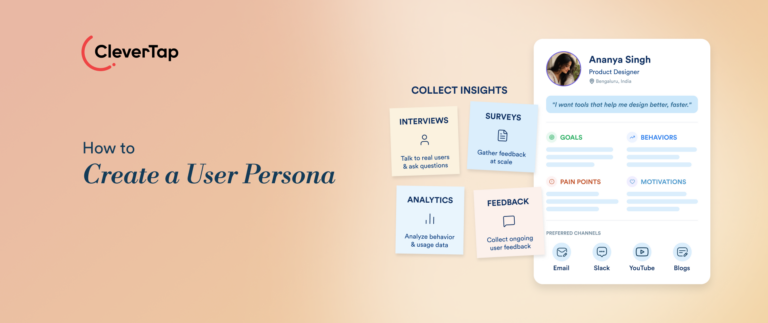
This guide explains how to create a user persona in five steps, from collecting customer insights to documenting and validating profiles. It also includes a practical template, examples, and common mistakes to avoid.
What Is a User Persona in Marketing?
A user persona is a research-based representation of a group of customers who share similar goals, motivations, behaviors, and challenges. It combines qualitative and quantitative insights into a profile that helps businesses understand customer needs and make informed product and marketing decisions.
For example, an e-commerce brand might create a persona representing shoppers who prioritize convenience and fast delivery. These insights can guide checkout improvements, personalized recommendations, and customer communications.
What Should a User Persona Include?
Before creating a user persona, identify the information needed to understand the customer’s needs, motivations, and behavior. A practical persona should include the following components:
- Relevant Demographics: Age range, location, occupation, or other characteristics supported by customer research and relevant to the product.
- Behavioral Patterns: Browsing activity, purchase frequency, feature usage, and other observed customer interactions.
- Goals and pain points: Desired outcomes and obstacles, such as saving time, simplifying a task or navigating a complicated checkout.
- Motivations and Decision Factors: Customer expectations, priorities, and concerns that influence product choices and purchasing decisions.
- Supporting Evidence: Customer interviews, survey findings, behavioral data, and feedback that validate the persona’s characteristics.
- Engagement Preferences and Triggers: Preferred communication channels and relevant customer actions that may inform future engagement strategies.
Together, these elements turn a user persona from a descriptive profile into a practical framework for delivering timely, relevant, and personalized customer experiences.
How to Build a Data-Driven User Persona in 5 Steps
Building an actionable user persona requires combining quantitative behavioral data with qualitative customer insights. Follow these five steps to create profiles that inform segmentation, personalization, and lifecycle marketing.
Step 1: Define Your Objectives and Collect Customer Data
Start by defining what the user persona should help your team understand or improve, such as onboarding completion, purchasing decisions, or repeat engagement. This objective determines which customer information is relevant.
Analyze event logs, retention cohorts, transaction histories, feature adoption, and conversion funnel drop-offs. Look for recurring patterns in session frequency, purchase value, engagement, and churn. For example, customers who repeatedly browse products without purchasing may represent a group worth investigating.
These findings provide an evidence-based starting point for persona research.
Step 2: Research Customer Goals, Motivations, and Challenges
Behavioral data reveals what customers do, but qualitative research helps explain why. Conduct customer interviews, in-app surveys, and feedback reviews to understand motivations, frustrations, and unmet needs. Analyze support tickets to identify recurring challenges.
Ask customers what they were trying to achieve, why they chose the product, what difficulties they encountered, and which factors influenced their decisions. Prioritize open-ended questions that reveal motivations rather than confirm existing assumptions.
For example, users who abandon investment onboarding may cite confusing terminology or concerns about risk. Combining these insights with behavioral data helps distinguish between customers who exhibit similar actions for different reasons.
Step 3: Identify Patterns and Group Similar Users
Analyze the research findings to identify customers with similar goals, motivations, challenges, and behavioral patterns. Group users based on meaningful similarities that influence their product experiences or purchasing decisions. AI-powered clustering can support this process by identifying patterns across larger datasets.
Predictive models can also identify users likely to convert, upgrade, or churn. Validate these segments against customer feedback and campaign outcomes before turning them into personas. A useful segment should reveal meaningful differences that influence marketing decisions, not merely produce statistical groupings.
Step 4: Build and Document Your Persona Profile
Turn the identified customer patterns into a structured profile. Give each persona a descriptive name and summarize its primary goals, motivations, pain points, behavioral characteristics, and decision factors.
Include relevant customer quotes or research findings to support the profile. Avoid adding fictional details that do not explain customer behavior.
For example, an e-commerce brand might create a “Convenience-Focused Shopper” persona representing customers who make frequent repeat purchases, prioritize fast checkout, and value predictable delivery.
Keep each profile concise enough for marketing and product teams to reference when making decisions.
Step 5: Validate, Refine, and Update Your Personas
Validate each persona against customer interviews, behavioral data, and feedback to ensure it accurately represents the intended audience. Check whether the identified goals, motivations, and challenges consistently appear across the customer group.
For example, if a persona assumes that customers abandon purchases because of high prices, investigate whether checkout data and customer research support that conclusion. Delivery concerns or payment difficulties may be more significant barriers.
Share validated personas with marketing, product, and customer experience teams, and assign responsibility for reviewing them periodically. Update profiles when new research reveals meaningful changes in customer behavior or needs.
User Persona Template for Marketing Teams
A user persona template helps marketers organize customer research into a structured profile that can guide segmentation, campaign personalization, and lifecycle engagement. The following template outlines the essential information to capture for each persona.
| Component | What to Include |
| Persona Name | A descriptive label representing the customer type |
| Persona Summary | A brief description of the customer group and its defining needs |
| Demographics | Relevant age range, location, and other characteristics |
| Goals | What the customer wants to achieve |
| Pain Points | Challenges or barriers affecting their decisions |
| Motivations | Factors influencing their preferences and actions |
| Behavioral Patterns | Browsing habits, purchase history, app usage, and engagement frequency |
| Preferred Channels | Communication channels customers use and respond to |
| Engagement Triggers | Customer actions or milestones that create opportunities for engagement |
| Supporting Evidence | Relevant behavioral findings, customer interviews, survey responses, and feedback supporting the persona |
| Engagement Strategy | Personalized campaigns, recommendations, or journeys suited to the persona |
| Success Metrics | KPIs such as activation, conversion, retention, and engagement rates |
Use this template as a starting point and refine each persona with quantitative behavioral data and qualitative customer insights. Review the profiles periodically to ensure they continue to reflect customer needs and inform relevant engagement strategies.
User Persona Examples: What Completed Profiles Look Like
The following illustrative user personas demonstrate how customer research and behavioral insights can be organized into actionable profiles. Each example includes defining characteristics, goals, pain points, supporting evidence to investigate, and recommended actions. These hypothetical profiles should be validated against actual customer data before being used for marketing decisions.
1. Convenience-Focused E-Commerce Shopper
Persona Summary: A returning customer who frequently purchases familiar products and values a simple, reliable shopping experience.
Goals and Motivations: Complete purchases quickly, find previously purchased products easily, and receive orders within predictable delivery windows.
Pain Points: Complicated checkout processes, unexpected delivery charges, and difficulty locating repeat purchases.
Behavioral Patterns: Frequently revisits familiar product categories, makes repeat purchases, and checks delivery information before ordering.
Supporting Evidence: Repeat purchase analysis, checkout funnel behavior, and customer feedback concerning delivery convenience.
Recommended Actions: Simplify repeat purchasing, highlight relevant previously purchased products, and provide clearer delivery information.
This illustrative persona demonstrates how marketers can translate customer research and behavioral patterns into a concise profile that informs product and marketing decisions.
2. First-Time Fintech Investor
Persona Summary: A new investment app user who wants to start investing but lacks the knowledge and confidence to make independent financial decisions.
Goals and Motivations: Understand investment options, start with manageable amounts, and build confidence in long-term financial planning.
Pain Points: Unfamiliar financial terminology, concerns about investment risks, complicated onboarding, and difficulty comparing available products.
Behavioral Patterns: Frequently explores educational content, reviews investment options without completing transactions, and revisits risk-related information before making decisions.
Supporting Evidence: Investment onboarding funnel analysis, educational content engagement, customer interviews, and support inquiries related to investment risks and account setup.
Recommended Actions: Simplify onboarding, provide contextual explanations of investment concepts, introduce beginner-friendly educational resources, and test personalized guidance that helps users complete their first investment.
3. Flexible Trip Planner
Persona Summary: A travel app user who enjoys exploring destinations and comparing accommodation or transportation options but prefers flexibility before confirming bookings.
Goals and Motivations: Discover suitable travel options, compare prices, and make bookings that accommodate changing schedules and preferences.
Pain Points: Unclear cancellation policies, unexpected booking fees, limited flexibility, and difficulty comparing similar travel options.
Behavioral Patterns: Frequently searches multiple destinations, saves hotels or flights, compares booking options across sessions, and revisits listings before confirming reservations.
Supporting Evidence: Search and booking funnel analysis, saved-item activity, repeated visits to cancellation policy pages, and customer feedback about booking flexibility.
Recommended Actions: Highlight flexible cancellation options, provide transparent pricing, simplify comparisons between saved options, and test relevant reminders when previously viewed travel options change in price or availability.
How to Use Your User Personas After Creating Them
Once your personas have been validated, share them with the teams responsible for marketing, product development, and customer experience.
Use the profiles to identify relevant customer segments, personalize communication, address recurring product challenges, and improve customer experiences.
For example, an e-commerce brand can simplify repeat purchasing for convenience-focused shoppers while providing additional product comparisons to customers who need more information before buying.
Connect these insights with behavioral data to identify relevant audiences and measure whether persona-informed strategies improve engagement, conversion, and retention.
For more detailed guidance on applying personas to lifecycle campaigns and personalized customer engagement, explore CleverTap’s User Persona Guide.
Common Mistakes to Avoid When Creating User Personas
Even a well-designed user persona can fail if it is based on assumptions rather than evidence. Avoid these four common mistakes when creating user personas.
1. The Stereotype Trap
Demographics alone don’t explain customer behavior. Labeling someone a “tech-savvy Millennial” reveals little about their actual preferences. Validate persona traits using event telemetry, including session frequency, feature adoption, purchase history, and conversion rates. Supplement these findings with customer interviews to understand motivations and retain only traits that inform marketing decisions.
2. Persona Overproliferation
Creating too many personas can fragment audiences and complicate campaign management. Start with a manageable number of core personas representing meaningful differences in customer behavior, needs, or motivations. Add profiles only when segments have distinct behaviors, needs, or campaign requirements. If two personas receive identical messaging, consider consolidating them.
3. Confusing Customer Segments With User Personas
A customer segment groups users based on shared characteristics or measurable behaviors, such as customers who have not purchased in 30 days. A persona adds context about the needs, motivations, and challenges behind those behaviors.
Avoid treating every behavioral segment as a separate persona. Validate meaningful differences through customer research before creating additional profiles.
4. Failing to Validate and Update Personas
Personas built from limited research may not accurately represent customer needs. Validate assumptions through interviews, behavioral analysis, and additional feedback before relying on them for important decisions.
Review personas periodically and update them when new evidence reveals significant changes in customer motivations or behavior.
How CleverTap Supports Data-Driven User Persona Creation
Creating research-backed personas requires reliable customer data and a clear understanding of how different audience groups behave. CleverTap helps marketers analyze customer interactions, identify meaningful behavioral patterns, and refine persona insights using analytics, AI-powered segmentation, and unified customer profiles.
Build Unified Customer Profiles With TesseractDB™
Powered by TesseractDB™, CleverTap brings together customer attributes, behavioral events, and transaction histories into unified customer profiles. Marketers can analyze purchase patterns, feature usage, engagement frequency, and customer preferences to validate personas using actual behavioral data.
For example, a fintech brand can distinguish frequent balance checkers from active investors and develop engagement strategies suited to their financial goals and product usage.
Understand Customer Behavior With Advanced Analytics
CleverTap’s Funnels, Cohorts, Retention Analytics, and RFM Analysis help marketers identify meaningful differences between customer groups.
- Funnels reveal where users abandon onboarding, purchases, or other conversion journeys.
- Cohorts and Retention Analytics help compare engagement and retention trends across customer groups.
- RFM Analysis identifies loyal customers, occasional buyers, and customers at risk of disengagement based on purchasing behavior.
These insights help marketers refine persona definitions and identify opportunities for targeted engagement.
Create Dynamic Segments With CleverAI™
CleverTap enables marketers to create dynamic segments based on customer behavior, lifecycle stage, purchase history, and engagement patterns. As customers interact with a brand, these segments can update to reflect changing interests and intent.
CleverAI™ adds predictive intelligence by helping marketers identify customers likely to churn or convert. For instance, a streaming platform can identify declining engagement and target at-risk viewers with recommendations based on their content preferences.
Apply Persona Insights Through Personalized Journeys
Once personas have been developed and validated, CleverTap Journeys helps marketers apply these insights through personalized campaigns across push notifications, email, SMS, WhatsApp, and in-app messaging.
Behavioral triggers and journey conditions enable teams to reach relevant customer segments, while CleverAI™ capabilities support personalization and engagement optimization.
Measure Impact and Continuously Refine Personas
CleverTap’s campaign analytics, funnels, retention cohorts, and experimentation capabilities help marketers evaluate the effectiveness of persona-based engagement.
Marketers can compare conversion, engagement, and retention outcomes across customer groups, while Real Impact helps assess incremental campaign results using control groups. These insights support continuous refinement of audience segments, engagement strategies, and customer journeys.
Turn customer insights into personalized journeys that drive engagement and retention with CleverTap.
Build User Personas That Drive Meaningful Engagement
Creating an effective user persona requires a structured process of collecting customer data, understanding motivations, identifying meaningful patterns, and validating the resulting profiles.
By combining customer research with behavioral analytics, marketers can develop personas that accurately reflect customer needs and support better product, personalization, and engagement decisions. Regular validation ensures these profiles remain useful as customer expectations and behaviors evolve.
Frequently Asked Questions (FAQs)
Q1. How Do You Create a User Persona?
To create a user persona, define your research objectives, collect customer data, conduct interviews or surveys, identify shared behavioral patterns and motivations, and document the findings in a structured profile. Validate the persona against additional research and update it as customer needs change.
Q2. What Information Should a User Persona Include?
A user persona should include a description of the customer group, its goals, motivations, pain points, behavioral patterns, and supporting research. Relevant demographics, communication preferences, and decision factors can provide additional context when they influence customer behavior.
Q3. Can You Create User Personas Without Customer Interviews?
Yes. Behavioral analytics, customer feedback, surveys, and support interactions can provide an initial foundation. However, without direct qualitative research, some assumptions about customer motivations may remain unverified. Treat these as preliminary personas and validate them when additional customer research becomes available.
Q4: How many user personas should we create?
There is no fixed number of user personas suitable for every business. Start with a manageable set that represents meaningful differences in customer goals, motivations, and behaviors. Create additional personas only when those differences require distinct marketing or engagement strategies.
Q5: How often should personas be updated?
Review user personas periodically to ensure they reflect current customer needs, motivations, and behaviors. Quarterly reviews can provide a useful starting point, but profiles should be updated sooner when new research or significant changes in customer behavior reveal outdated assumptions. While behavioral segments may update continuously as new data becomes available, persona profiles should be refined using validated customer insights.

Sagar Hatekar 
Leads product managementExpert in Marketing Analytics & Engagement platforms.
Free Customer Engagement Guides
Join our newsletter for actionable tips and proven strategies to grow your business and engage your customers.