





































Table of Contents
Categories
Most Popular


A chess grandmaster does not enter a match with a blank mind. Years of experience playing a multitude of opponents have built an instinct for patterns, threats, and promising moves. But memory alone does not win the match. The player must still read this board, this opponent, and this clock.
Customer engagement has the same requirement. A platform needs a deep understanding of what has worked across a customer’s history. It also needs to recognize what is happening now and adjust when the last interaction changes the situation.
Most systems often have one aspect stronger than the other. Some have a rich historical record but make decisions from periodically refreshed scores, segments, or journey rules. Others react quickly to a live event but lack enough history to interpret it well. One remembers without adapting. The other reacts without understanding.
Neither is sufficient for Live 1:1 Personalization. It’s only when the two forms of intelligence – memory and reflexes – work together that they can answer the question that matters in customer engagement: given everything we know and everything happening now, which available action is best to move the marketer’s goal for this person?
Recency-Depth Tradeoff in Customer Engagement
Customer engagement platforms have traditionally optimized for either depth or recency. Predictive models learn from rich historical patterns but can remain fixed after intent changes. Real-time systems see the latest event but may lack the history needed to interpret it.
But the latest event is not always the most important one. A salary credit could indicate new spending capacity, the start of a recurring savings routine, or simply the same salary event that happens every month. A shopper opening a product page could signal genuine interest, price comparison, or accidental discovery. A subscriber pausing a video might be disengaged, interrupted, or planning to return within minutes. Recency alone cannot tell the system what matters for the next decision.
What matters is whether an event changes what is relevant for the customer now – and therefore what, if anything, should happen next. Making that judgment requires a decisioning system to evaluate the live signal in the context of the customer’s history.
CleverAI™, the intelligence layer of CleverTap’s AI-native customer engagement platform, is designed to factor in both for decision-making.
CleverAI™’s Two-Brain Model: Intelligence Needs Memory and Reflexes
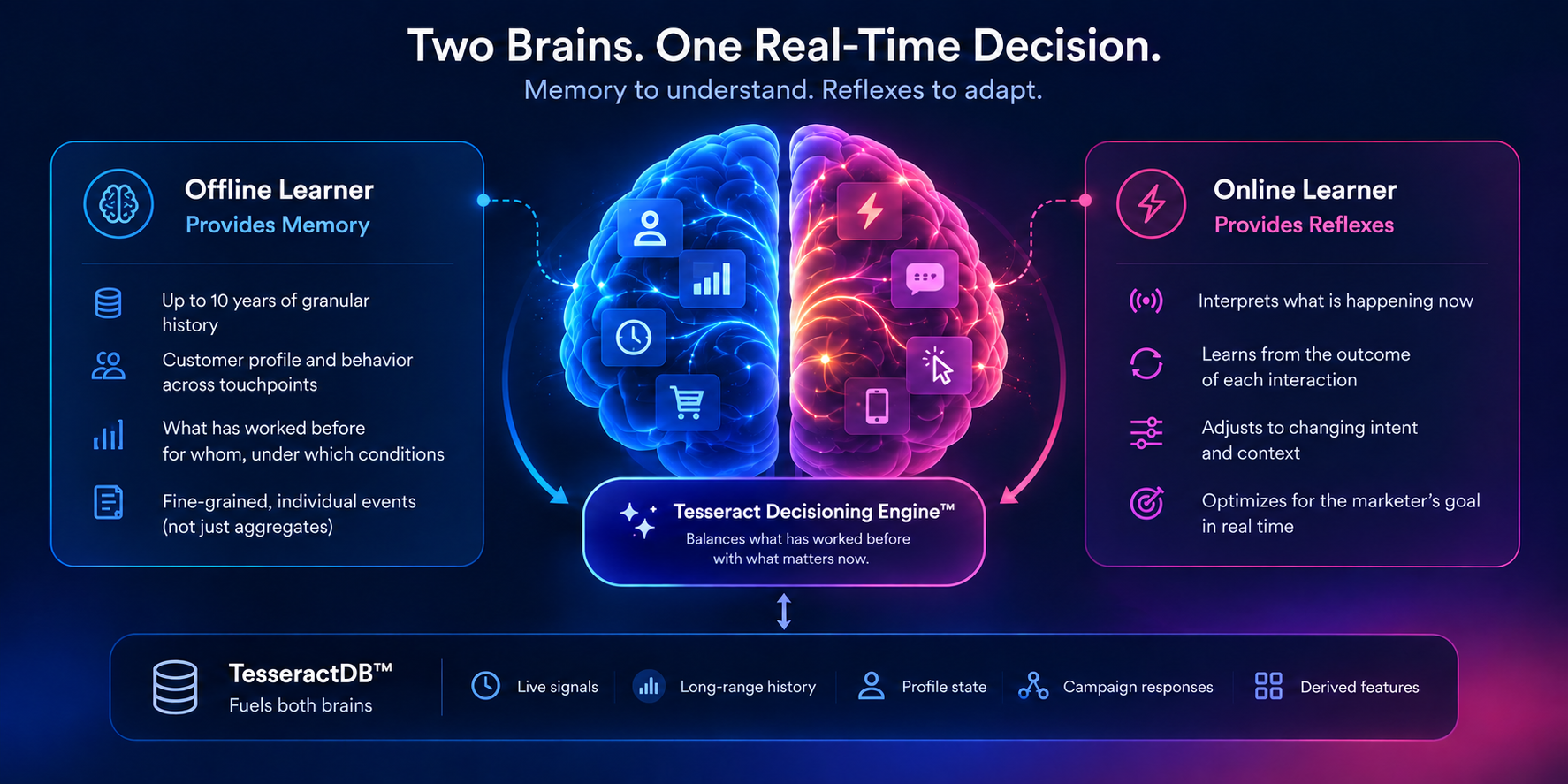
Inside CleverAI™’s decisioning layer, Tesseract Decisioning Engine™, the two forms of intelligence work together. The Offline Learner provides memory: a deep understanding of the customer, past interactions, and what has historically worked. The Online Learner provides reflexes: it adapts to what is happening now and learns from the outcome of the latest interaction.
The data layer, TesseractDB™, fuels both – giving the Offline Learner access to granular, long-range history while acting as the Online Learner’s nervous system for live signals. Privacy-preserving Clean Rooms can further enrich the engine’s understanding with relevant enterprise intelligence, without requiring the underlying raw data to move.
Together, the two brains enable the engine to balance what has worked before with what matters now. Marketers no longer have to choose between depth and recency – the platform delivers both simultaneously.
Brain One: Offline Learner Provides Memory
The Offline Learner draws on 10 years of granular history retained in TesseractDB™. Its advantage is not only how far back it can look, but how much detail it preserves.
Many systems can preserve years of customer history by compressing older data into aggregates. They may remember that a customer purchased in March, for example, while losing the individual events surrounding that purchase.
Those details, however, are crucial. There is far more intelligence in knowing which SKU they bought, at what price, on which device, after seeing which message, and what they did immediately before and after. Those details reveal relationships between behavior, engagement, and outcomes that aggregates can obscure.
By retaining individual events rather than only historical aggregates, TesseractDB™ gives the Offline Learner two dimensions of memory: granular data and an extended lookback period.
And this gives the decisioning engine a meaningful starting point. Think of it as the experienced part of the chess grandmaster. Each decision begins with accumulated evidence about what has worked, for whom, under which conditions, and toward which goal, not with random exploration.
Suppose a streaming subscriber finishes a thriller late at night. The completion event is current, but history helps interpret it. Have they been binge-watching this genre for weeks? Do they usually start another title immediately or return the next evening? Which genres have sustained their attention? Do they respond to push notifications at this hour, or have late-night messages historically led to opt-outs?
That said, even the richest memory has an unavoidable limitation: it describes patterns that existed before the present moment. If the model is periodically refreshed and then left unchanged, the decision may be highly personalized but already out of sync with the customer’s current reality.
The Offline Learner can say, “Given everything we have learned, this is what has historically worked for this customer and in similar circumstances.” It cannot, by itself, answer, “Given what is happening right now, is that still the best action?”
For that, the system needs a second brain.
Brain Two: Online Learner Provides Reflexes
The second brain learns online, much as the chess grandmaster adapts to the board in front of them. It takes in the latest customer signals and the outcomes of recent interactions, so the decisioning engine can weigh what has changed.
This is more than receiving real-time data. A platform can ingest an event immediately and still decide using a score refreshed yesterday or a fixed journey rule. Live data alone does not make the decision live.
Let’s go back to the streaming subscriber who usually starts another thriller after finishing one late at night. Tonight is different: they dismiss the suggested title and search for science fiction. That response gives the Online Learner new evidence about their present interest. If they instead close the app, that signal calls for a different assessment; it does not automatically justify another recommendation.
This is where TesseractDB™ plays a second role. The same data foundation that gives the Offline Learner years of granular memory also makes live behavior available to the Online Learner. To put it differently, the Offline Learner provides an intelligent head start; the Online Learner updates it with what is happening now.
Together, historical context and live signals inform decisioning on the same platform, without waiting for a separate data system to synchronize. The decisioning engine assesses whether to suggest a different title, wait until another visit, or do nothing. The latest signal matters because it is interpreted alongside the subscriber’s history, not in isolation.
Reflexes keep the decision as current as possible, allowing the system to respond to changes before a sensible action becomes an obsolete one. Yet reflexes also need memory. A system reacting only to the latest event can overcorrect, chase noise, or mistake a temporary behavior or isolated signal – one unusual browse or one ignored message – for a lasting change in intent.
The Online Learner can say, “This is what is happening now, and this is what happened when we last acted.” The Offline Learner helps answer, “What does that mean in the context of everything we already know?”
Live decisioning needs both for Live 1:1 Personalization: the memory to understand the customer and the reflexes to keep that understanding current.
How the Two Brains Come Together for Live 1:1 Personalization
The Tesseract Decisioning Engine™ runs on the two-brain model. Offline Learner provides a deep, bootstrapped understanding of customers and campaigns – rich customer profiles and what has historically worked. The Online Learner adapts from current signals and the outcome of the latest interaction.
Together, they help the decisioning engine deliver Live 1:1 Personalization – by ranking the best available action for this moment, this customer, against the marketer’s goal and guardrails.
The available choices may include a message, offer, recommendation, channel, moment, sequence, product experience, or deliberate silence. The best choice depends on the action that can improve the outcome compared with the alternatives.
Take two customers who abandon the same cart. Historical patterns may show that both usually respond to discounts. Live behavior may show that one has returned to the product page and is likely to complete the purchase unaided, while the other is repeatedly checking delivery information. The first customer may need no incentive. The second may need reassurance rather than a price reduction.
The two-brain model can make that distinction because the Offline Learner provides the learned baseline and the online learner updates it with the customer’s current behavior. The decision changes when the evidence changes.
This is also what makes uplift possible in practice. Uplift measures the additional effect of an intervention compared with what would have happened without it. Rather than target only the person most likely to act anyway,, the engine can learn which action is most likely to change the outcome for that person, including when no action is the better choice.
What Makes a Decision Live
“Real time” is often reduced to processing speed. But a fast response can still be based on a stale score, delayed synchronization, or a learning policy that updates only during the next retraining cycle.
A decision becomes live when the signal, the decision, and the resulting outcome remain part of one continuous loop. Memory and reflexes need a continuous path from evidence to decision to action to learning.
Putting memory and reflexes together is necessary, but a decision can still arrive too late if a live signal must leave the platform, wait to be scored, and return after the moment has passed. Keeping data, decisioning, and activation native to the same platform shortens these handoffs. This is foundational to how we have built CleverAITM. The decisioning happens inside the same request, without waiting for a synchronization cycle or an external round trip.
Two Brains, One Live Decision
A grandmaster brings years of study to the board, but still has to respond to the move just played. Memory without reflexes becomes stale. Reflexes without memory become shallow.
Customer engagement no longer has to choose between understanding the customer and responding to the moment. The Offline Learner supplies accumulated intelligence. The Online Learner keeps that intelligence current. TesseractDB™ fuels both, while the Tesseract Decisioning Engine™ turns their combined intelligence into the best action – or deliberate silence – for each customer.
That is the foundation of Live 1:1 Personalization with CleverAI™: every decision informed by both a memory and a reflex
Want to explore how CleverAI™ brings historical intelligence and online learning together for Live 1:1 Personalization?
Deliver Live 1:1 Personalization That Drives Higher Lifetime Value
Customer loyalty is built when engagement keeps pace with changing needs and behavior. With CleverTap’s AI-native Customer Retention Management Platform, powered by CleverAI™, you set the goals and guardrails while past context, live intent, and AI decisioning deliver Live 1:1 Personalization. Each outcome informs the next decision, helping curb churn, and maximize customer lifetime value.

Subharun Mukherjee 
Heads Cross-Functional Marketing.Expert in SaaS Product Marketing, CX & GTM strategies.
Free Customer Engagement Guides
Join our newsletter for actionable tips and proven strategies to grow your business and engage your customers.