






















Table of Contents
Categories
Most Popular


A shopper adds a pair of running shoes to her cart. Minutes later, she removes them, compares a more expensive pair, checks the delivery date, and applies a coupon.
From a distance, this looks like one customer with a stable interest in running shoes. In the moment, however, her needs keep changing. The recommendation that made sense when she first browsed may already be outdated. A cart reminder for the first pair would now be irrelevant. A discount that seemed necessary before she applied the coupon may only give away margin. And because she is moving toward purchase on her own, the best action to drive business uplift may be no action at all.
This is the real test of personalization: not simply whether a platform knows the customer, but whether it can recognize what has changed, reconsider the decision, and respond while the moment still matters.
That is where the distinction between native and bolt-on customer engagement architecture becomes consequential.
What Does AI-Native Mean for Customer Engagement?
AI-native customer engagement platform refers to platforms where AI is built into the platform architecture from the ground up – embedded into the very DNA of the platform – rather than bolted on as a separate layer on top of existing workflows.
That distinction matters because it changes the role AI plays.
In a bolt-on model, AI is added onto different parts of an existing engagement stack. It might generate campaign copy, predict a customer’s likelihood to purchase, recommend a product, determine the next-best action, or even personalize experiences for each customer. These can all be sophisticated AI capabilities.
AI-native goes further by making intelligence an integral part of how the platform understands and interprets customer data, makes decisions, takes action, and learns from the outcome. While that distinction may sound architectural, its ramifications go far beyond mere efficiency gains.
In the example of the shopper who was browsing running shoes, a platform might know her preferred brands, price range, past purchases, predicted conversion propensity, and preferred channel. With enough data and sophisticated AI models, both native and bolt-on approaches could potentially create a highly personalized recommendation for her.
Going back to where we started this example, within just a few minutes, the context behind the next best action has changed several times – what she wants, how close she is to purchasing, and whether she needs an intervention at all.
The question is no longer: Can the platform personalize for this customer?
It becomes: Can the platform continuously understand what this customer is doing now, reconsider the best action, and act while it still matters?
Live intent has a short half-life. The recommendation that made sense ten minutes ago may no longer be the right one. A discount that appeared necessary before she applied a coupon may now be unnecessary. A cart reminder that looked appropriate when she abandoned the first pair would be irrelevant after she moved on to another product. Sometimes, the best decision is to do nothing at all because the customer is already progressing toward conversion.
This is the difference between 1:1 personalization and Live 1:1 Personalization.
1:1 personalization answers: What is relevant for this individual customer?
Live 1:1 Personalization adds another dimension: What is relevant for this individual customer given what is happening right now?
Native Customer Engagement Platform: The Foundation for Live 1:1 Personalization
Generative AI can help produce copy, images, and journeys at a speed and scale no marketing team could match manually.
But content abundance has exposed a more difficult problem: If a platform can generate a thousand variations, which one should it use for this customer, on this channel, at this precise moment? Should it offer an incentive, provide reassurance, change the channel, wait, or take no action at all?
That is a decisioning problem, and solving it requires more than native AI. Native AI can undeniably create and optimize experiences at the individual level. But to make those experiences live, decisioning must also happen live and at the individual level – continuously determining the best action based on who the customer is and what they are doing now.
For this, the decisioning engine needs immediate access to the customer’s historical context and live intent, relevant content and action choices, the ability to execute across channels, and feedback on what happened next. Customer data, content generation, decisioning, execution, and learning therefore need to work together natively on the same platform.
This is the strategic difference between native and bolt-on customer engagement architecture. Both can deliver 1:1 personalization, but only native CEP can make it happen live – adapting the decision as quickly as the customer’s intent changes in the moment.
The Gaps Where Bolt-On Customer Engagement Platform Breaks
When customer data, decisioning, and execution sit across separate systems, they often rely on batch synchronization to exchange information. Customer data may sit in one system, models in another, content generation in a third, and channel execution in several more.
The problem isn’t that any individual system lacks intelligence. The recommendation engine may be excellent. The customer profile may be rich. The engagement platform may execute perfectly.
The problem appears in the spaces between them. Every handoff creates an opportunity for the customer’s reality to change before the stack catches up. A bolt-on CEP fails to keep up with the customer’s intent and behavioral change that happens live, in the moment.
It’s like a flipbook, which, when flipped fast enough, gives the illusion of motion, emulating real life, but it’s actually not – as opposed to a live video feed.
This creates four gaps that cause the platform to personalize against a version of the customer that no longer exists.
The signal-to-decision gap. The shopper suddenly switches from browsing running shoes to home essentials, but the decisioning system has not seen the new browse signal yet. It may therefore choose an action using the customer state available at the last synchronization rather than the state at the moment of decision. The same gap appears when a banking customer completes a repayment, a subscriber renews independently, or a telecom customer recharges before an offer is selected.
The decision-to-action gap. Even when the decision is correct, it can lose value while travelling back to the engagement platform for delivery. A discount coupon for running shoes may come after the shopper has made the purchase. A callback offer may arrive after a loan applicant has left the page. High-intent moments have a short shelf life.
The action-to-execution gap. This arises when the selected channel cannot act on the decision. Frequency rules, eligibility constraints, and activity on another channel may be applied inconsistently when execution is distributed across separate systems. A cart reminder is selected for WhatsApp, but gets sent even though the customer has already hit their messaging frequency limit through another system. Or a push recommends a new series even though the customer has already started watching it on another device.
The learning-loop gap. The customer converts, but the system does not learn that until the outcome is synchronized back. Until then, it cannot suppress an unnecessary follow-up or use the result to improve the next decision. Clicks, silence, abandonment, and conversion all lose learning value when they return too late.
Bolt-on CEP becomes a problem when the customer moves faster than the connections between them. And this is exactly why “native” becomes more than an architecture choice. It becomes the foundation for making personalization live and 1:1.
That said, these are not arguments against APIs or composable technology. Integrations remain essential across the enterprise. The issue is whether the live decisioning loop itself is fragmented. If the signal, decision, action, and outcome cross system boundaries during every interaction, latency and loss of context become properties of the architecture.
How Native Customer Engagement Platform Outshines Bolt-On
In a native customer engagement platform, customers’ past context and live relevance, decisioning, orchestration, AI, and learning to work together to provide the most complete, up-to-date picture possible at any given moment for decisioning to happen live, 1:1.
Instead of multiple platforms bolted on, it is one platform that understands past context, interprets what is happening now, determines the right action, executes it immediately, and learns from the outcome – without synchronization delays or information loss between systems.
Think of customer engagement as a continuous loop:
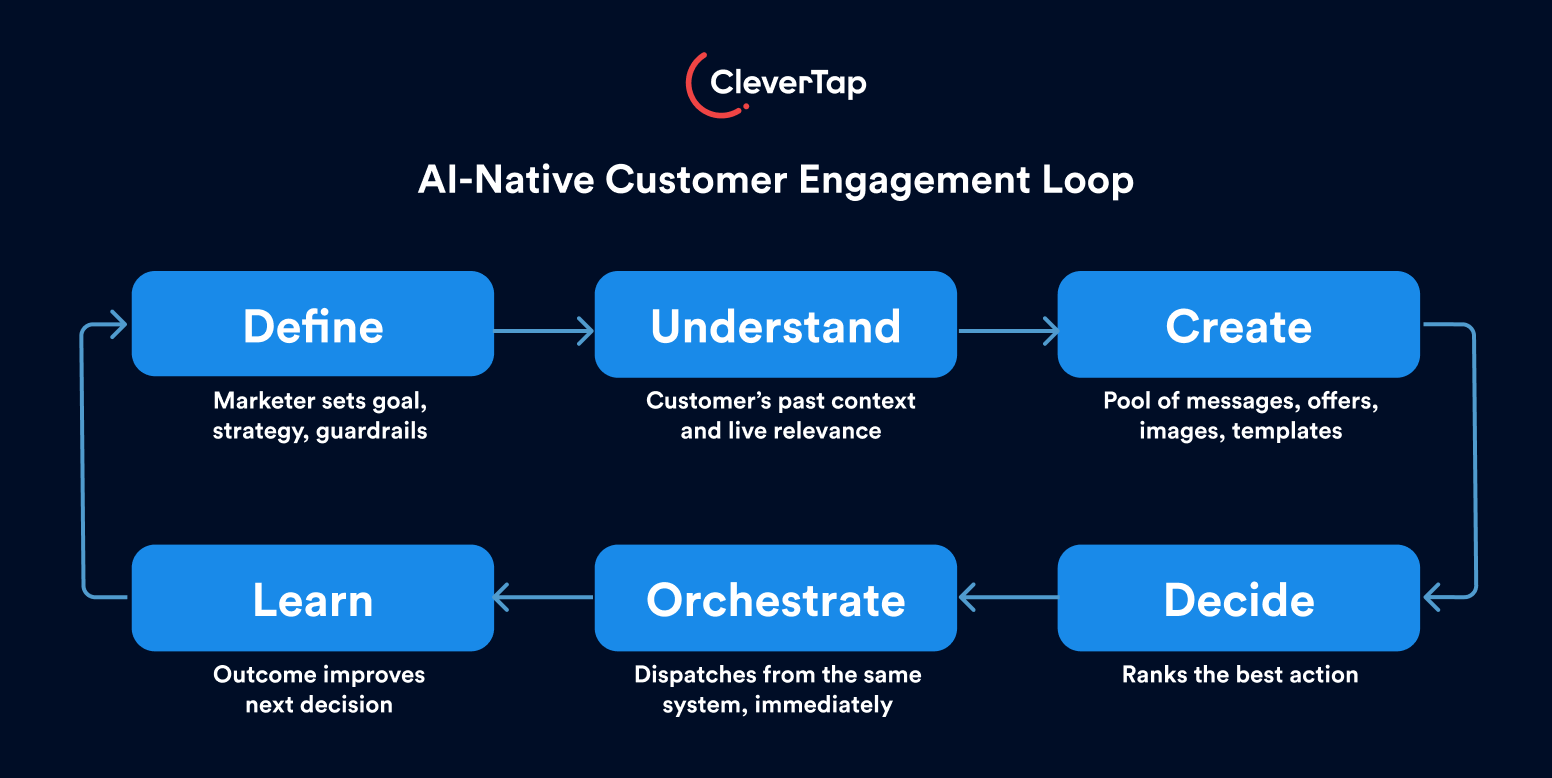
The word continuous matters. A new signal can trigger the system to reconsider what happens next, while every outcome becomes a new context that improves how it decides the next time. Learning is therefore not the end of the process. It reconnects the outcome to the next moment of understanding and decisioning.
The Plot Twist: No Action is the Best Action
Consider a financial institution that wants to improve the completion rate of personal loan applications. A marketer will set that as the business outcome on the native CEP, along with clear guardrails around eligibility, approved communications, frequency, and regulatory compliance.
Let’s say a customer begins a personal loan application but abandons at the income-verification step. That abandonment becomes a live signal. The data layer understands it alongside everything else it knows: the customer is eligible for the loan, has completed the preceding steps, and was actively progressing through the application moments ago.
Based on this information, AI-powered content creation supplies a current pool of messages, offers, images, and experiences that conform to brand rules.
The decisioning engine evaluates the live signal against the marketer’s goal and determines the intervention that is most likely to help the customer complete the application – perhaps offering a simpler verification path, a video explainer, or speaking to a customer representative. Then it ranks the best option from the available variants inside the same request, along with the best channel and send time for this particular customer.
Execution then turns the selected action into an experience on the appropriate channel without a separate handoff. If immediate assistance is likely to help, it could offer a callback while the application is still open rather than waiting to send an email the following day.
But then the story changes. Five minutes later, the customer returns and completes income verification independently.
That new signal changes the decision immediately. The planned callback or recovery message would now interrupt progress rather than support it. No action becomes the best action.
Whether the customer completes the application, accepts assistance, abandons again, or eventually takes the loan – that outcome returns to the same learning loop. It becomes the new information from which the system learns, improving subsequent decisions.
This is where a native CEP outshines a bolt-on one. It makes the customer engagement loop an intelligent, always-on, continuous system – so every new signal can inform what should happen now and every outcome informs what happens next, without letting critical information get lost or delayed between disconnected systems. It’s the architecture that knows the difference between the best action five minutes ago versus the best action now.
This also highlights why being AI-native is not sufficient on its own. For engagement to be truly live and 1:1, the platform must have data, AI, and execution as native layers that enable live 1:1 decisioning at the core. All these elements work together to serve a common goal, draw on the common information, and contribute outcomes to the same intelligence.
Native vs. Bolt-On CEP: The Differentiator is the Continuous, Live Intelligence
The native-versus-bolt-on debate can easily become a technology-stack discussion. But that misses the larger point.
The objective isn’t to eliminate integrations or consolidate software for its own sake. Nor does “native” mean that every external system suddenly becomes unnecessary.
What matters is keeping the core engagement loop – the past context required to understand the customer, the live signal to understand what matters to them now, the combined intelligence required to make the decision, the execution required to act on it, and the learning required to improve the next one – as continuous and real-time as possible.
A new, live customer signal then is not merely the data for the next campaign or system refresh. It is the missing piece that takes engagement from 1:1 Personalization to Live 1:1 Personalization.
Want to explore how this would look for your organization? Request a personalized demo today!
Master Your Seasonal & Holiday Campaign Strategy
Looking for inspiration to boost engagement and retention during key commercial moments? Check out our strategy guides:
- Creative Campaign Inspiration: Best Christmas Marketing Campaigns | Christmas Advertisement Examples
- Seasonal Planning: Holiday Marketing Ideas | December Marketing Ideas
- High-Impact Promotions: Halloween Marketing & Promotion Ideas | Thanksgiving Promotions | New Year Campaign Ideas
Deliver Live 1:1 Personalization That Drives Higher Lifetime Value
Customer loyalty is built when engagement keeps pace with changing needs and behavior. With CleverTap’s AI-native Customer Retention Management Platform, powered by CleverAI™, you set the goals and guardrails while past context, live intent, and AI decisioning deliver Live 1:1 Personalization. Each outcome informs the next decision, helping curb churn, and maximize customer lifetime value.

Subharun Mukherjee 
Heads Cross-Functional Marketing.Expert in SaaS Product Marketing, CX & GTM strategies.
Free Customer Engagement Guides
Join our newsletter for actionable tips and proven strategies to grow your business and engage your customers.