











































Table of Contents
Categories
Most Popular


Imagine driving while looking at a photograph of the road taken thirty seconds ago.
The photograph is not wrong. Thirty seconds ago, your lane was clear, the traffic looked manageable, and the road ahead was open. But you are not driving thirty seconds ago. A truck has moved into your lane, and the picture you are relying on has no way of knowing.
Much of personalization works in the same way. An OTT subscriber finishes a drama series finale at 11 p.m., an e-commerce shopper regularly buys skincare, and a banking customer explores a credit card. The platform captures that context and uses it to determine what happens next.
But the customer moves on quickly, often within seconds – the OTT subscriber starts searching for a horror movie, the skincare shopper browses baby products for the first time, and the banking customer receives a salary bonus and begins exploring home-loan pre-closure.
Yet the next message, recommendation, or journey continues to act on the earlier picture. Everything about the interaction may look personalized – the name is correct, the category affinity is accurate, and the channel and send time are optimized. The message can still be irrelevant because the decision was made for a moment that no longer exists.
This is the photograph problem: a perfectly personalized irrelevant experience. Most customer engagement platforms are good at capturing context. The harder challenge is using live signals to continuously reassess whether that context still matters.
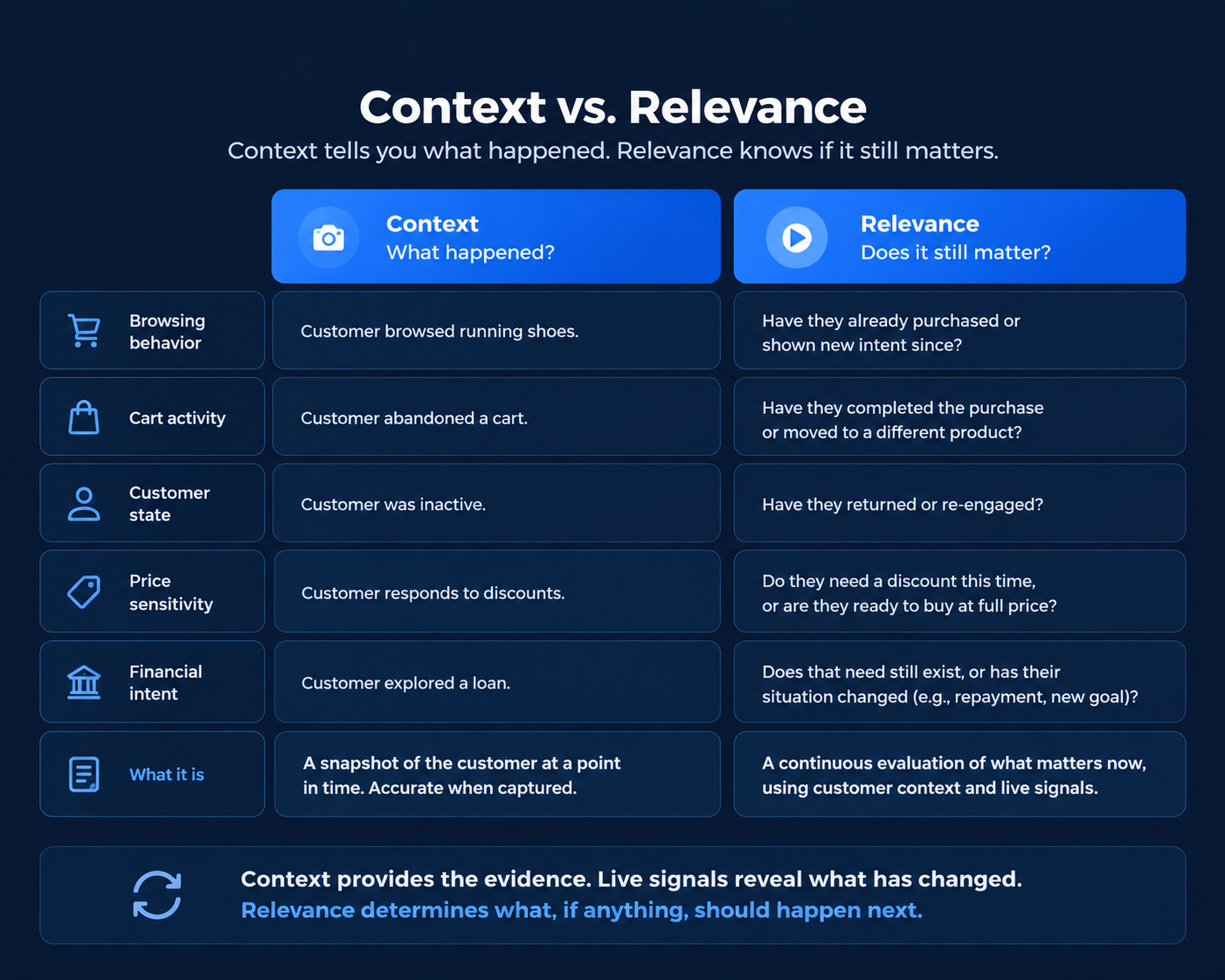
That is the shift from context to relevance. Context tells you what happened, while relevance asks if it still matters – right now, for this customer, against the business goal. And this needs to be continuously re-evaluated for Live 1:1 Personalization: deciding what, if anything, should happen next as the customer moves from one moment to another.
Context Can Be Accurate and Still Be Irrelevant
Contextual personalization was an important step forward. It moved marketing beyond broad audience blasts to sharper segments, making interactions more personalized through profile attributes, past purchases, browsing history, lifecycle stages, and predicted preferences.
While the progress was valuable and essential, it has also encouraged a dangerous assumption: if a platform knows enough about a customer, the resulting experience will automatically be relevant.
It will not. This is where the problem begins – a snapshot becomes a static piece of information for everything that follows.
A browse signal, segment, propensity score, or journey state may have been perfectly accurate when it was captured. But unless the platform keeps checking what has happened since, yesterday’s truth can continue shaping today’s experience.
The snapshot was not necessarily wrong. It became stale – its relevance expired. Relevant personalization therefore needs to continuously re-check that context against what is happening now – think a live video stream instead of a still frame.
That, however, should not be taken to mean that the historical context is not important – it remains indispensable. A platform cannot make an intelligent decision about the present without understanding the past that describes who the customer is – what they prefer, how their needs have evolved, which experiences they have responded to, and what the brand has already asked them to do.
Live 1:1 Decisioning: Relevance of Now
It is tempting to bridge the gap between stale context and live signal by increasing the frequency of data synchronization. Move from nightly updates to hourly ones. Then from hourly updates to every few minutes.
Faster data narrows the gap, but it does not close it. A more recent photograph is still a photograph if the platform continues to reuse a precomputed score, follow a fixed journey branch, or wait for another system before it can change the experience. The real test is whether the platform can determine what action matters the most for the customer based on the live signal and execute it while the intent it represents is still alive.
This is Live 1:1 Personalization.
Consider a shopper who adds the last available item to a cart. Their history may suggest that discounts work well. But the live signal suggests they may already be ready to buy, making no offer the better decision for protecting margin. Or consider a loan applicant who pauses at income verification. A generic reminder tomorrow may arrive too late – the relevant action could be an easier upload option, guidance on the required document, or a callback. But if the customer returns and completes the application within 10 minutes, the best action would probably be no action.
In each case, the original context may have been perfectly accurate when captured. Relevance requires continuously checking whether it still applies.
Relevant personalization, therefore, needs to constantly keep up with changing signals – not only from one customer to another, but from one moment to the next for the same customer. So for live 1:1 personalized experiences, the customer engagement platform also needs to continuously decide the next best action as the customer intent keeps changing in real time.
This is essentially live 1:1 decisioning – decisions that must be reconsidered for a customer whenever a meaningful new signal arrives. And this can only be achieved with an AI-native customer engagement platform, where customer historical context, live signals, AI decisioning, and execution operate as one.
AI-Native Customer Engagement Platform for Live 1:1 Decisioning
Live 1:1 decisioning is difficult to achieve when customer history, live data, AI decisioning, content, and channel execution operate as separate layers connected through periodic synchronization.
Every handoff creates a gap. A new signal may arrive after customer data was exported. The decision may be made on an outdated profile. The selected action may wait to be passed back to an execution platform. The customer’s response may return too late to suppress the next message or improve the next decision.
The result can be sophisticated personalization based on a version of the customer that no longer exists.
An AI-native customer engagement platform performs decisioning live and at the individual customer level by keeping the core loop connected on the same platform. Customer context establishes what has been true, live signals reveal what is changing, AI decisioning ranks the available actions against the business goal, agentic orchestration turns the selected decision into an experience, and continuous learning makes the outcome part of the next decision.
This is the foundation of Live 1:1 Personalization: deciding for the individual customer, using both historical context and live signals, and acting while the moment is still alive.
To learn more, read our blog “Native vs. Bolt-On: Why AI, Customer Data, Decisioning, and Engagement Belong Together”
The Marketer Still Defines Goals and Guardrails
Live 1:1 decisioning does not mean responding to every signal or handing the customer relationship to an unconstrained model. The newest event is not always the most important, and the fastest action is not always the best one.
Marketers remain responsible for defining the outcome worth pursuing and the boundaries within which AI can pursue it. That may include profitable conversion, completed onboarding, sustained retention, or lower service cost, along with constraints around eligibility, frequency, incentive spend, channel use, brand standards, customer experience, and risk.
Those choices give relevance a business definition. Relevance is not simply whatever signal happened most recently. It is the action that makes the most sense now, given the customer’s evolving context, the outcome the brand is trying to achieve, and the guardrails within which AI can act.
For a retailer, the relevant decision may be withholding a discount from someone already likely to purchase. For a bank, it may mean suppressing an offer that no longer fits the customer’s current need. For a streaming service, it may mean making a recommendation now and choosing no action tomorrow.
The customer engagement platform needs to drive live 1:1 decisioning within those goals and guardrails for it to be truly relevant and meaningful. Marketers decide the destination, the acceptable routes, and the boundaries that should not be crossed.
How CleverAITM Continuously Determines What is Relevant
CleverAI™, the intelligence layer of our AI-native customer engagement platform, combines live customer behavior with 10+ years of historical data, profile attributes, campaign responses, and derived features, such as average order value (AOV) and affinity.
While marketers are forced to trade recency against depth with bolt-on platforms, CleverAITM delivers both simultaneously – what has been true over time and what appears to be true now. What’s more, the data layer is updated in real time, not in batches – so at any given point in time, it provides the most complete picture of a customer.
The platform uses this information to generate possible messages, offers, recommendations, channels, moments, and experiences. CleverAI™’s Tesseract Decisioning Engine then evaluates these options against the customer’s context, live signals, and business goal – continuously reassessing which option is most relevant now and most likely to improve the desired outcome.
The selected action is then orchestrated across the appropriate channel or product surface while the customer’s intent still matters.
Every customer response, including a click, conversion, dismissal, continued inactivity, or independent completion, then becomes new information that goes back into the platform. The platform uses it to reassess what should happen next rather than waiting for the next campaign cycle or scheduled model refresh.
This is what makes relevance dynamic. The latest signal does not simply update the customer profile; it can change the decision about what should happen next.
Context and Relevance Together Power Live 1:1 Personalization
The photograph will always matter. Customer context gives every decision evidence to work with: what someone has done, preferred, purchased, ignored, responded to, and needed over time. But context should not become a conclusion that keeps being applied indefinitely.
The stronger standard is relevance: does what we know about this customer still matter now, given everything that has happened since and the outcome we are trying to achieve?
Answering that requires both customer context and live signals. Historical context without live signals can keep a brand reacting to a moment that has already passed. Live signals without historical context can make every new behavior look more important than it really is.
Live 1:1 Personalization brings the two together. It continuously re-evaluates what is known against what is happening now, then decides whether to act, how to act, or whether the most relevant decision is no action at all.
Because the goal is not simply to know the customer better but to know whether what you know still matters.
Ready to move from contextual personalization to live relevance? [Request a demo →]
Ready to move from contextual personalization to live relevance?

Subharun Mukherjee 
Heads Cross-Functional Marketing.Expert in SaaS Product Marketing, CX & GTM strategies.
Free Customer Engagement Guides
Join our newsletter for actionable tips and proven strategies to grow your business and engage your customers.