


















Table of Contents
Categories
Most Popular


If you’re evaluating a competitor or alternative to Insider, you’re comparing more than features.
You may have achieved early success with app marketing and now want to scale growth further. At any stage, a platform that doesn’t fit your stack creates debt you’ll repay later, draining your marketing budget and your team’s time.
The cost of a wrong choice makes this evaluation worth doing carefully. This guide helps you identify the best alternative and shows you what to look for when comparing platforms.
TL;DR
The best Insider alternative in 2026 is CleverTap for mobile-first B2C brands unifying analytics, engagement, and AI.
Other alternatives on this list include:
- WebEngage: For web-led growth-stage consumer brands
- Bloomreach: For retail and e-commerce, mid-market to enterprise
- MoEngage: For cross-channel B2C engagement with growing AI
- Netcore Cloud: For Consumer brands in India and Southeast Asia
- Braze: For Data-mature media, D2C, and enterprise consumer brands
- Iterable: For Email- and SMS-led D2C and media lifecycle teams
- Salesforce Marketing Cloud: For enterprises invested in the Salesforce ecosystem
Insider procurement data pegs the average contract at about $48,210 a year. That is a significant commitment for a product that may not fit your use case and stack, which makes a structured evaluation worth the effort.
Note: The company rebranded to Insider One, and G2 and Gartner now list it under that name.
What to Look for in an Insider Alternative
You can’t compare platforms if every product gets scored on a different rubric. The six criteria below hold all eight platforms in this list to the same standard. They also double as the questions to bring into every demo.
Customer Data and Segmentation
Start every demo by examining how the platform understands a customer. Every vendor claims a 360-degree view. The real test is recency and depth.
Check if the segmentation runs on live behavior or attributes imported last quarter. After all, customers aren’t static labels.
Ask:
- How quickly does a new action update a segment?
- How much behavioral history stays queryable before a platform archives it or samples it?
You need a long memory to identify churn patterns and purchase cycles. They might not reveal themselves in a 30-day window.
Omnichannel Engagement
Map where your customers actually spend their attention.
Reviewers on TrustRadius note that platforms skew mobile-centric or web-centric even when their feature lists look identical.
For app-led brands, the competitive benchmark for customer experience often extends beyond their own category. Customers compare the quality and relevance of every digital experience they receive, regardless of industry. Channels only compound value when a coordination layer connects them.
That coordination layer is journey orchestration.
Journey Orchestration
Test how journeys adapt, not how the builder looks. Most platforms draw similar flowcharts, so the differences surface in arbitration.
Check what happens when a user qualifies for three campaigns at once, whether frequency caps hold across channels, and whether a journey re-routes when behavior changes mid-flow.
An orchestration tool that cannot decide between competing messages automates noise at scale.
Personalization and AI
AI-first personalization is often equated with AI content generation, but generation is only one part of it. The bigger impact comes from AI decisioning. It determines who should receive a message, on which channel, and at what time, and whether to send anything at all.
A strong platform combines AI decisioning with AI-first content generation. For example, if a user is about to churn, AI needs to be equipped to create the right offer for them to bring them back in real time. Add guardrails to prevent excessive offers that erode profitability.
Ask vendors to show the model’s decisions, not just the content output.
Analytics and Experimentation
You need a clear way to look at how campaigns tie to revenue. Opens and clicks confirm that the message was delivered, not that it made an impact. Incrementality is becoming the credibility standard for measuring a campaign’s actual contribution. See if the platform can measure it.
Look for cohort and funnel analytics native to the platform, holdout groups on journeys, and experimentation that goes beyond subject-line A/B tests.
If proving lift requires exporting data to a separate BI stack, factor that workload into the total cost. Total cost also depends on what the platform includes out of the box.
Integrations and Scalability
Check what the price includes before comparing prices. Engagement platforms typically charge on monthly active or billable users, and modules like analytics, a CDP, or predictive AI often price separately.
If a platform consolidates those layers, it can cost less than a cheaper core surrounded by paid add-ons. You also need to look at how event volume limits, API rate limits, and segment build times hold up past 10 million profiles.
8 Best Insider Competitors and Alternatives
Every platform below gets evaluated against the above six criteria. The considerations for each platform are grounded in third-party reviews on platforms such as G2 and TrustRadius.
| Platform | Best For | Standout Capability | G2 Rating |
| CleverTap | Mobile-first B2C brands unifying analytics, engagement, and AI | TesseractDB™ behavioral depth + CleverAI™ decisioning | 4.6/5 |
| WebEngage | Web-led growth-stage consumer brands | Full-stack retention across web and email | 4.5/5 |
| Bloomreach | Retail and ecommerce, mid-market to enterprise | Native CDP fused with commerce and product discovery | 4.6/5 |
| MoEngage | Cross-channel B2C engagement with growing AI | Analytics-led journeys across app and web | 4.5/5 |
| Netcore Cloud | Consumer brands in India and Southeast Asia | Email strength within broader engagement channels | 4.5/5 |
| Braze | Data-mature media, D2C, and enterprise consumer brands | Canvas journey orchestration on streaming data | 4.5/5 |
| Iterable | Email- and SMS-led D2C and media lifecycle teams | Cross-channel journey building | 4.4/5 |
| Salesforce Marketing Cloud (Agentforce Marketing) | Enterprises invested in the Salesforce ecosystem | Suite depth across the Salesforce stack | 4.0/5 |
1. CleverTap
CleverTap is an all-in-one customer engagement platform for B2C brands that want customer understanding and engagement in one system rather than a stitched stack.
Its foundation is TesseractDB™, a database purpose-built for engagement data. It keeps granular, user-level behavior queryable over long periods, so RFM models, cohorts, and predictions draw on full customer history instead of recent snapshots. CleverTap’s fair-usage terms allow up to 10,000 data points per user with a 10-year lookback, so a purchase from two years ago can still shape today’s segment.
Real-time segmentation feeds omnichannel Journeys across push, in-app, email, SMS, WhatsApp, RCS, and web. CleverAI™ layers predictive, generative, and agentic AI on top: Prediction scores churn and conversion likelihood, Scribe generates campaign content, and IntelliNode runs continuous experimentation across journey paths to converge on the best performer.
Funnels, cohorts, and retention analytics are native, so measurement lives where campaigns run.
These capabilities compound in sequence rather than operate as modules. TesseractDB™’s long memory sharpens segmentation, real-time segments keep Journeys responsive across channels, and CleverAI™ turns both into decisions about who to reach, where, and when. Analytics then close the loop: funnels and cohorts show what worked, and IntelliNode routes traffic toward the winning journey path automatically.
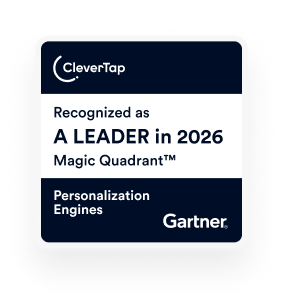
External validation supports the architecture. Gartner named CleverTap a Leader in the 2026 Magic Quadrant for Personalization Engines, the same market in which Insider One is evaluated. The platform rates 4.6 out of 5 on G2 and 4.4 out of 5 on Gartner Peer Insights for Mobile Marketing Platforms, and more than 2,000 brands run engagement on it, including Burger King, AJIO, SonyLIV, and IKEA.
Fashion e-commerce brand AJIO achieved a 4x increase in conversions with CleverTap-powered omnichannel engagement.
Best for: Mobile-first brands in e-commerce, fintech, QSR, travel, media, and gaming that want segmentation depth, orchestration, and AI decisioning in one platform.
2. WebEngage
WebEngage positions itself as a full-stack retention operating system spanning web and mobile engagement, with journey design, on-site personalization, and a built-in customer data layer.
It rates 4.5 out of 5 on G2, with a sizeable base among D2C, edtech, and consumer BFSI brands, particularly in India and emerging markets. Reviewers comparing the category on TrustRadius describe WebEngage as more web-centric, while CleverTap skews mobile, a useful signal when matching a platform to your channel mix.
Best for: Growth-stage consumer brands whose engagement runs primarily through web, with mobile as a supporting channel.
Consideration: WebEngage has thin analyst validation in personalization engines. You need to pressure-test support responsiveness and infrastructure reliability during evaluation.
3. Bloomreach
Bloomreach approaches engagement from commerce. Its engagement product pairs a native CDP with marketing automation. The wider platform adds product discovery and search, so merchandising and marketing run on the same customer data.
It rates 4.6 out of 5 on G2 and 4.5 out of 5 across 303 ratings on Gartner Peer Insights for Multichannel Marketing Hubs.
Best for: Retail and e-commerce brands from mid-market to enterprise, especially where product data and customer data need to work together.
Consideration: The commerce focus is both the appeal and the boundary. Brands in fintech, media, gaming, or subscription apps should confirm that its use cases, benchmarks, and integrations extend convincingly beyond retail before shortlisting it.
4. MoEngage
MoEngage is a customer engagement platform that combines analytics, personalization, journey orchestration, and cross-channel messaging.
Functionally, it overlaps heavily with CleverTap; TrustRadius reviewers who compare the two estimate around 90% feature overlap and choose based on channel emphasis and pricing. It rates 4.5 out of 5 on G2.
Best for: E-commerce, fintech, and media brands wanting cross-channel engagement with a growing AI decisioning layer.
Consideration: Some reviewers flag UI friction and occasional lags once campaign volume scales. Run high-volume scenarios in your trial rather than judging from a sandbox.
5. Netcore Cloud
Netcore Cloud spans email, SMS, push, WhatsApp, and on-site personalization for consumer brands, with particular strength in email programs. It rates 4.5 out of 5 on G2, with a concentrated base in e-commerce, retail, and consumer BFSI across India and Southeast Asia.
Best for: Consumer brands in those regions that want dependable email performance alongside broader engagement channels.
Consideration: There’s less analyst evidence for Netcore from firms like Gartner. This isn’t evidence of weakness. It shifts more diligence onto your own proof of concept, especially for advanced AI and journey capabilities.
6. Braze
Braze centers on real-time customer data, cross-channel messaging, and journey orchestration through Canvas, its visual flow builder, with AI applied to decisioning and optimization. It carries a rating of 4.5 out of 5 on G2, and it appears in the vendor roster of Gartner’s Magic Quadrant for Multichannel Marketing Hubs.
Best for: Media, D2C, and enterprise consumer brands with engineering support and a data-mature stack.
Consideration: Braze concentrates on messaging and orchestration, so evaluate what surrounds it. Teams often pair it with separate analytics or warehouse tooling, and that composability is a design choice for some stacks and an extra cost line for others.
7. Iterable
Iterable is a cross-channel marketing platform built around email- and SMS-led lifecycle programs, with journey building, experimentation, and expanding AI features across email, SMS, push, and in-app. It rates 4.4 out of 5 on G2, still firmly positive but the lowest of the mid-market-native set here, and it appears in Gartner’s Multichannel Marketing Hubs vendor roster.
Best for: D2C, ecommerce, and media brands whose lifecycle engine runs on email and SMS first.
Consideration: Independent review commentary on Iterable is thinner than for its larger peers, so treat this as a capability-fit evaluation. If a mobile app is your center of gravity, compare its push, in-app, and mobile analytics depth directly against mobile-first platforms in a trial.
8. Salesforce Marketing Cloud
Salesforce Marketing Cloud, which G2 now lists as Agentforce Marketing following Salesforce’s rebrand, is the enterprise suite option on this list. Its appeal is ecosystem depth for organizations already running sales and service on Salesforce. The trade-off shows in the ratings: 4.0 out of 5, the largest base and lowest score here, and 4.0 out of 5 across 60 ratings for its personalization product on Gartner Peer Insights.
Best for: Enterprises with dedicated admin and developer resources that value suite depth over speed of execution.
Consideration: Modular products, per-module pricing, and implementation weight mean time-to-value depends heavily on the team around the platform. You must budget for expertise over and above the licenses.
How to Choose the Right Insider Alternative
Use the following guidelines to pick the best-fit Insider alternative.
Start with Your Primary Engagement Use Cases
Write down the five campaigns that drive most of your retention revenue before any demo. Then ask each vendor to build one of them live.
A lifecycle marketing instructor at Treford observed that most engagement tools converge on similar features, and the real differentiator is the logic and thinking behind journey design. A platform that makes your highest-value use cases fast beats one that scores higher on a feature matrix.
Compare Real-Time Data and Segmentation Needs
Quantify how fresh your segments need to be. Cart abandonment and onboarding nudges need second-level recency. Win-back and loyalty programs need long behavioral memory. Strong evaluations test both extremes: trigger a message from a live event, then build a segment from behavior older than a year.
Platforms differ sharply on the second test because of how they store and price historical data.
Evaluate Journey and Channel Complexity
Match the platform’s channel center of gravity to yours. An app-first brand and a web-first brand can shortlist the same names and need different winners.
Count the channels you will actually run over the next 18 months, then test cross-channel frequency capping and journey arbitration across exactly those channels.
Consider AI and Personalization Requirements
Ask every vendor to separate decisioning proof from content demos. Copy generation is now table stakes. The harder capabilities are churn prediction accuracy, send-time optimization lift, and automated experimentation across journey variants.
Request measured results from comparable customers, and treat vague AI claims as a signal to dig deeper.
Assess Analytics and Experimentation
Decide where measurement will live before you buy. Native funnels, cohorts, and holdouts reduce dependence on a separate BI stack. Then match experimentation design to your traffic reality.
Mobile growth advisor Thomas Petit argues that low-traffic teams should take bigger multivariate swings instead of running one-variable tests that never reach significance.
A capable platform supports both modes.
Review Implementation and Integration Requirements
Price the migration. Bastian Bergmann, COO of Solsten, recalled a major brand’s early engagement program failing over “a skills gap that was far too vast for us to bridge.” Audit whether your team can run the platform without permanent vendor services.
Retention agency co-founder Nikki Tuman adds that partners pushing you to rip and replace your stack on day one “should be a red flag.” Favor platforms that connect to your existing warehouse, attribution, and support tools instead of demanding replacement.
Consider Long-Term Scale
Model costs at three times your current user base. Platforms priced on monthly active users behave very differently at 2 million profiles than at 20 million, and add-on modules compound the difference. Get the pricing curve in writing, confirm event and API limits, and check how segment build times hold at your projected scale.
The right platform gets more valuable with your data, not more expensive faster than your revenue.
Why CleverTap Is a Strong Alternative to Insider
For a team evaluating Insider, CleverTap’s case consolidates into three arguments. First, behavioral depth: TesseractDB™ keeps granular customer behavior queryable over long periods, so RFM models, predictive audiences, and churn intelligence draw on complete histories rather than recent snapshots.
Second, consolidation: segmentation, Journeys, CleverAI™ decisioning, and retention analytics ship in one platform, so there are no separately priced modules to assemble, and proving lift does not require a second stack. Third, continuous optimization: IntelliNode experiments across journey paths automatically, converging on the best performer without a manual A/B queue.
These strengths show up in customer outcomes:
- HDFC ERGO achieved 2x higher conversions on its Here App by moving from broad user groups to dynamic, real-time segments.
- Parco, an urban mobility app, lifted Prime subscriptions by 28% through RFM-based lifecycle journeys.
- Brevistay grew overall sales by 15%, with co-founder and CMO Aditya Naithani crediting segmentation and automation.
For B2C brands whose growth depends on converting behavioral data into retention, CleverTap compresses the stack Insider buyers often assemble from parts: analytics, CDP-grade profiles, orchestration, and AI decisioning in one system.
Make an Informed Choice
The best Insider alternative is the one that fits your engagement requirements, data maturity, channels, and operating model. Every platform here is credible, and the ratings prove it. The difference comes down to how well each converts your customer data into measurable engagement outcomes at your scale.
Shortlist two or three, bring your real use cases into the trial, and measure lift with holdouts. The platform that survives that test is your answer.
See how CleverTap can help you build personalized customer journeys and improve engagement and retention
Deliver Live 1:1 Personalization That Drives Higher Lifetime Value
Customer loyalty is built when engagement keeps pace with changing needs and behavior. With CleverTap’s AI-native Customer Retention Management Platform, powered by CleverAI™, you set the goals and guardrails while past context, live intent, and AI decisioning deliver Live 1:1 Personalization. Each outcome informs the next decision, helping curb churn, and maximize customer lifetime value.

Agnishwar Banerjee 
Leads content and digital marketing.Expert in SaaS sales, marketing and GTM strategies.
Free Customer Engagement Guides
Join our newsletter for actionable tips and proven strategies to grow your business and engage your customers.