
















































Table of Contents
Categories
Most Popular


For a growth team, the week can start to feel like a loop.
Build the segment. Create the offer matrix. Write the copy. Assemble the journey. Set the send time. Check the channel rules. Review the results. Then start again for the next lifecycle campaign, drop-off flow, or calendar moment.
AI has made parts of this process significantly faster – generating content and creatives, recommending audiences, summarizing reports, or suggesting journeys in seconds. These are meaningful efficiency gains. For teams managing dozens of campaigns across several channels, removing even one manual step creates real capacity.
But making individual tasks faster does not change the operating model. A marketer still has to connect the pieces, define every branch, and rebuild the experience campaign by campaign. As personalization becomes more granular – for each customer, each interaction – the number of decisions and content variations grows faster than any team can configure manually.
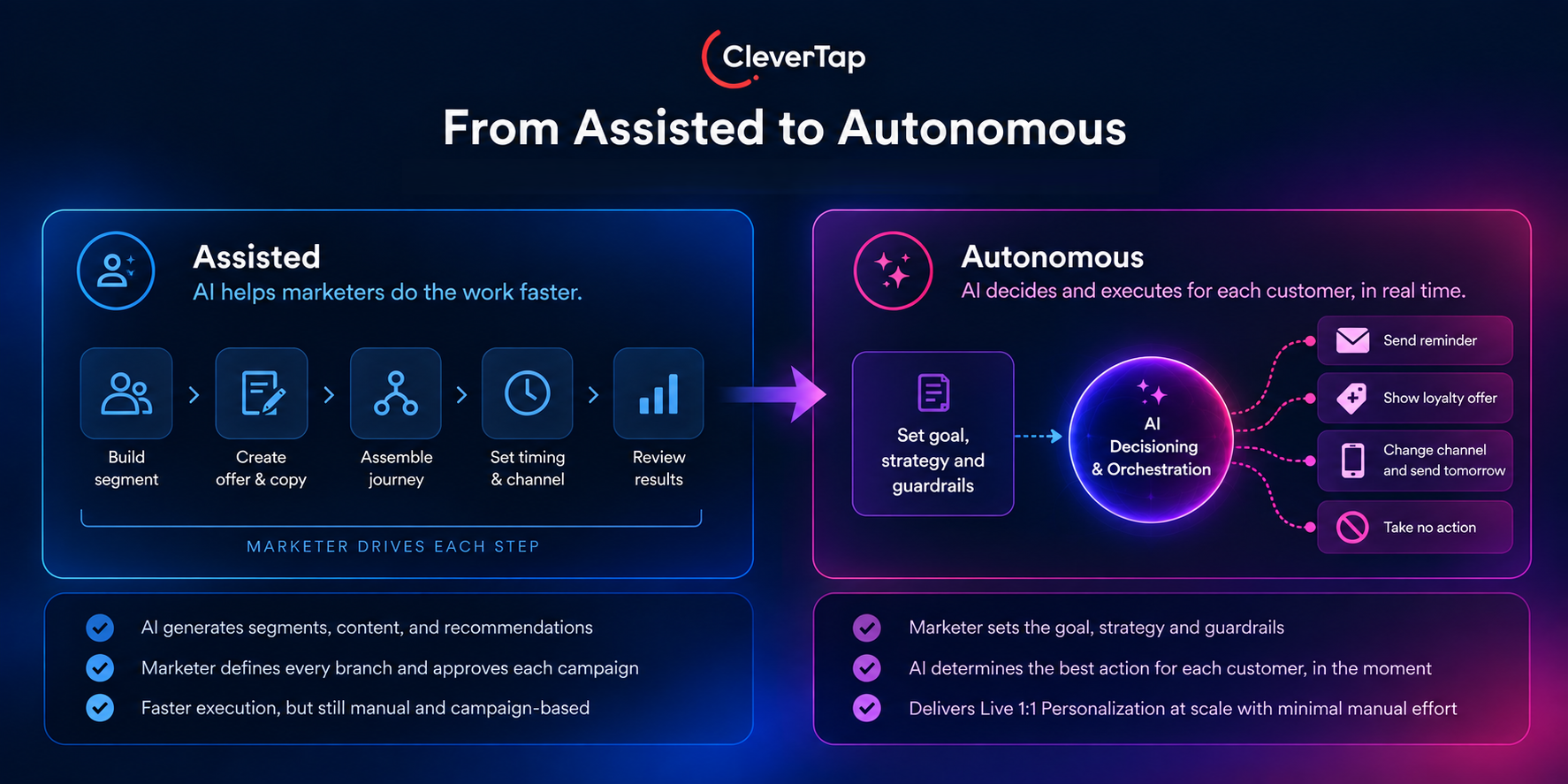
The shift from assisted to autonomous changes how that work gets done, and which responsibilities AI takes on. Instead of manually constructing every path a customer could take, marketers define the business goal, strategy, and guardrails. AI then moves beyond content generation and task automation to take on more decisioning and execution responsibilities.
At the assisted stage, AI takes on repeatable work – building segments, producing reports, generating copy and creative, assembling journeys, or recommending timing and channels – while customer-facing actions remain subject to human review.
For marketers, this shifts the work from executing each task themselves to delegating more of that to AI and reviewing the output. This enables the team to launch faster, create more variants, and spend less time on production tasks that repeat with every campaign.
Requiring human review of every action, however, becomes a constraint as personalization moves toward live 1:1. Even in the same segment, one customer may need a reminder, another may respond better to a recommendation, a third may require reassurance rather than an incentive, and someone else may already be returning and should receive nothing. Each decision may call for a different message, offer, channel, moment, sequence, or product experience.
A team can manually design a few journeys for a few segments. But it cannot realistically design a different sequence of decisions for millions of customers whose intent, context, and behavior are constantly changing.
To achieve Live 1:1 Personalization, teams need more than faster campaign assembly or automated creation of copy, images, and variants. They need an AI system that can take on decisioning at the individual customer level – determining the best action for this customer, in this moment, against the business goal.
That said, AI assistance provides the foundation for this evolution. Teams learn where AI performs reliably, where human judgment remains essential, and which rules need to become explicit before more responsibility can be delegated.
Autonomous AI: When AI Takes On the Decision
In the autonomous stage, AI determines and executes customer-level actions within approved goals and guardrails, without a marketer reviewing each action before it happens.
Consider a streaming service aiming to increase subscription renewals while limiting unnecessary discounts. One subscriber might need a renewal reminder. Another might benefit from a loyalty offer. For a third, the system might delay the reminder until tomorrow morning and use a different channel. For someone likely to renew without intervention, the best action could be no action.
The autonomous AI system evaluates which action is most likely to advance the renewal goal for each subscriber, then turns that decision into a customer experience suited to the right channel, format, tone, and moment. The marketer does not disappear from this process but moves up a level – from specifying every action to defining what good looks like.
Autonomous Engagement: Decisioning and Agentic Orchestration
Delivering Live 1:1 Personalization requires customer data, decisioning, and execution to be native to the customer engagement platform, so that it can act on the current moment and learn from the response. In that architecture, decisioning and execution are two key areas where AI can work autonomously.
Decisioning determines what should happen for this customer now. It evaluates the available actions based on the customer’s historical context and live intent, and against the business goal. The answer could be a recommendation, offer, service intervention, channel change, different moment, or deliberate silence.
Execution via agentic orchestration translates that decision faithfully into a tailored customer experience: an email subject line, concise push copy, or a banner, depending on what the decision calls for. AI agents adapt the expression to the selected channel and format, while preserving the decision and brand tone.
If that translation fails, even a sound decision can result in a poor customer experience. The customer sees only the result: a message that feels awkward, off-tone, or out of place. The agents’ role, therefore, is to preserve the decision while adapting how it is expressed and executed.
In short, decisioning determines what should happen, and agentic orchestration makes it happen. The resulting outcome feeds back into the learning loop. In an AI-native platform, that loop remains continuously connected, allowing each outcome to inform what happens next.
Autonomy is Earned Through Trust
The shift from assistance to autonomy is a progression, not a switch.
For many organizations, especially those operating in regulated categories or with complex approval processes, autonomy should not be switched on overnight just because the technology is available. The progression is gradual because greater autonomy requires evidence that the system can operate safely within its boundaries.
Businesses should not simply ask, “Can the AI do this?” Instead, to ensure the AI system functions as intended, they should ask, “What would need to be true for us to trust AI to do this without reviewing every decision first?”
And the answer changes as autonomy increases. At CleverTap, we think about this progression as a Trust Ladder.
At the Assisted stage, AI drafts, predicts, and recommends, but every action is reviewed by the marketer before it reaches the customer. Individual-decision explainability must make that review possible.
At the Co-Pilot stage, marketers approve at defined checkpoints or in batches rather than reviewing every individual action. This requires guardrails strong enough to support batch approval, an audit trail for retrospective checks, and automatically enforced frequency controls.
At the Autonomous stage, AI makes and executes customer-level decisions in real time within the approved goal and guardrails. Real-time override capabilities, blast-radius limits that contain the impact of an incorrect decision, and continuous anomaly monitoring must be in place.
For teams to delegate greater responsibility, they need evidence that the system can operate reliably at the next level of autonomy. But moving up the ladder should not require rebuilding the engagement architecture each time. Governance therefore needs to be part of the architecture itself, not a review layer bolted on at the end.
That means controls such as predefined guardrails, auditability, automated enforcement, monitoring, and human intervention need to be built into the underlying platform.
The Marketer Moves From Execution to Direction
There is an understandable anxiety whenever we talk about autonomous marketing: If the system decides and executes, what is left for the marketer?
Autonomy does not remove the marketer from the equation, but changes where their judgment matters most. A platform can optimize only for the goal it has been given and within the boundaries that have been defined. Marketers remain responsible for defining those goals and boundaries:
What outcome should we optimize for? What trade-offs are acceptable? What does the brand stand for? Where should AI never act without approval? How much autonomy has the system earned?
These are not trivial marketing questions, but they form the very foundation for ensuring the AI system operates as intended.
The shift from Assisted to Autonomous therefore changes the marketer’s center of gravity. Instead of executing every step themselves, marketers take the helm – setting the engagement strategy, defining the boundaries, and directing AI toward the business goal.
How CleverAI™ Supports the Move from Assisted to Autonomous AI
CleverAI™ brings decisioning and agentic orchestration together on the same platform, providing the foundation for the progression from assistance toward greater autonomy.
Marketers define the business goal, strategy, and guardrails. The platform’s native architecture creates a connected loop from customer context to decision to execution to learning:
TesseractDB™, the data layer, provides the customer intelligence behind each decision, combining long-range history with live behavior, profile state, and campaign responses.
CleverAI™ Creators generate copy, images, templates, and variants within brand rules.
Tesseract Decisioning Engine™, the decisioning layer, ranks the best action for the individual customer against the goal, including when the best action is no action.
Experience Builder, the agentic orchestration layer, turns the selected decision into execution across campaigns, journeys, channels, product surfaces, and rewards.
Every outcome returns to the learning loop and informs subsequent decisions.
The agents, therefore, do not operate as isolated prompt-driven tools. They act on the selected decision, keeping judgment and execution connected.
Importantly, trust and governance are built across the architecture through capabilities such as explainability, marketer-defined guardrails, frequency controls, user-level inspection, audit trails, and human oversight. Teams can expand delegated responsibility as they gain evidence that the system and its controls can support the next level of autonomy – without the need to move to a different underlying platform.
Autonomous Engagement Starts With Trust
The objective should never be autonomy for autonomy’s sake. It is to give marketers greater capacity to focus on strategy and outcomes while AI handles the volume of customer-level decisions and execution that no team could manually sustain.
Marketers define the goals, strategy, and guardrails. Decisioning chooses the move. Agentic orchestration turns it into action.
That is the shift from assisted to autonomous engagement: from AI helping marketers execute faster to AI taking on greater decision-making and execution responsibility within boundaries marketers trust. And as that trust grows, so can the level of autonomy.
Ultimately, the best autonomy should be invisible to the customer. They should simply experience a brand that responds with relevance, restraint, and consistency in the moments that matter.
Ready to progress from assisted execution toward trusted autonomy with CleverAI™?

Subharun Mukherjee 
Heads Cross-Functional Marketing.Expert in SaaS Product Marketing, CX & GTM strategies.
Free Customer Engagement Guides
Join our newsletter for actionable tips and proven strategies to grow your business and engage your customers.