




































Table of Contents
Categories
Most Popular


Netflix configured its messaging so that someone who watched season 1 would get a nudge about season 2, unless a similar message went out that week.
Grace Huang, who led machine learning for that system, said this rule became unruly and hard to manage as the catalog, channels, and exceptions piled up. This is what happens to a journey canvas that runs long enough.
AI-driven automation covers a lot of ground, but its success depends on which decisions you hand over to the machine and how it makes them. To give you better clarity, this guide covers AI decisioning, how it works, and where humans stay in control.
What Is AI Decisioning in Marketing and Customer Engagement?
AI decisioning is a system that reads what a customer is doing right now and weighs every possible action it can take. It picks the action most likely to move a business goal, then executes it on its own. The system learns from what happens next.
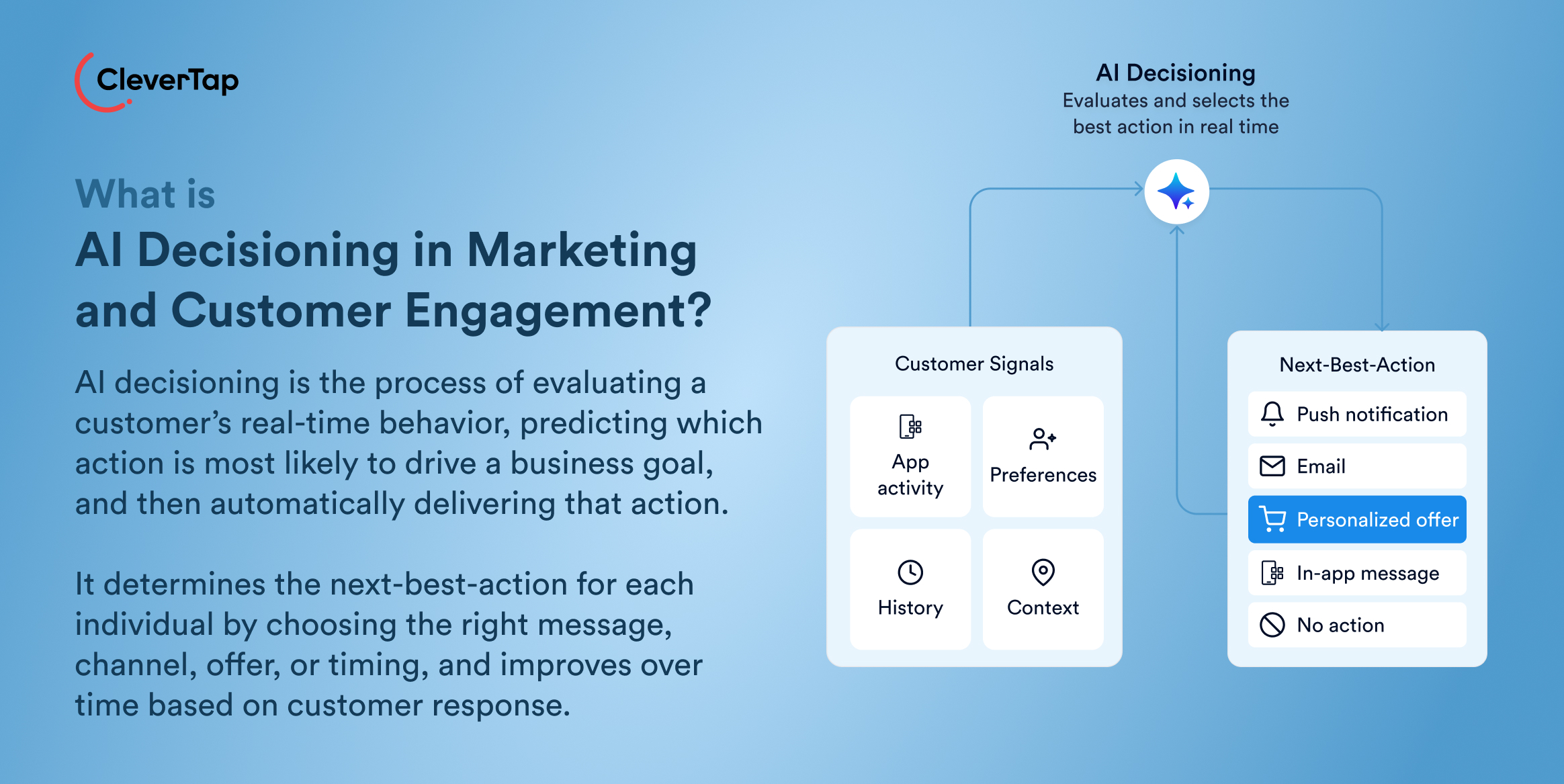
The output has an industry name: the Next-Best-Action. For one user at one moment, it might be a push notification, a 10% coupon, an in-app card, a WhatsApp message tomorrow morning, or nothing at all.
The decision covers the message, channel, incentive, and timing. It’s made for one person. Without it, you have a system that answers “which group does this user belong to. With AI decisioning, you get to answer what action maximizes the probability of engagement right now. And you get to act on it.
What AI Decisioning Is Not
An AI decisioning system isn’t a more sophisticated version of rules-based automation with a slicker interface. It chooses the next action.
And if you work in fintech, note the naming collision. “Credit decisioning” means automated loan and risk approval. That is a different system with different rules and regulators. This guide covers engagement decisions: what to say to a customer, not whether to lend to them.
The Four Components of an AI-Based Decision-Making System
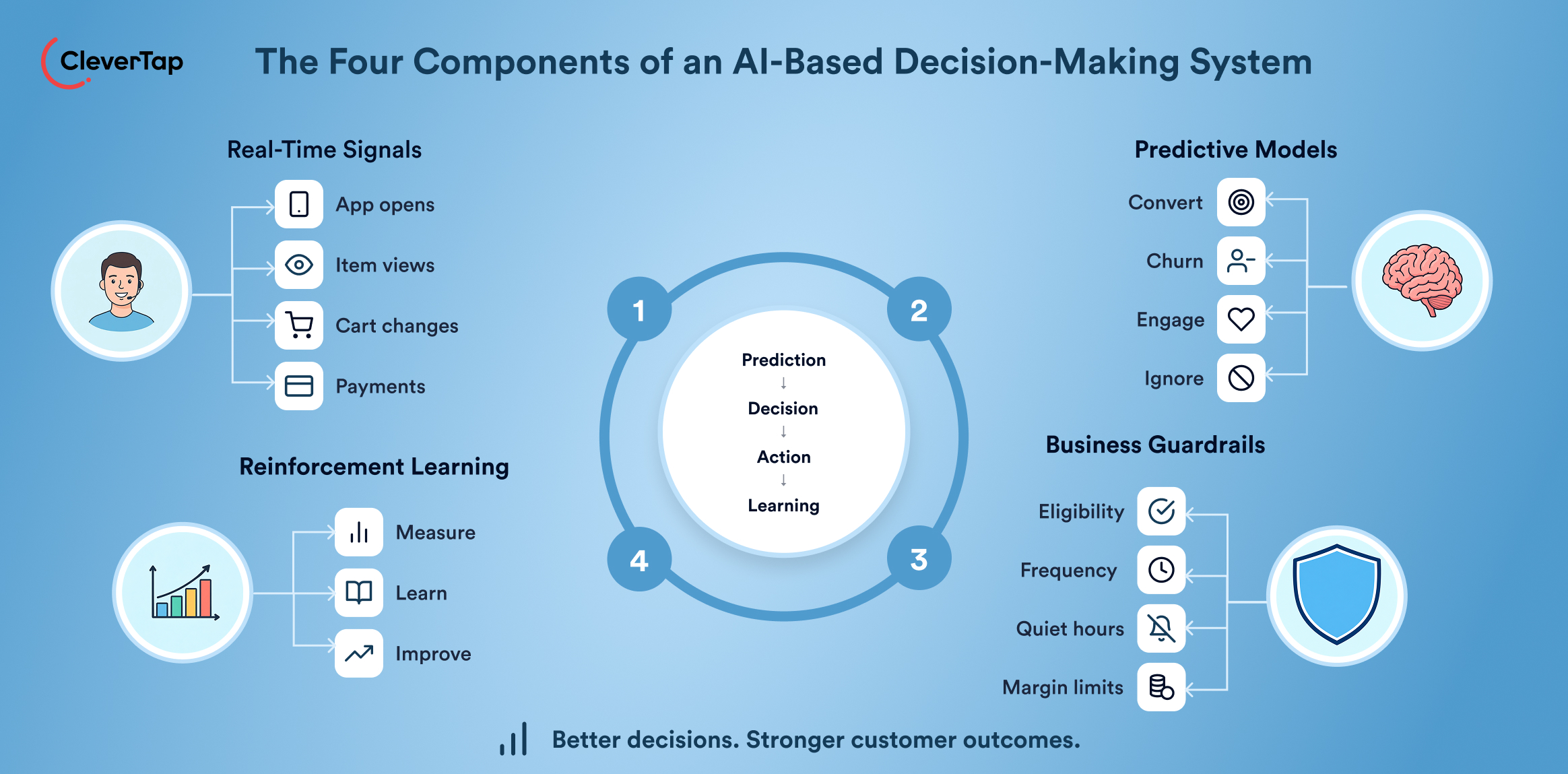
Every real AI-based decision-making system for engagement has four parts working together:
- Real-Time Signals: Live behavior such as app opens, item views, cart changes, and payment events, plus known traits and history
- Predictive Models: Estimates of what each user is likely to do next, such as churn, convert, or ignore a message
- Business Guardrails: The rules an action must pass before it ships, including eligibility, frequency caps, quiet hours, and margin limits
- Reinforcement Learning: The method that learns which actions produce the best outcomes and keeps adjusting as results come in
Together, these turn a prediction into an action and the action into a lesson. The confusion does not stop at automation, though. Three different kinds of AI now sit in the same stack, and each gets called by the others’ names.
AI Decisioning vs. GenAI vs. Agentic AI
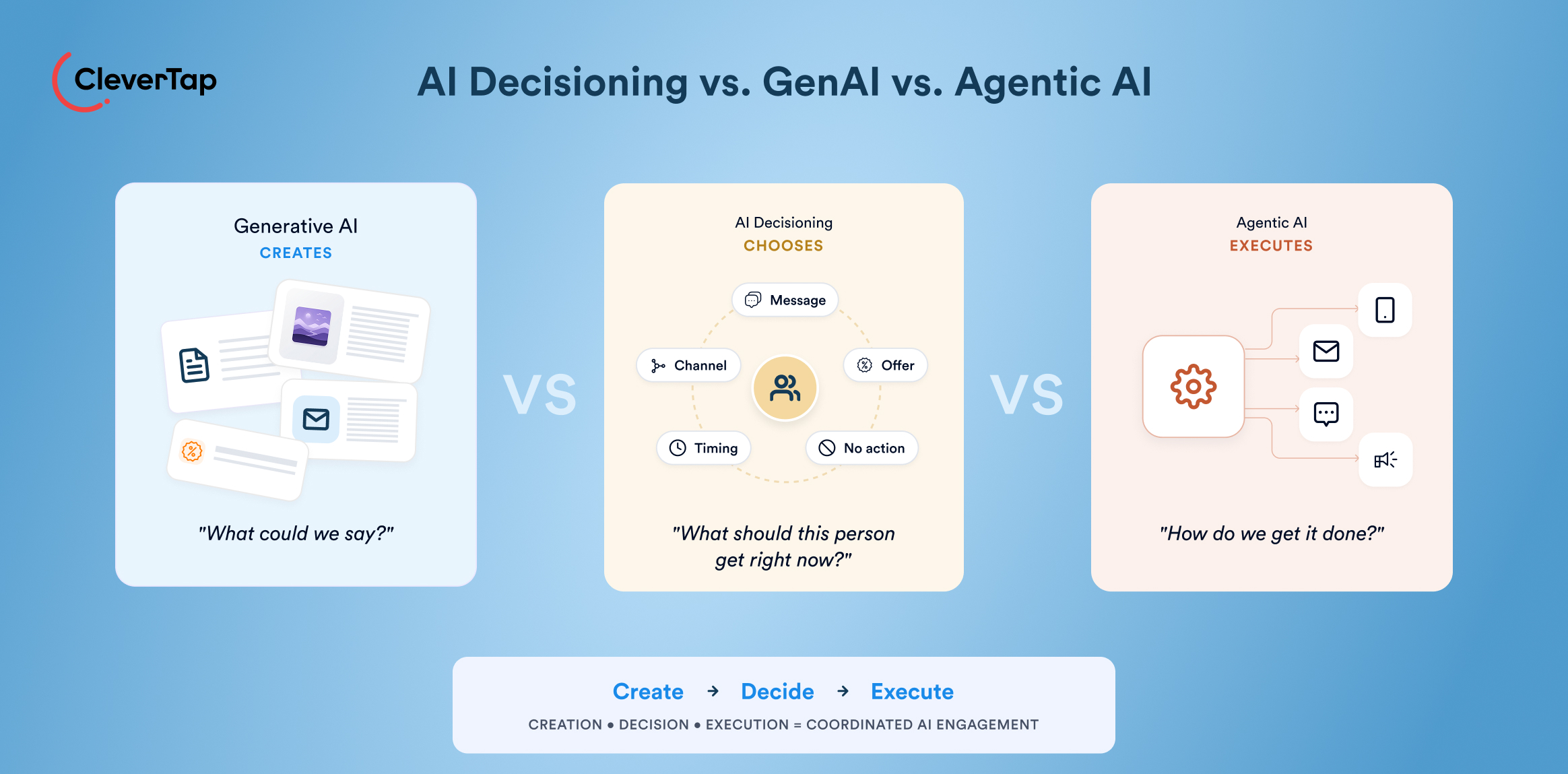
They sit in the same stack now, and each gets called by the others’ names. Here’s an overview of GenAI, Agentic AI, and AI decisioning systems, and what they do.
| Generative AI | AI Decisioning | Agentic AI | |
| What It Does | Produces content variants: copy, subject lines, images, offers | Evaluates likely outcomes and selects the best message, channel, incentive, and moment per user | Executes a chosen decision across systems and channels and handles the surrounding workflow |
| Question It Answers | “What could we say?” | “What should this person get right now?” | “How do we get it done?” |
| What It Cannot Do | Decide who should receive a variant, or when | Write the creative or run the delivery workflow | Judge which action is best without a decisioning layer underneath |
In a working stack, the three compose. Generative AI drafts twelve versions of a cart-recovery message. Decisioning picks which version, which channel, and which minute for each abandoner, or decides to send nothing. An agent then builds the journey, checks the compliance rules, and ships it.
The decisioning layer has more consequential impact on effectiveness. You get efficiency from what generative and agentic AI delivers. Decisioning drives effectiveness because it determines which message reaches which consumer, in what context, through which channel, and at what price.
Also read: 40+ Powerful AI Agent Examples Transforming Marketing, Sales, and Beyond
Why Traditional Rule-Based Journeys Fail: The Limits of Personalization
Traditional rule-based journeys don’t fail because there are many. They fail because they freeze a guess at the moment they’re written. When your guess about a customer’s timing or action no longer holds, rules fail. Here’s a closer look at it:
The If/Then Trap
When you start with rule-based journeys, initially, it’s one condition and one exception. Nothing about it is wrong. But as you add more, it becomes hard to keep it working effectively.
For example, when you have ten channels, twenty segments, five offer tiers, three time windows, and a frequency cap that interacts with all of them, it becomes tricky for a human to reason.
Tony Jebara, who has led personalization at both Netflix and Spotify, traced the lesson back to the 1990s. Writing rules to make computers intelligent “didn’t really seem to scale”. Showing data to an algorithm that learns on its own worked far better.
Static A/B Testing Regret
A/B testing has its own version of the freeze. Split traffic 50/50, wait for statistical significance, ship the winner. Two problems hide inside that routine.
First, for the entire test window, half your traffic sits on the losing variant by design. That is the “regret” of a fixed split: conversions spent to confirm something the data suggested a week in. Second, and less discussed, the winner ships to everyone. A variant that wins on average still loses for some users. A segment-level winner is a population-level compromise. The test answers “which is better for most people” when you wanted to ask, “which is better for this person, now.” Autonomous AI decisioning handles the latter.
Here is the full contrast in one place.
| Rule-Based Marketing Journeys | Autonomous AI Decisioning | |
| Who Chooses the Action | A marketer, in advance, for a segment | The system, at the moment, for one user |
| Unit of Personalization | Segment or branch | Individual |
| How It Learns | It doesn’t. Someone reviews reports and edits rules | Every outcome updates the next decision |
| Testing | Fixed A/B splits that wait for significance | Continuous allocation that shifts traffic to winners while it learns |
| Timing | Fixed delays, such as “send 15 minutes after cart add” | Learned per user and per context |
| Maintenance | Grows with every new channel and segment | Grows with goals and guardrails, not branches |
| Where It Breaks | When behavior drifts away from the rules | When goals, rewards, or guardrails are poorly defined |
How AI Decisioning Works
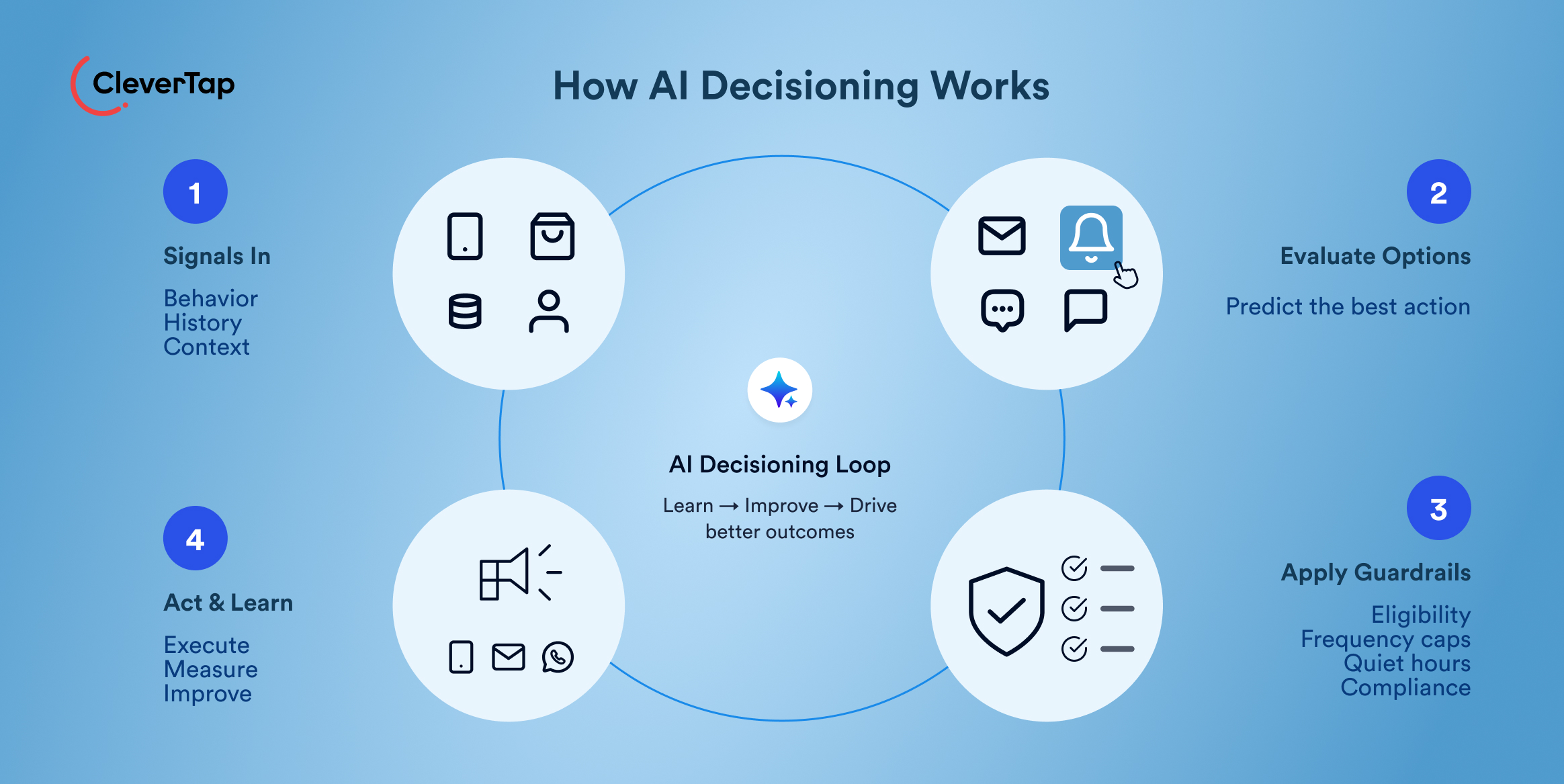
An AI decisioning engine runs on a four-stage loop. Signals come in, a model weighs the options, a policy filter checks the winner, and the action goes out. The outcome comes back as the first signal of the next cycle.
1. Signal Ingestion and Context
The engine starts with what it can see. First-party event streams carry app launches, product views, cart updates, payment starts, session length, device, and time of day. Historical traits add past purchases, RFM tier, and preferred channel. Zero-party data adds whatever the user volunteered.
A decision is only as good as the freshest signal it has.
2. Model Evaluation and Contextual Bandits
This is where plain English usually gives up, so here is the slot-machine version.
Imagine a row of slot machines, each paying out at a different, unknown rate. You want to earn the most coins. Pull only the machine that has paid best so far, and you might be stuck on a mediocre one. Pull machines at random, and you waste coins on losers. The balance between those two moves is called exploration versus exploitation. An algorithm that manages that balance is a multi-armed bandit.
| Did you know? A bandit is a type of machine learning algorithm that is used to solve decision-making problems in which an agent needs to make sequential decisions. |
Now add context. Suppose the machines pay out differently depending on who is pulling: time of day, whether the player is new, what they did a minute ago. A contextual bandit learns which machine is best for this player in this situation. Swap “machines” for actions (a 10% coupon or a push at 7 pm) and “player” for user, and you have the core of an engagement decisioning engine.
Reinforcement learning is the wider family that bandits belong to. It’s about learning the best action for each state an agent observes.
3. Business Guardrails and Policy Filter
Before the chosen action ships, it passes through a policy layer. This is where the following questions are answered:
- Is this user eligible for the offer?
- Have they hit the frequency cap?
- Is it inside quiet hours?
- Does the discount clear the margin floor?
- Does the copy meet brand and compliance rules?
4. Autonomous Execution and Feedback Loop
The action goes out on the chosen channel. Whatever happens next, whether an open, a click, a purchase, an unsubscribe, or silence, returns to the engine as a labeled outcome and updates the model. In a well-built system, this happens continuously.
The loop only works if the signals arrive before the moment passes. This is an architecture design. Make sure you discuss this with the vendor in your demo.
The Sub-Second Latency Requirement: Warehouse-Native vs. Native Engagement Engines
Warehouse-native, or reverse-ETL, decisioning runs on data synced out of your data warehouse. It is complete and consistent, but it is only as fresh as the last sync. Native decisioning runs inside the engagement engine on the live event stream, and it can act mid-session.
The gap between them is measured in minutes, and minutes are the whole game for in-session behavior.
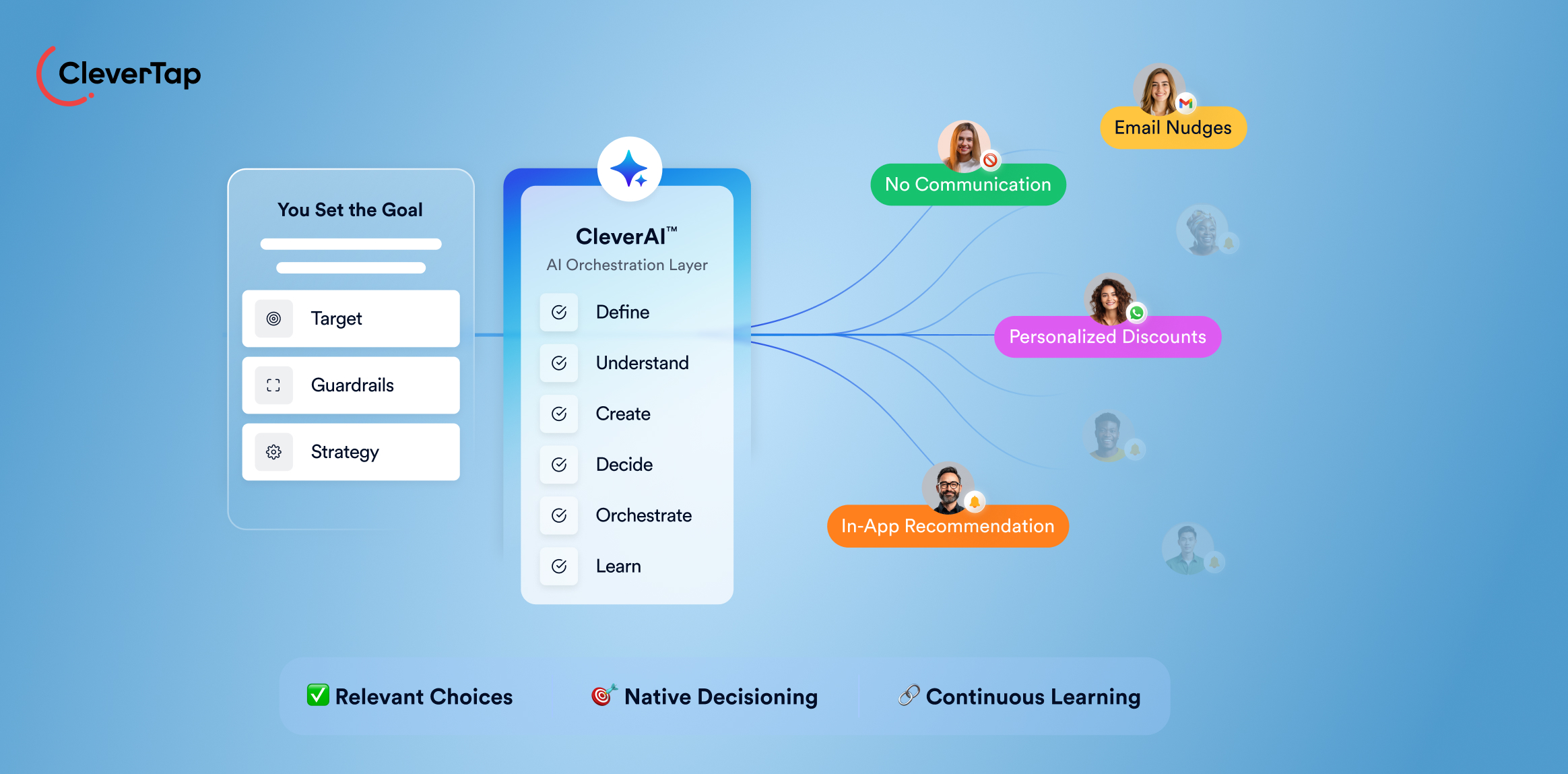
CleverTap’s platform is powered by CleverAI™, built for the native path. Event ingestion, the decision layer, and the delivery channels sit in one system.
High-Impact Use Cases and Examples for Customer Engagement
Below are a few cases where an AI decisioning system shines.
E-Commerce and Retail: Cart Recovery Without Blanket Discounts
Discounts are tricky. You discount customers who would have paid full price, and you under-discount the ones who needed a nudge.
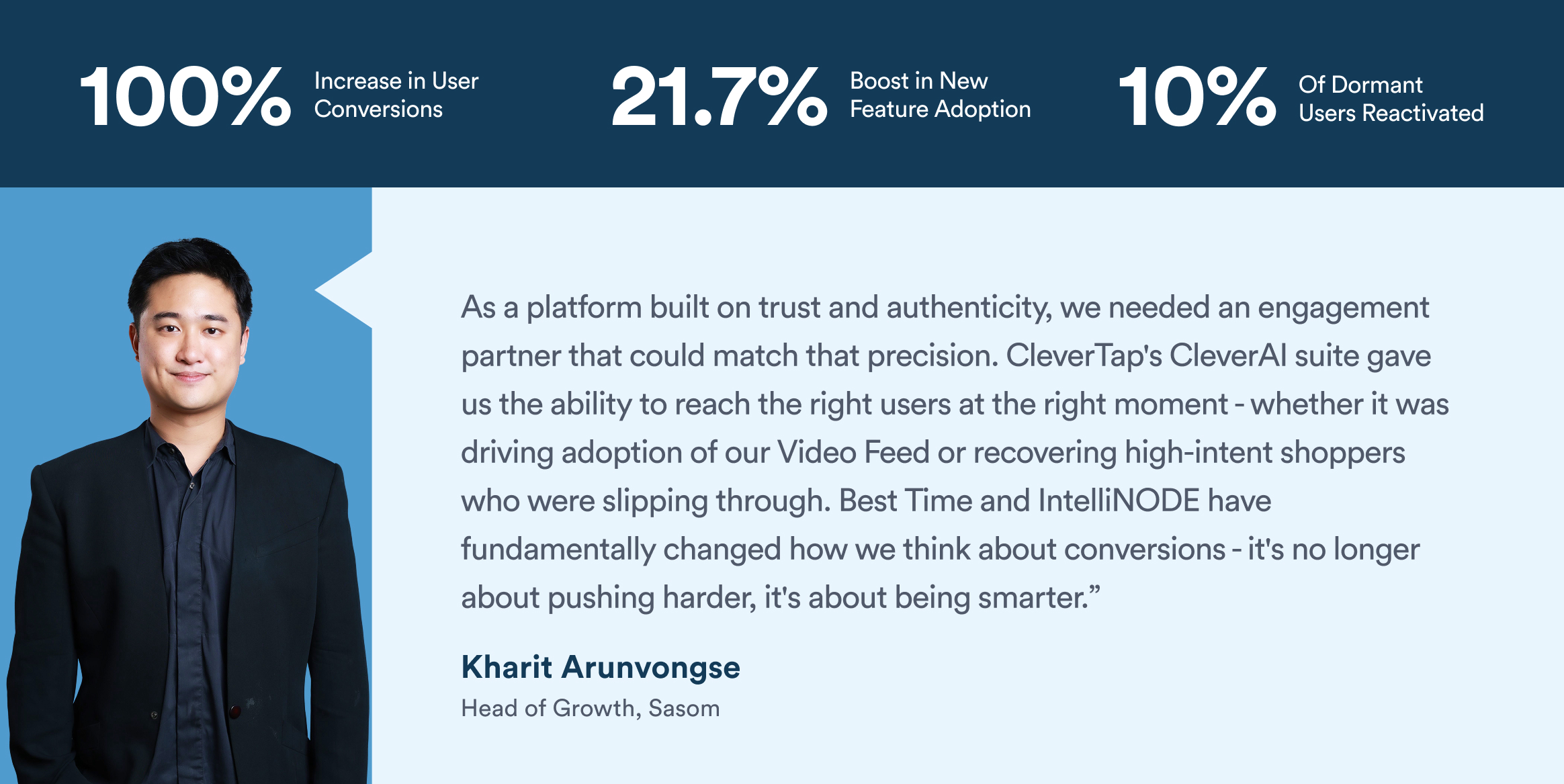
Sasom, a Southeast Asian e-commerce marketplace, ran this play on CleverTap. The team focused on high-intent users with repeated checkout visits and high cart values. CleverAI™’s IntelliNODE then routed them across paths testing fixed discounts, percentage offers, and different expiry windows, each timed with Best Time push.
Conversions doubled, and 10% of dormant users came back. The engine was choosing the incentive level, not just the message.
Fintech and Banking: Recovering Dropped Applications
Axis Bank, one of India’s largest banks, faced a familiar problem: users abandoning credit card upgrade and personal loan applications midway. The bank used CleverAI’s IntelliNode to run automated, real-time channel testing and Scribe to generate the messaging, then retargeted those users with timely nudges across channels.
The result was a 27% boost in conversions among users who had dropped off the credit card upgrade journey. The decision here is the channel and the moment, which is often the case in regulated categories where the product itself cannot change per user.
Media, Gaming, and Streaming: Churn Suppression Through Content and Timing
For a streaming service, the next-best action is usually a piece of content and a moment to surface it. VieON, a Vietnamese streaming platform, combines recommendations with the best time and IntelliNODE to choose what to suggest and when to deliver it per viewer, and reports 10% higher user engagement.
The reward you choose matters more here than anywhere. Spotify’s research found that users who consume more diverse content convert more and churn less. A decisioning engine that only chases the next click will narrow what it recommends, and shorten the relationship it was meant to extend. The same logic applies to games: the action that drives one more session is not always the action that drives month-three retention.
Food Delivery and QSR: Dynamic Discount Suppression
Food delivery is the cleanest illustration of the decision as a budget. Promo spend is finite. The engine reserves it for price-sensitive users and serves zero-discount upsells to buyers who would order anyway.
Two CleverTap case studies show the mechanics behind this. Faasos, an Indian food delivery brand, sent a push exactly 15 minutes after add-to-cart inside the mealtime window and saw a 7% lift in conversions and 30% higher push CTR. That fixed rule worked. A decisioning engine would learn that window per user instead of fixing it at 15 minutes.
Shawarmer, a Saudi QSR chain, used ML-driven RFM segmentation to vary incentives by segment and delivered a 9% uplift in overall sales with zero media spend. It also retained 36% of at-risk customers and reactivated 27% of hibernating ones. The step past segment-level incentives is per-user incentives, which is exactly what the decisioning engine adds.
Every case above reports a number. The harder question is which part of that number the engine actually caused.
What Impact Does AI Decisioning Have on Business KPIs?
Below is an overview of what you can expect as the impact of AI decisioning on your KPIs.
- Customer-Facing KPIs: Expect the impact on conversion rate, average order value, and lifetime value.
- Operational Efficiency: Three things get cheaper. Rule authoring, because goals and guardrails replace branches. Testing, because traffic reallocation happens automatically. And discount spend, because incentives go only to users whose behavior changes because of them.
- Holdout-Based Attribution: A decisioning engine makes it easy to get incrementality right. Bibit, an Indonesian investing app, reports a 26% increase in conversion from automated payment-drop-off nudges compared to a control group. This is where the A/B testing nuance resolves.
This is also where the earlier A/B nuance resolves. Bandits improve allocation. Holdouts certify the result. Netflix runs both, and so should you.
A 5-Step Framework for Implementing AI Decisioning
Most failed rollouts of AI for decision-making fail at step two or step four, not at the model. The framework below front-loads both.
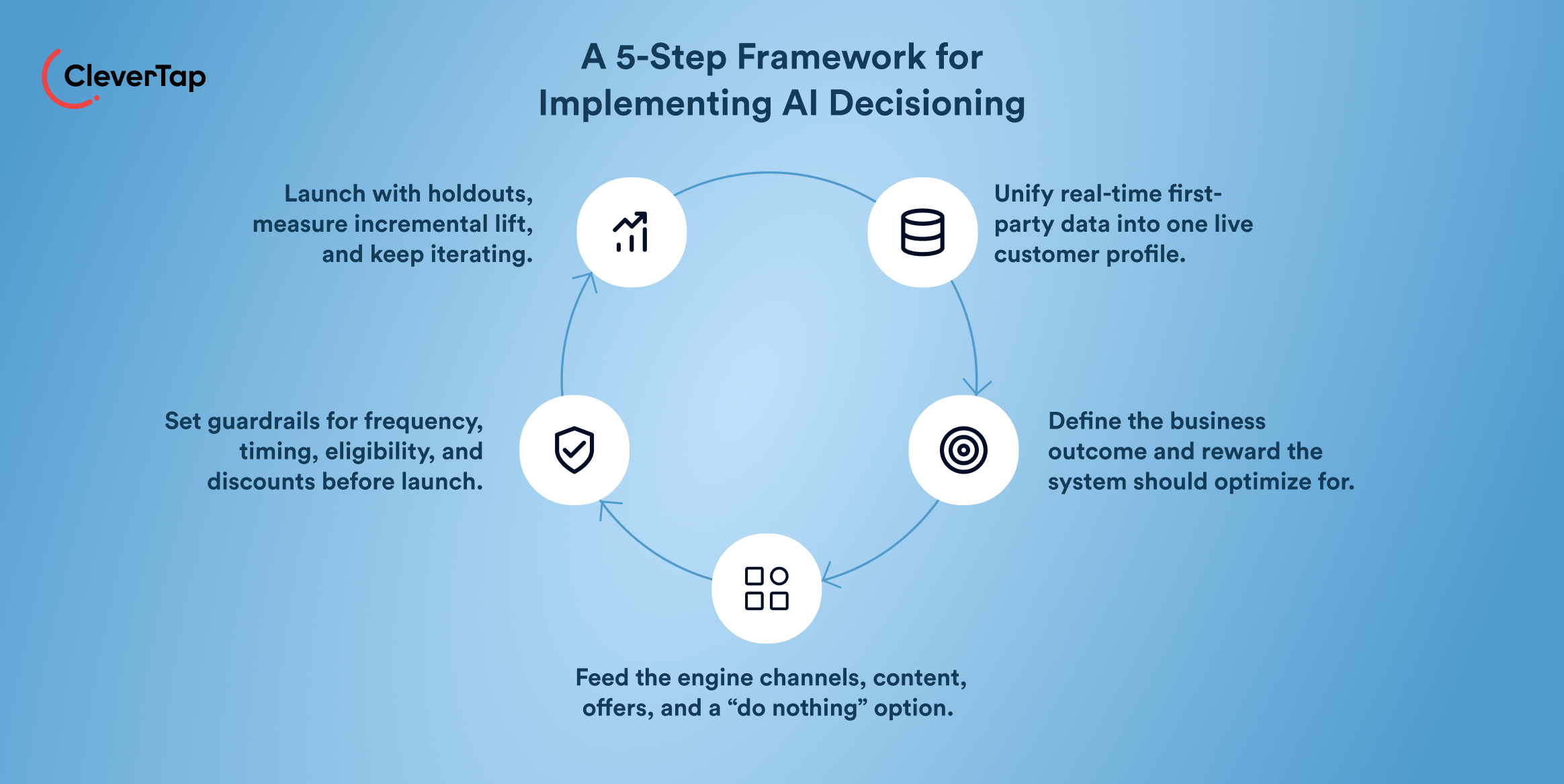
- Unify Real-Time First-Party Event Streams: The engine cannot decide on what it cannot see. Bring behavioral events, user traits, and transaction logs into one live profile before anything else. Audit the freshness of each source. If your cart events arrive on a five-minute delay, your cart decisions will too.
- Define Outcome Goals and Rewards: Pick the metric the engine will work toward, and pick a long one. Thirty-day retention, incremental revenue, or completed onboarding beats open rate every time.
- Feed Content Assets and Action Levers: The engine chooses from what you give it. Load the channels (push, in-app, email, SMS, WhatsApp), the creative variants, and the incentive tiers, including a zero-incentive option. “Do nothing” should always be an available action. An engine that must send something will send too much.
- Establish Brand Guardrails and Governance: Write the policy layer before the first decision fires. Set maximum contact frequency per user per week, and Quiet hours by region, discount caps by margin band, and eligibility rules for regulated products.
- Launch, Measure Incrementality, and Iterate: Deploy against a randomly assigned holdout of 10 to 15%. Read incremental lift. Watch for drift: rewards that were right in January may be wrong by June, and a model trained before a pricing change will misjudge behavior after it. Re-check the reward definition on a schedule.
Steps four and five are where marketers ask the question that decides whether any of this ships: what happens when the engine gets it wrong?
How to Ensure Governance, Ethics, and Control In an AI-Decisioning System
An engine that decides on its own can send an unapproved discount, message a customer at 3 am, or favor one group of users for reasons nobody can explain. Each of those has a control.
Preventing Rogue Actions
If you have written a policy layer, no action will reach a customer without passing eligibility, frequency, timing, and margin rules. Scrutinize the execution layer before you fire any decisions. Working with a trusted vendor can help avoid rogue actions through standard guardrails.
Explainability and Transparency
A marketer should be able to open any decision and see why. Which signals weighed most, which alternatives were considered, which guardrail applied. Without this, you cannot debug a bad quarter, and you cannot defend a decision to a compliance team. Treat “the model decided” as an unacceptable answer from any vendor.
Bias Detection
The machine only learns because a human first tells it which journeys were successes and which were failures. For example, if the system is under-serving a cohort, you need to give feedback to fix it. Keep a human in the loop to monitor a decisioning system’s outcomes and provide feedback on what qualifies as success.
Frequently Asked Questions
1. Does AI decisioning replace marketing automation platforms?
No. It replaces the rigid rule builder inside them. Journeys, channels, and delivery stay where they are. What changes is who chooses the branch: the engine, not a static if/then tree.
2. How much customer data do I need to start with AI decisioning?
Less than you think, but fresher than you have. Reinforcement learning models learn from live feedback, so a brand with modest history but real-time events can start and improve quickly. More historical event data raises accuracy on day one; it is not a prerequisite.
3. What is the main difference between A/B testing and AI decisioning?
An A/B test is a fixed, manual experiment. It splits traffic evenly, waits for significance, and ships one winner to everyone. AI decisioning uses contextual bandits to shift traffic toward winners continuously and to learn a different winner per user.
How CleverTap Brings AI Decisioning Into Customer Engagement
Everything above describes a loop: define the goal, read live signals, generate options, choose, execute, and learn. CleverAI™ is built as that loop. You set the business goal and the guardrails. TesseractDB supplies live user signals. Creative agents produce message, offer, and experience variants. The decision layer picks the best action for each user, orchestrates delivery across journeys and channels, and feeds every response back into the next decision.
IntelliNODE randomly assigns users entering a journey to different paths. A multi-armed bandit algorithm then routes traffic toward the path that converts best for the defined goal, and keeps re-evaluating as behavior shifts.
Around that core sit the CleverAI™ Agents.
- The Predictions Agent forecasts churn, conversion, and drop-off in real time and shows the reasoning behind each prediction.
- The Send Time Optimizer Agent and Channel Optimizer Agent learn each user’s timing and channel preferences.
- The Recommendations Agent surfaces the right product, offer, or content.
- The Segment Builder Agent and Journey Builder Agent turn a plain-language goal into an editable segment or a ready-to-run journey.
Every decision is inspectable, policies enforce brand and compliance needs, and you decide how much autonomy each agent gets.
See how CleverAI™ makes the next-best decision for your users

Jacob Joseph 
Heads Data Science.Expert in AI, Data & Analytics and awarded 40 under 40 Data Scientists in India.
Free Customer Engagement Guides
Join our newsletter for actionable tips and proven strategies to grow your business and engage your customers.