





































Table of Contents
Categories
Most Popular


For nearly a decade, personalization centered on the customer journey.
But that model is becoming harder to scale. BCG’s 2026 research notes that as channels multiply, customer signals become real-time, and the number of possible content, offers, and experiences expands, marketer-orchestrated journeys struggle to keep pace.
Agentic personalization shifts the unit of decision from prebuilt journeys to real-time, goal-directed actions. AI agents interpret context, choose and execute actions, and adapt based on outcomes, while marketers define the objectives, available options, and guardrails.
The challenge is separating genuinely agentic systems from products simply adopting the label. Gartner has warned about “agent washing” and estimated in 2025 that only about 130 out of thousands of claimed agentic AI vendors were genuinely agentic.
This guide explains how agentic personalization works, where it differs from other forms of AI, and what teams need to implement it responsibly.
What Is Agentic Personalization?
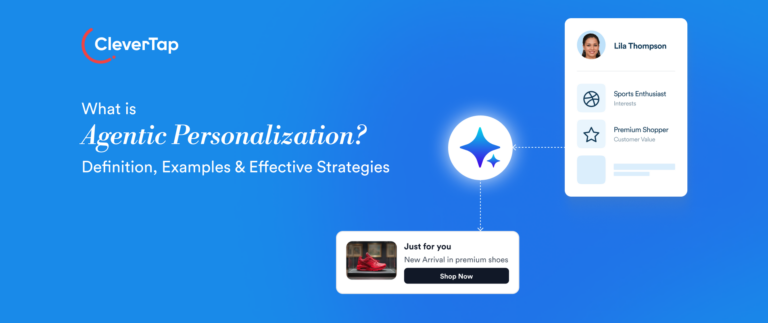
Agentic personalization uses goal-directed, autonomous AI agents that perceive a customer’s real-time context, decide the best interaction, execute it across channels, and learn from the outcome. The marketer sets the goal and the boundaries; the agent handles every individual decision inside them.
This matters because it changes the unit of work. Traditional customer engagement relies largely on predefined campaigns and journeys. Agentic personalization shifts toward a continuous per-user decision loop, where each new signal can influence the next interaction. Historical behavior provides context, while real-time behavior reveals what may matter in the current moment.
The loop rests on four pillars: real-time perception, contextual reasoning, autonomous action selection, and continuous feedback. History (what a user did last month) provides deeper context about the customer, while the current session (what a user did just now) reveals what may matter in the moment.
Just as important is what agentic personalization is not. It is not a recommendation widget, which surfaces a suggestion and waits. And it is not automation, which repeats a pre-set trigger no matter the context.
AI Taxonomy: Generative AI vs. Predictive AI vs. Agentic Personalization
Most confusion about AI and decision-making comes from lumping three different technologies into one word. Each answers a different question.
- Predictive AI forecasts a likelihood. It scores outcomes such as churn risk, conversion propensity, or lifetime value, which can then inform automated or marketer-defined actions.
- Generative AI produces or transforms content, such as copy, subject lines, images, and other campaign assets. By itself, it does not determine the best next action for each customer.
- Agentic personalization adds a decision and action layer. It can use predictive intelligence and generative capabilities as inputs, then select, execute, and refine the next best action against a defined goal.
| Predictive AI | Generative AI | Agentic Personalization | |
| Core job | Forecast a likelihood | Produce content on demand | Achieve a goal per user |
| Output | A score | An asset | An executed action |
| Decides on its own? | No | No | Yes, within guardrails |
| Can adapt from outcomes | Only when retrained | No | Yes, when connected to a learning loop. |
Why Traditional Personalization Hits an Efficiency Wall
Rule-based personalization fails through arithmetic. Every new segment, product, or channel multiplies the journey branches a team must build and maintain. Eventually, your team has to manage a hundred micro-segments across five channels. On top of it, three lifecycle stages produce more paths than any team can handle.
So teams simplify, and relevance dies. Also, static A/B testing costs you opportunities until you reach a verdict. Tests run toward statistical significance while a fixed share of traffic hits the losing variant. Adaptive decisioning approaches, such as contextual bandits, can shift traffic toward better-performing options as results accumulate instead of waiting for a fixed test to conclude.
| Rule-Based Personalization | Agentic Personalization | |
| Autonomy | Executes pre-set if-then rules | Pursues goals within guardrails |
| Data processing | Batch segments, refreshed on a schedule | Live event streams, per user |
| Scaling speed | Every new case needs a new branch | New cases handled by the same learning policy |
| Optimization loop | Manual A/B tests, weeks per verdict | Can continuously optimize actions using adaptive learning |
You can avoid hitting a wall with a different architecture. Here’s how that architecture works:
How Agentic Personalization Systems Work
If we move beyond the buzzwords, the AI decision-making process runs in four steps:
- Real-Time Behavioral Ingestion: Live events, such as clicks, app opens, cart adds, searches, and location, stream into a unified profile the moment they happen. This profile is the context the agent reasons over.
- Contextual Reasoning: The agent weighs what this user is likely to do against the business goal. The algorithms balance exploring new options with exploiting known winners for each user’s context.
- Business Policy and Guardrail Filtering: Before anything ships, the chosen action passes through frequency caps, margin controls, consent rules, and brand constraints. The policy you set filters everything that the agent proposes.
- Execution and Feedback: The message, offer, or experience goes out on the best channel, and the response flows straight back into the model.
This might not be as exotic as you’d think. Bandits, event streams, and feedback loops are established product engineering. What’s new is packaging them for marketers. And all four steps depend on how fast the data moves.
Sub-Second Latency and Real-Time Event Streaming: Native vs. Batch Architectures
AI for decision-making is only as fast as the pipeline feeding it. This is the part of agentic personalization that decides which moments a brand can act on at all.
Reverse-ETL architectures commonly move warehouse data to engagement tools on scheduled syncs rather than responding directly to each event. Tealium’s technical breakdown puts reverse-ETL syncs at 15- to 60-minute intervals, with total latency from customer action to tool often exceeding an hour. Event-based streaming architectures process and activate the same signal in under 100 milliseconds.
For in-session moments such as checkout hesitation, even a short delay can mean acting after the customer has already left. A batch pipeline learns about that hesitation after the session is over and can only attempt recovery. A streaming engine can act while the user is still in the app.
Engineering teams that made the jump confirm the pattern with hard numbers. Credit Karma rebuilt its recommendation stack and cut data latency “from like 48 hours to a minute.” This is also why CleverTap built decisioning natively into its engagement engine rather than syncing from a warehouse: the in-session moment is the whole point.
How CleverTap Runs This Loop: Inside CleverAI™
CleverTap brings agentic personalization to life through CleverAI™, its AI-native customer engagement platform built around Live 1:1 Personalization. Marketers define the business goal, strategy, and guardrails, while CleverAI™ combines customer context, creation, decisioning, orchestration, and learning to determine the next relevant action for each individual.
TesseractDB™, CleverTap’s purpose-built engagement database, combines live actions, past behavior, profile attributes, and campaign performance into a single context for each user. Creator agents then generate the messages, offers, images, and template variants the decision layer will choose from.
The Tesseract Decisioning Engine ranks the best available action for each individual against the defined goal, and an orchestration layer executes it across channels, product experiences, and rewards. It combines historical intelligence with an online learner that adapts to current behavior and recent outcomes.
Each response becomes a new signal in the learning loop, helping improve subsequent interactions.
Decisioning is built natively into the engagement engine rather than stitched from a warehouse, so it runs in real time, in-session. And decisions are made per individual, not per segment. Gartner named CleverTap a Leader in its 2026 Magic Quadrant for Personalization Engines.
With the machinery and the speed in place, the question becomes what agents actually do for real brands.
Turn real-time customer signals into Live 1:1 Personalization with CleverAI™.
Agentic Personalization Use Cases: What the Building Blocks Look Like in Practice
Agentic personalization brings together capabilities such as real-time decisioning, recommendations, adaptive experimentation, content generation, and orchestration. The following examples show how those building blocks already create measurable impact across industries.
E-Commerce and Retail
In this sector, the most common use case is autonomous message and offer selection at sale-level scale. UK electronics retailer Currys handed its Black Friday email program to an agentic model that picked the message, product, send time, and subject line per customer. In the words of the team that ran it, “it was millions of unique decisions being made instantly.”
They sent fewer emails and made more money because the agent targeted only the high-intent users. The same logic powers dynamic discount suppression. It reserves promos for shoppers who seem price-sensitive. This way, it prevents you from subsidizing purchases that would have happened anyway.
Fintech and Banking
Agentic personalization can observe live spend signals and let agents orchestrate credit products inside the app feed at the relevant moment. CleverTap reports that Axis Bank increased conversions from dropped-off credit card upgrade users by 27%. The bank used real-time behavioral insights and omnichannel journeys alongside CleverAI™ capabilities to personalize and optimize engagement.
Media and Streaming
For content apps, the agentic levers are send-time and channel selection to prevent churn. CleverTap reports that streaming platform ZEE5 lifted campaign CTRs by 60% using AI-selected send times, alongside a 20% increase in in-app conversion, by reaching each viewer at their individually predicted active window.
Travel and On-Demand
PYMNTS reporting on airline puts dynamic pricing gains at 3 to 10% of revenue and personalized bundles at 15 to 25% higher conversion.
On the dining side, CleverTap reports that reservation platform Eatigo saw a 100% increase in gross transactions using the CleverAI Recommendation Engine to serve intent-driven restaurant suggestions.
What Operational Guardrails to Set In Agentic Personalization
Governance can look like a constraint on autonomy, but it is what makes autonomy deployable in practice. As agents gain the ability to make and execute more decisions, brands need clear boundaries around what they can do independently and what requires oversight.
If you look closely, the market is already pricing this in. Gartner predicts that guardian agents, whose job is to oversee other AI agents, will account for 10% – 15% of the agentic AI market by 2030.
Guardrails help ensure autonomous decisions remain within the boundaries the business has defined. To ensure this, there are a few controls that do most of the work:
- Human-in-the-Loop Boundaries: Agents act autonomously on low-risk, reversible decisions like individual re-engagement nudges. High-value or irreversible actions, such as a large promo or a credit decision, need to be routed to a human for approval.
- System-Wide Contact Caps and Quiet Hours: Using hard limits stops a goal-hungry agent from spamming users across channels for short-term conversions.
- Explainability and Decision Logs: Every agent choice needs to be auditable. You should be able to look at which signals it saw, which options it weighed, and why it selected a particular action in that customer context.
With guardrails understood, implementation becomes a sequence rather than a leap.
5-Step Framework to Implement Agentic Personalization
AI-based decision-making rewards teams that build in the right order. Five steps cover it.
- Unify Real-Time First-Party Event Streams: Connect behavioral tracking, profiles, and catalog data into one event-driven engine. For use cases that depend on in-session behavior, stale data limits the agent’s ability to respond while the moment is still relevant.
- Define Outcome Metrics and Goal Rewards: Agents optimize exactly what you tell them to. Set precise objectives with constraints, such as maximizing 30-day retention or minimizing promo cost per incremental order. Vague goals produce vague behavior.
- Connect Action Levers and Asset Libraries: Feed the agent modular copy variants, templates, and offers to choose from.
- Establish Governance Rules and Approval Boundaries: Encode the caps, exclusions, and human-in-the-loop checkpoints from the previous section before launch.
- Deploy Against Control Groups, Measure Incrementality, Scale: Start narrow, prove lift against a holdout, then expand.
How to Measure Impact of Agentic Personalization
In order to measure the impact of agentic personalization, you need to track two KPI families.
One is about growth, covering lift in LTV, AOV, conversion, and churn reduction.
The other is operational metrics, including campaign setup time, manual segment maintenance, and journey upkeep.
Agentic systems can reduce operational overhead by automating parts of segmentation, decisioning, experimentation, and journey maintenance.
The harder question here is about attribution.
How do you say the revenue lift came from the agentic system rather than organic behavior?
The honest answer to this will come from holdout tests. It measures the true incremental impact of a marketing campaign by withholding ads or messages from a specific control group and comparing their behavior with those who received agent-driven personalization.
Get Started With CleverTap
Features and capabilities of a reliable agentic personalization system ultimately boil down to sub-second data access, a learning decision layer, deep creative choice, guardrails, and holdout-grade measurement.
CleverAI™ brings these capabilities into one connected engagement loop. Marketers define the goal and guardrails, TesseractDB™ provides live per-user context, Creator Agents generate relevant variants, and the Tesseract Decisioning Engine ranks the best available action for each individual. Each response then becomes a signal that helps improve the next interaction.
Book a CleverTap demo and see what agentic personalization looks like on your own funnel.
Frequently Asked Questions (FAQs)
1. Does agentic personalization replace campaign marketers?
No. It moves marketers from builders to strategists who set goals, guardrails, and creative direction while agents handle execution.
2. How does agentic personalization handle cold-start or anonymous users?
Agents don’t need identity to act. Real-time contextual signals, such as device, session behavior, referral source, and location, are enough to personalize the first visit. As identity resolves, the agent’s model of that user deepens.
3. How is it different from standard A/B testing?
Traditional A/B testing compares fixed variants across predefined groups and evaluates the result after enough evidence accumulates. Adaptive decisioning techniques, such as contextual bandits, can continuously adjust which option is selected based on performance and user context. These techniques can form part of an agentic personalization system, but they are not inherently agentic on their own.
4. What data does agentic personalization need?
Agentic personalization works best with a combination of historical customer data and real-time behavioral signals. This can include profile attributes, past purchases, campaign responses, app or website activity, and current-session events. The more relevant and timely the context, the better the system can evaluate which action is appropriate for each user.

Jacob Joseph 
Heads Data Science.Expert in AI, Data & Analytics and awarded 40 under 40 Data Scientists in India.
Free Customer Engagement Guides
Join our newsletter for actionable tips and proven strategies to grow your business and engage your customers.