










































Table of Contents
Categories
Most Popular


Buyer personas help marketers turn customer research into a clearer understanding of the people they want to reach. Rather than relying on assumptions about what customers want, effective personas are grounded in research, customer data, and observed behavior. Deloitte research found that customer-centric companies were 60% more profitable compared to companies that were not customer-focused.
For B2C marketers, buyer personas can inform more relevant targeting, personalization, and lifecycle engagement. In this guide, we’ll explain what buyer personas are, what to include in one, how to create and validate them, and how to apply them effectively.
What Is a Buyer Persona?
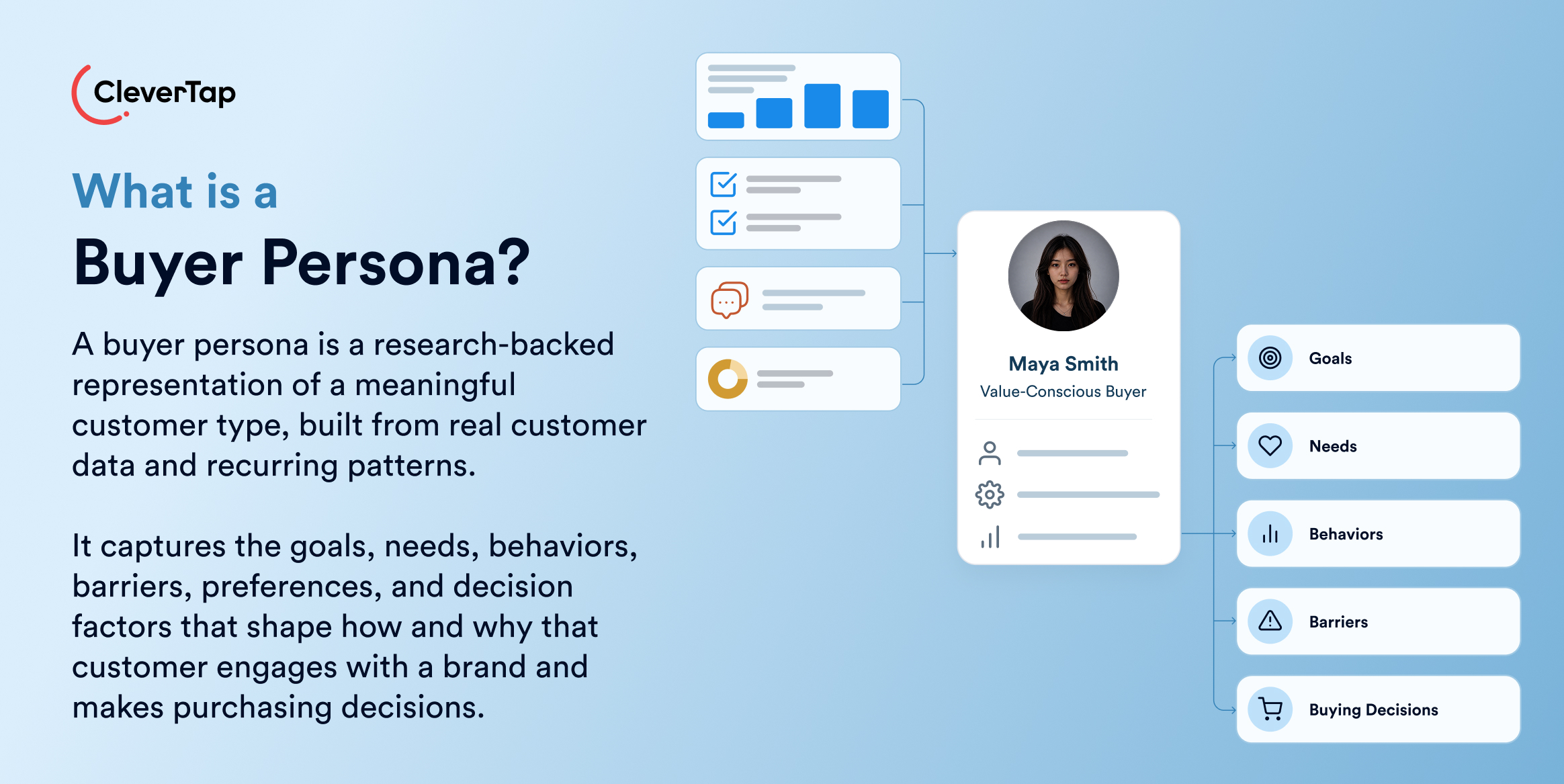
A buyer persona is a research-backed representation of a meaningful customer type. It brings together the characteristics that help explain how and why that type of customer makes purchasing decisions, rather than simply describing who they are. A useful persona may capture customer motivations, needs, preferences, barriers, behaviors, decision factors, and other insights that influence the buying journey.
The goal is not to create a fictional customer based on assumptions. Instead, marketers use research and customer data to identify recurring patterns among real customers and turn those patterns into a practical representation. Demographic details can provide context, but they become more useful when connected to behaviors, needs, or motivations that affect engagement and purchasing decisions.
Buyer Persona vs. Target Audience
A target audience describes a broad group a brand wants to reach, while a buyer persona represents a more specific customer type within that audience.
Buyer Persona vs. Customer Segment
A customer segment groups customers based on shared characteristics or behaviors. A buyer persona adds context by exploring the motivations and needs behind those patterns.
Buyer Persona vs. User Persona
A user persona describes someone who uses a product, while a buyer persona focuses on someone involved in purchasing it. In B2C, the buyer and user are often the same person, but not always.
Buyer Persona vs. Ideal Customer Profile
An ideal customer profile (ICP) is primarily a B2B concept that describes the type of organization a business wants to target. A buyer persona focuses on the individual customer or decision-maker.
Why Buyer Personas Matter in Marketing
Buyer personas help marketers make more informed decisions by providing a clearer picture of who their customers are and what influences their behavior. They can help marketers:
- Understand customer motivations and decisions: Identify the needs, goals, preferences, and barriers that influence how customers evaluate and choose products.
- Improve messaging and creative direction: Develop messaging, content, and creative concepts that reflect what matters to specific customer types.
- Build more relevant audience segments: Group customers according to meaningful differences in behaviors, needs, or motivations rather than relying only on broad demographics.
- Personalize content and offers: Tailor content, promotions, product recommendations, and experiences to make customer interactions more relevant. According to Epsilon, 80% of consumers are more likely to make a purchase when brands offer personalized experiences
- Select suitable channels: Identify the channels and formats where different customer types are most likely to engage.
- Design stronger lifecycle journeys: Create more relevant onboarding, activation, retention, upsell, and re-engagement experiences for different personas.
Together, these applications can make marketing more relevant and effective, helping improve engagement, conversion, retention, and long-term customer loyalty.
What Should a Buyer Persona Include?
A buyer persona should include only information that helps marketers understand customer decisions or shape their engagement strategy. Demographic or geographic details, such as age, location, income, or occupation, can provide useful context when they influence behavior, but they should not become the core of the persona. The most useful information explains what customers want, what influences their choices, and how they engage with a brand.
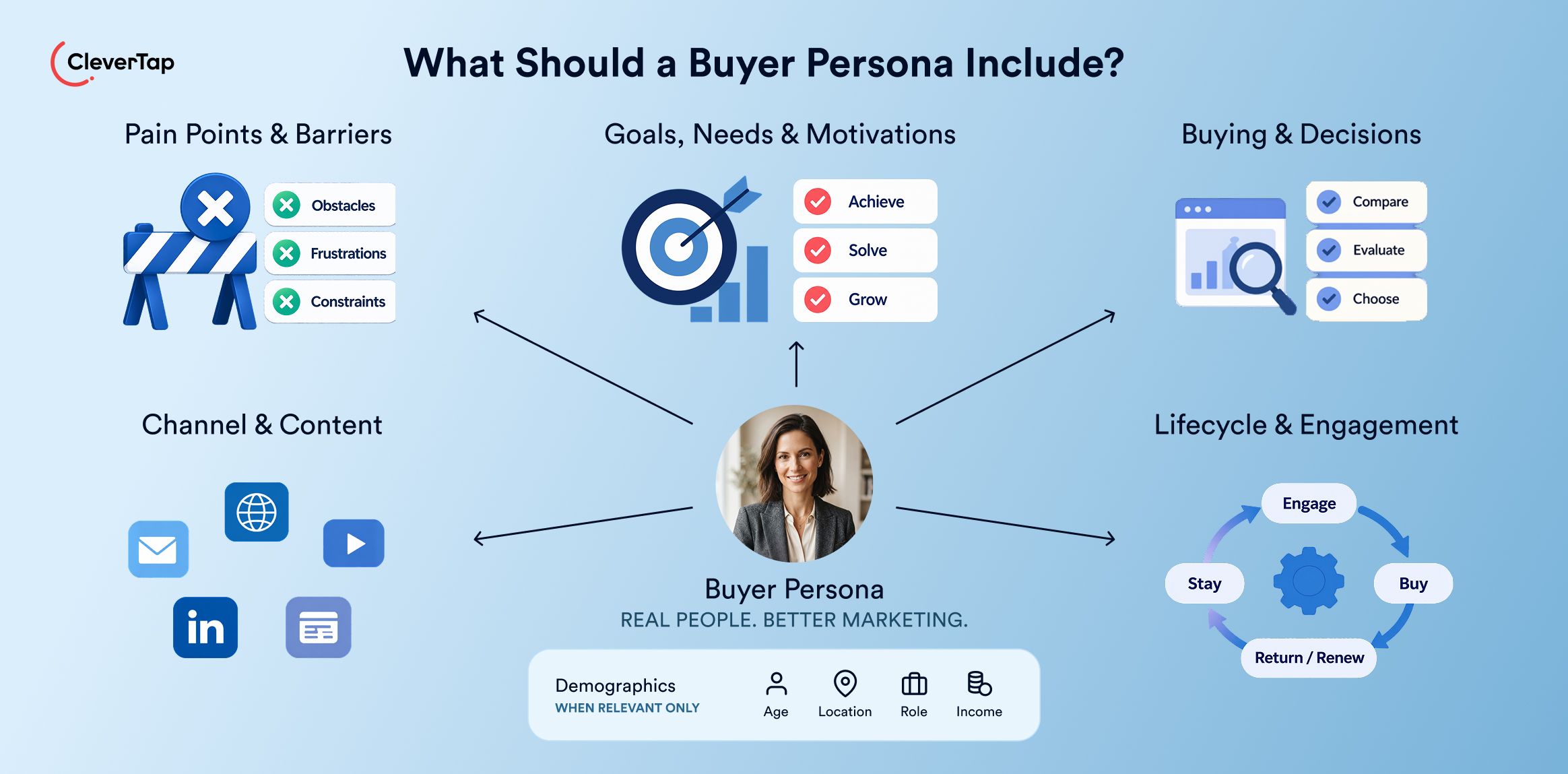
Goals, Needs, and Motivations
Capture what the persona wants to accomplish, what they need, and what motivates them to take action. These insights help marketers connect products and messages to meaningful customer priorities.
Pain Points and Barriers
Identify the problems, frustrations, objections, or constraints that may prevent the persona from achieving their goals or completing a purchase. These can reveal opportunities to reduce friction.
Buying Behaviors and Decision Factors
Describe how the persona researches, evaluates, and purchases products. Include relevant decision criteria, such as price, convenience, quality, reviews, or brand reputation.
Channel and Content Preferences
Document the channels and content formats the persona prefers for discovering information and engaging with brands, such as email, social media, blogs, video, or in-app messaging.
Engagement and Lifecycle Behaviors
Include meaningful patterns across the customer lifecycle, such as purchase frequency, product usage, loyalty, renewal, or re-engagement behavior. These insights can help marketers design more relevant experiences at each stage.
What Data Should You Use to Build Buyer Personas?
Strong buyer personas combine qualitative and quantitative evidence to create a more reliable picture of customer behavior. Qualitative research reveals what customers think and why they act, while quantitative data shows patterns in what they actually do. Using both helps marketers avoid building personas around assumptions.
Customer Research and Feedback
Interviews, surveys, focus groups, and customer feedback can reveal motivations, needs, preferences, language, and objections that behavioral data may not explain. Direct customer conversations are especially valuable for understanding the reasons behind purchasing decisions.
Website and App Behavior
Website and app analytics show how customers interact with digital experiences. Analyze content views, navigation patterns, feature usage, conversions, and drop-off points to identify behaviors and friction that can inform different personas.
Transaction and Campaign Data
Purchase history, order frequency, spending patterns, and campaign engagement provide measurable evidence of customer behavior. CRM and marketing data can help identify differences in purchasing habits, content engagement, and responses to specific offers or messages.
Support, Reviews, and Internal Insights
Support tickets, product reviews, feedback forms, and customer-facing team observations can reveal recurring concerns and unmet needs. Internal insights can help form initial hypotheses, but they should support, not replace, direct customer evidence. Validate assumptions against research and behavioral data before incorporating them into a persona.
How to Create a Buyer Persona
Creating a buyer persona involves turning customer evidence into a practical profile that can guide marketing decisions. A structured process helps ensure the persona reflects real customer behavior rather than assumptions and gives teams a consistent framework for targeting, personalization, and lifecycle engagement.
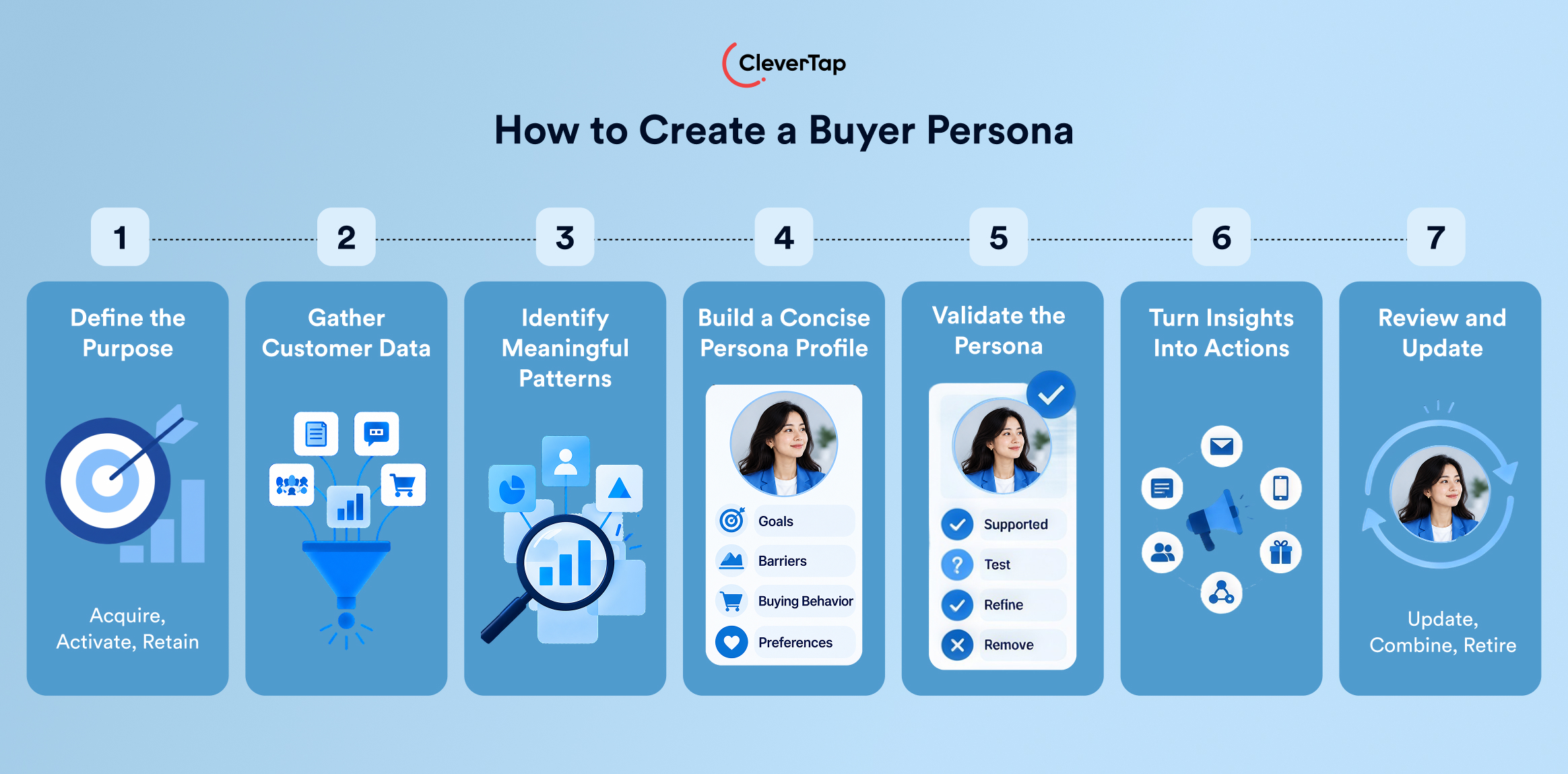
Define the Persona’s Purpose
Start by identifying the marketing decision or customer outcome the persona should support. This could include improving acquisition, increasing activation, reducing churn, or improving repeat purchases. A clear purpose helps determine which customer characteristics and behaviors are worth investigating. Avoid creating personas simply because they are a standard marketing deliverable; each persona should have a defined use case.
Gather Relevant Customer Data
Combine qualitative evidence, such as interviews, surveys, reviews, and customer feedback, with quantitative data from analytics, transactions, CRM systems, and campaign performance. Qualitative research can explain customer motivations and barriers, while quantitative data can reveal the scale and frequency of those behaviors. Use multiple sources where possible to reduce the risk of basing a persona on a narrow or incomplete view of customers.
Identify Meaningful Patterns
Look for recurring goals, needs, pain points, behaviors, preferences, and decision factors. Pay attention to patterns that affect purchasing or engagement rather than characteristics that simply describe customers. Compare findings across data sources to determine whether an observed behavior is consistent. Group customers around meaningful differences, and avoid creating too many personas that overlap or are difficult for marketing teams to act on.
Build a Concise Persona Profile
Turn each meaningful pattern into a concise profile that teams can easily understand and use. Include the persona’s goals, motivations, barriers, buying behaviors, decision factors, channel and content preferences, and relevant lifecycle behaviors. Add demographic or geographic information only when it helps explain behavior or inform a marketing decision. Keep the profile focused on actionable insights rather than creating a detailed fictional biography.
Validate the Persona
Treat each persona as a hypothesis that needs validation. Compare the profile against additional customer research and behavioral data, and test whether persona-based messaging, offers, or campaigns generate the expected response. Ask whether the proposed persona accurately reflects a meaningful customer group and whether the differences between personas are significant enough to warrant separate strategies. Refine or remove personas when evidence does not support them.
Turn Persona Insights Into Marketing Actions
Translate persona insights into specific marketing decisions. Use them to inform audience segments, messaging, creative direction, content, offers, product recommendations, channel selection, and lifecycle journeys. For example, marketers can connect persona attributes with behavioral segments to deliver more relevant email, push, in-app, or other cross-channel experiences. The goal is to make the persona operational, not simply store it in a marketing document.
Review and Update the Persona
Buyer personas should evolve as customer needs, behaviors, products, and market conditions change. Review them when new research or behavioral data becomes available and after significant changes in campaign performance. Track whether persona-based strategies continue to produce meaningful differences in engagement, conversion, or retention. Update, combine, or retire personas when the evidence changes.
Buyer Persona Examples for B2C Marketing
Buyer personas become useful when they connect customer patterns to marketing decisions. These examples show how B2C marketers can turn research into practical profiles without creating detailed fictional biographies.
Ecommerce Buyer Persona
Convenience and value may be central to an ecommerce persona. This customer frequently browses products, compares options, saves items, and responds to relevant promotions. Concerns about price, product quality, delivery, or returns can delay a purchase. Personalized recommendations, email, and mobile notifications can keep relevant products and offers visible. Marketers can use browsing and purchase behavior to promote restocks, price changes, and products of interest while reinforcing easy returns or reliable delivery.
Fintech Buyer Persona
A fintech persona might represent customers seeking greater financial control without unnecessary complexity. They may regularly check balances, track spending, use savings tools, or explore financial products. Security concerns, unclear fees, or uncertainty about financial decisions can limit engagement. Educational content, personalized insights, and timely in-app guidance can build confidence. Marketing should emphasize transparency and security while using observed behaviors to deliver relevant financial guidance and recommendations.
Gaming or Subscription Buyer Persona
For gaming or subscription businesses, ongoing entertainment and value can drive engagement. Customers may frequently play, consume content, explore new releases, or interact with recommendations, but perceived cost, limited usage, or choice overload can create churn risk. Personalized recommendations, push notifications, and relevant updates can sustain interest. Marketers can use engagement history to promote suitable content, features, rewards, or experiences that demonstrate continued value.
How to Use Buyer Personas in Marketing and Customer Engagement
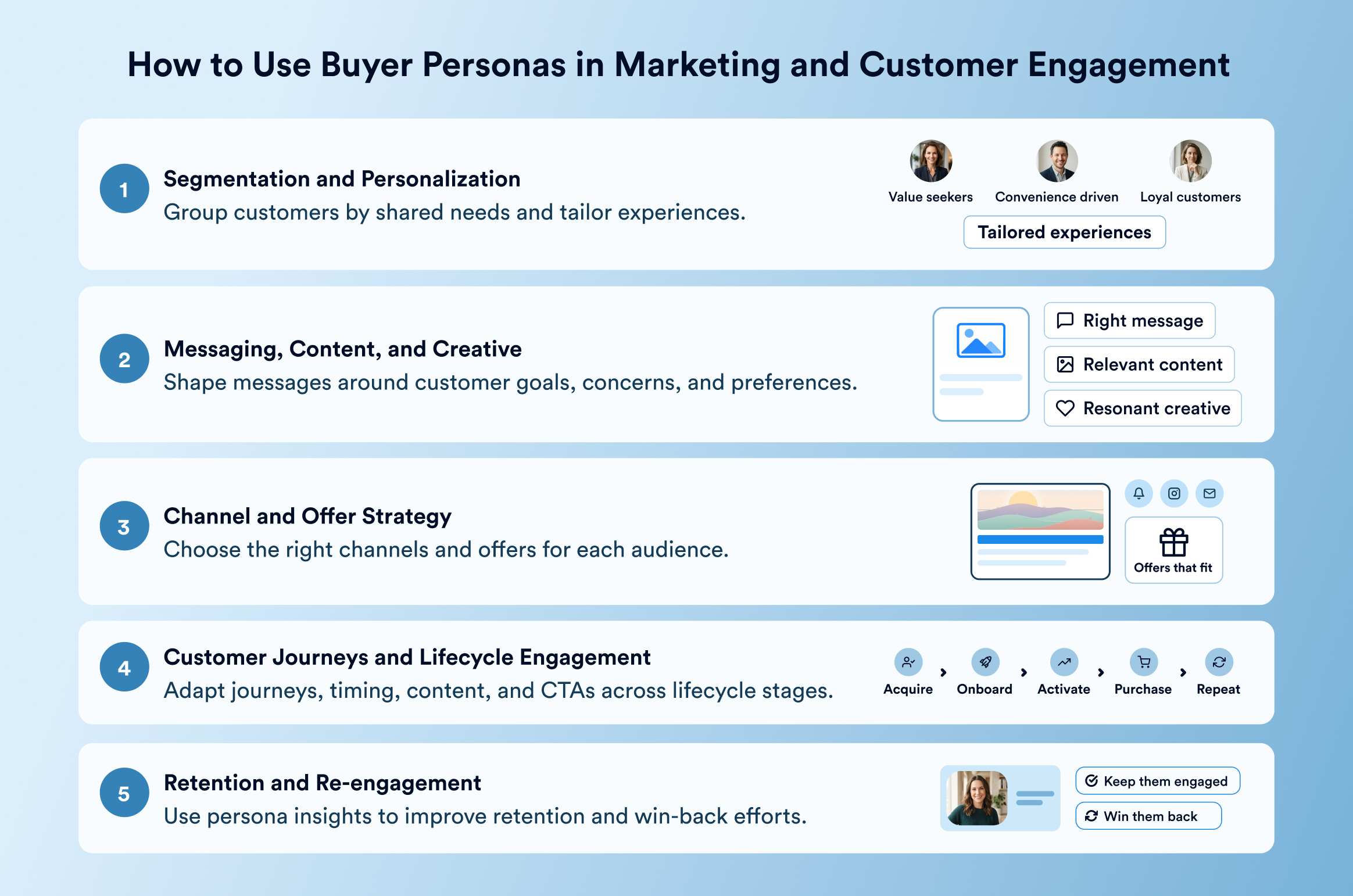
Buyer personas become valuable when marketers use them to make specific decisions about who to target, what to communicate, and how to engage customers throughout their relationship with a brand. They should act as a strategic framework, not a substitute for current customer behavior. Combine persona insights with real-time signals, then test whether the resulting experiences actually improve performance.
Segmentation and Personalization
Use persona insights alongside behavioral and transactional data to create more meaningful audience segments. Customers with similar motivations or needs can receive tailored content, offers, recommendations, and experiences rather than the same message across an entire audience.
Messaging, Content, and Creative
Let each persona’s goals, concerns, and preferences shape the message and creative approach. A convenience-driven customer may respond to speed and simplicity, while a security-conscious customer may need stronger reassurance and trust-focused messaging.
Channel and Offer Strategy
Personas can help determine where and how customers should be reached. Combine channel preferences with behavioral data to prioritize email, push, social, in-app, or other relevant channels. Offers should similarly reflect what motivates each audience, whether that is value, convenience, exclusivity, or education.
Customer Journeys and Lifecycle Engagement
Apply persona insights across the customer lifecycle, from acquisition and onboarding to activation and repeat purchases. Tailor journey steps, content, timing, and calls to action to the needs of different customer types. Use journey performance to identify where persona assumptions need refinement.
Retention and Re-engagement
Use personas to understand what encourages customers to remain engaged and what may cause them to lapse. Combine these insights with behavioral signals to create targeted retention and win-back experiences. Measure engagement, conversion, repeat purchases, and retention to determine which persona-driven strategies are effective.
Buyer Personas vs. Behavioral Segmentation
Buyer personas and behavioral segmentation serve different purposes, but they work best together. A persona provides broader context about a customer’s motivations, needs, preferences, and barriers. Behavioral segmentation, by contrast, groups customers according to what they are actually doing, such as purchasing frequently, abandoning carts, becoming inactive, or engaging with a particular feature.
| Buyer Persona | Behavioral Segment | |
| Focus | Why customers may act | What customers are doing |
| Data | Research, feedback, preferences | Current and historical behavior |
| Use | Guides messaging and strategy | Drives targeting and timing |
| Example | Values convenience and prefers a quick checkout | Abandoned cart after adding an item |
Personas should not override current customer behavior. A customer may fit a convenience-oriented persona but behave differently in a particular situation, making their latest actions more useful for deciding what message or offer to deliver. Marketers should therefore combine persona insights with behavioral and lifecycle data. Use personas to inform positioning, creative direction, and journey design, while behavioral signals determine which customers receive an experience and when. This approach keeps engagement both strategically relevant and responsive to changing customer needs.
Common Buyer Persona Mistakes
Buyer personas can lose their value when marketers treat them as fictional profiles rather than evidence-based tools. Avoid these common mistakes:
- Building personas from assumptions: Relying on internal opinions instead of customer research can produce inaccurate profiles. Validate important assumptions with direct customer evidence and behavioral data.
- Relying too heavily on demographics: Age, gender, income, or location rarely explain customer decisions on their own. Prioritize motivations, needs, behaviors, and barriers that influence engagement.
- Using stereotypes: Avoid generalized or stereotypical descriptions. Persona characteristics should reflect observed customer patterns, not assumptions about a group.
- Including irrelevant details: Every attribute should have a clear connection to a marketing decision. Remove personal or descriptive details that do not affect targeting, messaging, or engagement.
- Creating too many similar personas: Overlapping personas make execution difficult. Focus on a manageable set of distinct customer types with meaningful differences.
- Confusing personas with targetable segments: A persona provides strategic context; an audience segment defines who can actually be targeted using available data.
- Treating personas as static: Customer needs and behaviors change. Review personas regularly and update them when new evidence reveals meaningful shifts.
- Failing to connect personas with marketing decisions: A persona should influence segmentation, content, offers, channels, or journeys. If it does not change an action, reconsider why the persona exists.
Turn Buyer Persona Insights Into Personalized Engagement With CleverTap
CleverTap helps marketers turn broad buyer persona insights into measurable, behavior-driven engagement. Unified customer profiles bring behavioral and transactional data together, giving marketers a more complete view of each customer and making it easier to connect persona insights with actual behavior.
Marketers can build Past Behavior Segments, Live User Segments, and Psychographic Segments to identify customers who match specific persona characteristics. RFM segmentation can further distinguish high-value, loyal, or at-risk customers, while predictive and intent-based segments can identify users who are likely to convert, engage, or churn.
These segments can power real-time triggers and personalized campaigns across channels. Marketers can tailor messages, offers, and product recommendations based on individual behavior, then coordinate interactions through Omnichannel Journeys. For example, a customer who browses a product but does not purchase can receive a relevant email, push notification, or in-app message based on their behavior and persona-informed preferences.
CleverTap also combines experimentation and analytics to help marketers measure engagement, conversions, and retention, test different approaches, and continuously optimize campaigns. This creates a feedback loop where customer insights inform execution and campaign results strengthen future engagement strategies.
Use CleverTap to turn customer insights into personalized, behavior-driven engagement across the customer lifecycle
Turn Buyer Persona Insights Into Better Marketing
Effective buyer personas are grounded in customer research and behavioral evidence, not assumptions or stereotypes. Their value comes from helping marketers turn customer motivations, needs, and preferences into clearer marketing decisions. Personas should work alongside behavioral and lifecycle data to inform segmentation, personalization, and engagement rather than replace real-time customer signals.
Because customer needs and behaviors change, personas should be continuously validated and updated with new evidence. When treated as evolving strategic tools, buyer personas can help marketers create more relevant experiences across the customer lifecycle.
Ready to turn buyer persona insights into personalized, behavior-driven engagement? Try CleverTap.

Sagar Hatekar 
Leads product managementExpert in Marketing Analytics & Engagement platforms.
Free Customer Engagement Guides
Join our newsletter for actionable tips and proven strategies to grow your business and engage your customers.