















































Table of Contents
Categories
Most Popular

Behavioral segmentation helps marketers understand customers through the actions and patterns they exhibit across apps, websites, products, and campaigns. Instead of relying only on who customers are, it focuses on what they actually do.
These behaviors can reveal important differences between frequent and occasional buyers, active and inactive users, customers who adopt certain features, and users who abandon key actions. That makes behavioral segmentation useful for building more relevant audiences and shaping better marketing decisions.
In this guide, you’ll learn what behavioral segmentation is, the main types and examples, how to build and use behavioral segments, and how behavioral insights can support more relevant customer engagement.
What is Behavioral Segmentation?
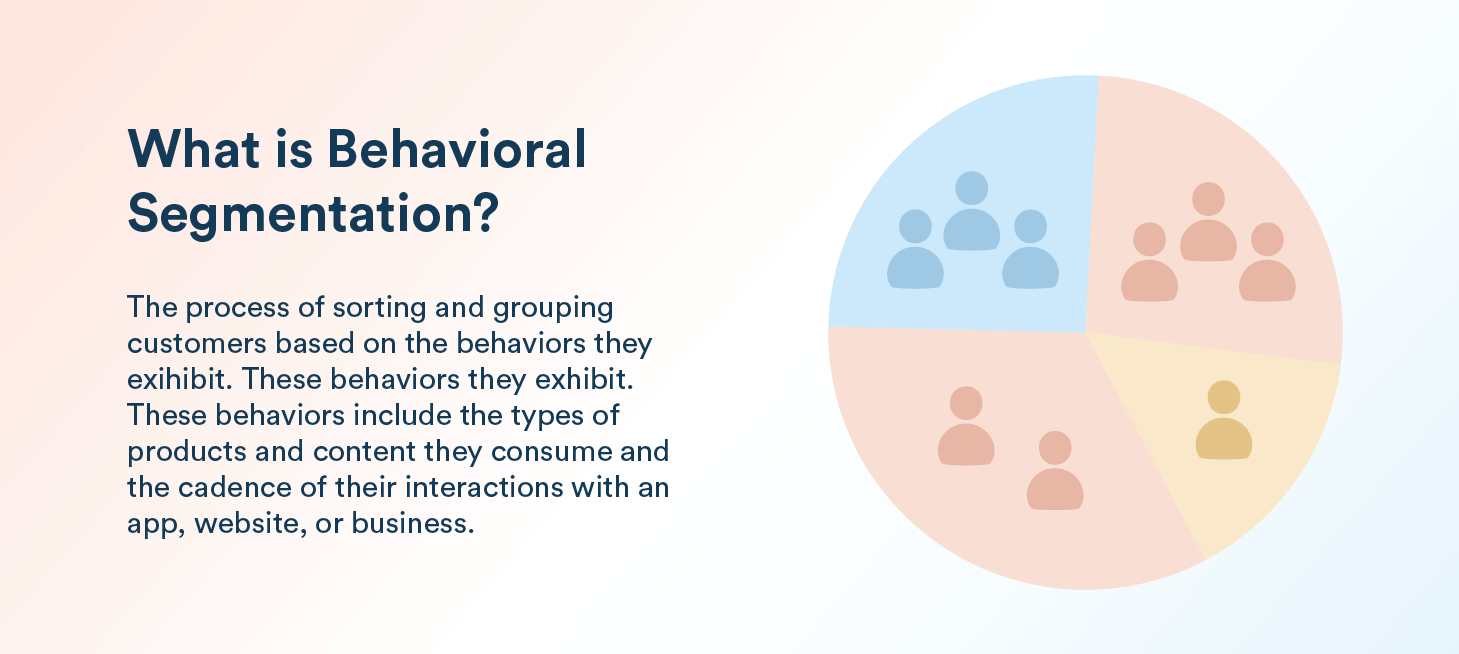
Behavioral segmentation is the process of sorting and grouping customers based on the behaviors they exhibit across an app, website, product, or business. These behaviors can include purchases, product or content views, clicks, feature usage, campaign engagement, and progress through different stages of the customer journey.
Behavioral segmentation can also account for what customers do not do, as well as how recently and frequently they take an action. For example, marketers can distinguish between frequent and occasional purchasers, highly engaged and inactive users, customers who adopt a particular feature and those who do not, or users who start but do not complete an important journey. These observed actions, inactions, patterns, and changes in behavior can then be used to create more relevant audiences and messaging.
Case study – Learn how StarQuick enhanced their customer lifecycle with automated segmentation
Why is Behavioral Segmentation Important?
Once mobile marketers identify users by their specific behavior, they can target messages and campaigns specifically tailored to these audiences. The benefits of behavioral segmentation include:
- Personalization: Behavioral segmentation doesn’t just tell you what product or service a certain group of customers likes. It helps you understand what channels they frequent and what type of messaging they respond to so you can boost your conversions.
- Budget allocation: Since you know which segments spend the most and how they spend, you can better allocate your efforts to target them.
- Forecasting: Looking at each segment’s patterns, you can identify trends and more effectively plan for the future.
- Retention: Behavioral segmentation makes customers feel understood and looked after throughout their customer journey. This doesn’t just provide an extraordinary boost to customer satisfaction levels; it also means higher customer lifetime values and long-term revenue.
Behavioral Segmentation vs. Other Types of Segmentation
Behavioral segmentation focuses on what customers do, while other segmentation approaches group customers based on who they are, where they are, or what influences their attitudes and preferences.
| Segmentation Type | What It Uses | Example |
|---|---|---|
| Behavioral | Actions, inactions, recency, frequency, purchases, engagement, and usage patterns | Users who added an item to their cart but did not purchase |
| Demographic | Characteristics such as age, income, occupation, or household attributes | Customers within a particular age group |
| Geographic | Location, region, city, country, or climate | Customers located in a particular city |
| Psychographic | Interests, attitudes, motivations, values, and lifestyles | Customers who prioritize sustainability |
These approaches do not have to be used separately. Marketers can combine behavioral signals with demographic, geographic, or psychographic information when the additional context makes a segment more relevant. The defining feature of behavioral segmentation, however, is that the audience is grouped according to observed customer actions or patterns of activity.
Behavioral Segmentation Examples
Some of the most common nuances of behavioral segmentation boil down to when users become customers (acquisition), how they use the app (user journey), how frequently they use the product (engagement), and how long they continue to use the product (retention).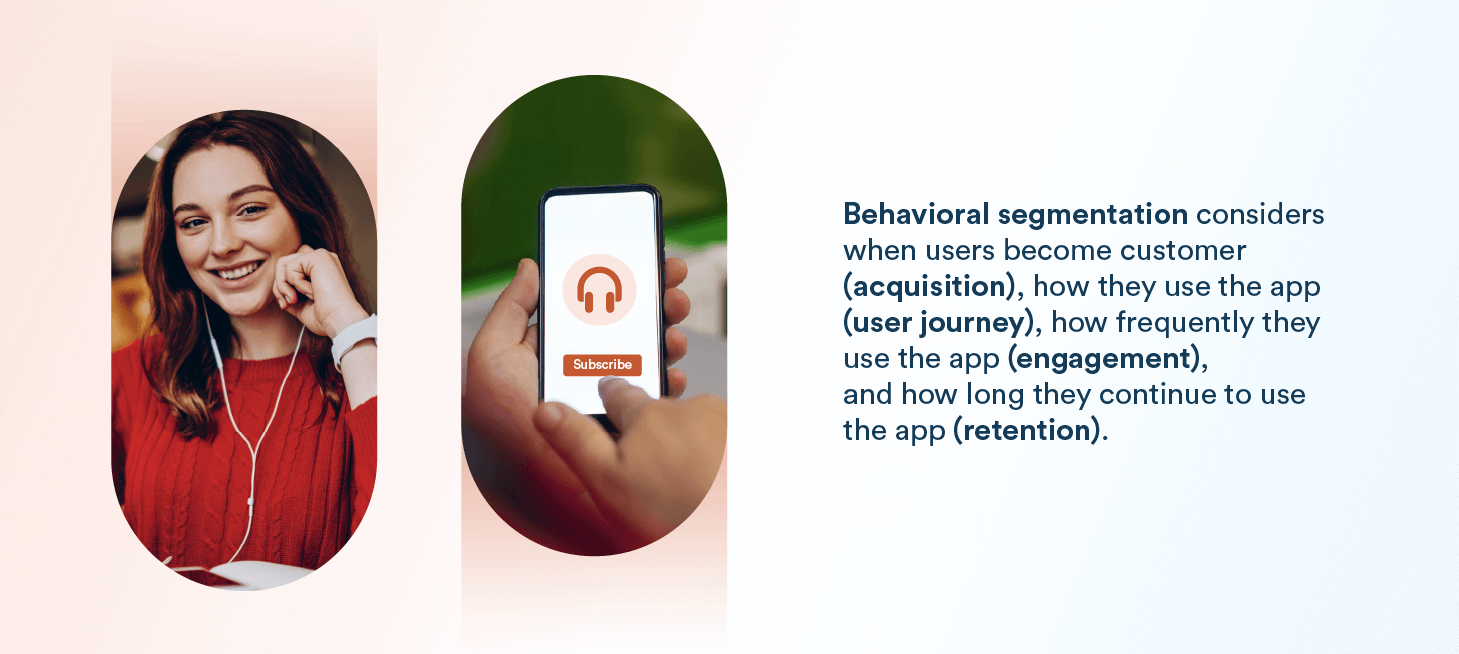
In fact, these are all key behavioral segmentation examples that can help you better understand your customers’ needs and preferences. Acquisition, engagement, and retention are all important factors to keep in mind when analyzing customer behavior and selecting behavioral segmentation variables. Understanding the following ways your users can interact with your product will help you accomplish a sustainable and constructive behavioral segmentation strategy.
01. Purchasing and Usage Behavior
Let’s use your ride-sharing app of choice as an example. A working professional uses the service to commute to and from the office Monday through Friday. On weekends, however, the user has the extra time needed to drive, park, and walk to their destination, so they never use the service then.
Understanding this user’s behavior, the ride-sharing service could offer discounts on the weekends to encourage usage on days they normally wouldn’t use the app.
Most companies recognize the power of tracking the purchase, usage, and consumption of their product as a means of forecasting demand. Customer segmentation based on purchase behavior is essential to understanding when your marketing will be most effective.
02. Occasion Purchasing
This component of behavioral segmentation considers the timing within a customer’s life, year, or day as a determinant of purchasing.
Life milestone purchases such as an engagement ring or house; seasonal purchases like holiday decorations and gifts; and daily purchases like coffee or food are all variations of occasion purchasing.
Starbucks uses behavioral segmentation to target their regular morning customers with an incentive to get them back in for another purchase later in the day. Since these regular users will likely have an afternoon coffee on occasion, Starbucks uses email marketing and push notifications within their mobile app to offer happy hour events.
03. Benefits Sought
Benefits sought can be useful for behavioral segmentation when marketers infer them from what customers actually do rather than relying only on assumed preferences or motivations. Repeated interactions can reveal whether users consistently prioritize factors such as convenience, price, variety, speed, or a particular product experience.
For example, customers who repeatedly order through a coffee shop’s mobile app before arriving may demonstrate a preference for speed and convenience. Customers who consistently order and spend time in-store exhibit a different usage pattern. Observing these behaviors allows marketers to build segments around demonstrated preferences and tailor experiences accordingly.
04. Customer Loyalty
One of the most important behavioral segmentation components is loyalty. Users who exhibit loyal behavior to your business should not be overlooked. Establishing a customer loyalty rewards program is one of the most common methods marketers use to reciprocate loyalty among customers.
Loyalty behavior can be measured through signals such as purchase frequency, repeat visits, spending, and reward activity. These signals can help marketers distinguish occasional customers from increasingly engaged or highly loyal customers and tailor recognition and rewards accordingly.
Starbucks, for example, launched a redesigned Starbucks Rewards program in March 2026 with Green, Gold, and Reserve membership levels. Members progress based on Stars earned over a 12-month period, with higher levels unlocking additional earning benefits and experiences. This provides a current example of how observable engagement and loyalty activity can be used to distinguish different customer groups.
05. Engagement, Recency, and Frequency
Not all customers interact with a product at the same level or cadence. Marketers can segment users based on how often they engage, how recently they were active, and whether that engagement is increasing or declining.
For example, an app could distinguish between users who open it daily, those who engage a few times a month, and users who were previously active but have not returned recently. These differences can guide how frequently users are contacted and whether the objective should be continued engagement, deeper adoption, or re-engagement.
06. Feature and Content Usage
The features, products, or content customers interact with can reveal what they find most relevant within an app or service. Behavioral segments can be created around users who repeatedly use a particular feature, consume certain categories of content, or have not yet adopted an important capability.
For example, a subscription app could identify users who regularly consume one content category and recommend similar content, while users who have not tried a core feature could receive targeted education designed to encourage adoption.
07. Journey, Conversion, and Inactivity Behavior
Behavioral segmentation can also reflect where users are in a journey and which actions they have completed or abandoned. This includes users who completed onboarding, started but did not finish a purchase, upgraded a subscription, abandoned a cart, or became inactive after previously engaging regularly.
Actions and inactions are equally useful signals. A user who completes a purchase may enter a post-purchase segment, while someone who adds an item to their cart but does not purchase within a defined period could enter an abandonment segment. This allows marketers to respond to what users actually do at different points in the customer journey.
Automate your segmentation with CleverTap today!
Behavioral Segmentation Strategies
Regardless of a user’s behavior, personalization is a strategy that works well. For example, we all have an affinity towards our own names, and if marketers can learn to use this effectively, users are likely to be more receptive. Personalization can be more than just calling people by their names, though.
Your behavioral market segmentation can guide other strategies, including retargeting, targeting complementary products, marketing based on attribution, and even avoiding certain segments.
01. Retarget Based on Past Behavior
Past behavior can help marketers identify customers who have already demonstrated interest or intent and create relevant audiences for re-engagement. Rather than assuming that every past action will predict future behavior, marketers can use specific actions and inactions as signals for what may be relevant next.
For example, an ecommerce app could create a segment of users who viewed the same product multiple times but did not purchase, or users who added an item to their cart but did not complete checkout. Those audiences could receive a reminder, relevant product information, or another message designed around the action they left incomplete.
The same approach can be applied throughout the customer lifecycle. Users who started onboarding but did not finish, engaged with a feature and then became inactive, or previously purchased from a particular category can each be targeted differently based on their observed behavior.
02. Combine Behavioral and Location Data
Location by itself is a geographic or contextual attribute rather than a behavioral one. However, combining location with observed behavior can make behavioral segments more useful and relevant.
For example, a ride-sharing app might identify that a user regularly books a ride from the same area at a particular time of day. Current location, past trip behavior, and timing can then be considered together to surface a relevant destination or experience. Similarly, a retail app could combine a customer’s previous store visits or purchases with their current location to determine whether a nearby-store message is relevant.
The key is to use location as additional context for an observed behavioral pattern rather than treating someone’s location as a behavior on its own.
03. Respond to Funnel and Journey Behavior
Customers often reveal intent through the steps they complete, skip, or abandon within a journey. Segmenting users according to these actions allows marketers to respond differently depending on how far someone has progressed toward an important outcome.
For example, a subscription app could distinguish between users who created an account but never started a trial, users who started a trial but have not used a core feature, and users who actively used the product but did not convert before the trial ended. Each group has demonstrated a different behavior and therefore requires a different message.
The same principle can be applied to onboarding, checkout, subscription renewal, feature adoption, and other important journeys. Instead of treating everyone who has not converted as one audience, marketers can use behavioral signals to understand where users stopped and tailor the next interaction accordingly.
04. Suggest Complementary Features or Products
Behavioral segmentation is helpful for building recommendation engines that can accurately predict which products or features each customer may be interested in next.
Amazon uses past behavior and the purchase history of segments with similar behaviors to recommend other products. These product recommendations—a direct result of behavioral segmentation—are responsible for a whopping 35% of sales.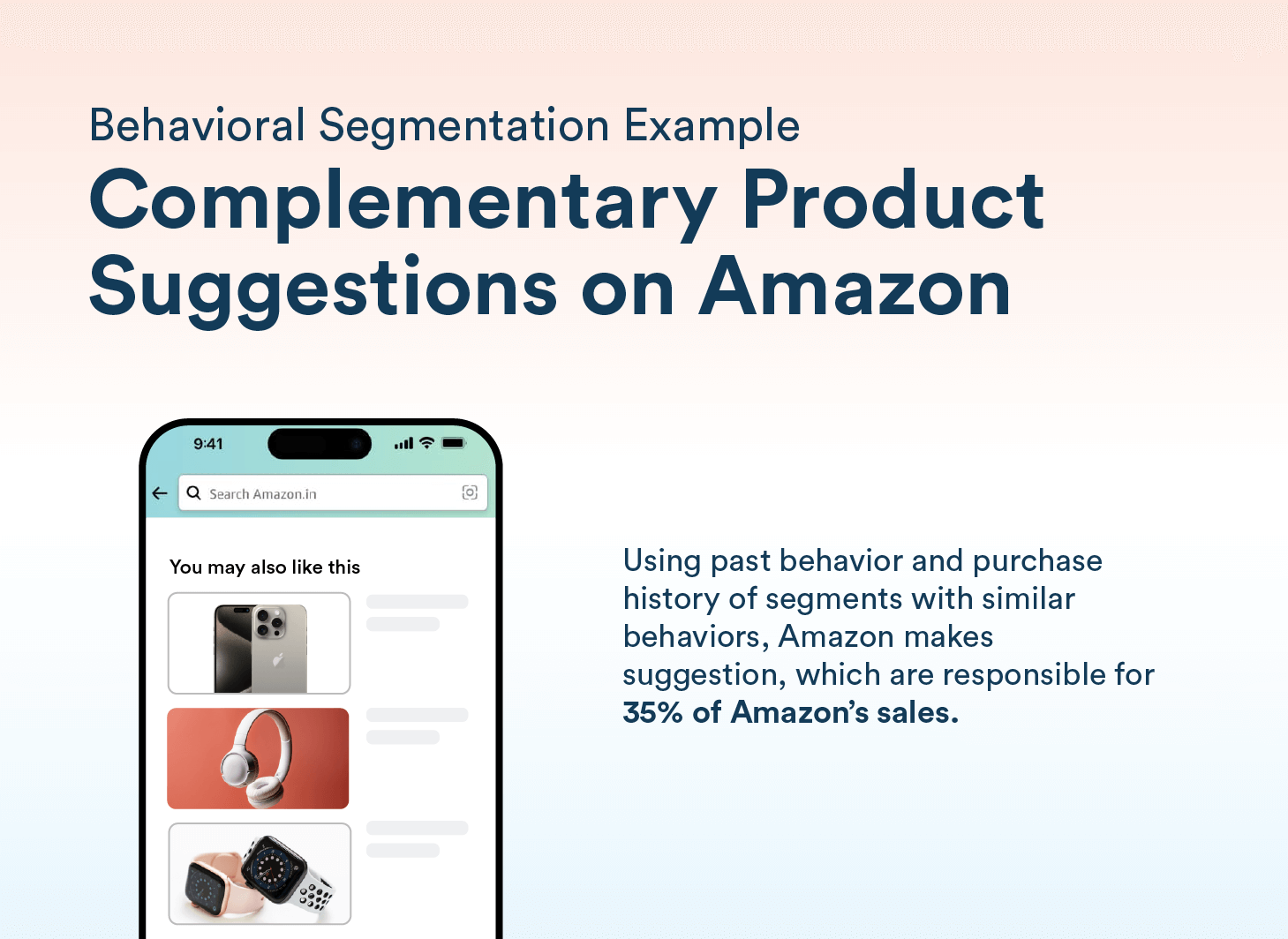
05. Perfect Your Timing
Some users have a regimented schedule, while others are more flexible. Understanding the cadence at which users re-engage with your app can help you know when to send push notifications, email marketing material, or other messages to bring users back.
Analyzing your behavioral segmentation data allows you to optimize the timing of your messaging and might reveal some valuable insights.
Let’s assume your company has localized the app for South America, but after analyzing behavioral segmentation, you realize many users are using the app in the middle of the night. Instead of sending push notifications in the early morning, when your insomnia-prone users are catching up on lost sleep from the night before, you could send push notifications shortly before midnight for the most engagement.
News and media applications deeply contemplate their push notification strategy to reach the right audience at the right time. Some newsrooms argue that the lock screen should be held sacred for breaking news, while others are confident their segmentation strategies will deliver the most engaging content for each particular user.
06. Use Historical Behavior to Identify Patterns
Historical behavior helps marketers identify patterns that may not be visible from a single interaction. Looking at recency, frequency, repeat actions, and changes in activity over time can reveal whether a customer is becoming more engaged, maintaining a regular pattern, or beginning to disengage.
For example, an ecommerce brand might identify customers who typically repurchase a product every 30 to 45 days. If a customer moves beyond their usual purchase window without ordering again, they can enter a re-engagement segment. Customers who continue to purchase frequently can instead receive loyalty-oriented messaging or relevant recommendations.
Historical behavior can also help distinguish meaningful patterns from isolated actions. Someone who viewed a category once may require a different approach from someone who has returned to the same category five times in the past month. Defining segments around these patterns helps marketers respond to how customer behavior develops over time.
Now that you understand the definition, examples, and strategies, you can start to plan how to use behavioral segmentation within your marketing.
Tips to Implement Behavioral Segmentation
Effective behavioral segmentation starts with defining the action or pattern that matters, then turning that behavior into clear segment rules that can be activated and measured.
- Define the objective and target behavior: Start with the outcome you want to influence, such as activation, conversion, feature adoption, retention, or re-engagement. Identify the behaviors that indicate progress toward or away from that outcome.
- Choose the relevant behavioral signals: Select the events that matter, including purchases, content views, feature usage, campaign interactions, completed actions, or inactions. Avoid adding signals simply because the data is available.
- Set recency, frequency, and time-window rules: Define how recently or frequently an action must occur for someone to enter the segment. “Purchased once” represents a very different audience from “purchased three times in the past 30 days.”
- Define inclusion and exclusion criteria: Specify who should enter the segment and who should not. For example, an abandoned-cart segment should include users who added an item to the cart but exclude anyone who completed the purchase afterward.
- Match the experience to the behavior: Determine what message, offer, recommendation, or journey makes sense for each segment. The response should relate directly to the behavior that qualified the customer for the audience.
- Measure and refine the segment: Track whether each segment responds differently and whether the campaign influences the intended outcome. Update segment definitions, time windows, and activation strategies as customer behavior changes.
You Might Like to Read: What is Demographic Segmentation? Its Importance, Factors & Examples!
How CleverTap Supports Behavioral Segmentation
CleverTap is an AI-native customer engagement platform and customer retention platform that helps marketers turn customer behavior into actionable audiences and relevant customer experiences. Marketers can build segments using actions, inactions, user properties, event properties, frequency, and defined time periods, then activate those audiences across campaigns, journeys, analytics, and personalization.
Build Segments From Past and Live Behavior
CleverTap supports Past Behavior Segments for users who meet defined criteria based on previous activity, as well as Live User Segments that qualify users when an action or inaction occurs. For example, marketers can identify customers who purchased a product within the past 30 days, users who repeatedly engage with a feature, or customers who add an item to their cart but do not complete a purchase within a specified period.
These rules can also combine behavior with relevant user properties to create more precise audiences. This allows marketers to move beyond broad customer groups and define segments around the specific patterns that matter to a campaign or business objective.
Create Behavioral Segments Faster With CleverAI™
Segment Builder, part of CleverAI™, allows marketers to describe the audience they want using natural language. It converts the request into structured segmentation rules based on events, user properties, and time filters, which marketers can review and edit before saving the segment.
For example, a marketer could ask for “active iOS users who haven’t purchased in the last 30 days,” then refine the generated rules before using the segment in a campaign. This reduces the manual work involved in translating a marketing idea into complex segmentation logic while keeping the marketer in control of the final audience definition.
Move From Segments to Live 1:1 Personalization
Behavioral segmentation helps marketers identify meaningful groups, but customer behavior can change from one interaction to the next. CleverAI™ extends personalization beyond a static segment by combining live and historical user context to determine the relevant message, offer, channel, moment, and experience for each individual.
Marketers define the business goal, strategy, audience boundaries, and guardrails. CleverAI™ then uses changing customer context to inform decisions and learns from each interaction, allowing the next experience to adapt as customer behavior changes.
Activate Behavioral Insights Across the Customer Journey
Behavioral segments can be used to trigger campaigns and journeys based on what customers do or fail to do. A user who abandons a cart can enter a recovery journey, someone who adopts a new feature can receive the next relevant experience, and a previously active customer whose engagement declines can enter a re-engagement journey.
This connects behavioral segmentation with action. Instead of creating audiences only for analysis, marketers can use changing customer behavior to determine who qualifies for an experience and when that experience should begin.
CleverTap also helps support user segmentation strategies with demographic, geographic, and psychographic segmentation.
Use Live and Historical Context With TesseractDB™
TesseractDB™ provides the data and feature foundation behind CleverAI™, bringing together live behavior, long-range customer history, campaign responses, profile attributes, and other customer context in a real-time feature store. This gives CleverAI™ both the depth of historical behavior and the immediacy of what a customer is doing now.
For behavioral segmentation, this means marketers can work with more than isolated or recent actions. Historical patterns can provide context around recency, frequency, past engagement, and changing customer behavior, while live signals can indicate what is happening in the current moment. Together, these signals create a stronger foundation for relevant segmentation, personalization, and decisioning.
Build smarter behavioral segments and activate them across the customer journey with CleverTap.
Behavioral Segmentation for Your Mobile Marketing
Behavioral segmentation becomes most useful when marketers treat customer groups as dynamic rather than permanent labels. A user who is highly engaged today may become inactive next month, a first-time buyer may become a repeat customer, and someone who abandoned a purchase may convert shortly afterward. Segments should change as the behavior behind them changes.
Every useful behavioral segment should answer four questions: What behavior qualifies the customer? Over what time period? What action should follow? What outcome will determine whether the strategy worked? A segment such as “inactive users,” for example, becomes much more actionable when inactivity is clearly defined and tied to a specific re-engagement goal.
Behavioral segmentation can help marketers:
- Identify customers showing purchase intent or signs of disengagement.
- Distinguish frequent, occasional, new, and inactive users.
- Adapt onboarding and feature education according to actual usage.
- Recover customers who abandon important journeys or conversions.
- Personalize communication based on recency, frequency, engagement, and purchase behavior.
- Allocate marketing effort toward audiences where a particular intervention is most relevant.
Once campaigns are active, measure the outcome that corresponds to the behavior being targeted. A cart abandonment segment should be evaluated against recovered purchases, while an inactivity segment might be measured using reactivation and subsequent retention. Looking at how customers move between behavioral segments over time can also reveal whether engagement is strengthening or declining.
Behavioral data can be combined with demographic, geographic, and psychographic information when additional context improves relevance. However, the behavioral component should always remain grounded in what the customer has actually done, not assumptions about what people with similar characteristics are expected to do.
The goal is not to create as many customer segments as possible. It is to identify meaningful patterns of behavior and use them to make the next interaction more relevant.
Turn live and historical customer behavior into actionable segments and more relevant engagement. Try CleverTap.
Frequently Asked Questions About Behavioral Segmentation
1. What is behavioral segmentation in marketing?
Behavioral segmentation is the practice of grouping customers based on observable actions and patterns, such as purchases, product usage, content engagement, feature adoption, frequency of activity, and inactivity. It helps marketers create more relevant campaigns and experiences based on what customers actually do.
2. What are the main types of behavioral segmentation?
Common types of behavioral segmentation include purchasing and usage behavior, occasion or timing, benefits sought, and customer loyalty. Digital businesses can also segment users by engagement level, recency and frequency, feature usage, journey progress, conversion behavior, and inactivity.
3. What is an example of behavioral segmentation?
An ecommerce brand could create a segment of customers who added an item to their cart but did not complete the purchase within 24 hours. That audience could then receive a targeted reminder or recovery message based on the specific behavior they exhibited.
4. What data is used for behavioral segmentation?
Behavioral segmentation can use data such as purchase history, app and website activity, clicks, searches, content consumption, feature usage, campaign interactions, product views, cart activity, conversions, session frequency, and periods of inactivity. Recency and frequency add further context by showing how recently and how often a behavior occurs.
5. What is the difference between behavioral and demographic segmentation?
Behavioral segmentation groups customers based on what they do, while demographic segmentation groups them based on characteristics such as age, income, occupation, or household attributes. The two can be combined, but behavioral segmentation is specifically based on observed actions and patterns.
6. How does behavioral segmentation improve customer retention?
Behavioral segmentation helps marketers identify signs of declining engagement, inactivity, reduced purchase frequency, or incomplete journeys. These signals can be used to trigger more relevant retention and re-engagement campaigns instead of sending the same message to every customer.

Subharun Mukherjee 
Heads Cross-Functional Marketing.Expert in SaaS Product Marketing, CX & GTM strategies.
Free Customer Engagement Guides
Join our newsletter for actionable tips and proven strategies to grow your business and engage your customers.