




































Table of Contents
Categories
Most Popular


Your team spent six weeks building a re-engagement campaign. You did everything by the playbook. Initially, the open rates looked fine. CTR was also okay. But retention barely moved.
The board asked what had changed, and the honest answer was: not much.
The pressure to make every customer interaction count is growing. A Gartner survey of 321 customer service leaders found that 91% are being pushed by leadership to deploy AI specifically to improve how they engage and retain customers. That pressure won’t ease until customer engagement metrics actually move.
It’s best to start exploring how to use AI to boost customer engagement now. This guide breaks down how AI can be applied across engagement workflows, with clear steps, tools, and examples to help teams move from experimentation to measurable impact.
What is AI for Customer Engagement?
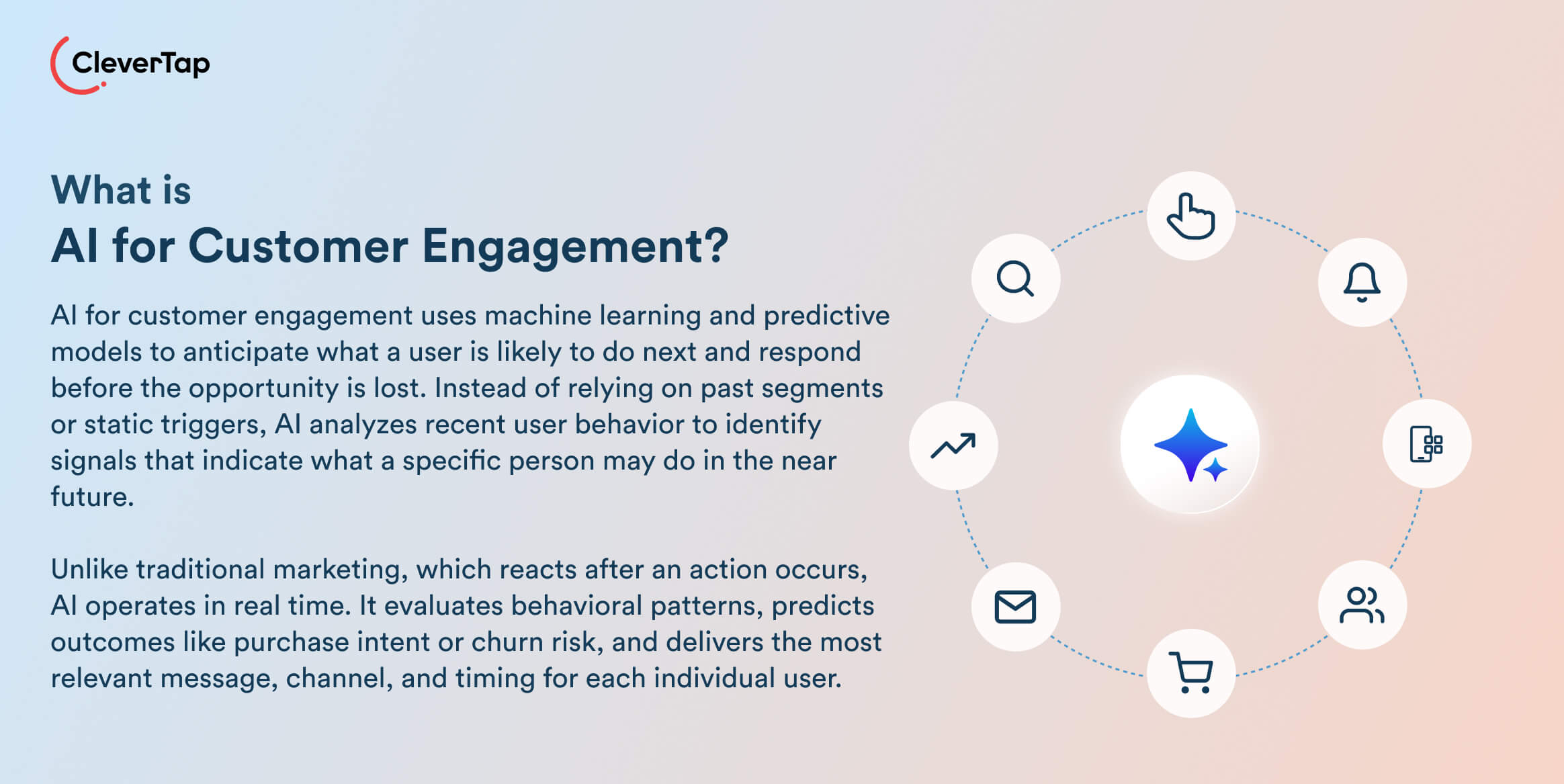
An AI customer engagement strategy uses machine learning, predictive models, and generative AI to predict what each user is about to do and act on it before the moment passes.
That phrase is key. About to do. Not what they did yesterday. Not what their segment did last quarter. What this one person is likely to do in the next 48 hours, based on what they have done in the last 72 hours.
Traditional marketing is reactive. A user abandons a cart, so you send a recovery email. AI flips that order. It reads user behavior in real time. It scores how likely someone is to buy, leave, or come back. Then it picks the right message, the right time, and the right channel for that person, bringing together timing, personalization, and delivery into a single decision system rather than separate campaign steps..
Why does this matter right now? Because users already expect it. McKinsey research found that over 75% of consumers lose interest when content doesn’t feel relevant to them. Three out of four people tune out when your message misses the mark. AI helps you stop guessing and start knowing, at a speed no human team can match.
One thing to clear up early: the use of artificial intelligence for customer engagement is not limited to chatbots. It’s not a rules engine that sends a push when someone hits a trigger. Those are automation tools. They’re useful, but they are often rigid and limited to predefined logic. AI learns from each interaction and gets better over time. Automation follows a script. AI rewrites the script as things change, and that difference shapes how engagement strategies evolve over time.
AI vs. Rule-Based Automation
Most marketing teams already use automation. It works well enough. Campaigns go out on time. But nothing gets better, either.
A rule says: “If the user abandons the cart, send an email in 2 hours.” It does that. But it can’t tell you which user needs a 10% discount and which just needs a nudge. It can’t figure out that one user reads email at 11 PM and another taps push at 7 AM. It treats everyone in a segment the same, because that’s all it was built to do.
AI-powered customer engagement fills those gaps. Here’s the difference side by side:
The difference between AI-powered customer engagement and rule-based customer engagement
| Capability | Rule-Based Automation | AI-Powered Engagement |
| Segmentation | Static, set up by hand | Dynamic, updates with live behavior |
| Timing | Fixed schedule or trigger | Set per user’s habits |
| Content | Same for the whole group | Different for each person |
| Channel | Chosen ahead of time | Picked based on user data |
| Optimization | Manual A/B tests | Ongoing, self-learning |
| Churn response | Reacts after the user leaves | Acts before the user starts to leave |
The core difference is adaptability. Rule-based systems execute predefined instructions, while AI continuously adjusts decisions based on changing user behavior and context.
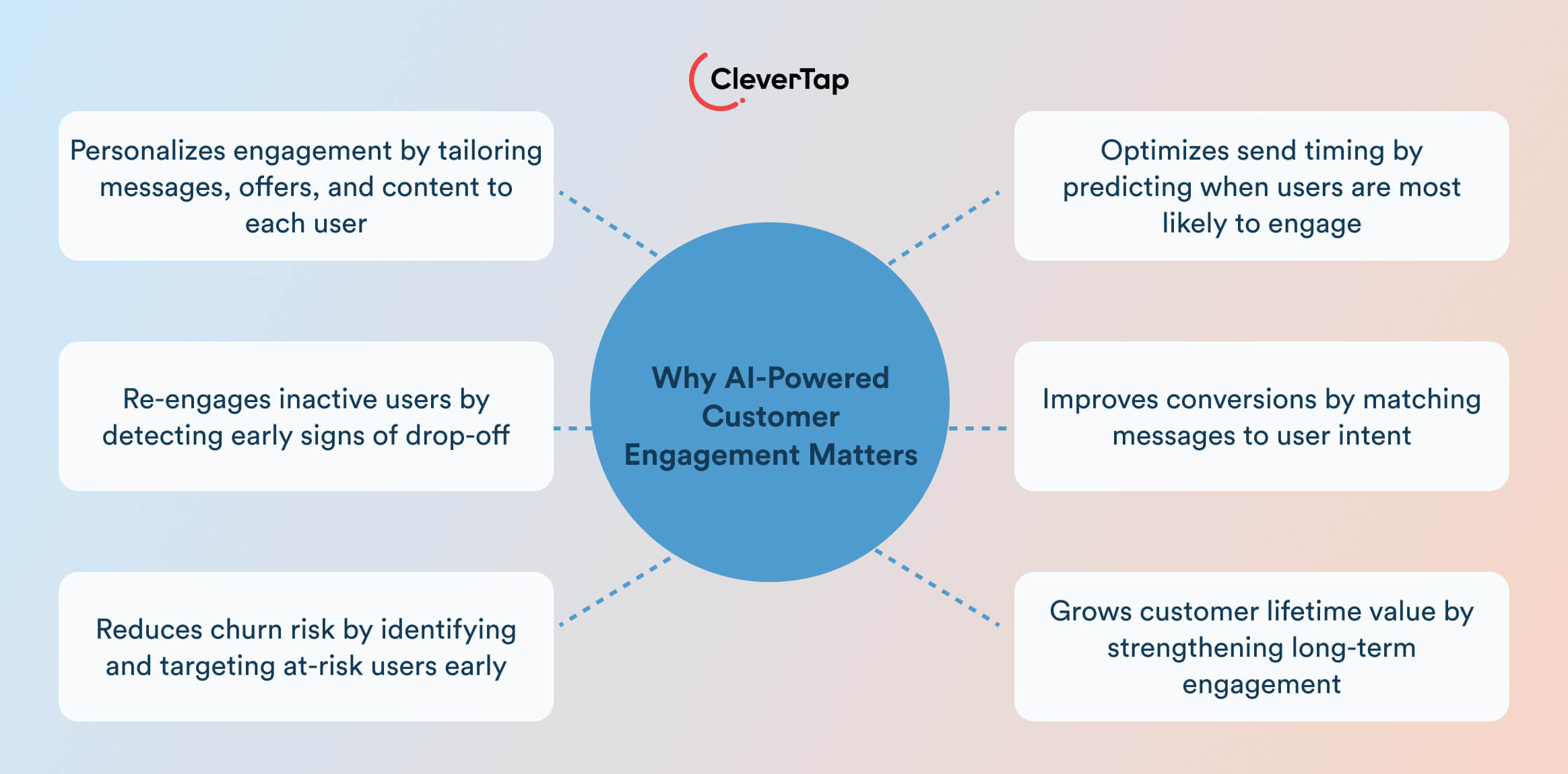
Why AI-Powered Customer Engagement Matters
Customer expectations have outpaced what manual campaigns can deliver. Users now move across apps, channels, and devices in patterns that change week to week. Static segments and scheduled sends can’t keep up.
AI-powered engagement matters because it closes the gap between how fast your users change and how fast your team can respond. It allows teams to respond to user behavior as it evolves, rather than reacting after patterns have already shifted.
When done right, the impact shows up across the board. McKinsey’s 2025 research on AI-powered next best action platforms found that they lift satisfaction by 15 to 20%, grow revenue by 5 to 8%, and cut service costs by 20 to 30%. One major US airline used AI to improve targeting of at-risk customers by 210%, increase satisfaction eightfold, and cut churn intent among high-value passengers by 59%.
But the technology alone isn’t enough. Forrester’s CX Index 2025 found that 25% of US brands saw CX quality actually drop, partly because of poorly rolled out AI. The difference between AI that works and AI that flops comes down to process. Bolt it onto a broken workflow, and it amplifies the problems. Build it into a sound engagement strategy, and it compounds results over time.
In practice, AI amplifies the strength of your underlying engagement system, it does not replace it.
Engagement Metrics AI Directly Impacts
If you run lifecycle programs, you watch these numbers every day. AI moves each one, and they build on each other.
- Click-through rate measures how many users act on a message. AI improves it by tailoring subject lines, content, and offers to each person rather than to broad groups.
- Open rates track whether messages get seen at all. AI lifts them by delivering messages at the exact hour a user usually checks in, so they land at the top of the inbox or notification tray.
- Session frequency reflects how often users return to your app. AI keeps it steady by re-engaging users before they go quiet, not weeks after they’ve already left.
- Conversion rate shows how many users complete a desired action. AI raises it by using scoring models to sort out which users need a reminder, which need a deal, and which need a product walkthrough.
- Retention rate captures how many users stick around over time. AI improves it by using churn prediction to spot at-risk users early enough for your team to act.
- Lifetime value is the total revenue a user generates across their relationship with your brand. AI grows it by making sure every message builds toward the long-term relationship, not just the next tap.
Improvements across these customer engagement metrics are interconnected. Gains in engagement often translate into stronger retention and higher customer lifetime value over time. It creates a flywheel that picks up speed the longer it runs. That brings up the real question: which AI tools create these lifts, and how do they work?
6 Core Ways to Use AI to Boost Customer Engagement
Six tools. Each one solves a specific problem, and each comes with proof that it works.
1. Predictive Segmentation
Predictive segmentation is the practice of grouping users based on what they are likely to do next, not what they have already done. Traditional segments are static: they rely on past actions like “purchased in the last 30 days” or “inactive for 14 days.” Predictive segments are dynamic. They use machine learning to score each user on factors like churn risk, purchase likelihood, and potential lifetime value, and these scores update automatically as new data comes in.
The practical difference is significant. Your “inactive users” segment probably holds thousands of people with very different intentions. Some will leave for good. Some just had a busy week. Predictive segmentation separates them so you can spend on the users who actually need a nudge and stop wasting budget on those who would have come back on their own. It scores each user on churn risk, purchase likelihood, and potential lifetime value. These scores update automatically as new data comes in.
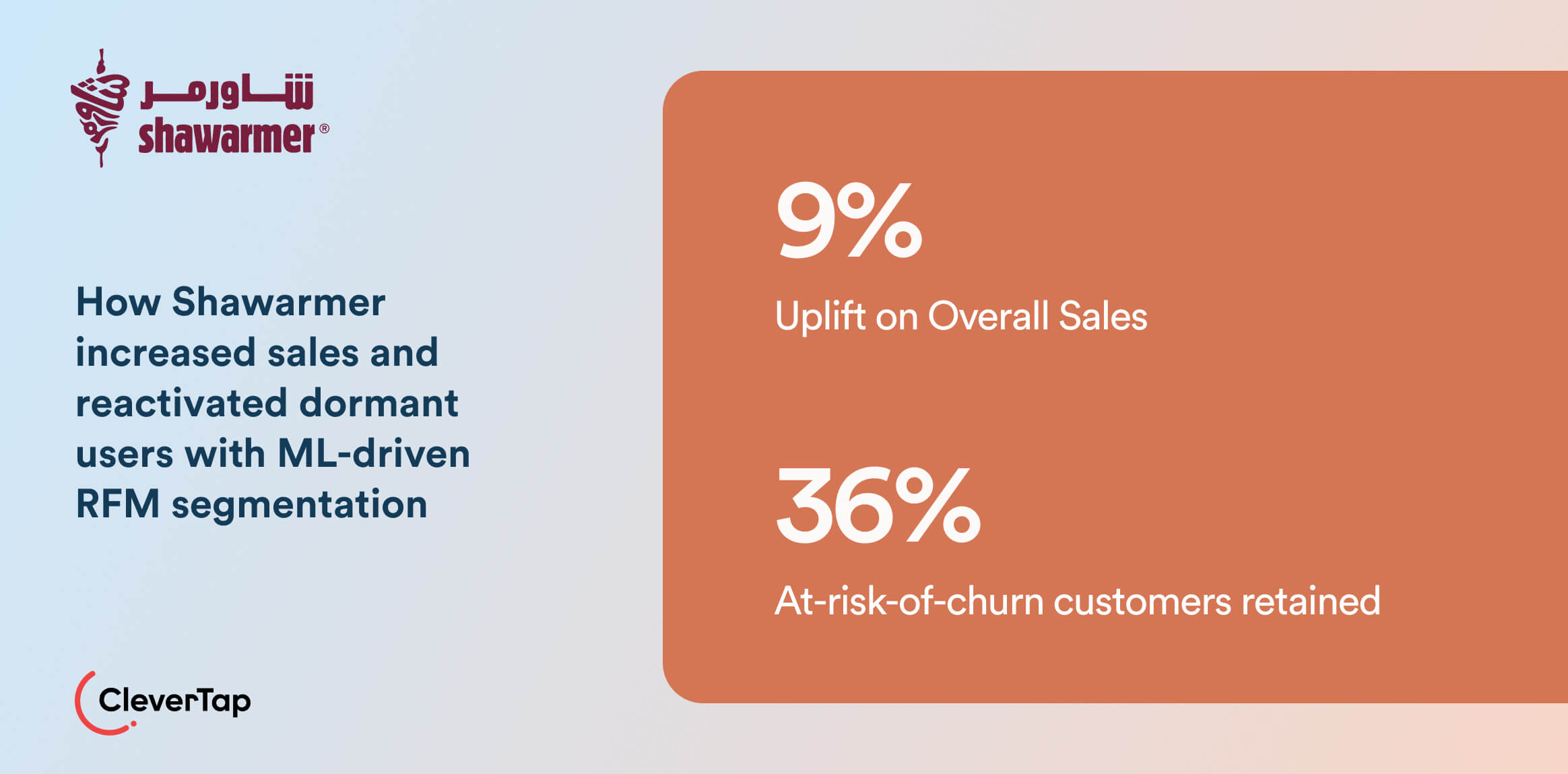
As a result, segments continuously reshape themselves without manual intervention, keeping targeting aligned with real user intent. Shawarmer, a restaurant chain with 160 locations in Saudi Arabia, used ML-driven RFM segmentation on its customer base. The result: a 27% reactivation rate among dormant users and 36% retention of at-risk customers, with overall sales up 9%. The whole program ran without any ad spend.
Just smarter grouping is doing the heavy lifting.
In practice: A food delivery app identifies users who haven’t ordered in 10 days but still browse menus. Instead of sending blanket discounts, it targets only high-value users with personalized offers, while letting low-intent users drop off naturally. This reduces wasted incentives and improves ROI.
Also read: How to Use AI for Customer Segmentation? 5 Easy Steps & Insights
2. Real-Time Personalization
Real-time personalization means adapting the content, offer, or experience a user sees based on what they are doing right now, not what their segment did last week. Instead of locking content in at the time a campaign is built, AI reads live signals like page views, cart additions, searches, and time spent in the app, and assembles a message for that one person in that moment.
Most personalization is pre-set and group-level. Real-time personalization is individual and immediate. That speed is what makes the difference between a message that feels relevant and one that feels like it was meant for someone else.
AI reads live behavior, things like page views, cart adds, searches, and time spent in the app, and builds content for each person right then. Not for a group of 50,000. For one person.
A European telecom tested this with AI-powered personalized messaging. Users who got personalized messages acted on them 10% more often, according to McKinsey. The content was also made 50x faster than by hand.
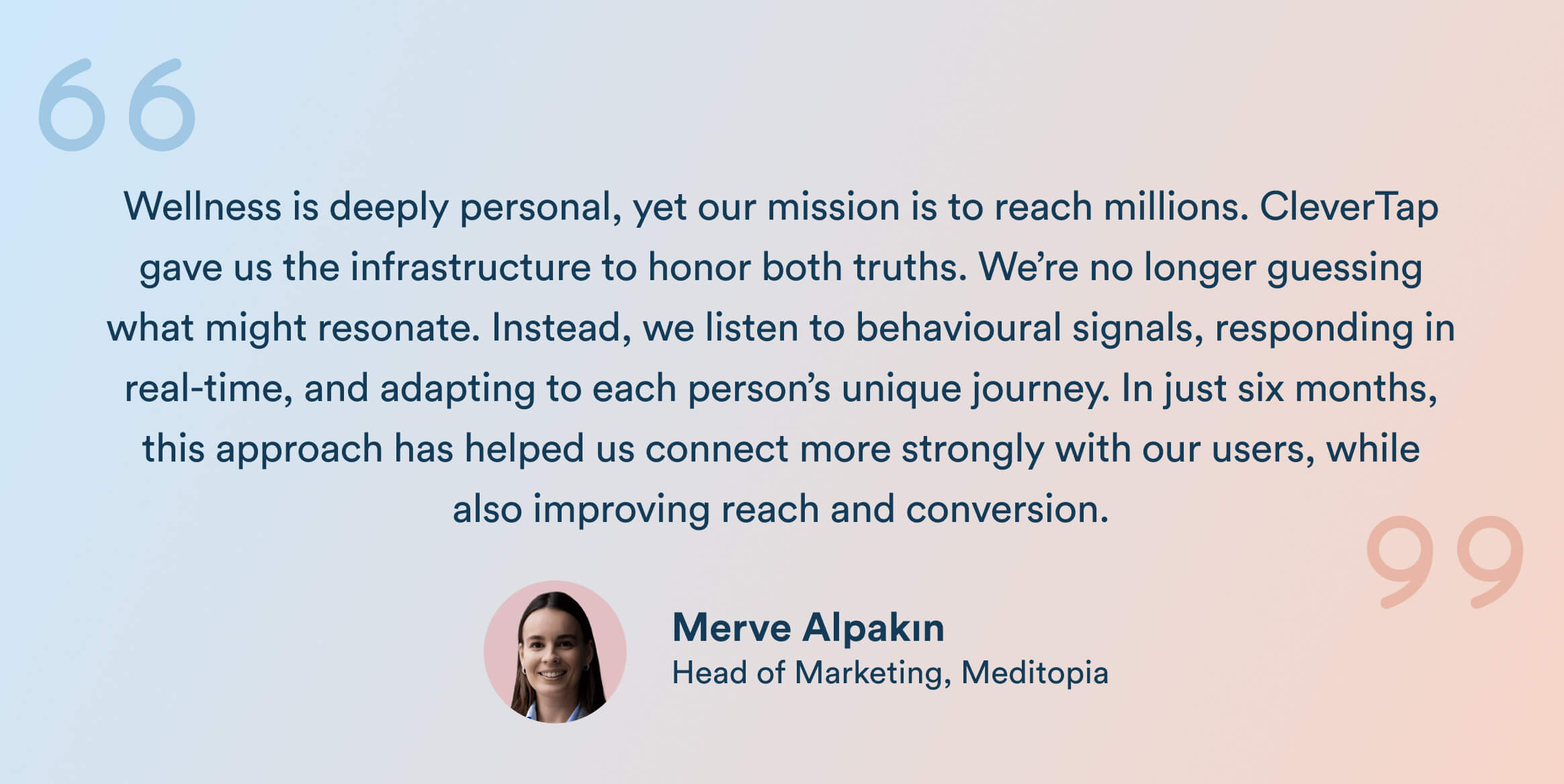
Meditopia, a wellness app with 40 million users across 100+ countries, went further. Personalized campaigns got 12x more engagement than standard ones. And 63% of their best campaigns used personalization. Nearly two-thirds.
In practice: A streaming app sees a user watch three thriller trailers in one sitting. AI reshuffles the in-app content to show more thrillers, sends a push about a new release in the genre, and changes the next morning’s email picks. One session of data reshapes three channels right away.
This ability to act on in-session signals is what turns personalization from static targeting into real-time engagement. But personalized content only works if it shows up at the right time. That leads to the next piece.
3. Send-Time Optimization
Send-time optimization uses AI to determine the best moment to deliver a message to each individual user. Instead of picking a single send time for an entire segment, the model learns each person’s habits: when they open emails, tap push notifications, and browse the app. Then it delivers the message at the time that person is most likely to engage.
The problem with batch sends is simple. A push notification at 10 AM hits a night-shift worker mid-sleep and a parent during school drop-off. Both swipe it away. The message wasn’t bad. The timing was. Send-time AI eliminates that mismatch at scale.
Find out what is the best time to send push notifications and the best marketing email send time.
Send-time AI learns each user’s habits: when they open emails, tap push notifications, and browse the app. Then it sends the message at the best time for that one person.
Vodafone’s My Vodafone app team found a 2-minute window to reach users who hadn’t completed a transaction. By hitting that window, re-engagement CTRs reached 23.7%, and conversions doubled.
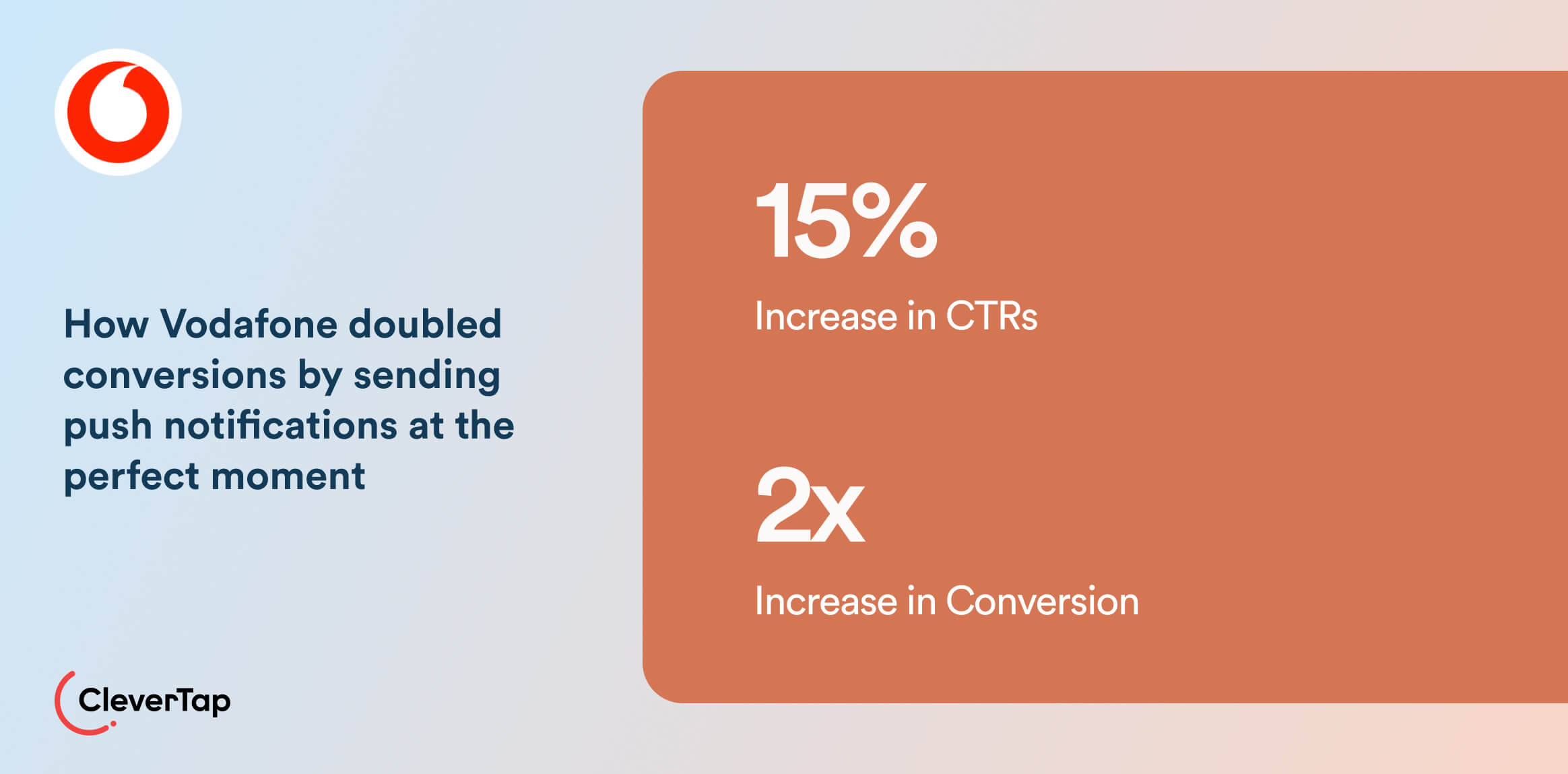
Two minutes. No human can time that. Only a model that knows each user’s patterns can. This is where AI adds precision at scale, aligning delivery timing with individual behavior rather than segment averages.
In practice: An e-commerce app sends cart recovery messages at different times for each user. One user receives a push at 8 PM when they usually browse, while another gets an email at 7 AM during their commute, increasing the likelihood of engagement for both.
So now you have the right audience, the right message, and the right timing. The next step is linking all of it into a journey that adapts as the user moves through it.
4. Journey Orchestration
Journey orchestration is the process of designing multi-step, multi-channel campaigns that adapt in real time based on how each user responds. Instead of a fixed sequence where every user gets the same email on day 1, push on day 3, and in-app message on day 7, AI evaluates each person’s behavior at every step and decides the next best action.
AI changes this. It checks each user’s response at every step and picks the next best move. Should the channel switch from push to WhatsApp? Should the offer go up? Should the user exit the journey because they already bought? These choices happen in real time. This turns journeys from fixed workflows into adaptive systems that respond to user behavior as it unfolds.
Wing Bank in Cambodia used this approach to get 2x higher engagement and click rates, a 25% retention rate, and 20% weekly conversion. The journey changed with each user, not on a fixed calendar.
In practice: A food delivery app runs a campaign for lapsed users. User A opens the app after the first push and gets routed to an in-app tour of a new feature. User B skips push and email, so AI sends a WhatsApp message with a time-limited deal. User C opens the email but doesn’t order, so AI follows up with a push showing restaurants they’ve ordered from before. Three users. Three paths. One campaign.
Adaptive journeys handle the present well. But the real edge comes from seeing what’s about to happen next.
5. Predictive Analytics and Forecasting
Predictive analytics uses historical and real-time data to forecast user-level outcomes like churn probability, purchase likelihood, and the rate at which engagement is declining. It turns raw behavioral data into scores that tell you what a specific user is likely to do over the next 7, 14, or 30 days.
Most retention programs only kick in after a user has already gone quiet. By that point, the cost of winning them back is high, and the odds are low. Predictive analytics changes the timeline, giving your team a window to act while the user is still reachable.
An Asia-Pacific telecom that built a “next best experience” engine on predictive analytics cut churn by 5% and got nearly 4x the ROI of its old approach, per McKinsey. Five percent sounds small. Then you figure out what 5% of your user base is worth over a year.
The value of predictive analytics lies in shifting intervention earlier, when the probability of influencing behavior is still high. All of these tools, segmentation, personalization, timing, journeys, and prediction, depend on one more thing: the message itself. And that’s where teams usually get stuck.
In practice: A subscription app identifies users whose engagement has started to decline over the past week. Instead of waiting for churn, it triggers a personalized retention journey with relevant content or offers while the user is still active, improving the chances of recovery.
6. AI-Powered Content Generation
AI-powered content generation uses generative AI to write subject lines, message copy, and full campaign content tailored to specific segments, tones, languages, and contexts. Instead of a copywriter manually creating 30 versions for 30 micro-segments, the model generates variations at scale and learns from past performance data to prioritize what works, not just what reads well.
This solves the bottleneck that slows down most lifecycle teams. Targeting and timing can be automated, but if content creation stays manual, it becomes the constraint that limits how personalized your campaigns can actually get.
Axis Bank combined AI content writing with automated A/B testing. The result: a 27% jump in conversions from users who had dropped off during credit card upgrades. Click-to-conversion rates for personal loan campaigns via mobile push increased by 13%. This allows personalization efforts to scale without increasing content production overhead.
In practice: A fintech app generates multiple push notification variations for different user segments, testing tone, urgency, and messaging style automatically. The system then prioritizes high-performing variants in real time, improving conversion rates without manual copy iteration.
Try CleverTap’s Scribe, an AI-powered content generation tool that helps teams scale personalized, high-performing campaign copy without slowing down execution.
These six tools work best together. The question is how to connect them into a system your team can actually run.
How to Build an AI-Powered Customer Engagement Strategy
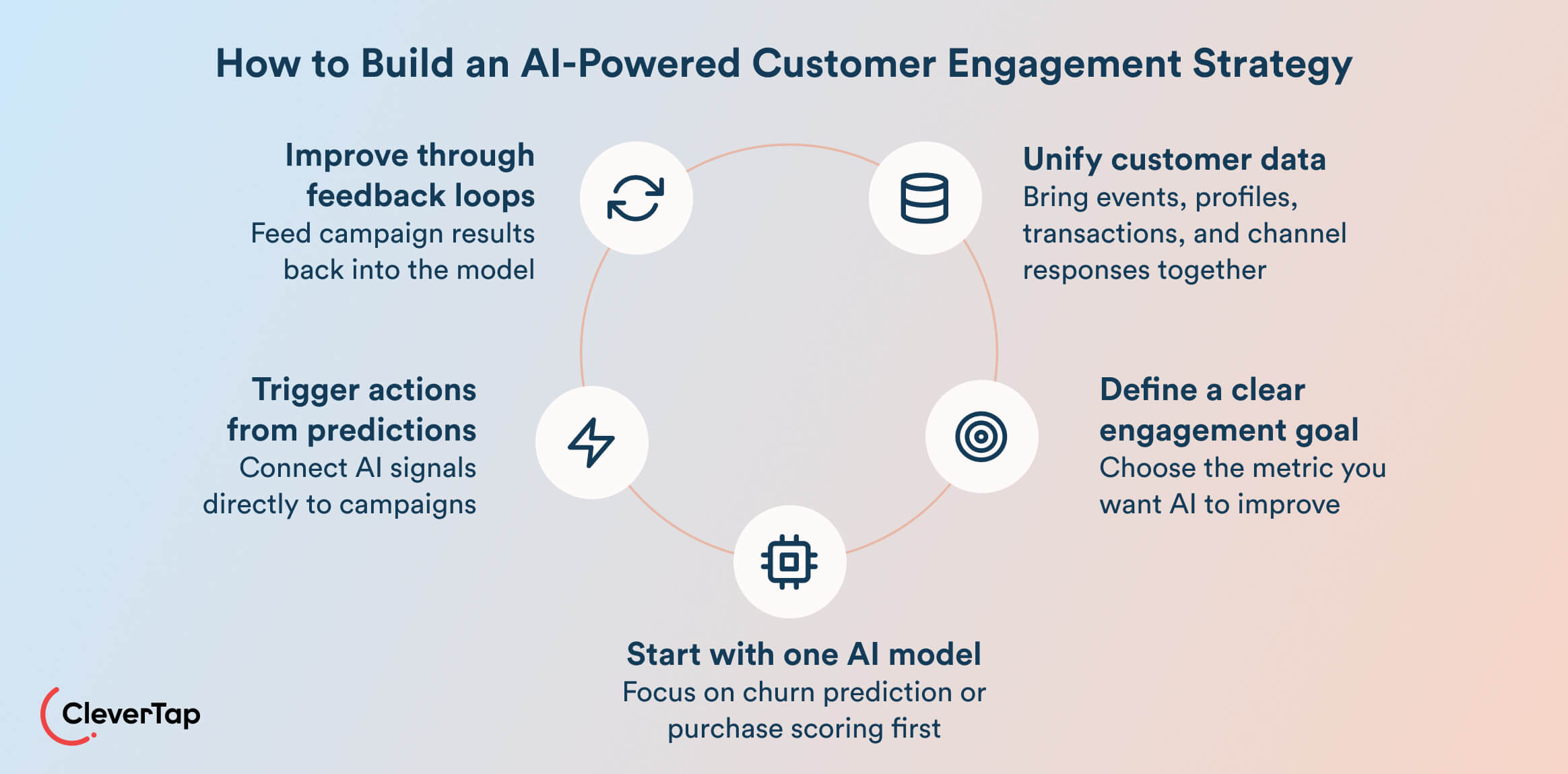
Knowing what AI can do is the start. Putting it into your team’s daily work is where it pays off. Five steps.
1. Bring All Your Data Together
AI learns from data. If user events are in one tool, transactions in another, and channel data in a third, no model will give you good answers. Pull event data, user profiles, channel responses, and purchase records into one place. This is the base. Without it, everything else falls short.
A unified data foundation ensures models can capture the full customer journey rather than fragmented signals.
2. Pick Your Goals
Before you turn on a single model, decide what “better engagement” means for your business.
- Is it Day-7 retention?
- How often do people buy?
- LTV in the first 90 days?
Each goal needs a different model. Without a clear target, AI ends up chasing vanity numbers like opens and impressions while the metrics your leadership cares about stay flat.
Clear goals ensure AI efforts are aligned with measurable business outcomes, not just engagement signals.
3. Start with One Model
Match it to your biggest problem. If churn is the issue, start with churn prediction. If conversion is low, start with purchase scoring.
Launch one model, test it against a control group, and grow from there only after you see proof. Starting small reduces risk and makes it easier to validate impact before scaling.
4. Connect Predictions to Actions
A prediction sitting in a dashboard doesn’t change anything. Wire model outputs to your campaign tools. When a churn score reaches a threshold, the retention journey should trigger automatically. When a purchase score spikes, the right offer should appear immediately.
The time between seeing a signal and acting on it should be seconds, not weeks. This connection between insight and execution is where most AI initiatives succeed or fail.
5. Keep Improving with Feedback Loops
AI is not set-and-forget. User behavior changes with seasons, competitors, and product updates. Build loops that feed campaign results back into the model, so predictions get sharper with each round.
This is the key difference: automation stays the same. AI gets better the longer it runs. Continuous feedback ensures models remain relevant as user behavior evolves over time.
Common Mistakes When Using Artificial Intelligence for Customer Engagement
Five patterns keep tripping teams up.
- More messages are not AI. Sending more emails faster from a rules engine is spam, not intelligence. If that’s your “AI strategy,” expect unsubscribes to climb before conversions do. AI improves relevance and timing, not just volume.
- Dirty data kills models. Duplicate profiles, missing event tags, and messy naming break every model they feed. No AI can fix bad inputs. Clean your data first. Data quality directly determines model accuracy and campaign effectiveness.
- Black boxes break trust. When a model picks WhatsApp over push for a user, your team needs to know why. If the logic is hidden, no one can improve the results. Explainability is essential for adoption, not just accuracy.
- Wrong metrics, wrong focus. AI chasing open rates while your board watches LTV is a mismatch that shows up fast. Tie every AI goal to the numbers leadership tracks. Aligning AI outputs with business metrics ensures long-term impact.
- One-off use doesn’t work. Brands that build AI into segmentation, journeys, timing, and content see growing returns. Brands that use it for a single campaign see shrinking ones. AI works as a system, not a feature. The real value comes from compounding improvements across the lifecycle, not isolated wins.
Avoiding these mistakes is easier when the platform itself is built to prevent them. That’s the idea behind CleverTap’s approach. This is where platform design plays a critical role in making AI practical, not just theoretical.
How CleverTap Powers AI Customer Engagement with Clever.AI
CleverTap is an all-in-one customer engagement platform that helps brands analyze user behavior, build dynamic audiences, and run personalized campaigns across mobile and web channels from a single system. For teams trying to use AI to improve engagement, that matters because AI only works when data, decisioning, messaging, and measurement are connected.
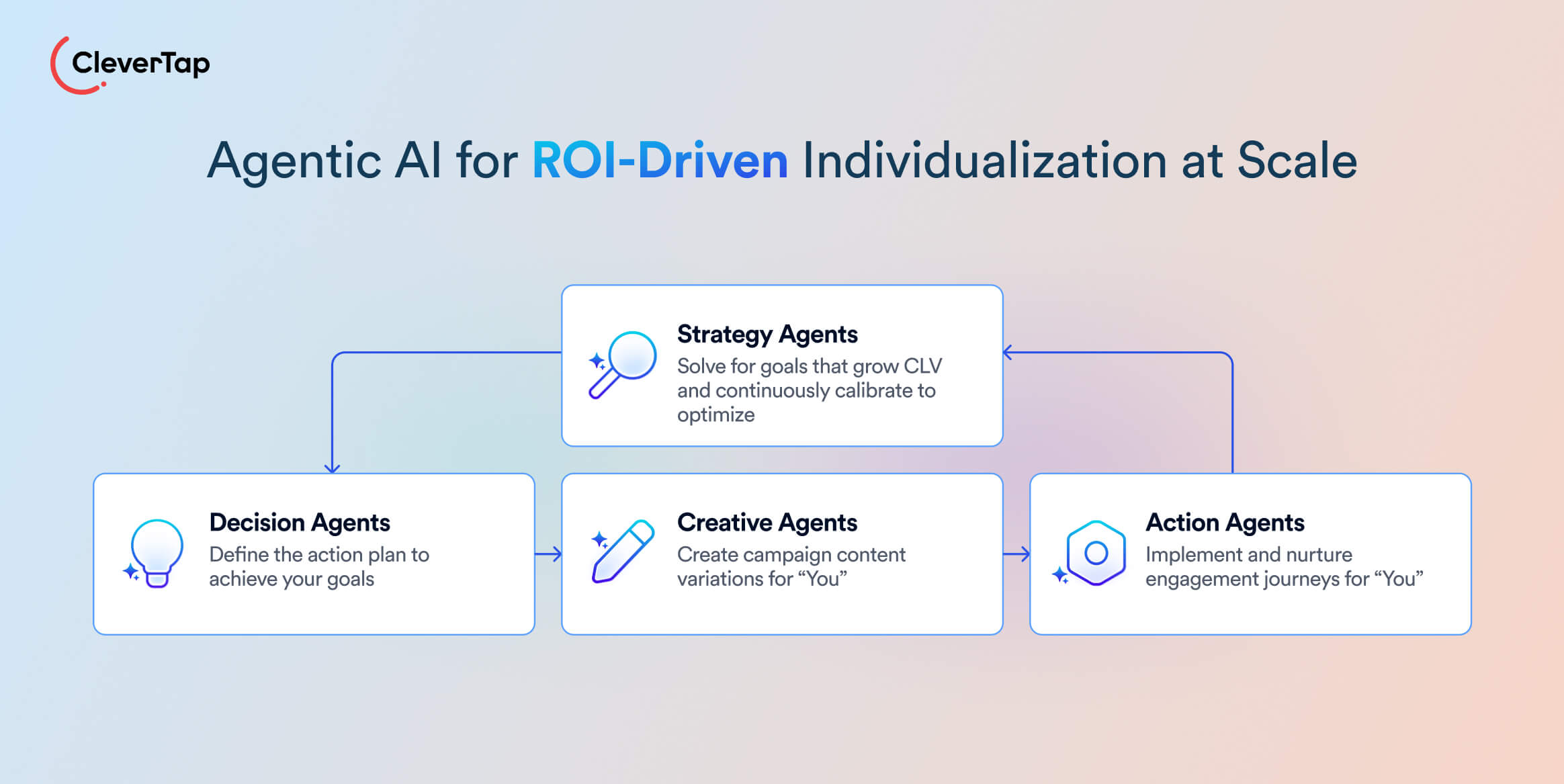
CleverTap combines those layers in one platform. It brings together real-time analytics, segmentation, lifecycle orchestration, experimentation, and cross-channel delivery, then uses Clever.AI to make those systems more predictive, adaptive, and efficient.
Here’s how that translates into the engagement levers covered in this guide.
Predictive Segmentation That Updates With User Behavior
CleverTap helps marketers move beyond static cohorts by continuously scoring users based on behavior, engagement trends, and transaction signals. Instead of defining audiences only by what users did in the past, teams can target users based on likely next actions such as churn risk, conversion likelihood, drop-off probability, or expected lifetime value.
Its predictive segmentation engine updates these audience groups dynamically as user behavior changes. That means a user who shifts from active to at-risk can move into a retention journey automatically, without waiting for someone to manually rebuild a segment.
Clever.AI strengthens this through the Predictions Agent, which forecasts outcomes like churn and conversion in real time, and the Segment Builder Agent, which lets marketers create editable segments using plain-language prompts instead of manual event and filter logic. This is what makes segmentation useful for engagement, not just reporting. It turns changing behavior into changing action.
Real-Time Personalization Based On Intent Signals
CleverTap captures real-time behavioral events such as page views, searches, cart additions, session drops, and purchase activity, then uses those signals to personalize what users see and receive across channels. This is where AI-driven engagement moves beyond broad personalization. Instead of showing the same offer to everyone in a segment, brands can tailor messages and experiences based on what a user is doing now, not just what they did last week.
The Recommendations Agent helps surface the most relevant product, offer, or content based on recent and historical behavior, while real-time event streams update user context continuously. That makes it possible to reshape in-app experiences, push campaigns, and follow-up messages around live intent.
For engagement teams, this means personalization becomes responsive instead of scheduled.
Send-Time and Channel Optimization At The User Level
One of the biggest weaknesses of manual engagement is that timing and channel choices are often made at the segment level. CleverTap improves this by using AI to personalize both. The Send Time Optimizer Agent learns when each user is most likely to engage based on past opens, clicks, sessions, and response windows. The Channel Optimizer Agent evaluates which channel each person is most likely to respond to, whether that is push, email, WhatsApp, SMS, or in-app.
Together, these features help teams stop treating timing and delivery as campaign defaults. Instead, every message can be adjusted to the user’s habits and preferences. That matters because even the right message underperforms when it arrives at the wrong moment or in the wrong channel.
Axis Bank used both to get 13% higher click-to-conversion rates. WhatsApp and mobile push were each tuned for the groups where they worked best.
Automated Journey Optimization
CleverTap’s journey orchestration tool lets marketers build multi-step engagement flows across onboarding, activation, retention, and win-back. But the real advantage is that these journeys do not have to remain fixed once launched. The platform uses predictive signals, event-based triggers, and path-level optimization to adapt journeys while they are running.
A user can be moved into a different path if they engage, ignore a message, show higher purchase intent, or become more likely to churn. The Journey Builder Agent turns a goal into a full journey with messages, visuals, and proven logic for your industry. It’s ready to edit and launch. During the campaign, the Path Optimizer Agent moves users to the best-performing path in real time and shifts as behavior changes.
Wing Bank used this approach to double engagement and click rates while maintaining a 20% weekly conversion rate, as journeys adapted dynamically for each user.
AI-Assisted Content and Creative At Scale
Most teams hit a content bottleneck long before they hit a targeting bottleneck. They may know which users to reach and when to reach them, but producing enough relevant copy and creative for multiple segments, channels, and experiments becomes the constraint.
CleverTap addresses that with generative AI inside the engagement workflow.
The Copywriter Agent writes personalized copy shaped by data from top campaigns, within the rules you set for tone, language, and length. The Designer Agent makes visuals from a prompt or sample image, applies your brand colors and fonts, and creates versions for A/B testing and different markets.
Niyo, an Indian fintech, used CleverTap’s generative AI for crisis messaging when a banking partner hit trouble. It reached at-risk users on WhatsApp and email with caring, context-aware messages faster than any manual process could.
Analytics, Experimentation and Continuous Improvement
CleverTap does not stop at campaign execution. It also connects AI decisions to measurement. Because analytics, segments, journeys, and channels sit inside the same platform, teams can evaluate how predictive segments, personalization logic, timing choices, and journey paths affect actual engagement outcomes. That includes click-through rates, conversions, session frequency, retention, and longer-term value signals.
Native experimentation, control groups, and path optimization help teams validate what is actually improving engagement instead of relying on assumptions. That feedback then flows back into the system so predictions, segments, and journey decisions can improve over time.
This is what separates one-off AI usage from a real engagement system. Campaigns do not just run. They learn.
How Clever.AI Fits Into All Of This
Underneath these workflows, Clever.AI provides the intelligence layer that helps teams decide, create, and act faster.
It combines predictive, generative, and agentic AI inside the CleverAI™ Decisioning Engine, supported by the CleverAI™ Dataverse and TesseractDB for real-time context and scale. Its agents are useful not because they are categories on a slide, but because they support the actual work marketers need to do:
- understand behavior and predict outcomes
- build segments and queries without technical friction
- generate copy and creative quickly
- optimize timing, channel, and journey paths
- and continuously improve results over time
CleverTap also keeps this system controllable. AI-generated segments, journeys, and content operate within a human-in-the-loop framework, so teams review and approve outputs before launch. The platform also surfaces the reasoning behind predictions and optimization choices, which makes AI decisions easier to trust, refine, and operationalize.
CleverTap brings predictive segmentation, real-time personalization, send-time and channel optimization, adaptive journeys, and AI-assisted content into one platform. This allows teams to move beyond isolated experiments and build a system that continuously improves how they engage and retain users.
See how CleverTap helps you turn AI-driven engagement into measurable growth.
AI Customer Engagement Use Cases by Industry
Below is an overview of different AI customer engagement use cases:
- E-commerce: AI identifies which abandoned carts need a simple reminder, which need a discount, and which aren’t worth chasing. It personalizes product recommendations based on browsing and purchase history to increase average order value and conversion efficiency.
Beyond cart recovery, AI powers dynamic pricing nudges, restock alerts for previously viewed items, loyalty program triggers based on spend velocity, and cross-sell campaigns timed to post-purchase windows. CleverTap’s AI-powered tools have raised conversions by 35% and improved stickiness by 15% for e-commerce clients. - Fintech: Users switch financial apps easily, so retention depends on catching early signals. AI detects declining transaction frequency, reduced feature usage, and drops in session depth before the user decides to leave, then triggers a retention campaign while there’s still time.
It also powers spend-based segmentation for personalized credit or savings offers, fraud alert follow-ups that double as engagement moments, onboarding nudges that guide users to activate key features, and referral prompts targeted at high-satisfaction users. Maya, a Philippine fintech, used segmentation and journey tools to grow its Easy Credit user base by 95% year-over-year and double credit user retention. - Gaming: AI distinguishes between a player who hit a losing streak and one who simply missed a day, so each gets the right nudge. It groups players by lifetime value to ensure high spenders receive VIP treatment while casual players get a rhythm that fits their play style.
Beyond that, AI drives lapsed-player reactivation campaigns timed to new content drops, in-game event invitations matched to player skill level, spend prediction models that identify players approaching their first or next purchase, and difficulty-adjusted reward offers that reduce churn during frustrating stages. - Media and Streaming: AI combines watch or reading history, session length, and engagement trends to surface recommendations that feel hand-picked. For subscription platforms, it catches early signs of drop-off and starts retention campaigns before the renewal date.
Additional use cases include content preference profiling that adapts to shifting tastes over time, re-engagement nudges for users who stopped mid-series or mid-playlist, cross-format promotion (e.g., suggesting a podcast to a video user based on topic overlap), win-back campaigns with personalized “what you missed” content summaries, and trial-to-paid conversion nudges timed to peak engagement moments.
In every vertical, the pattern holds: AI works when it’s tied to a specific engagement problem. Use it as a generic add-on, and the results stay generic too.
Moving From a Static Playbook to a Dynamic Engagement System
The campaigns you ran last quarter are already outdated. Not because they were bad, but because your users moved on. Their behavior shifted, and the static playbook you used to reach them can’t keep up with the pace of that change.
AI for customer engagement helps you keep up. It gives your team the ability to respond to every user as an individual, in the moment, across every channel, without burning out or scaling headcount. The brands already doing this aren’t guessing better. They’re learning faster. Every campaign makes the next one sharper, and every interaction adds to a system that improves on its own.
You have read the framework and seen the numbers. The gap between knowing what AI can do and putting it to work is smaller than you think.
CleverTap’s Clever.AI brings predictive segmentation, real-time personalization, smart timing, adaptive journeys, and AI-generated content into one system that learns from every interaction. Your engagement keeps getting sharper without adding headcount or complexity.
Try CleverTap and see Clever.AI in action. Schedule a demo today.

Jacob Joseph 
Heads Data Science.Expert in AI, Data & Analytics and awarded 40 under 40 Data Scientists in India.
Free Customer Engagement Guides
Join our newsletter for actionable tips and proven strategies to grow your business and engage your customers.