






































Table of Contents
Categories
Most Popular


Klaviyo is widely used by e-commerce and DTC brands for email and SMS marketing, offering automation flows, segmentation, and integrations with platforms like Shopify. It’s effective for campaigns such as cart abandonment, product restocks, and flash sale alerts.
But as businesses expand to mobile apps, omnichannel journeys, and advanced retention strategies, some teams begin exploring alternatives. This guide compares 12 Klaviyo alternatives and competitors that meet those evolving needs, starting with CleverTap, followed by a range of options built for different goals, budgets, and levels of complexity.
Best Klaviyo Alternatives
Klaviyo is a marketing automation platform focused on email and SMS campaigns, primarily used by e-commerce and DTC brands. It offers behavioral segmentation, a visual flow builder, and integrations with platforms like Shopify and WooCommerce. Key features include predictive analytics, product recommendations, and real-time performance tracking. Businesses use it for campaigns such as cart abandonment, post-purchase emails, and flash sale texts.
Klaviyo is widely used for email and SMS campaigns, with expanding support for additional channels such as push notifications, WhatsApp, forms, and ads. Many teams explore alternatives for broader channel support, ease of use, or different pricing models. Below is a comparison of Klaviyo and the 12 top alternatives.
| Platform | Notable Pros | Notable Cons |
|---|---|---|
| CleverTap | – Omnichannel messaging across push, in-app, SMS, email, WhatsApp, and web- Real-time analytics with instant campaign triggering – AI-driven churn prediction, recommendations, and optimization – Unified customer profiles across channels – Personalization at scale using behavioral data – Proven outcomes including up to 561% ROI and 30% increase in retention | – Some G2 reviewers mention a learning curve when adopting advanced features |
| Klaviyo | – Built for ecommerce workflows like cart abandonment and promotions – Segmentation and predictive analytics – Strong integrations with ecommerce platforms | – Expensive pricing and unclear billing, with G2 reviews noting unexpected cost increases – Limited features in SMS, templates, and advanced automation despite premium positioning – Steep learning curve, basic reporting, and slow support frustrate users |
| ActiveCampaign | – Advanced automation with conditional logic – Built-in CRM for managing contacts and pipelines – Supports multi-step lifecycle campaigns | – G2 reviews highlight a steep learning curve, especially when navigating automation and setup – Users report pricing concerns, particularly for startups needing simpler, budget-friendly plans – Missing and limited features in reporting, testing, and customization are frequently mentioned |
| Intuit Mailchimp | – Email campaign builder with templates – Audience segmentation and tagging – Suitable for structured campaign execution | – Users highlight rising costs as subscriber lists grow, impacting affordability over time – G2 feedback points to limited customization and missing features in areas like contact import and integrations – Some reviews also mention onboarding challenges and concerns around spam handling and support responsiveness |
| HubSpot Marketing Hub | – Unified CRM and marketing platform – Campaign tracking and lifecycle reporting – Strong integration with sales workflows | – A steep learning curve is frequently mentioned in G2 reviews, requiring extensive training to use effectively – Users report high and increasing costs, especially with add-ons and scaling contact lists – Feature limitations and restricted access to advanced capabilities are common concerns among reviewers |
| Iterable | – Cross-channel messaging across email, push, SMS, and in-app – Event-based campaign triggering – Supports lifecycle journey orchestration | – Users report inconsistent and unreliable reporting, making it difficult to trust campaign performance data – G2 feedback highlights missing or limited features that impact workflow efficiency and onboarding – A steep learning curve and lack of intuitive controls are frequently mentioned in reviews |
| Braze | – Cross-channel messaging with journey orchestration – Real-time engagement based on user actions – Strong lifecycle campaign capabilities | – G2 feedback highlights a steep learning curve, especially for advanced features – Users report limitations in analytics and reporting for deeper insights – Some reviews mention missing capabilities and constraints in data handling |
| MoEngage | – Multi-channel engagement across push, email, SMS, and WhatsApp – Behavioral segmentation and campaign execution – Supports lifecycle-based messaging | – G2 reviews point to missing features and reliance on technical support in some cases – Users highlight a steep learning curve and complexity in advanced use cases – Limited features and usability challenges are noted by reviewers |
| Omnisend | – Ecommerce automation workflows such as cart recovery – Supports email, SMS, and push campaigns – Built for ecommerce campaign execution | – G2 feedback highlights limited features in advanced personalization and flexibility – Users report rising costs as contact lists grow – Limited customization and usability issues are mentioned in reviews |
| Brevo (Sendinblue) | – Multi-channel messaging across email, SMS, WhatsApp, and CRM – Campaign automation within a single platform – Suitable for SMB-focused marketing use cases | – Users report poor deliverability and very basic reporting, based on G2 feedback – The UI feels unintuitive, with limited automation and customization capabilities – Reviews also highlight account suspensions and inconsistent customer support |
| Drip | – Ecommerce-focused automation and workflows – Segmentation based on customer behavior and purchase data – Built for DTC and ecommerce brands | – Pricing is considered high, especially for small businesses, based on G2 feedback – Users report limited integrations, reducing flexibility across marketing stacks – Feedback also points to a steep learning curve and restricted customization |
| Customer.io | – Event-based messaging triggered by user activity – Flexible segmentation and workflow control – API-driven architecture for customization | – Users report a steep learning curve and unintuitive navigation – G2 feedback highlights limited analytics and filtering capabilities – Campaign organization challenges and pricing concerns are frequently noted |
| Agentforce Marketing (formerly Salesforce Marketing Hub) | – AI-driven automation using CRM data – Deep integration with Salesforce ecosystem – Supports workflow-based task execution | – Implementation is complex, requiring strong data hygiene and workflow setup – G2 feedback points to ecosystem dependency, increasing overall costs – Integration and onboarding challenges make initial setup difficult |
CleverTap – The #1 Alternative to Klaviyo
CleverTap is an all-in-one customer engagement and retention platform that helps brands maximize user lifetime value through real-time, personalized communication across mobile apps, websites, and messaging channels. It enables marketers to unify customer data, analyze behavior in real time, and execute omnichannel campaigns based on live user activity. Unlike Klaviyo, which is primarily optimized for e-commerce email and SMS use cases, CleverTap supports messaging across push notifications, in-app messages, SMS, email, WhatsApp, and web, within a single platform.
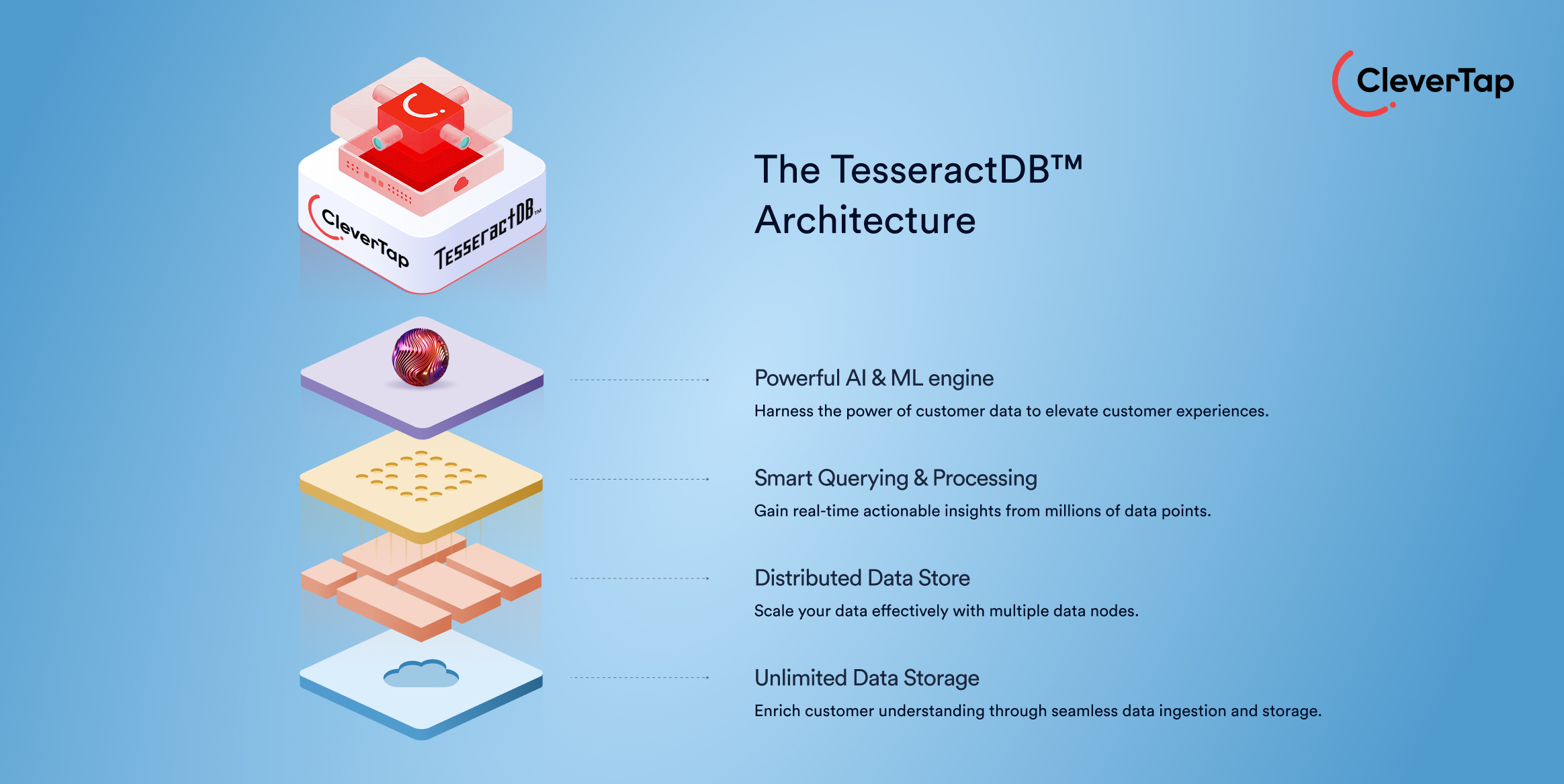
At the core of the platform is TesseractDB™, CleverTap’s proprietary database built specifically for customer engagement use cases. TesseractDB™ is designed to store, process, and query large volumes of behavioral and event data in real time, enabling instant segmentation and campaign triggering across millions of users. It allows brands to maintain an extended lookback period and access granular user-level data, supporting deeper behavioral analysis and long-term lifecycle engagement.
Why Choose CleverTap?
CleverTap is built for brands that need more than campaign-based email and SMS marketing. It combines real-time analytics, behavioral segmentation, and omnichannel messaging in one platform, enabling marketers to understand user behavior and act on it instantly across push, in-app, SMS, email, WhatsApp, and web.
This creates a clear distinction from Klaviyo. While Klaviyo is widely used for email and SMS, particularly in e-commerce, CleverTap is designed for broader lifecycle engagement across more touchpoints. G2 category data reflects this difference, with CleverTap scoring strongly in Mobile Marketing (8.6), Mobile Analytics (9.1), and Personalization (9.3), where Klaviyo has limited or no reported data.
This advantage is consistently reflected in user feedback. G2 reviewers highlight CleverTap’s strong segmentation, real-time engagement, and multi-channel capabilities as key strengths, enabling more precise targeting and continuous optimization. As one reviewer noted, CleverTap has been a “game changer for analytics and audience engagement,” helping teams track behavior, personalize content, and improve retention through real-time insights. While Klaviyo is often appreciated for usability and email marketing efficiency, CleverTap stands out for delivering deeper analytics and more advanced lifecycle engagement at scale.
Key Features and Strengths
1. Omnichannel Messaging Across All Touchpoints
CleverTap enables engagement across push notifications, in-app messaging, SMS, email, WhatsApp, web push, and more from a single platform. This allows marketers to design unified customer journeys that span multiple touchpoints without relying on separate tools for each channel.
Messaging is orchestrated based on real-time user behavior, ensuring that communication is timely, contextual, and coordinated across channels. This helps avoid message fatigue, improves delivery efficiency, and maintains a consistent user experience throughout the lifecycle.
2. Real-Time Behavioral Analytics and Customer Intelligence
CleverTap provides a comprehensive analytics suite, including Cohorts, Funnels, Trends, Pivots, and Flows, to analyze user behavior across the lifecycle. These tools help teams understand not just what users do, but how they move through journeys and where drop-offs occur.
Because data is processed in real time, marketers can act immediately on insights. This enables faster iteration, more accurate targeting, and the ability to trigger campaigns based on live user actions instead of delayed reporting.
CleverTap builds unified customer profiles by combining data from mobile apps, websites, and external systems into a single view. Each profile updates continuously with real-time events, attributes, and engagement history.
This eliminates data silos and ensures every campaign is informed by complete, up-to-date context. Marketers can create highly specific segments based on behavior, lifecycle stage, and attributes without requiring complex data stitching across systems.
3. AI-Driven Decisioning and Personalization With CleverAI™
CleverAI™ brings together predictive AI, generative AI, and agentic AI into a unified system that helps marketers move from insight to action faster. Predictive models identify users likely to convert, churn, or disengage, enabling proactive targeting. Generative AI supports the creation of campaign copy and creative assets aligned with performance goals.
What differentiates CleverAI™ is its ecosystem of AI agents that assist across the entire workflow. These include agents for analytics, segmentation, recommendations, send-time optimization, channel selection, and journey orchestration. Marketers can use natural language to generate insights, build segments, or get campaign suggestions without relying on manual analysis.
These agents also support execution by helping optimize when to send messages, which channel to use, and how to guide users through journeys. Instead of configuring every rule manually, teams can rely on the system to continuously refine targeting and delivery based on real-time behavior.
CleverTap enables 1:1 personalization by combining real-time behavior, historical data, and predictive insights. Features such as recommendations and next-best-action logic help tailor content, timing, and channel selection for each individual user.
This approach ensures that every interaction reflects the user’s current context and past behavior. Personalization extends across all touchpoints, allowing brands to deliver consistent, relevant experiences while maintaining scalability across large user bases.
4. Real-Time Journey Optimization With IntelliNODE
IntelliNODE enables automated experimentation within customer journeys by testing multiple paths and optimizing them in real time. Instead of relying on fixed workflows, it continuously evaluates how users respond to different messages, timings, and sequences.
As users move through a journey, IntelliNODE dynamically routes them toward higher-performing paths based on live engagement data. This allows marketers to improve campaign performance without manually setting up and managing multiple A/B tests.
By embedding optimization directly into journeys, teams can continuously refine engagement strategies and maximize conversions, retention, and overall campaign effectiveness.
5. Data Infrastructure and Real-Time Segmentation With TesseractDB™
TesseractDB™ powers CleverTap’s ability to store, process, and query large volumes of customer data in real time. It enables segmentation across millions of data points, allowing marketers to build audiences based on both recent activity and long-term behavioral patterns.
Because data is continuously updated and instantly accessible, campaigns can be triggered immediately after user actions. This reduces delays between insight and execution, ensuring that engagement is timely and aligned with user intent. The system also supports deep historical analysis, enabling teams to identify trends, compare behavior over time, and refine targeting strategies.
6. Global Scale, Localization, and Proven Impact
CleverTap supports multilingual messaging, localized delivery timing, and region-specific engagement strategies. This allows brands operating across different geographies to tailor campaigns based on language, time zones, and regional behavior patterns.
By combining localization with real-time data and optimization capabilities, marketers can ensure that campaigns remain both globally scalable and locally relevant, improving engagement and conversion outcomes across diverse audiences.
CleverTap is used by over 2,000 global brands across industries such as ecommerce, financial services, gaming, and subscriptions. Based on reported customer outcomes and case studies, brands have seen measurable improvements in retention, engagement, and campaign performance.
The platform’s combination of real-time analytics, AI-driven decisioning, and omnichannel orchestration enables teams to continuously optimize customer journeys and drive long-term customer value.
Final Verdict
CleverTap is a strong alternative to Klaviyo for businesses looking to move beyond channel-specific marketing and adopt a more comprehensive, retention-focused engagement strategy.
Its strength lies in combining real-time analytics, AI-driven decisioning, and omnichannel orchestration into a single platform. This enables marketers to understand user behavior, act on insights instantly, and continuously optimize customer journeys across the lifecycle.
For brands that require real-time responsiveness, unified customer data, and advanced personalization across multiple channels, CleverTap provides a scalable solution designed to drive long-term engagement, retention, and customer lifetime value.
Discover how leading brands are driving retention and lifetime value with CleverTap.
2. ActiveCampaign
ActiveCampaign is a marketing automation platform that combines email marketing, CRM, and cross-channel messaging within a single system. It is designed to help businesses automate customer journeys, manage contacts, and track sales activity across the lifecycle.
The platform is built around its automation engine and Active Intelligence layer, which supports goal-based workflows and AI-assisted campaign execution. It also integrates with a wide range of tools, allowing teams to connect marketing, sales, and customer data to run more coordinated campaigns and improve engagement over time.
Features:
- Automation builder with conditional logic and goal-based workflows
- Built-in CRM for managing contacts, deals, and sales pipelines
- Active Intelligence for AI-assisted campaign creation and optimization
- Cross-channel messaging across email, SMS, and WhatsApp
- 900+ integrations across ecommerce, CRM, and marketing tools
Limitations:
ActiveCampaign offers good automation, but according to G2 reviewers, many users report a noticeable learning curve when setting up workflows and navigating its features. The platform’s flexibility can make it less intuitive, especially for teams new to multi-step automation or behavioral targeting. Users often mention needing additional time or support to fully understand and use its capabilities effectively.
According to reviewers, cost and feature limitations are also recurring concerns. As contact lists grow, pricing can increase significantly, making it less suitable for smaller or budget-conscious teams. Users also highlight gaps in areas such as automation testing, reporting, and customization, along with occasional challenges in account management and support responsiveness, which can impact teams relying heavily on consistent campaign execution.
3. Mailchimp (Intuit Mailchimp)
Mailchimp is a marketing platform focused on email and SMS campaigns, along with audience management and campaign automation. It enables businesses to create campaigns, manage subscriber data, and run marketing workflows from a centralized interface.
The platform includes AI-powered tools for content generation, campaign recommendations, and performance insights. It also supports integrations with e-commerce and business tools, allowing teams to connect customer data and automate communication based on user activity, making it suitable for structured campaign execution and audience-driven marketing.
Features:
- Email and SMS campaign management within one platform
- AI-powered content generation and campaign recommendations
- Audience management with segmentation and tagging
- Customer journey builder for automated campaign flows
- Integrations with e-commerce platforms and marketing tools
Limitations:
According to G2 reviewers, Mailchimp’s pricing becomes a concern as subscriber counts increase, with many users noting that costs scale quickly and impact affordability. Users also report that the platform has become more complex over time, with workflows such as managing audiences, building forms, and organizing campaigns feeling more difficult and less streamlined as additional features have been introduced.
Reviewers also highlight limitations in feature depth and customization. Users hint at limitations in feature depth and customization, particularly for more advanced use cases and workflows. They mention restricted customization options that affect how campaigns and lists can be tailored. In addition, some users report challenges with onboarding and usability, as well as delays in support responsiveness and concerns around spam management, which can impact overall campaign reliability.
4. HubSpot Marketing Hub
HubSpot Marketing Hub is a CRM-based marketing platform that combines customer data, campaign execution, and reporting within a unified system. It allows teams to manage marketing activities while maintaining a centralized view of customer interactions across the lifecycle.
The platform includes tools for lead capture, email marketing, automation, and analytics, with a strong focus on connecting marketing performance to revenue outcomes. Its integration with HubSpot CRM enables teams to align marketing and sales efforts, track engagement, and manage customer relationships within a single environment.
Features:
- Unified CRM and marketing data within a single platform
- Workflow automation for email and customer engagement
- Landing pages, forms, and lead capture tools
- Attribution and reporting tied to customer and revenue data
- Contact management with centralized activity tracking
Limitations:
HubSpot Marketing Hub has a steep learning curve, especially when managing advanced workflows and automation at scale, as per many G2 reviews. Users report that navigating complex use cases, debugging workflows across teams, and setting up advanced capabilities can require significant time and training, with some features still needing workarounds or external tools.
Users have mentioned that pricing and feature access are key concerns. Costs increase as contact lists grow and as additional features or hubs are required, making it less accessible for smaller teams. Users also report limitations in customization and feature depth, along with challenges in managing workflows and configurations as use cases become more complex.
5. Iterable
Iterable is a customer communication platform designed for lifecycle marketing across multiple channels. It supports messaging across email, SMS, push notifications, in-app messaging, WhatsApp, and web, enabling teams to engage users based on real-time behavior and event data.
The platform focuses on personalized engagement through real-time triggers and structured customer journeys. It also includes capabilities such as Smart Ingest for data ingestion and Catalog for dynamic content, allowing teams to activate customer data and deliver targeted messaging across channels.
Features:
- Cross-channel messaging across email, SMS, push, in-app, WhatsApp, and web
- Real-time campaign triggering based on user behavior
- Journey builder for managing multi-step lifecycle campaigns
- Segmentation using behavioral data and customer attributes
- Smart Ingest and Catalog for data ingestion and dynamic content
Limitations:
According to G2 reviewers, Iterable lacks certain critical features and flexibility in areas such as experimentation and workflow control. Users point out missing capabilities like holdout testing, limitations in journey configuration, and gaps in feature depth that require manual workarounds. These constraints can make it harder to run structured experiments and optimize campaigns effectively.
In addition, users report a noticeable learning curve when setting up and managing campaigns. The platform can feel less intuitive during onboarding, with challenges in navigating workflows, updating user data, and interpreting reporting. Concerns around inconsistent tracking, unclear attribution, and usability issues are also mentioned, which can impact confidence in campaign performance and day-to-day execution.
6. Braze
Braze is a customer engagement platform focused on real-time, cross-channel messaging and lifecycle orchestration. It supports communication across email, push notifications, SMS, in-app messaging, and web, enabling brands to engage users based on live behavioral data.
The platform is built around real-time interaction and journey orchestration, with a focus on delivering personalized experiences at scale. It incorporates AI-driven capabilities through BrazeAI™, along with tools for segmentation, experimentation, and campaign optimization across customer touchpoints.
Features:
- Canvas journey builder for designing and managing multi-step customer journeys
- Cross-channel messaging across email, push, SMS, in-app, and web
- Real-time data processing for triggering campaigns based on user behavior
- BrazeAI™ for AI-driven decisioning, optimization, and personalization
- Behavioral segmentation using customer activity and attributes
Limitations:
As per multiple G2 reviews, Braze shows gaps in certain feature areas, with users pointing out missing or limited capabilities in analytics, reporting, and overall functionality. Some reviewers also mention the absence of features like a mobile wallet solution, along with constraints in how data and campaigns can be structured and managed.
Users also report a steep learning curve, particularly when working with advanced features such as Liquid templating and complex campaign setups. In addition, reviewers highlight challenges with reporting clarity, limited testing capabilities, and reliance on add-ons, which can make campaign execution and optimization more difficult for some teams.
7. MoEngage
MoEngage is a customer engagement platform designed for mobile-first and digital-first businesses, supporting messaging across push notifications, email, SMS, WhatsApp, and in-app channels. It enables teams to run campaigns based on user behavior and lifecycle stages.
The platform combines analytics, segmentation, and campaign execution within a single system, allowing marketers to track user activity and trigger targeted communication. It also includes AI-driven capabilities for insights and recommendations to improve engagement and retention.
Features:
- Cross-channel messaging across push, email, SMS, WhatsApp, and in-app
- Real-time campaign triggering based on user behavior
- Journey builder for creating multi-step lifecycle campaigns
- Segmentation using behavioral data and customer attributes
- AI-driven insights and recommendations for campaign optimization
Limitations:
Some users point to gaps in certain features, particularly around session-related capabilities, where tasks like profile updates and notification handling may require additional technical support. Feedback on G2 also highlights delays in feature releases and limitations in personalization and campaign flexibility.
There is also a noticeable learning curve, especially when working with complex segmentation, event setup, and AI-driven workflows. Reviewers mention that debugging journeys and managing multiple conditions can be difficult, with UI clutter and configuration complexity making navigation and execution more time-consuming.
8. Omnisend
Omnisend is a marketing automation platform focused on e-commerce use cases, supporting messaging across email, SMS, and web push notifications. It is designed to help online businesses run campaigns and automate workflows based on customer actions.
The platform provides pre-built automation workflows for common e-commerce scenarios such as cart abandonment and order follow-ups. It also includes tools for segmentation and campaign management, allowing teams to engage customers across multiple touchpoints.
Features:
- Email, SMS, and web push messaging within one platform
- Pre-built ecommerce automation workflows (e.g., cart recovery, welcome series)
- Campaign automation triggered by customer actions
- Segmentation based on purchase behavior and activity
- Integration with e-commerce platforms for campaign execution
Limitations:
User feedback highlights limitations in feature depth, particularly around email customization, templates, and personalization. Reviewers note that design flexibility is restricted, with fewer options for building tailored campaigns beyond standard ecommerce workflows. Some users also report gaps in automation, where workflows may not execute as expected or require workarounds for more advanced use cases.
G2 reviews also point to concerns around scalability and reliability as usage grows. Users mention instances of automation flows stopping unexpectedly, along with account restrictions or sending limits disrupting campaigns. Feedback also highlights delays in support response and challenges during setup, including difficulties with list management and exports, which can slow down onboarding and campaign execution.
9. Brevo (formerly Sendinblue)
Brevo (formerly Sendinblue) is a multi-channel marketing platform that combines email, SMS, WhatsApp, chat, and CRM capabilities within a single system. It is designed to help businesses manage campaigns, automate workflows, and communicate with customers across multiple touchpoints.
The platform focuses on simplicity and accessibility, offering tools for campaign creation, contact management, and basic automation. It is often used by small to mid-sized businesses looking for an integrated solution to run email and messaging campaigns without relying on multiple tools or complex setup.
Features:
- Email, SMS, WhatsApp, chat, and CRM capabilities within a single platform
- Drag-and-drop email builder with prebuilt templates
- Automation workflows triggered by user behavior
- Contact management and segmentation for targeted campaigns
- Integrations with ecommerce platforms and third-party tools
Limitations:
Users report that Brevo’s feature set can feel limited in areas such as automation depth, email design flexibility, and advanced campaign capabilities. This can restrict more complex marketing use cases, particularly for teams looking to build highly personalized or multi-step journeys. Limitations in customization, especially within templates and campaign layouts, also make it harder to create tailored experiences.
Some users report challenges when navigating workflows and managing campaign configurations. There is also a learning curve when working with integrations and advanced setups. G2 feedback highlights concerns around deliverability and campaign performance, including inconsistent results and issues related to IP reputation. Users also mention pricing considerations as usage scales, along with occasional delays in support responsiveness.
10. Drip
Drip is a marketing automation platform designed specifically for ecommerce brands and direct-to-consumer businesses. It helps brands create email and SMS workflows based on customer behavior, enabling personalized campaigns that drive conversions and repeat purchases.
The platform focuses on ecommerce-centric automation, offering tools for segmentation, campaign orchestration, and revenue tracking. Drip positions itself as a CRM for B2C commerce, allowing businesses to manage customer relationships while executing targeted marketing campaigns at scale.
Features:
- Visual automation builder with behavior-based triggers such as product views and cart abandonment
- Real-time segmentation based on browsing behavior and purchase history
- Email and SMS marketing workflows designed for ecommerce use cases
- Prebuilt integrations with platforms like Shopify and WooCommerce
- Revenue tracking and campaign performance insights
Limitations:
Users report limitations in customization and personalization capabilities, particularly around templates and advanced personalization features. There is demand for more flexibility in creating dynamic content and automated variations for different customer segments. G2 feedback also highlights concerns around pricing, with some users finding the cost relatively high, especially for smaller businesses as their contact lists grow.
Some users express challenges with integrations and platform flexibility, noting limitations when connecting with certain tools or managing more complex setups. There is also a learning curve when navigating workflows and configuring campaigns, particularly for new users. In some cases, users report issues with usability and performance, including bugs, formatting inconsistencies, and difficulties when working with templates or editing content.
11. Customer.io
Customer.io is a customer engagement platform designed to help businesses create automated messaging workflows based on user behavior and data. It enables teams to build campaigns across email and other channels using event-triggered automation and segmentation.
The platform is commonly used for lifecycle messaging and behavioral targeting, offering the core tools needed to manage campaigns and user communication. However, based on user feedback, it is often viewed as functional for basic use cases rather than a highly differentiated or advanced solution.
Features:
- Event-triggered workflows based on user actions and behavioral data
- Flexible segmentation using event and user attribute data
- Automated messaging campaigns across email and other channels
- Workflow builder for creating lifecycle and drip campaigns
- Basic email editing and campaign management capabilities
Limitations:
Users on G2 report challenges with usability and platform complexity, particularly when navigating workflows, campaign organization, and UI structure. The feedback indicates that the platform is not always intuitive, with some users finding it difficult to locate features, manage lists, or configure campaigns efficiently. There is also a noticeable learning curve, especially when setting up workflows or adapting to how the platform structures data and campaigns.
Several users also highlight limitations in features, analytics, and overall flexibility. Feedback on G2 points to missing or basic reporting, limited filtering options, and constraints in customization and personalization. Some users note that while the platform covers core functionality, it lacks advanced capabilities for more complex use cases. Reviews also mention concerns around pricing increases, rigid renewal policies, and negative experiences with sales processes, adding to overall dissatisfaction.
12. Agentforce Marketing (Previously Salesforce Marketing Cloud)
Agentforce Marketing is an AI-driven automation layer built within the Salesforce ecosystem, designed to help businesses execute tasks using CRM data, workflows, and predefined guardrails. It enables users to leverage Salesforce data context to automate actions and streamline processes across sales and customer operations.
As part of the broader Salesforce platform, Agentforce is closely tied to existing data structures and workflows, making it most relevant for organizations already deeply invested in the Salesforce ecosystem.
Features:
- AI agents that can execute tasks using CRM data and workflows
- Native integration with Salesforce data, processes, and automation tools
- Ability to reason through tasks using structured CRM context
- Workflow-driven automation with built-in guardrails and controls
- Support for action execution beyond basic conversational interfaces
Limitations:
Users report significant implementation complexity, particularly due to the need for clean data, well-defined workflows, and strict governance. G2 feedback highlights that setup can be challenging, especially when integrating with data cloud environments or configuring permissions correctly. Without proper data hygiene and structure, users note that outputs may degrade, making the system harder to manage effectively.
Several users also point to concerns around pricing, integration clarity, and ecosystem dependency. Feedback indicates that the platform often requires additional Salesforce products to deliver full value, increasing overall cost and creating lock-in. Users also mention limited visibility into integration capabilities, complexity in connecting external systems, and gaps in support or product familiarity, which can make troubleshooting and adoption more difficult.
Choosing the Best Klaviyo Competitor
Choosing the right Klaviyo alternative comes down to how effectively a platform can support real-time engagement, unified customer data, and lifecycle-driven growth. As customer expectations shift toward instant, personalized experiences across channels, relying on tools built primarily for email and SMS campaigns can limit long-term retention and engagement outcomes.
CleverTap is built to address this shift. It enables teams to unify customer data across touchpoints, analyze behavior in real time, and execute personalized journeys across push notifications, in-app messaging, SMS, email, WhatsApp, and web. Instead of operating across disconnected tools, marketers can manage analytics, segmentation, experimentation, and campaign execution within a single system.
With capabilities powered by TesseractDB™ and CleverAI™, the platform allows brands to move from reactive campaigns to proactive engagement. Teams can predict user behavior, optimize journeys in real time, and deliver context-aware messaging at scale without delays between insight and execution.
For businesses looking to move beyond campaign-based marketing and build a retention-first growth strategy, CleverTap provides a more complete and scalable solution. It is designed to support real-time decisioning, continuous optimization, and long-term customer lifecycle management from a single platform.
Ready to move beyond email and SMS? Discover how CleverTap helps you drive real-time engagement, improve retention, and maximize customer lifetime value. Schedule your demo today!

Agnishwar Banerjee 
Leads content and digital marketing.Expert in SaaS sales, marketing and GTM strategies.
Free Customer Engagement Guides
Join our newsletter for actionable tips and proven strategies to grow your business and engage your customers.