

















Table of Contents
Categories
Most Popular


If you’re seeking customer.io competitors and alternatives, you’re likely looking for a platform that offers easier usability for non-technical marketers. Or, you’re searching for tools that deliver richer cross-channel engagement with built-in intelligence.
You’re on the right track.
Customer.io can be technically complex for custom implementations. There is a learning curve to be able to effectively set up advanced workflows. For fast-growing brands, it makes sense to have more user-friendly tools that marketers can leverage without a lot of engineering effort. Additionally, having a customer engagement platform that delivers better real-time personalization and native mobile channel support is always an added advantage.
In this article, we’ll list the top 10 customer.io competitors that deliver a better value proposition for marketers.
How to Evaluate Customer.io Competitors and Alternatives
Exploring a list of top Customer.io competitors won’t help much unless you know how to evaluate them. Not all customer engagement platforms are built the same; some focus on messaging, others on data, and only a few truly unify engagement, intelligence, and analytics in one place.
If you’re looking for a reliable, scalable customer engagement platform, here are the key criteria to guide your evaluation:
1. Unified Customer Data
A modern engagement platform should provide a single, real-time customer profile that consolidates data from your app, website, CRM, backend systems, and all communication channels. Without unified data, you risk fragmented messaging, inconsistent personalization, and duplicate outreach. A strong alternative should eliminate silos and give you a 360-degree view of every user, updated in real time.
2. Real-Time Personalization
Look for platforms that support instant triggers and dynamic updates, not just batch-based campaigns.
Real-time personalization ensures users receive messages based on live behavior, such as abandoning a cart, browsing a product category, or completing a transaction. Delayed or batch messaging often results in missed opportunities and lower engagement.
3. True Omnichannel Orchestration
Many tools offer multiple channels. Few offer true orchestration across them. The right platform should let you design a single workflow that seamlessly coordinates email, SMS, push notifications, in-app messages, WhatsApp, and web messaging.
4. AI-Driven Decisioning
As your user base grows, manual segmentation and rule-building become unsustainable.
Look for AI-powered capabilities such as:
- Predictive segmentation
- Next-best-action recommendations
- Automated campaign optimization
AI-driven decisioning helps you move beyond static rules and deliver smarter, more relevant experiences at scale.
5. Built-In Analytics and Testing
A strong Customer.io alternative should include native analytics tools like funnels, cohorts, attribution tracking, and A/B testing, all within the same platform. This allows you to analyze performance, identify drop-offs, and optimize campaigns without relying on external tools or manual data stitching.
6. Ease of Use for Marketers
Your marketing team shouldn’t depend heavily on developers to launch campaigns.
Look for an intuitive interface, drag-and-drop workflows, quick onboarding, and minimal technical overhead. A marketer-friendly platform accelerates experimentation, reduces turnaround time, and drives faster results.
7. Pricing and Total Cost of Ownership
Pricing transparency matters, especially as you scale. Beyond base subscription costs, consider hidden expenses like:
- Message volume charges
- Event tracking limits
- Developer or engineering overhead
- Add-on analytics tools
Choose a platform with transparent, scalable pricing that aligns with your growth without unexpected cost spikes.
By evaluating Customer.io alternatives against these criteria, you can move beyond feature checklists and focus on what truly impacts customer engagement: unified data, real-time intelligence, seamless orchestration, and measurable results.
The Top Customer.io Competitors and Alternatives In Customer Engagement
Let’s take a look at the best Customer.io competitors you must consider:
1. CleverTap: Best Customer.io Alternative for Omnichannel and AI-Driven Engagement at Scale
CleverTap helps businesses build lasting customer relationships through data-driven insights and personalized experiences. It stands out for its ability to analyze data from multiple sources in real time, providing a comprehensive view of customer behavior.
It powers advanced customer segmentation and timely, relevant messaging that increase retention and conversion metrics. Essentially, you’ll find it combining a unified customer data platform, robust analytics, and multi-channel messaging into one solution.
If your goal is to deliver omnichannel campaigns with personalization at scale without relying on developers for every tweak, CleverTap is a top choice.
CleverTap’s Key Features
CleverTap offers a broad feature set. Here are some highlights:
1. Advanced User Segmentation: CleverTap enables powerful segmentation based on user actions, lifecycle stage, demographics, and custom attributes. This helps marketers deliver highly targeted engagement instead of one-size-fits-all messaging.
2. True Omnichannel Campaign Orchestration: Run coordinated campaigns across several channels, including email, push, SMS, in-app, WhatsApp, web messaging, and more. CleverTap ensures a seamless customer experience across every touchpoint from one unified workflow.
3. Real-Time Personalization at Scale: CleverTap supports 1:1 personalization with instant triggers and dynamic content updates based on live user behavior. This allows brands to personalize experiences in the moment.
4. Event Tracking & Behavioral Intelligence: Track user actions across apps and websites, such as purchases, clicks, browsing patterns, or churn signals. These events power automation, deeper behavioral insights, and smarter lifecycle engagement.
5. Unified Customer Profiles: Every user interaction is stitched into a single, continuously updated customer profile. This unified view helps brands deliver consistent, contextual messaging across channels.
6. Advanced Analytics Suite: Go beyond basic reporting with built-in tools like Funnels, Cohorts, Trends, Pivots, and Flows. These features help teams visualize journeys, identify drop-offs, and improve retention.
7. Experimentation and A/B Testing Built In: CleverTap allows marketers to test messaging, timing, channels, and journey paths directly within campaigns. This makes continuous optimization easier without relying on external experimentation tools.
8. Scalable Integrations & Robust APIs: CleverTap integrates with leading CRMs, attribution platforms, ad networks, and communication providers. Its APIs also enable seamless import/export of user and event data for automation at scale.
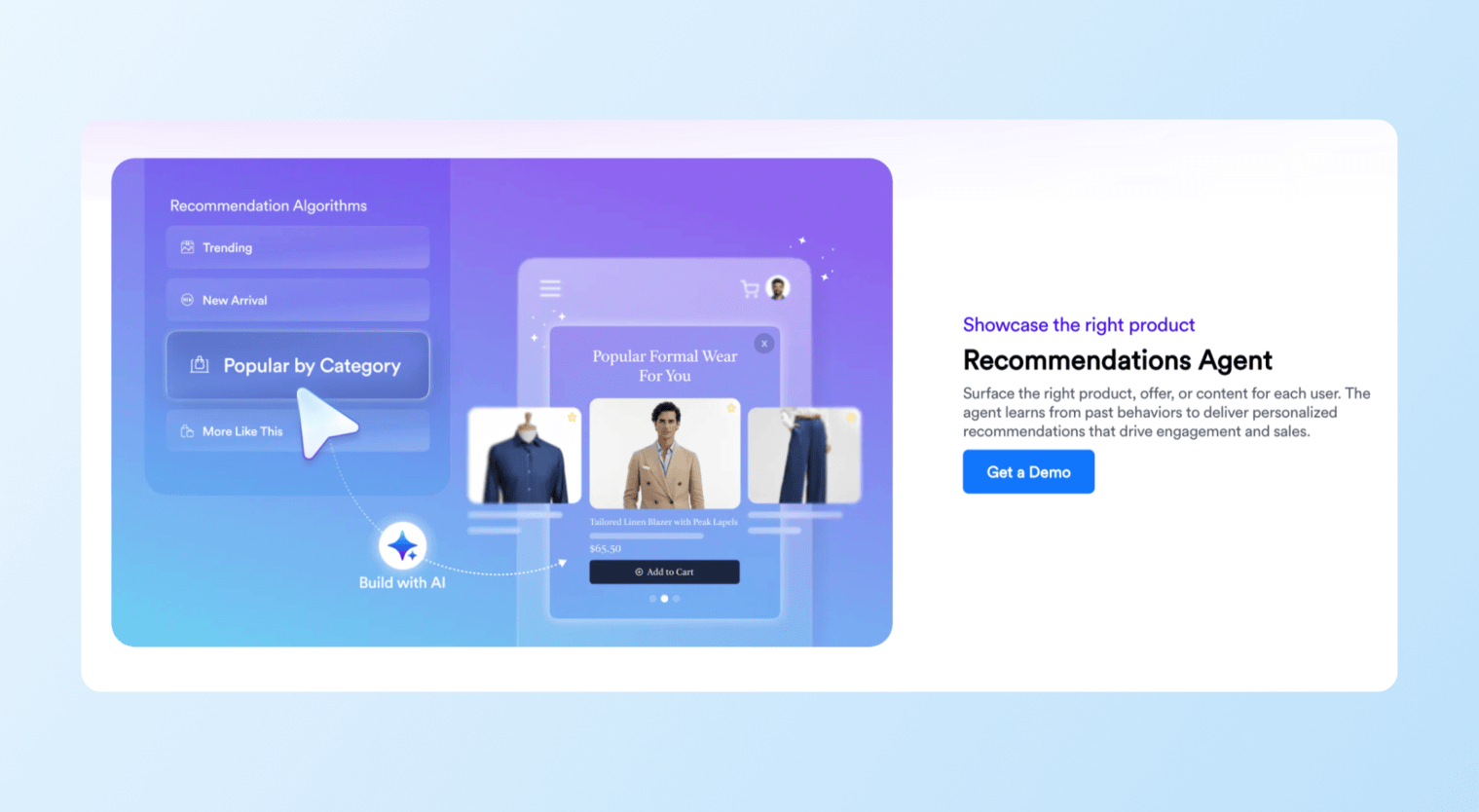
9. Agentic AI with CleverAI™ and TesseractDB™: CleverTap’s CleverAI™ introduces AI Agents that autonomously reason, plan, and act on your marketing goals, from building segments and journeys to optimizing send times and messaging, while staying within brand guardrails. These intelligent agents help individualize experiences at scale and accelerate campaign execution with minimal manual work.
At the core of this innovation is TesseractDB™, CleverTap’s purpose-built customer engagement database. It enables real-time data processing, extended historical context, and deep behavioral granularity, powering richer personalization, better predictions, and more intelligent decision-making across campaigns.
Why CleverTap Is the Smarter Alternative to Customer.io for Scalable Customer Engagement
While Customer.io is a capable platform for basic messaging automation, multiple G2 reviewers point out limitations that become increasingly noticeable as teams scale their personalization, omnichannel execution, and campaign complexity.
CleverTap addresses these gaps with a more comprehensive customer engagement stack. Let’s see why CleverTap is a stronger alternative, based on G2 reviews.
Limited Email Design and Customization Flexibility
A G2 review notes that Customer.io’s visual builder lacks advanced customization features that make emails look simple. Better capabilities, such as banner editing, typography options, and CTA styling, for richer creative control would be ideal.

CleverTap provides more robust content creation and personalization tools, allowing marketers to design high-impact campaigns. Its robust email design and customization flexibility allow users to build emails using pre-built, drag-and-drop, AMP, or custom HTML templates for advanced personalization and branding consistency.
Missing AI Features Like Send-Time Optimization
A reviewer highlights the absence of an “optimize send time” feature, something increasingly essential for improving engagement in modern lifecycle marketing.

CleverTap’s AI-powered send-time optimization, known as the Best Time feature, analyzes each user’s historical activity to determine and deliver messages at the most optimal time for engagement, personalizing delivery based on when users are most active with your app. This helps increase engagement, improve conversion rates, and create a more personalized user experience.
Journey Workflows Become Hard to Manage at Scale
As campaigns grow more complex, reviewers note that Customer.io workflows become difficult to navigate and audit.

CleverTap’s omnichannel journey builder is designed for scalability, offering clearer visualization, streamlined orchestration, and easier management of large customer lifecycle flows.
Campaign Builder Limitations and Workflow Inefficiencies
Customer.io reviewers on G2 note several usability challenges, such as difficulty reusing campaign elements, lack of error visibility, and limited default formatting controls.
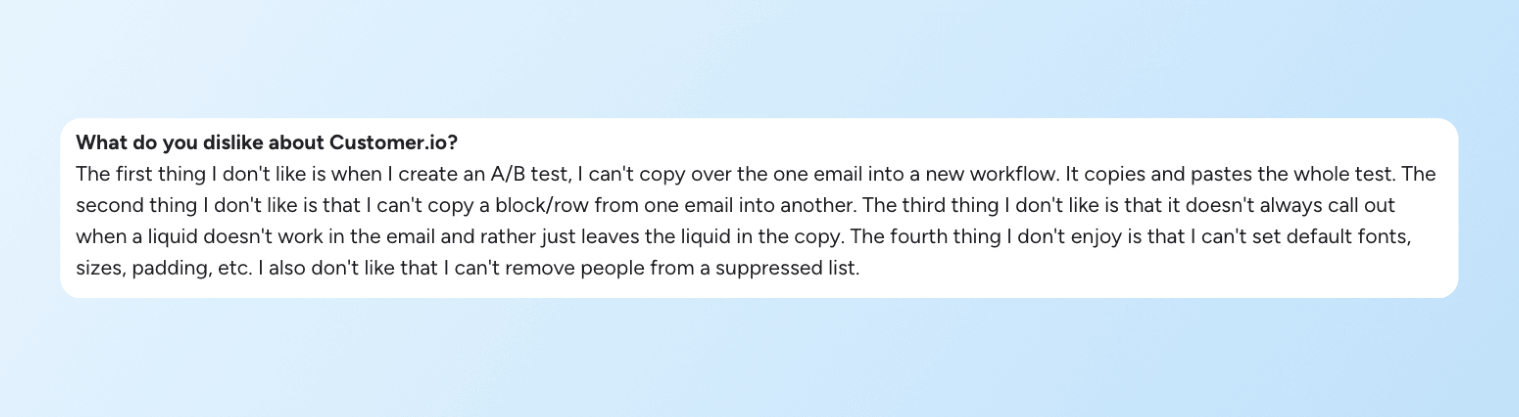
CleverTap provides a more intuitive campaign-building experience with reusable components, enabling users to create, configure, and launch personalized campaigns across multiple messaging channels via the dashboard or APIs, with robust targeting and performance-tracking features. The platform supports advanced segmentation, scheduling, and conversion goal tracking to optimize user engagement.
On G2, CleverTap earns 4.6/5 stars compared to Customer.io’s 4.4, bagging better ratings for ease of use, quality of support, and other key requirements.
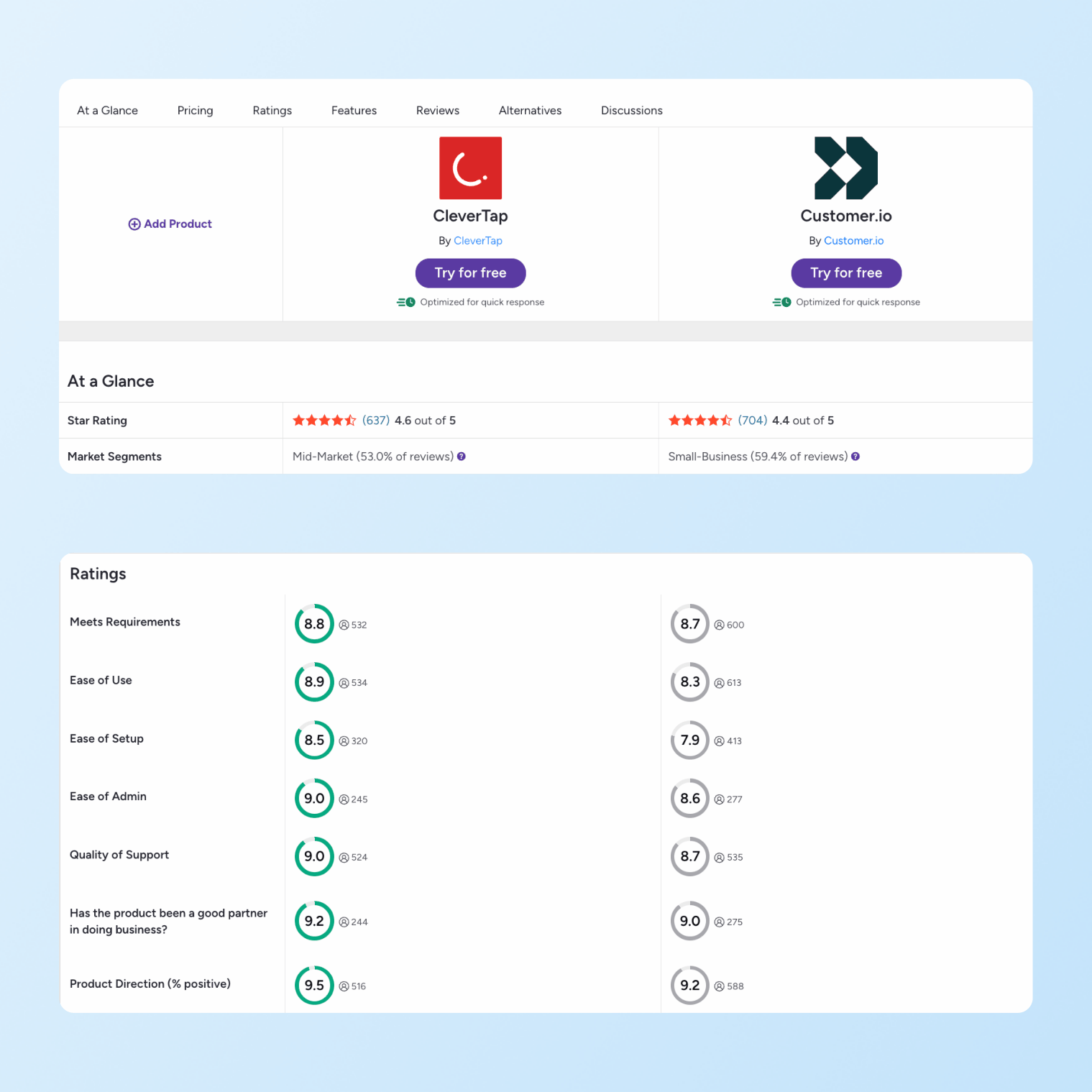
Customer.io may work well for lightweight messaging needs, but G2 feedback suggests it can fall short in areas like design flexibility, AI-driven optimization, workflow scalability, and marketer usability.
CleverTap stands out as a more comprehensive customer engagement platform, built for real-time personalization, true omnichannel orchestration, advanced analytics, and enterprise-grade scalability.
2. Braze
Braze is known for its real-time messaging and scalability for enterprise workloads. It enables companies to orchestrate messaging through push notifications, in-app messages, email, SMS, and more, all in response to customer behavior in real time.
Below are some key features of Braze that make it a suitable alternative to Customer.io.
- Visual Journey Orchestration: Braze provides a drag-and-drop journey builder for designing and optimizing cross-channel lifecycle campaigns.
- Real-Time Personalization: Messages update instantly based on live user behavior, attributes, and context across email, push, SMS, web, and in-app channels.
- In-App Messaging And Content Cards: Persistent in-app feeds allow brands to surface updates, onboarding content, and promotions that users revisit over time.
- Streaming Data and Predictive AI: Braze processes events within seconds and applies predictive churn and propensity models to trigger actions.
Learn more about the top Braze competitors.
Compare Braze vs. MoEngage, Braze vs. Insider One, Braze vs. Salesforce Marketing Cloud, Braze vs. CleverTap, Braze vs. Iterable, and Braze vs. Klaviyo to deep dive into Braze’s competitor landscape and choose the best tool for your needs.
3. MoEngage
MoEngage is a well-established customer engagement platform with strong adoption among mobile-first B2C companies, particularly across Asia and Europe. It positions itself as an insights-driven alternative to Customer.io, helping teams track user behavior across web and mobile and activate those insights across push, email, SMS, in-app, and web channels.
Below are some key features of MoEngage that make it a suitable alternative to Customer.io.
- Omnichannel Journey Orchestration: MoEngage offers a visual, drag-and-drop journey builder that allows teams to design cross-channel campaigns.
- Real-Time Behavior Tracking: User actions across mobile and web are captured in near-real-time and can be used to trigger campaigns.
- AI-Powered Analytics and Predictive Segmentation: MoEngage’s Sherpa AI engine predicts outcomes, including the likelihood of conversion, churn, or uninstallation.
- Product Analytics and Experimentation: MoEngage includes A/B testing and product analytics features that let teams analyze user paths and engagement flows.
Learn more about the top MoEngage alternatives.
Compare CleverTap vs. MoEngage and MoEngage vs. WebEngage customer engagement platforms.
4. Iterable
Iterable is a cross-channel marketing platform built around event-triggered engagement and marketer autonomy. It helps teams design sophisticated, multi-touch campaigns across email, SMS, push, in-app, and web push without heavy ongoing engineering, while retaining flexibility through behavioral triggers and dynamic segmentation.
Below are some key features of Iterable that make it a suitable alternative to Customer.io.
- Visual Workflow Studio: Iterable’s workflow builder supports complex branching logic and conditional paths.
- Event-Triggered Messaging: Campaigns can be triggered by real-time events sent via API or internal tracking.
- Advanced Segmentation And Personalization: Marketers build segments using virtually any user attribute or historical event data.
- Email and Mobile-First Execution: Iterable has deep email capabilities paired with SMS, push, in-app, and web push.
Get a comprehensive list of the top Iterable competitors.
5. Insider One
Insider One is a comprehensive omnichannel customer engagement platform built around personalization at scale. It combines a built-in CDP, journey orchestration, and AI-driven personalization into a single system, enabling enterprise teams to manage messaging, on-site experiences, and customer data without stitching together multiple tools.
Below are some key features of Insider that make it a suitable alternative to Customer.io.
- Unified Customer Data Platform: Insider includes a native CDP that centralizes user data across channels.
- Omnichannel Journey Orchestration: Marketers design complex journeys across email, SMS, WhatsApp, push, web, in-app, Facebook Messenger, and on-site overlays from a single interface.
- AI-Powered Personalization and Recommendations: Insider uses predictive models to personalize content and even on-site layouts in real time based on user behavior and intent.
- On-Site And In-App Experience Personalization: Beyond messaging, Insider enables dynamic personalization of websites and apps.
Compare the top Insider One competitors and get a deeper look at Klaviyo vs. Insider One to choose the best platform for your needs.
6. WebEngage
WebEngage is a full-stack customer engagement and retention platform that positions itself as a “Retention OS.” Originating in India and expanding globally, it combines customer data unification, analytics, and multichannel engagement to help teams drive repeat usage and long-term retention through personalized messaging.
Below are some key features of WebEngage that make it a suitable alternative to Customer.io.
- Unified Customer Data Platform. WebEngage includes a built-in CDP that collects and unifies user data from multiple sources.
- Journey Designer For Lifecycle Campaigns: Its visual journey builder supports event-based workflows for onboarding, reactivation, and retention.
- Broad Omnichannel Messaging: The platform supports push, email, SMS, web push, on-site messages, and WhatsApp.
- Feedback And Compliance Capabilities. Built-in NPS and survey tools, along with a focus on data security and compliance.
Compare the top WebEngage competitors and alternatives. Directly compare CleverTap to WebEngage to find the best fit.
7. Netcore Cloud
Netcore Cloud is a customer engagement and communications platform that blends messaging automation with a strong delivery infrastructure. With roots in high-volume email delivery, Netcore has expanded into a full-fledged engagement platform focused on AI-driven personalization across email, SMS, push, in-app, WhatsApp, and more.
Below are some key features of Netcore Cloud that make it a suitable alternative to Customer.io.
- Email-First Infrastructure With Engagement Automation: Netcore’s heritage in email APIs and deliverability gives it a reliability edge.
- Omnichannel Journey Orchestration: A unified journey builder allows teams to design personalized workflows.
- AI-Driven Personalization And Predictive Segments. Netcore’s AI capabilities, including Raman AI, help predict user intent, churn risk, and likelihood to convert.
- Product Experience Layer: Through its acquisition of Hansel.io, Netcore adds in-app nudges, walkthroughs, and contextual prompts to improve activation.
Find the best Netcore Cloud competitors and alternatives for your business.
8. HubSpot Marketing Hub
HubSpot Marketing Hub is best known as part of HubSpot’s broader CRM and inbound marketing ecosystem rather than a pure customer engagement platform. It earns a place on this list because, for many teams, its ease of use and all-in-one approach can be a practical alternative to a more developer-heavy tool like Customer.io.
Below are some key features of HubSpot Marketing Hub that make it a suitable alternative to Customer.io.
- Visual Email Automation and Workflows: HubSpot provides a no-code workflow builder for creating email-based nurture flows.
- Built-In CRM And Unified Contact Data: Marketing, sales, and support teams share the same CRM, making it easy to segment audiences and align outreach without syncing multiple systems.
- Extensive App Marketplace: HubSpot integrates with hundreds of third-party tools.
9. Klaviyo
Klaviyo is a marketing automation platform purpose-built for e-commerce and DTC brands. It focuses heavily on email and SMS, with deep, native integrations into platforms like Shopify, Magento, and WooCommerce, allowing brands to activate purchase and browsing data without complex setup.
Below are some key features of Klaviyo that make it a suitable alternative to Customer.io.
- E-Commerce–Native Segmentation: Klaviyo lets marketers segment users based on purchase history, cart behavior, browsing activity, and order frequency.
- Email and SMS Automation Flows: A visual flow builder supports common e-commerce use cases such as welcome series, abandoned cart, and browse abandonment.
- Predictive Analytics: Klaviyo provides predictive metrics such as expected next-order date, churn risk, and customer lifetime value, all derived directly from commerce data.
- AI-Powered Product Recommendations: Emails include personalized product recommendations based on user behavior and trending items.
10. OneSignal
OneSignal began as a push notification service for mobile and web apps and has gradually expanded into a lightweight multi-channel messaging platform. While it now supports email, SMS, and in-app messages, push notifications remain its core strength and primary reason teams adopt it.
Below are some key features of OneSignal that make it a suitable alternative to Customer.io.
- Mobile and Web Push Notifications: OneSignal delivers push notifications across iOS, Android, and the web.
- In-App Messaging: Teams create targeted in-app pop-ups and banners triggered by basic user behavior.
- Simple Automation and Triggers: A lightweight automation engine allows messages to be triggered by user actions.
- Email and SMS Add-Ons: OneSignal includes email and SMS capabilities for simple campaigns, enabling teams to combine push with other channels.
Find the best OneSignal alternatives in this comprehensive list.
How to Switch from Customer.io to Another Platform
Migrating away from Customer.io is a sizable project, but it pays off when done methodically. Start with a full audit of your current setup. Document events, segments, journeys, integrations, and custom attributes. This step prevents blind spots and helps you remove outdated workflows before moving them.
Then, you need to take care of the following things:
- Map Customer.io features to equivalents in your new platform. Identify how event triggers, personalization logic, and segmentation rules translate.
- Plan data and integration work. Migrate contacts and attributes first. For historical events, prioritize forward-looking tracking instead of forcing old logs into the new system. Implement SDKs, APIs, and third-party integrations in parallel.
- Rebuild critical journeys and test aggressively. Validate triggers, personalization, compliance settings, and unsubscribe logic. Roll out via a pilot, then complete the full cut-over once results stabilize.
Migration is effort-heavy, but better scalability, usability, and insight usually justify the move.
Why Migrating to CleverTap Is Easier
If CleverTap happens to be your choice, it’s worth noting a few reasons why moving to CleverTap from Customer.io can be relatively smooth:
- Native SDKs and Data Capture: CleverTap provides SDKs for all major platforms (iOS, Android, web) that not only handle messaging but also automatically capture a lot of user events once installed.
- Dedicated Onboarding and Support: CleverTap assigns respective teams to new customers, guiding the migration.
- Minimal Disruption via Data and People Integration: CleverTap can ingest historical data if needed.
- Lower Total Effort in the Long Run: Once migrated, you consolidate capabilities like analytics, messaging, and A/B testing into one. This means less time spent maintaining multiple systems or doing manual data transfers.
FAQs While Exploring Customer.io Competitors
Before we wrap up, here are answers to a few common questions teams have when evaluating Customer.io alternatives:
Q1: How do I convince stakeholders it’s worth switching from Customer.io?
Focus on the impact and ROI. Highlight the pain points, then show how an alternative addresses them. Also, consider cost: you might be paying for multiple tools, while a single platform could save you money overall. A migration guide or vendor-provided ROI analysis can help make the case.
Q2: Will I lose any data or functionality during migration?
If planned well, you shouldn’t lose critical data. You will archive some historical data, but those can be kept in a database or cloud storage for reference if needed.
Q3: How long does it typically take to migrate to a new customer engagement platform?
The timeline depends on the complexity of your setup and the platform you choose. For a mid-sized company with moderate campaigns, it often takes around 4-6 weeks from project start to full cut-over.
Q4: What if my team is very used to Customer.io? Will training on a new tool be difficult?
Modern engagement platforms have invested in good UX, so most find the transition fine after an initial learning period. In many cases, the new platform may be easier (especially for non-dev users) because it may include visual builders and less coding.
Make a Wise choice
The best customer engagement platforms empower your team to create customer experiences that drive your growth without creating new silos or headaches. It’s all about the best fit for your context.
If you’re looking for an easy-to-use solution with the right omnichannel and AI capabilities, you might want to explore CleverTap or take a personalized demo. The demo will help you understand how effortlessly CleverTap fits into your customer engagement strategy.
See how CleverTap can help boost customer engagement.

Agnishwar Banerjee 
Leads content and digital marketing.Expert in SaaS sales, marketing and GTM strategies.
Free Customer Engagement Guides
Join our newsletter for actionable tips and proven strategies to grow your business and engage your customers.