































![Customer Lifetime Value vs Customer Acquisition Cost [Formulas, Ratio Benchmarks & Growth Strategy]](https://clevertap.com/wp-content/uploads/2026/03/Customer-Lifetime-Value-vs-Customer-Acquisition-Cost.jpg)

Table of Contents
Categories
Most Popular


Growing a business requires balancing the customer acquisition cost (CAC), i.e., the amount spent on getting new customers, with customer lifetime value (CLV), i.e., the revenue those customers deliver over their lifetime. CAC measures how much you spend to win a customer, while CLV estimates what that customer will earn your business over time.
For growth-focused teams, the ratio between customer acquisition cost and customer lifetime value reveals whether a business is building lasting value or simply spending to keep momentum going. When these metrics are aligned, growth compounds. When they’re not, even fast-growing companies can run into trouble.
Understanding this balance requires knowledge of how these metrics are calculated, what healthy benchmarks look like, and how to interpret the signals when the numbers drift out of alignment. More importantly, it involves identifying practical ways to either reduce acquisition costs or increase the value each customer brings over time.
In this guide, we’ll explore how CLV and CAC work together, what their relationship reveals about business health, and how companies can optimize it through smarter strategies.
What Is Customer Acquisition Cost (CAC)?
Customer acquisition cost measures the average amount a business spends to acquire a new customer. It helps companies understand how efficiently their marketing and sales efforts convert prospects into paying users.
CAC = Total Acquisition Costs ÷ Number of New Customers Acquired
Total acquisition costs should include all expenses tied to attracting and converting customers. This typically covers the following:
- Advertising spend
- Sales and marketing team salaries and commissions
- Marketing software and tools
- Agency or creative production fees
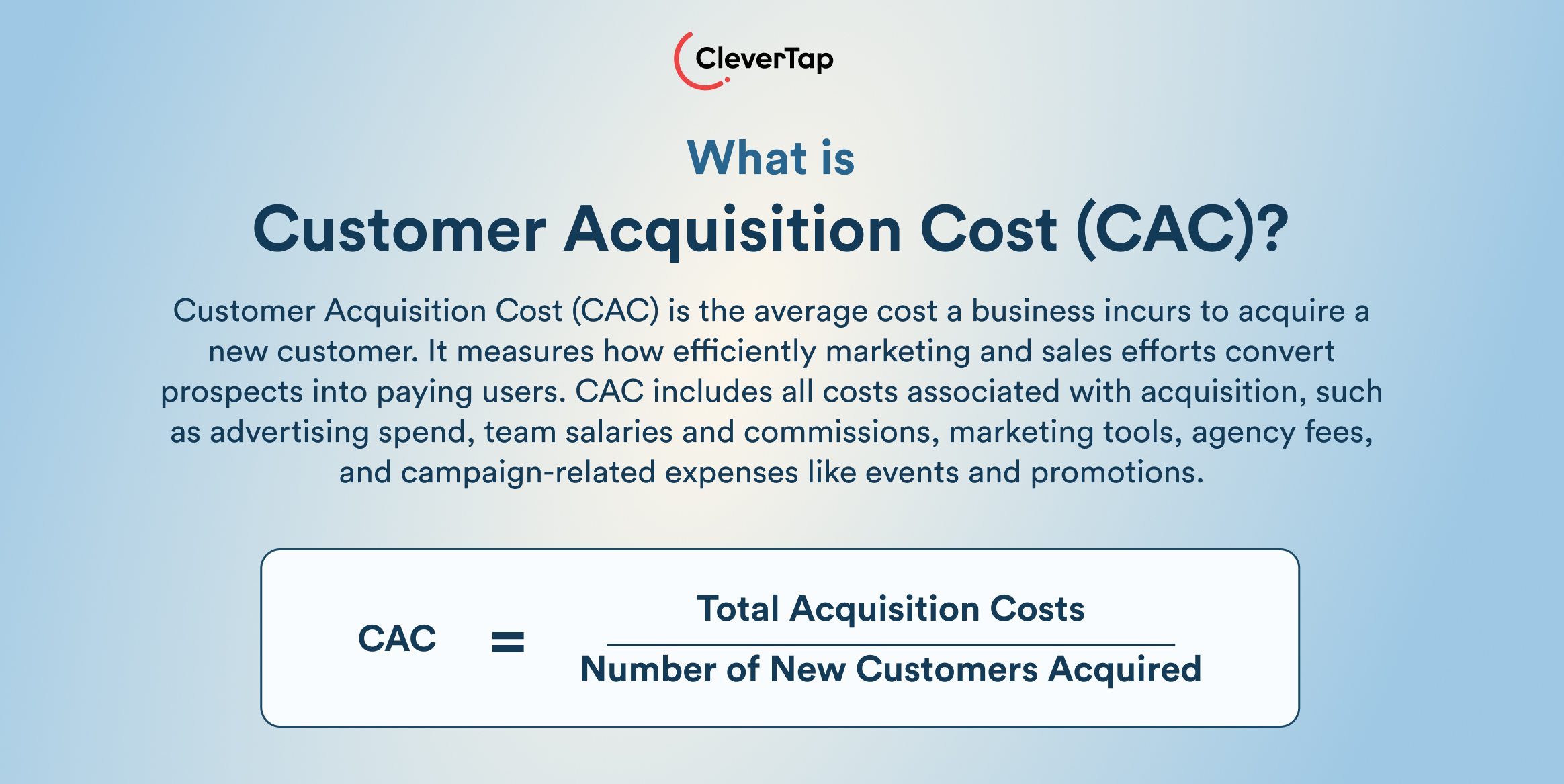
Businesses may also include campaign-related costs such as trade shows, promotional materials, or marketing operations support.
For example, if a company spends $10,000 on marketing and sales activities in a month and acquires 100 new customers, its CAC would be $100 per customer.
However, CAC rarely looks the same across every channel. Paid advertising campaigns, organic acquisition, referrals, and partnerships can each produce very different costs per customer.
If CAC is calculated using incomplete data, such as excluding salaries or software costs, it can significantly underestimate acquisition costs and lead to misleading growth decisions.
What Is Customer Lifetime Value (CLV)?
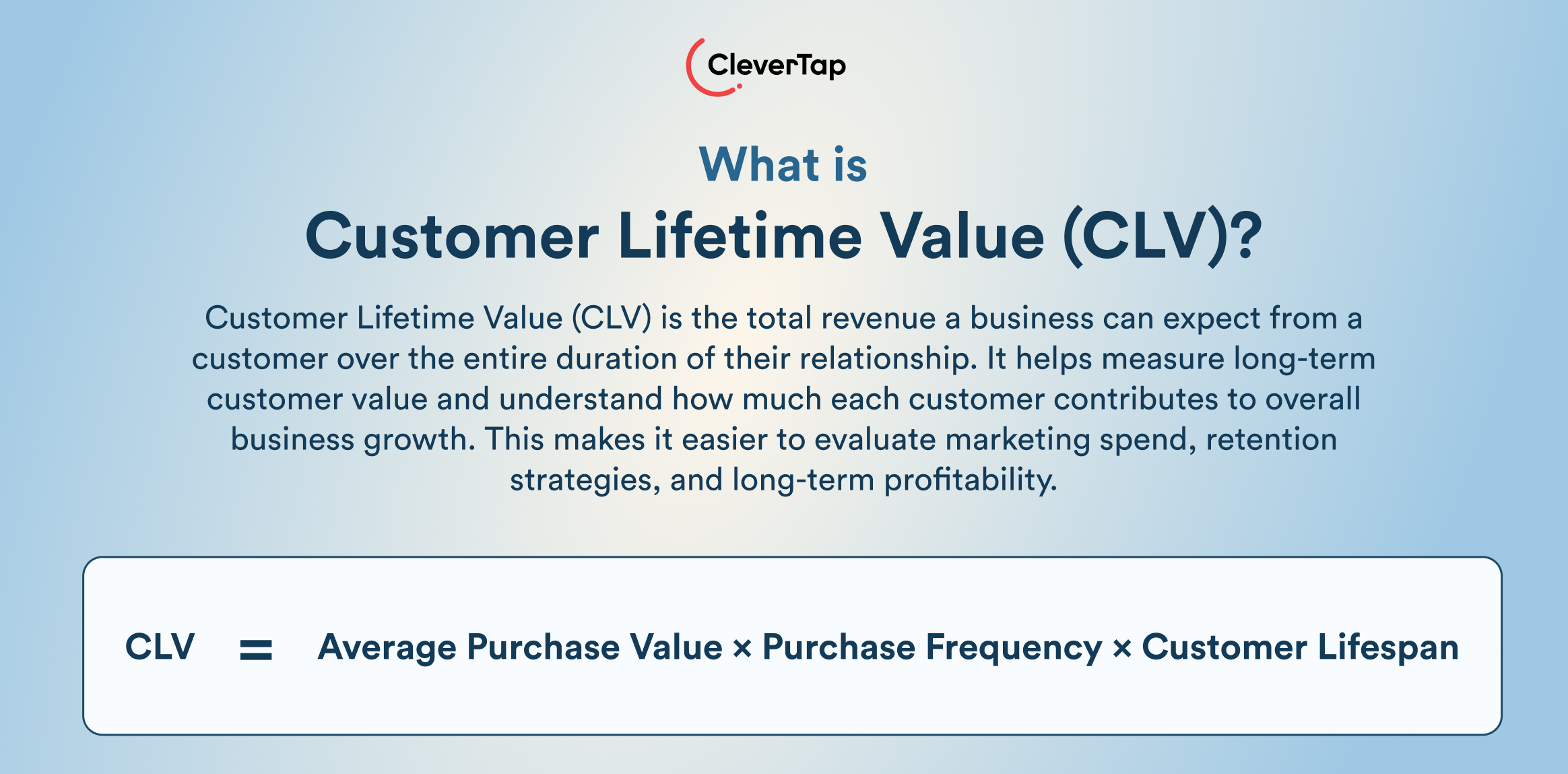
Customer lifetime value (CLV), sometimes also called lifetime value (LTV), estimates the total revenue a customer generates during their entire relationship with a business. It helps companies understand how much value each customer brings over time, making it easier to evaluate marketing investments and long-term growth strategies.
A commonly used formula for CLV is:
CLV = Average Purchase Value × Purchase Frequency × Customer Lifespan
For example, if the average purchase value is $50, a customer buys 4 times per year, and the average customer relationship lasts 3 years, the CLV would be:
$50 × 4 × 3 = $600
This means the business can expect to generate $600 in revenue from a typical customer over their lifetime.
Companies calculate CLV in different ways depending on the data available. Historical CLV looks at the actual revenue generated from past purchases to determine lifetime value. Predictive CLV, on the other hand, estimates future revenue by modeling customer behavior, churn rates, and expected purchase patterns.
Many organizations also use cohort-based CLV modeling, which groups customers based on when or how they were acquired and tracks how each cohort behaves over time. This approach helps businesses identify which acquisition channels or campaigns bring in customers who generate the highest long-term value.
Retention plays a major role in CLV. When customers continue purchasing for longer periods, their lifetime value increases significantly. Even small improvements in the repeat purchase rate or reduction in churn can meaningfully increase CLV over time.
Because CLV compounds over time, even small improvements in retention can significantly increase long-term revenue.
CLV vs CAC: The Core Differences
Customer lifetime value and customer acquisition cost measure two sides of the same equation. These metrics show businesses what they spend to gain customers and what those customers are worth over time. Together, they provide a clearer picture of whether growth is financially sustainable.
At a fundamental level, CAC is a cost metric, while CLV is a revenue metric. CAC measures how much a company spends on marketing and sales to acquire a single customer. CLV estimates the total revenue that a customer generates during their relationship with the business.
The two metrics also differ in the time horizon they represent. CAC measures short-term efficiency, capturing the immediate cost of running marketing and sales campaigns. CLV reflects long-term profitability because customer value accumulates over months or years through repeat purchases or ongoing subscriptions.
Another important distinction is what each metric evaluates. CAC measures acquisition performance, indicating how effectively marketing converts prospects into customers. CLV reflects retention strength, showing how well a business keeps customers engaged and encourages repeat transactions.
| Aspect | Customer Acquisition Cost | Customer Lifetime Value |
| Metric type | Cost metric | Revenue metric |
| Time horizon | Short-term efficiency | Long-term profitability |
| Business focus | Acquisition performance | Retention strength |
| Strategic lever | Expense control | Revenue expansion |
Neither metric provides a complete picture on its own. A low CAC may appear efficient, but if customers churn quickly, the business loses long-term value. Similarly, a high CLV reflects strong long-term revenue potential, but if acquisition costs are too high, growth can still become unprofitable.
Why the CLV to CAC Ratio Determines Business Viability
The CLV: CAC ratio measures how much value a customer generates compared to what it costs to acquire them. It is calculated using a simple formula:
CLV: CAC Ratio = Customer Lifetime Value ÷ Customer Acquisition Cost
This ratio acts as a quick benchmark for evaluating whether a company’s growth strategy is financially sustainable.
A 1:1 ratio means the business earns only as much revenue from a customer as it spends to acquire them. In this case, acquisition efforts generate no real profit. A 2:1 ratio suggests the company is generating some value, but margins remain thin after accounting for marketing, operational, and support costs.
Most companies aim for a 3:1 ratio, which is often considered a healthy benchmark. However, the ideal ratio depends on factors such as margins, payback period, and growth stage, so it should always be interpreted within the context of your business model.
At this level, the value generated by each customer significantly exceeds acquisition costs, leaving room to reinvest in marketing, product development, and growth. Ratios above 5:1 can sometimes indicate the opposite problem of underinvestment in acquisition, suggesting the company could scale faster by spending more to acquire new customers.
Another important factor is the CAC payback period, which measures how long it takes for customer revenue to recover the initial acquisition cost. Even with a strong CLV: CAC ratio, long payback periods can strain cash flow. For this reason, leadership teams and investors typically evaluate both the ratio and the payback timeline when assessing business viability and growth potential.
How to Calculate the CLV to CAC Ratio Step by Step
Once you’ve calculated customer lifetime value and customer acquisition cost, finding the CLV: CAC ratio is straightforward. The goal is to compare how much value a customer generates with what it costs to acquire them.
Step 1: Determine CAC
Start by identifying your customer acquisition cost for a given time period. This is the average amount spent on marketing and sales to acquire a single customer.
Step 2: Determine CLV
Next, estimate the total revenue a typical customer generates during their relationship with the business.
Step 3: Divide CLV by CAC
Finally, divide the lifetime value by the acquisition cost to determine the ratio.
For example, if CAC = $100 and CLV = $300, the calculation is:
CLV:CAC = $300 ÷ $100 = 3:1
This means the business generates three dollars in lifetime revenue for every dollar spent on acquisition, a level often considered healthy for sustainable growth.
The exact inputs used to estimate CLV can vary by business model. Transactional businesses typically rely on purchase value and repeat purchase rates, while subscription companies often use recurring revenue metrics such as ARPU and average customer lifespan to estimate long-term value.
What a Healthy CLV to CAC Ratio Looks Like
The commonly cited 3:1 CLV: CAC ratio is often used as a baseline for sustainable growth, but the ideal benchmark depends on industry, business model, and company maturity. Rather than treating it as a universal rule, companies should interpret the ratio within their specific operating context.
Industry benchmarks vary significantly. According to insights published by Forbes, many e-commerce companies consider 3:1 a healthy baseline, with high-retention subscription businesses sometimes targeting 4:1–5:1 due to the compounding effect of recurring revenue.
Industry data also shows meaningful variation across sectors. Benchmark datasets summarized by FirstPageSage indicate that LTV: CAC ratios can range from 3:1 to 6:1 or more, depending on customer lifetime value and acquisition costs.
| Business Context | Typical CLV: CAC Range | Reason |
| E-commerce/marketplaces | ~3:1 | Revenue depends on repeat purchases |
| SaaS/subscription apps | 4:1–5:1 | Recurring revenue increases lifetime value |
| Early-stage startups | ~2:1–3:1 | Focus on rapid customer acquisition |
| Mature companies | 3:1+ | Emphasis on profitability and efficiency |
Growth stage also matters. Startups may temporarily accept lower ratios to scale faster, while mature companies focus more on efficiency.
At the same time, extremely high ratios can signal conservative marketing investment. If CLV is five or more times CAC, companies may have room to increase acquisition spending and accelerate growth.
When CAC Is the Problem vs When CLV Is the Problem
When the CLV:CAC ratio weakens, the underlying issue usually falls into one of four scenarios. A simple way to diagnose the problem is to map customer acquisition cost against customer lifetime value.
| Low CLV | High CLV | |
| Low CAC | Scenario 1: Low CAC, Weak CLV Customers are inexpensive to acquire but generate little long-term value. Drivers: weak onboarding, low engagement, poor retention, low purchase frequency. Meaning: acquisition is efficient, but monetization and retention need improvement. | Scenario 2: Low CAC, Strong CLV The ideal scenario for scalable growth. Customers are inexpensive to acquire and generate strong lifetime value. Drivers: strong product-market fit, efficient acquisition channels, high retention, and consistent repeat purchases. Meaning: the business model is scalable. Companies should increase acquisition investment while monitoring CAC payback and cash flow. |
| High CAC | Scenario 3: High CAC, Weak CLV The most dangerous scenario. Customer acquisition is expensive, and customers fail to generate meaningful value. Drivers: poor product-market fit, misaligned targeting, or weak value proposition. Meaning: structural growth issues that require changes across product, pricing, and marketing strategy. | Scenario 4: High CAC, Strong CLV Customers eventually generate strong value, but acquisition is inefficient. Drivers: rising ad costs, poor targeting, or weak funnel conversion rates. Meaning: growth potential exists, but marketing efficiency must improve. |
This matrix helps growth teams quickly identify whether the primary issue lies in acquisition efficiency or lifetime value creation. Once diagnosed, companies can focus on either reducing CAC or increasing CLV to improve the overall ratio.
How to Improve Your CLV to CAC Ratio
Improving the CLV:CAC ratio requires strengthening the balance between acquisition cost and customer value.
Businesses can improve the ratio in two ways: reduce the cost of acquiring customers or increase the value those customers generate over time. High-performing companies typically pursue both strategies simultaneously.
Lower Customer Acquisition Cost
Reducing CAC means improving the efficiency of how customers are acquired.
- Improve audience targeting: Better customer segmentation and targeting ensure marketing spend reaches users more likely to convert. Lookalike audiences, behavioral targeting, and intent-based campaigns can significantly increase conversion efficiency.
- Optimize funnel conversion rates: Small improvements in the acquisition funnel can dramatically lower CAC. Optimizing landing pages, simplifying signup flows, and improving call-to-action messaging can increase conversion rates and reduce the cost per customer.
- Refine channel mix: Not all acquisition channels deliver the same efficiency. Analyzing performance across channels helps identify which sources generate customers at the lowest cost. Shifting investment toward high-performing channels, such as organic search, referrals, or partnerships, can reduce overall CAC.
- Shorten activation time: The faster a new user becomes an active customer, the more efficiently acquisition spending translates into revenue. Improving onboarding flows or offering incentives for early purchases can accelerate activation.
Increase Customer Lifetime Value
Improving CLV focuses on maximizing the revenue generated from each acquired customer.
- Improve retention: Strong retention is the biggest driver of lifetime value. Engaged customers remain active longer and generate more revenue over time.
- Increase repeat purchase frequency: Encouraging customers to buy more frequently through reminders, subscriptions, or replenishment campaigns directly increases lifetime value.
- Optimize cross-sell and upsell opportunities: Recommending complementary products, bundles, or premium tiers increases the average revenue generated from each customer.
- Personalize lifecycle engagement: Behavioral segmentation and personalized messaging help deliver relevant experiences that keep customers engaged throughout their lifecycle.
- Reduce churn: Identifying and re-engaging at-risk users can extend customer lifespans and significantly increase CLV.
Ultimately, improving the CLV:CAC ratio requires balancing efficient acquisition with strong retention and monetization.
Real-World Examples of CLV vs CAC in Action
Mentioned below are some real-world examples of brands using different strategies to optimize these two metrics.
Example 1: Ecommerce brand improving retention before scaling acquisition
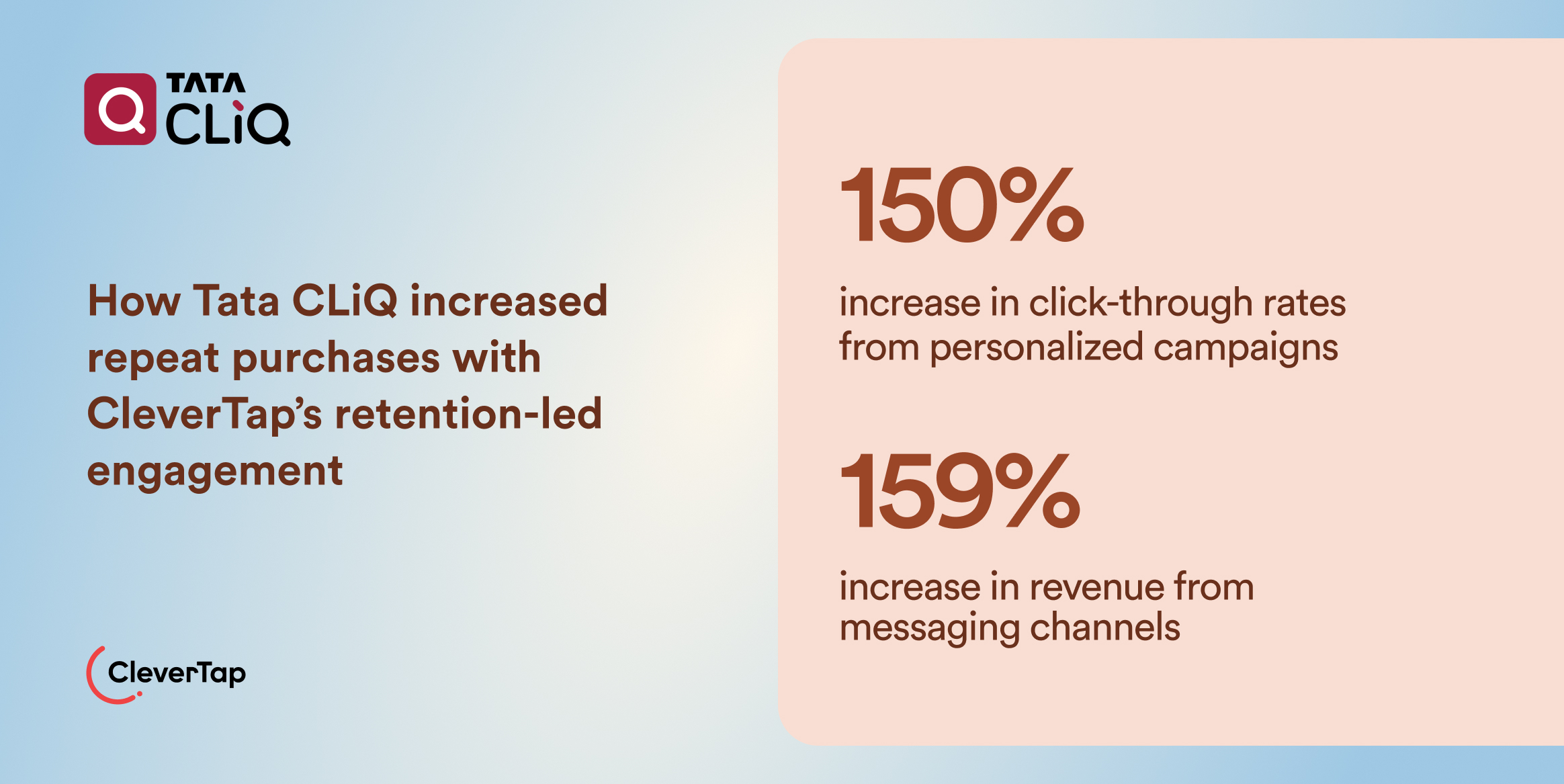
India’s ecommerce platform, Tata CLiQ, wanted to strengthen repeat engagement and maximize the value generated from existing customers. They used CleverTap to improve click-through rates and revenue.
Problem: While the platform continued to attract shoppers, the team needed a better way to understand user intent and encourage customers to return and make repeat purchases.
Metric imbalance: Acquisition was working, but improving customer lifetime value (CLV) required stronger retention and repeat purchase behavior.
Action: The team implemented a retention-focused strategy using cohort analysis and behavioral segmentation. By analyzing user actions such as product views, cart abandonment, and browsing behavior, they launched personalized omnichannel campaigns across push notifications, email, SMS, and web messaging.
Result: The targeted engagement campaigns significantly improved performance, delivering an average 150% increase in click-through rates and a 159% increase in revenue generated from messaging channels.
Example 2: Subscription media increasing CLV through automated onboarding
The subscription strategy of The Washington Post focused on increasing early subscriber engagement to improve retention.
Problem: A significant portion of new subscribers disengaged shortly after signing up.
Metric imbalance: Customer acquisition costs were substantial due to subscription marketing, but CLV suffered when subscribers churned early.
Action: The publication launched a personalized onboarding journey where new subscribers selected their content interests during signup. Automated email sequences then delivered tailored article recommendations to encourage frequent visits in the first few weeks.
Result: The onboarding program produced statistically significant improvements in retention and incremental CLV within the first 12 weeks, increasing subscriber value without raising acquisition spend.
Example 3: Fintech brand improving conversion efficiency
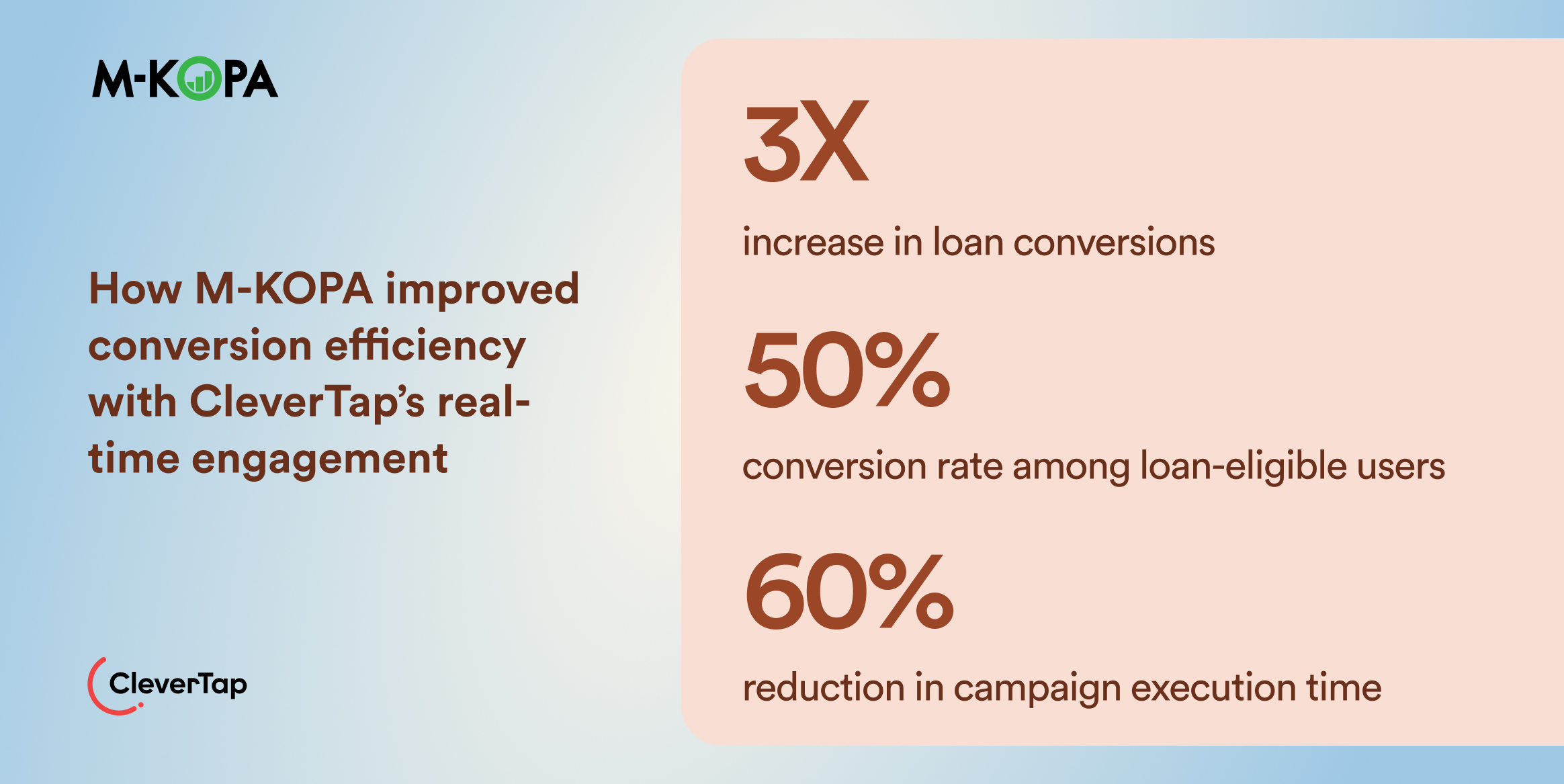
Kenyan fintech platform M-KOPA wanted to scale customer engagement across multiple markets while improving conversion efficiency. It used CleverTap to scale customer engagement across multiple markets while improving conversion efficiency.
Problem: The company relied on fragmented tools that limited its ability to build a unified view of customers and trigger real-time engagement. Segmentation was manual and slow, making it difficult to reach users with relevant messaging at the right moment.
Metric imbalance: Inefficient engagement workflows meant many potential customers were not progressing smoothly through the conversion journey, limiting acquisition efficiency.
Action: The team implemented real-time user segmentation and automated omnichannel journeys. Event-based messaging allowed customers to receive contextual communication, such as eligibility notifications and loan offers. A/B testing and delivery optimization further improved campaign performance.
Result: The new engagement strategy delivered a 3X increase in loan conversions and a 50% conversion rate among loan-eligible customers, while campaign execution time dropped by 60%, significantly improving marketing efficiency.
How CleverTap Helps Increase CLV and Control CAC
Improving the CLV:CAC ratio requires more than isolated improvements in acquisition or retention. It requires a system that can identify inefficiencies, act on them in real time, and continuously optimize both sides of the equation.
CleverTap is a customer engagement platform that connects behavioral analytics, predictive intelligence, segmentation, and lifecycle orchestration into a single system. This allows marketing and growth teams to reduce acquisition inefficiencies while increasing customer lifetime value through better retention, engagement, and monetization.
CleverTap improves CLV and CAC across four key areas:
Identifying and Reducing Acquisition Inefficiencies
CleverTap’s analytics layer helps teams identify where acquisition spend is being wasted. Funnel analysis and user flow reports surface drop-offs across signup, onboarding, and conversion journeys. This help pinpoint friction points such as incomplete onboarding, slow activation, or poor landing page performance.
Improving conversion at each stage allows businesses to acquire more customers from the same spend, reducing CAC without increasing budgets. Cohort-level acquisition analysis also shows which channels drive high-retention, high-value users, enabling smarter allocation toward sources that improve long-term returns.
Increasing Customer Lifetime Value Through Retention and Engagement
CleverTap increases CLV by improving retention and engagement over time. Behavioral segmentation and RFM analysis help identify high-value, at-risk, and dormant users, with segments updating dynamically based on real-time activity.
Lifecycle journeys automate engagement across onboarding, activation, retention, and re-engagement, guiding users through each stage with relevant interactions. Improving retention and reducing churn directly increases the total revenue generated per customer.
Driving Revenue Expansion Through Personalization and Targeting
CleverTap enables personalized engagement at scale using real-time behavioral data and predictive signals. Messages can be tailored based on user activity, preferences, purchase history, and lifecycle stage, including recommendations, replenishment reminders, cross-sell, and upsell campaigns.
Personalized messaging across push, in-app, email, and SMS keeps communication timely and relevant, improving engagement, conversion, and repeat purchases, all of which contribute to higher CLV.
Continuous Optimization Through Measurement and Experimentation
CleverTap connects engagement to measurable outcomes, enabling continuous optimization of acquisition and retention. Cohort analysis tracks retention, churn, and lifetime value across acquisition sources, helping teams identify which channels generate the most valuable customers.
A/B testing allows teams to optimize messaging, timing, and journey logic, while control groups measure incremental impact and validate performance. This feedback loop ensures CAC and CLV improve continuously rather than remaining static.
By combining acquisition analytics, real-time segmentation, lifecycle orchestration, and continuous optimization, CleverTap brings acquisition, engagement, and retention into a single, connected system. This allows teams to identify where acquisition spend is inefficient, act on user behavior as it happens, and continuously improve how customers are acquired, engaged, and retained over time.
Instead of treating CAC and CLV as separate metrics, teams can actively optimize both in parallel, reducing wasted spend while increasing the long-term value each customer generates.
See how CleverTap helps you improve your CLV:CAC ratio with real-time, data-driven engagement.
Balancing CAC and CLV for Sustainable Growth
Sustainable growth doesn’t come from optimizing acquisition or retention in isolation. It comes from balancing the cost of acquiring customers with the value they generate over time. The CLV:CAC ratio brings these two forces together into a single measure of marketing efficiency and long-term profitability. When the ratio is healthy, businesses can scale confidently, knowing each new customer contributes meaningful value.
For growth teams, the goal should be to acquire customers efficiently and continuously increase their lifetime value. Platforms like CleverTap help make this possible by connecting acquisition insights with lifecycle engagement.
Schedule a demo to see how CleverTap can help improve your CLV:CAC ratio.

Agnishwar Banerjee 
Leads content and digital marketing.Expert in SaaS sales, marketing and GTM strategies.
Free Customer Engagement Guides
Join our newsletter for actionable tips and proven strategies to grow your business and engage your customers.