



































Table of Contents
Categories
Most Popular


Customer retention is often associated with stronger profitability and long-term growth. But retaining customers also requires ongoing investment across lifecycle campaigns, loyalty programs, engagement tools, customer success operations, and retention-focused marketing.
As these efforts scale, so does the cost of maintaining them. Many businesses track the retention rate closely but fail to measure how much they actually spend to keep customers engaged over time. Without that visibility, it becomes difficult to evaluate whether retention efforts are financially efficient or sustainable.
Customer Retention Cost (CRC) helps solve this problem. CRC measures the total cost of retaining customers during a specific period. It gives businesses a clearer view of retention efficiency alongside metrics like customer lifetime value, churn, and profitability.
In this guide, we’ll break down how to calculate customer retention cost. We will find out what expenses should be included, how to interpret the metric properly, and how businesses can reduce CRC without hurting retention performance.
What Is Customer Retention Cost (CRC)?
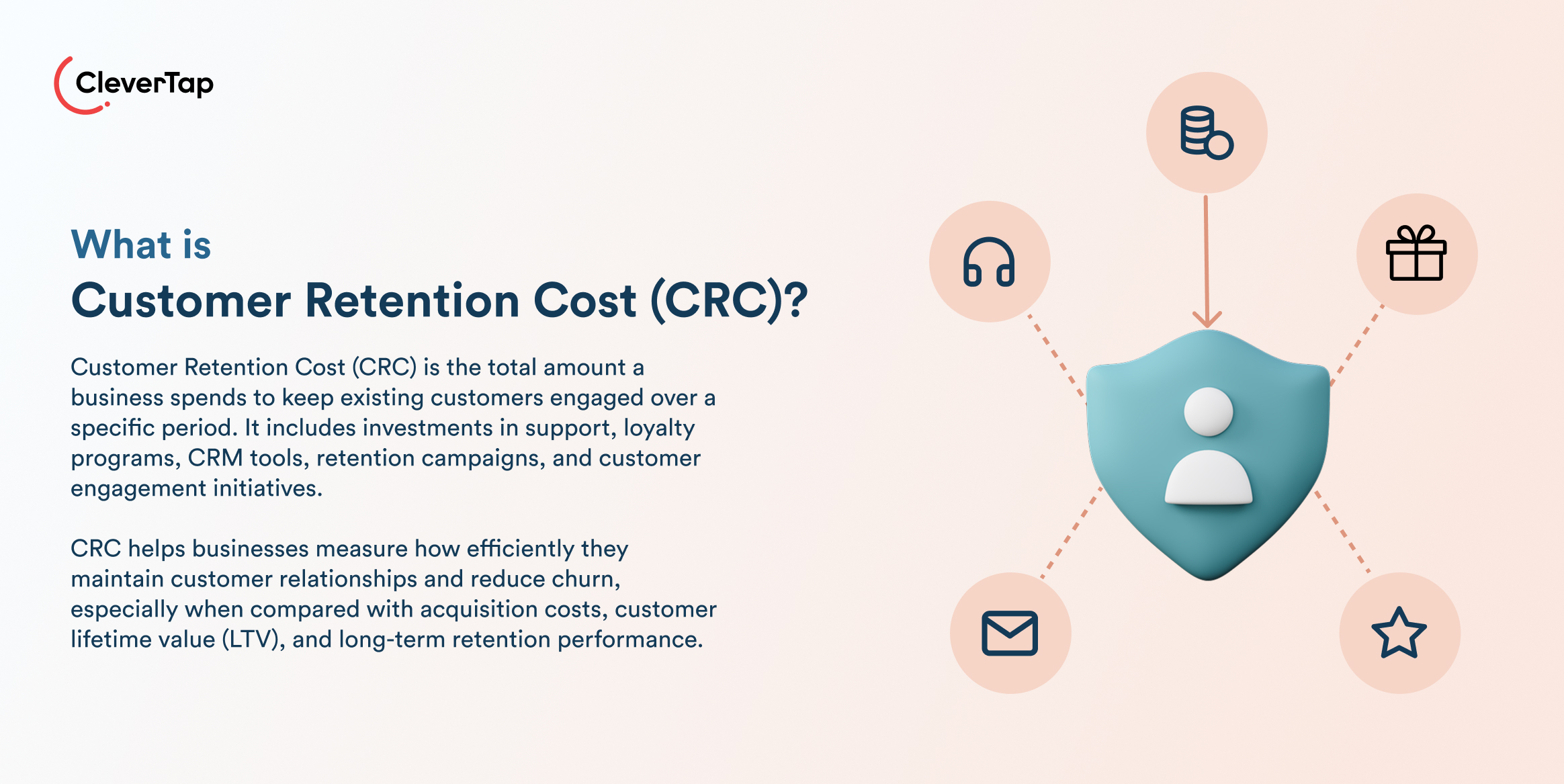
Customer Retention Cost (CRC) is the total amount a business spends to retain existing customers over a specific period.
It measures the financial investment required to keep customers engaged, active, and purchasing over time. This includes spending across retention-focused campaigns, loyalty programs, engagement tools, customer success operations, and lifecycle marketing efforts.
Businesses commonly analyze CRC alongside metrics like customer lifetime value (LTV), retention rate, churn rate, and Customer Acquisition Cost (CAC) to evaluate retention efficiency and long-term profitability. Retention metrics show how well a business keeps customers, but CRC helps determine how efficiently those results are achieved.
A rising retention rate may appear positive in isolation, but profitability can still decline if retention costs increase faster than customer value. This is why CRC is an important operational and financial metric, not just a marketing metric.
Why Customer Retention Cost Matters
Customer Retention Cost (CRC) helps businesses evaluate whether their retention strategy is financially efficient. While retention rates show how well a business keeps customers over time, CRC reveals how much it actually costs to achieve those results.
This becomes important because retention spending can increase quickly across campaigns, loyalty programs, engagement tools, customer success operations, and incentives. Without tracking CRC, businesses may continue investing in retention strategies that improve engagement but reduce overall profitability.
CRC also provides important context alongside metrics like Customer Acquisition Cost (CAC) and customer lifetime value (LTV). A higher CRC may still be healthy if it is retained customers who generate strong long-term value. On the other hand, even a relatively low CRC can become inefficient if customer profitability remains weak.

The metric also helps businesses optimize retention and spend more effectively. In fact, it can reveal inefficient campaigns, excessive discounting, poor audience segmentation, or high-cost retention efforts that fail to generate meaningful long-term value. This allows businesses to allocate retention budgets more strategically instead of focusing only on increasing retention rates.
Also read: Customer Lifetime Value vs Customer Acquisition Cost [Formulas, Ratio Benchmarks & Growth Strategy]
Customer Retention Cost Formula
Customer Retention Cost is calculated by dividing the total amount spent on retention efforts by the number of customers retained during a specific period.
CRC = Total Retention Costs / Number of Customers Retained
For example, if a business spends $40,000 on retention activities in a quarter and retains 8,000 customers during that period, the customer retention cost would be $5 per retained customer.
The calculation itself is straightforward, but the accuracy of CRC depends on how retention costs and retained customers are defined. Retention costs typically include spending on lifecycle campaigns, loyalty programs, engagement tools, customer success operations, and retention-focused communication channels such as email, SMS, and push notifications.
Businesses must also use consistent retention criteria and timeframes when calculating CRC. Differences in how retained customers are measured can significantly affect retention cost analysis and overall profitability evaluation.
Step-by-Step Example of Calculating CRC
The CRC formula is relatively straightforward. However, the real value comes from understanding how retention spending translates into cost per retained customer in practical business scenarios.
Suppose a subscription business wants to calculate its customer retention cost for a single quarter. During that period, the company spends:
- $18,000 on email, push notification, and SMS retention campaigns
- $10,000 on CRM and customer engagement software
- $7,000 on loyalty rewards and retention incentives
- $5,000 on customer success and retention operations
This brings the total retention spend for the quarter to $40,000.
During the same period, the business retains 8,000 active customers. Using the CRC formula:
CRC= 40000 / 8000 = 5
The customer retention cost is $5 per retained customer.
A $5 CRC may be highly efficient for a business with strong customer lifetime value and healthy profit margins. However, the same retention cost may be unsustainable for businesses with lower customer value or weaker retention economics. This is why CRC should always be evaluated alongside metrics like LTV, churn rate, and profitability rather than analyzed in isolation.
What Costs Should Be Included in Customer Retention Cost?
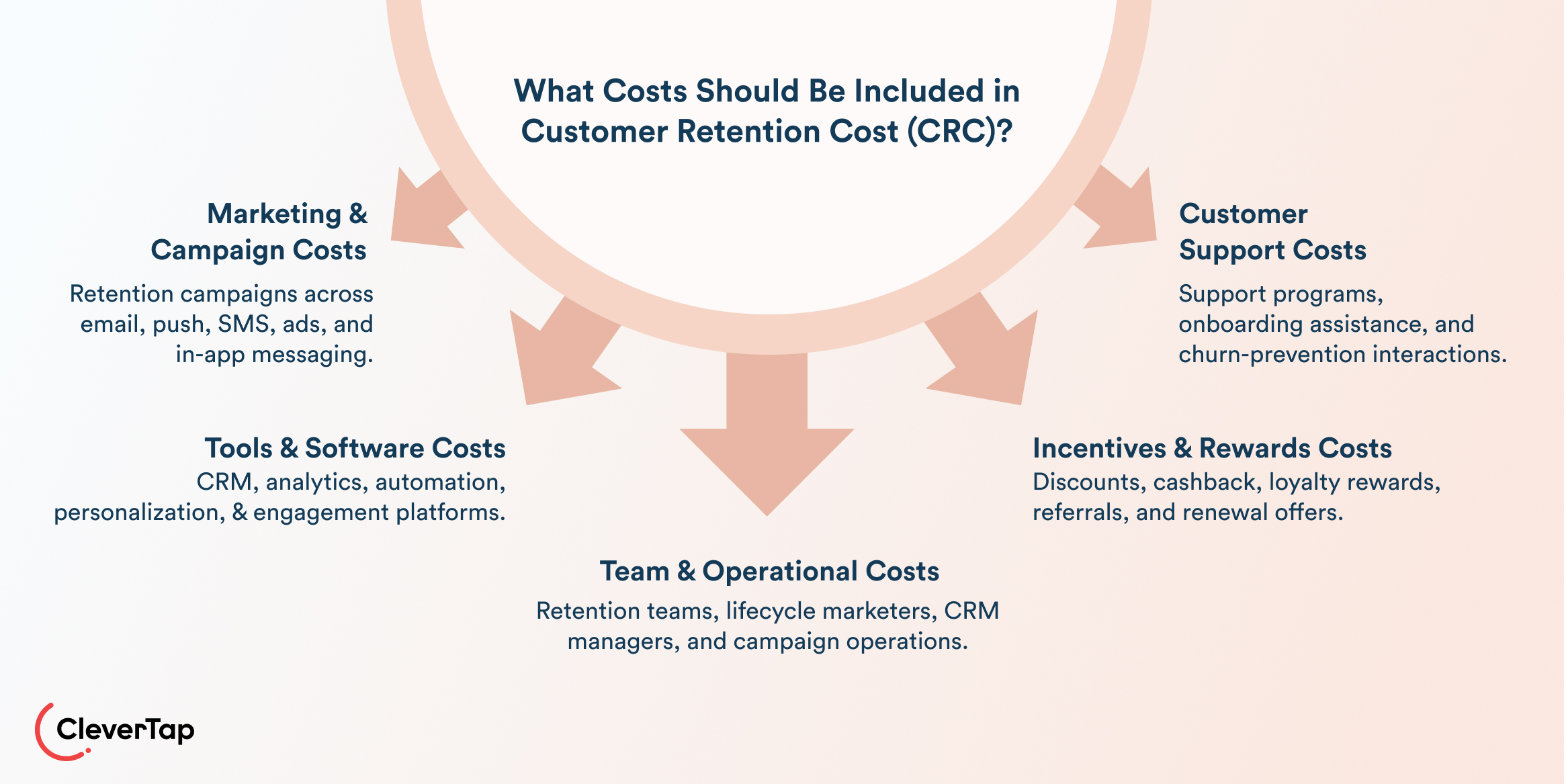
Customer retention cost includes every major expense directly associated with keeping existing customers engaged, active, and purchasing over time. Retention efforts often span multiple teams, tools, and channels. So, businesses need a consistent way to categorize these costs accurately.
Retention Campaign Costs
This includes spending on retention-focused marketing campaigns across channels such as email, push notifications, SMS, in-app messaging, retargeting campaigns, and win-back campaigns. These campaigns are designed to reduce churn, improve repeat purchases, and maintain long-term engagement.
Well, campaign costs can increase significantly as businesses scale retention efforts across multiple lifecycle stages. High-frequency messaging, re-engagement workflows, and personalized retention campaigns often require both media spend and operational resources. This makes them an important part of CRC calculations.
Retention Software and Tools
Businesses also invest in platforms that support retention efforts. This includes CRM systems, customer engagement platforms, analytics tools, personalization engines, and lifecycle automation software. These tools help teams execute campaigns, segment audiences, analyze retention trends, and automate customer journeys.
For many businesses, retention software becomes a recurring operational expense. As retention programs become more sophisticated, platform costs often increase alongside customer volume, messaging activity, and data requirements.
Team and Operational Costs
Retention efforts frequently involve lifecycle marketers, CRM managers, customer success teams, campaign operations specialists, and support teams responsible for improving long-term engagement. Salaries, operational overhead, and campaign management costs associated with these functions may contribute to CRC calculations.
In some businesses, retention operations become highly resource-intensive, especially when campaigns require continuous optimization, manual segmentation, or high-touch customer management. Ignoring these operational costs can lead to an incomplete view of actual retention spending.
Incentives and Loyalty Costs
Discounts, cashback offers, loyalty rewards, referral incentives, and promotional credits can significantly increase retention spending over time. These incentives are commonly used to encourage repeat purchases, reduce churn risk, and strengthen long-term customer relationships.
While incentive-driven retention programs may improve short-term engagement, excessive reliance on discounts or rewards can increase CRC quickly and reduce profitability margins. Businesses must evaluate whether retention gains justify the long-term cost of these programs.
Customer Support Costs
Retention-focused support interactions, onboarding assistance, escalation handling, and proactive customer outreach may also contribute to customer retention costs, particularly in subscription and service-based businesses. Strong customer support often plays an important role in reducing churn and improving customer satisfaction.
For high-value customers or complex products, retention support can become a meaningful operational investment. Businesses that offer personalized onboarding, account management, or proactive retention outreach should account for these costs when evaluating overall retention efficiency.
What Is Considered a Good Customer Retention Cost?
There is no universal benchmark for a “good” Customer Retention Cost because retention economics vary significantly across industries, business models, customer value, and purchase behavior.
In most cases, a healthy CRC depends on how much long-term value the retained customers generate. A higher retention cost may still be financially sustainable if customers have strong lifetime value, high repeat purchase frequency, or long subscription cycles. On the other hand, even a relatively low CRC can become inefficient if retained customers generate limited revenue or churn quickly.
Businesses should also evaluate CRC differently depending on their business model. For example, subscription businesses may tolerate higher retention costs because customers generate recurring long-term revenue. Whereas, e-commerce brands with shorter purchase cycles or lower margins may require tighter retention efficiency to maintain profitability.
Instead of focusing only on lowering retention cost, businesses should evaluate whether retention spending is generating sustainable long-term value. A good CRC is one that supports profitability while maintaining healthy customer retention and engagement over time.
How to Make Customer Retention Cost More Sustainable
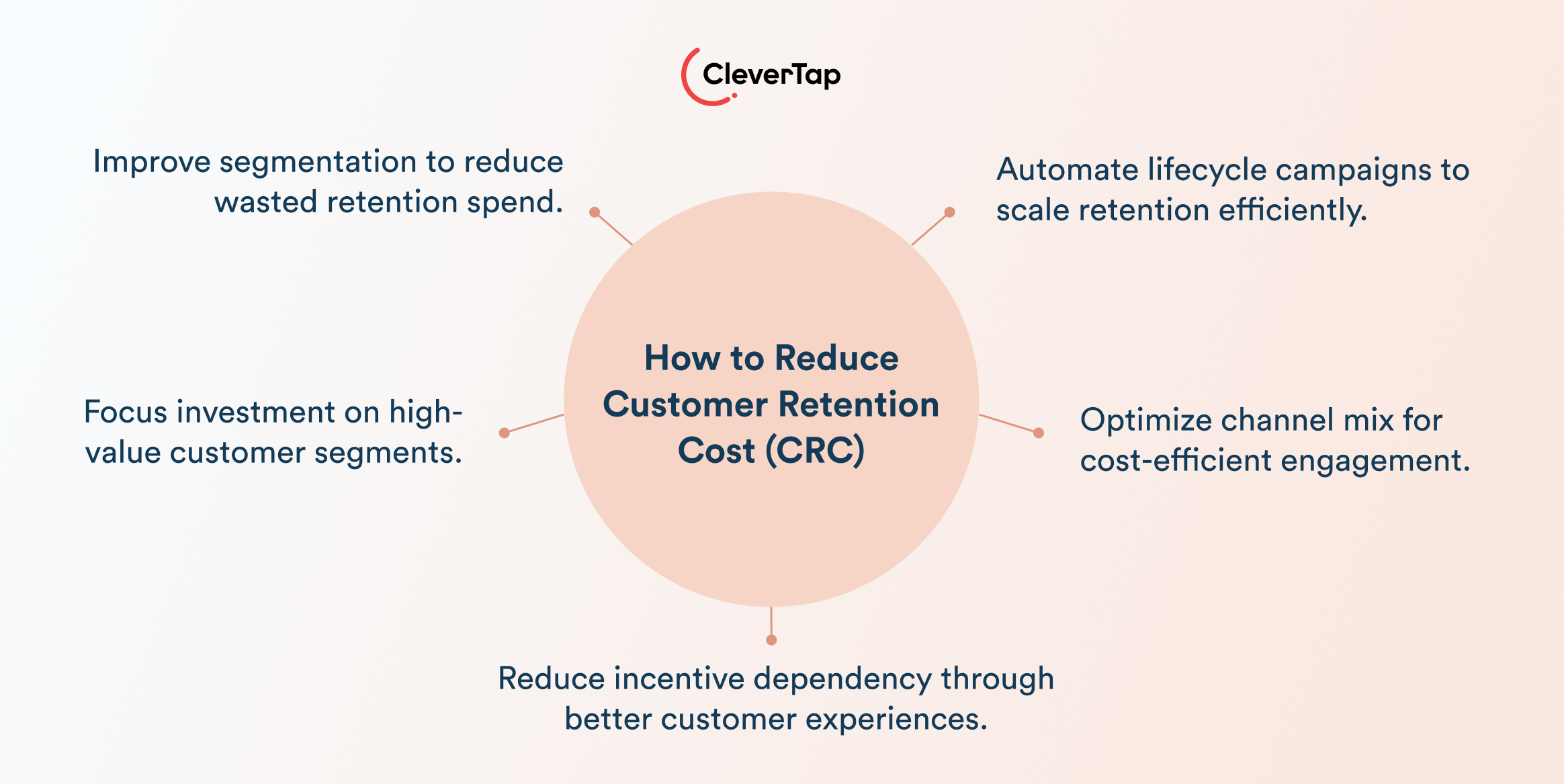
Improving Customer Retention Cost does not simply mean reducing retention spending. The goal is to build a retention strategy that remains financially sustainable while continuing to deliver long-term customer value and engagement.
Improve Retention Segmentation
Broad retention campaigns often increase messaging costs without improving meaningful retention outcomes. Segmenting customers based on behavior, lifecycle stage, churn risk, or customer value helps businesses focus retention efforts more efficiently and allocate budgets more strategically.
Identify Retention Efforts With Low Long-Term Value
Not every retention campaign contributes equally to long-term profitability. High-frequency messaging, repetitive win-back campaigns, or aggressive discounting strategies may increase operational costs without generating sustainable retention value.
Businesses can identify which campaigns improve long-term customer engagement and which simply increase retention spending if they regularly analyze retention performance.
Automate Lifecycle Journeys
Manual retention operations can become expensive as customer volume grows. Lifecycle automation helps businesses scale onboarding, engagement, and reactivation efforts more efficiently while reducing operational overhead.
Automated journeys also improve consistency by delivering more timely and behavior-driven customer communication across the customer lifecycle.
Balance Incentives With Long-Term Customer Value
Discounts, cashback offers, and rewards programs can improve short-term retention. However, excessive reliance on incentives often increases retention costs over time and reduces profitability margins.
Businesses should focus on improving customer experience, personalization, and engagement quality rather than depending heavily on incentives to maintain long-term customer relationships.
How CleverTap Helps Businesses Track and Optimize Customer Retention Cost
CleverTap is an all-in-one customer engagement and retention platform that helps businesses improve retention efficiency through real-time analytics, behavioral segmentation, lifecycle automation, and AI-powered engagement optimization. Instead of relying on broad retention campaigns and reactive engagement strategies, businesses can use CleverTap to deliver more personalized, timely, and cost-efficient customer experiences across the lifecycle.
Real-Time Behavioral Segmentation
More precise audience targeting helps businesses avoid unnecessary retention spending and improve campaign efficiency. CleverTap’s live user segmentation capabilities allow teams to group users dynamically based on behavior, activity patterns, purchase frequency, churn risk, lifecycle stage, and customer value. This makes it easier to run more targeted retention campaigns instead of relying on broad messaging across the entire user base.
Cohort Analysis and Retention Analytics
Retention performance often varies significantly across acquisition sources, onboarding experiences, campaigns, and customer segments. Using cohort analysis, retention dashboards, funnels, and behavioral analytics, businesses can identify which retention strategies generate sustainable long-term value and which increase retention costs without meaningful retention impact.
AI-Powered Churn Prediction With CleverAI™
Identifying churn risk early is critical for keeping retention spending sustainable. CleverAI™ Predictions helps businesses detect users who are likely to disengage before inactivity occurs. This allows teams to intervene proactively with more personalized retention campaigns instead of relying heavily on expensive win-back efforts later.
Journeys for Lifecycle Automation
CleverTap Journeys enables businesses to automate onboarding, engagement, retention, and reactivation workflows across the customer lifecycle. Campaigns can be triggered automatically based on real-time customer behavior, inactivity signals, conversion actions, or engagement patterns. It helps reduce manual operational overhead while improving retention consistency.
Send Time Optimization and Omnichannel Engagement
Delivering messages at the wrong time or through ineffective channels can increase retention costs without improving engagement. CleverAI™ Send Time Optimization helps businesses identify when individual users are most likely to engage. CleverTap’s omnichannel engagement platform support coordinated retention campaigns across push notifications, email, SMS, in-app messaging, App Inbox, web push, and WhatsApp.
Personalization and Recommendation Capabilities
CleverTap’s personalization and product recommendations capabilities help businesses deliver more relevant products, offers, content, and engagement experiences based on real-time and historical customer behavior. More relevant engagement improves retention quality while reducing dependency on excessive incentives and blanket retention campaigns.
Frequency Control and Smarter Engagement Management
Over-messaging users across channels can increase engagement fatigue and reduce retention efficiency over time. Features like frequency capping and intelligent campaign controls help businesses manage communication volume more effectively while improving customer experience and long-term engagement quality.
By combining real-time analytics, AI-powered optimization, lifecycle automation, and omnichannel engagement in a single platform, CleverTap helps businesses build more efficient and sustainable customer retention strategies over time.
Build more sustainable customer retention strategies with AI-powered engagement and retention analytics from CleverTap.
The Real Cost of Retaining Customers
Customer retention can drive stronger profitability, higher customer lifetime value, and sustainable long-term growth. But retaining customers also requires continuous investment across campaigns, engagement tools, loyalty programs, lifecycle automation, and retention operations.
Customer Retention Cost helps businesses evaluate whether those retention efforts are financially sustainable over time. When analyzed alongside metrics like customer lifetime value and profitability, CRC provides a clearer view of retention efficiency and long-term retention performance.
Improving retention efficiency requires better visibility into customer behavior, engagement performance, and lifecycle trends. CleverTap helps businesses build more sustainable and data-driven retention strategies through real-time analytics, behavioral segmentation, lifecycle automation, and AI-powered engagement optimization. Schedule a demo to see how CleverTap can help your business improve retention efficiency and build more sustainable long-term customer engagement.

Agnishwar Banerjee 
Leads content and digital marketing.Expert in SaaS sales, marketing and GTM strategies.
Free Customer Engagement Guides
Join our newsletter for actionable tips and proven strategies to grow your business and engage your customers.