









































Table of Contents
Categories
Most Popular


Savvy marketers increasingly rely on predictive approaches to gain an edge in a data-driven market. With fragmented customer journeys, shorter attention spans, and more data than teams can manually process in time, predictive methods help marketers act faster by identifying patterns early and focusing effort where outcomes are most likely.
Instead of guessing or reacting after the fact, teams now ask a more practical question: who is most likely to take a specific action, and when?
Propensity modeling brings this probability-driven thinking into everyday marketing. It uses past behavior and customer signals to assign each user a likelihood score for actions such as purchasing, engaging, or churning. These scores help marketers prioritize audiences, personalize messages, and reduce wasted outreach.
This guide explains how marketers can use propensity modeling to personalize, prioritize, and optimize engagement across the customer lifecycle.
What Is Propensity Modeling?
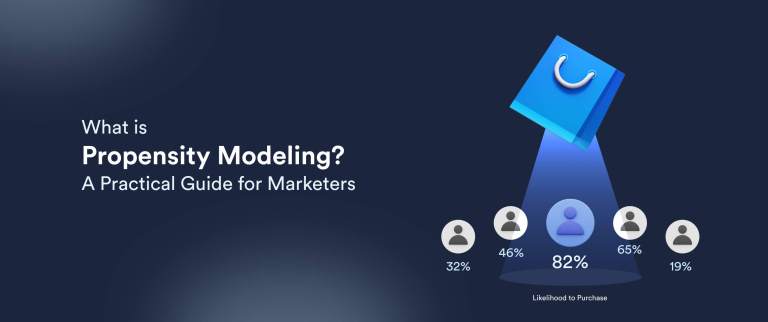
Propensity modeling is simply the practice of predicting the probability that a customer will take a desired action. In plain marketing terms, it means analyzing a person’s past behavior and available customer attributes to estimate how likely they are to do something in the future, like making a purchase, clicking a link, or churning.
Rather than a binary yes or no guess, each user gets a score, often between 0 and 1, that represents their likelihood of the target outcome. For example, someone who has frequently interacted with a product page might have a high purchase-propensity score, while someone whose engagement is dropping might have a high churn-propensity score.
How do the models work at a high level?
Without going into mathematical details, let’s try to understand how these models work. They combine many signals, such as past purchases, frequency of visits, email responses, demographics, and more, and find patterns.
Machine learning finds which factors are associated with the outcome of interest. Over time, the model learns from real outcomes and refines its rules. The end result is that marketers can attach a propensity score to each customer. A score closer to 1 indicates a high likelihood of the action, and a score closer to 0 means low likelihood.
In this way, propensity modeling gives a probability-based prediction, not a guarantee. It tells you who is most likely to act, so you can focus your efforts on them.
Why Propensity Modeling Matters for Modern Marketing
Modern marketing no longer focuses on reaching the largest possible audience. The focus has now shifted to reaching the right audience with the right message at the right time.
Propensity modeling enables this shift by helping marketers move from reactive, broad-based campaigns to probability-driven decision-making. Instead of treating all users equally, teams can prioritize effort based on who is most likely to act.
Here’s why that matters for modern marketing:
- Improves prioritization across audiences: Propensity scores help marketers rank customers by likelihood to convert, churn, engage, or upgrade. This allows teams to focus budget, offers, and sales attention on high-propensity users first, rather than spreading effort evenly across the entire database.
- Enables deeper, more relevant personalization: Knowing who is likely to act enables how you personalize. High-propensity users can receive stronger CTAs, premium offers, or urgency-based messaging, while mid- or low-propensity users can be nurtured with educational or lighter-touch communication.
- Reduces wasted impressions and campaign fatigue: By suppressing or deprioritizing users with low likelihood to respond, marketers avoid unnecessary spend, reduce message fatigue, and prevent over-communication. This replaces a spray-and-pray outreach with intentional targeting.
- Drives impact across the entire customer lifecycle: Propensity modeling supports smarter acquisition of high-intent leads, stronger conversion based on purchase likelihood, proactive retention, and revenue expansion by banking on upsell or cross-sell potential.
- Maximizes ROI through probability-driven decisions: By aligning campaigns with likelihood instead of assumptions, marketers improve efficiency, lift performance, and deliver better customer experiences while lowering overall costs.
Common Types of Propensity Models
Common types of propensity modeling are typically defined by the specific customer action they predict.
For example, marketers often build propensity models to estimate purchase, churn, engagement, and upsell or cross-sell propensities. Each of these scores a customer on their likelihood to buy, leave, engage, or buy additional products, respectively.
1. Purchase Propensity
A purchase-propensity model predicts how likely each customer is to make a purchase. These models focus on spending behavior and use signals like past purchase frequency, recency, which includes how long since their last order, and average order value.
For example, a fashion retailer launching a new seasonal collection might use purchase propensity to find customers who regularly buy similar items. These high-scoring customers can then be sent targeted promotions, such as new collection offers or early access to a sale, to encourage them to return.
By prioritizing audiences with high purchase scores, marketers run conversion campaigns more effectively and improve ROI. They avoid wasting discounts on unlikely buyers and instead invest in customers with proven interest. Over time, this builds loyalty as customers who frequently respond to relevant offers become repeat buyers.
Purchase-propensity scoring helps turn one-off buyers into long-term customers by delivering the right incentives to the right people. This data-driven approach is especially valuable in e-commerce, where even small improvements in conversion can significantly boost revenue.
2. Churn Propensity
A churn-propensity model predicts which customers are most likely to stop using your product or service. These models look for warning signs of churn, such as declining purchase frequency, longer gaps between visits, or reduced engagement levels.
A subscription service might score a user highly if they haven’t made a purchase or logged in for weeks. Such high-risk customers can then be targeted with proactive retention campaigns that may include personalized offers, special content, or win-back emails to encourage them to stay subscribed.
By acting on these scores, marketers can often save customers who would have quietly churned. Churn-propensity scoring turns attrition from a surprise into something marketers can anticipate and prevent. The payoff is significant as acquiring new customers is 5 to 25 times more expensive than retaining existing ones, so even small retention gains can greatly boost revenue and profitability.
3. Engagement Propensity
Engagement-propensity models score how likely customers are to interact with your marketing. They analyze behavioral signals like email open rates, click-through rates, social shares or likes, and page views. The goal of engagement propensity modeling is to understand which users are most likely to engage with each channel in order to tailor messaging and channel mix.
For example, marketers can send more emails to contacts with high email-engagement scores or focus push notifications on highly active app users. By concentrating on high-engagement customers, marketers make campaigns more efficient and avoid overloading uninterested users.
Campaigns built around engaged audiences tend to perform better because they’re aligned with real customer interest, not assumptions. When marketers prioritize users who consistently open, click, browse, or return to the product, messages feel more relevant and timely, which naturally improves response rates. At the same time, reducing outreach to consistently inactive users helps minimize fatigue and keeps opt-outs under control.
4. Upsell and Cross-Sell Propensity
Upsell and cross-sell propensity models predict which existing customers are likely to purchase additional products or upgrades. They analyze past purchases and usage patterns to identify upsell or cross-sell opportunities.
If data shows that owners of a basic smartphone often upgrade to a premium model, those users will have high upsell propensity scores. The company can then market an upgrade bundle, with a trade-in offer. Likewise, cross-sell models might find that a customer who bought a camera is likely to buy a tripod or insurance next.
These scores integrate with recommendation engines and campaigns. Only customers with high scores see targeted suggestions, while others won’t be spammed. Doing this increases average order value by focusing on deals each customer is likely to accept, making recommendations relevant and timely. It also improves the customer experience by helping shoppers find products aligned with their needs, boosting satisfaction and revenue simultaneously.
Propensity Modeling vs Traditional Segmentation
Traditional customer segmentation groups them into fixed buckets based on shared traits, like demographics, location, lifecycle stage, or RFM scores. It’s useful for creating structured audience groups, but it doesn’t tell you who within that segment is most likely to act right now.
Propensity modeling, on the other hand, assigns each customer a probability score that predicts the likelihood of a specific outcome, such as purchase, churn, engagement, or upsell. Instead of saying “this group is valuable,” a propensity score helps you identify which individuals inside the group are most likely to convert.
The table below sheds more light on the propensity modeling vs traditional segmentation discussion.
| Aspect | Traditional Segmentation | Propensity Modeling |
| Output | Static segments (groups) | Probability scores (individuals) |
| Logic | “If user matches criteria, include” | “User is X% likely to act” |
| Targeting style | Rules-based targeting | Predictive prioritization |
| Best for | Audience structure and messaging themes | Ranking and timing decisions |
| Changes over time | Changes only when rules change | Updates as behavior shifts |
Marketers often use both together. Segmentation sets the context by tagging “new users,” “repeat buyers,” or “high-value customers.” Then propensity scores add precision by telling you whom to prioritize, whom to suppress, and what to trigger first.
For example, instead of messaging every repeat buyer, you can focus first on users within the repeat buyer segment who have the highest purchase propensity. Similarly, you can exclude customers with high churn risk from upsell campaigns and move them into retention journeys instead.
How Marketers Use Propensity Modeling in Practice
Marketers apply propensity scores in many practical ways, as discussed in the pointers below.:
- Prioritize and suppress audiences: Contacts with high propensity for the target action are placed at the top of campaign lists, while low-scoring users may be excluded from certain campaigns. A retailer might send a flash-sale alert only to users with top purchase-propensity scores, avoiding spam to uninterested people. This focus on high-propensity audiences boosts ROI, since marketing spend goes to those most likely to respond.
- Personalize content deeply: A high propensity score can be set to trigger specific content. A user flagged as very likely to buy might automatically receive premium product recommendations or an exclusive discount. A moderate-propensity user might get more informational or soft-sell content. In this way, propensity models help decide which offer or creative variant to deliver, making each message more relevant to the recipient.
- Optimize timing and channel: Predictive models can surface the best time and channel to reach each user. Data might show that a high-propensity customer usually opens messages on mobile after dinner time. Marketers can then schedule a push notification to hit that customer at 7 pm. This approach ensures every outreach is intentional rather than random.
- Trigger churn-prevention journeys proactively: Propensity modeling can also flag customers who are likely to drop off or disengage. Marketers can use churn propensity scores to automatically activate retention workflows, such as reminders, loyalty nudges, support outreach, or win-back offers, before the customer actually churns.
- Support lead scoring and sales prioritization: For pipeline-focused teams, propensity scores can act as an advanced form of lead scoring by highlighting which leads are most likely to convert into paying customers. This helps marketing and sales teams align follow-ups, reduce wasted outreach, and close deals faster by focusing effort on the most conversion-ready leads.
Best Practices for Using Propensity Modeling in Marketing
Propensity scores are powerful, but they deliver the best results when used with the right mindset and guardrails. With that in mind, here are a few best practices to follow:
- Prioritize, don’t overrule: Use propensity scores to prioritize outreach within defined segments, rather than discarding segmentation altogether. Propensity should refine whom to contact first, not become the only rule. You can still segment by product interest, then rank within that segment by score.
- Combine signals thoughtfully: Propensity scores work best when used alongside other customer contexts. Always consider recent behavior and lifecycle stages. For instance, don’t send a buy now offer to someone who already purchased yesterday, even if their score is high.
- Keep models fresh: Retrain or update propensity models regularly; the cadence can be monthly or quarterly, so they adapt to changing trends. A static model loses accuracy as customer preferences evolve and new offers are introduced.
- Avoid one-size personalization: Treat propensity as a guide, not a command. Instead of assuming everyone with a score >90 will buy, use score ranges, like 90–100, 70–90, etc., to decide message intensity. This avoids over-targeting and makes personalization feel more natural.
- Tie to clear goals: Use propensity-driven targeting only when it aligns with measurable business objectives, like lift in conversions or churn reduction. Clearly define which outcome you’re predicting and how you’ll measure success, so that targeting remains purposeful and tied to real ROI.
Common Propensity Modeling Use Cases for Marketers
Marketers have found many ways to leverage propensity scores. Here are some use cases:
- Focus conversion campaigns: Use purchase propensity to prioritize high-intent users. Those with top scores get conversion offers first, which boosts overall sales.
- Trigger retention journeys: Use churn propensity to spot at-risk customers. When scores indicate a customer is likely to churn, automatically put them into win-back or loyalty flows, such as sending a special discount or personalized re-engagement message. Preventing just a few cancellations can protect substantial revenue.
- Personalize recommendations: Leverage upsell/cross-sell propensity to make relevant product suggestions. For instance, if a shopper has a high propensity to upgrade to a premium model, present them with an upgrade bundle. If they’re likely to buy accessories, add those to their email or cart. This tailors offers to each customer’s needs or interests.
- Optimize timing and channel: Apply engagement propensity to decide when and where to reach out. Customers with high engagement scores might get more frequent messages on their preferred channels, e.g., app push notifications, while others get fewer touches. This ensures messages hit when people are most likely to respond.
- Suppress low-propensity contacts: Marketers often exclude very low-scoring users to reduce fatigue and wasted impressions. If a user has near-zero propensity, it may make sense to pause messaging to them until their behavior changes. This respects the customer and avoids burning budget on uninterested audiences.
How CleverTap Enables Propensity-Based Engagement
CleverTap helps marketers operationalize propensity modeling by embedding predictive insights directly into segmentation and lifecycle journeys. Instead of treating propensity as a standalone analytics output, CleverTap makes it actionable within everyday campaign workflows, guiding who to target, when to engage, and how to personalize messaging.
Built-in predictive models for core marketing outcomes
CleverTap provides built-in propensity models focused on key outcomes such as purchase likelihood and churn risk. These models analyze historical user behavior along with recent engagement patterns to estimate the probability of specific actions.
Rather than requiring marketers to interpret raw probability scores, CleverTap organizes users into intent-based groups such as high, medium, or low likelihood. This allows teams to act on predictions quickly without managing thresholds or model logic. As customer behavior changes over time, users can move between intent groups based on updated behavioral signals.
Behavior-led data foundation
Propensity predictions in CleverTap are grounded in real user behavior across the lifecycle, including app launches, page views, clicks, conversions, campaign interactions, and transaction history.
Because predictions are based on observed actions rather than static attributes alone, they reflect actual customer intent. As new behavioral data is captured, propensity insights can reflect meaningful shifts in engagement over time, supporting use cases like conversion optimization, churn prevention, and lifecycle engagement.
Activating propensity through segmentation
CleverTap allows marketers to directly use propensity-based intent groups within audience segmentation. Teams can create segments such as users with high purchase likelihood or users at risk of churn and combine them with filters like lifecycle stage, geography, device type, or product interest.
This approach maintains a structured audience strategy while adding predictive prioritization. Instead of targeting all repeat buyers, marketers can focus on repeat buyers with high purchase propensity. Low-propensity users can also be deprioritized or excluded to reduce message fatigue and unnecessary outreach.
Using propensity in lifecycle journeys
CleverTap enables marketers to incorporate propensity-based segments into automated customer journeys, allowing journeys to be designed around likelihood-driven decision points rather than static rules alone.
For example, retention journeys can target users whose churn risk increases, delivering reminders or loyalty incentives. If engagement improves, journeys can be designed to move users to different paths or conclude based on updated segment membership. Conversion journeys can similarly prioritize users whose purchase propensity rises, triggering stronger calls to action when intent is higher.
Prioritizing engagement across channels
Propensity insights in CleverTap can be used to prioritize audiences across channels such as push notifications, email, in-app messages, and SMS.
High-propensity users can be targeted first during time-sensitive campaigns, while medium-propensity users receive lighter-touch messaging. Very low-propensity users can be excluded until their behavior changes. This helps balance reach with relevance and reduces over-communication.
Faster execution without data science overhead
CleverTap enables marketers to apply propensity-driven strategies without building predictive models or relying on in-house data science teams. Predictive insights are available directly within the platform and can be applied using familiar tools like segmentation builders and journey orchestration.
This shortens the path from insight to action and allows teams to test and optimize engagement strategies based on customer intent, without added technical complexity.
Try CleverTap to turn customer insights into consistent, high-impact engagement.
Win With Predictive Targeting
Propensity modeling adds a probabilistic decision-making layer to marketing. Instead of guessing who will convert or churn, teams can anticipate behavior and tailor tactics accordingly. Ultimately, it’s about delivering the right message to the right person at the right time.
The brands that integrate predictive insights into their engagement strategies will proactively reach customers instead of reacting. By embracing propensity-based, behavior-led marketing, companies can increase engagement and conversions by aligning outreach with true customer intent.
Try CleverTap to power behavior-led predictions and personalize journeys at scale. Schedule a demo today!

Jacob Joseph 
Heads Data Science.Expert in AI, Data & Analytics and awarded 40 under 40 Data Scientists in India.
Free Customer Engagement Guides
Join our newsletter for actionable tips and proven strategies to grow your business and engage your customers.