


































Table of Contents
Categories
Most Popular


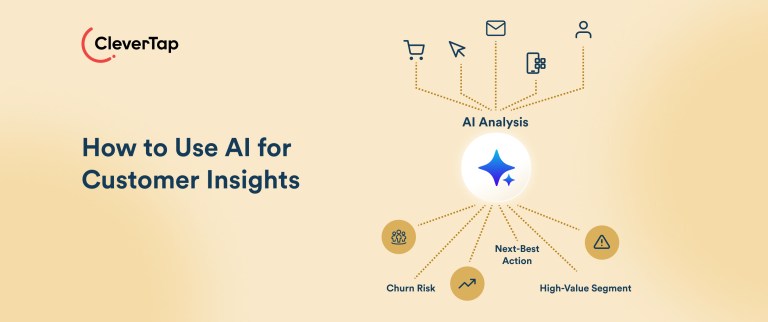
Artificial intelligence is changing how marketers understand and act on customer behavior. Instead of relying only on past reports, teams can now use AI to identify patterns, predict what users are likely to do next, and respond with more relevant campaigns.
For retention and personalization, that shift matters. AI-powered customer insights help marketers detect churn risk earlier, identify high-value segments faster, and tailor messaging with greater precision. McKinsey reports that companies investing in AI are seeing revenue uplift of 3–15% and sales ROI uplift of 10–20%.
What Are AI-Powered Customer Insights?
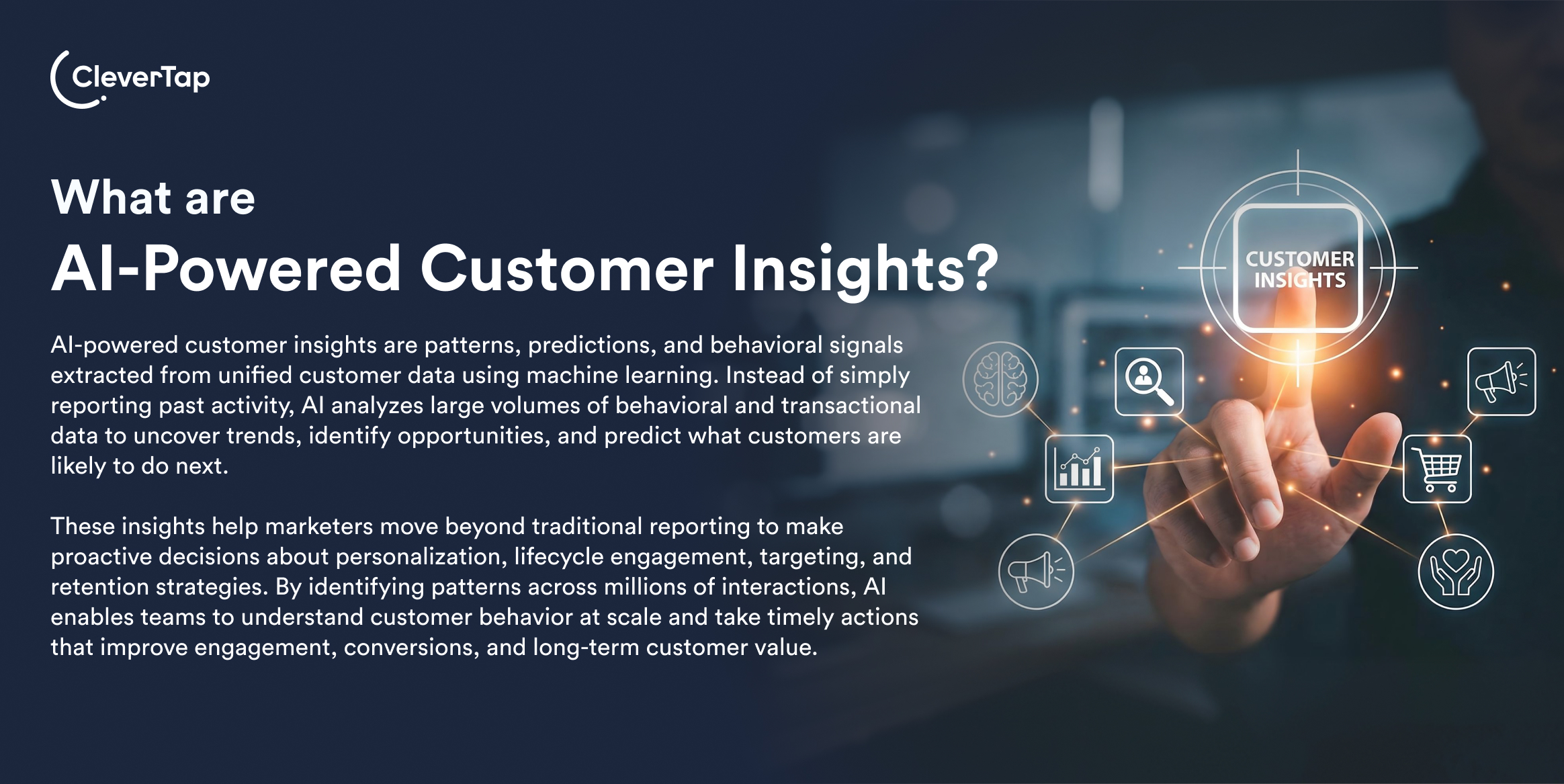
AI-powered customer insights are patterns, predictions, and behavioral signals extracted from unified customer data using machine learning. Rather than simply summarizing what users did in the past, AI helps marketers understand what users are likely to do next.
To understand how these insights differ from traditional reporting, it’s helpful to break down the types of analytics:
- Descriptive analytics explains what happened. For example, “30% of users dropped off after signup.”
- Predictive analytics anticipates what will happen next, such as which users are likely to churn.
- Prescriptive intelligence recommends what to do about it, like triggering a win-back campaign based on churn risk.
AI moves marketers from reacting to past behavior to proactively influencing future outcomes. These insights can inform everything from personalized messaging to lifecycle strategy and retention forecasting.
A common misconception is that AI replaces the marketer. In reality, AI enhances human decision-making by spotting trends, micro-segments, and opportunities at scale and more accurately than manual analysis.
The marketer remains in control, using AI-powered customer insights as a strategic layer to drive better targeting, timing, and impact across campaigns.
Why AI for Customer Insights Matters for Marketing Performance
AI-powered customer insights directly improve marketing performance by driving precision, speed, and scale across the customer lifecycle. Here’s how:
- Earlier churn intervention: AI identifies early signals of disengagement, like session frequency drops or feature abandonment, so marketers can act before churn occurs. This proactive approach helps retain users who would otherwise slip away unnoticed.
- Better targeting precision: It analyzes vast behavioral data to uncover high-intent, high-value segments. Instead of blanket campaigns, marketers can target users based on predicted outcomes like conversion likelihood or lifetime value.
- More effective personalization: AI tailors content, product recommendations, and offers to each user in real time. Whether through push, email, or in-app, the experience feels uniquely relevant, boosting engagement and brand affinity.
- Higher conversion rates: Predictive models guide next-best actions, such as what message to send, when, and on which channel, leading to better click-throughs, responses, and conversions across campaigns.
- More efficient retention spend: Budgets go further by focusing on high-propensity users. AI ensures incentives and outreach are used strategically, not wasted on low-impact segments.
- Stronger lifecycle outcomes: With improved targeting and personalization, customers stay longer, buy more, and engage more frequently, driving lifetime value and long-term loyalty.
How AI Generates Actionable Customer Insights
AI-powered customer insights are only as strong as the data they’re built on. From raw events to real-time predictions, here’s how AI transforms complex behavior into clear marketing action.
1. Data Collection and Unification
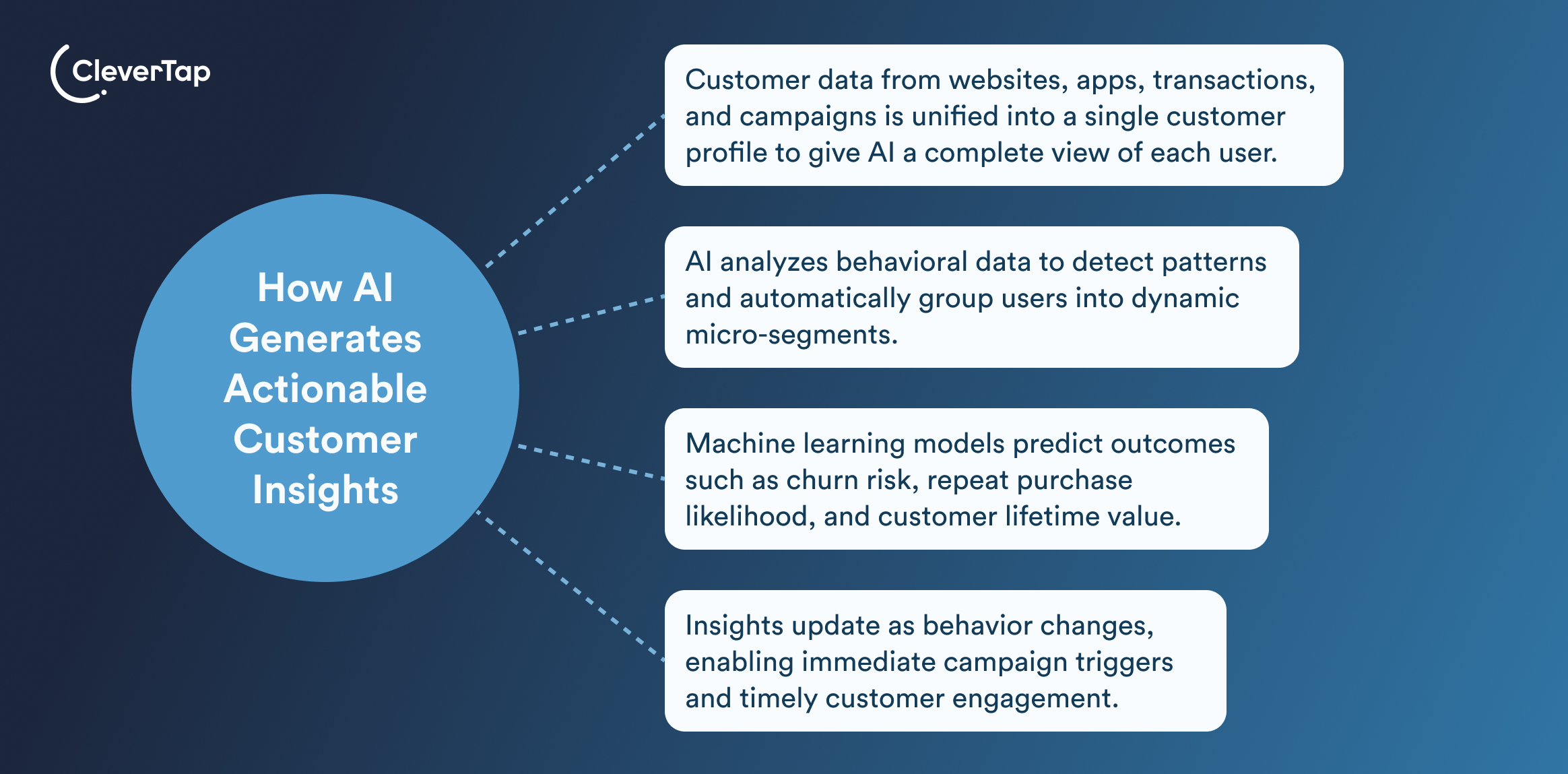
The first step is gathering data from every customer touchpoint, be it website visits, app interactions, transactions, email clicks, support tickets, and more. These events are unified into a single customer profile, giving AI complete visibility into each user’s journey. Without this holistic view, insights remain fragmented and incomplete. Platforms like CleverTap automatically stitch this data together, setting the foundation for meaningful analysis.
2. Pattern Recognition and Behavioral Clustering
Once data is unified, AI detects behavioral patterns and performs affinity grouping to cluster users into micro-segments. For example, one group might exhibit frequent purchases in short timeframes, while another only browses during sales events. These affinity-based clusters help marketers target users based on actual behavior, not just demographics. This segmentation evolves automatically as behaviors change, giving teams dynamic targeting capabilities without manual effort.
3. Predictive Modeling
AI then applies predictive models to score and forecast user behavior. These models estimate churn probability, repeat purchase likelihood, and customer lifetime value (CLV). A user might receive a 70% churn risk score, signaling an urgent need for re-engagement. These scores feed directly into audience segmentation and campaign logic, helping marketers prioritize their outreach.
4. Real-Time vs Batch Insights
Traditional batch insights are generated periodically, often daily or weekly, creating lags in decision-making. In contrast, real-time AI updates scores and segments the moment behavior changes. For example, if a user stops interacting, a churn prediction can instantly trigger a personalized push notification. This immediacy is critical for marketers who want to engage users when intent is highest or risk is emerging. Real-time insights ensure your messaging always keeps pace with customer behavior.
High-Impact Marketing Use Cases of AI for Customer Insights
Mentioned below are some impactful marketing use cases of AI that can help marketers with customer insights.
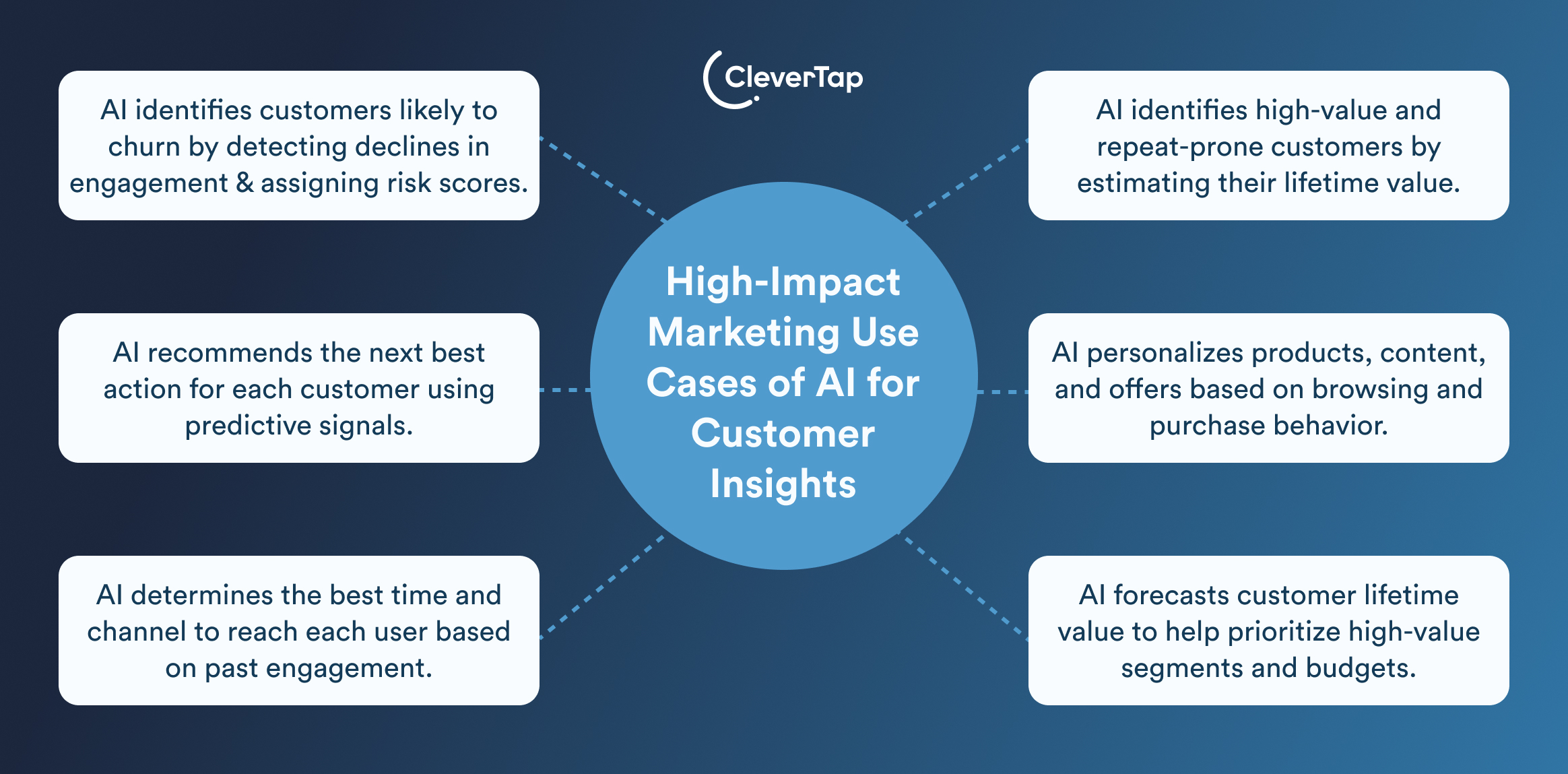
1. Predicting Customer Churn Before It Happens
AI can forecast which customers are about to leave. By spotting declines in usage or engagement, the system assigns each user a churn probability. When a customer’s risk is high, the marketing platform can auto-trigger a retention action like a targeted offer or reminder to re-engage them.
For example, streaming platforms like Netflix use behavioral signals such as watch frequency and incomplete shows to predict churn risk. If engagement drops, users are nudged with personalized recommendations or notifications.
2. Identifying High-Value and Repeat-Prone Customers
AI for customer insights highlights the most valuable segments. Models analyze past purchases and engagement to estimate each customer’s lifetime value (CLV). This lets marketers identify their highest-spending, most loyal users early.
Predictive CLV lets businesses identify high-value and at-risk customers early, enabling targeted retention and growth strategies. These users can then receive special loyalty perks or tailored product recommendations to maximize their value.
3. Next Best Action Recommendations
Marketing platforms using AI can recommend the single best next action for each customer. Many platforms implement a “next best action” engine that uses predictive scores and context to pick the highest-impact message.
For example, if the model predicts Customer A has a high likelihood of buying product X, it might automatically serve an X-related upsell offer. This automated decisioning means each customer gets the message or offer they’re most likely to respond to, maximizing conversion.
4. Dynamic Product and Content Personalization
AI drives personalization by tailoring content to each individual. Based on browsing and purchase history, models automatically recommend relevant products, articles or offers. For instance, instead of sending the same email to all users, the system might show each person different product suggestions they are predicted to like using dynamic content.
5. AI-Driven Send-Time and Channel Optimization
By analyzing past engagement, AI learns when each user is most active. For example, send-time optimization tools determine each user’s peak hour. Then the campaign automatically hits inboxes at those moments. This data-driven timing yields much higher open and engagement rates, since messages arrive exactly when users are most receptive rather than at random.
6. Forecasting Customer Lifetime Value
Predictive analytics can estimate how much each customer will spend over time. By crunching historical purchases and engagement, AI assigns a projected CLV to every user. With this insight, marketers can focus budgets on high-value segments: for example, paying more to acquire or retain customers who will deliver the most revenue. This shifts the strategy from short-term sales to maximizing customer lifetime profitability.
Leading vs. Lagging Indicators in AI-Driven Marketing
In marketing analytics, lagging indicators reflect what has already occurred. They’re useful for historical reporting but offer limited value when trying to influence future outcomes. Common examples include:
- Past purchases: These reveal historical buying behavior but don’t show whether a customer is still engaged or likely to return.
- Historical churn rates: These help quantify how many users have left over time, but can’t identify who’s about to churn now.
Relying solely on lagging indicators keeps marketing teams reactive. By the time churn or drop-offs are reported, the damage is already done.
That is why most teams are now increasingly relying on leading indicators. These are early behavioral signals that hint at what a customer may do next. Examples include:
- Engagement decay: Gradual reduction in time spent or feature usage.
- Session frequency changes: Longer gaps between logins or interactions.
- Category exploration patterns: Shifting interest across product categories.
- Time-between-actions: Delays between meaningful actions like browse-to-cart or cart-to-purchase.
AI is uniquely capable of analyzing these signals at scale and in real time. It observes patterns and interprets them, flags risk or opportunity, and enables proactive campaigns, like retention journeys, before issues escalate. This predictive power helps prevent revenue loss and keeps engagement high.
Read in detail: What are Leading vs. Lagging Indicators? Explained With Examples
How AI Improves Segmentation and Personalization at Scale
AI transforms how marketers segment and personalize by enabling real-time intelligence and automation. Here’s how it works across four key capabilities:
- Dynamic Segmentation: AI automatically updates customer segments based on live behavior. As users engage with new products or channels, they’re instantly reclassified, ensuring campaigns always reflect the latest context.
- Micro-Cohorts: Instead of broad audience buckets, AI identifies narrow behavioral groups, such as frequent weekend shoppers and users who explore but don’t convert. These micro-cohorts allow precise targeting and experimentation.
- Intent-Based Targeting: Machine learning models detect signals of user intent, like browsing frequency, category interest, or feature usage, and use those to personalize offers, messages, or recommendations.
- Behavior-Triggered Personalization: When a user takes or stops taking an action, like abandoning a cart, revisiting a product, or reducing session frequency, AI can instantly trigger a relevant message, offer, or journey.
Because these changes happen automatically and continuously, marketers can scale personalization across millions of users without manual list creation or lag. AI ensures each customer interaction reflects their most current behavior and predicted needs, turning customer insights into action, at scale.
Also read: How to Use AI for Customer Segmentation? 5 Easy Steps & Insights
How to Operationalize AI Insights in Your Campaign Workflows
To make AI insights actionable, integrate them directly into your campaigns:
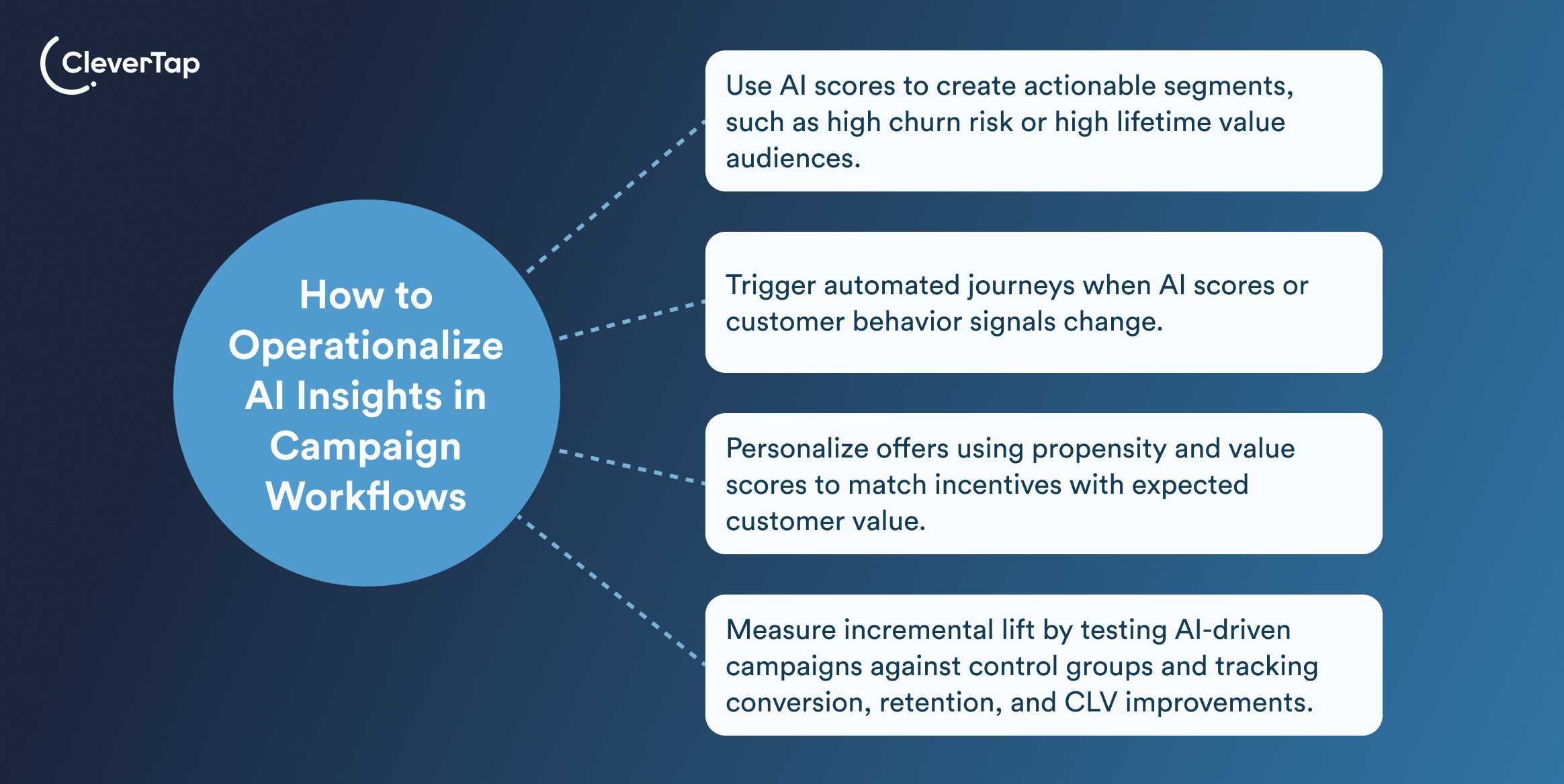
- Turn Predictions into Segments: Use AI scores to define target audiences. For example, create a High Churn Risk segment for customers above a certain churn score and a High-CLV segment for predicted top spenders. These AI-powered segments become the targetable audiences for specific campaigns.
- Trigger Journeys on Score or Intent Changes: Set up automated journeys that start when a user’s AI score or behavior changes. For instance, if a user’s engagement score drops, immediately trigger a re-engagement email or loyalty offer. CleverTap’s event-driven segmentation makes it easy to engage customers the moment their intent changes.
- Personalize Offers Without Overspending: Leverage propensity modeling and value scores to customize promotions. Offer your best deals to those whose predicted lifetime value justifies it, and use smaller incentives for lower-value segments. This prevents blanket discounts and preserves margins.
- Measure Incremental Lift: Always test and quantify impact. Use control groups or holdout samples to compare AI-driven campaigns against a baseline. Track lift in conversion, retention, and CLV by comparing the personalized campaign to a control cohort. This validates that your AI personalization is driving real business value.
Discover the 10 Best AI Personalization Tools in Marketing
How CleverTap Helps You Turn AI Customer Insights into Retention and Personalization at Scale
CleverTap is a customer engagement platform that helps brands analyze user behavior, build dynamic segments, and run personalized campaigns across channels. This includes push notifications, WhatsApp marketing, email campaigns, SMS marketing, and in-app messaging.
It brings together analytics, segmentation, journey orchestration, and AI-driven decisioning in a single system, making it easier for marketers to turn customer insights into real-time engagement across the lifecycle.
CleverTap helps marketers operationalize AI-powered customer insights by connecting predictive intelligence directly to segmentation, personalization, and campaign execution.
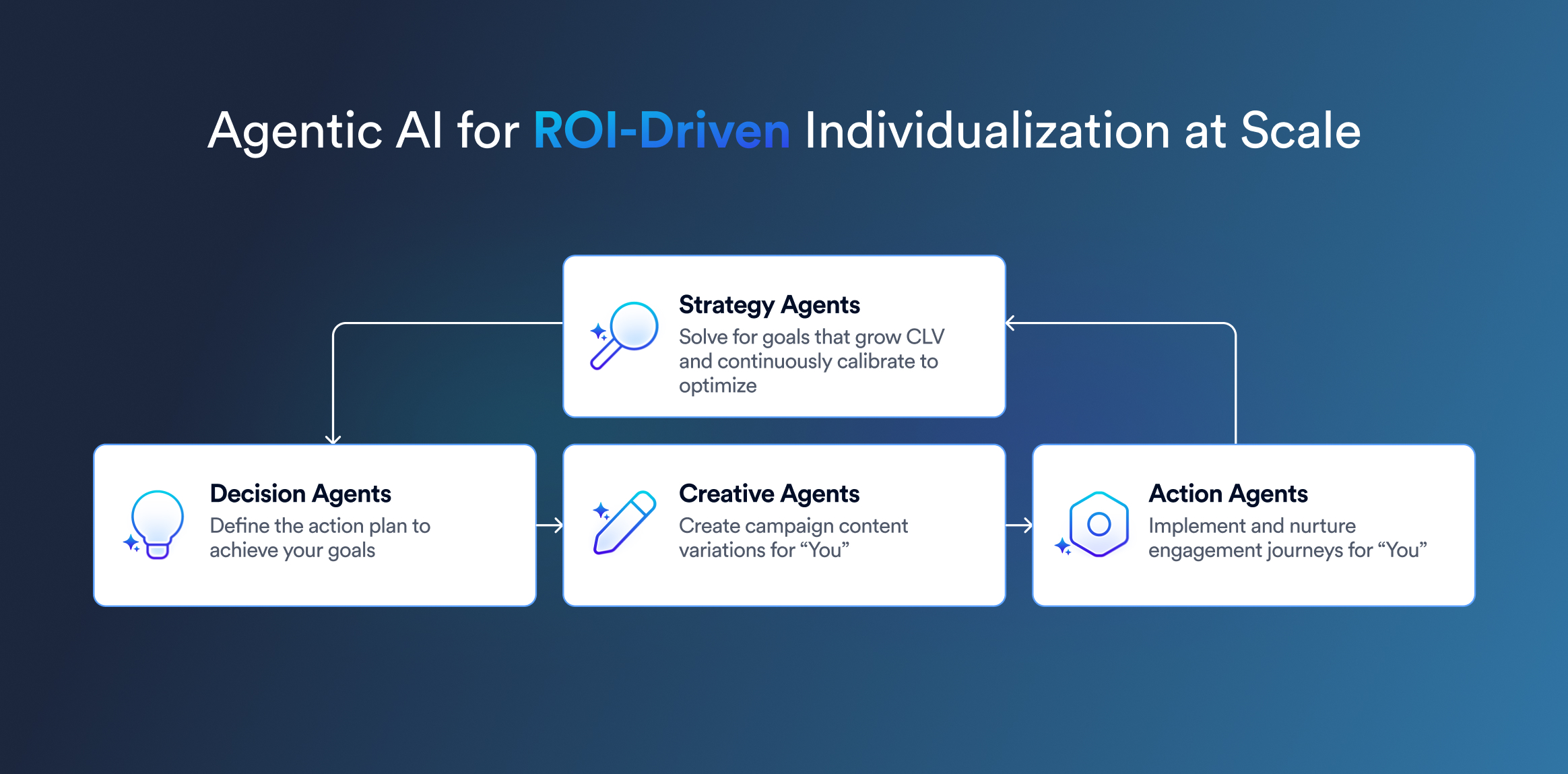
Turning Predictive Signals into Actionable Segments
CleverAI™ analyzes behavioral data to generate predictive signals such as churn probability, repeat purchase likelihood, and expected lifetime value. These signals are directly usable within segmentation, allowing marketers to build audiences based on risk, intent, and value.
For example, teams can create segments such as high churn risk users, high-intent converters, or high-value customers and target them with tailored campaigns. Because these segments update automatically as user behavior changes, targeting remains aligned with real-time intent rather than static lists.
Behavioral and RFM Segmentation for Lifecycle Targeting
CleverTap combines predictive insights with behavioral and RFM segmentation to give marketers a clear view of customer value and engagement.
Users can be grouped based on recency, frequency, and monetary behavior, along with real-time actions such as feature usage, session activity, or drop-offs. This makes it easier to identify lifecycle stages like new users, active users, loyal customers, and at-risk segments, and map campaigns accordingly.
This layered segmentation ensures that personalization is based not just on who the user is, but how they behave and how that behavior is evolving.
Real-Time Personalization Across Channels
Using behavioral signals and predictive insights, CleverTap enables personalized messaging across push notifications, email, SMS, WhatsApp, and in-app channels.
Messages can be tailored based on user activity, preferences, lifecycle stage, and predicted outcomes. This includes product recommendations, onboarding nudges, retention offers, and engagement reminders, all delivered in context.
Because personalization is driven by real-time data, campaigns feel timely and relevant rather than pre-scheduled or generic.
Event-Driven Journeys That Adapt to User Behavior
CleverTap’s journey orchestration allows marketers to build multi-step lifecycle campaigns that respond to user behavior and predictive signals in real time.
For example, a user showing early signs of churn can be moved into a retention journey instantly, while a high-intent user can be guided toward conversion through targeted messaging. Journeys can branch based on engagement, inactivity, or changes in predictive scores, ensuring that each user follows a path aligned with their behavior.
This turns customer insights into continuous engagement rather than one-time interventions.
AI-Driven Optimization of Timing, Content, and Channels
CleverAI improves campaign performance by optimizing when, what, and how messages are delivered.
Send-time optimization ensures messages reach users when they are most likely to engage. AI-assisted content generation through tools like Scribe helps marketers create high-performing messaging variations. Channel optimization helps identify where users are most likely to respond, improving overall campaign effectiveness.
Together, these capabilities reduce manual testing and improve performance across the lifecycle.
Measurement and Continuous Improvement
CleverTap connects AI-driven decisions to measurable outcomes. Marketers can track how predictive targeting, personalization, and journey logic impact conversion, retention, and lifetime value.
With features like cohort analysis, control groups, and funnel analytics, teams can measure incremental lift and identify what is actually driving performance. These insights then feed back into the system, improving future targeting and personalization.
This creates a continuous feedback loop where every campaign helps refine the next.
Bringing It All Together
By combining predictive insights, dynamic segmentation, real-time personalization, adaptive journeys, and continuous optimization, CleverTap enables marketers to move from reactive campaigns to proactive lifecycle engagement.
See how CleverTap helps you turn AI customer insights into real-time retention and personalization.
How to Implement AI for Customer Insights in Your Marketing Strategy
Implementing AI customer insights helps embed intelligence into your marketing operations to drive meaningful action. Here’s how to get started effectively:
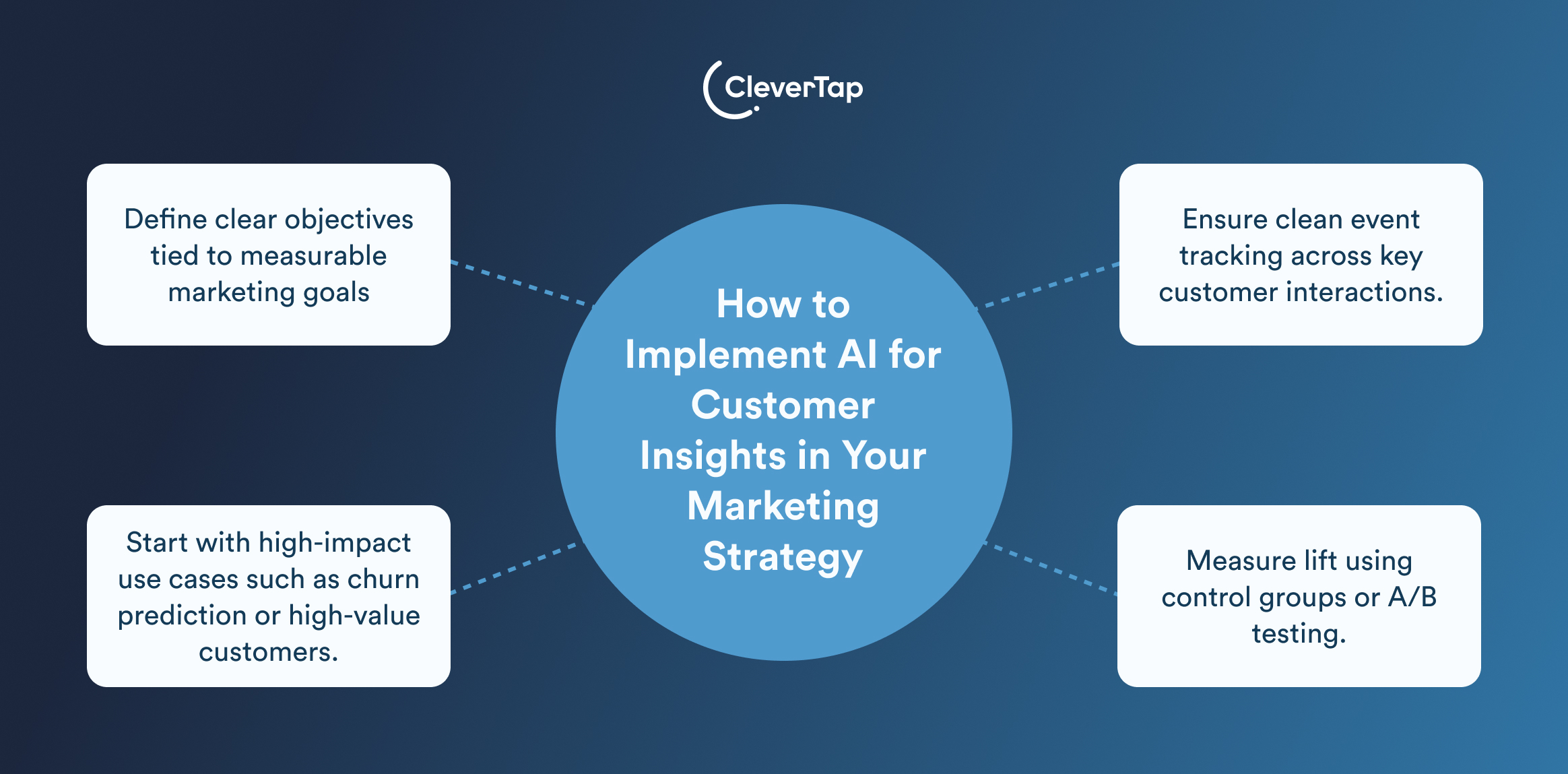
1. Define Clear Objectives
Begin by identifying measurable goals. Are you aiming to reduce churn by 10%? Increase repeat purchases by 20%? AI should be tied directly to key performance indicators (KPIs) that align with business outcomes. Clarity on goals ensures focused implementation and relevant use-case selection.
2. Ensure Clean Event Tracking
AI models rely on accurate and consistent data. Ensure your product and marketing analytics track key user events, such as sessions, purchases, logins, and clicks, across all touchpoints. Incomplete or inconsistent data can significantly reduce the quality of your predictions.
3. Start with High-Impact Use Cases
Focus on one or two high-value use cases to begin, such as churn prediction or high-CLV customer identification. Deploy AI models that generate actionable outputs, like predictive scores or segments, and integrate those into existing campaign workflows.
4. Measure Incremental Lift
Always test the effectiveness of AI-driven decisions. Use control groups, holdout segments, or A/B testing to quantify lift in retention, conversions, or revenue. Treat insights as hypotheses and validate them through real-world impact.
Turning AI Customer Insights into Real Marketing Outcomes
AI-powered customer insights are most valuable when they move beyond analysis and start shaping real customer experiences. When used effectively, they help marketers identify churn risk earlier, personalize engagement more precisely, and make better lifecycle decisions.
The real advantage comes from activation. Insights only create value when they are turned into segments, journeys, and timely campaigns that influence customer behavior. This is what enables teams to move from reactive marketing to proactive engagement.
Schedule a demo with CleverTap to see how AI-driven customer insights can improve retention, personalization, and lifecycle performance.
Frequently Asked Questions About AI for Customer Insights
Q1. What are AI customer insights?
These are actionable predictions and patterns, like churn risk or product affinities, generated by AI models on your customer data. It translates raw behavior data into forecasts and segments that help marketers.
Q2. How is AI different from analytics?
Traditional analytics just report what happened. AI-driven analytics uses that data to predict what will happen, and can even recommend next steps. AI adds a forward-looking, prescriptive layer on top of historical reports.
Q3. Do you need data scientists?
Many marketing platforms include AI features out-of-the-box. More important is clean data and clear goals. In practice, savvy marketers or analysts can configure and interpret these tools.
Q4. Is AI expensive?
It depends. Cloud-based AI services and APIs have made it more accessible. If you start with high-impact use cases and measure the results, the improvements in targeting, retention, and revenue typically outweigh the investment in the AI solution.

Jacob Joseph 
Heads Data Science.Expert in AI, Data & Analytics and awarded 40 under 40 Data Scientists in India.
Free Customer Engagement Guides
Join our newsletter for actionable tips and proven strategies to grow your business and engage your customers.