















Table of Contents
Categories
Most Popular


Many marketers send email campaigns, but struggle to move subscribers through the customer journey because emails are often treated as one-off broadcasts instead of part of a structured lifecycle. An email funnel reframes email marketing as a series of automated, behavior-driven messages that guide each user from awareness through purchase and beyond.
It maps real user actions across the user journey, like signup, browsing, purchasing, etc., to relevant email sequences. This systematic approach clarifies stages, triggers, and outcomes, providing a clear roadmap and measurable results.
In this article, we’ll define the email funnel, explain how it differs from broader marketing funnels and one-off email campaigns, and share stage-based strategies, key performance indicators (KPIs), and real-world examples to help you turn email into a connected growth engine.
What Is an Email Funnel?
An email funnel is an automated sequence of emails tailored to a subscriber’s lifecycle stage and behavior. Unlike a generic newsletter schedule, it maps user actions to email communication.
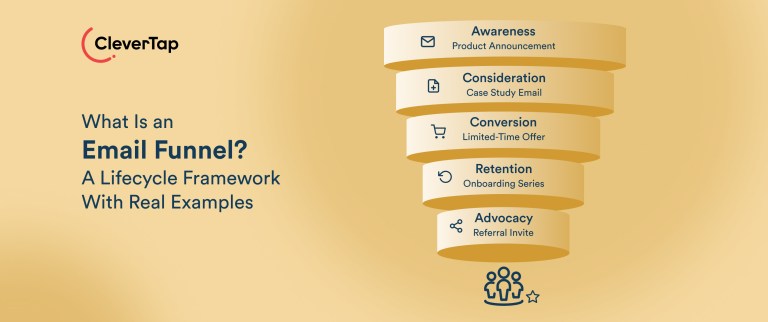
For example, a user who subscribes or downloads a guide enters the Awareness stage within email, where the focus is on building familiarity and trust after opt-in. If they later browse products or attend a webinar, they move to Consideration; adding an item to cart triggers Conversion emails; a purchase moves them into Retention and eventually Loyalty or Advocacy. Each stage has its own goal, messaging, and KPI, creating a continuous nurture loop rather than isolated blasts.
An email funnel is different from a mini marketing funnel or a campaign plan. While a marketing funnel spans multiple channels such as ads, social media, and website interactions, an email funnel focuses specifically on how email guides users after they opt in. It operates as a lifecycle layer within the broader funnel, ensuring that every email interaction moves the user toward the next stage.
How an Email Marketing Funnel Works in Practice
An email marketing funnel runs on behavioral triggers and automation logic that adapts to how users interact. Key mechanics include the following:
- Multiple entry points: Users can enter through different actions, such as a newsletter signup, product inquiry, app install, or content download.
- Behavior-based progression: Actions like clicking, browsing a product, or making a purchase move users to deeper funnel stages.
- Conditional branching: Different emails are sent depending on behavior. For example, an email sent after a click vs the one sent after the previous email is ignored.
- Exit rules: Users leave, or pause flows when they convert, unsubscribe, or complete a key action.
- Re-engagement paths: Inactive users can enter win-back or reactivation sequences.
- Automation workflows: Triggered journeys such as onboarding flows, cart abandonment emails, and post-purchase follow-ups.
- Real-time progression: Users move through the funnel based on behavior rather than fixed delays or campaign schedules.
The result is a dynamic email campaign funnel where every message responds to the user’s actions instead of following a static email calendar.
Also read: 21 Best AI Email Marketing Tools to Boost Conversions.
The 5 Core Stages of an Email Marketing Funnel
An effective email marketing funnel typically includes five lifecycle stages. Each stage has a clear goal, entry trigger, exit condition, email type, and performance metrics. Together, these stages move subscribers from initial awareness to long-term loyalty.
1. Awareness Stage
Goal: Introduce the brand and provide value without heavy selling. At this stage, the focus is on building trust and encouraging the first meaningful interaction with your emails.
Entry triggers: Email sign-ups, lead magnet downloads, webinar registrations, or account creation.
Exit criteria: The subscriber engages with content by clicking on links or browsing pages, and moves to the next stage, or becomes inactive or unsubscribes.
Email types: Welcome series, onboarding emails, educational content, blog articles, checklists, templates, and brand story emails.
Leading KPI: Engagement metrics such as open rate and click-through rate.
Lagging KPI: Movement to the next stage, such as clicking a product page or signing up for a trial.
2. Consideration Stage
Goal: Build trust, address objections, and deepen interest in the product or service. The goal is to help prospects understand how your offering solves their problem.
Entry triggers: Repeated engagement with awareness emails, browsing product pages, or downloading detailed content, such as case studies.
Exit criteria: The user shows strong purchase intent by clicking pricing pages or adding products to cart. Or they may also stop engaging.
Email types: Case studies, testimonials, product demos, webinars, comparison guides, feature breakdowns, and objection-handling content.
Leading KPI: Click-throughs to product pages or demo requests.
Lagging KPI: Trial signups, product demos booked, or progression toward purchase.
3. Conversion Stage
Goal: Encourage the user to complete the primary action, usually a purchase, subscription, or account activation. Messaging here becomes more direct and action-focused.
Entry triggers: High-intent signals such as demo requests, repeated pricing-page visits, or cart abandonment.
Exit criteria: The user completes the purchase, or the sequence ends after multiple attempts.
Email types: Promotional offers, limited-time discounts, product launch announcements, checkout reminders, and urgency-driven emails with strong calls to action (CTAs).
Leading KPI: Clicks on purchase or action-oriented CTAs.
Lagging KPI: Conversion rate and immediate revenue generated from the campaign.
4. Retention Stage
Goal: Keep customers engaged after the first purchase and encourage repeat interactions. This stage focuses on strengthening the customer relationship and increasing lifetime value.
Entry triggers: A completed purchase or product activation.
Exit criteria: The customer either becomes a repeat buyer and moves toward loyalty programs or goes inactive.
Email types: Post-purchase onboarding, product usage tips, feedback surveys, replenishment reminders, cross-sell recommendations, and customer newsletters.
Leading KPI: Engagement with onboarding or product-related emails.
Lagging KPI: Repeat purchase rate, upsell conversions, and customer lifetime value growth.
5. Loyalty and Advocacy Stage
Goal: Turn satisfied customers into loyal advocates who continue buying and referring others. At this stage, the focus shifts from conversion to long-term brand relationships.
Entry triggers: Multiple purchases, high engagement, or qualification for VIP or loyalty programs.
Exit criteria: Reduced engagement or leaving the loyalty program.
Email types: Loyalty program invitations, rewards updates, referral campaigns, VIP offers, early access to launches, and exclusive content.
Leading KPI: Loyalty program participation, referral clicks, and social sharing.
Lagging KPI: Referral-driven signups, advocacy-driven revenue, and long-term customer value.
Each stage in the email funnel functions as a mini-journey with its own messaging, automation rules, and success metrics. Tracking both leading indicators (engagement and clicks) and lagging outcomes (stage progression, conversions, and revenue) helps marketers identify where users drop off and where the funnel can be optimized.
Email Funnel vs. Email Campaigns: Why This Distinction Impacts Revenue
Thinking in terms of funnels, not just campaigns, changes how email drives results. Campaign thinking treats email as a broadcast channel: you send occasional newsletters or promotions and hope for engagement. This often leads to disconnected efforts and limited impact.
A funnel mindset treats email as a continuous lifecycle journey powered by automation.
For example, consider these two scenarios:
- Disconnected campaigns: A retailer sends a generic “10% off sale” newsletter every month to all subscribers. Many emails feel irrelevant to where customers are in their journey, leading to low engagement or unsubscribes.
- Structured funnel journeys: The retailer instead builds automated flows. New subscribers receive a welcome series, cart abandoners get reminder emails, and customers receive post-purchase cross-sell or re-engagement messages designed to move them to the next stage.
Automated flows typically outperform campaigns. Well-structured funnels push more users toward conversion because every email is relevant to the recipient’s current mindset. This leads to a reduction in drop-off and an increase in revenue per subscriber.
How to Build an Email Marketing Funnel Strategy Step by Step
Mentioned below is a step-by-step guide you can follow to come up with your email marketing funnel strategy.
Step 1: Define Lifecycle Stages Based On Behavior
Start by mapping the lifecycle stages that make sense for your business, such as Awareness, Consideration, Conversion, Retention, and Loyalty. Each stage should reflect a real customer behavior rather than a vague label.
For example, an e-commerce brand might define Awareness as a new email subscriber, Consideration as someone browsing products, Conversion as the first purchase, and Retention as repeat purchases. Anchoring stages to observable actions ensures the funnel reflects the real customer journey rather than theoretical marketing stages.
Step 2: Identify Trigger Events And Entry Points
Next, identify the events that bring users into the funnel or move them forward. These triggers can include actions like email signup, downloading a guide, browsing products, adding items to a cart, completing a purchase, or becoming inactive.
For example, a cart abandonment event may trigger a reminder sequence, while a newsletter signup may trigger a welcome series. Mapping these trigger points ensures every meaningful user action connects to a funnel step.
Step 3: Build Behavioral Segments
Create audience segments that reflect different levels of intent and engagement. Examples include high-intent browsers, first-time buyers, repeat customers, and dormant subscribers.
Segmentation can use recency (when the user last engaged), frequency (how often they interact), and behavioral signals like feature usage or purchase patterns. These segments help determine which users should enter which funnel journeys. However, over-segmentation can reduce impact if audiences become too narrow, so segments should balance precision with scale.
Step 4: Map Content To Funnel Objectives
Every stage of the funnel should have a specific communication goal.
Early stages should focus on education and trust-building through onboarding content, helpful resources, and social proof. Middle stages should introduce persuasive content such as product comparisons, case studies, or limited-time offers. Later stages should prioritize retention and relationship-building through loyalty rewards, cross-sell recommendations, and post-purchase support.
Step 5: Design Automation Architecture
Once the strategy is clear, translate it into automated workflows in your email platform.
Use branching logic so different messages are sent depending on user behavior, for example, sending a reminder email if a user abandons a cart or moving them into a post-purchase sequence if they complete a transaction. Suppression rules should prevent irrelevant emails, such as sending a promotion to someone who has already bought the product. Without these controls, over-triggering can lead to message fatigue and reduce overall engagement.
Step 6: Define Stage Transition Criteria
Clearly define what actions move users from one stage to the next.
For example, clicking a product link might move a user from Awareness to Consideration, while completing a purchase moves them into the Retention stage. You should also define exit conditions, such as inactivity or unsubscribing, and determine when users should re-enter the funnel.
Step 7: Establish Stage-Based KPIs
Each stage should have its own performance metrics. Early-stage KPIs may track engagement metrics like open rates and clicks, while mid-funnel stages focus on conversion rates.
Later stages measure retention indicators such as repeat purchase rate, customer lifetime value, or loyalty participation. Tracking stage-level metrics helps identify where users drop off and where optimization is needed. It also helps avoid over-optimizing for surface email marketing metrics like open rates at the expense of conversion and revenue outcomes.
Step 8: Map Revenue Attribution
Finally, connect funnel performance to revenue outcomes. Measure how each stage contributes to conversions, assisted revenue, and long-term customer value.
Metrics such as revenue per subscriber, revenue per campaign, or lifecycle value uplift can reveal which parts of the funnel generate the most business impact. Over time, this allows marketers to optimize their email marketing funnel strategy around the stages that drive the highest ROI.
By systematically building these steps, you create an email funnel strategy that ties every email to a stage-based objective and measurable outcome.
Real-World Email Funnel Examples
Below are three illustrative examples of email funnels in diverse B2C contexts.
1. Online Travel Booking Platform: Ixigo
Ixigo used targeted lifecycle email campaigns and funnel analytics to re-engage users after app download and improve email engagement.
Entry trigger: Users who download the ixigo app or sign up for the platform.
Stage progression: Welcome email campaign (Awareness) → targeted lifecycle emails based on user activity → optimized email campaigns through testing and analytics.
How the funnel works: Ixigo used email campaigns through CleverTap to improve engagement with users after they downloaded the app. The team created visually appealing email templates and used A/B testing to refine campaigns. They also used funnel analytics to analyze the customer journey from app launch to booking and identify drop-off points. Based on these insights, ixigo launched targeted email campaigns to re-engage users and encourage them to return to the app.
Primary KPI: Email engagement metrics such as open rates and click-through rates.
Outcome: After implementing these campaigns, ixigo achieved a 54% email open rate, significantly improving engagement with its email communications.
2. Music Streaming Platform: JioSaavn
JioSaavn used personalization and automated campaigns to deliver tailored music recommendations and promotional offers through email and push notifications.
Entry trigger: User interactions with the platform, such as listening to playlists, genres, or artists.
Stage progression: User behavior analysis → segmentation based on listening preferences → personalized communication via email and push notifications → promotional campaigns with dynamic coupon codes.
How the funnel works: JioSaavn integrated its in-house recommendation engine with CleverTap to segment users based on interactions with playlists, genres, and other listening behavior. The platform then delivered dynamically tailored emails and push notifications promoting relevant music content and new releases from favorite artists. Campaigns were continuously optimized through A/B testing, and personalized coupon codes were embedded in emails using real-time linked content pulled from JioSaavn’s backend systems.
Primary KPI: Email click-through rate and click-to-conversion performance for campaigns.
Outcome: The personalized campaigns resulted in a 67% boost in click-to-conversion rates for campaigns using catalogues and a 2X increase in Email CTR for promo code campaigns with linked content.
3. Marketplace Platform: Apna
Apna built its email channel to engage job seekers with personalized job recommendations and scale communication as its user base grew.
Entry trigger: Users sign up on the Apna platform to search for jobs and connect with employers.
Stage progression: User segmentation based on profile data and preferences → personalized job recommendation emails → targeted engagement campaigns to keep users active.
How the funnel works: As Apna’s user base expanded rapidly, the company introduced email as a scalable engagement channel alongside existing communication channels. Using CleverTap, the team segmented users based on job preferences, roles, and other profile attributes. Email campaigns were then used to deliver relevant job opportunities and updates tailored to each user segment. These campaigns helped maintain engagement with job seekers and encouraged them to return to the platform to explore opportunities.
Primary KPI: Email open rates and click-through engagement with job recommendation emails.
Outcome: Email campaigns on Apna scaled 30X within a year, achieved a 28% increase in open rate, and drove higher click-through engagement by up to 88%, contributing to improved user retention on the platform.
These examples illustrate how funnels adapt to different industries.
Stage-Based Metrics Framework for Email Funnel Performance
Beyond stage-level KPIs, evaluating the overall health of an email funnel requires tracking how users move across stages and how each stage contributes to revenue. While leading indicators like opens and clicks matter, the real measure of success is progression, conversions, and revenue.
Key metrics to track include:
- Conversion rate: The percentage of users who move from one stage to the next.
- Funnel velocity: How quickly users progress through stages, for example, time from signup to first purchase.
- Drop-off rate: The share of users who exit at each stage, helping identify leaks in the funnel.
- Revenue per stage: The revenue generated or influenced by emails at each lifecycle stage.
- Retention lift: Improvements in repeat purchases or reduced churn among users who go through retention flows.
- Cohort progression: The percentage of users from a signup cohort who reach each stage within a set timeframe.
These metrics help shift measurement beyond simple open rates toward lifecycle impact. The goal is to understand how many users progress, where they drop off, and how each stage contributes to revenue.
How CleverTap Enables Lifecycle-Driven Email Funnels
CleverTap is an all-in-one customer engagement platform that helps brands build, automate, personalize, and measure lifecycle email funnels from a single system. This is critical because email funnels only work when behavioral data, segmentation, journey orchestration, and measurement are tightly connected. Without that, email remains a broadcast channel instead of a structured lifecycle engine.
Behavioral Segmentation Aligned to Funnel Stages
CleverTap enables marketers to build highly precise audience segments using signals such as user activity, demographics, lifecycle stage, and predictive insights like churn risk or purchase intent.
These segments can be mapped directly to funnel stages. For example:
- New subscribers can enter onboarding and awareness flows
- Engaged users can move into consideration journeys
- High-intent users can be targeted with conversion campaigns
- Inactive users can be automatically pulled into reactivation flows
Because behavioral segmentation is based on real-time behavior, users move dynamically between stages without requiring manual updates. This ensures that email communication always reflects current user intent rather than static lists.
Event-Based Journeys That Mirror Real User Behavior
CleverTap translates these segments into automated lifecycle journeys using event-based triggers, branching logic, delays, and exit rules.
This allows marketers to build flows such as:
- Welcome and onboarding series
- Product discovery and nurture journeys
- Cart abandonment and checkout recovery
- Post-purchase onboarding and cross-sell
- Re-engagement and win-back campaigns
Each journey adapts based on how users interact. For example, a user who clicks but does not convert can receive follow-ups, while a user who completes a purchase is automatically moved into a retention flow.
This ensures that emails are not sent as isolated campaigns, but as part of a connected system that responds to user behavior in real time.
Personalization and Interactive Email Experiences
CleverTap supports multiple layers of personalization to improve engagement across funnel stages.
Marketers can use:
- Dynamic content and merge fields for basic personalization
- Liquid Tags for conditional logic within emails
- Linked Content to pull real-time data from external systems
- Catalog-based personalization for product recommendations
In addition, CleverTap supports AMP-powered emails, allowing users to take actions such as browsing products, submitting forms, or interacting with content directly within the inbox.
This reduces friction and helps users progress through the funnel without needing to switch channels.
AI-Driven Optimization Across the Funnel
CleverTap enhances email funnel performance through its AI layer, CleverAI.
AI is applied across multiple stages of the funnel:
- Send-time optimization ensures emails are delivered when each user is most likely to engage
- CleverTap’s AI-powered writing assistant Scribe helps teams generate high-performing, brand-aligned campaign copy at scale
- Predictive insights, such as churn risk or conversion likelihood, help prioritize the right users
- Journey optimization identifies better-performing paths and improves campaign logic over time
This allows marketers to move beyond static automation and build funnels that continuously improve based on user behavior and campaign performance.
Funnel Analytics and Lifecycle Measurement
CleverTap provides built-in funnel analytics to measure how users progress through each stage.
Marketers can define funnels as sequences of events, such as:
Sign-up → Email Open → Product View → Add to Cart → Purchase
This makes it possible to:
- Identify drop-offs at specific stages
- Measure conversion between steps
- Track the time taken to move through the funnel
- Compare performance across segments, channels, or user cohorts
Additional capabilities such as cohort analysis, click heat maps, and revenue attribution help teams connect email performance to actual business outcomes, not just engagement metrics.
Deliverability and Trust Infrastructure
CleverTap also ensures that lifecycle email funnels perform reliably at scale.
The platform supports:
- Email authentication protocols such as SPF, DKIM, and DMARC
- IP warm-up and reputation management
- Preference centers and unsubscribe controls
- Compliance with global privacy standards
These features help maintain inbox placement, reduce spam risk, and ensure that lifecycle messaging remains both effective and user-friendly.
Bringing It All Together
Together, these capabilities turn email from a broadcast channel into a behavior-driven lifecycle system. Each message is triggered by real user actions, personalized based on context, and optimized to move users from awareness to conversion, retention, and long-term loyalty.
See how CleverTap helps you turn lifecycle email funnels into measurable growth.
Turning Email Into a Lifecycle Growth Engine
Email marketing delivers its strongest results when it operates as a lifecycle system rather than a collection of isolated campaigns. By structuring emails around stages like awareness, consideration, conversion, retention, and loyalty, marketers can respond to real user behavior and guide subscribers toward meaningful actions at the right time.
This approach helps teams create more relevant messaging, improve engagement across the customer journey, and build stronger long-term relationships. Instead of focusing only on immediate clicks or conversions, email funnels create a continuous value exchange that supports both customer needs and sustainable business growth.
Platforms like CleverTap make this shift practical by connecting behavioral data, segmentation, journey orchestration, personalization, and analytics in one system. This allows marketers to move beyond static campaigns and build lifecycle email funnels that adapt, optimize, and improve over time.
Want to turn your email campaigns into a high-performing lifecycle funnel? Schedule a demo with CleverTap.

Sagar Hatekar 
Leads product managementExpert in Marketing Analytics & Engagement platforms.
Free Customer Engagement Guides
Join our newsletter for actionable tips and proven strategies to grow your business and engage your customers.