








































![10 Best Geofencing Marketing Platforms Compared [+How to Choose the Best]](https://clevertap.com/wp-content/uploads/2026/01/10-Best-Geofencing-Marketing-Platforms.jpg?w=768)

Table of Contents
Categories
Most Popular


Geofencing is one of the few mobile marketing strategies that meet a user in the moment. When you enter a store, approach a venue, or move through a high-value location, that signal is immediate and actionable. That’s why location-triggered campaigns outperform generic messaging. In fact, 9 out of 10 marketers say that location-based marketing drives more sales by engaging customers precisely when their intent is highest.
You’re here to find the best geofencing marketing platforms to turn location into measurable results. In real-world use, however, performance depends heavily on trigger accuracy, device signals, and mobile permission flows. GPS drift can create false entries, triggers may fire late, and iOS and Android constraints can reduce match rates. Without lifecycle context, location targeting alone can also miss relevance.
That’s why growth, CRM, and product teams need more than map-based triggers. The best platforms combine precise geofence engines with real-time evaluation. They also layer in behavioral segmentation, clean integrations, and reporting tied to retention and revenue. This guide compares the leading tools across those criteria and explains why CleverTap stands out as the strongest end-to-end option for scalable, ROI-driven geofencing.
What Is Geofencing Marketing?
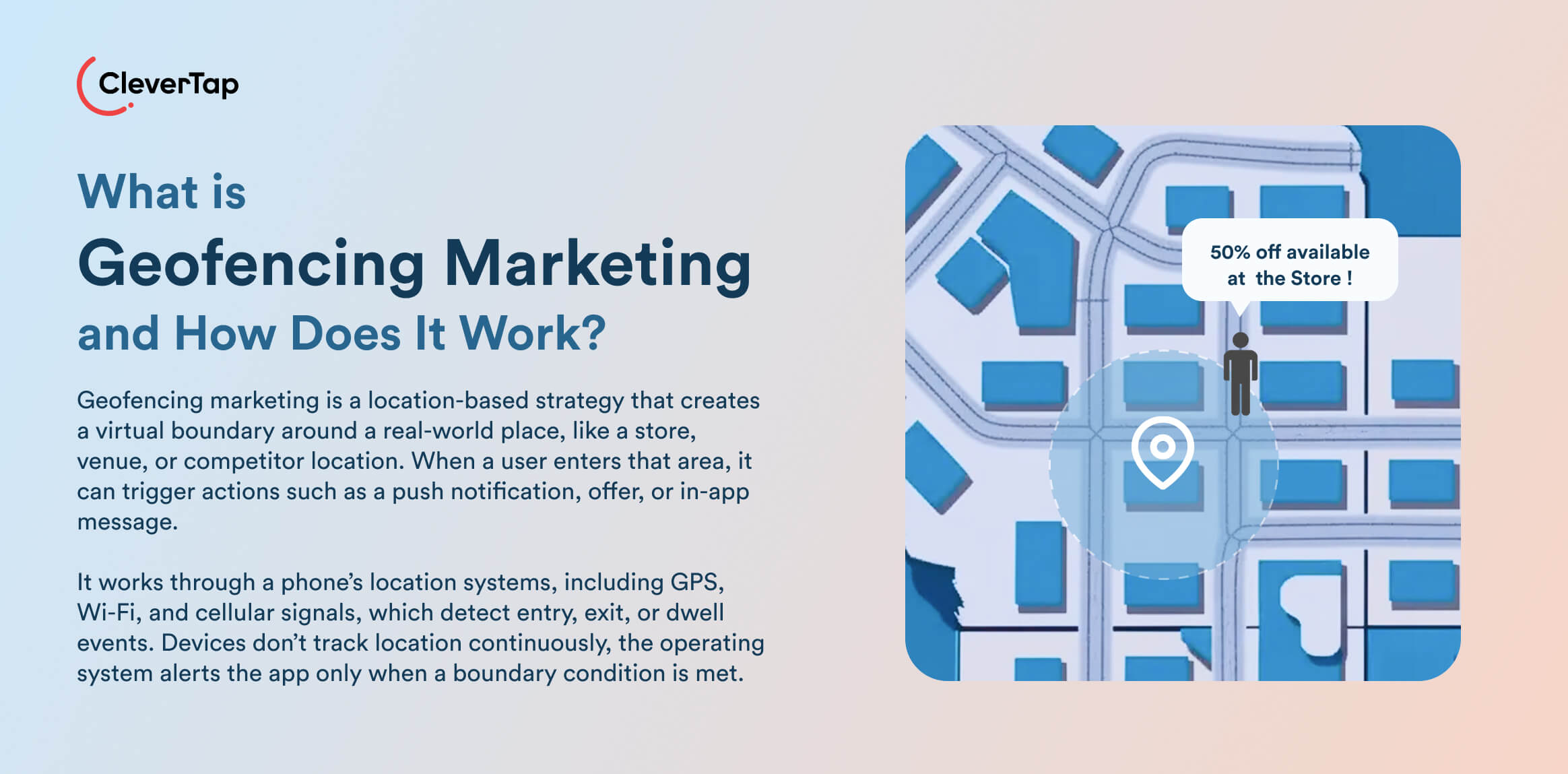
Geofencing marketing is a location-based strategy where you draw a virtual boundary around a real-world place, like a store, venue, airport, neighborhood, or competitor location, and trigger a marketing or product action when a user’s device crosses that boundary.
A user entering a radius can kick off a push notification, an in-app message, a coupon, a journey step, or a measurement event (store visit, repeat visit, post-visit conversion). The value is timing. You’re acting based on a real-world moment instead of guessing intent from browsing history.
How Geofencing Works
A geofencing marketing platform defines a boundary (usually a circle or polygon) and checks for transition events like enter, exit, or dwell. On mobile, geofencing relies on the device’s location stack, which can combine GPS, Wi-Fi positioning, cell signals, and sometimes Bluetooth beacons for nearby detection.
Devices don’t constantly poll location to preserve battery life and comply with operating system (OS) limits. Instead, the OS evaluates movement in the background and notifies the app only when a boundary condition is met. This is why geofencing performance varies significantly by platform, device settings, and user permissions.
A strong geofencing advertising platform like CleverTap optimizes around these constraints, prioritizing accuracy and speed while minimizing false triggers and delayed events.
Key Features of a Strong Geofencing Platform
If you’re evaluating geofencing marketing tools, these capabilities decide whether location becomes a growth lever or a source of noise.
- Precise geofence creation for modeling real-world locations and firing triggers where intent exists.
- Real-time trigger support ensures messages, journeys, or product actions activate at the moment a user crosses a boundary.
- Behavior and location segmentation keep triggers relevant and contextual by layering who the user is and what they’ve done.
- Integrated journey orchestration to route location events directly into CRM flows and cross-channel experiences instead of isolating them.
- Scalable multi-geofence management makes it easy to handle hundreds or thousands of locations without manual overhead or trigger conflicts.
- Permission and privacy compliance preserve reach and trust while aligning with iOS, Android, and respecting user consent and regional privacy laws.
- Visit and conversion analytics tie location events to retention, revenue, and incremental lift.
These features set the bar. Next, we evaluate which geofencing platforms consistently clear it.
Best Geofencing Marketing Platforms
This section compares geofencing marketing platforms on accuracy, real-time processing, and segmentation depth, because OS limits and permission flows directly affect scale. We also look closely at journey alignment, integrations, and reporting. That’s where you see whether location data actually drives business outcomes.
Below are the top tools teams use today, ranked by lifecycle strength, trigger accuracy, and segmentation depth.
| Real-time capability | Segmentation depth | Geofence precision | Journey orchestration | Industry suitability | |
| CleverTap | Real-time enter/exit events (Geocluster Entered/Exited) usable in campaigns and segmentation | Deep: behavior, RFM, purchase history, predictive signals | Very high: clustered geofences, large-scale configurations | Native, multi-step, cross-channel journeys | Mobile-first brands, retail, consumer apps |
| Airship | Location triggers via geofence integrations and Custom Events | Moderate: attributes and engagement data | Geofencing via integration/custom events | Automation flows, push-led | Mobile-first brands |
| Braze | Event-driven, near real-time | Basic to moderate: attributes, events | Attribute-based, not precision-led | Campaigns and lifecycle flows | Consumer apps, mobile, and web |
| Radar | Real-time API and server events | No built-in segmentation, requires custom development | High: polygons, signal filtering | None (infrastructure only) | Logistics, fraud, compliance, and development teams |
| Bluedot | Real-time arrival detection | Limited (location-centric) | High: detection of actual on-site arrivals | Limited (event-driven actions) | QSR, retail ops, enterprise mobility |
| PlotProjects | Near real-time triggers | Moderate: visit and movement data | Moderate: point-of-interest-based | Campaign activation, not full journeys | Retail, real estate, and urban marketing |
| HEROW | Contextual triggers | Moderate: visit and dwell patterns | Moderate: visit-level, not live GPS | Limited orchestration | Retail, hospitality, and venues |
| Xtremepush | Real-time and scheduled | Moderate: behavior and attributes | Standard geofencing | Lifecycle and re-engagement flows | Retail, finance, travel, and media |
| OneSignal | Event and schedule-based | Basic: tags and properties | Country/coordinates native, geofencing via Radar integration | Limited automation | SaaS, apps needing a simple push |
| Pushwoosh | Event-driven | Basic to moderate | Standard app-provided geofences | Automated and manual workflows | Mobile-first products |
1. CleverTap
CleverTap is the best geofencing platform for marketers looking to bring geofencing into a unified lifecycle ecosystem rather than treating it as an isolated add-on. Its geofencing engine lets you define virtual boundaries around physical locations, including stores, venues, campuses, or any custom coordinate set, and trigger campaigns when users enter or exit those zones across Android and iOS.
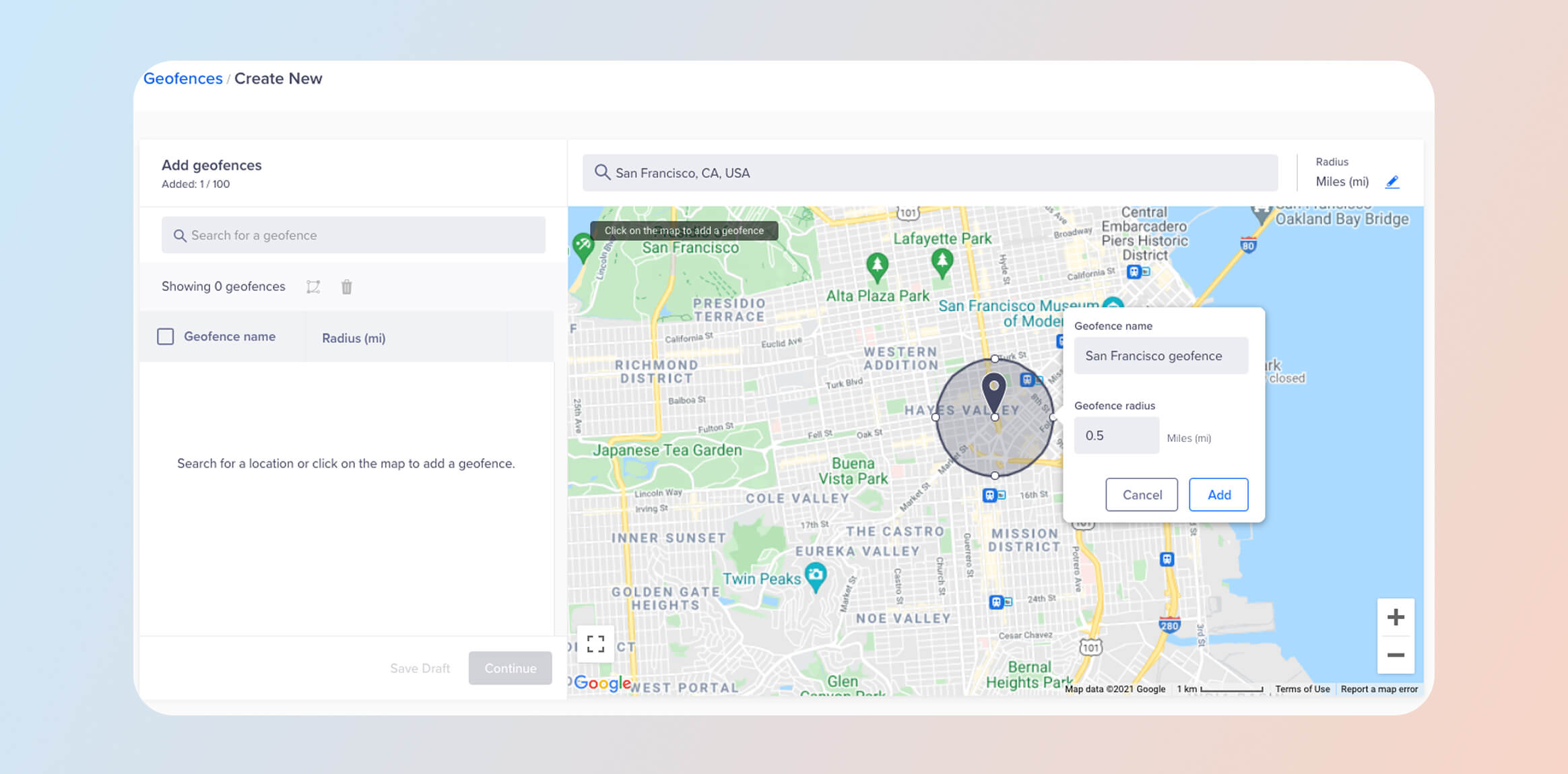
To support scale, the platform offers flexible geofence configurations where you can cluster multiple zones together (up to 100 geofences per cluster and up to 100 clusters per app). This lets marketers cover everything from single retail points to large multi-location footprints without overhead. When a user crosses a boundary, the trigger fires in real time, aligning messaging with the exact moment intent forms. That event is immediately recorded in the user’s activity history and becomes usable across segmentation and automation.
Here’s what sets CleverTap apart:
- Integration of location signals and user intelligence: CleverTap unifies geofence entry and exit events with behavioral history, purchase activity, recency, frequency, and engagement patterns inside each user profile. By combining where a user is with who they are and how they behave, teams can refine geofence audiences and build high-intent segments instead of relying on location alone.
- CleverAI’s predictive intelligence: CleverTap’s CleverAI adds predictive depth to geofencing. It analyzes behavior patterns to predict future actions, allowing location-based campaigns to anticipate user needs rather than react after the fact. Here’s what you can do using CleverAI:
- Predictions Agent scores users in real-time to help you spend your budget on those with a high propensity to convert.
- Decision Agents help teams determine the most relevant next-best action for each user based on engagement signals and context.
- Channel Optimizer Agent determines exactly where a user is most likely to respond. It can send a WhatsApp message to one user and a push notification to another to evaluate what works best for whom.
These triggers connect seamlessly with CleverTap’s journey orchestration engine. A geofence entry or exit can start, branch, suppress, or accelerate multi-step journeys across channels. This integration eliminates the need to sync multiple tools and ensures location triggers feed directly into lifecycle orchestration.
- Measure the outcome of geofencing: CleverTap ties location events to engagement metrics, retention curves, funnel progression, and revenue outcomes. Location events roll into funnels, retention analysis, and revenue reporting, making it clear whether geofencing drives repeat visits, conversions, or long-term value.
If you want a single platform that brings together geofencing, predictive intelligence, journey orchestration, and analytics, CleverTap stands out as the strongest choice for turning location into measurable growth.
Key Strengths
- Real-time geofence detection and trigger processing: CleverTap’s geofencing engine fires campaigns based on enter/exit events and makes this data available for retargeting and analytics.
- Deep behavior and location segmentation: You can combine location events with behavior, dwell time, past visits, and more to build context-rich segments.
- Automated journeys initiated by geofence events: Geofence triggers can be entry conditions for cross-channel, multi-step journeys.
- Predictive and Clever AI-supported decisioning: CleverAI layers predictive, generative, and decisioning intelligence that helps tailor actions and next-best actions.
- Unified analytics, including funnels, retention, and geofence performance: Geofence events integrate with full analytics and reporting dashboards.
Best for
CleverTap is best for mobile-first brands and growth marketers who want geofencing to operate as part of a unified lifecycle strategy, not as a standalone trigger. It is ideal when you need location events to flow directly into segmentation, journey orchestration, and measurable retention and revenue outcomes.
Why Choose CleverTap
CleverTap is typically chosen by teams that want to:
- Activate geofence entry and exit signals as part of unified lifecycle journeys, not standalone alerts.
- Combine location triggers with behavioral history, segmentation, and predictive intelligence for higher relevance.
- Orchestrate real-time, cross-channel engagement flows that respond immediately to physical-world intent.
- Measure the downstream impact of geofencing through retention, funnel progression, and revenue analytics.
- Scale location-based engagement across hundreds of zones while maintaining trigger accuracy and control.
See how CleverTap turns geofencing into measurable retention and revenue impact.
2. Airship
Airship is a customer experience platform that supports location-based automation by using geofence and geolocation signals captured through integrations such as the Woosmap Geofencing SDK. These signals can be passed into Airship as Custom Events, which teams can then use to trigger Journeys and Automations for push notifications and in-app experiences.
Geofence-driven events can be combined with audience segmentation based on user attributes and engagement behavior. Airship is typically used by mobile-first brands running push-led personalization and real-time in-app engagement flows.
Why Choose Airship
Airship is typically used by teams looking to:
- Drive interactions through push-led personalization and in-app experiences rather than web or email-heavy workflows.
- Feed location events into mobile automation flows for creating multi-step customer journeys rather than one-off alerts.
3. Braze
Braze is a customer engagement platform that supports the ingestion of location-related attributes alongside behavioral, transactional, and device-level data. Location data can be passed from mobile SDKs and used as part of event payloads or user profiles.
The platform enables push notification triggering based on actions, schedules, or contextual conditions, including location-derived properties. Braze also provides basic audience filtering through segments built on attributes, events, and custom fields. Braze does not position geofencing as a core engine, but supports location data as part of broader segmentation and messaging workflows.
Common use cases include customer lifecycle messaging, contextual push notifications, geo-aware segmentation, and coordinated engagement across mobile and web channels.
Why Choose Braze
Braze is often used by companies that want to:
- Centralize data by ingesting location attributes directly alongside behavioral, transactional, and device-level data.
- Initiate contextual push notifications based on a mix of location properties, user actions, and schedules.
4. Radar
Radar provides geolocation APIs for applications that require location tracking, geofence creation, and place detection. Developers can configure geofences around custom polygons, venues, or geographic coordinates and receive real-time entry and exit events. Radar includes signal processing to improve accuracy by filtering noisy GPS, Wi-Fi, and cellular data.
The platform also supports background location updates and server-side event handling. Brands use it for geofence-based workflows, location verification, logistics visibility, fraud detection, compliance monitoring, and triggering backend actions from physical location events.
Why Choose Radar
Radar is primarily used by developer-focused teams that:
- Need robust APIs to build custom geofencing, tracking, and place detection features directly into their apps.
- Prioritize built-in signal processing to filter out noisy GPS, Wi-Fi, and cellular inputs.
5. Bluedot
Bluedot’s geofencing marketing platform focuses on high-precision geofencing and accurate arrival detection. It uses proprietary location technology designed to identify true arrivals without requiring frequent GPS polling. The platform is typically deployed in enterprise environments where location accuracy is operationally critical.
Bluedot supports large-scale implementations across distributed physical locations. Teams use it for arrival confirmation, curbside pickup workflows, drive-through detection, location-triggered messaging, and operational analytics based on verified visits rather than approximate proximity signals.
Why Choose Bluedot
Bluedot is typically deployed by QSR and retail brands that need:
- Operationally critical precision for workflows like curbside pickup and drive-through detection.
- Technology to manage verified visits across large, distributed physical networks instead of approximate proximity signals.
6. PlotProjects
PlotProjects provides location-based tooling built around points of interest (POI), geofence triggers, and movement-based insights. Businesses can define POIs, configure geofences, and trigger actions when users enter, exit, or dwell within specific locations. The platform also supports campaign activation and reporting based on location events.
Brands use PlotProjects to connect physical movement signals with location-triggered engagement and attribution workflows. Use cases include proximity marketing, footfall analysis, offline attribution, audience segmentation based on visit behavior, and location-driven campaign measurement.
Why Choose PlotProjects
PlotProjects is commonly used by teams looking for:
- Versatile trigger options that allow them to act on entry and exit, as well as dwell within specific points of interest.
- Location-based analytics for use cases like footfall analysis, visit-based segmentation, and measuring the outcome of location-driven campaigns.
7. HEROW
HEROW is a context intelligence platform that interprets real-world presence and movement around physical locations. Rather than relying on continuous GPS tracking, it analyzes movement patterns to identify visits, dwell time, and contextual location events. The platform emphasizes understanding how people interact with places over time instead of pinpointing exact real-time coordinates.
Teams apply HEROW to measure footfall, analyze visit behavior, and support location-aware personalization. Retailers, hospitality brands, and venue operators use these insights to design contextual engagement strategies based on observed physical-world behavior.
Why Choose HEROW
HEROW is ideal for organizations aiming to:
- Prioritize context over coordinates and want to understand how people interact with places over time.
- Identify visit, dwell time, and contextual location events that go beyond simple presence.
8. Xtremepush
Xtremepush is a mobile engagement platform that enables messaging across push notifications, in-app messages, email, and SMS. It provides geofence-based triggers that activate campaigns when users enter or exit defined geographic areas. Teams can combine location data with behavioral events, device attributes, and user profile properties to build targeted segments. The platform supports both real-time triggers and scheduled campaign execution.
Businesses use Xtremepush to deliver location-triggered notifications, manage lifecycle messaging, run re-engagement flows, and support contextual communication for mobile apps in sectors like retail, finance, travel, and media.
Why Choose Xtremepush
Xtremepush is typically used by teams that want to:
- Have multi-channel unification to activate geofence campaigns across push, in-app, email, and SMS.
- Use layered targeting that combines location triggers with behavioral events, device attributes, and user profiles for precise segmentation.
9. OneSignal
OneSignal is a customer engagement platform that supports push automation for mobile and web applications. Teams set up automated push notifications using events, schedules, and user behavior without manual sends.
The platform supports location-based targeting through country-level segmentation, coordinate and radius targeting, and geofencing when paired with an integration such as Radar. Location attributes can be passed from the app and used for Journeys and audience segmentation, though full perimeter-based geofence triggering typically depends on the connected location provider.
OneSignal provides basic analytics for message delivery and engagement. Common use cases include automated onboarding flows, broadcast alerts, re-engagement campaigns, and location-aware notifications that rely on coarse geographic signals rather than precise geofencing.
Why Choose OneSignal
OneSignal is often used by teams that need:
- Broad location targeting over precise geofencing notifications.
- Efficient push automation to set up event-driven flows and broadcast alerts for mobile and web applications without manual intervention.
10. Pushwoosh
Pushwoosh is an omnichannel customer engagement platform centered on push notifications and in-app communication for mobile applications. It supports geo-triggered messaging through location-based conditions, including geofence entry and exit events provided by the app. Teams create segments using tags, behavioral events, and user attributes like location data. The platform supports both automated workflows and manual campaign launches.
Organizations use Pushwoosh to deliver location-based push notifications, run contextual in-app messages, manage re-engagement campaigns, and coordinate geo-aware communication for mobile-first products that rely on timely, location-informed outreach.
Why Choose Pushwoosh
Pushwoosh is commonly used by mobile-first products that need:
- Geo-triggered messaging that activates on geofence entry and exit events to deliver timely, location-informed outreach.
- Coordinated contextual campaigns that drive re-engagement using segments built from a mix of tags, behavioral events, and location attributes.
Turn Location Signals Into Real-Time Engagement
Geofencing breaks down fast when accuracy slips or triggers fire late. That means wasted sends and missed intent for teams running real campaigns. The best geofencing marketing platforms capture location signals cleanly and tie them directly to lifecycle context, so messages land when they matter. That’s how location turns into revenue impact.
But accuracy and triggers are only the baseline. The real competitive advantage comes from what happens after the trigger fires. While many geofencing marketing tools excel at specific technical challenges, they often lack the lifecycle context to drive true ROI.
CleverTap solves this by combining real-time location data with deep behavioral segmentation and predictive AI. That’s how you go beyond generic blasts and deliver hyper-personalized experiences that convert. CleverTap helps teams turn physical entry events into strategic opportunities for deeper retention.
See how real-time geofencing performs when it’s connected to lifecycle intelligence. Book a CleverTap demo to explore location-triggered journeys, segmentation, and measurement.

Kiran Pius 
Leads Product Launches, Adoption, & Evangelism.Expert in cross-channel marketing strategies & platforms.
Free Customer Engagement Guides
Join our newsletter for actionable tips and proven strategies to grow your business and engage your customers.