













































Table of Contents
Categories
Most Popular


Retention is one of the most powerful growth levers for companies. After all, retaining customers is far cheaper than finding new ones. A 5% lift in retention can increase profits significantly, with some studies estimating gains as high as 95% depending on the business model. And with rising acquisition costs, wasted spend on churned users is a huge drain.
Yet many teams still rely on manual, rules-based retention tactics such as batch win-back emails, loyalty programs, and generic customer segmentation. These methods inevitably plateau because they react too late and lack precision. Most retention systems respond after churn becomes visible, not when it begins.
By contrast, AI for customer retention introduces a proactive, data-driven approach. Machine learning models continuously analyze signals such as drops in usage, slowed purchases, and abandoned carts to flag churn risk early and trigger timely, targeted interventions. More importantly, AI shifts retention from campaign execution to decision-making, from “what campaign should we send” to “which user needs what action right now.”
AI-powered systems act as adaptive engines that learn from user behavior and optimize engagement decisions over time, shifting the focus from campaign KPIs to lifetime value. However, AI is not a shortcut. Without clean data, clear objectives, and proper experimentation, it can amplify noise rather than improve outcomes. When implemented well, it makes retention more measurable and systematic, turning every interaction into an opportunity to drive long-term revenue growth.
How AI Fundamentally Changes Customer Retention Strategy
AI for customer retention introduces a foundational shift in how marketers design, execute, and optimize lifecycle strategies. Instead of merely automating existing workflows, AI fundamentally changes how retention is designed and executed, from how risk is detected to how actions are triggered and evaluated.
This shift is less about automation and more about replacing static rules with adaptive decision systems that learn from user behavior over time.
At its core, this transformation embeds decision intelligence into lifecycle management, enabling systems to learn, adapt, and act at speed and scale. The change does not replace marketers, but rather equips them with intelligent infrastructure that automates low-value decisions and surfaces high-impact opportunities in real time.
In practice, this shifts the marketer’s role from campaign execution to defining strategy, guardrails, and success metrics. This shift shows up across four key areas:
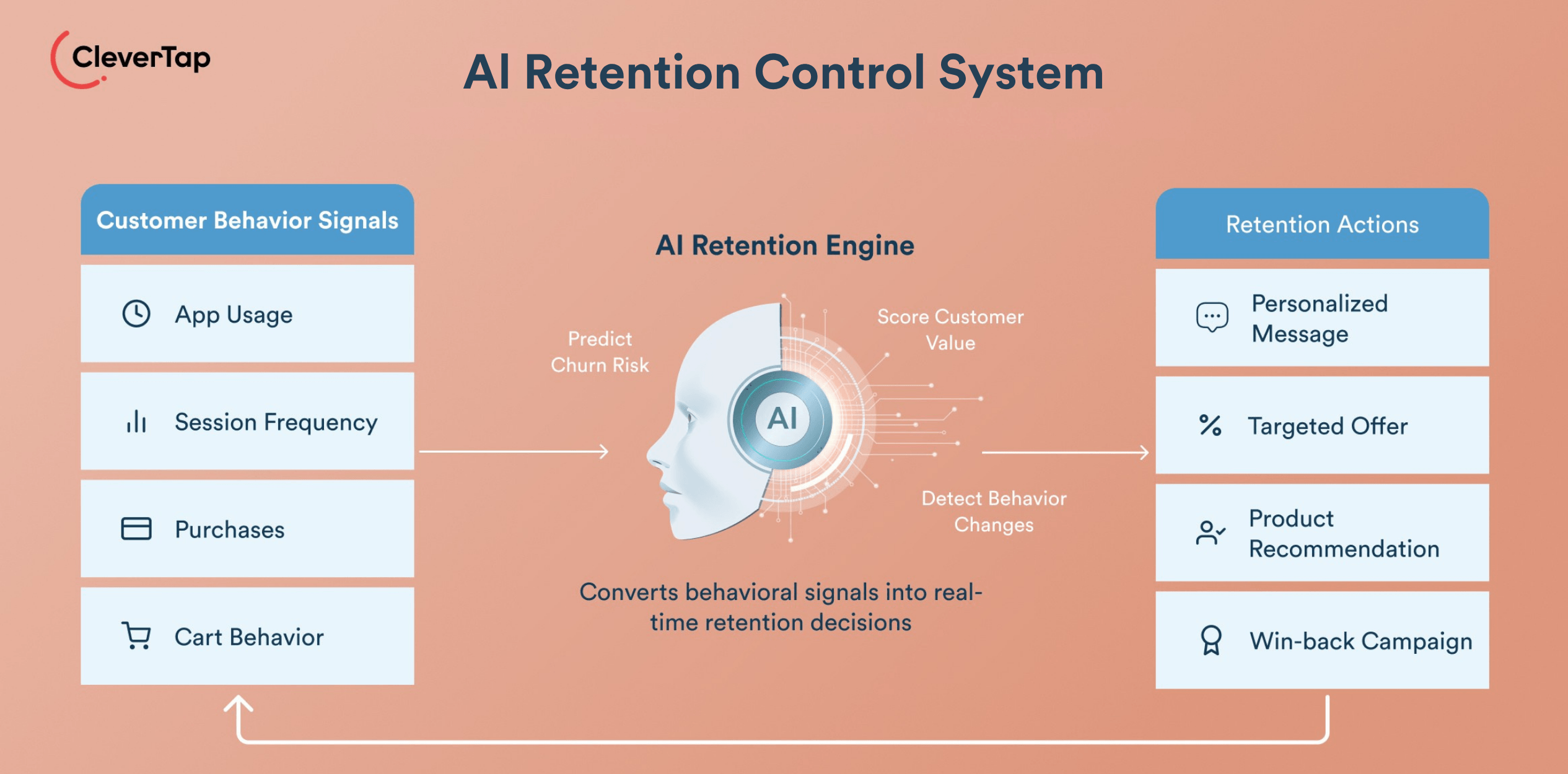
Here’s how this shift plays out across four key strategic dimensions:
- From reactive to proactive retention: Traditional churn campaigns are triggered after engagement has already declined, and it is often too late. AI enables early detection of churn signals through predictive scoring models. These systems identify behavioral drop-offs and engagement decay before users disengage, allowing interventions to happen earlier and with greater impact.
In many products, the difference between saving and losing a customer is measured in hours or days, not weeks, which makes early detection critical. - From static cohorts to probabilistic modeling: Rule-based segments are rigid and quickly become outdated. AI models assign dynamic risk, value, and intent scores to each customer based on ongoing behavior. This moves retention logic from “people like this” to “this specific person right now,” increasing relevance and reducing wasted effort.
This also reduces over-targeting, where users receive unnecessary messages or incentives despite already being likely to convert. - From batch messaging to real-time behavioral triggers: Campaigns scheduled weekly or monthly often miss the moment of need. AI ingests live behavioral data to trigger messages the moment churn risk or opportunity spikes. For example, a drop in session frequency or cart abandonment can instantly trigger the most relevant retention action.
However, real-time engagement alone is not enough. Without prioritization, faster messaging can increase volume without improving outcomes. - From campaign metrics to lifetime value optimization: Rather than focusing on clicks or opens, AI systems optimize for long-term metrics like lifetime value (LTV), average revenue per user (ARPU), and cohort retention curves. Every retention action is evaluated based on its contribution to sustainable value creation and not short-term engagement.
This forces teams to rethink success metrics, shifting from campaign performance to actual business impact.
In this way, AI transforms retention from a set of campaigns into a continuous, intelligence-driven system, where every decision is informed by data, executed in the moment, and tied to long-term value.
Core AI Strategies to Improve Customer Retention
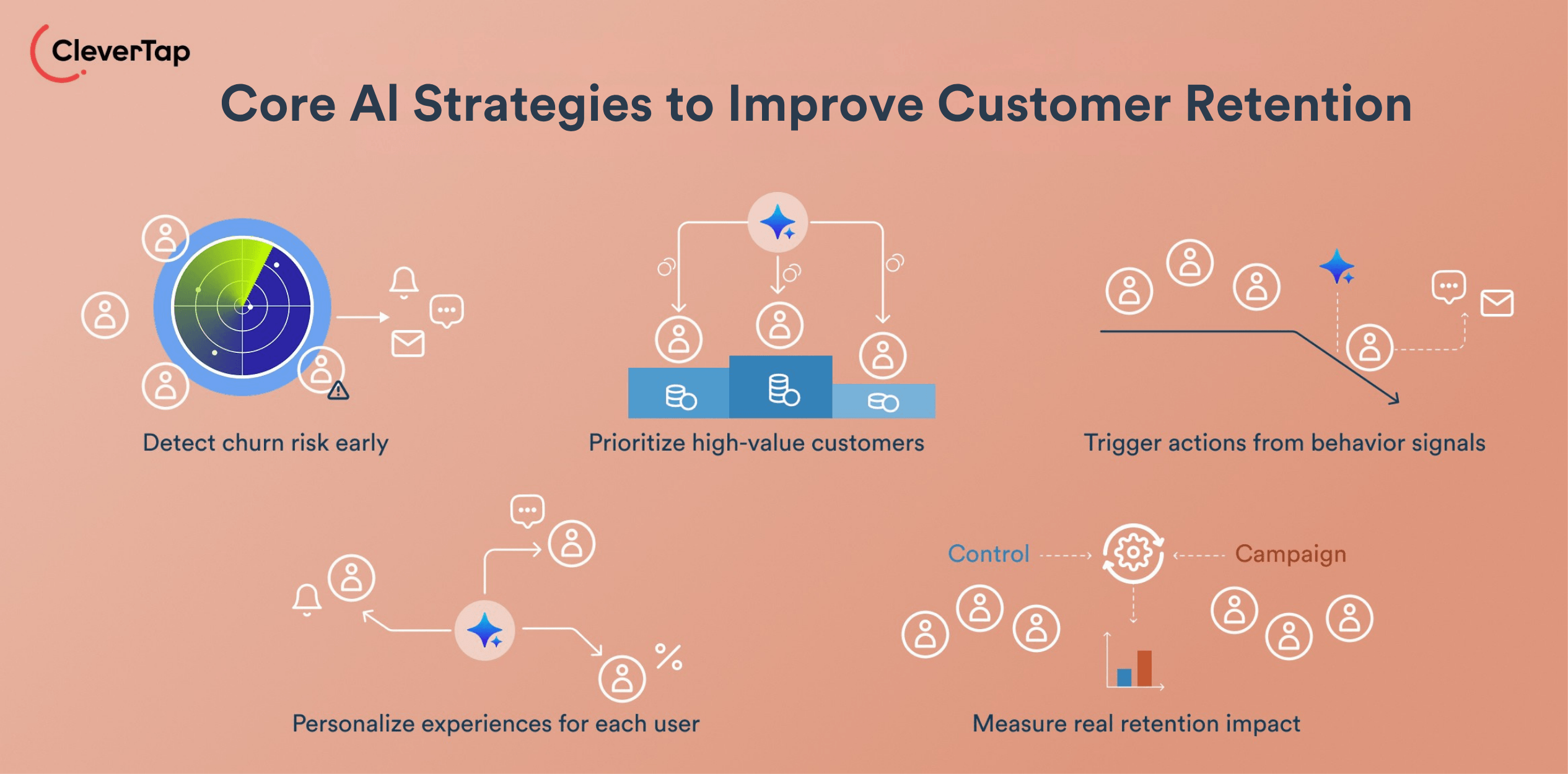
The strategic pillars below define how AI delivers retention impact. Each strategy ties to key metrics like churn rate, repeat purchase frequency, or LTV.
Together, these strategies shift retention from isolated interventions to a coordinated, data-driven system.
1. Predictive Retention Strategy
Predictive retention uses machine learning models to spot churn risk early. These models continuously score each customer’s behavior, such as declining logins, reduced purchases, etc., and flag high-risk users before they leave.
For example, if a frequent app user suddenly stops engaging for a week, the AI identifies this as an early churn signal and triggers an intervention like sending a personalized offer. This proactive approach replaces the old reactive model of chasing customers after they have already churned.
The key advantage is timing. Intervening even a few days earlier can significantly increase the probability of recovery, especially in habit-driven products.
Companies using AI-driven churn prediction detect at-risk customers faster and achieve better retention. Key metrics include a reduction in overall churn rate and risk migration, which is defined as the share of users moved from high-risk to low-risk groups. Models should be continuously validated by comparing predicted churn to actual outcomes over time.
2. Value-Based Retention Strategy
Value-based retention allocates resources by customer LTV. If AI predicts one at-risk user will spend $1,000 and another $50 over their lifetime, the system prioritizes the higher-value user. This might mean offering richer incentives or more one-to-one outreach to the $1,000 user.
This shifts retention from equal treatment to economic prioritization, where effort and budget are aligned with expected return. An AI platform automatically scales incentive budgets based on predicted LTV. For example, premium support or larger vouchers can be reserved for top-tier customers, while lower-tier customers receive simpler rewards.
However, this approach requires guardrails. Over-incentivizing high-value users can erode margins if not balanced with incrementality testing. The outcomes are higher ROI on retention spend and increased aggregate lifetime value. Teams measure impact by tracking LTV lift and revenue captured from high-value segments.
3. Real-Time Engagement Strategy
AI shifts engagement from static and scheduled campaign calendars to intelligent, behavior-driven orchestration. Instead of waiting for scheduled sends, AI systems process event streams in real time, track logins, purchases, session drops, and identify meaningful deviations. These deviations act as signals, triggering retention actions at precisely the right moment.
At the core is signal processing. Machine learning models define thresholds for change. For example, the threshold can be a 40% drop in purchase frequency or a missed habit loop. When a user crosses that threshold, the system automatically transitions their lifecycle state from active to dormant, or engaged to at-risk, and triggers the next-best action.
However, real-time engagement is only effective when paired with prioritization. Without it, faster messaging can increase volume without improving outcomes
This approach enables real-time orchestration across push, email, in-app, or SMS, ensuring customers receive timely, context-aware messages. For example, an AI system might detect a drop-off in session frequency and trigger a push offer within minutes.
4. Adaptive Personalization Strategy
Traditional personalization relies on static rules like showing Product A to Segment B. AI replaces this with adaptive learning models that evolve based on individual behavior, context, and response history. Rather than one-size-fits-all logic, machine learning models evaluate what content, offer, or channel a specific user is most likely to engage with at that moment.
These models learn continuously. If a user starts ignoring emails but responds to in-app messages, the system adapts automatically. If they respond better to social proof or urgency cues, future messages will emphasize those attributes. Personalization is no longer limited to content; it extends to timing, format, channel, and sequence.
This moves personalization from predefined segments to continuously evolving individual-level decisions.
This real-time adaptability significantly boosts retention. According to McKinsey, AI-powered personalized experiences can lift customer satisfaction by 15-20%, increase revenue by 5-8% percent, and reduce the cost to serve by 20-30%. Adaptive personalization ensures every retention touchpoint is not just targeted, but also optimized for individual conversion potential.
The challenge is maintaining relevance without over-personalization, which can increase complexity without proportional gains.
5. Incrementality-Driven Retention Strategy
AI-driven retention must go beyond correlation to prove causation. By using uplift modeling, A/B testing, or control groups, marketers can isolate the true effect of a campaign on retention outcomes.
For example, rather than measuring campaign success through opens or click rates, teams can ask: Did this action measurably increase retention versus doing nothing? AI can help identify the movable middle, i.e., users who are persuadable, and suppress campaigns to those unlikely to respond or already likely to convert. This reduces noise and wasted spend. This also prevents overspending on users who would have converted anyway, improving overall campaign efficiency.
Over time, these experiments feed back into the AI models, improving targeting precision and ROI. Controlled experimentation also enables defensible attribution, which is critical for budgeting and executive reporting. Incrementality ensures retention programs drive measurable, net-new value.
Tactical AI Applications That Operationalize These Strategies
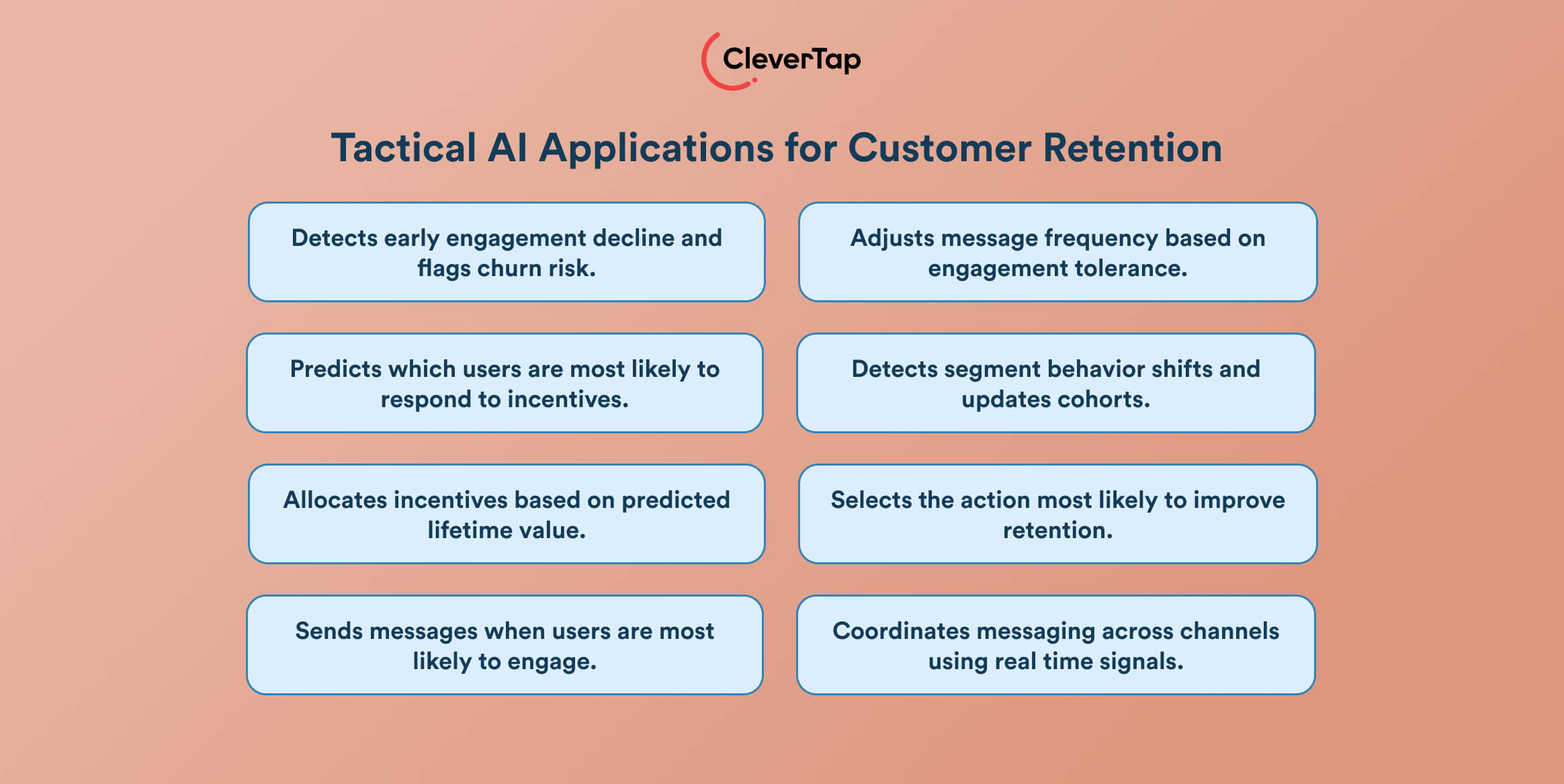
The strategic value of AI in customer retention becomes tangible only when it’s embedded into specific, repeatable workflows. Below are eight AI-powered tactics that transform decision-making into measurable execution.
These tactics translate high-level strategy into day-to-day execution, where most retention programs either succeed or break down.
1. Dynamic Churn Risk Windows
AI identifies churn as a progressive behavioral shift. By modeling each user’s normal engagement rhythm, it flags early signs of risk based on deviations, such as fewer logins, slower purchase frequency, or skipped habit loops. These velocity changes trigger a risk score increase, prompting timely, context-aware interventions.
Instead of waiting for arbitrary inactivity thresholds, e.g., 30 days, brands can act within 1–3 days of detected decay. This tactic directly supports predictive retention, allowing marketing teams to reach customers before disengagement sets in. Key outcomes include reduced churn rate and faster time-to-recovery.
The key advantage is shifting from fixed inactivity rules to behavior-based detection, which better reflects how churn actually develops.
2. Propensity-Based Offer Targeting
Rather than sending blanket offers to everyone, AI predicts which users are most likely to respond positively to a specific incentive. It evaluates both the likelihood to convert and the expected uplift compared to doing nothing, focusing spend only on movable middle users.
High-value customers who would convert anyway don’t get unnecessary discounts, while unresponsive users are excluded. This improves ROI and reduces offer fatigue. Propensity modeling operationalizes incrementality-driven retention and value-based prioritization, allowing teams to scale smarter, not louder.
This ensures that incentives drive incremental behavior change, not just reward actions that would have happened anyway. Marketers can expect measurable improvements in redemption rates, cost efficiency, and campaign-attributed retention gains.
3. LTV-Weighted Incentive Allocation
Every dollar spent on retention should yield future value. AI models assign predicted customer lifetime value scores to each user and optimize incentive investment accordingly. For instance, a high-LTV at-risk user might receive a $20 discount, while a low-LTV user may get a light-touch reminder.
This ensures that retention spend maps directly to revenue potential. This tactic operationalizes value-based retention by aligning resource intensity with expected payoff. Measurable outcomes include improved ROI per incentive dollar, reduced spend on low-return users, and greater overall LTV from retained cohorts.
The effectiveness of this approach depends on accurate LTV prediction, which requires sufficient historical data and continuous model validation.
4. AI-Driven Send-Time Optimization
Timing affects whether a user opens or ignores a message. AI models analyze each user’s past engagement behavior to predict the best delivery windows per channel and per user.
For example, some users might engage more on weekday mornings via email, while others prefer push notifications in the evening. These delivery preferences are updated dynamically as patterns change.
By personalizing timing at scale, this tactic boosts open and click rates without changing content or audience. It supports adaptive personalization and real-time orchestration, and typically results in higher message visibility, lower bounce rates, and stronger session reactivation. However, timing optimization alone does not improve outcomes unless the message itself is relevant and well-targeted.
5. Intelligent Frequency Governance
Too many messages can lead to fatigue, while too few can cause missed opportunities. AI governs frequency by modeling each user’s sensitivity to contact volume. If engagement drops after three weekly messages, the system auto-throttles future sends. Conversely, if a user continues to engage, frequency can be increased within safe bounds.
This tactic directly supports incrementality and long-term retention curve health. It maintains optimal cadence to prevent opt-outs while maximizing engagement. Key performance indicators include reduced unsubscribes, higher engagement per message, and more stable LTV curves across lifecycle stages. This replaces static frequency caps with adaptive controls that respond to individual user behavior.
6. Behavioral Cohort Drift Detection
Segments that perform well today may not stay consistent. AI continuously monitors behavioral patterns within cohorts and detects when users begin to diverge. For example, if a power user segment starts logging in less often or engaging with different features, AI flags drift and suggests segment reclassification.
It can automatically split, merge, or reconfigure cohorts based on updated activity trends. This ensures that engagement logic stays relevant as user behavior evolves.
The behavioral cohort drift detection supports predictive and adaptive strategies, keeping journeys effective over time. Measurable benefits include improved segment performance and longer engagement duration. Without this, segments gradually lose accuracy, leading to declining campaign performance over time.
7. Next-Best-Action Modeling
At every touchpoint, there’s an optimal action to retain the user. Next-best-action (NBA) modeling uses AI to evaluate available tactics, which can be to send an email, push, show an in-app message, offer a discount, and select the one with the highest predicted impact on retention or revenue.
The model takes into account user preferences, timing, prior actions, and campaign performance. NBA models reduce guesswork, enabling highly targeted decision-making at scale. This tactic brings together real-time engagement and value-based prioritization, helping marketers automate personalized experiences with measurable lift.
KPIs include uplift in conversion rate, retention rate, and customer lifetime value. The challenge lies in ensuring models remain interpretable and aligned with business goals, rather than becoming opaque decision systems.
8. Cross-Channel Orchestration
Modern customers interact across push, email, SMS, in-app, and many other channels. Without proper campaign orchestration, users risk receiving disjointed or repetitive messages. AI coordinates outreach across channels based on real-time behavior and preferences.
For instance, if a user doesn’t open a push notification, the system might follow up with an SMS. AI also ensures no overlap, avoiding the same message being sent via multiple channels simultaneously.
This tactic is central to real-time and adaptive engagement, ensuring message flow feels intuitive and not spammy. Measured results often include higher total reach, increased cross-channel conversion rates, and improved net retention. Effective orchestration depends on unified user data, without which channel coordination becomes fragmented and inconsistent.
Data and Infrastructure Requirements for AI-Driven Retention
AI-powered retention cannot succeed without a solid data and systems foundation. To move from rules-based automation to intelligent orchestration, teams need infrastructure that enables real-time insights, experimentation, and learning at scale. In practice, the biggest constraint is not the availability of AI models, but the quality, consistency, and accessibility of underlying data.
At the core is a unified customer profile. All identity, behavioral, and transactional data across web, app, CRM, and support must be stitched into a single view. This foundation allows AI models to analyze complete lifecycle context and make decisions at the individual level.
Equally essential is event-level behavioral tracking. Every user action, like logins, feature usage, purchases, and time-in-app, should be captured with timestamped precision. These events feed into real-time scoring engines that detect churn risk or purchase intent based on micro-behavioral shifts.
To activate this intelligence in the moment, companies need:
- Real-time data ingestion: Streaming infrastructure ensures data updates customer states and triggers journeys without delay. This is critical for use cases like churn risk windows or next-best-action modeling. Without near real-time data flow, even well-trained models will act too late to influence user behavior.
- Historical data depth: AI models require a robust history for training. In many cases, this spans several months to years of behavioral and revenue data, depending on business complexity. Shallow or siloed data will reduce model accuracy and generalizability.
- Experimentation framework: The tech stack must support control groups, A/B tests, and lift measurement. Without this, teams can’t validate whether AI-driven actions truly improved retention or LTV. This is critical because AI-driven decisions can appear effective without actually driving incremental impact.
- Model monitoring and governance: Teams must continuously track model performance, detect drift, retrain as needed, and ensure compliance, privacy, fairness, and explainability. Without monitoring, model performance can degrade over time as user behavior and market conditions change.
Measuring the Business Impact of AI for Customer Retention
AI’s value in retention must be proven through rigorous, outcome-based measurement instead of relying on assumptions or vanity metrics. The focus should be on causation over correlation, using structured experiments and holdouts to isolate true business impact.
Without this, improvements in engagement or conversion may be incorrectly attributed to AI rather than underlying user behavior.
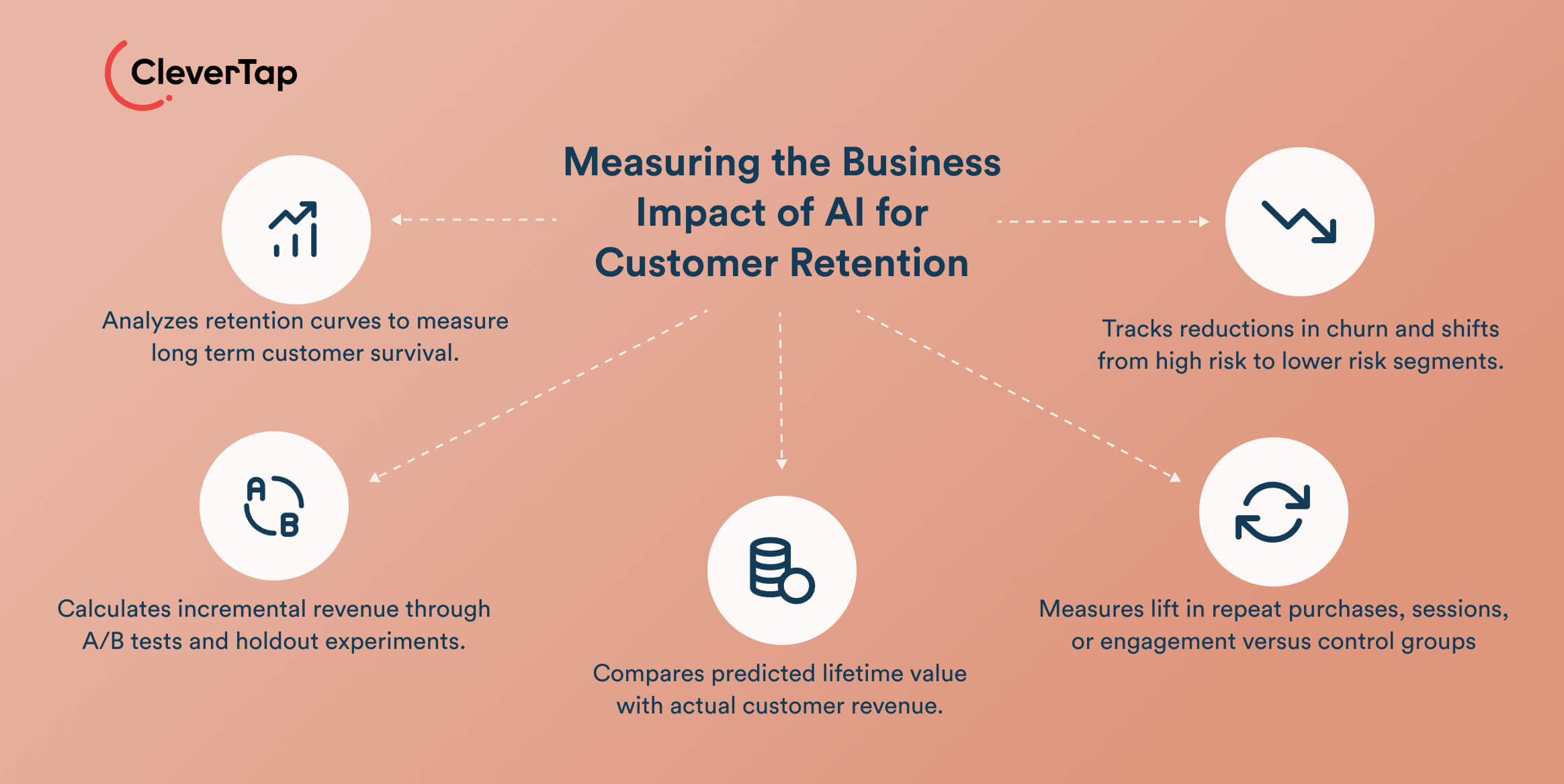
Here’s how to measure it effectively:
- Churn reduction and risk migration: Track changes in overall churn rate after AI deployment, and quantify how many customers transition from high-risk to lower-risk segments. This reflects the system’s ability to predict and reverse churn behavior. Risk migration is particularly useful because it shows whether interventions are actually changing user trajectories, not just outcomes.
- Lift in repeat purchase frequency or engagement: Measure increases in session frequency, purchase events, or ARPU among customers receiving AI-driven interventions. Compare these metrics to control groups to identify meaningful lift in engagement and transactional behavior. Control groups are essential here to distinguish true impact from natural user activity patterns.
- Improvement in predicted vs. actual LTV: Evaluate how well the AI forecasts lifetime value by comparing predicted outcomes to realized customer revenue. Strong convergence indicates reliable modeling and high-impact orchestration. This also helps validate whether LTV-based prioritization is aligned with real business outcomes.
- Incremental revenue via controlled experiments: Use A/B testing or randomized holdouts to measure the net-new revenue generated by AI. Calculate incremental ROI to determine whether a campaign caused the behavior change instead of just coinciding with it. This is one of the most reliable ways to justify retention investments at a leadership level.
- Retention curve improvements over time: Plot survival curves for AI-exposed cohorts. A slower rate of drop-off signals stronger long-term retention. These trends provide a holistic view of AI’s compounding impact on customer lifetime. Over time, improvements in retention curves often matter more than short-term campaign lift, as they reflect sustained behavior change
How CleverTap Enables AI for Customer Retention at Scale
AI-driven retention requires more than individual capabilities like prediction or personalization. It depends on how well data, decisioning, and execution are connected into a single system. CleverTap, an all-in-one engagement platform, supports both AI-driven retention by leveraging real-time customer data, predictive intelligence, and cross-channel engagement.
Here’s how it turns strategy into execution:
At the core of this system is CleverAI™, an intelligence layer that combines predictive, generative, and agentic AI to power decision-making across the customer lifecycle.
Unified Real-Time Customer Data Foundation
CleverTap captures behavioral, transactional, and campaign data across mobile, web, and offline touchpoints. This is unified into a 360° real-time customer profile, enabling precise lifecycle decisioning and predictive modeling.
This data foundation is supported by a real-time data layer that ensures AI models and campaigns operate on live user context rather than delayed or fragmented signals. This is critical for retention use cases where timing directly affects conversion probability.
Built-in Predictive Models
The platform includes prebuilt AI models with no manual setup required. These are:
- Churn Prediction: Scores each user’s likelihood to churn based on activity decay and lifecycle signals.
- Conversion Propensity: Identifies users likely to convert, allowing smarter offer allocation.
- LTV Forecasting: Projects long-term value, enabling value-based retention prioritization.
These models continuously learn from user behavior and improve over time, allowing predictions to adapt as engagement patterns change. They also provide explainability signals, helping teams understand why a user is predicted to churn or convert, rather than treating predictions as black-box outputs.
AI-Powered Decisioning With CleverAI Agents
CleverAI operates through a system of specialized CleverAI Agents designed to help teams decide, create, and act based on business goals described in plain language.
- Decision Agents analyze behavioral signals and generate outputs such as churn probability, conversion likelihood, next-best actions, and user insights. They also surface the reasoning behind predictions, improving transparency and trust.
- Creative Agents generate personalized, brand-aligned content, including copy and visuals. These outputs are informed by historical campaign performance and can be adapted for localization and experimentation.
- Action Agents operationalize decisions by building journeys, triggering campaigns, and optimizing paths in real time based on user engagement signals.
- Strategy Agents act as coordination layers, defining goal-driven plans such as improving retention or increasing LTV, and orchestrating other agents to execute those plans effectively.
This agent-based system reduces manual effort while maintaining a human-in-the-loop approach, where teams review and approve outputs before activation.
AI-Powered Journey Orchestration
CleverTap’s Journey Builder enables marketers to orchestrate lifecycle experiences at scale. With CleverAI, journeys evolve from static flows into adaptive systems that continuously adjust based on user behavior, predictions, and campaign performance.
- Journey Builder auto-generates retention flows aligned to a business goal.
- Path Optimizer selects the best-performing journey path in real time based on engagement.
- Intent-Based Segmentation automatically builds predictive segments such as “likely to drop off” or “high-conversion potential.”
This allows teams to move from manually configured journeys to continuously optimized lifecycle systems that respond dynamically to user intent.
Multi-Channel Engagement Engine
CleverTap engages users across push, in-app, email, SMS, WhatsApp, and more. AI ensures contextual delivery:
- Send Time Optimizer sends each message at the predicted moment of highest engagement.
- Channel Optimizer selects the most effective channel per user based on past response behavior.
This ensures that engagement is optimized across multiple dimensions, including timing, channel, and user context, not just message content. It also reduces channel fatigue by avoiding redundant or overlapping communication across touchpoints.
Built-in Experimentation and Analytics
The platform comes with channel- and journey-level analytics that track delivery, engagement, and conversion outcomes. Marketers can compare performance across campaigns, segments, and touchpoints.
In CleverTap, campaigns are directly connected to downstream metrics such as retention, conversions, and revenue. These insights feed into funnels, cohort analysis, and reporting dashboards, allowing teams to understand how engagement impacts long-term user behavior.
Native support for A/B testing, control groups, and lift analysis ensures that AI-driven actions are measured for incremental impact, not just surface-level engagement. These insights also feed back into CleverAI models, enabling continuous learning and optimization of retention strategies.
By combining real-time data, predictive intelligence, agent-based decisioning, and continuous experimentation, CleverTap enables teams to move from fragmented retention tactics to a unified, intelligence-driven system that drives measurable improvements in retention and lifetime value.
This allows marketers to shift from campaign execution to system-driven growth, where every interaction is optimized for long-term value.
See how CleverTap helps you turn AI-driven retention into a scalable and measurable growth engine.
Put Predictive Retention Into Practice
AI is transforming retention from guesswork into a precise science. By combining predictive scoring, value-based targeting, real-time orchestration, adaptive personalization, and rigorous testing, marketers can achieve substantial ROI, higher lifetime value, lower churn, and stronger customer loyalty.
The key is not just implementing these capabilities, but measuring their impact consistently. When you act on continuous insights and experimentation, retention programs become powerful growth engines. AI shifts retention from reactive campaigns to a more continuous and data-informed lifecycle process. The future of retention is intelligent and outcome-focused, making it a driver of growth.
CleverTap helps bring this approach into practice by connecting real-time data, predictive intelligence, and cross-channel execution into a single system, making it easier to move from isolated campaigns to a measurable retention strategy. To see how this works in practice, schedule a demo with CleverTap.

Agnishwar Banerjee 
Leads content and digital marketing.Expert in SaaS sales, marketing and GTM strategies.
Free Customer Engagement Guides
Join our newsletter for actionable tips and proven strategies to grow your business and engage your customers.