























Table of Contents
Categories
Most Popular


Conversion funnel optimization helps teams understand how users move through a journey and where conversions are lost. Instead of treating conversion as a single event, it focuses on improving each stage of the funnel, from initial interaction to final action
Drop-offs often stem from unclear messaging, mismatched expectations, slow load times, confusing interfaces, or poorly timed nudges. By closely examining user behavior at every stage, teams can identify these bottlenecks and make targeted improvements by refining copy, simplifying UX flows, reducing cognitive effort, and aligning value propositions with user intent.
Data plays a central role in marketing funnel optimization. High-performing teams rely on behavioral data, cohort analysis, and real-time insights to validate assumptions, prioritize changes, and measure impact with confidence. By linking funnel optimization insights to lifecycle engagement, teams can close gaps immediately.
Platforms like CleverTap help bridge this gap by connecting funnel analytics with real-time engagement, enabling teams to act immediately on insights.
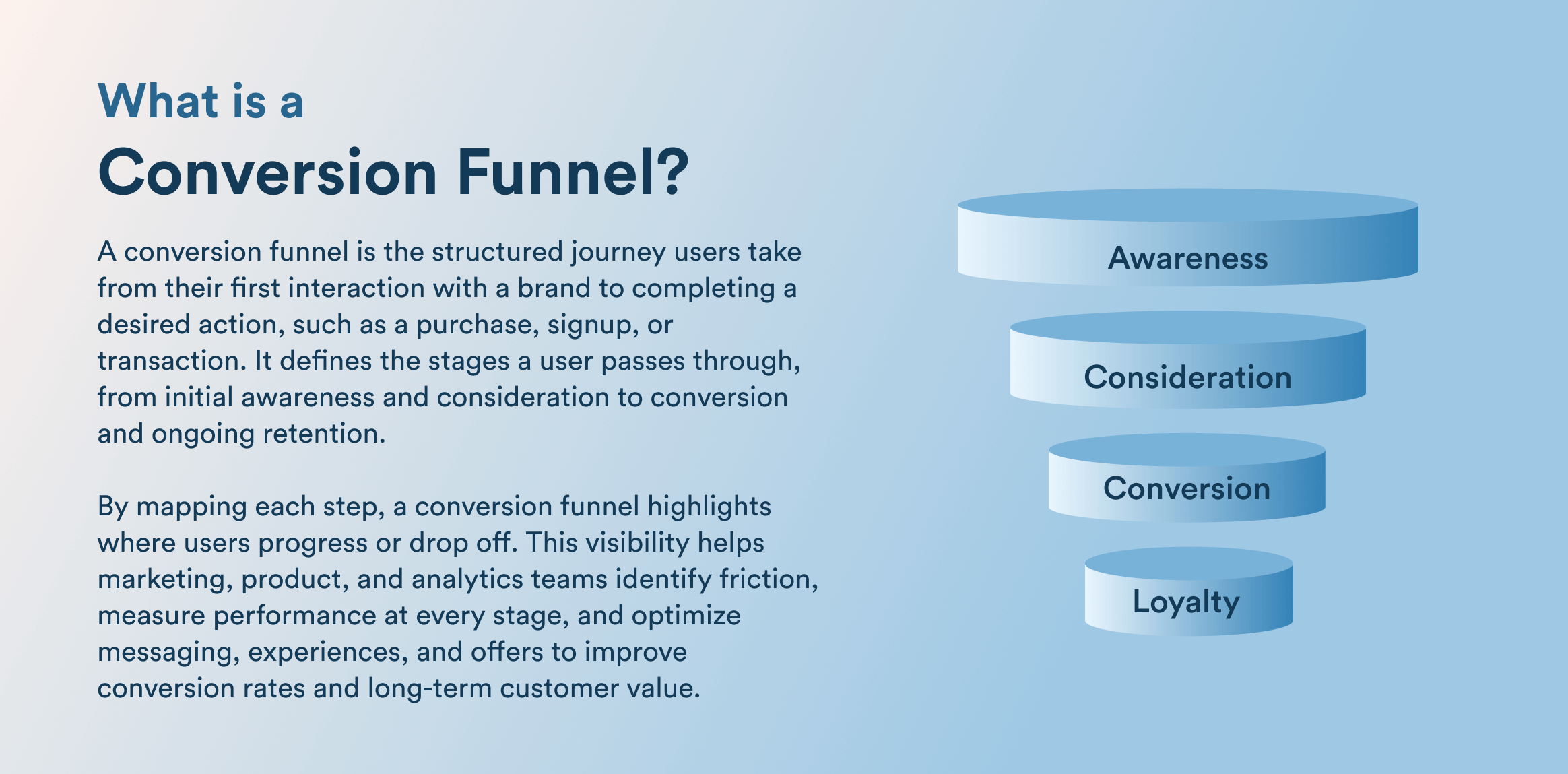
What Is a Conversion Funnel?
A conversion funnel is the staged path users follow from first learning about your product to taking a desired action, such as making a purchase or signing up. The funnel typically spans from awareness at the top to action or retention at the bottom.
For example, an e-commerce funnel might have stages like the following:
- Awareness
- Product Discovery
- Cart
- Checkout
- Purchase
- Retention
A mobile app conversion funnel might include the following stages:
- Install
- Account Signup
- Feature Onboarding
- First Transaction
- Repeat Use
In each industry, the steps look different. Apps have installs and onboarding, SaaS companies have trial signups and activation milestones, and fintech products have KYC and usage stages. However, the idea remains the same: to guide users from their first touch to conversion.
The Purpose of a Conversion Funnel
The funnel’s purpose is to guide customers to the final conversion step. It exists to maximize the number of people who complete the final conversion by continuously improving the path they take.
A well-defined funnel helps businesses measure conversion rates at each stage to know how many people advance or drop out from awareness to action. It provides a shared roadmap for marketing, product, and analytics teams to focus efforts.
Why Funnels Break
Funnels break when friction or misalignment causes users to leave instead of advancing. Drop-offs can happen for many reasons, including the following:
- Confusing navigation
- Slow pages
- Unclear messaging
- Missing trust signals
- Mis-Targeted offers
A conversion funnel analysis helps identify where users abandon the process. For instance, if a checkout page is too slow or has extra fields, many users may exit there. Similarly, showing generic ads to high-intent users can cause lost interest.
Role of User Intent in Funnel Performance
User intent plays a crucial role in funnel conversion. Two funnels that look the same on paper can perform very differently depending on who’s in them. The quality of traffic can vary greatly by channel and audience. For example, email or branded search traffic usually indicates higher intent than generic social visitors. Research shows that email marketing campaigns often convert around 15.2% of recipients, whereas the benchmark for social channels is around 3%.
Part of optimization is segmenting by intent. Tailor messaging and offers to where users are in their journey. High-intent users might get direct purchase prompts, while new prospects may need more educational content. By aligning funnel steps with user intent and traffic source, you minimize mismatches that cause drop-off.
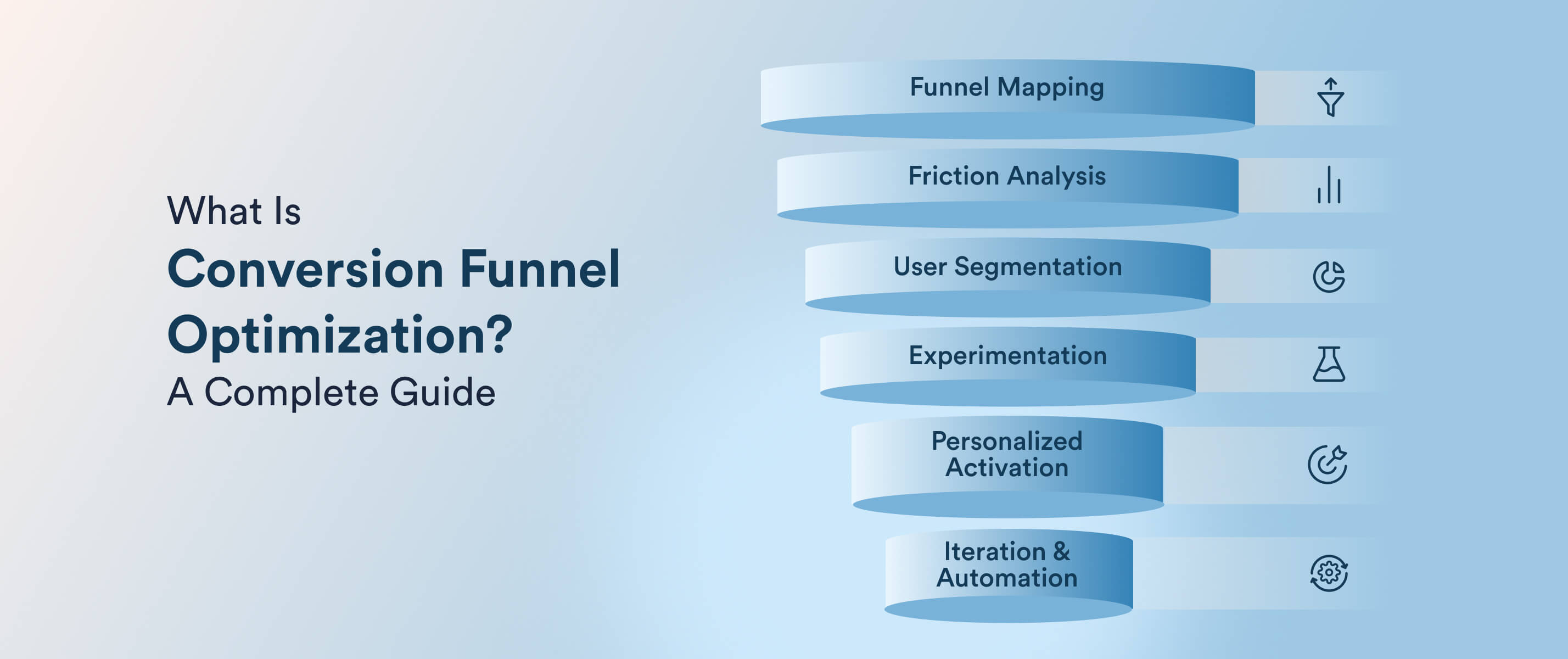
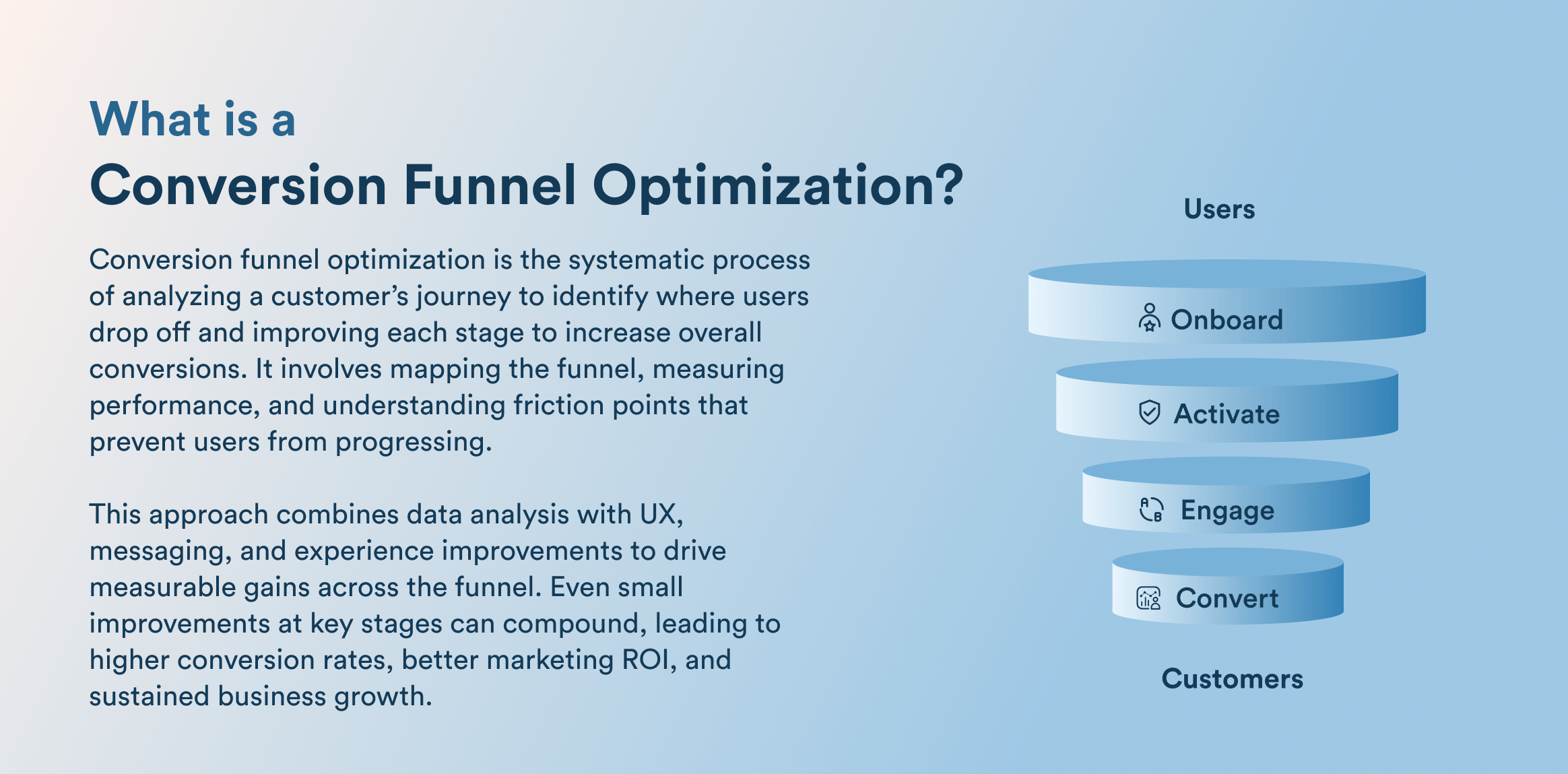
What Is Conversion Funnel Optimization?
Conversion funnel optimization is the systematic discipline of improving how users progress from one stage to the next within a defined journey. It goes beyond identifying drop-offs and focuses on understanding why those drop-offs occur, what behavioral signals precede them, and which interventions can meaningfully improve progression.
The process blends quantitative funnel analysis with qualitative insight, experimentation, behavioral segmentation, and experience refinement. Teams map user journeys, isolate friction points, generate structured hypotheses, test variations, and implement changes that improve both immediate conversion and downstream retention.
Rather than treating conversion as a static KPI, funnel optimization treats it as an evolving system that continuously adapts based on user behavior and performance data.
Why Funnel Optimization Matters for Growth
Funnel optimization is critical for growth because small percentage gains compound dramatically through the funnel. Improving conversiomn at each step has a cumulative, larger downstream impact. For example, if 10,000 visitors enter the funnel, a 2% increase in early-stage conversions could result in hundreds more sales. That directly impacts ROI on marketing spend. Moreover, by debugging the funnel, teams learn which stages have the most leverage.
How Funnel Optimization Impacts Retention
While funnels often focus on the path to first conversion, the impact of optimization extends to retention and lifetime value. An optimized funnel sets the stage for ongoing engagement. For example, a frictionless onboarding or checkout experience tends to build trust, making customers more likely to come back.
Many optimizations, like tailored messaging or personalized product recommendations, can be applied post-purchase as well, effectively turning a marketing funnel into a retention funnel. By contrast, a leaky funnel can frustrate customers, pushing them to competitors. Teams can use funnel analytics to design win-back flows and loyalty programs, ensuring the funnel feeds a retention engine as well.
Choosing the right analytics tool matters. Discover the top 10 funnel analysis tools and how they compare.
Optimized vs Unoptimized Funnel Example
For better understanding, consider a mobile app’s user journey.
In an unoptimized scenario, only 20% of users return after the first install, and a mere 10% complete a purchase. This indicates a severe drop-off after initial interest.
Through funnel analysis, the team might learn that their onboarding flow is confusing, and no incentive exists to convert first-time buyers. After optimization efforts such as streamlining signup, showing value quickly, and avoiding cart-upset upsells for new users, conversion can dramatically improve.
The Six-Stage Conversion Funnel Optimization Framework
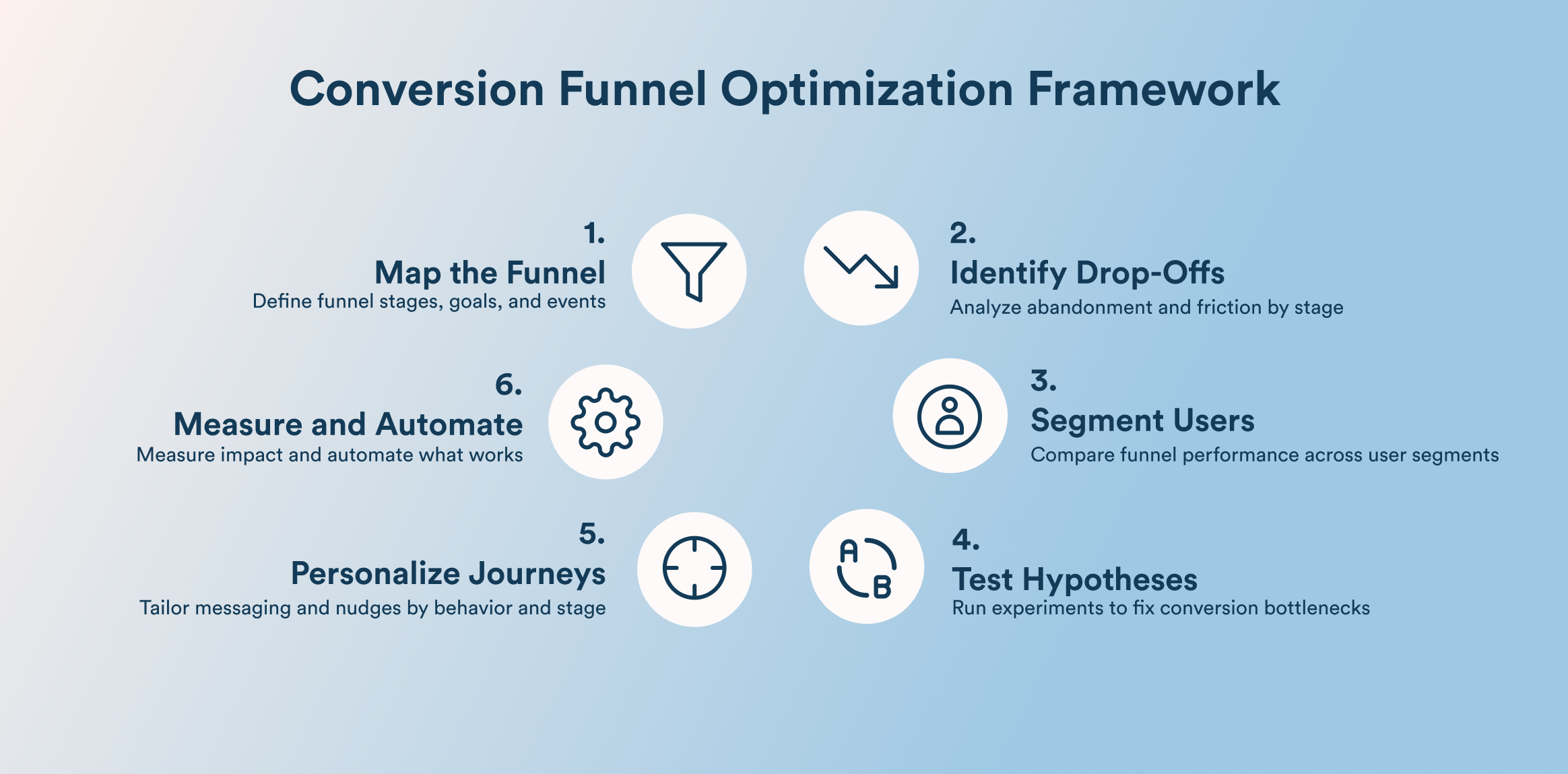
To make funnel optimization repeatable, it helps to follow a structured framework rather than relying on one-off fixes or intuition. By breaking the process into clear stages, teams can align analytics, experimentation, and optimization efforts, making it easier to prioritize changes that have the highest impact on conversion performance.
Stage 1: Map Your Existing Funnel and Events
First, define your funnel stages and key events. This means using analytics to map out each step a user takes toward conversion.
You can start by setting clear goals and essential metrics for your funnel. For example, for e-commerce, it might be transactions, for an app, it could be sign-ups or purchases. Ensure the events are instrumented correctly so you can see the number of users at each stage. This baseline map gives you visibility and helps validate that your data is complete before you try to fix anything.
Stage 2: Identify Drop Off Points and Friction Areas
Next, analyze where users drop off. Look for steps with unusually high abandonment rates. Create visual funnel reports to see the percentage conversion between each stage. For example, if 1,000 users view a product but only 100 add to cart, the drop from product page to cart is a 90% fall-off.
Common friction points include confusing forms, a lack of information, or an unexpected step, like forcing account creation too early. Document each suspected bottleneck so you can test targeted improvements.
Stage 3: Segment Users for Funnel Insights
Conversion rates often vary by user segment, so break down the funnel by key segments. Compare how different groups progress through the funnel. You can look at mobile vs desktop users, new vs returning customers, marketing channel sources, or demographic cohorts.
Such segmentation reveals nuanced insights. You may see that one traffic source yields high-intent users and high conversion, while another brings low-intent users. Use these findings to prioritize fixes. Focus first on the segments and stages with the biggest gaps.
Stage 4: Run Hypotheses and Experiments to Improve Conversion
With drop-offs identified and segments understood, generate hypotheses and run experiments. For each friction point, brainstorm a change that might fix it. Then A/B test it or run an experiment if you have enough traffic. For example, if cart abandonment is high, hypothesize that adding a progress indicator or simplifying checkout will lower abandonment. Implement the change for a test group and measure its impact on the funnel.
Stage 5: Personalize Messaging and Activation Steps
Once experimentation identifies which changes improve progression, personalization operationalizes those learnings at scale by tailoring experiences to users based on their behavior and funnel stage.
Hypothesize changes often point to personalized solutions. Tailor your messaging, offers, and experience based on user behavior and stage. Show different content to different segments, and use targeted channels and timing. This step involves setting up dynamic content, user journeys, and campaign flows to nudge users through the funnel seamlessly.
One approach is using lifecycle campaigns. For example, send a re-engagement email to users who hit a mid-funnel stage but didn’t convert, or trigger an in-app tip when a user reaches a new screen.
Stage 6: Measure, Iterate, and Automate
Finally, measure the impact of your changes, iterate on results, and automate what works. Gather funnel metrics after implementing tests and personalization. Calculate conversion rates, lift, and statistical significance. Use these insights to refine your hypotheses and run another cycle.
Over time, funnel optimization becomes an ongoing feedback loop. Wherever possible, automate repetitive processes. Set up automated journeys that trigger when any new user takes a certain action or falls out of the funnel. Tools like CleverTap enable automation by providing predictive segmentation and real-time funnel analytics so you can continuously iterate without manual intervention.
Key Components of a High-Converting Funnel
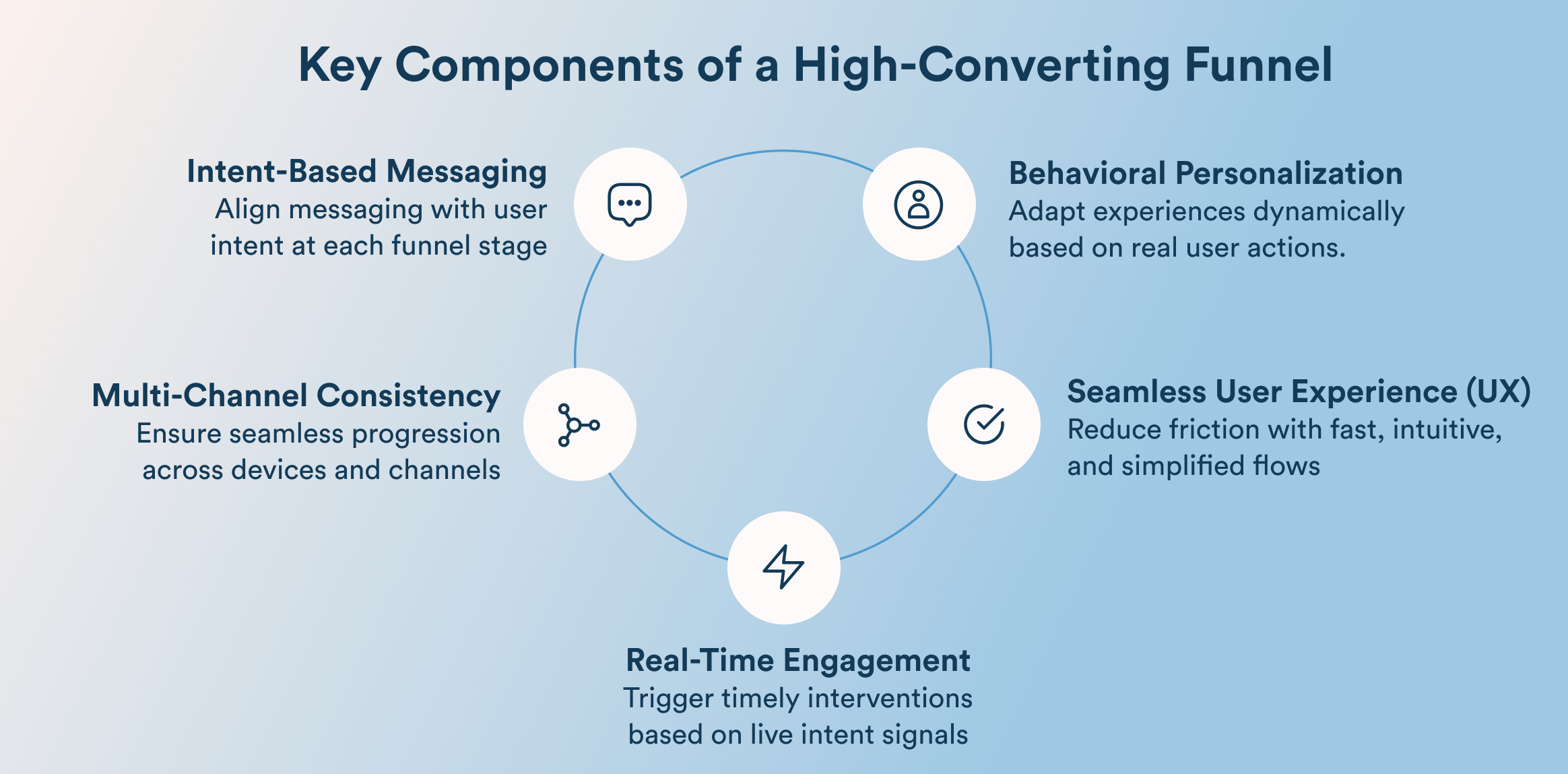
Conversion funnel optimization relies on certain core elements that work together to guide users smoothly from initial interest to final conversion. When these components are aligned, the funnel feels intuitive, relevant, and frictionless rather than forced or transactional.
- Intent-Based Messaging
Align communication with user intent at each funnel stage. Top-of-funnel (TOFU) messaging should educate and clarify value, while bottom-of-funnel (BOFU) messaging must reduce risk through social proof, urgency, and clear CTAs. Misaligned messaging, such as pushing sales too early, often increases drop-offs instead of conversions.
- Behavioral Personalization
Optimize experiences based on real user actions, not static segments. Browsing behavior, repeat visits, feature usage, and engagement depth should dynamically influence content, recommendations, and follow-ups. Personalization driven by behavior improves relevance and accelerates progression through the funnel.
- Seamless User Experience (UX)
Remove friction at every step. Fast load times, mobile-first layouts, intuitive navigation, and minimal form fields are essential. Small UX improvements, such as auto-filled inputs, simplified checkouts, or reduced visual clutter, can produce gains by eliminating hesitation at high-intent moments.
- Real-Time Engagement
Act on intent signals while they are still fresh. Trigger contextual interventions, such as assistance, reminders, or incentives, when users stall, abandon carts, or show signs of uncertainty. Real-time responsiveness turns funnels into adaptive systems rather than fixed sequences.
- Multi-Channel Consistency
Maintain continuity across web, mobile, email, and paid channels. Users often switch devices before converting, and progress should persist seamlessly across touchpoints. Unified data and omnichannel orchestration prevent context-switching from becoming a source of drop-off.
Real World Conversion Funnel Optimization Examples
Real-world examples show how conversion funnel optimization works beyond theory. The examples below demonstrate how brands identify drop-offs, remove friction, and drive measurable gains across acquisition, activation, and retention.
Example 1: E-commerce Conversion Funnels
Amazon runs one of the most optimized e-commerce funnels globally, engineered to convert high-intent shoppers across product discovery, consideration, and purchase.
Amazon streamlines product discovery using personalized recommendations and SKU targeting based on browsing and search behavior. Persistent carts, one-click checkout, and transparent delivery timelines reduce friction at checkout. For cart abandonment, Amazon re-engages users through reminders and relevant offers tied to the exact products left behind. Trust signals such as reviews, ratings, and easy returns are surfaced throughout the journey.
These optimizations drive high purchase conversion, reduce abandonment, and increase repeat buying at scale.
In this way, Amazon shows how combining SKU targeting, discovery optimization, and cart-abandonment recovery creates a high-performing, conversion-led e-commerce funnel.
Example 2: Subscription or SaaS Funnels
Netflix’s subscription funnel is a great example of optimizing onboarding and first-use conversion in subscription businesses.
The company reduces friction by keeping sign-up flows short, minimizing required form fields, and clearly communicating value, such as content variety and flexible plans, before asking for payment details. The funnel is designed to move users smoothly from awareness to trial and then to subscription without unnecessary interruptions.
This streamlined, value-first approach enables Netflix to convert a significant share of trial users into paying subscribers at scale across global markets. It boasts a 93% conversion rate.*
Netflix demonstrates how lowering friction and delaying commitment can materially improve subscription conversion via an approach many SaaS and subscription brands aim to replicate.
Example 3: Fintech Funnels
Niyo, an Indian fintech brand, faced complexity in its mobile onboarding funnel, involving mobile verification, card selection, document upload, VKYC, and card activation. To streamline this multi-step process and reduce drop-offs, Niyo adopted CleverTap for automation and intelligent engagement powered by CleverAI.
Niyo used CleverTap to automate customized notifications and omnichannel journey flows tied to actual user behavior at each onboarding stage.
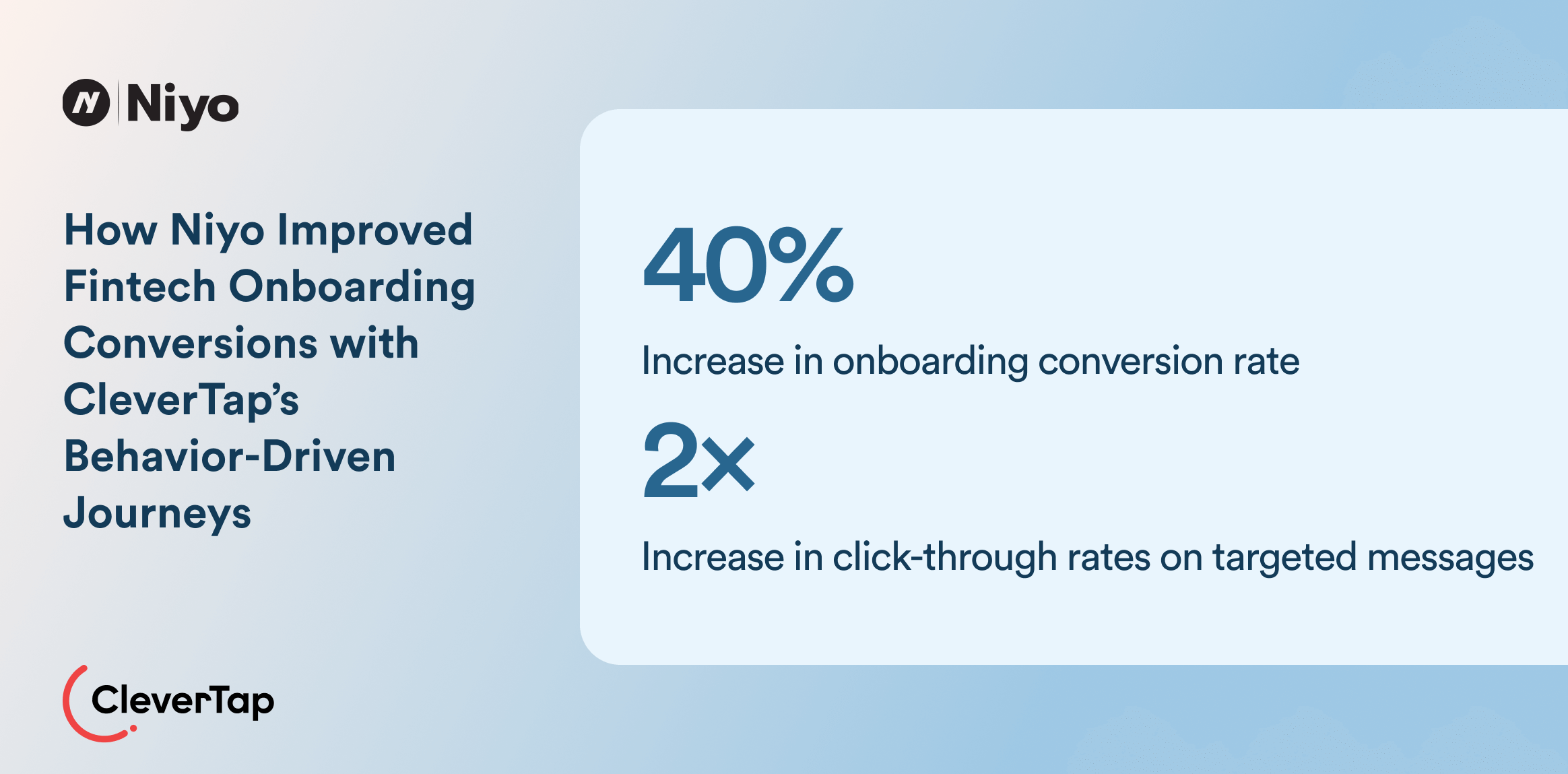
This tailored approach delivered a 40% conversion rate in the onboarding funnel and a 2X increase in click-through rates on targeted messages.
By linking real-time behavioral guidance with compliance-aware funnels, Niyo reduced friction across a regulated, multi-step experience.
Example 4: Mobile App Funnels
MobiKwik, a leading Indian fintech app, aimed to reduce high uninstall rates and improve early-stage engagement by gaining clearer visibility into its onboarding and retention funnel.
Using CleverTap, the team analyzed early funnel drop-offs, implemented personalized onboarding and launch reminders, built behavioral retention cohorts, and ran targeted reactivation campaigns via SMS and email for users who had uninstalled.
MobiKwik used CleverTap to achieve a 20% reduction in uninstalls, a 2X increase in engagement, and 23–25% win-back of previously uninstalled users.
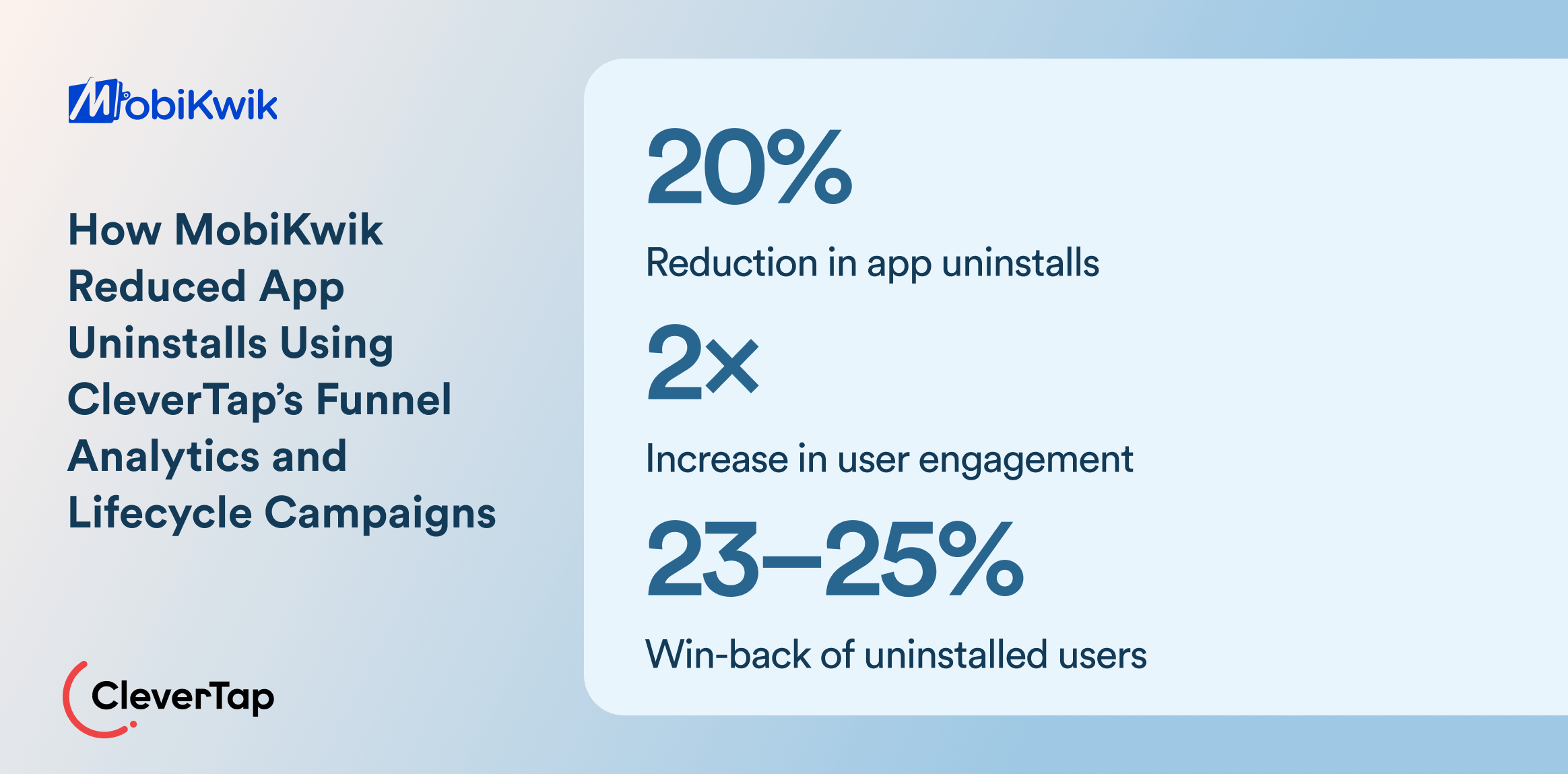
The case demonstrates how combining funnel analytics with lifecycle engagement drives measurable gains in retention and reactivation, not just initial conversion.
Funnel Optimization Techniques for Each Funnel Stage
Below are practical optimization techniques mapped to each stage of the funnel, focusing on reducing friction, increasing relevance, and moving users forward efficiently.
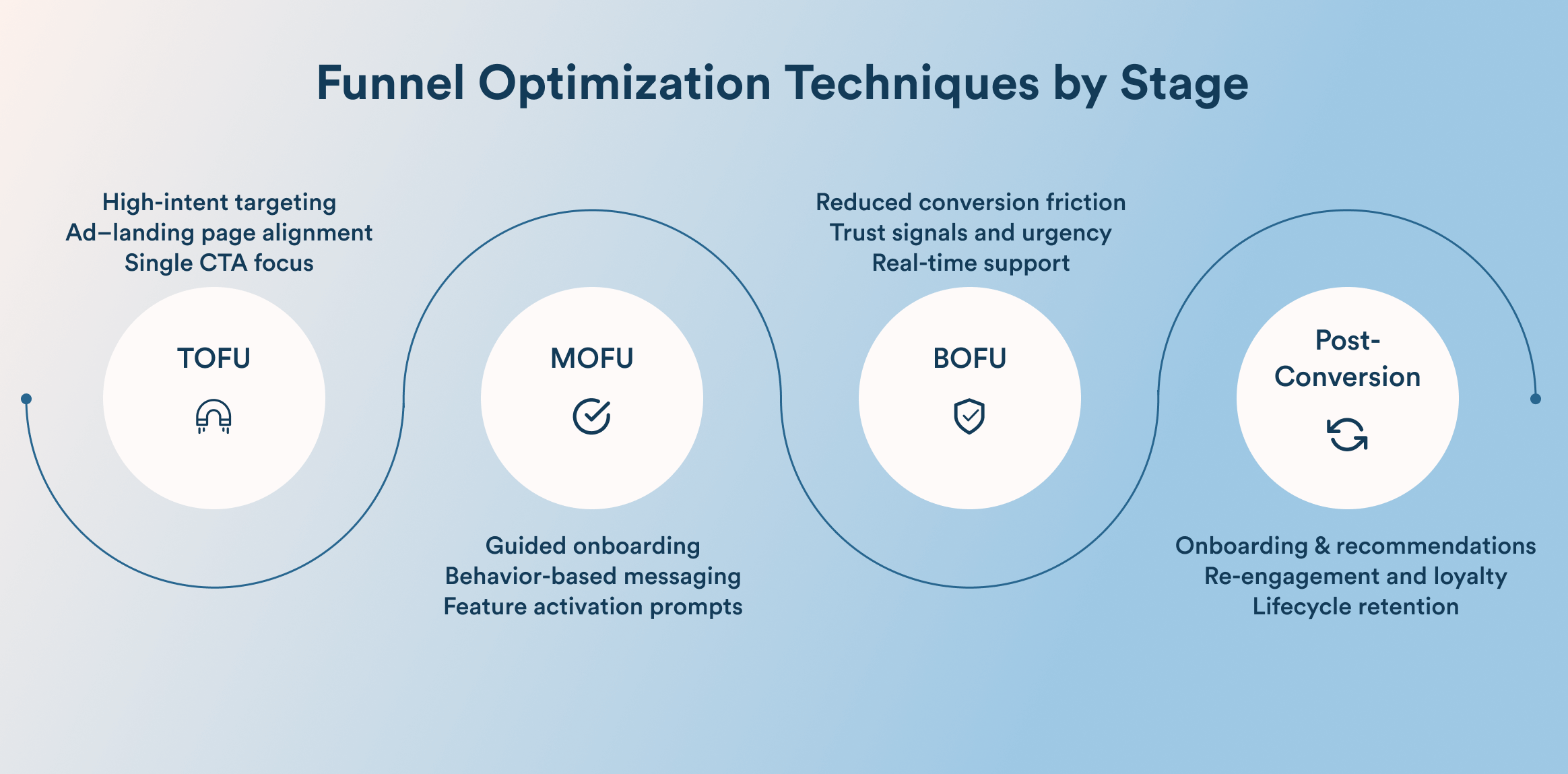
Top of Funnel (TOFU): Attract and Qualify the Right Audience
- Target high-intent audiences using intent-driven keywords, lookalike segments, and retargeting pools
- Match ad messaging tightly with landing page value propositions
- Use a single, focused CTA on landing pages to reduce distraction
- Optimize headlines and above-the-fold content to communicate value instantly
- A/B test ad creatives, copy, and landing page variants to improve click-to-entry conversion
- Prioritize channels with higher intent
Middle of Funnel (MOFU): Nurture Interest and Drive Activation
- Design clear onboarding flows with tooltips, walkthroughs, and progress checklists
- Use behavioral segmentation to trigger personalized email, push, or in-app messages
- Prompt users to activate key features when inactivity or hesitation is detected
- Simplify forms, reduce steps, and clarify instructions where drop-offs occur
- Deliver educational content, such as use cases, tips, and comparisons, to build trust before conversion
- Continuously analyze funnel drop-offs and A/B test fixes using funnel analytics
Bottom of Funnel (BOFU): Remove Final Conversion Barriers
- Minimize checkout or signup friction with fewer fields, auto-fill, and social login
- Add trust signals such as reviews, testimonials, guarantees, and security badges
- Use urgency and incentives carefully, provide limited-time offers, free shipping, and trials based on user intent
- Make pricing, terms, and next steps fully transparent
- Introduce real-time support chat or prompts when users stall or hesitate
- Test micro-optimizations like progress indicators and field order
Post-Conversion Funnel: Drive Retention and Lifetime Value
- Send post-purchase onboarding, usage tips, or success content
- Recommend complementary products or features based on behavior
- Trigger re-engagement or win-back campaigns when activity drops
- Introduce loyalty programs, subscriptions, or renewal reminders
- Treat retention as an extension of the funnel using lifecycle engagement tools
Tools for Conversion Funnel Optimization
Optimizing a funnel manually is daunting, but the right tools make it feasible. Funnel analytics platforms help you visualize each stage’s drop-off. Personalization engines come with branch-based recommendations and user segmentation that help deliver tailored content. Journey or campaign builders automate outreach via email, push, or in-app.
End-to-end platforms like CleverTap unify analytics, segmentation, experimentation, and lifecycle engagement, allowing teams to analyze funnels, trigger contextual experiences, and continuously optimize conversions from acquisition through retention in one system.
Why Tools Matter More Than Ever
Users expect instant, relevant experiences, and they generate massive amounts of data in real time. Without tools, teams get lost in spreadsheets. A good conversion funnel optimization platform surfaces issues quickly and ties them to actions.
Without integrated funnel analytics and engagement systems, teams struggle to translate behavioral data into timely, personalized interventions. Moreover, competition is fierce, and every percentage point of conversion can mean millions in revenue. Tools allow continuous optimization at scale via 24/7 campaign triggering and automatic audience updates that manual processes simply can’t match.
What Modern Funnel Optimization Tools Must Include
A truly modern funnel tool should offer:
- Real-time funnel analytics with dynamic conversion paths and drop-off charts
- Advanced segmentation, including predictive or intent-based segments
- Automated A/B testing and built-in experimentation capabilities
- Omnichannel campaign orchestration, so triggers from funnel events can launch emails, SMS, push, and in-app messages
- AI/ML features for predicting user actions and recommending next best actions.
When evaluating conversion funnel optimization tools, ensure they unify analytics and engagement to create a feedback loop.
CleverTap combines funnels, cohorts, and live user segments, with journey designer and Clever.AI decisioning, all in one.
How CleverTap Helps Teams Optimize Funnels Faster
CleverTap helps teams move from diagnosing funnel drop-offs to acting on them, without switching between analytics and engagement tools. By combining real-time funnel analysis, flexible computation controls, segmentation, predictive intelligence, and campaign orchestration in one platform, teams can continuously improve conversion performance across acquisition, activation, and retention.
Real-Time Funnel Analytics With Flexible Computation Controls
CleverTap allows teams to build funnels with up to eight steps, defined by specific user events. Each step can include filters based on event properties to narrow the analysis to precise user behaviors. You can easily build funnels from any event sequence and filter or compare them across segments.
Funnel results update continuously as user events occur, enabling teams to monitor stage progression and detect emerging drop-offs without waiting for delayed reporting cycles. This granular insight means teams don’t wait days to find an issue and can react immediately.
Teams can control how funnel completion is calculated using:
- Flexible Order, which counts users as converted as long as they complete all defined steps in sequence, even if they repeat earlier steps.
- Strict Order, which enforces exact progression and excludes users who repeat or deviate from the defined step order.
This flexibility allows teams to choose between measuring natural user exploration and diagnosing friction within tightly controlled flows such as onboarding, authentication, or payments.
CleverTap also supports configurable conversion windows, allowing teams to define the maximum time users have to complete all funnel steps. This ensures results reflect realistic journey timelines and prevents delayed completions from distorting performance analysis.
Breakdown by Event and User Properties
Understanding who converts is as important as understanding where users drop off.
CleverTap allows funnels to be split by:
- Event properties, such as product category or SKU
- User profile properties, such as language, geography, or device
This enables teams to compare conversion behavior across product variants, user segments, or regions within the same funnel. By identifying which attributes drive stronger progression, marketers can prioritize optimization efforts where they will have the highest impact.
Funnels can also be compared across predefined or custom segments, allowing teams to evaluate how engaged users differ from new or less active cohorts.
OR Logic Within Funnel Steps
CleverTap supports grouping multiple events into a single funnel step using OR logic. This ensures that equivalent user actions across platforms or channels are correctly treated as one stage of progression.
For example, mobile login and web login events can be grouped into the same step, providing a more accurate representation of user advancement through the funnel.
Measured By: Total Conversion and Trends
Funnel performance can be analyzed in two ways:
- Total Conversion, which provides an aggregate conversion rate or count for the selected time range
- Trends, which shows how funnel conversions change over time by day, week, or month
This allows teams to distinguish between structural funnel issues and time-based performance fluctuations driven by campaigns, product launches, or seasonal shifts.
Actionable Funnels: Turning Insights Into Engagement
Funnel insights in CleverTap are directly actionable.
From any funnel stage, teams can:
- Create a live user segment of users who completed a specific step
- Create a segment of users who dropped off at a particular stage
- Launch targeted campaigns directly from the funnel analysis
This eliminates manual exports and reduces the delay between identifying friction and triggering recovery or activation campaigns.
Beyond static analysis, CleverTap also offers automated journeys triggered by funnel behavior. When a user reaches a certain stage or fails to progress, the platform can initiate a multi-step campaign. This could be a cart abandonment email if checkout isn’t completed in X minutes, or a loyalty push when a user makes a second purchase. These journeys draw on live segments and run across channels, ensuring funnel analysis and user engagement occur within the same platform.
CleverTap also provides predictive recommendations. Its predictive analytics can identify which users are most likely to convert or churn, enabling pre-emptive actions before drop-offs fully materialize. For instance, the platform might flag users who are unlikely to buy unless nudged, so teams can send targeted offers, while high-value segments can receive differentiated messaging designed to accelerate progression. By incorporating predictive segments and automated engagement, CleverTap helps teams automate smart personalizations that improve conversion.
Teams can use this capability to:
- Re-engage users who abandoned checkout
- Nurture users who stalled during onboarding
- Upsell high-intent users who reached advanced funnel stages
By connecting funnel analytics with campaign execution in one environment, CleverTap enables a continuous feedback loop between measurement and engagement.
Table and Chart Views for Deeper Analysis
CleverTap provides both visual chart views and structured table views for funnel analysis.
The chart view highlights cumulative progression and drop-offs across steps, while the table view surfaces detailed metrics such as:
- Overall conversion percentage from first to last step
- Conversion rate between consecutive steps
- Median time between stages
This dual perspective allows teams to quickly spot bottlenecks and then drill into the operational details behind them.
Together, these capabilities mean teams can iterate faster. They can diagnose funnel progression, test variations, and deploy automated journeys within a unified environment, reducing fragmentation between analytics and engagement workflows. CleverTap even includes templates and best-practice workflows, shortening the learning curve. This shifts optimization from periodic, retrospective analysis toward a more continuous and operational improvement cycle.
See how CleverTap helps you turn funnel insights into real conversion gains.
Turning Funnel Insights into Actionable Improvements
Conversion funnel optimization is a continuous cycle of analysis and improvement across all stages of the customer journey. By rigorously mapping funnels, segmenting users, applying targeted fixes, and using integrated tools like CleverTap, marketers can dramatically boost conversions and retention. Teams that align analytics with personalized engagement consistently see their funnel ROI climb.
Ready to see how funnel optimization could work for your business? Schedule a demo with CleverTap today!

Agnishwar Banerjee 
Leads content and digital marketing.Expert in SaaS sales, marketing and GTM strategies.
Free Customer Engagement Guides
Join our newsletter for actionable tips and proven strategies to grow your business and engage your customers.