
























Table of Contents
Categories
Most Popular

A conversion funnel maps the path users take from first discovering your brand to completing a key action, like a purchase or sign-up. This framework reveals where prospects drop off, enabling marketers to refine each stage for higher performance. By analyzing conversion funnel marketing data, teams can reduce friction, boost conversion rates, and scale revenue predictably.
Without funnel visibility, teams optimize channels in isolation instead of improving the journey that actually drives conversions. In this guide, learn the stages, measurement tactics, optimization strategies, and tools you need to build high-performing funnels.
What Is a Conversion Funnel?
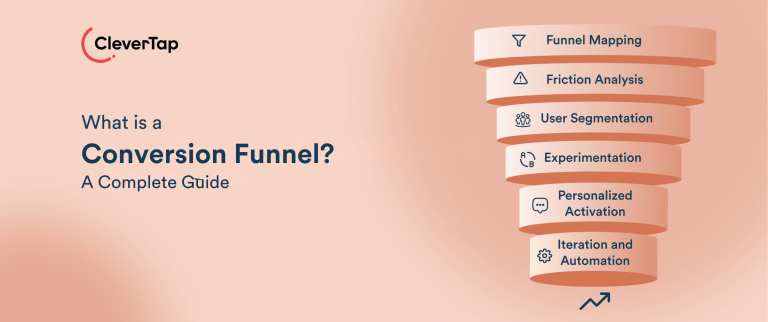
A conversion funnel provides a structured view of the stages users navigate before taking a target action. You can think of it as an inverted pyramid with the broad base being initial contacts that narrow through progressive steps until a focused group completes the goal at the bottom. Each stage represents a measurable behavioral milestone that signals growing intent.
Conversion takes different forms depending on your business, for example, a purchase in e-commerce, a subscription for streaming services, a sign-up for newsletters, an upgrade in gaming apps, or a booking for fintech services.
This model goes beyond simple visualization, and it serves as a practical optimization tool, highlighting drop-offs and inefficiencies. Marketers use it to diagnose issues, like why cart abandoners never return, and test fixes such as personalized reminders.
Conversion funnels evolve with data, aligning with real user paths as behavior shifts. In e-commerce, for example, brands map journeys from product views to checkout, tweaking elements like urgency messaging to improve funnel conversions. This dynamic approach turns insights into revenue growth.
Why Conversion Funnels Matter in Modern Marketing
Conversion funnels deliver strategic advantages that separate high-performing marketing teams from the rest. They enable you to visualize how users move toward action, revealing behavioral patterns that predict revenue. You can identify which stages drive the most revenue impact, focusing efforts where they matter most, like high-drop consideration phases in fintech apps.
These frameworks help allocate budget based on stage performance, shifting spend from low-ROI awareness ads to intent-driven retargeting. Marketers improve stage-to-stage conversion rates by addressing specific leaks, such as abandoned carts in e-commerce. They also align messaging with user intent, delivering personalized prompts at decision points, and build predictable growth systems that scale across campaigns.
Yet many brands struggle with the same reality. They optimize traffic volume without dissecting drop-offs, treating funnels as static diagrams rather than live tools. Acquisition efforts often disconnect from retention, and in subscription services, brands can lose 70% of first-time buyers to inactivity within 90 days. Conversion funnel marketing bridges these gaps, turning raw traffic into sustained revenue through continuous, data-driven iteration.
Read more: Top 10 Funnel Analysis Tools to Improve Conversion and Retention
The Core Stages of a Conversion Funnel
Conversion funnels break user journeys into measurable stages, from initial contact to ongoing value. Each phase offers optimization opportunities that compound into higher funnel conversions.
Awareness
Users enter your conversion funnel through discovery channels: paid ads on social platforms, organic search results, referrals from influencers, or app store installs. In gaming, this means banner ads driving downloads; in e-commerce, Google searches for product categories.
Volume matters here, but quality traffic sets the foundation. Track impressions-to-visit ratios to gauge initial interest.
Interest
Engagement signals mark this stage: repeated page views, time spent on content, video watches, or feature explorations. Fintech users might browse loan calculators; teams evaluating a product may review demo videos or tutorials.
Focus on dwell time and interaction depth. Weak signals here often predict later drop-offs, so use content like guides and tutorials to nurture curiosity.
Consideration
High-intent behaviors define this stage: adding items to carts, comparing subscription tiers, viewing pricing pages, or starting checkouts. E-commerce shoppers hesitate at shipping costs; banking customers evaluate APRs side by side.
This is where a significant share of drop-offs occur. Friction, like unclear value propositions, kills momentum. Address it with testimonials, guarantees, and transparent pricing.
Conversion
Users complete the target action: purchase confirmation, subscription activation, account sign-up, plan upgrade, or appointment booking. This first win validates your upper-funnel efforts.
Acknowledge it with thank-you screens and relevant upsell prompts, but don’t stop there. Optimizing only for this moment leaves revenue on the table.
Retention and Repeat Conversion
Modern conversion funnel marketing extends well past the initial conversion. Retention tracks post-conversion activity: login frequency, feature adoption, and reorder rates. Repeat conversions build lifetime value; think of subscription renewals in streaming services or wallet reloads in gaming.
Brands that optimize only for first conversions limit their own growth. Ignoring lifecycle engagement leads to significant churn within months of acquisition. Funnels and conversions perform best when they’re built on behavioral loops, re-engaging lapsed users through personalized, timely offers.
You can even extend your funnel with RFM analysis (recency, frequency, monetary value) to segment high-value repeaters. In e-commerce, this approach is what drives a disproportionate share of revenue from loyal customers. Lifecycle orchestration turns one-time buyers into advocates, fueling sustainable scale.
Conversion Funnel vs. Marketing Funnel vs. Sales Funnel
Conversion funnels zero in on the path to action completion, tracking users from intent signals to purchase, sign-up, or upgrade. E-commerce teams use them to optimize cart-to-checkout flows, while gaming managers monitor install-to-first-play sequences.
Marketing funnels take a broader view, mapping awareness through engagement and brand nurturing. They cover top-of-funnel tactics like content downloads or social follows, building audiences before revenue focus kicks in. Brands rely on these to nurture prospects before they reach the decision stage.
Sales funnels emphasize revenue pipeline progression, from qualified leads to closed deals. Financial services teams, for example, track consultations through application completion and contract signing, prioritizing high-value prospects through negotiation stages.
Overlap happens naturally: all three start with awareness and aim for revenue. The conversion funnel often nests within the marketing funnel as its bottom half, while sales funnels share conversion metrics but add human touchpoints.
Marketers interchange these terms because real journeys blend stages. Subscription services often see marketing build trials, conversion funnels activate payments, and sales teams manage enterprise upgrades. Clear boundaries prevent confusion, but flexible application maximizes funnel conversions across channels.
Conversion funnel marketing thrives on this integration. Gaming apps blend all three: ads drive awareness (marketing), onboarding completes the first purchase (conversion), and account management secures renewals (sales).
Related reads: What Is a Purchase Funnel? A Practical Guide to Stages, Analysis & Optimization
How to Build a High-Performing Conversion Funnel
Building an effective conversion funnel requires precision at every step: clear goals, mapped behaviors, measurable tracking, identified leaks, and stage-specific communication.
Define the Primary Conversion Goal
Unclear goals weaken optimization efforts. Pinpoint one measurable action, for example, a trial activation, a first deposit, a loan application, or a completed purchase. Vague targets like “more traffic” dilute focus, while specific ones like “30-day trial sign-ups” guide every decision downstream.
This clarity is what separates teams that improve funnel conversions from those that chase vanity metrics.
Map Stage-Wise User Actions
Define measurable behaviors at each stage. Awareness: ad clicks or app installs. Interest: product views or feature tours. Consideration: cart adds or plan comparisons. Conversion: transaction complete. Retention: repeat logins or reorders.
The key is specificity. A gaming app might track “level 1 complete” as an interest signal; a fintech platform maps “credit score check” to consideration. Document these behaviors so every action connects back to your primary goal.
Instrument Funnel Tracking
Before optimizing a funnel, ensure every stage is measurable. Track key actions such as product views, feature explorations, cart additions, form submissions, and completed purchases so you can see how users move from one stage to the next.
Without reliable event tracking, marketers rely on assumptions instead of behavioral evidence. A streaming platform’s team might track “pricing page view” and “trial started” as critical transition events, while an e-commerce brand monitors “product view → add to cart → checkout start” in their e-commerce funnel. Instrumenting these actions creates the visibility needed to diagnose leaks and improve funnel conversions.
Identify Friction Points
Analyze drop-offs between stages. Significant leaks commonly appear at checkout pages and pricing views, and optimizing only the top of your funnel while ignoring them leads to wasted spend.
Use heatmaps, session recordings, and exit surveys to understand why users leave. Then run A/B tests on friction points such as form length, trust signals, or copy clarity before scaling traffic.
Align Channels and Messaging
Stage-specific intent demands stage-specific messaging. Awareness calls for broad, discovery-oriented copy. Consideration needs urgency and proof. Retention focuses on value reinforcement and loyalty.
Blasting the same message across all stages creates fatigue and missed opportunities. For example, a brand might send educational content during the interest stage and demo invitations or product comparisons during consideration. Conversion funnel marketing performs best when communication maps directly to where the user is in their journey.
How to Measure Conversion Funnel Performance
Effective measurement turns conversion funnels into revenue engines. Track stage-specific metrics to pinpoint leaks and opportunities at every step.
Key Stage-Wise Metrics:
- Traffic Volume: Total visitors entering the awareness stage via ads, search, or installs
- Engagement Rate: Time spent, pages viewed, or content interactions in the interest phase
- Click-Through Rate: Clicks from awareness to consideration, such as ads to product pages
- Add-to-Cart Rate: Items added relative to total product views
- Checkout Completion Rate: Successful payments as a percentage of checkout starts
- Conversion Rate: Primary action completions divided by total funnel entrants
- Drop-Off Rate: Percentage of users exiting between stages
Segment-based analysis reveals hidden patterns. Break data by device, geography, acquisition channel, or user type. What looks like a funnel-wide problem often turns out to be isolated to one segment.
Cohort tracking takes this further by monitoring behavior over time. Group users by their first action date, then measure how conversion behavior shifts from Day 1 to Day 30.
Trend monitoring helps teams detect seasonality and sudden shifts in funnel performance. Weekly dashboards make it easier to catch declines early, before they compound into larger revenue gaps.
A few common pitfalls distort measurement. Using overly short time windows misses delayed conversions. Relying only on aggregate data hides segment-level differences. Focusing on vanity metrics like total visits obscures what is actually happening at each stage.
Meaningful measurement requires tracking funnel conversions at the segment and cohort level, not just overall volume. Behavioral analytics adds another layer by revealing hesitation patterns, rage clicks, and exit behavior. These signals explain why users drop off and provide context that raw numbers alone cannot capture.
How CleverTap Helps You Optimize Your Conversion Funnel
CleverTap helps marketing teams turn conversion funnels from static diagrams into operational growth systems. With real-time behavioral analytics, customer segmentation, and automated engagement, teams can identify drop-offs quickly and respond with targeted campaigns that move users toward conversion.
Visualize Funnel Progression Across User Journeys
CleverTap’s Funnels analytics allows marketers to define and analyze a sequence of events users perform inside an app or website. By mapping actions such as product viewed → added to cart → purchase completed, teams can see exactly how users progress through the funnel and where drop-offs occur.
Funnels can include up to eight steps, allowing marketers to model complete user journeys from discovery to purchase. Each step can also include event properties to narrow the analysis to specific behaviors, helping teams isolate exactly which interactions lead to conversions.
Identify Where and Why Users Drop Off
CleverTap’s funnel charts reveal cumulative conversions at each stage, making it easy to identify the points where users abandon the journey.
For example, a funnel like:
Product Viewed → Added to Cart → Charged
shows exactly how many users move between each step and where abandonment happens. Instead of guessing which stage is underperforming, marketers can see the drop-off clearly and prioritize optimization efforts accordingly.
Analyze Conversion Timing and User Behavior
Conversion funnel analysis goes beyond just identifying drop-offs. CleverTap also tracks how long it takes users to move between funnel steps, helping teams understand when engagement should happen.
Marketers can analyze:
< typical time between discovery and purchase
< how long users hesitate before completing checkout
< which segments convert faster or slower
These insights help teams time engagement campaigns more effectively, reaching users while they are still within the typical conversion window.
Compare Funnel Performance Across Segments
Not all users behave the same way. CleverTap allows marketers to break down funnel performance by user segments or properties, revealing patterns hidden in aggregate data.
Teams can compare funnels by:
< acquisition channel
< device type
< geography
< user lifecycle stage
This segmentation helps identify exactly which audiences convert well and which segments require targeted optimization.
Trigger Engagement When Users Stall in the Funnel
Once drop-offs are identified, CleverTap enables teams to respond immediately using behavior-triggered engagement campaigns.
For example:
< a cart abandonment event can trigger a push notification reminder
< a pricing page exit can trigger an email with product comparisons
< inactive trial users can receive onboarding guidance
These triggers ensure communication happens when intent is highest, helping recover users who might otherwise leave the funnel.
Extend Funnel Optimization Beyond the First Conversion
High-performing funnels do not stop at the first purchase. CleverTap helps teams optimize repeat conversions and long-term customer value using behavioral segmentation and lifecycle automation.
Features like RFM segmentation and predictive analytics identify high-value users and detect churn risk early. Marketers can then trigger personalized campaigns that encourage repeat purchases, renewals, or upgrades.
This transforms the funnel from a one-time conversion path into a continuous lifecycle growth engine.
See how CleverTap helps you identify drop-offs, trigger timely engagement, and improve conversions across every stage of the funnel.
Build Conversion Funnels That Continuously Improve
Conversion funnels are dynamic systems that require continuous measurement, behavioral segmentation, and timely engagement. Brands that treat them as living frameworks rather than static diagrams are better positioned to uncover drop-offs, respond to user signals, and steadily improve funnel conversions over time.
When marketers analyze each stage closely, they can identify where users hesitate, remove friction from critical moments, and guide prospects toward action with more relevant messaging. Over time, these improvements compound, turning funnel optimization into a reliable driver of revenue growth.
CleverTap helps marketing teams operationalize this approach with real-time behavioral analytics, funnel analysis, and automated engagement journeys that respond to user actions as they happen. Instead of simply observing where users drop off, teams can immediately trigger personalized campaigns that move them forward in the journey.
If you’re ready to turn funnel insights into measurable growth, schedule a demo with CleverTap and see how smarter funnel optimization drives higher conversions.
Frequently Asked Questions About Conversion Funnels
What Is a Conversion Funnel?
A conversion funnel tracks the step-by-step path users follow from brand discovery to a target action, like a purchase or sign-up. Visualized as an inverted pyramid, it shows a broad entry at the top narrowing to fewer completions at the bottom. This structure helps marketers understand how users progress through key stages and where drop-offs occur.
How Is It Different from a Sales Funnel?
Conversion funnels map full digital journeys from awareness to action, emphasizing optimization across marketing channels and product interactions. Sales funnels focus more narrowly on qualified leads progressing through human-led steps toward closed revenue.
In many businesses, both funnels work together. Marketing activities generate awareness and engagement, the conversion funnel drives the initial action, and the sales funnel manages deeper qualification or enterprise deals.
What Is a Good Conversion Rate?
There is no universal benchmark. Conversion rates vary widely depending on the industry, traffic source, product price, and funnel stage.
Instead of chasing generic averages, marketers should focus on improving their own stage-to-stage conversion rates over time. A steady improvement in each step of the funnel often leads to larger revenue gains than trying to dramatically increase a single metric.
How Often Should You Optimize a Funnel?
High-traffic funnels should typically be reviewed weekly, while lower-volume funnels can be analyzed monthly. This ensures teams catch performance changes early before they impact revenue.
Optimization usually involves testing one variable at a time, such as messaging, CTAs, page layout, or form friction, using controlled A/B experiments. Regular monitoring combined with structured experimentation helps teams continuously improve funnel performance.

Agnishwar Banerjee 
Leads content and digital marketing.Expert in SaaS sales, marketing and GTM strategies.
Free Customer Engagement Guides
Join our newsletter for actionable tips and proven strategies to grow your business and engage your customers.