



































Table of Contents
Categories
Most Popular

Online purchase journeys usually succeed at awareness, but they crumble in the gaps between actions. Baymard’s aggregated research shows shopping cart abandonment averaging 70%, often due to hidden friction like shipping surprises or payment glitches. Teams know the revenue is there, but without clear visibility into where intent drops, optimization usually stays as guesswork.
That’s why purchase funnels matter. They help map real behaviors, like product views becoming repeat sessions, cart adds flowing to payment starts, and abandons exposing friction. This guide explains purchase funnel stages, analysis techniques, and optimization tactics that growth and CRM teams use daily. You’ll learn how to map real user behaviors to events, spot breakdowns with cohorts, and launch campaigns that recover drop-offs. With these practical steps, build and refine your funnel for better results.
What Is a Purchase Funnel?
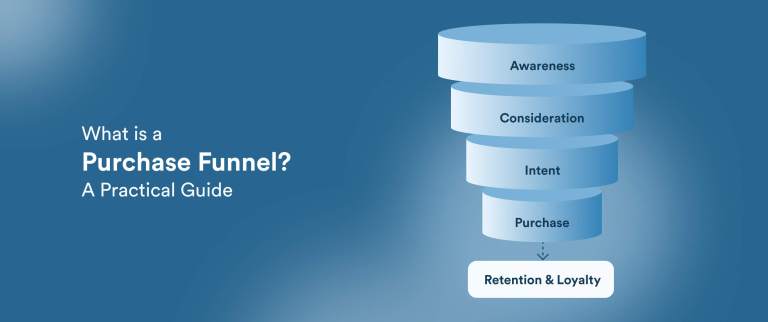
A purchase funnel is a structured, event-driven model that maps the sequence of user actions from first interaction to completed transaction, helping teams measure how prospects move toward revenue.
It illustrates the customer journey from initial brand discovery to final purchase, shaped like a funnel since fewer users advance through each phase, filtering broad awareness down to committed buyers. It equips growth and CRM teams to analyze user behavior, pinpoint marketing bottlenecks, and steer prospects via stages like interest, evaluation, and decision-making for stronger conversions and loyalty.
Growth teams and CRM managers treat it as a diagnostic tool to track the sequence of actions users take from first product view to completed buy and beyond, like a pipeline of measurable behaviors.
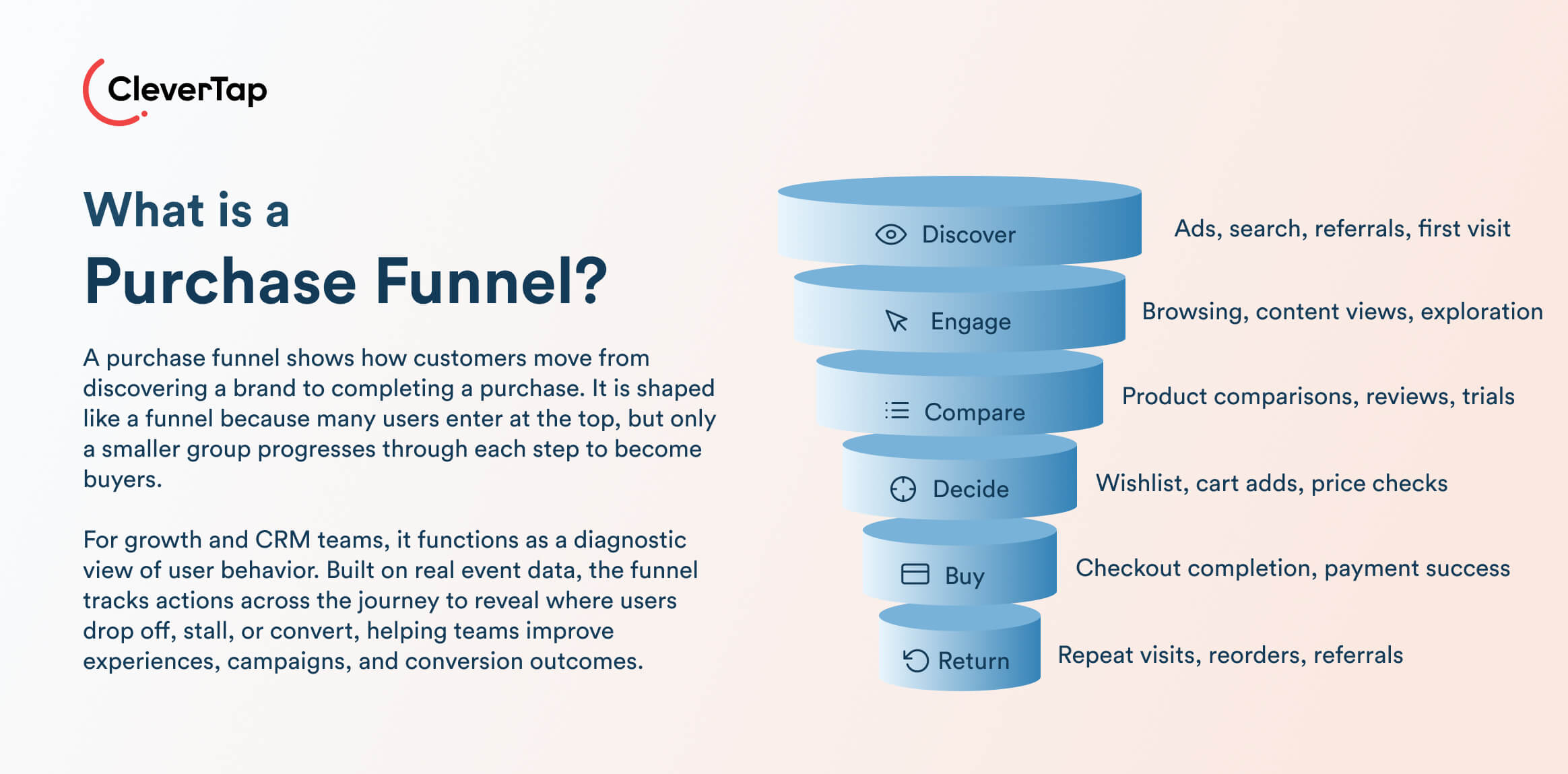
Unlike theoretical diagrams showing Awareness → Interest → Action, real purchase funnels rely on event data platforms logging sequential steps, such as session starts, product views, cart adds, and payment completion. This exposes actual drop percentages between handoffs, letting marketers spot patterns like deep engagers who abandon before payment.
Build it right, and every stage ties to revenue signals. Product teams fix UX friction spikes. Growth leads launch of targeted campaigns. The behavioral approach beats static models by capturing how customers really move today, looping back, skipping steps, or stalling on trust gaps.
Why the Purchase Funnel Still Matters for Marketers
Understanding the stages is only the first step. The real value of a purchase funnel shows up in how it improves decisions, from identifying drop-offs to planning targeted campaigns and driving measurable revenue growth. When each stage is tied to real behavior, marketers can replace assumptions with precision.
- Diagnosing Drop-offs: Purchase funnels deliver the precision marketers need to spot drop-offs, friction points, and fading intent that broad metrics overlook. A 25% drop from cart add to checkout start might flag pricing confusion or trust gaps, informing CRM teams to drill into these breaks to uncover root causes and test fixes that boost progression.
- Campaign Planning: Funnels guide campaign timing and lifecycle engagement with pinpoint accuracy. Growth teams send re-engagement messages with product recommendations to users lingering in consideration after multiple views. They trigger urgency campaigns for repeat visitors and post-purchase onboarding for retention, while win-back flows hit lapsed users on signals like app reinstalls.
- Revenue Impact: Clear funnel visibility fuels real-time revenue optimization by exposing stage-to-stage conversion rates and bottlenecks. Teams that track and refine these paths avoid vanity metrics like total sessions, focusing instead on scalable actions across acquisition, conversion, and loyalty. Studies show this approach delivers up to 30% higher ROI by prioritizing high-impact interventions over guesswork.
Also read: Top 10 Funnel Analysis Tools to Improve Conversion and Retention
Core Stages of a Purchase Funnel
Core stages of a purchase funnel aren’t universal; they adapt to your business model, whether app, e-commerce, or subscriptions, yet they follow consistent intent patterns that growth teams track across any digital product.
In the Awareness stage, users first discover your brand via ads, search, or referrals. Interest follows as they engage deeper, browsing categories or reading details. During consideration, users weigh options, like comparing items or reading reviews. Action happens when they commit to a purchase or sign up. Finally, retention/loyalty sees buyers return for repeats or referrals.
Awareness
Awareness is the top of the funnel, and it kicks off when users first encounter your brand or product. They might find it through app store searches, social media scrolls, paid search clicks, or referral traffic from influencers. These entry points are where volume matters most, but conversions are still distant.
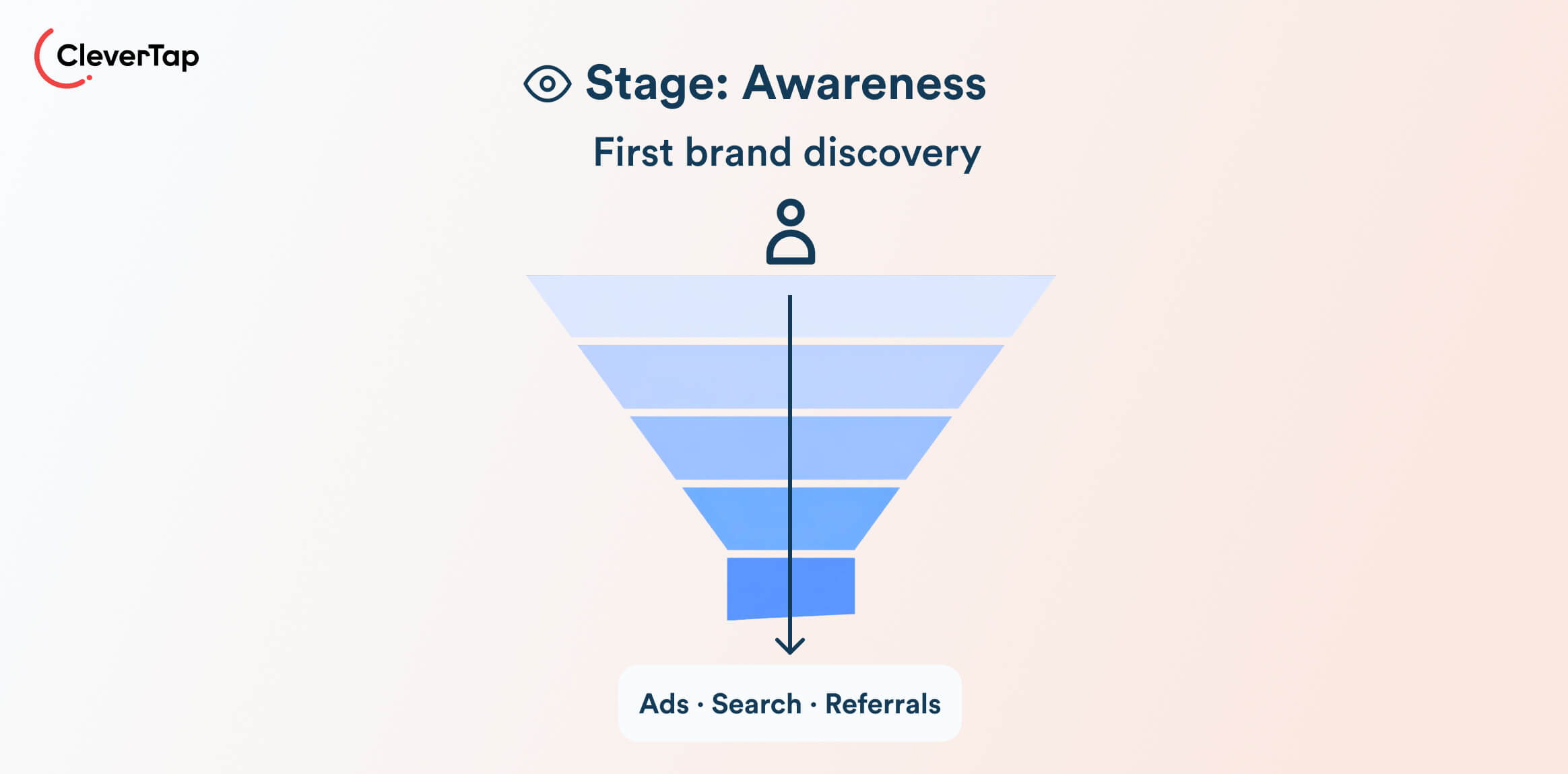
Marketers track signals as first-time session starts, landing page views within 24 hours, or basic event triggers such as screen opens. Marketers now blend organic discovery (SEO-driven content) with paid channels, so awareness now spans push notifications, pulling back lapsed users alongside fresh installs.
A few common mistakes teams make here include pouring all their budget into top-funnel ads without tagging entry behaviors and missing out on how paid traffic converts differently than organic. Others treat all awareness as equal, ignoring channel quality, as social browsers bounce faster than search intent. This can easily be fixed by segmenting first-touch sources from day one.
Consideration
Users enter consideration when they move past casual browsing to actively compare your product against competitors. They look deeper into features, compare pricing, read reviews, or test free trials. The consideration phase of the purchase funnel decides if prospects turn into customers.
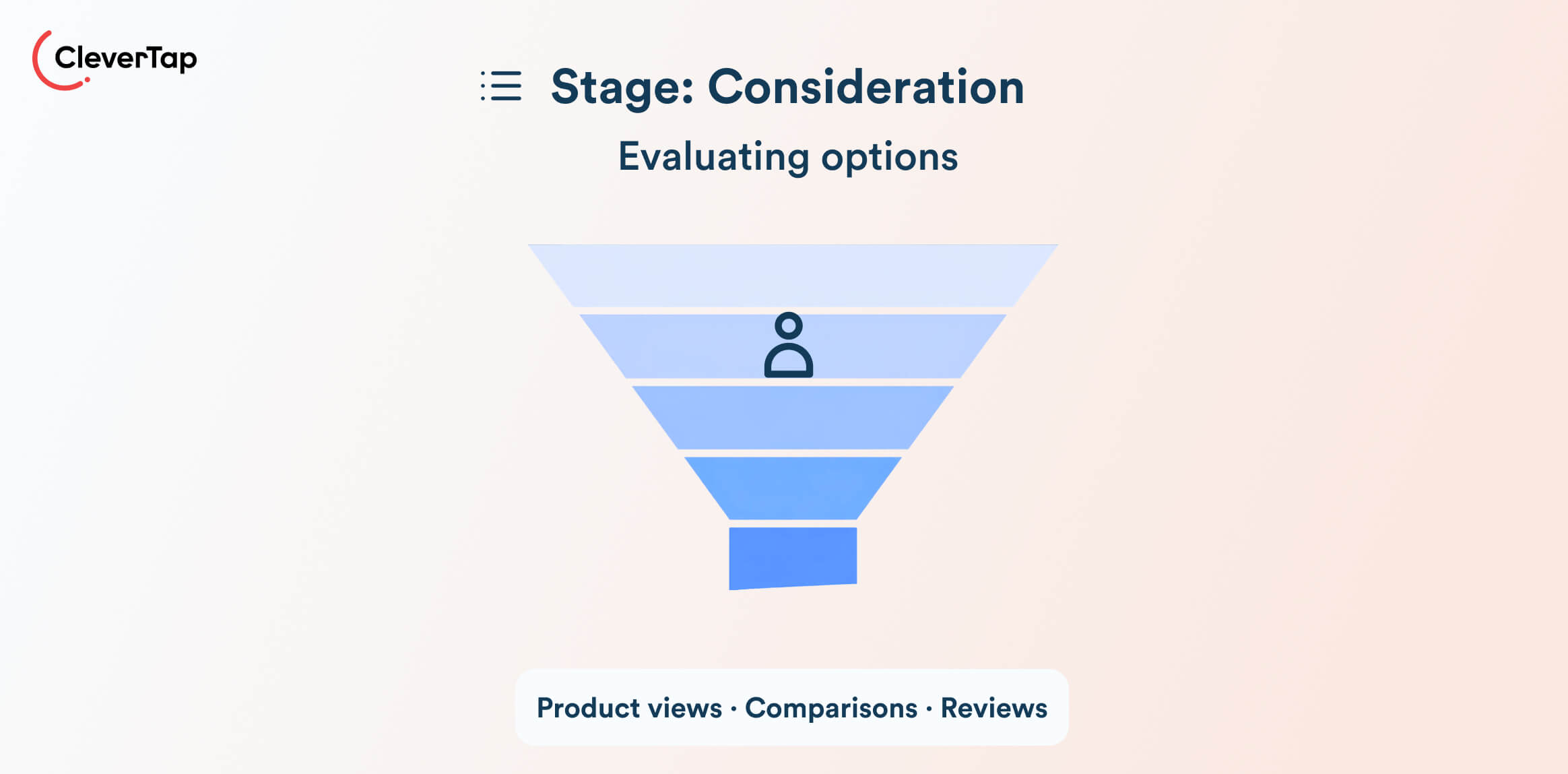
Your content plays a key role here, where product tours, comparison tables, user-generated reviews, and personalized recommendations help your audience reach a decision. Nudges, like in-app messages or emails highlighting social proof, push them forward. Product experience matters most, as smooth navigation and quick value demos help keep them engaged.
Tracking early intent signals, such as multiple product detail views, feature clicks, saved items, or time spent over 2-3 minutes per session, is crucial. Repeat visits within 48 hours are signals of growing commitment. Growth teams usually miss this stage by not instrumenting these micro-actions, leaving mid-funnel leaks invisible.
Intent
Users shift from consideration to intent when passive evaluation turns decisive—they stop comparing broadly and zero in on ownership, like finalizing size/color choices, running price calculators, or testing checkout previews. This marks the pivot from “should I?” to “how do I?” often visible in repeat sessions within hours, not days.
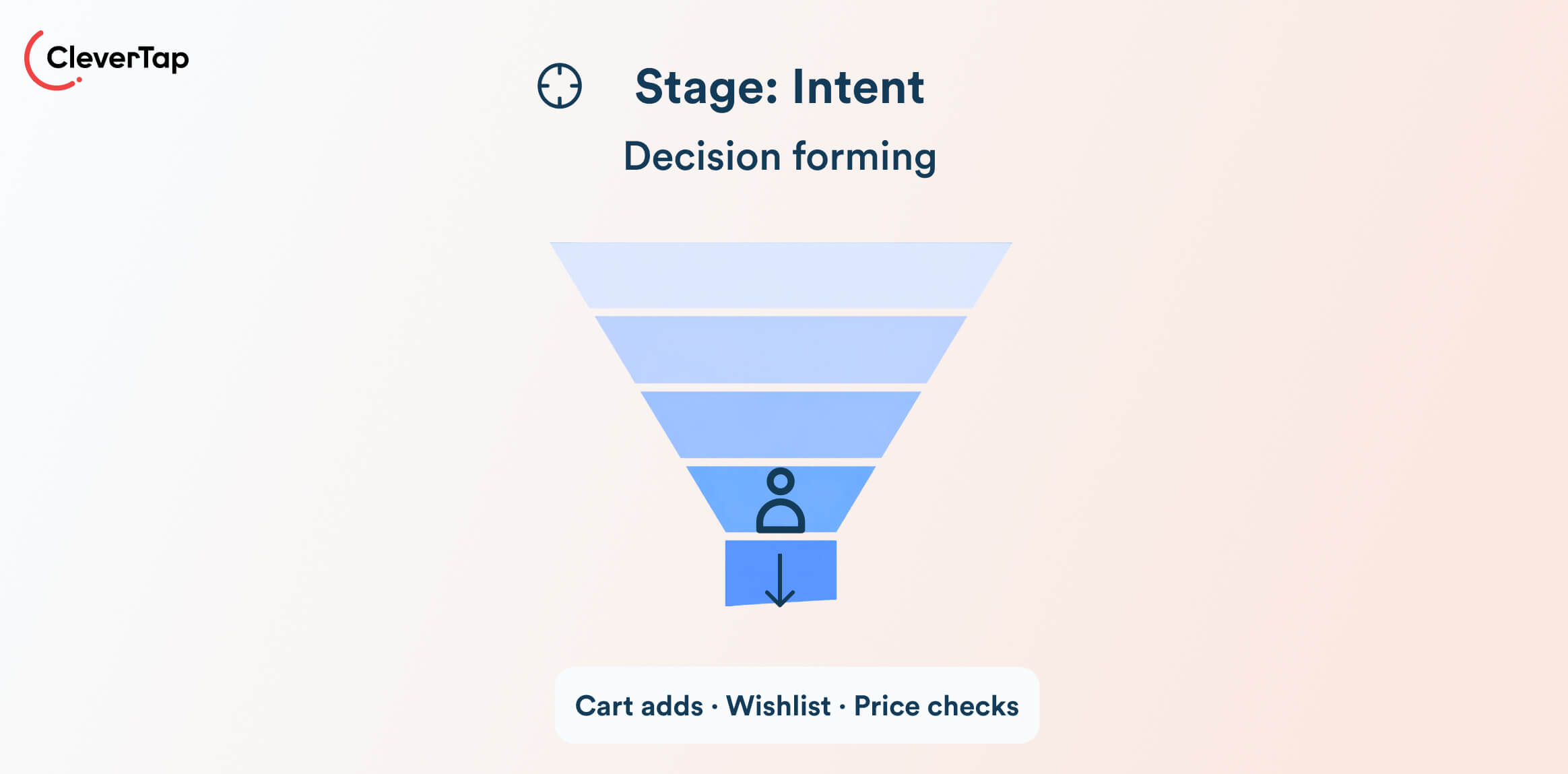
Key behavioral shifts confirm it: tight focus on one product (vs. category browsing), wishlist/cart adds without checkout, saved customizations, or price page revisits. These differ from Consideration’s scattered reviews or multi-item scans, showing commitment ready for a final nudge.
Marketers miss this phase without precise event tracking, mistaking stalled intent for random drop-offs and losing 20-30% of recoverable revenue. Log these signals explicitly to segment high-intent users, then hit them with personalized urgency, like dynamic discounts or one-click checkout, to bridge the last gap to purchase.
Purchase/Conversion
A true conversion event happens when a user completes the core revenue action for your business. Partial actions like cart adds or form starts don’t count; you need to define it precisely in your platform as the first full transaction event, timestamped and tied to the user ID.
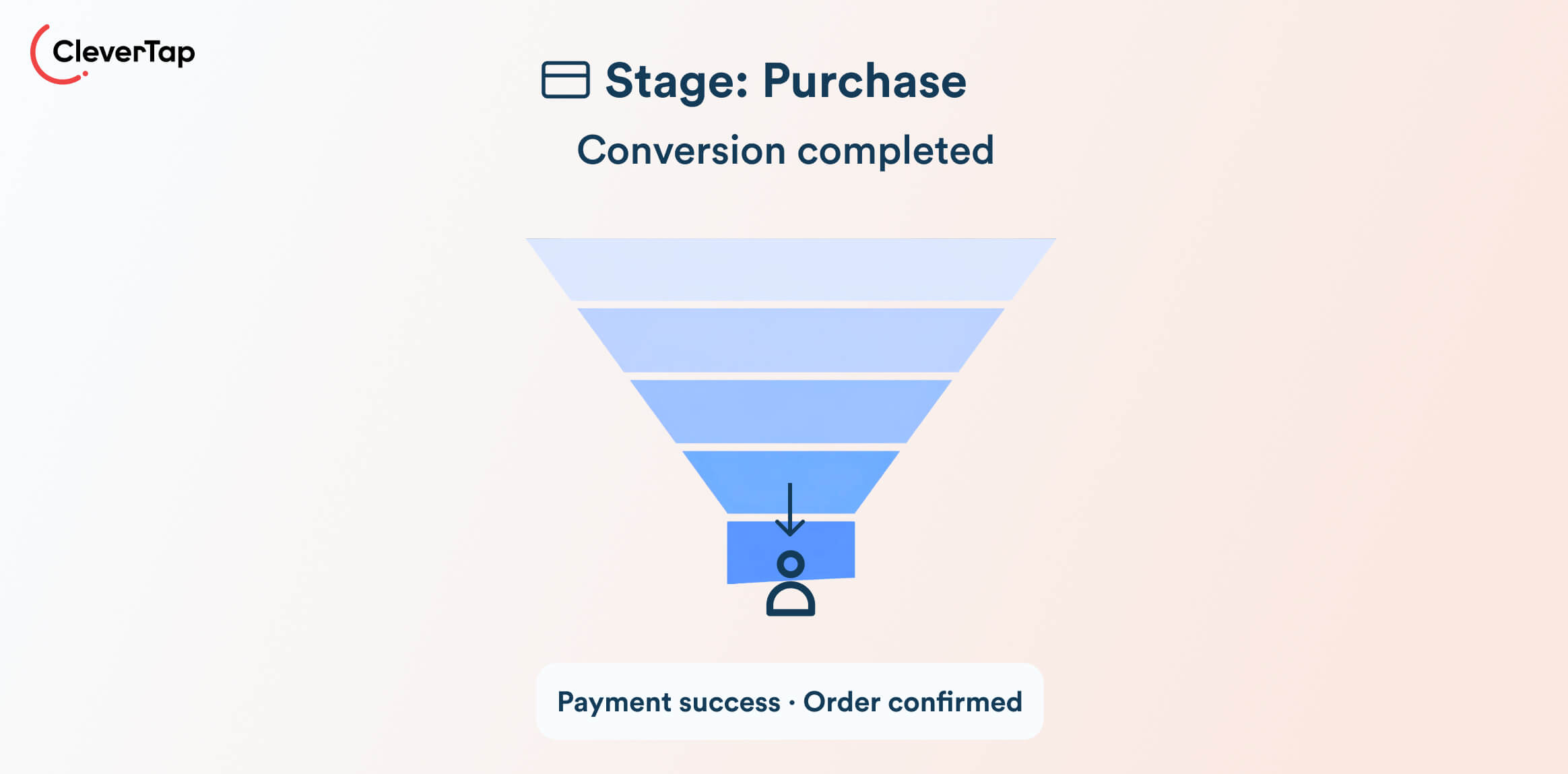
Last-stage drop-offs stem from micro-frictions, like unexpected shipping costs spiking at checkout, payment form errors on mobile, trust blockers, or forced account creation. Teams see 60-70% abandonment here because users hit real roadblocks.
Conversion marks the funnel peak, not the end. Revenue depends on repeat behavior and lifetime value. Users who convert once but churn on Day 7 cost more to acquire than they deliver. Track the first purchase as a launchpad for onboarding flows and retention campaigns.
Related: What Is Conversion Funnel Optimization? A Complete Guide
Post-Purchase and Retention
Users enter the post-purchase stage right after their first transaction, focusing on onboarding, value realization, and early repeat behaviors that signal loyalty or churn risk. Growth teams track actions like account logins, feature unlocks, or Day 3/7 returns to gauge if the product delivers the promised fit.
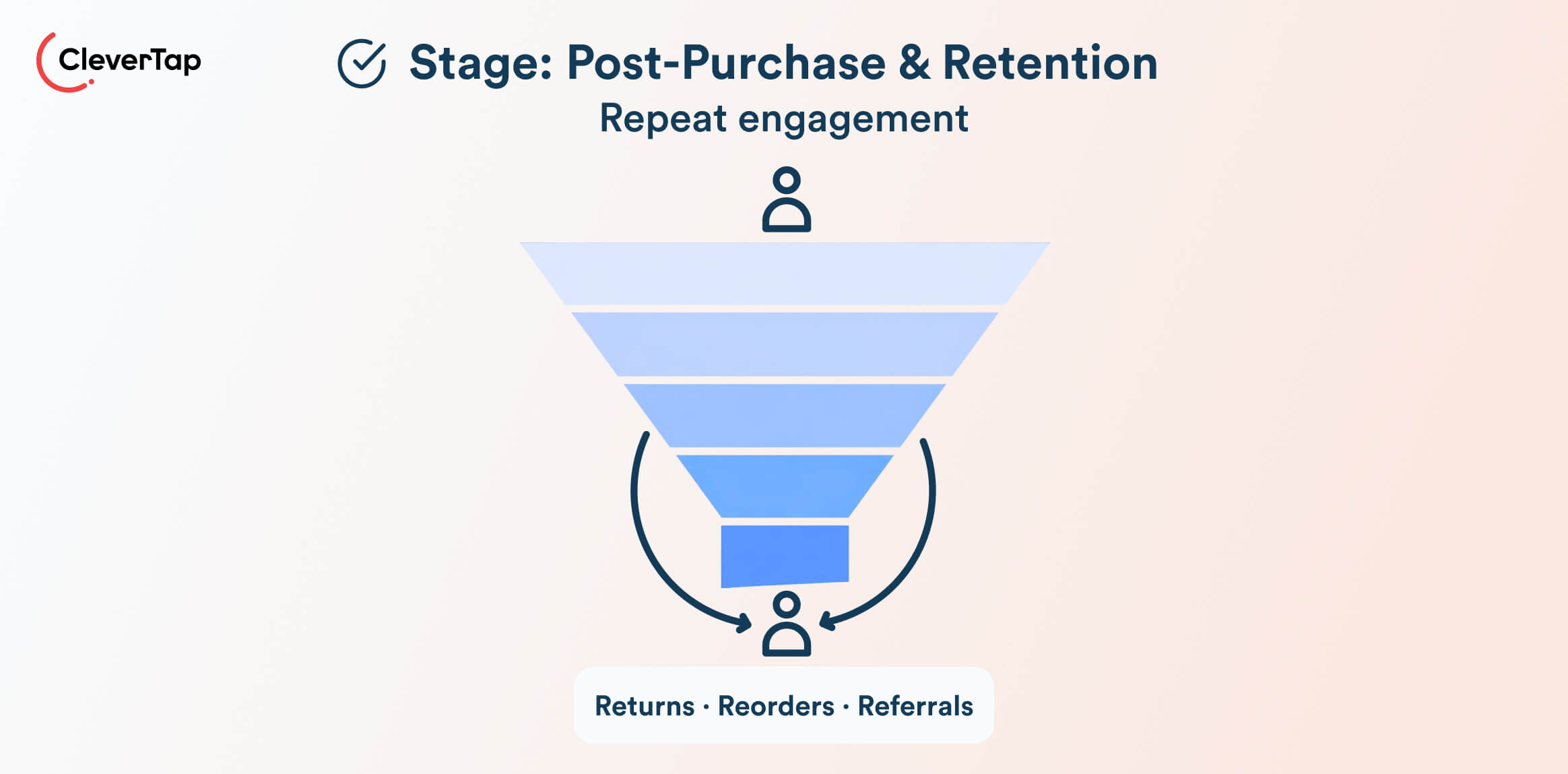
Onboarding flows deliver quick wins through targeted sequences, such as custom setup guides, feature tutorials, or usage benchmarks. Value realization follows as users hit adoption milestones, like second transactions or advanced tool usage, confirming sustained engagement over one-time buys.
Modern funnels turn cyclical here as lapsed users re-enter via win-back campaigns, hit upsells in consideration, or jump straight to repeats. Cohort analysis at Day 30 reveals these loops, aligning efforts with lifetime revenue rather than linear endpoints.
How Purchase Funnels Differ By Business Model
Purchase funnels follow the same broad stages, but how users move through them and what counts as a meaningful action change sharply by business model. Defining those stages properly is what makes your analysis usable instead of generic.
E-commerce and App-Based Funnels
In e-commerce, purchase funnels usually center on product discovery, cart behavior, and checkout completion. Key stages often include product views, add-to-cart, checkout start, and successful payment. App-based funnels, especially for mobile, add layers like app installs, first open, permission grants, and key in-app actions before any purchase even appears. A user might install, browse multiple times across sessions, and only much later add an item to the cart.
Because of this, app funnels lean heavily on early activation events, like first session depth, search usage, or onboarding completion, while e-commerce funnels put more weight on cart and checkout metrics. Treating both as identical “awareness → consideration → purchase” flows hides these differences.
Fintech and Subscription Nuances
Fintech funnels usually include high-friction steps such as KYC, document upload, or account verification. A user might show strong intent (account creation, form completion) but drop at verification, so “conversion” may need to include approval and first funding, not just sign-up.
Subscription funnels (SaaS, streaming, memberships) hinge on trial or plan selection, onboarding, and first value moments before payment renewals. Here, a free trial start is not the same as a completed conversion; the real funnel extends through trial-to-paid and early retention windows.
Since the stakes and friction vary across industries, regulatory checks in fintech and recurring commitment in subscription models require different stage boundaries and success definitions. Conversion events must be tailored accordingly to reflect what truly drives revenue in each model.
Using a generic funnel across products leads to misleading insights. The same “intent” label can mean different things in different industries. For a proper purchase funnel analysis, each stage needs:
- Clear Behavioral Definition: Tied to actual events your product can track
- Business-Relevant Outcomes: Mapped to revenue drivers for that model
- Contextual Friction Points: Reflecting real-world obstacles users face
When stages reflect the product context, drop-off points point to specific issues, like verification friction, trial fatigue, or cart anxiety, instead of vague “interest loss,” making your optimization work far more precisely.
Purchase Funnel vs. Marketing Funnel vs. Conversion Funnel
Marketers often confuse these funnels because they track overlapping journeys but target distinct outcomes and ownership.
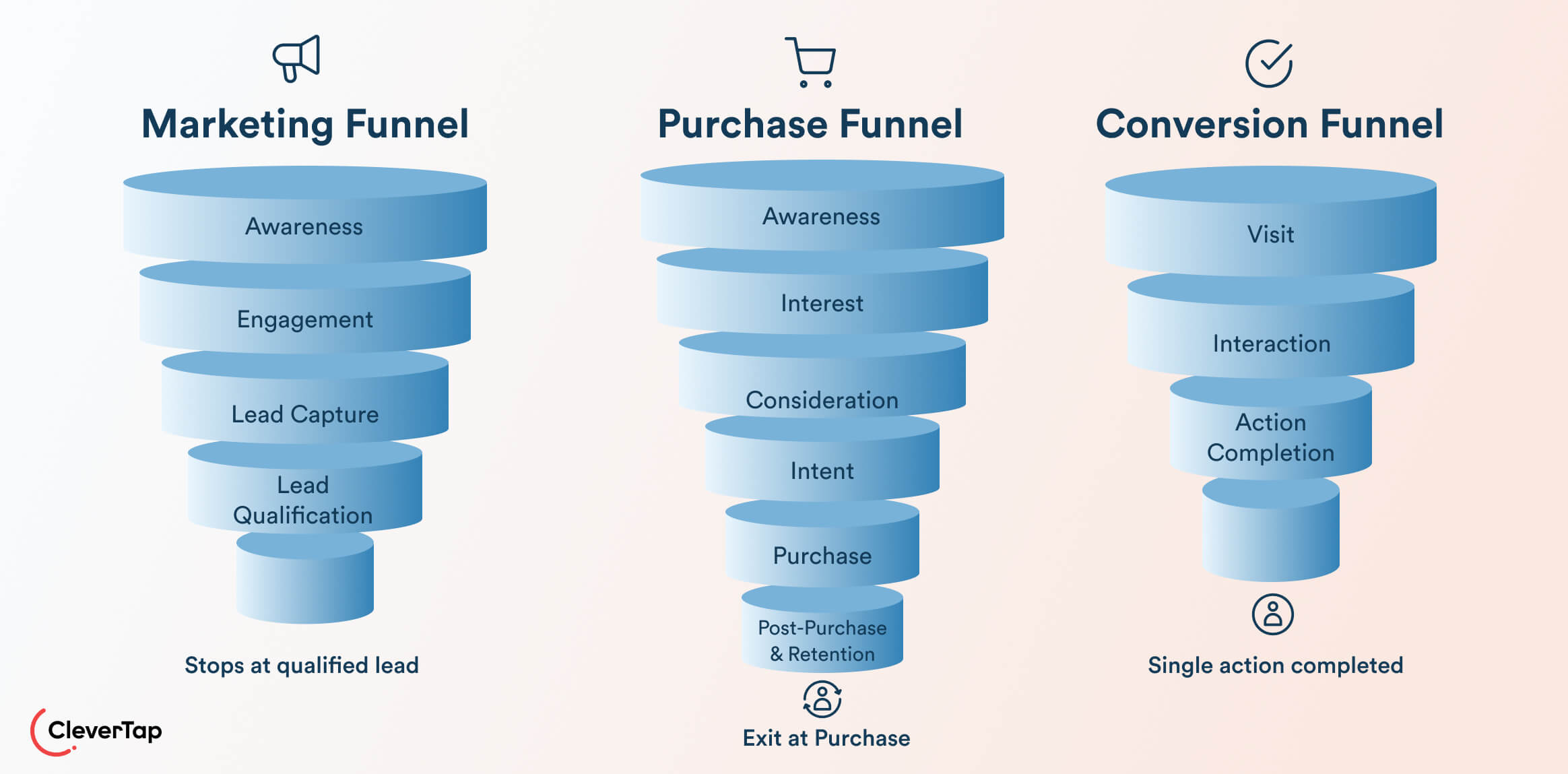
Purchase funnel maps the full path to revenue transactions, from product views and cart adds, through checkout completion, and into retention tracking. Growth and CRM teams use it to diagnose buying breakdowns at payment or pricing stages, tying every step to transactional revenue.
Marketing funnel emphasizes earlier lead generation with the help of broad awareness through content engagement, email signups, or demo requests. It ends at qualified lead handoff, managed by demand gen teams, stopping short of actual payment.
Conversion funnel zooms into specific, often session-bound goals like landing page to form submission or cart recovery flows. Narrow scope excludes lifecycle; it prioritizes immediate action completion.
Mislabeling creates blind spots, such as cart abandonment reports labeled “marketing funnel” ignore revenue context, while trial starts called “purchases” skip retention measurement. In analytics platforms, they integrate marketing funnels that pass leads to purchase stages and conversion funnels that optimize upsells. Align event tracking across all three for unified customer purchase funnel visibility.
How Marketers Actually Analyze Purchase Funnels
Marketers analyze purchase funnels through event-based tracking, not vague diagrams. Platforms capture discrete user actions as sequential steps. Each event carries user properties like device type, traffic source, or session count, letting teams build dynamic funnels that update in real time.
Drop-off analysis measures conversion rates between stages. A 40% drop from cart add to checkout flags friction. An 80% drop from checkout start to payment points to payment issues.
Teams set time windows to match behavior: 24 hours for impulse buys and 7 days for considered purchases.
Layer high drops with user details like device or traffic source for clarity. Mobile users drop more? Optimize one-tap payments. Organic traffic stalls? Test pricing clarity. Raw percentages turn into targeted fixes.
Cohort analysis and segmentation add depth. Group users by acquisition week, first-touch channel, or behavior cluster, then track progression differences. Fintech teams might see Google-acquired cohorts drop 15% more at KYC than organic ones. Segment drop-offs further by high-value signals (repeat sessions, high spend history) to prioritize recovery campaigns.
Static dashboards limit insight because behaviors shift daily. Real analysis needs live event streams and query flexibility to test hypotheses fast. Without this, insights become outdated before campaigns launch.
Common Purchase Funnel Mistakes Marketers Make
Purchase funnels don’t fail because of missing data. They fail when stages are misaligned, overgeneralized, or left unacted upon. These common mistakes prevent insights from turning into revenue.
- Generic Funnel Templates: E-commerce demands cart and checkout metrics. Fintech requires visibility into KYC and verification friction. Subscriptions hinge on trial-to-paid transitions. Applying one-size-fits-all stage masks the real conversion leaks in your model. Funnels must be built around your primary revenue event, not borrowed from a generic framework.
- Traffic Over Engagement: High pageviews can create a false sense of momentum. Ten thousand sessions mean little if users bounce after a single visit. Repeat sessions, depth of interaction, and progression between steps signal intent far more clearly than volume alone.
- Awareness Over Mid-Funnel: Ad budgets often fill the top of the funnel while consideration and intent stages remain under-optimized. Warm prospects stall on unclear value propositions, pricing confusion, or checkout hesitation. Growth efforts must address mid-funnel friction as deliberately as acquisition.
- Data Without Campaigns: Spotting a 50% drop-off at the intent stage is only half the job. Without segmentation and targeted recovery campaigns, insights remain static. Funnel analysis must trigger action, whether through urgency messaging, onboarding flows, or personalized nudges.
A purchase funnel only drives growth when insights lead to intervention. Avoiding these mistakes ensures that stage-level visibility turns into measurable conversion gains rather than unused reports.
How CleverTap Helps You Build and Optimize Purchase Funnels
CleverTap turns funnel analysis into direct execution by unifying behavioral insights, segmentation, and journey orchestration on a single platform. Instead of diagnosing drop-offs in one system and activating segments in another, teams can analyze user behavior and act on it without tool-switching or data lag.
Real-Time Funnel Analytics That Expose Friction
CleverTap lets you define multi-step behavioral paths such as product view → cart add → checkout → purchase, and track progression across each step. You can configure sequential events, set conversion windows, and measure both conversion rates and time-to-convert trends to identify where users stall and how long they take to move forward.
Capabilities include:
- Segment comparisons to evaluate how different user groups convert across the same funnel
- Breakdowns by user or event properties such as device, geography, acquisition source, or product type
- Time-based trend analysis to understand progression speed and optimize engagement timing
Because data is ingested in real time and tied to unified customer profiles across web and app, funnels reflect live behavior rather than static snapshots.
Advanced Segmentation for Stage-Level Targeting
Funnel insights become actionable through CleverTap’s behavioral segmentation engine. You can instantly create segments of users who:
- Viewed a product repeatedly but never added to cart
- Added to cart but did not check out within a defined window
- Completed a purchase but failed to return within 7 days
Segments update dynamically as users meet criteria and can combine behavioral triggers with profile attributes such as device type, region, or subscription tier. This allows teams to prioritize high-intent users and isolate stage-specific drop-offs with precision.
Journey Orchestration Aligned to Funnel Stages
Once drop-offs are identified, CleverTap’s Journeys canvas enables automated, multi-step engagement tied directly to funnel behavior.
For example:
- Trigger push or in-app messages when a cart add does not convert within hours
- Send checkout reminders via email or WhatsApp
- Launch onboarding sequences immediately after the first purchase
Journeys operate across push, in-app, email, SMS, web push, and WhatsApp, allowing stage-specific interventions across channels without disconnecting analysis from activation.
Predictive Intelligence and Optimization
CleverTap enhances funnel optimization with AI-powered capabilities that identify users most likely to convert, churn, or lapse. Predictive segmentation surfaces high-propensity audiences within intent or retention stages, enabling prioritized recovery campaigns.
Built-in experimentation tools support A/B testing across messages and journey paths, while unified analytics measure conversion lift and revenue impact using the same event data powering the funnel. This closes the loop between diagnosis, activation, and measurement.
From Insight to Revenue Action
Where static reporting highlights drop-offs, CleverTap connects funnel visibility to immediate engagement. Teams can move directly from identifying a breakdown to launching a recovery flow, tracking performance shifts in near real time.
The result is a purchase funnel that is not only visible but continuously optimized through behavioral targeting, predictive prioritization, and cross-channel lifecycle orchestration.
Ready to turn funnel insights into measurable revenue? Try CleverTap and see how stage-level optimization drives growth.
Final Thoughts
Purchase funnels aren’t static diagrams, but they’re live systems reflecting real customer behavior. Data reveals drop-offs and intent shifts; engagement turns those insights into revenue through targeted nudges at every stage. Growth teams win by connecting the two: track actions, segment users, and then execute campaigns that recover leaks and build loyalty.
Make your customer purchase funnel work harder. Smarter tracking means higher conversions. Start instrumenting behavioral events today and tie them to lifecycle flows. Schedule a demo with CleverTap today!

Agnishwar Banerjee 
Leads content and digital marketing.Expert in SaaS sales, marketing and GTM strategies.
Free Customer Engagement Guides
Join our newsletter for actionable tips and proven strategies to grow your business and engage your customers.