


















































Table of Contents
Categories
Most Popular


Email is still one of the most powerful channels in a marketer’s toolkit, but when your audience includes people in the EU/EEA, every campaign you send carries legal weight. GDPR and email marketing are closely linked, and getting that relationship wrong can lead to fines, reputational damage, and loss of subscriber trust. The GDPR was adopted in 2016 and has been applied since 25 May 2018.
This guide explains what GDPR requires of email marketers, how to build compliant opt-in flows, how consent interacts with email-marketing rules under the ePrivacy framework, how to handle subscriber rights, and what capabilities to look for when choosing an email marketing platform.
What GDPR and Email Marketing Mean for Marketers
The General Data Protection Regulation (GDPR) is a comprehensive data privacy law adopted by the European Union in 2016 and enforceable since 25 May 2018. It governs how organisations collect, store, process, and use the personal data of EU residents. Email addresses are personal data. This means that any time you collect an email address, send a marketing message, or store subscriber information, you are processing personal data, and GDPR applies.
GDPR in email marketing creates specific obligations around consent, transparency, and data minimization, plus respecting individual rights. Non-compliance carries steep penalties: up to €20 million or 4% of global annual turnover, whichever is higher.
GDPR vs. ePrivacy Regulation
It’s worth distinguishing between GDPR and the ePrivacy Directive (sometimes called the “Cookie Law”), which is often confused with it. While GDPR governs the processing of personal data broadly, the ePrivacy Directive specifically covers electronic communications, including marketing emails and SMS. In most EU countries, the ePrivacy Directive requires prior consent before sending marketing emails to individuals.
These two frameworks work together. GDPR sets the standard for what valid consent looks like and how data must be handled. ePrivacy sets the rule that you need consent to send marketing emails in the first place.
The proposed ePrivacy Regulation, which was widely anticipated to replace the ePrivacy Directive, was formally withdrawn by the European Commission in its 2025 work programme (announced February 2025). The existing ePrivacy Directive and its national implementations therefore remain the law of the land for the foreseeable future.
Who GDPR Applies To (Even If You’re Not in the EU)
One of the most common misconceptions about GDPR is that it only applies to companies based in the EU. This is incorrect. GDPR has extraterritorial reach: it applies to any organisation, anywhere in the world, that processes the personal data of EU residents.
EU Residents vs. EU Businesses
What matters under GDPR is not where your company is incorporated. It’s whether the people whose data you process are located in the EU. If a US-based e-commerce brand collects email addresses from German customers and sends them promotional emails, GDPR applies. The regulation applies based on the location of the data subjects (the people whose data you hold), not the location of the data processor or controller.
Here are examples of organisations that must comply with GDPR email marketing rules even without an EU office:
- SaaS companies offering free trials or subscriptions to EU-based users
- E-commerce brands shipping products to EU customers
- Newsletter creators and media publishers with EU readers
- Mobile apps with EU user bases
If even a portion of your email list consists of EU residents, those contacts fall under GDPR. You don’t get to segment your compliance obligations.
GDPR Consent Rules for Marketing Emails
Consent is the legal basis most commonly relied upon for sending GDPR marketing emails. Under GDPR, consent is a defined legal standard with specific requirements.
What Counts as Valid Consent?
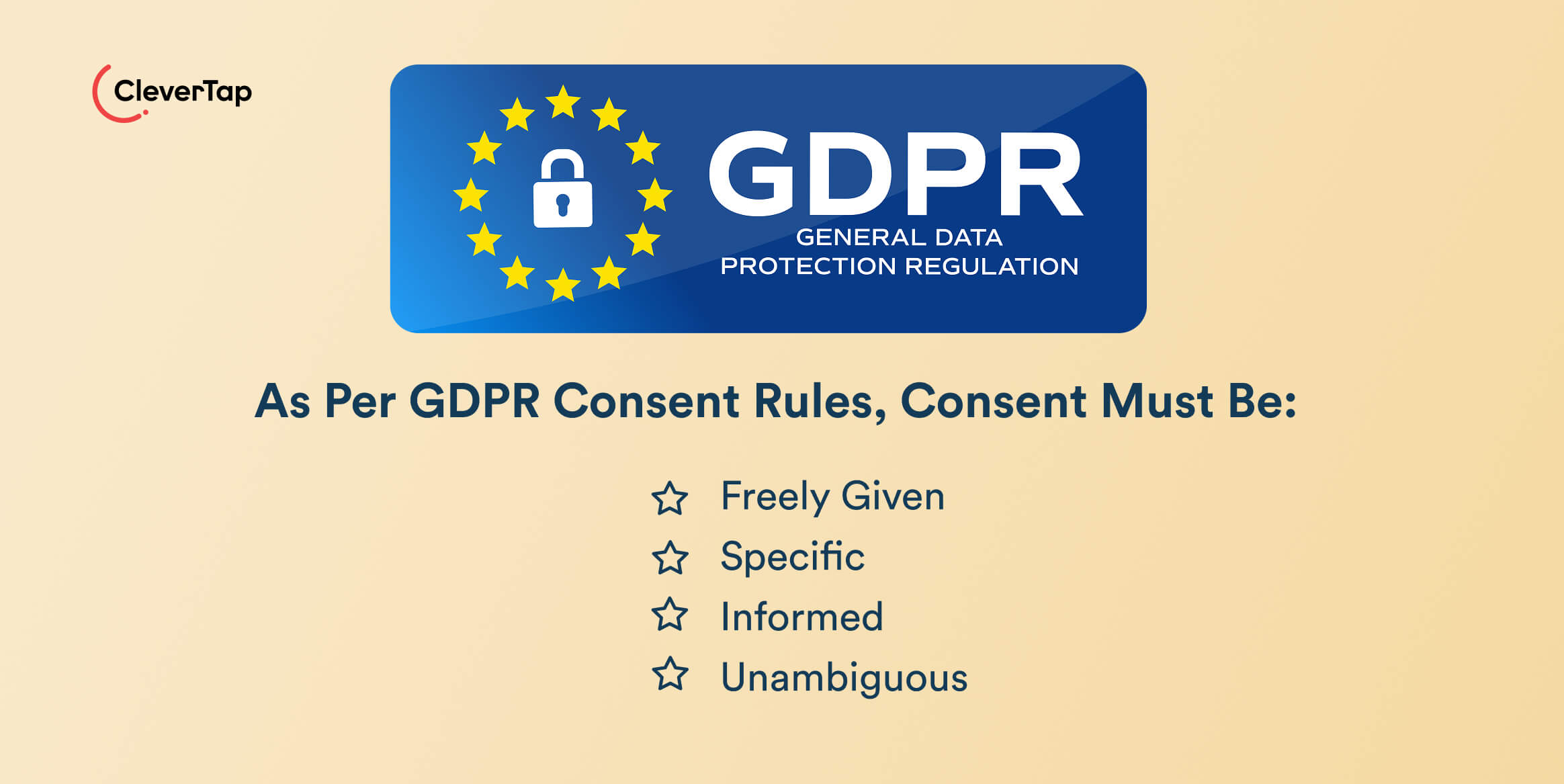
Let’s understand the GDPR consent requirements. Under Article 4(11) of the GDPR, valid consent is defined as freely given, specific, informed, and unambiguous. Article 7 then sets out the practical conditions for consent, including the burden of proof, the right to withdraw, and the prohibition on bundling consent with service access. Together, these articles establish four criteria that every act of consent must satisfy.
Freely Given
Consent must be given voluntarily, without any penalty for withholding it. Bundling consent to marketing emails with a condition of service access, for example, requiring someone to opt in to your newsletter just to download a free ebook, is not freely given consent. Users must have a genuine, real choice.
Specific
Consent must be granular. If you want to send marketing emails and also share data with third parties, you need separate consent for each purpose. A single blanket tick-box covering multiple purposes does not meet the specificity requirement.
Informed
People must understand what they’re consenting to before they give consent. This means your signup form must clearly identify who is collecting the data, what it will be used for, and how they can withdraw consent. Vague language like “We may use your data for various purposes” does not satisfy the informed requirement.
Unambiguous
Consent must be expressed through a clear affirmative action. This could be ticking an unchecked box, clicking an explicit consent button, or otherwise actively signalling agreement. Pre-ticked boxes, implied consent through inaction, and buried opt-out clauses do not meet this standard.
Consent vs. Implied Consent
One of the most important distinctions in GDPR email marketing compliance is between explicit consent and implied consent. Under GDPR, implied consent, for example, “by giving us your email address, you agree to receive marketing from us,” does not meet the legal standard for marketing emails to EU residents.
Explicit consent means the person has taken a specific, affirmative step to agree to receive your marketing emails. This is a meaningfully higher bar than the opt-out or soft opt-in mechanisms that many marketers used before GDPR. Past business relationships, email addresses found on public websites, or business card exchanges do not constitute consent under GDPR.
GDPR Opt-In Email Requirements
For a GDPR opt-in email process to be legally sound, you need the following in place at the point of data collection:
An unchecked opt-in checkbox (not pre-ticked)
- Clear language describing what the subscriber is opting into
- Identification of your organisation as the data controller
- A link to your privacy policy
- Information about the subscriber’s right to withdraw consent
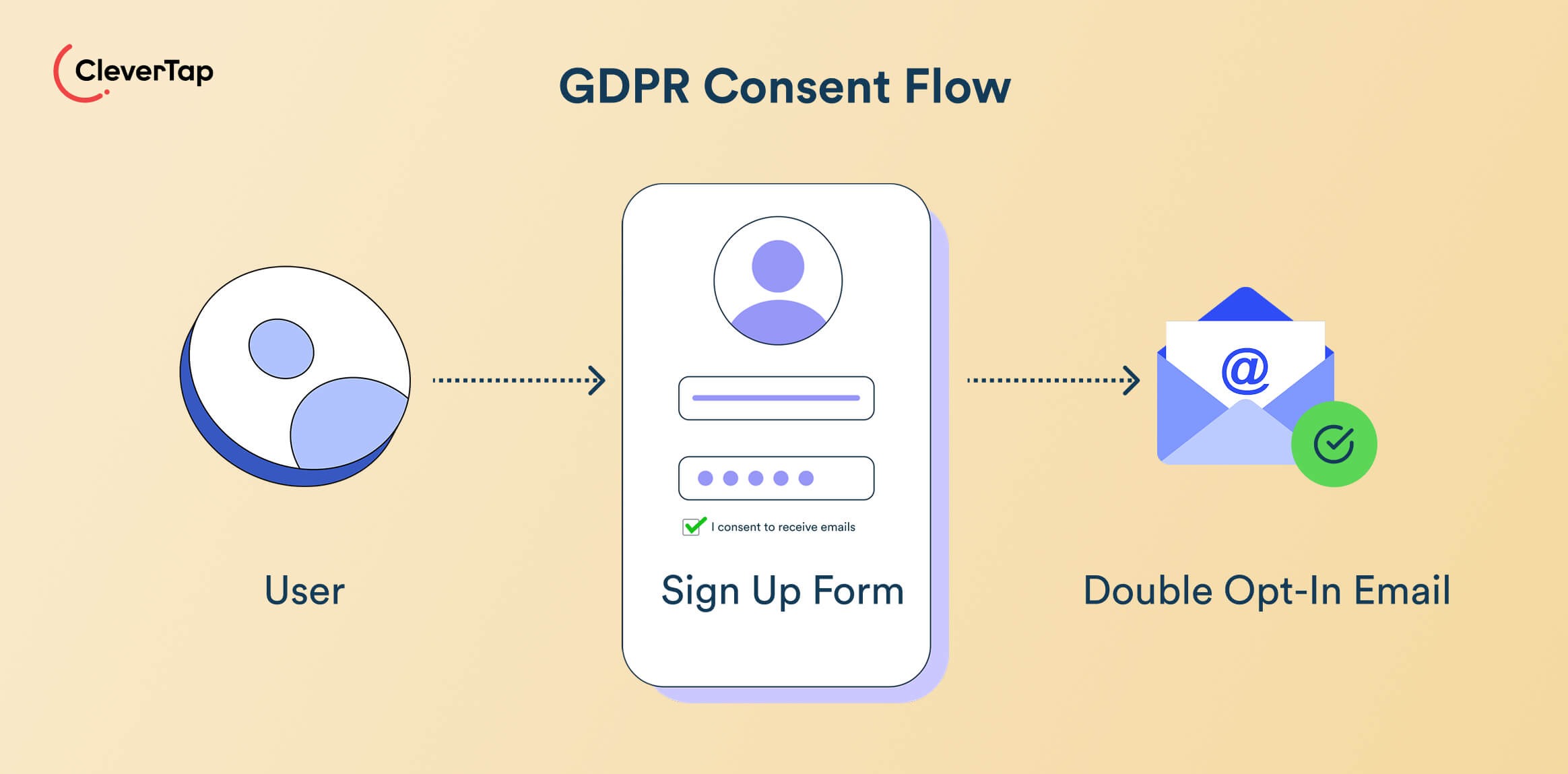
Once consent is collected, you must be able to prove it, including what was said at the time, when it was given, and through what mechanism.
GDPR and Email Marketing: How to Build a Compliant Email List (Step-by-Step)
Building an email list that complies with GDPR isn’t complicated once you understand the rules but it does require careful attention to how and where you collect data.
How to Collect Email Addresses Legally
Only collect email addresses through forms or mechanisms where the user has been fully informed about what they’re signing up for. This means your landing pages, popups, checkout flows, and any other data collection touchpoints must clearly state what the subscriber will receive, who will contact them, and how to opt out.
Do not purchase email lists. Email lists purchased from third-party vendors cannot include verifiable consent given to you specifically. Under GDPR, consent must be given specifically to the data controller, not to a third party on your behalf. Purchased lists are not GDPR compliant for marketing emails.
Signup Form Best Practices
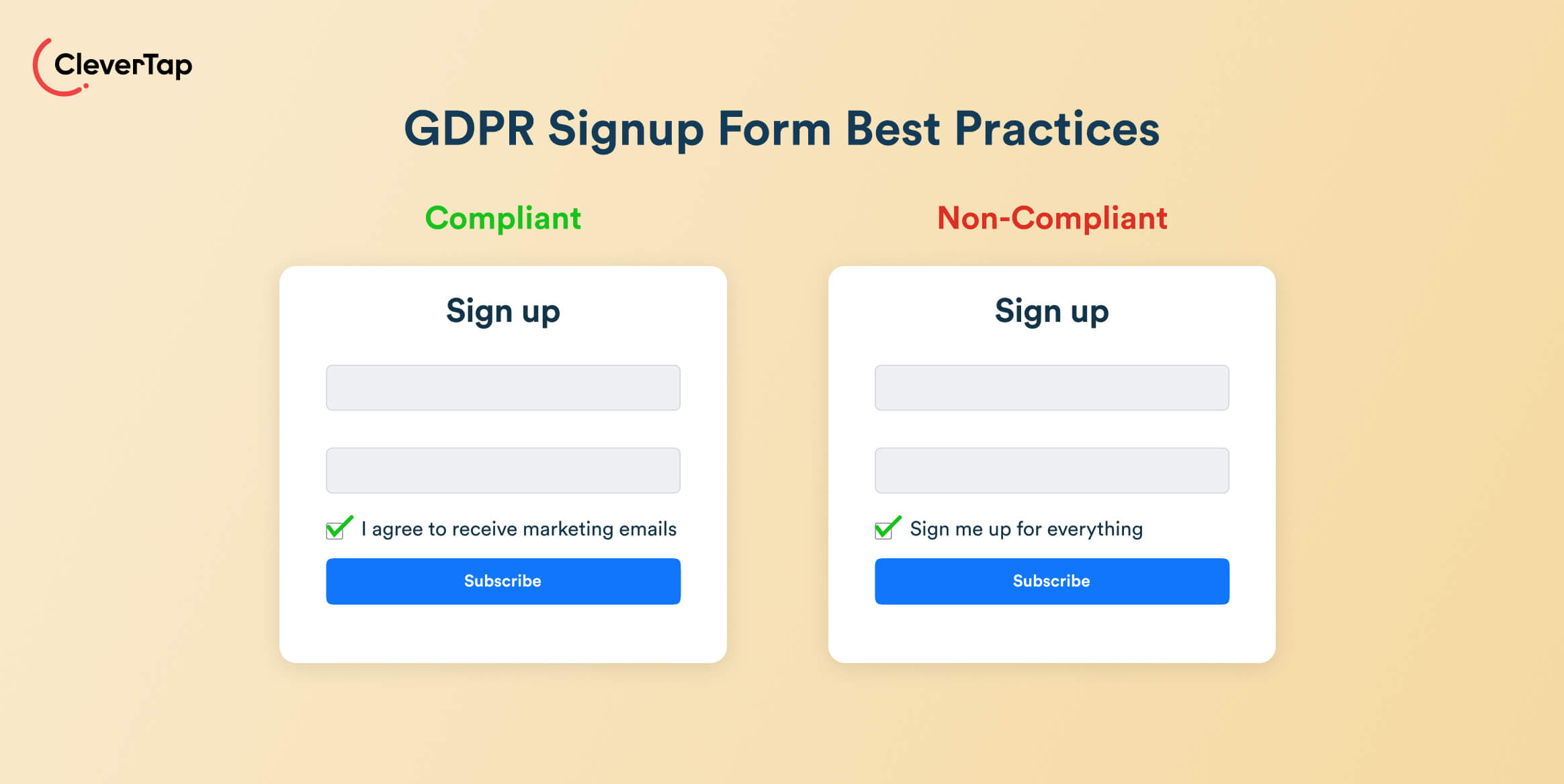
Your email signup forms are the first point of compliance. Every form collecting email addresses from potential EU contacts should follow these principles:
Required Checkbox Language Examples
Here are examples of compliant and non-compliant checkbox language for signup forms:
- Compliant: “Yes, I’d like to receive product updates, offers, and marketing communications from [Company Name]. I understand I can unsubscribe at any time. View our Privacy Policy.”
- Compliant: “Subscribe me to [Company Name]’s weekly newsletter. I agree to the Privacy Policy and can opt out at any time.”
- Non-compliant: “By signing up, you agree to receive marketing from us and our partners.” (too vague, lacks granularity)
- Non-compliant: “Stay informed about products and services.” (not specific enough about marketing intent)
What NOT to Do
Pre-ticked checkboxes are explicitly prohibited as a mechanism for obtaining GDPR-compliant consent. GDPR Recital 32 directly states that pre-ticked boxes do not constitute valid consent.
This was further reinforced by the Court of Justice of the EU in the Planet49 ruling (2019), though it is worth noting that ruling arose specifically in the context of cookie consent under the ePrivacy Directive, not email marketing forms. The underlying principle is the same: pre-ticked boxes do not satisfy the unambiguous affirmative action requirement.
Similarly, hiding opt-out language in lengthy terms and conditions, using double negatives, or bundling marketing consent with service agreements are all non-compliant practices.
Double Opt-In: Required or Recommended?
Double opt-in is not required under GDPR, but it is widely considered best practice. In this process, a subscriber confirms their signup by clicking a link in a follow-up email before being added to your active list. It strengthens proof of consent, confirms the email owner’s intent, and reduces spam complaints. For EU-facing lists, double opt-in is strongly recommended.
How to Store Proof of Consent
Under GDPR, you bear the burden of proof when it comes to consent. If a regulator or data subject challenges whether you had valid consent to process their data, you need to be able to demonstrate it. This means your consent records must capture:
- The identity of the subscriber (email address)
- The date and time of consent
- The version of the consent form or language shown at signup
- The IP address or device from which consent was given
- Whether a double opt-in confirmation was completed
These records should be stored in your CRM, ESP, or a dedicated consent management platform and retained for as long as you hold the subscriber’s data, plus a reasonable additional period to cover any potential disputes.
GDPR and Email Marketing: Consent Management Framework
A robust consent management framework is the operational backbone of GDPR compliant email marketing. Rather than treating consent as a one-time event at the point of signup, a full framework treats it as an ongoing relationship with clear processes for capture, storage, activation, and honouring preferences.
The 4-Part GDPR Compliance System
- Capture: Collect consent at every point of data entry using compliant forms. Ensure the language is clear, the checkbox is unticked, and consent is specific to the purpose. Use double opt-in for all EU contacts.
- Store: Record and retain consent evidence in a durable, queryable format. Every consent event should be timestamped and tied to the subscriber’s record, with the form version and channel documented.
- Activate: Only send marketing communications to subscribers who have given valid, recorded consent for that specific purpose. Your ESP or CDP should enforce consent status before messages are triggered.
- Honour preferences: Maintain a live preference centre where subscribers can update their consent, change email frequency, or opt out of specific communication types. Process preference changes in real time across all connected platforms.
Consent Logging and Audit Readiness
Audit readiness means being able to produce a compliance report on demand. For GDPR email marketing compliance, you should be able to answer the following questions for any subscriber in your database at any time:
- When did this person consent, and what did the consent form say?
- What communication types have they consented to?
- Have they ever withdrawn consent, and when?
- What data do you hold about them, and where is it stored?
- Has any automated processing been applied to their profile?
This level of audit readiness requires consent data to be structured, searchable, and integrated across your marketing stack, not buried in spreadsheets or isolated in a single tool.
Managing Consent Across Platforms (ESP + CDP + CRM)
A key GDPR challenge is keeping consent status synchronised across your tools. If a subscriber unsubscribes, that change should be reflected across your ESP, CDP, and CRM as quickly as possible. Fragmented opt-out records create legal risk. Ensure your systems are integrated to propagate consent updates and regularly audit suppression lists for consistency.
GDPR Rules for Different Types of Emails
Not all emails are governed by the same rules under GDPR. The type of email you’re sending, and the relationship you have with the recipient, determines what legal basis you can rely on.
- Marketing emails promote products, services, or brands, such as campaigns, offers, and newsletters. These generally require explicit consent or a clearly documented alternative legal basis.
- Transactional emails are necessary to fulfil a service, such as order confirmations or password resets. These rely on contract performance and do not require marketing consent. However, if promotional content becomes the primary purpose, the message may be treated as marketing.
- Lifecycle emails sit in a grey area. If they are closely tied to the service (e.g., onboarding or account notices), they may be justified under contract or legitimate interest. If they are promotional in nature, consent is the safer basis.
- For newsletters and creator lists, each subscriber must explicitly opt in. Scraped contacts, imported lists, or business cards without specific marketing consent are not compliant. Double opt-in is strongly recommended.
Legitimate Interest vs. Consent
Legitimate interest is one of the most misunderstood legal bases in GDPR email marketing. It is not a backup option when you fail to obtain consent. It can only be used where processing is necessary for a legitimate purpose and does not override the individual’s rights and expectations.
In limited situations, it may apply to follow-up communications with existing customers about similar products (subject to national ePrivacy rules) or certain service-related lifecycle messages not covered by contract performance.
However, using legitimate interest for broad promotional campaigns, especially to individuals who would not reasonably expect to hear from you, carries significant regulatory risk. Supervisory authorities across the EU have made clear that marketing consent cannot simply be substituted with legitimate interest.
If you rely on this basis, you must conduct and document a Legitimate Interest Assessment (LIA). This evaluates:
- Purpose: Is there a legitimate interest?
- Necessity: Is the processing necessary to achieve it?
- Balancing: Do your interests outweigh the individual’s rights?
You must also provide a clear and easy opt-out mechanism and avoid sending to anyone who has previously opted out.
If recipients would not reasonably expect your marketing emails, legitimate interest is unlikely to apply. In most promotional contexts, consent remains the safer and more defensible legal basis.
GDPR and Email Marketing: GDPR Compliance Checklist for Email Campaigns
Before sending any marketing campaign to EU contacts, work through the following checklist. Each point represents a potential compliance gap that could expose your organization to regulatory action.
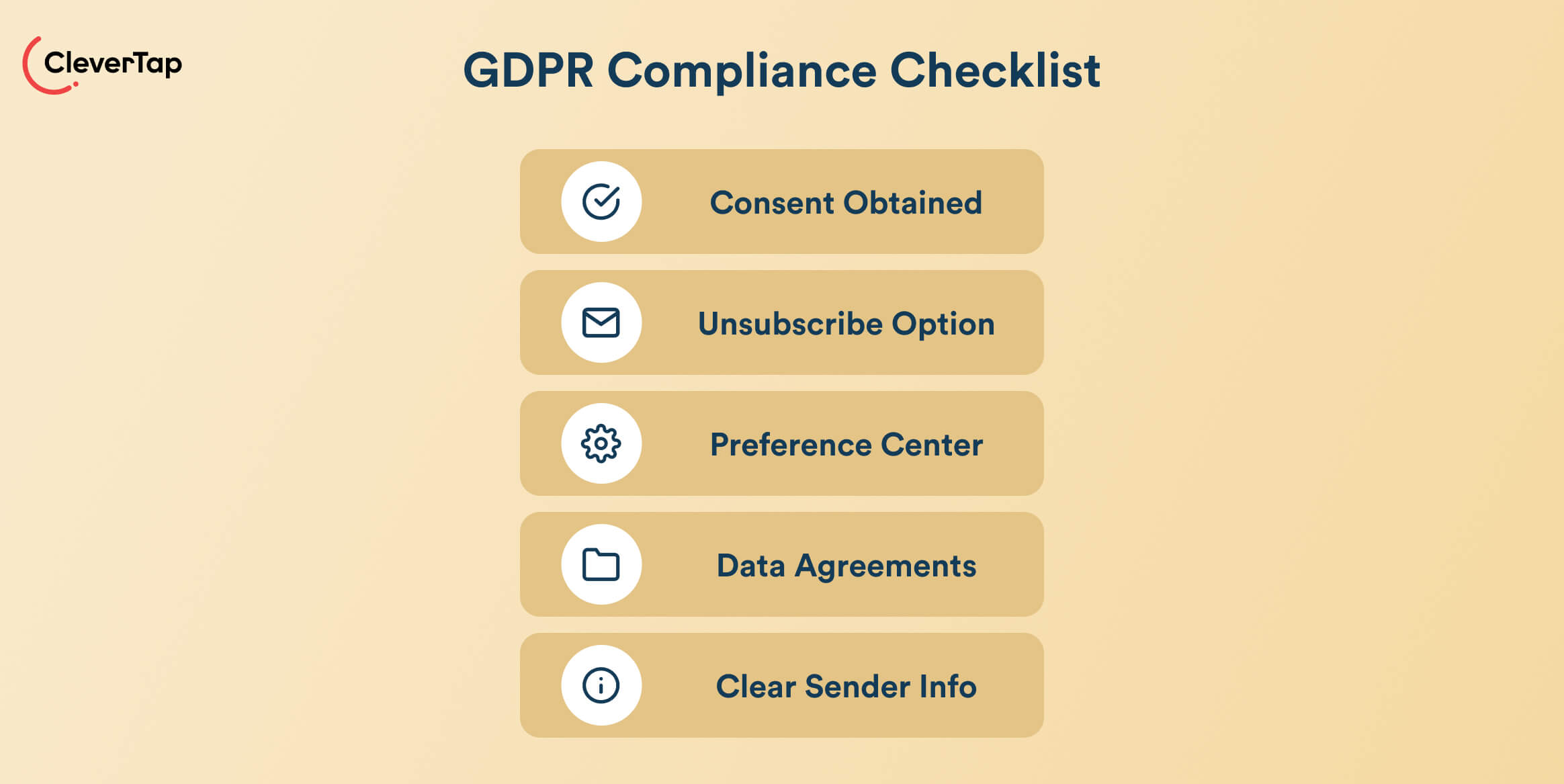
Before Sending Any Campaign, Confirm:
- Consent captured: Every contact in the send list has provided valid, documented consent for marketing emails (or another legal basis has been assessed and recorded)
- Consent current: Consent has not expired; if it was collected more than 12–24 months ago with no engagement, consider re-permissioning
- Clear unsubscribe link: Every email contains a prominent, functional unsubscribe mechanism that processes immediately
- Preference centre available: Subscribers can access a preference centre to update their communication preferences
- Data processing agreements in place: If you use any third-party ESPs, CDPs, or analytics tools that process subscriber data, a Data Processing Agreement (DPA) must be signed
- Sender identification: Every email clearly identifies your organisation as the sender — no misleading sender names or subject lines
- Purpose alignment: The content of the email matches what the subscriber consented to receive
- Suppression lists updated: Opt-outs and unsubscribes from all channels have been applied before sending
Email Footer Compliance Requirements
Every marketing email sent to EU contacts must include the following in the footer:
- Your organisation’s full legal name and registered address
- A clear, one-click unsubscribe link
- A link to your privacy policy
- Optionally, a link to your preference centre so subscribers can update (not just cancel) their preferences
The unsubscribe process must be simple. Requiring a login, a multi-step form, or any delay before processing an unsubscribe request violates both GDPR and, in many jurisdictions, local email marketing laws such as the CAN-SPAM Act (for US contacts) or CASL (for Canadian contacts).
Handling Subscriber Rights
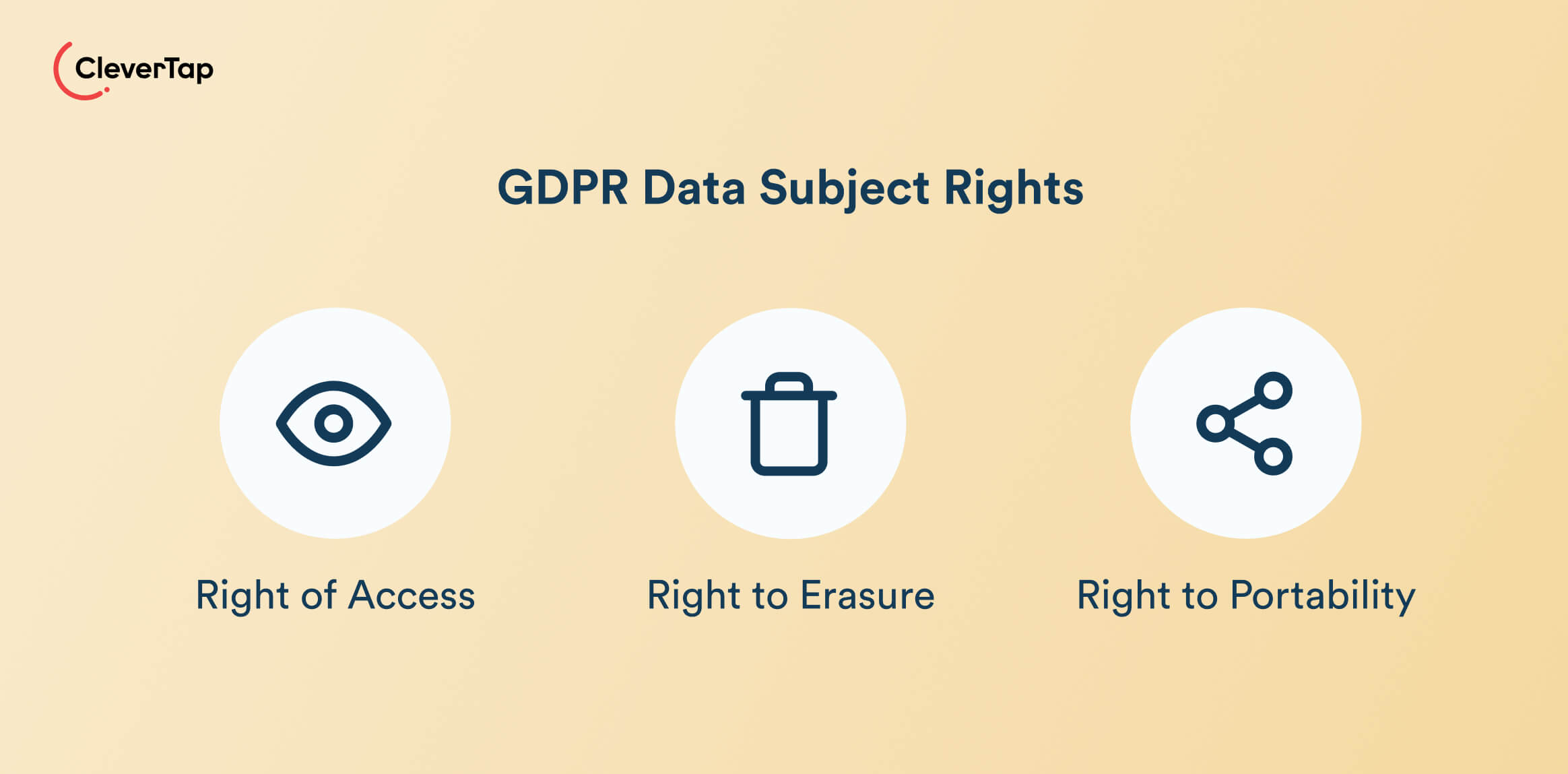
Art. 15–20 GDPR grants individuals specific rights over their personal data. Marketing teams must have documented processes to respond without undue delay and generally within one month.
Right of Access
Subscribers can request a copy of the personal data you hold about them, including contact details, consent records, and profile or engagement data stored across your systems. You must be able to retrieve and provide this information in a clear, structured format. Build a repeatable process for handling Subject Access Requests across your entire marketing stack.
Right to Erasure
Individuals may request deletion of their personal data. Upon receiving a valid request, you must remove their data from your ESP, CRM, analytics tools, and other systems, unless legal retention obligations apply. You may retain a minimal suppression record to prevent re-adding them inadvertently.
Right to Data Portability
Subscribers can request their data in a machine-readable format. In email marketing, this typically includes contact details, consent information, preferences, and related profile data.
Opt-Out vs. Deletion
An unsubscribe updates marketing preferences and stops promotional emails, but does not require deleting all personal data. A deletion request requires removing personal data, subject to lawful retention requirements. Teams should clearly distinguish between these workflows to avoid compliance errors.
Re-Permissioning Old Email Lists (If You Collected Emails Pre-GDPR)
If your email list includes contacts collected before May 2018, or collected under consent mechanisms that would not meet today’s GDPR standard, you may need to run a re-permissioning campaign before you can continue sending marketing emails to those contacts.
When You Need a Re-Consent Campaign
You need to re-permission contacts when: you cannot demonstrate valid, documented consent for marketing emails; consent was collected via a pre-ticked box or bundled with terms of service; the consent record does not specify what types of communications were agreed to; or a significant amount of time has passed since consent was given with no engagement from the subscriber.
Best-Performing Re-Permission Email Sequence
A re-permission campaign should be brief, honest, and value-focused. The goal is to give contacts a genuine opportunity to re-engage. A three-email sequence works well:
- Email 1 (30 days before cutoff): “We’re updating our email list. Confirm you’d like to stay in touch.” Remind them of the value you provide, include a clear CTA to confirm subscription
- Email 2 (14 days before cutoff): A gentle reminder: “Last chance to stay subscribed,” with the same confirmation CTA
- Email 3 (7 days before cutoff): Final notice: “We’re removing unconfirmed contacts on [date],” make the stakes clear without being alarmist
What Happens If Users Don’t Respond?
Contacts who do not respond to a re-permissioning campaign should be removed from your active marketing list. This is non-negotiable under GDPR. Silence does not equal consent. You can retain a suppressed record (email address only, flagged as inactive) to prevent future inadvertent re-import, but you cannot continue sending marketing emails to non-respondents.
Removing non-consenting contacts is not a loss, it’s list hygiene. Contacts who don’t engage are damaging your deliverability metrics and providing no business value. A smaller, consenting list will consistently outperform a large, unengaged one.
GDPR Penalties and Enforcement
Since 2018, supervisory authorities across EU member states have issued penalties totalling billions of euros, including significant enforcement actions specifically related to email marketing and consent failures.
How Fines Are Calculated
GDPR provides for two tiers of fines. For less severe infringements (such as failures in data minimisation or record-keeping obligations), fines can reach €10 million or 2% of global annual turnover.
For more serious infringements, including violations of the basic principles for processing, consent requirements, or data subject rights, the maximum fine is €20 million or 4% of global annual turnover, whichever is higher. Supervisory authorities also take into account factors including the nature, gravity, and duration of the violation; the number of people affected; the intentional or negligent character of the infringement; and cooperation with the regulator.
Financial penalties are only part of the picture. Regulatory action against a company for email marketing violations can result in mandatory audits, corrective orders requiring operational changes, reputational coverage in national press, and lasting damage to subscriber trust.
What to Look for in a GDPR-Compliant Email Marketing Platform
Your email marketing platform is the operational center of your GDPR compliance program. Choosing the right tool can make the difference between a compliant, audit-ready email program and a fragmented, risky one. Here are the key capabilities to evaluate:
- Consent tracking: The platform should store and surface consent status for every subscriber, including the date, source, and form version used to collect consent. You should be able to filter and segment based on consent status.
- Preference management: Look for a built-in preference centre where subscribers can manage their own communication preferences, email types, frequency, and topics, without requiring IT involvement. Preferences should sync across the platform in real time.
- Data governance: The platform should support Data Processing Agreements (DPAs), data residency controls (particularly EU-based data storage options), configurable data retention periods, and automated data deletion workflows to support erasure requests.
- Automation controls: Automated campaigns and lifecycle sequences should include consent-gate logic, ensuring messages are only triggered for contacts with valid consent for that communication type. Suppression lists should be applied globally across all automated and manual sends.
- Audit logs: Look for detailed activity logs covering consent events, opt-out processing, data access requests, and any manual changes to subscriber records. These logs are essential for audit readiness.
- Integration capabilities: Your ESP should integrate cleanly with your CRM and CDP to ensure consent data is synchronised across the stack. Look for native integrations or well-documented APIs with real-time sync capabilities.
GDPR compliant email marketing is not the obstacle to growth it might appear to be. A consenting, engaged list built on trust will always outperform a bloated list built on corner-cutting in deliverability, engagement, and ultimately, revenue.
How CleverTap Helps With GDPR Compliance
CleverTap helps email marketers stay GDPR-ready by combining compliance-focused features with best practice guidance.
- Consent and privacy controls: Encourages marketers to obtain user consent and track only necessary data, supported by clear privacy and data protection policies.
- Opt-in/opt-out support: Enables users to opt out of communications across email, push, and SMS, with controls to ensure opted-out users are not contacted.
- Data minimization and security: Does not collect personal data by default; GDPR-compliant SDKs and role-based access controls help secure and manage data.
- Email marketing best practices: Guides marketers to target only opted-in, engaged users, avoid purchased lists, and maintain transparency in communication.
- Support for data subject rights: Helps marketers fulfill GDPR requirements such as data access, rectification, restriction, and erasure requests.
See how CleverTap can help you stay GDPR-compliant while driving better engagement.
Stay Compliant Without Compromising Growth
CleverTap equips marketers with the tools and guidance needed to navigate GDPR requirements confidently. By prioritizing user consent, data security, and transparent communication, businesses can build trust while delivering effective, personalized campaigns using our email personalization tool.

Agnishwar Banerjee 
Leads content and digital marketing.Expert in SaaS sales, marketing and GTM strategies.
Free Customer Engagement Guides
Join our newsletter for actionable tips and proven strategies to grow your business and engage your customers.