









































Table of Contents
Categories
Most Popular


Not long ago, fintech apps had one job: help users move money.
Send. Receive. Pay. Track. Repeat.
But that version of fintech is fading as fast as customer expectations are evolving. Today’s experience-centric, outcome-driven customer expects the app to not just enable transactions, but actively support day-to-day life with smart reminders, seamless bill payments, savings nudges, investment guidance, credit decisions, and financial well-being.
Unsurprisingly, fintech apps are evolving from being a utility to becoming lifestyle managers that help people not only transact, but also decide, plan, save, grow, and live better. And the next major force accelerating this shift is agentic AI systems that can interpret intent, take initiative, and orchestrate next-best actions across moments and channels.
This isn’t just theory. Gartner projects that 40% of enterprise applications will include task-specific AI agents by the end of 2026 (up from less than 5% in 2025), signaling how quickly “agents” are moving from experimentation to mainstream.
This blog explores the ongoing evolution of fintech apps to lifestyle managers and what it means for marketers, the powerful role of agentic systems in catalyzing this evolution, how CleverAITM Decisioning Engine and Agentic Universe can help, and more.
Why “Lifestyle Management” is the New Fintech North Star
Fintech apps are increasingly becoming a daily companion, helping customers navigate not just money movements, but money decisions that shape everyday life:
- “Can I afford this trip?”
- “How do I pay my bills without stress?”
- “How do I save without feeling restricted?”
- “What’s the smartest way to use my credit?”
- “Am I on track this month?”
However, many fintech apps still rely on engagement patterns built for a simpler era, such as rule-based triggers, static segments, scheduled campaigns, generic “weekly summary” messages, and reactive customer support. These approaches aren’t wrong, but they fall short in meeting the nuanced expectations of today’s customer because they assume the user will do the heavy lifting:
- Figure out what they need
- Navigate the app
- Interpret dashboards and charts
- Decide what action to take
- Repeat the cycle every week
That’s exactly where friction begins. In a world where attention is scarce and expectations are high, fintech users don’t want more choices, menus, or steps; they want clarity.
When fintech apps evolve into lifestyle managers, the value shifts from simply enabling transactions to actively helping customers make progress by automating decision-making, becoming always-on wealth advisors who provide financial guidance when needed. Instead of overwhelming users with features, these apps provide decision support, turning complex financial choices into clear next steps. This reduces decision fatigue and builds confidence because customers don’t have to constantly figure out what to do, when to do it, or how to stay on track.
“The AI-driven financial lifestyle will be one where the financial provider will actually predict your needs in 3, 5, or 10 years and manage those for you. And at the moment, we don’t have that. You have to do it yourself,” said Chris Skinner, Financial Services Thought Leader and Author. “But what’s going to happen with AI is, you’re going to find your firm – it’s going to not tell you what products to buy because they’re obviously trying to sell you pensions and insurances, but they’re going to tell you what you have to think [about].”
Lifestyle-first fintech supports customers in timely, real-life moments, such as before bills are due, when spending spikes, or when savings habits start slipping. And personalization evolves from just sending “relevant messages” to delivering meaningful outcomes, like helping customers save consistently, avoid missed payments and fees, improve credit health, and feel more in control of their financial well-being.
What Agentic AI Unlocks for Fintech Lifestyle Managers and Decision Enablers
Fintech engagement today is still largely campaign-centric – onboarding flow, activation messages, offer campaigns, and winback sequences. But customers don’t experience apps in campaigns; they experience them in moments.
Agentic AI is the next leap forward because it changes what an app does, enabling fintech brands to design engagement around:
- Intent signals (what users are trying to do)
- Behavioral context (what they’ve been doing lately)
- Lifecycle stage (where they are in their journey)
- Friction points (where they drop off)
- Emotional cues (stress, urgency, uncertainty)
That’s how fintech becomes lifestyle. Instead of waiting for commands, agentic AI systems can understand intent, proactively plan and execute actions, learn from feedback, and improve outcomes over time.
This is the difference between:
- a chatbot vs. a personal finance concierge
- a recommendation engine vs. a goal-achieving assistant
- a campaign scheduler vs. an engagement orchestrator
Together with agentic capabilities, fintech apps become less like interfaces and more like intelligent companions. For example, instead of showing a monthly spending chart after the fact, an agent can detect overspending trends early, suggest adjustments in real time, and recommend small, achievable actions, ultimately, preventing stress before it starts.
To explore more such trends shaping fintech engagement in 2026, download our eBook “Fintech Engagement Trends 2026”.
What This Means for Fintech Brands and Marketers
This shift, underpinned by agentic AI, is redefining what “good engagement” looks like. It is enabling fintech brands to move from engagement volume to engagement value, from broadcast messaging to intent-driven assistance, and from retention campaigns to nurturing long-term relationships and loyalty.
The Upside for Fintech Brands
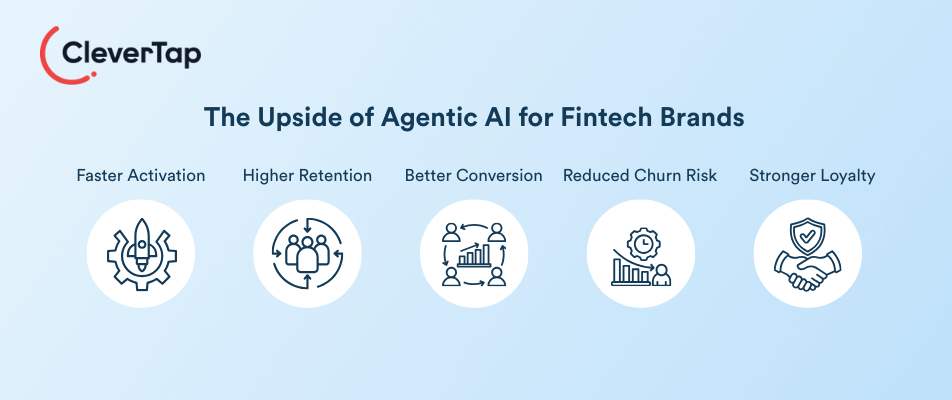
Agentic AI helps brands design engagement that behaves less like “marketing” and more like real-time advisors, customer support, and guidance, delivering measurable benefits such as:
- Faster activation by guiding users to their first meaningful “win”, such as first bill paid, first savings goal set, first successful investment, or first credit repayment plan.
- Higher retention by helping customers to stay on track – not just reminding them to return.
- Better conversion by timing offers around intent, such as travel, large purchases, and cash flow gaps, rather than blanket promos.
- Higher engagement by seamlessly managing daily decision-making, reminders, and expenditures – as engagement is no longer time-specific, but 1:1 personalized at scale.
- Reduced churn risk through early detection of disengagement signals and proactive interventions.
- Stronger trust and loyalty by minimizing noise and maximizing relevance in every interaction.
What Marketers Can Do Differently (Starting Now)
Here are a few high-impact, practical moves fintech marketers can make to align with this shift:
1) Design journeys around customer intent, not app features
Instead of “push feature adoption,” build engagement around real customer goals such as helping them stay on budget, build a savings habit, avoid late fees, or improve credit health. When the customer’s goal is clear, engagement becomes naturally valuable.
2) Shift from campaign calendars to “moment marketing”
The biggest engagement wins in fintech happen in moments like salary credited, bill due windows, sudden spend spikes, cart abandonment/payment failures, and goal milestones and streaks. Agentic AI helps brands show up exactly when it matters, without spamming customers when it doesn’t.
3) Replace generic nudges with next-best actions
Instead of “Check your balance,” say:
- “Your bill is due tomorrow – pay now or schedule it?”
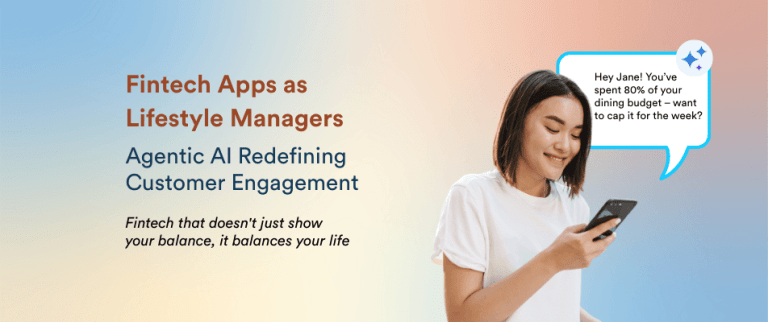
- “You’ve spent 80% of your dining budget – want to cap it for the week?”
- “You’re ₹500 away from your savings goal – top up now?”
This makes engagement feel like guidance, not noise.
4) Make personalization outcome-driven
True personalization isn’t adding a first name to a push notification. It’s using context to drive real outcomes such as increased savings consistency, improved repayment behavior, better portfolio engagement, reduced drop-offs in onboarding, higher repeat usage of core money habits, and more.
Agentic AI makes this possible at scale without needing marketers to manually design hundreds of edge-case journeys.
CleverAI Agents: Enabling Fintech Brands Deliver Lifestyle-First Engagement
As fintech apps evolve into lifestyle managers, the engagement stack needs to evolve too – from static automation to intelligent orchestration. That’s where CleverAITM Decisioning Engine and Agentic Universe plays a powerful role.
CleverAITM agents are designed to help brands move beyond one-off personalization and into adaptive, always-on engagement, where experiences are shaped in real time by user behavior, intent, and context.
Here’s what CleverAI agents can enable for fintech engagement:
- Autonomous intelligence that supports everyday financial moments
By autonomously evaluating customer behavior, intent signals, and lifecycle context, CleverAI agents can determine when to intervene and how to help – whether that’s nudging a user before a bill is due, adjusting savings prompts when spending spikes, or guiding the next best action during onboarding. This reduces manual effort for teams while ensuring customers get help when it actually matters.
- True individualization that reflects real life, not static segments
Lifestyle management is inherently personal – no two customers manage money the same way. CleverAI agents enable true 1:1 engagement, tailoring interactions based on each individual’s habits, goals, and real-time context.
- Faster execution that keeps experiences helpful, not chaotic
To behave like a lifestyle manager, fintech brands need to move fast without losing control. CleverAI agents allow marketers to instantly create segments, journeys, and creatives through simple prompts, while staying within predefined brand, compliance, and governance guardrails.
- Real-time, context-aware decisioning that reduces friction
CleverAI agents continuously evaluate live behavioral signals and predictive insights to decide if, when, and how to engage. The result is fewer irrelevant interruptions and more timely assistance, such as intervening before a missed payment, offering clarity during a high-spend moment, or reinforcing positive habits at the right time.
- Unified orchestration that feels seamless to the customer
Behind the scenes, CleverAI agents bring analytics, messaging, optimization, and content together into a single, coordinated system. For customers, this translates into a seamless experience where every interaction feels connected.
Want to see CleverAI agents in action? Request a personalized demo today!
The Rise of Lifestyle-First Fintech
The future of fintech will not be defined by who offers the most features, but by who removes the most friction from everyday financial life. As fintech apps evolve into lifestyle managers, success will depend on delivering timely guidance, continuous support, and personalized progress without overwhelming customers.
Agentic AI makes this shift possible, enabling fintech brands to move from reactive engagement to proactive assistance. And with CleverAI agents orchestrating intelligent, context-aware, and truly individualized experiences at scale, fintechs can transform engagement from a series of messages into a lasting relationship – one built on trust, relevance, and real outcomes that improve how customers live, spend, and grow.

Mrinal Parekh 
Leads Product Marketing & Analyst Relations.Expert in cross-channel marketing strategies & platforms.
Free Customer Engagement Guides
Join our newsletter for actionable tips and proven strategies to grow your business and engage your customers.