



























Table of Contents
Categories
Most Popular


In marketing, AI personalization, or AI-driven personalization, refers to using machine learning and data analysis to tailor content, offers, and experiences to each individual user.
Consumers today expect this level of personalization: about 70–76% expect companies to deliver personalized interactions and get frustrated when they don’t. In fact, fast-growing companies generate roughly 40% more revenue from personalization than their peers.
AI makes personalization scalable, predictive, and real-time by automating one-to-one customer experiences across channels.
In the sections below, we’ll understand how AI personalization works, see some high-impact examples, and step-by-step implementation frameworks, with actionable marketing guidance.
What Is AI Personalization in Marketing?
AI personalization refers to using artificial intelligence (including machine learning, NLP, and now generative AI) to tailor marketing content and experiences to individual users. This means analyzing a user’s data (behavior, preferences, context) and predicting which content, products, or messages they’re most likely to engage with next.
AI personalization goes far beyond traditional rule-based methods: unlike simple segmentation by demographics, AI systems continuously learn and evolve, creating truly dynamic one-to-one experiences.
Traditional personalization might send a generic email blast to a segment; AI-based personalization instead constantly refines who sees what, when, and how, based on patterns in the data. For example, AI can decide in real time whether a customer sees a product recommendation or a custom offer on your website, or whether they should be sent an email or a push notification next.
Types of AI Personalization in Marketing
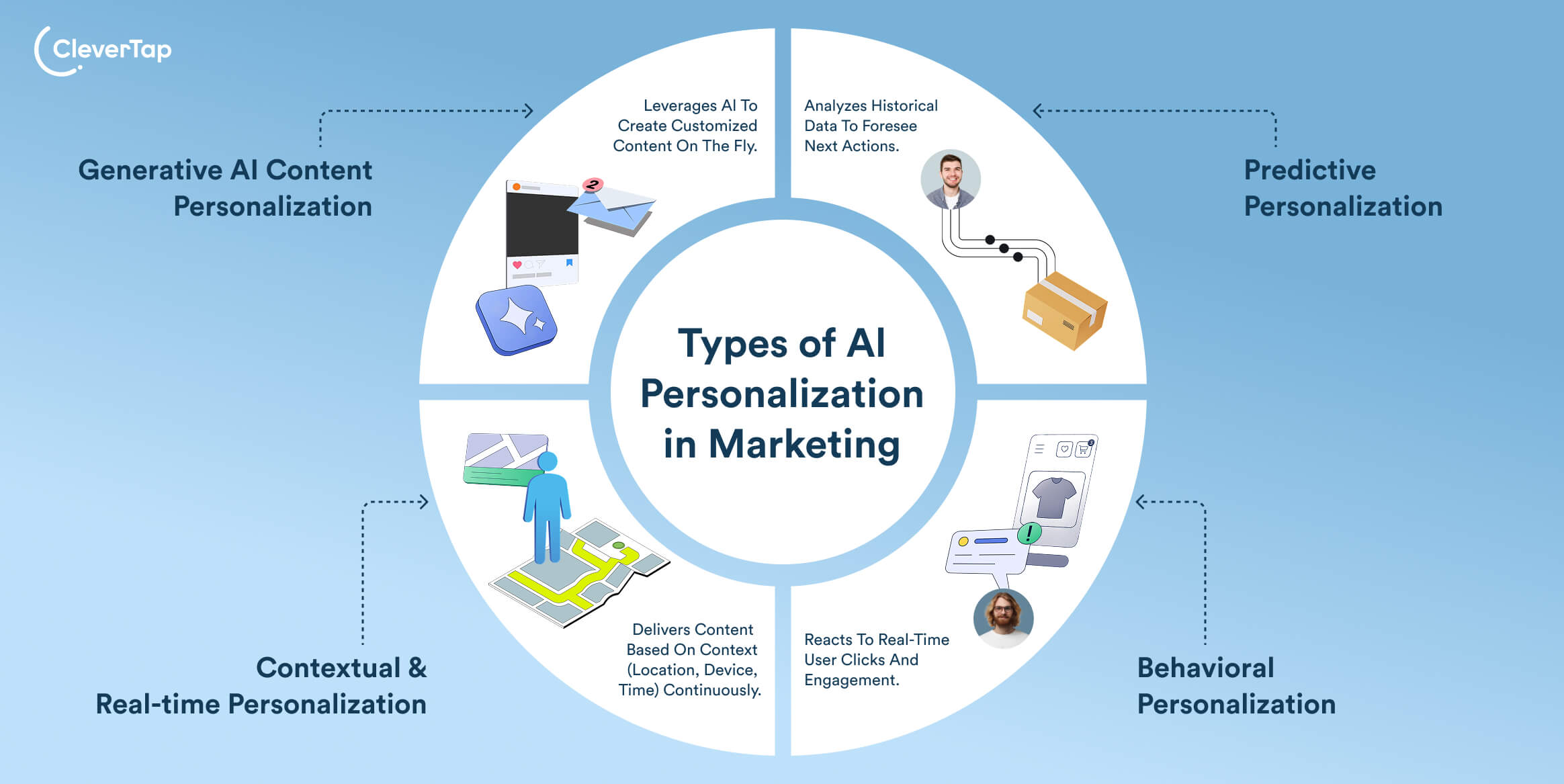
- Predictive personalization: Uses AI models to anticipate a customer’s needs or next actions. By analyzing historical data and behavior, it predicts which products or offers a user will want. Starbucks, for example, uses predictive models to offer app users specific drink suggestions based on their past purchases and even the time of day.
- Behavioral personalization: Reacts to real-time user actions. For instance, if a shopper clicks on certain categories or spends time on a page, the system updates content or messages accordingly. Behavioral personalization tailors the experience based on what the user actually does, not just who they are.
- Contextual and real-time personalization: Delivers content based on context (location, device, time) and updates continuously. Known as hyper-personalization, this approach dynamically responds to user navigation. It ensures the right message is delivered on the right channel at exactly the right moment.
- Generative AI content personalization: Leverages generative AI to create customized content on the fly. For example, generative AI can write personalized email copy, craft targeted ad creatives, or even generate product images tailored to user tastes. This lets marketers produce far more relevant content at scale than ever before.
By combining these types, AI-powered personalization can serve each customer a unique journey. The next section shows how these pieces fit together.
How AI Personalization Works in Marketing
Implementing AI personalization typically follows a multi-step architecture. The major components include:
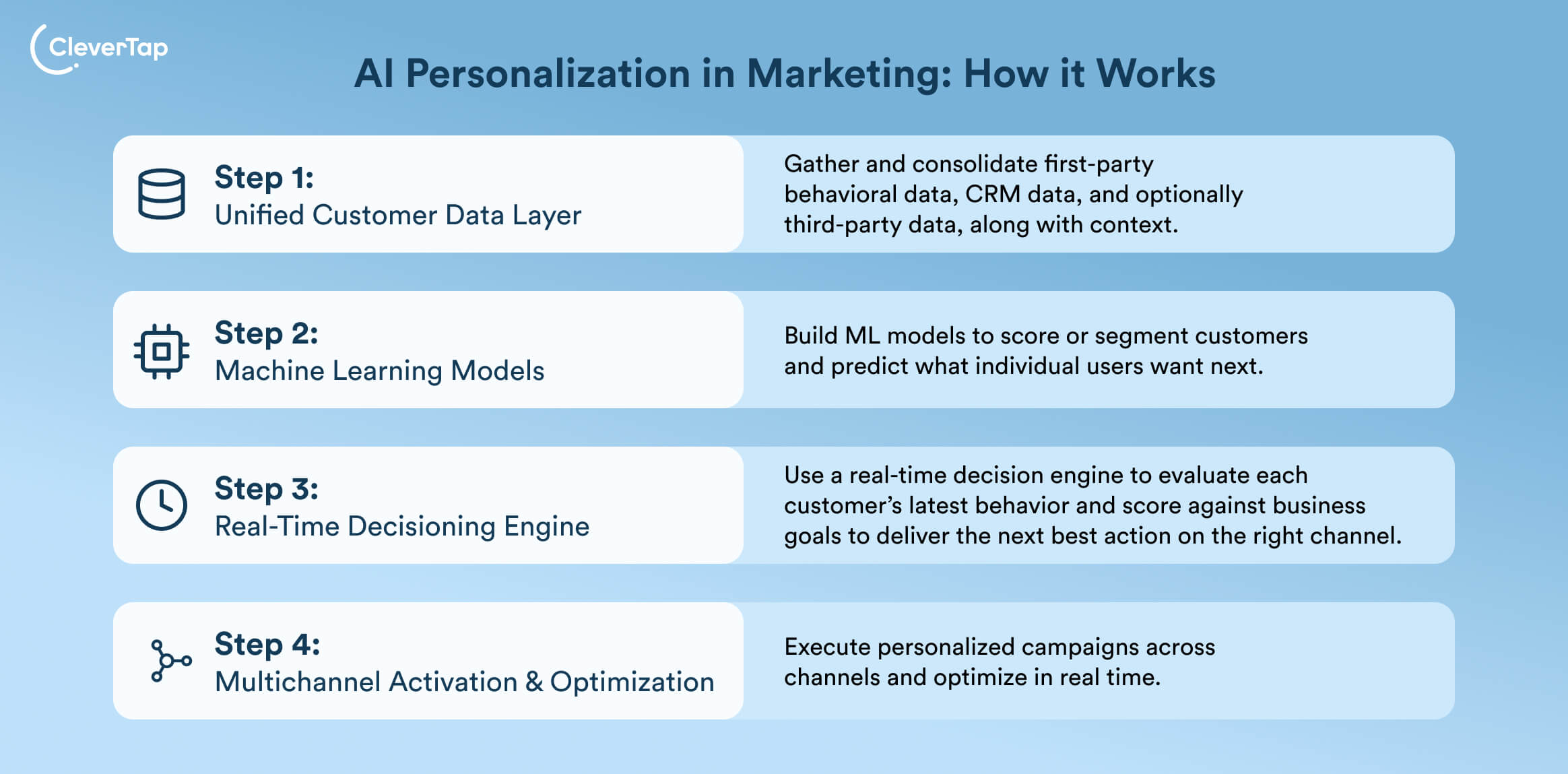
Step 1: Unified Customer Data Layer
First, gather and consolidate all available customer data into a single location, often via a customer data platform. This data layer collects first-party behavioral data (site clicks, app usage, purchase history), CRM data (profiles, segments), and optionally third-party data, along with context (time, location, device). A strong data foundation enables real-time personalization.
Step 2: Machine Learning Models
With unified data, the next step is building ML models to score or segment customers. Common models include:
- Propensity models: Score each user’s likelihood to take actions (like clicking, buying, or churning) based on historical behavior.
- Customer lifetime value (CLV) prediction: Estimate a customer’s future value so you can prioritize high-value segments.
- Churn prediction: Identify which users are at high risk of leaving.
- Affinity scoring: Determine user interests or affinities (e.g., fashion vs. electronics) for better content matching.
- Recommendation engines: Use collaborative filtering or content-based models to suggest products.
These ML models analyze patterns in past data to predict what individual users want next. For instance, a machine learning model might see that a customer frequently buys running shoes and has been browsing socks, and thus assign a high propensity score for purchasing athletic socks. Based on these scores, users are grouped into dynamic segments or profiles that feed into personalization.
Step 3: Real-Time Decisioning Engine
An AI personalization platform needs a decision engine that acts on the model outputs instantly. This engine continuously evaluates a customer’s current state (their scores, segments, and latest actions) against business rules and goals, then chooses the next best action and channel for that user.
CleverTap’s CleverAI™ decision engine can autonomously handle this. For example, if the model shows a user is likely to churn, the engine might trigger a special offer via push notification; if a user is browsing but idle, it might display a recommended product in-app. These agentic AI systems learn from outcomes and optimize decisions in real time without human intervention.
Step 4: Multichannel Activation & Optimization
Finally, the system executes personalized campaigns across channels (web, mobile app, email, push, SMS, ads, etc.) and continually optimizes. Each personalized message or interface is delivered to the user through the appropriate channel determined in Step 3.
For example, a user’s highest-propensity recommendation might be inserted into the homepage, sent via email, and included in a push notification, all tailored with dynamic content. The personalization platform then monitors response metrics (opens, clicks, conversions) and feeds this data back into the models. Over time, the AI learns which strategies work best and fine-tunes its models, completing the loop.
12 High-Impact Examples & Use Cases of AI Personalization in Marketing
Consider the following examples of personalization that use AI to improve customer experience.
1. Dynamic Homepage & App Personalization
Website personalization increased conversion rates for 94% of companies. In this case, the AI system modifies the homepage or app screens in real time based on who the user is and what they’ve done. It selects banners, featured products, and content modules tailored to the user’s profile and behavior. For example, returning visitors might see a “Welcome back” banner with their name and products related to their past interests.
Using proprietary models, Walmart tailors homepages, product recommendations, and search results based on each customer’s preferences and behavior. The result is a dynamic, context-aware shopping journey that adapts in real time, making every visit feel more relevant and engaging.

Channels: Website and mobile app home screens.
2. AI-Powered Product Recommendations
Relevant product suggestions greatly boost sales. Two-thirds of customers say personalized recommendations are the most important factor in their purchase decisions. Especially for e-commerce personalization, AI analyzes each shopper’s browsing and purchase history to suggest products they’re likely to buy next.
For example, Amazon’s system uses recommendation engines (collaborative filtering, content-based, or hybrid) to dynamically display “Recommended for you” or “Similar items.” This runs in real time: as soon as a user views a product, the AI instantly computes the most relevant suggestions.

Channels: On-site widgets, email, in-app recommendation carousels.
3. Predictive Send-Time Optimization
This AI feature finds each customer’s ideal message timing. By examining when each user has historically engaged (opened emails or clicked app notifications), machine learning models predict the optimal send time. Messages (emails, push, or SMS) are then automatically scheduled for when that user is most receptive.
CleverTap’s Best Time to Send feature helps personalize and optimize message timing.
A strong example is ZEE5, a leading global streaming service. By leveraging CleverTap’s Best Time to Send optimization, ZEE5 saw a 60% boost in click-through rates for its South Asian content campaigns. The outcome demonstrates just how impactful location-aware, personalized email timing can be when executed intelligently.

Read the full case study here.
Channels: Email, mobile push, SMS notifications.
CleverTap’s CleverAI takes it one step further with its Send Time Optimizer Agent that learns each customer’s engagement patterns and schedules messages for when they’re most likely to notice and act.
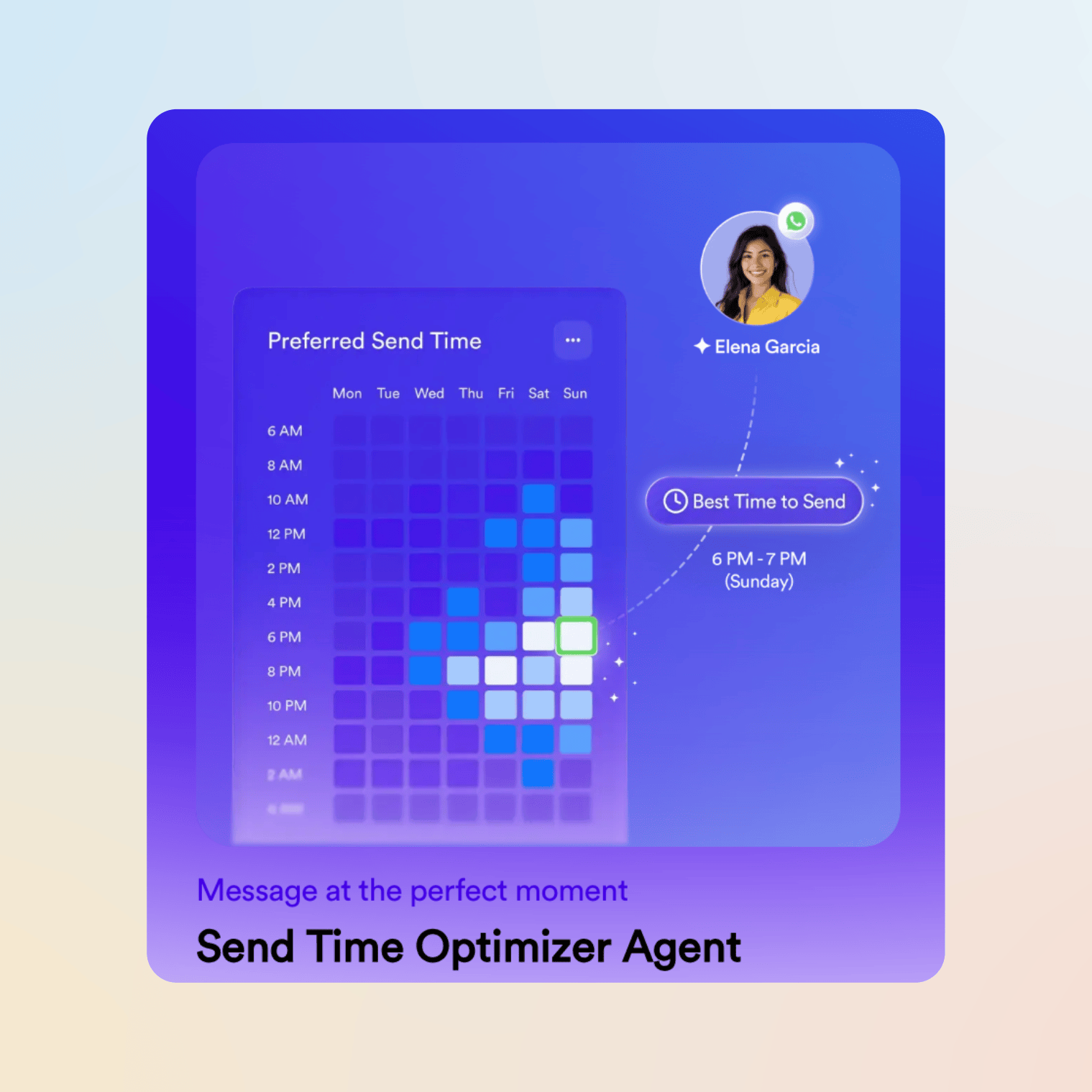
See how CleverAI™ Agents think, act, and collaborate to deliver true 1:1 personalization at scale.
4. Abandoned Cart & Browse Recovery with AI
In this type of AI personalization, an AI system detects when a shopper abandons their cart or exits after browsing and triggers a personalized follow-up in near real time. Instead of generic “You forgot something” emails, it references the exact items left behind, suggests relevant alternatives, or offers a smart incentive timed to when purchase intent is still high. It also segments abandoners into loyal customers vs. first-time visitors to tailor tone and offers accordingly.
Real-time recovery drives higher conversion rates, while AI-powered recommendations and dynamic coupons help lift average order value.
APLAZO, Mexico’s leading buy-now-pay-later platform, used CleverTap’s automated journey orchestration to re-engage users at precisely the right moment after cart abandonment, achieving a 60% incremental lift in conversions. It used dynamic catalog templates and liquid tags to automatically personalize messaging for every user segment.
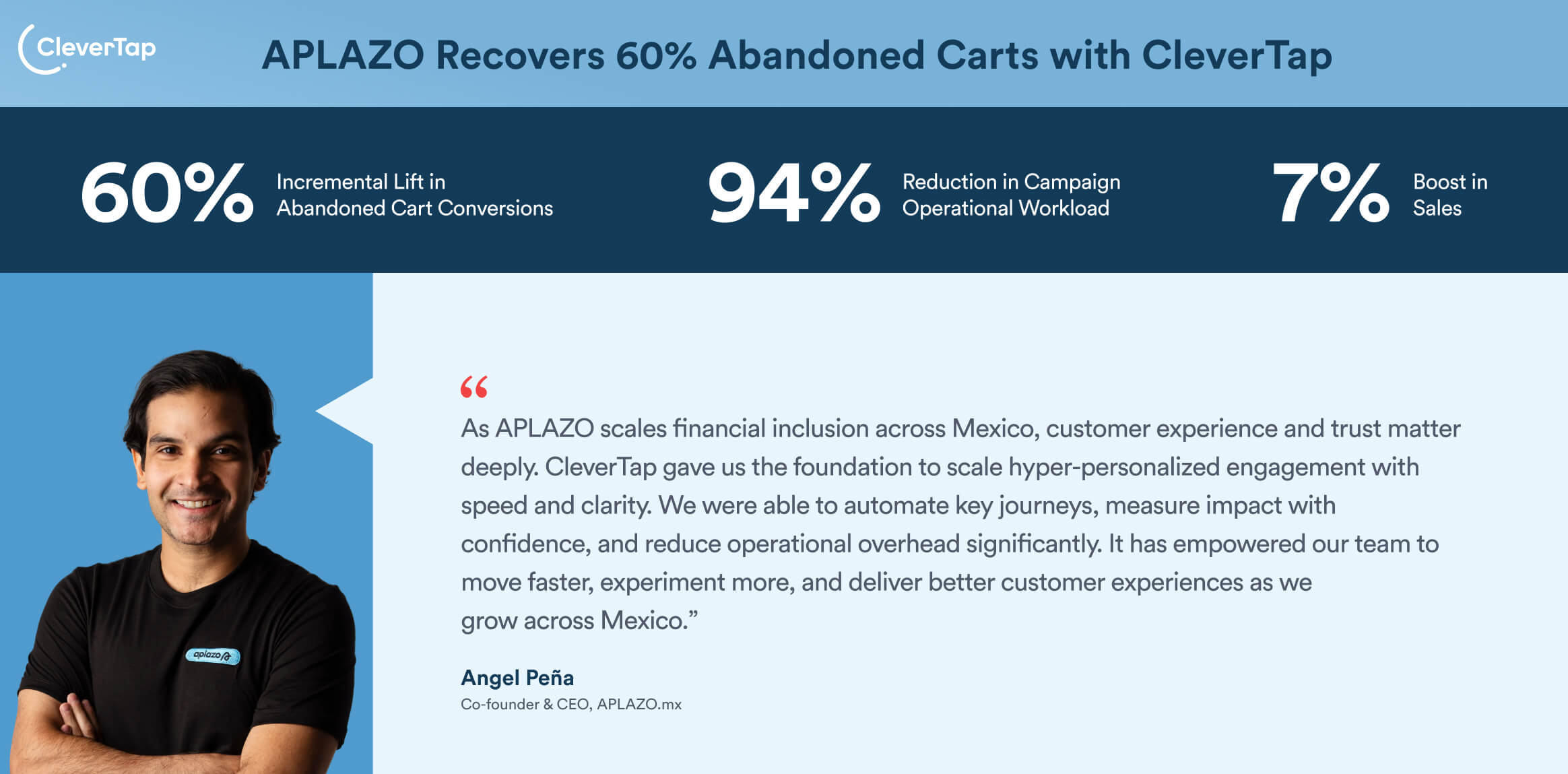
Read the full case study here.
Channels: Email, push notification, in-app message, SMS.
5. Generative AI Content Personalization (Messaging, Offers)
Generative AI can create personalized marketing content for each user, such as a unique email subject line or promotional copy, based on the user’s profile and recent actions. It can also generate personalized offers, such as coupon codes or ad graphics, all in real time.
Klarna is a compelling example of generative AI content personalization at scale: the fintech company uses generative AI for 80% of all copywriting, and saved $6 million in image production costs while actually generating more creative assets and running more campaigns, proving that AI-generated content expands what a team can produce and personalize at speed.

Channels: Email copy, ad creatives, social media posts, chatbots.
6. Personalized Onboarding Flows
With AI, new user onboarding adapts in real time based on attributes and early behavioral signals. From the moment someone signs up or installs the app, AI determines the most relevant tutorials, prompts, and messages, tailoring flows by segment, region, language, and intent.
It can dynamically adjust the order and content of introductory emails, pop-ups, and in-app guides to reduce friction and accelerate activation.
For example, a marketplace app might detect a user’s location or browsing history and surface region-specific tips, categories, and promotions first, guiding them to value faster.
Channels: In-app tutorial modals, welcome emails, push notifications.
7. AI-Powered Journey Orchestration
AI orchestrates multi-step journeys by determining the best next action for each user. Instead of fixed drip campaigns, flows adapt in real time. If a user ignores an email, the system can pivot to SMS or in-app messaging. Using predictive signals, it moves users across stages like welcome, nurture, or re-engagement at the right moment, not on a preset schedule.
With this, two users in the same campaign may experience entirely different paths, optimized for their behavior and intent.
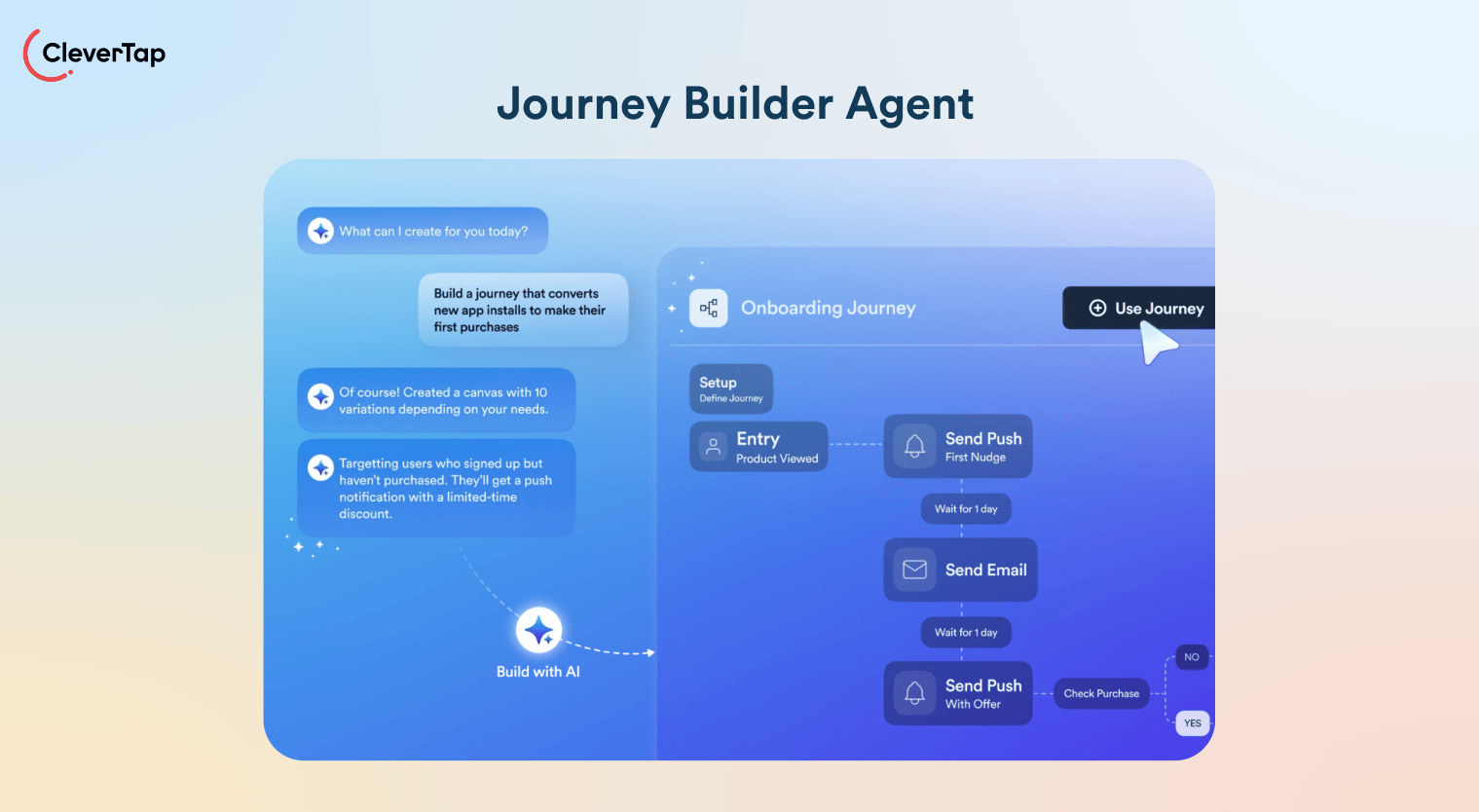
CleverAI’s Journey Builder Agent converts your goals into journeys autonomously. You can describe your goal in plain language, like “reduce churn,” and the agent instantly creates a ready-to-edit journey, complete with messages and visuals, optimized using best practices and tailored to your use case.
Maya, a leading digital bank in the Philippines, illustrates how AI-powered journey orchestration drives meaningful business outcomes across a user’s full lifecycle.
Using CleverTap’s omnichannel journeys, Maya automated personalized communication that strategically nudged users at relevant lifecycle stages. The results speak for themselves: a 95% year-over-year growth in credit base and a 2x increase in retention.
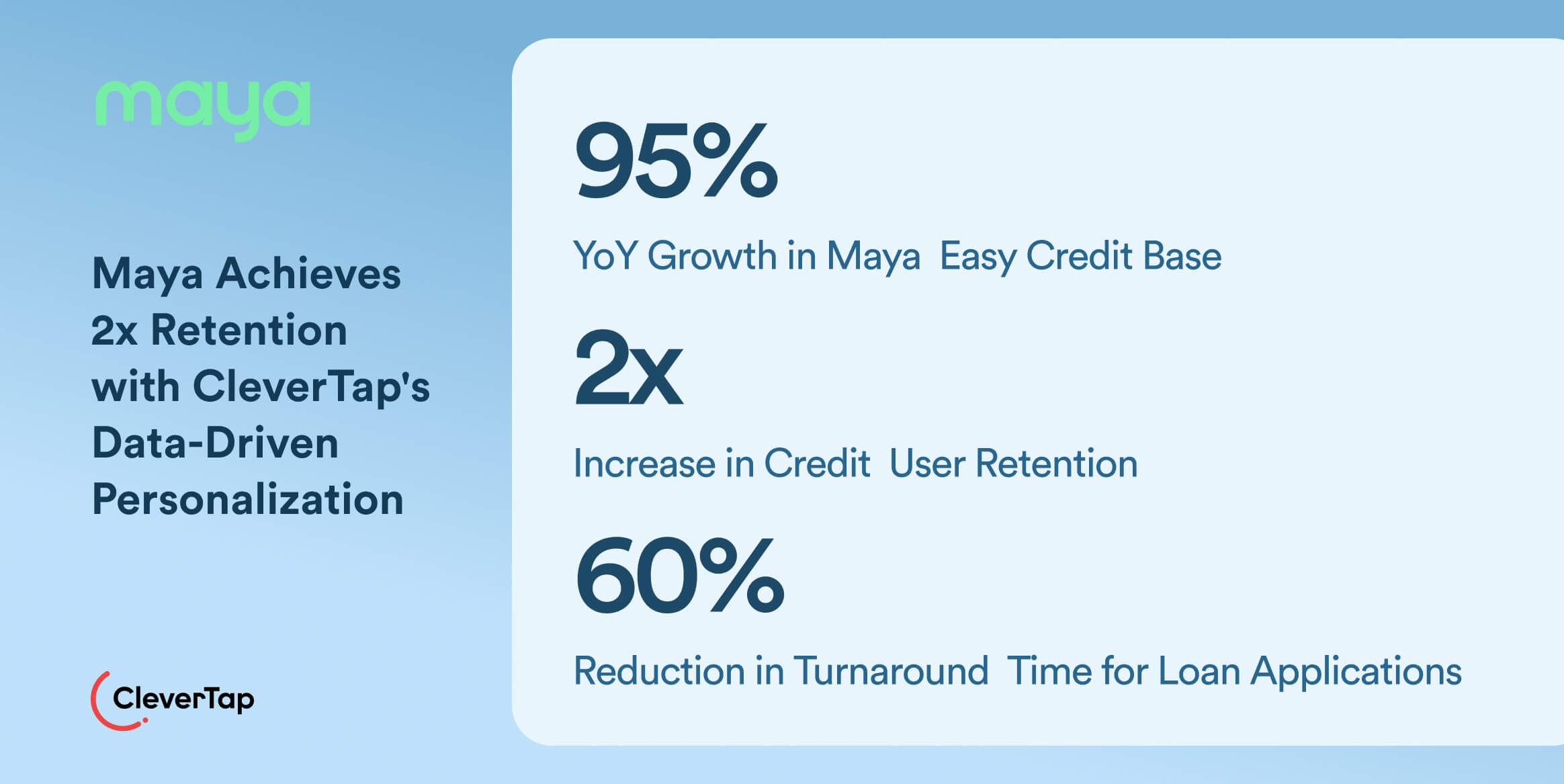
Read the full case study here.
Channels: Cross-channel (email, push, SMS, web, app).
8. Real-Time Pricing/Offer Personalization
AI dynamically adjusts pricing and offers at the individual level. It can surface personalized discounts, recommend optimized bundles, or tailor incentives in real time.
Dynamic pricing is common in travel and e-commerce, where prices shift in response to demand. At the user level, AI can identify price-sensitive shoppers and offer targeted coupons, while presenting value-based offers to loyal customers.
By factoring in user behavior, market conditions, and inventory levels, AI balances conversion and margin to maximize both sales and revenue.
Channels: Website/app pricing display, targeted ads, SMS.
Discover examples of AI personalization in e-commerce and learn which e-commerce personalization tools can make it happen.
9. In-App Personalization for Engagement
In mobile app personalization, AI personalizes the interface in real time. Elements such as menu highlights, content feeds, and promotional pop-ups change based on the user’s profile and actions. In-app personalization can significantly boost engagement metrics such as session length and screens per visit.
Channels: In-app messaging, personalized UI components.
10. AI-Powered Loyalty Personalization
AI personalizes loyalty programs at the individual level. By analyzing purchase frequency, preferences, and redemption history, it determines the most relevant reward, perk, or incentive for each customer.
A daily coffee buyer might receive a free drink at the right cadence, while a frequent electronics shopper gets early access to gadget sales. AI can also tailor tiers, milestones, and messages (like birthday bonuses) to drive deeper engagement.
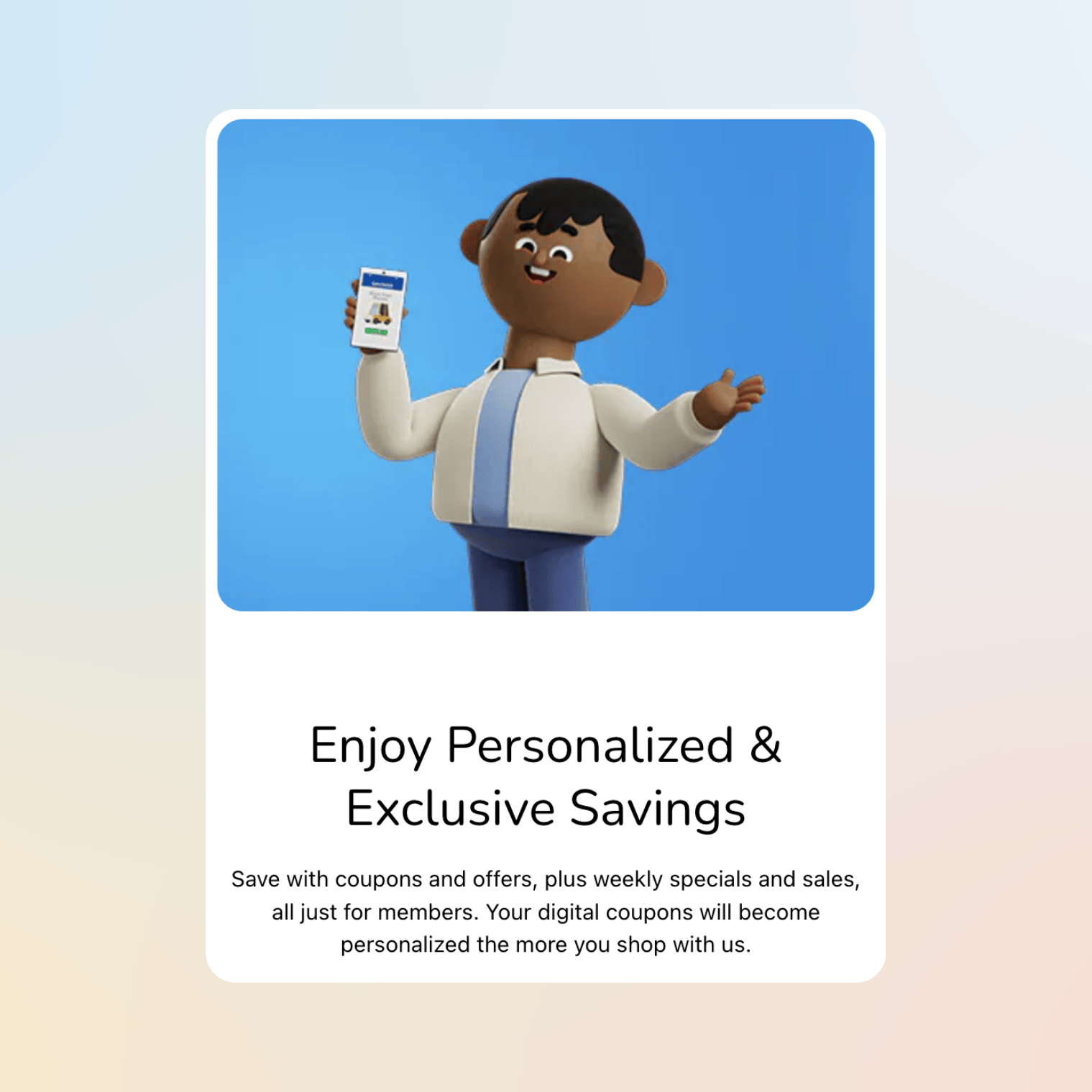
Kroger is a standout example at scale. Using machine learning, Kroger delivers personalized offers across 150 million customer touchpoints and distributes 1.9 billion unique coupons, ensuring each shopper receives rewards aligned with their individual buying behavior.
Channels: Email, app notifications, loyalty dashboards.
11. Personalized Push Notifications With Dynamic Content
Push notifications on mobile or web are made more relevant by AI. The system chooses which content to insert into each notification and exactly when to send it. It may use deep linking to take the user to a personalized page or feature. Importantly, the AI schedules push for each user’s active hours and can switch channels if needed. Personalized push messages typically see higher open and click rates.
Channels: Mobile push, web push.
12. Predictive Churn Interventions
AI models flag users at risk of churning before they lapse, spotting signals like declining usage or negative feedback. When churn propensity spikes, the system automatically triggers targeted win-back journeys.
If a user hasn’t engaged in a week, AI might deploy a personalized offer or feedback prompt, optimized for what’s most likely to re-engage that individual.
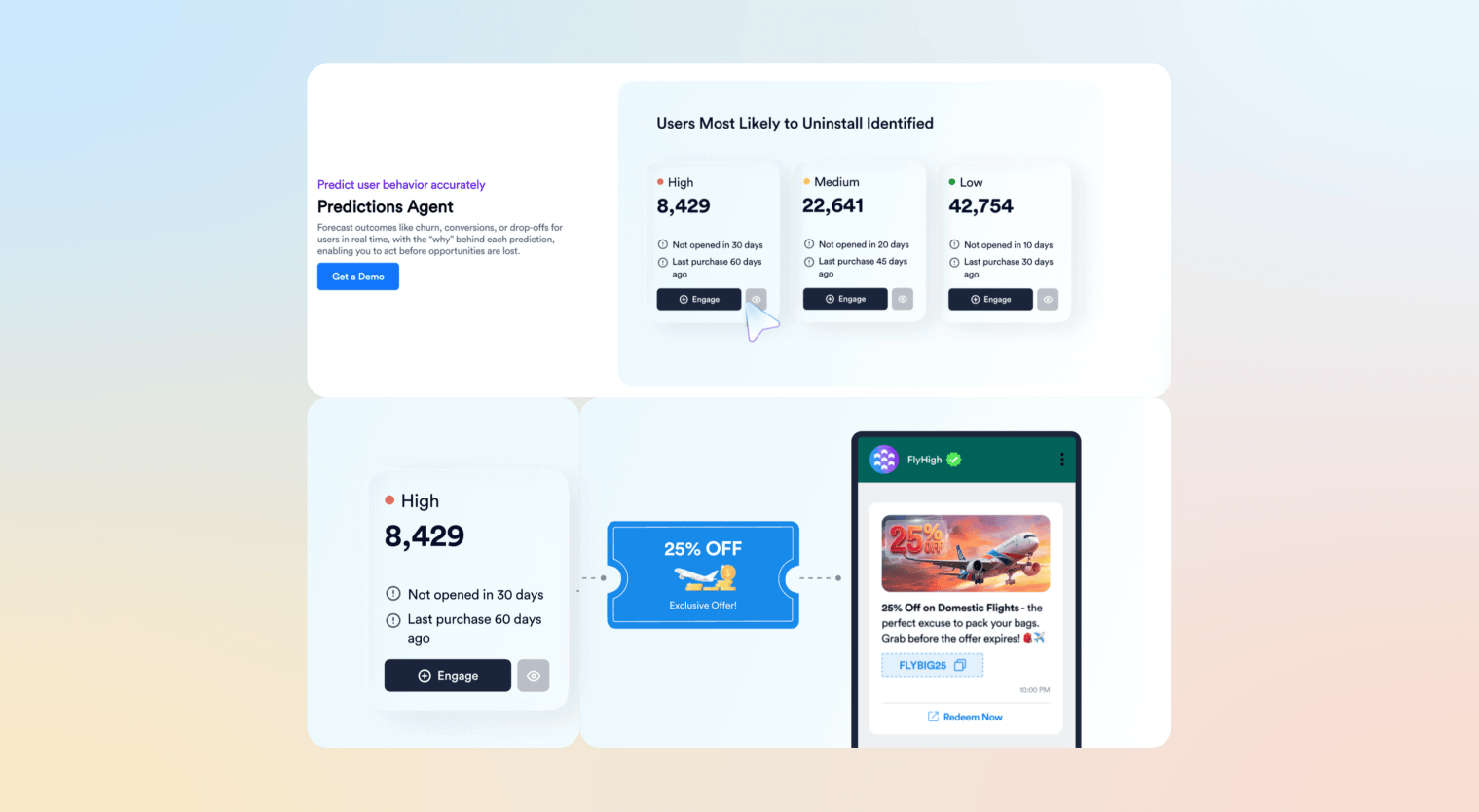
CleverAI’s Predictions Agent forecasts churn, conversions, and drop-offs in real time and explains the “why” behind each prediction, so teams can act before revenue is lost.
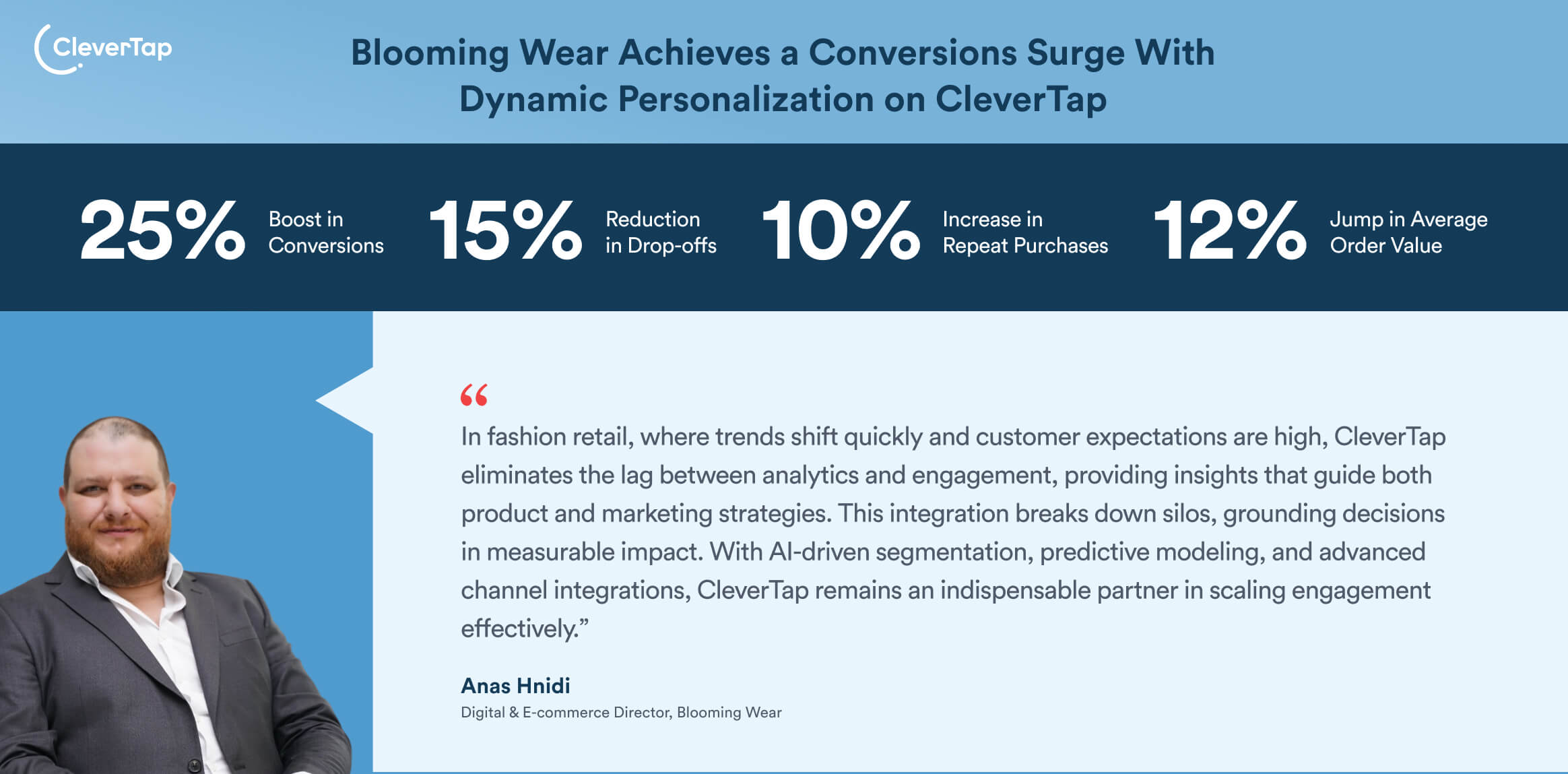
Saudi fashion brand Blooming Wear shows the impact in action. Using CleverTap’s cohort analysis to track churn and funnel insights to identify drop-offs, the team launched behavior-triggered journeys with contextual messaging at key risk moments, reducing drop-offs by 15% and increasing repeat purchases by 10%.
Read the full case study here.
Channels: Email, push, SMS, in-app.
AI Personalization Framework for Marketers
To implement these tactics systematically, follow a repeatable framework. One helpful model is CLEAR:
- Collect: Unify customer data across channels (web, app, email, CRM, etc.) into one data layer (e.g., a CDP). Ensure data quality and privacy compliance.
- Learn: Use machine learning to analyze this data: build predictive models (propensity, CLV, churn, affinity) and generate real-time segments. Continuously train them on fresh data.
- Execute: Apply personalization across customer journeys. Deploy the AI decision engine to send the right content through the right channel at the right time (page content, email, push, etc.). Orchestrate multi-step campaigns dynamically.
- Adjust: Monitor performance (opens, clicks, purchases) and A/B test to validate results. Feed engagement data back into the AI models. Refine targeting rules and content regularly.
- Repeat: Automation is key. The AI should continuously loop: collect new data, update models, and optimize journeys without manual intervention. This way, personalization improves over time.
How CleverTap Helps with AI Personalization in Marketing
CleverTap powers AI personalization with its CleverAI™ Agents, an agentic AI layer that makes 1:1 marketing both smarter and easier at scale. Instead of manual rules and segments, marketers get AI-driven decisioning, content generation, and execution, all tied directly to business outcomes.
CleverAI Agents help across the personalization lifecycle:
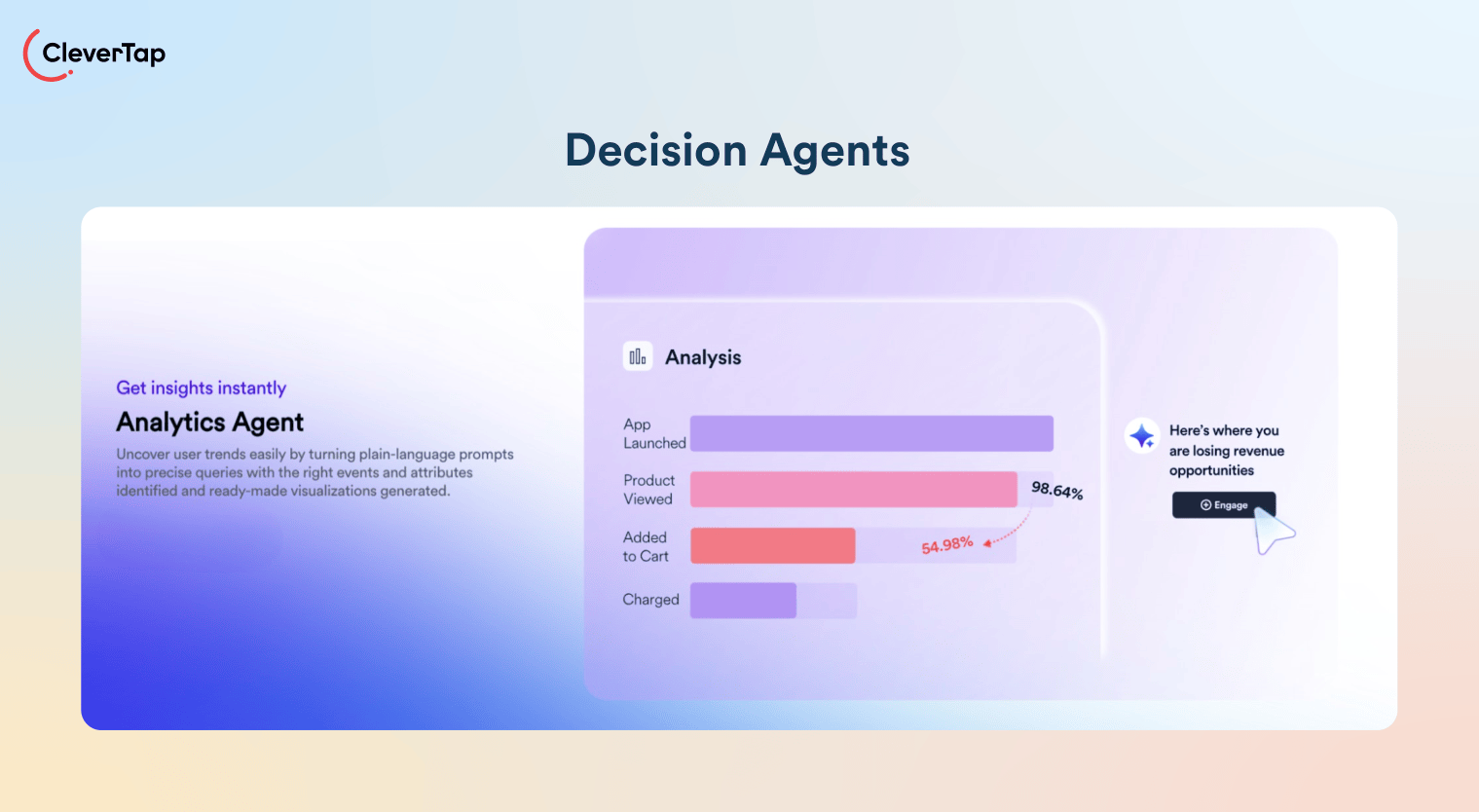
- Decision Agents choose the right experience, channel, and next-best action for each user in real time.
- Creative Agents generate personalized copy and visuals based on brand tone and audience context.
- Action Agents build and orchestrate dynamic journeys that adapt to user behavior.
- Strategy Agents forecast outcomes like churn or conversions and translate goals into ready-to-deploy campaigns.
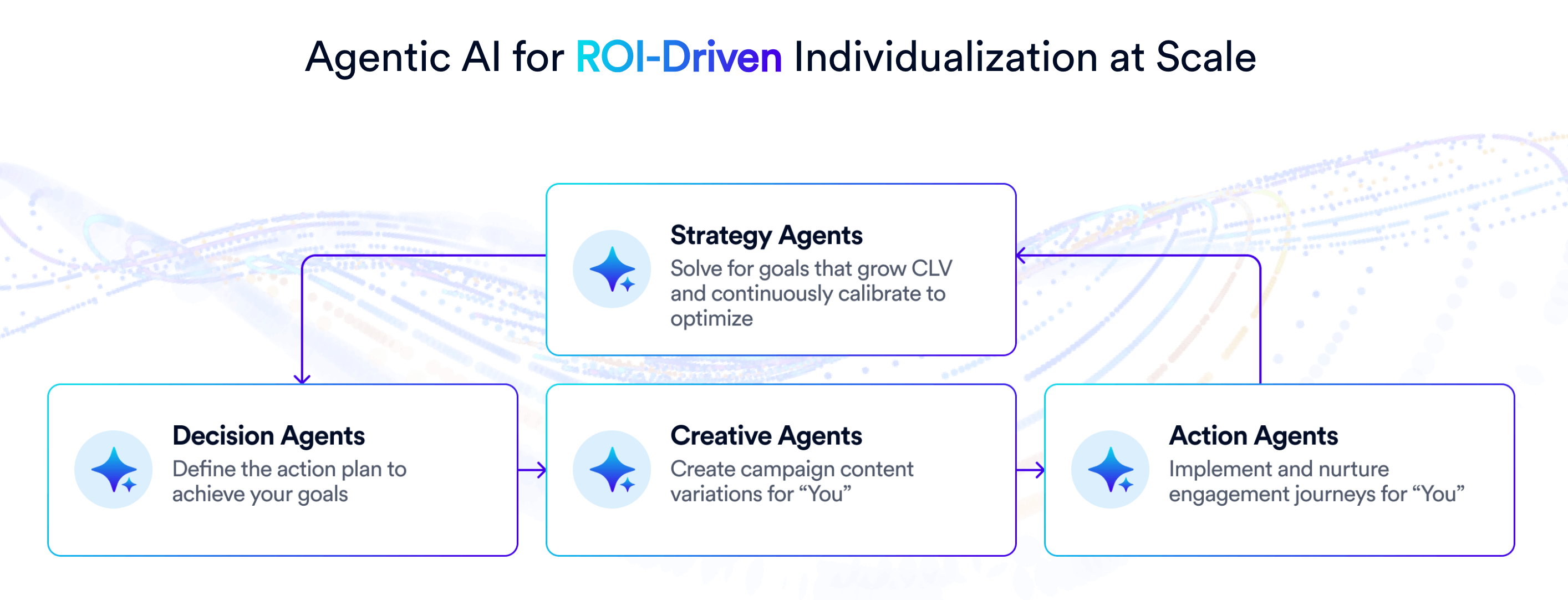
The platform integrates predictive scoring, recommendations, send-time optimization, and channel selection to deliver context-aware experiences across email, push, SMS, in-app, and more, while keeping marketers in control through transparent workflows and human review where needed.
Frequently Asked Questions (FAQs) about AI Personalization in Marketing
Q1. What is AI personalization in marketing?
AI personalization uses machine learning and data to tailor content, offers, and experiences to each individual user in real time. It predicts what a customer is likely to engage with and automatically delivers it across channels.
Q2. How is AI personalization different from traditional personalization?
Traditional personalization relies on static segments and fixed rules. AI personalization continuously learns from user behavior, dynamically adjusting content, timing, and channel for true one-to-one experiences.
Q3. What data is needed for AI personalization?
You need unified customer data, including behavioral data, CRM profiles, engagement history, and contextual signals like device or location. Strong data quality drives better predictions.
Q4. What are the best use cases for AI personalization?
Top use cases include product recommendations, cart recovery, churn prediction, send-time optimization, personalized onboarding, and AI-driven journey orchestration.
Q5. How quickly can AI personalization be implemented?
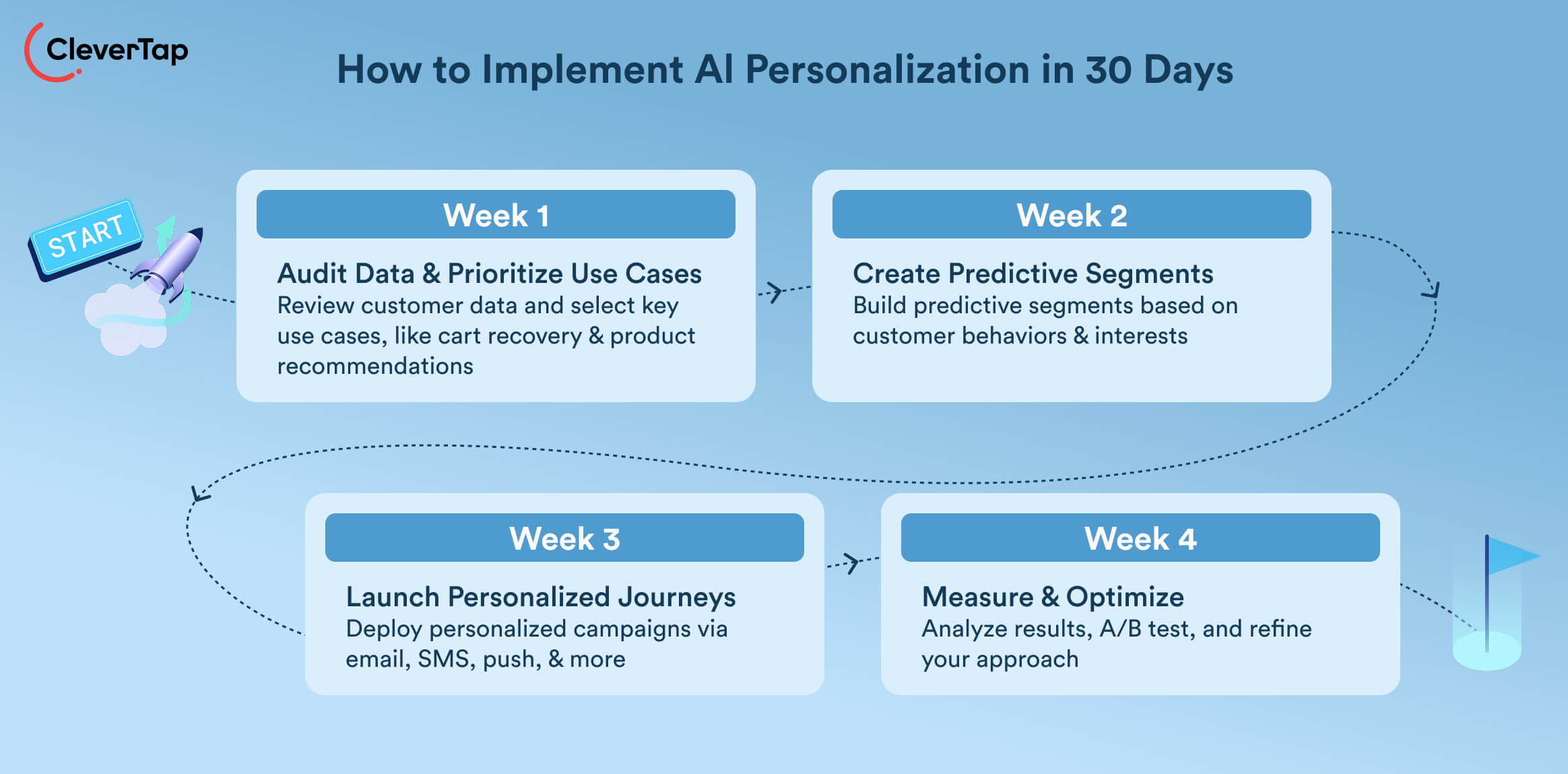
With the right tools and data, companies can launch initial use cases in about 30 days and start seeing measurable gains in engagement and conversions quickly.
Turning AI Personalization into a Competitive Advantage
AI personalization has moved from a competitive advantage to a marketing necessity. As customer expectations for relevance and timing continue to rise, static segments and rule-based campaigns can no longer deliver meaningful engagement. AI-driven personalization enables marketers to understand intent, predict behavior, and deliver one-to-one experiences in real time across channels.
Learn how CleverTap can help you achieve 1:1 personalization.

Subharun Mukherjee 
Heads Cross-Functional Marketing.Expert in SaaS Product Marketing, CX & GTM strategies.
Free Customer Engagement Guides
Join our newsletter for actionable tips and proven strategies to grow your business and engage your customers.