









































Table of Contents
Categories
Most Popular


Traditional “if-this-then-that” rules used to suffice for e-commerce personalization. They powered straightforward wins back in the day, but those static setups now feel outdated and clunky.
Modern shoppers juggle apps, websites, and notifications, bouncing between channels with zero patience for generic blasts or off-target suggestions. They demand relevance that lands right now, tuned to their live intent, mood, or even cart indecisions.
AI personalization in e-commerce processes every click, scroll, hover, and cross-session signal in real time. It anticipates and adjusts dynamically, delivering highly personalized and intuitive experiences. Brands pulling this off see 15-25% jumps in conversions, because it finally aligns with how people actually shop.
In this blog, we’ll break down what AI personalization in e-commerce means, compare it to old-school methods, explore key types with real examples, and evaluate if your business is ready for AI e-commerce personalization.
What Is AI Personalization in E-Commerce?
AI personalization in e-commerce is machine learning that digs into customer data live, spotting patterns from every click, scroll, and cross-device move to serve up shopping experiences tailored just for them, at scale. It skips surface-level stuff like age or past buys, instead predicting what they’ll want next based on real intent signals, like lingering on a sale item or pairing products in their cart.
Traditional Personalization vs. AI-Driven Personalization
Traditional methods lean on rule-based segmentation, where you set fixed “if-then” logic; for example, if a user viewed shoes, show shoe ads. If they bought once, tag them as “loyal” for a discount email. These deliver quick wins for simple cases.
But they hit walls fast when shoppers zig-zag across channels or show subtle shifts, like price hunting after an initial browse. That is where AI-driven personalization differs.
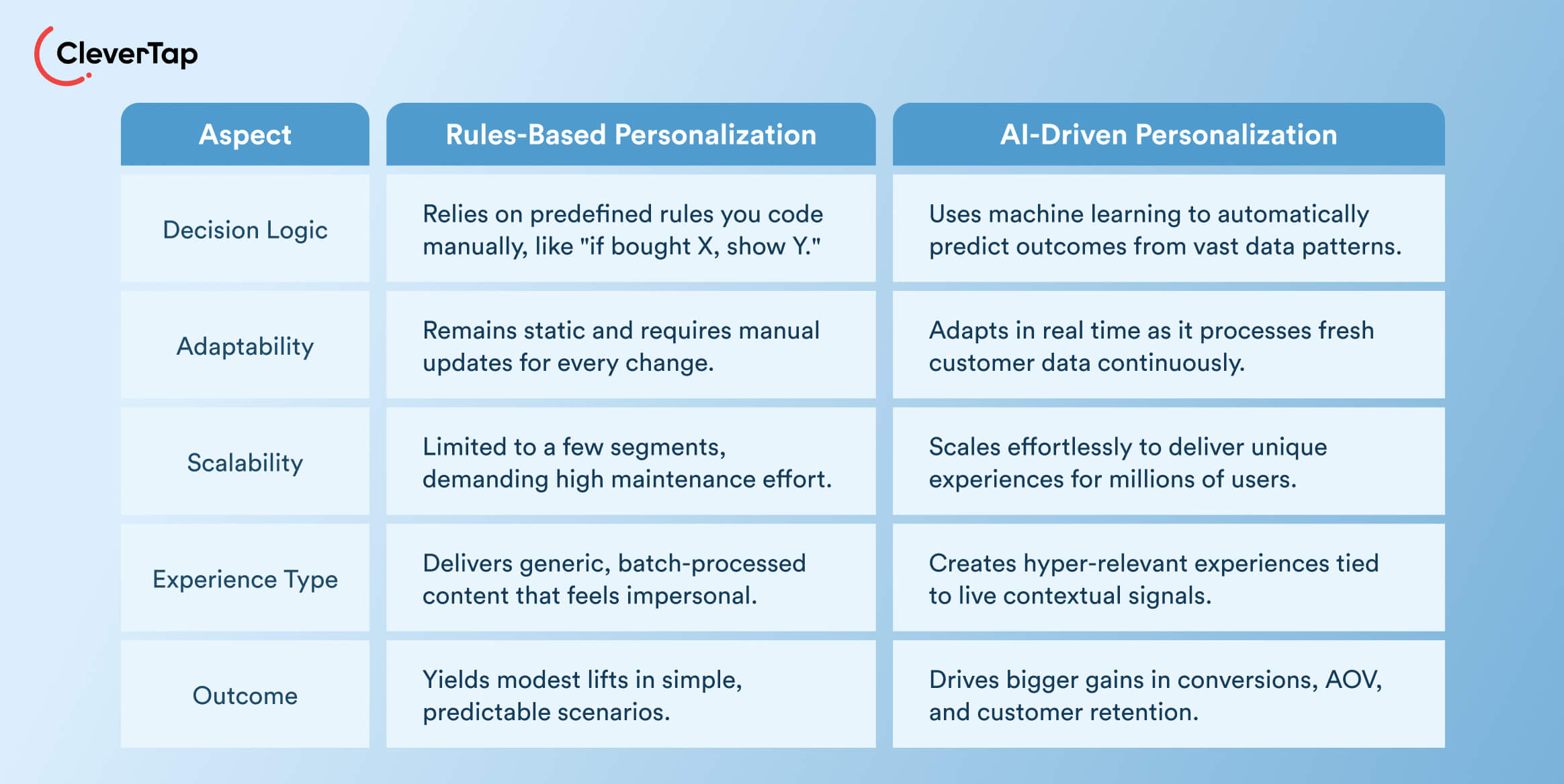
AI uses complex customer behavior to its advantage and creates adaptive experiences that learn continuously, spotting nuances like seasonal intent or price sensitivity that no rigid rule could catch.
Why AI Personalization Matters More Than Ever in E-Commerce
E-commerce teams face skyrocketing expectations from shoppers who demand relevance at every touchpoint. AI personalization in e-commerce meets that bar by turning data into instant and effective actions, delivering the ROI proof you’ve been after.
Shoppers grew up with Amazon’s spot-on “customers also bought” recommendations and Netflix’s binge-predicting thumbnails; they now expect that seamlessness everywhere. No one sticks around for mismatched suggestions or all-in-one pages. 88% abandon sites after one bad experience. Customers will bail in seconds if content doesn’t click with their immediate intent, pushing brands to AI for that always-on relevance.
Businesses see incredible impact with AI personalization in e-commerce:
- Conversion rate lift: Personalized experiences boost conversion rates by 20%, as real-time tweaks turn browsers into buyers.
- Higher AOV: Smart upsells and bundles tailored to cart behavior lift average order value by 20%.
- Better retention & CLV: Customers who receive personalized experiences based on their preferences have a 33% higher lifetime value.
How AI Personalization Works
AI personalization runs on a tight loop of data, models, and decisions that keep experiences fresh and relevant. Here’s how it breaks down:
- Data ingestion: Pulls in signals such as clicks, views, cart adds, and scroll depth or time spent from the site, app, email, and more. Clean, unified data from all channel feeds powers the system, revealing patterns no single source could detect.
- Machine learning models: Algorithms crunch this data to build user profiles and predictions. Think collaborative filtering for “people like you” matches, or propensity models that score next-action likelihood, such as churn or upsell readiness.
- Real-time decisioning: At the moment of truth, when the page loads and the push notification opens, the system decides instantly. It matches the right content, product, or offer to that user’s live context, like surfacing deals for price-sensitive browsers.
- Continuous optimization: Models retrain automatically on new data, refining accuracy over time. What worked yesterday evolves as behaviors shift, ensuring experiences stay sharp without manual intervention.
Key Types of AI Personalization in E-Commerce (With Real-World Examples)
AI personalization shines across the funnel, from discovery to loyalty. These five types, with real-world examples, show how they drive results across industries.
1. AI-Powered Product Recommendations
AI recommendations leverage collaborative filtering, deep learning, and live session context to deliver spot-on suggestions that feel intuitive and timely. They create lists by analyzing user similarity across millions of profiles, real-time cart contents, browsing patterns like dwell time on items, and even external signals such as trending categories or inventory levels to predict exactly what will resonate next.
Take Amazon, for example: its deep learning models power the “customers also bought” sections, seamlessly blending vast historical purchase data with current session signals to generate contextual recommendations that drive 35% of total sales.
This approach keeps users deeply engaged throughout the discovery phase, turning casual window shopping into high-intent cart additions and repeat visits, which is why it’s a must-prioritize tactic for scaling e-commerce growth.

2. Personalized E-Commerce Search
AI improves search from rigid keyword matching to true intent interpretation, using natural language processing (NLP), semantic embeddings, and contextual analysis to decode complex queries by incorporating synonyms, situational factors such as event type or season, and individual user history, including past purchases or style preferences. This creates a fluid experience that evolves with customer needs.
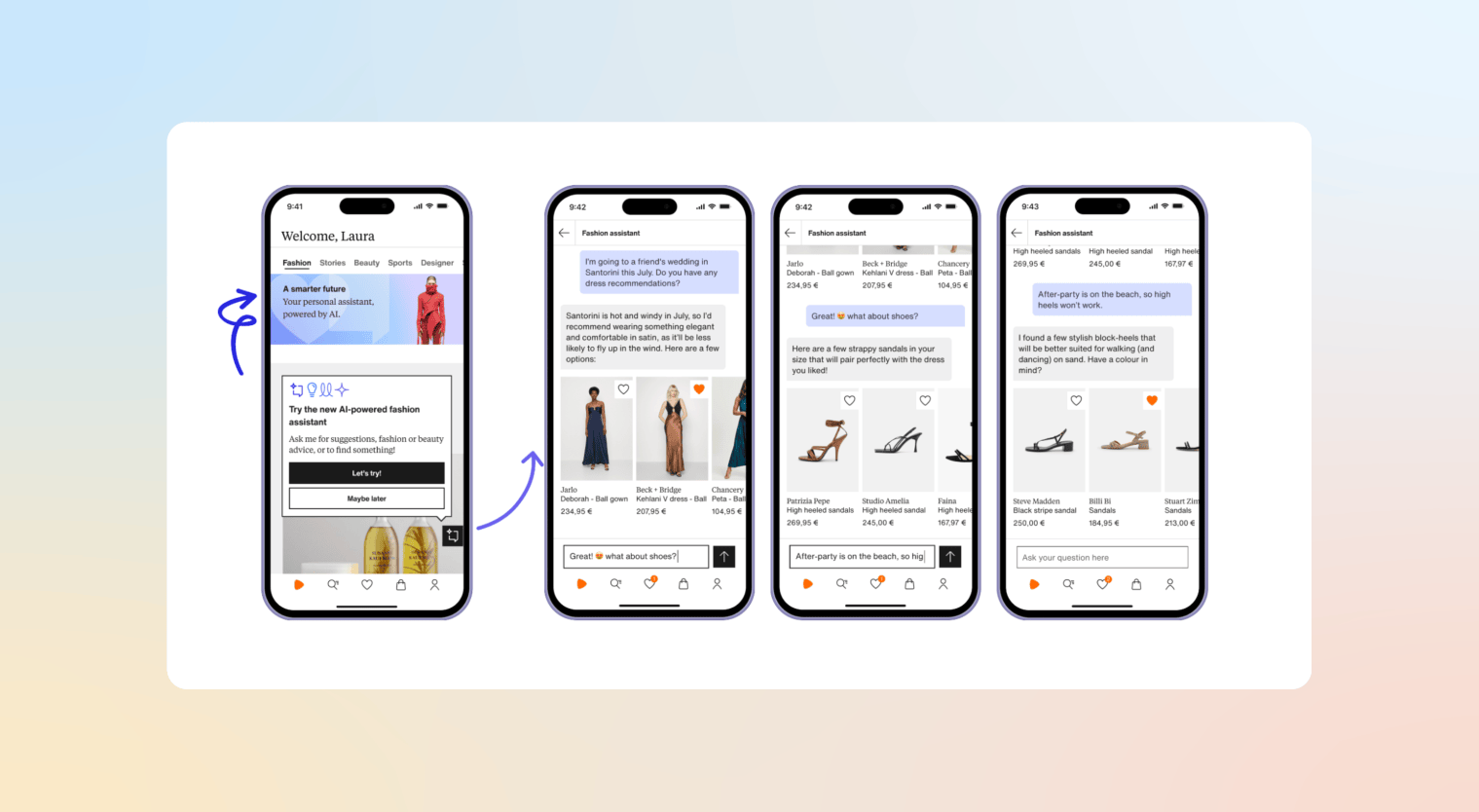
Zalando stands out with its AI-powered assistant. It understands conversational searches and uses real-time data, like local weather, event details, and a shopper’s style preferences, to show highly relevant results across different languages and markets.
Instead of displaying individual items at random, it presents complete outfit suggestions. This makes browsing feel smooth and intuitive, helping shoppers find what they need faster and increasing both time spent on the site and conversion rates.
3. Behavioral & Predictive Personalization
AI personalization looks at user behavior across multiple sessions to predict what they’re likely to do next. It calculates the chances of actions like making a purchase, churning, or accepting an upsell, and then sends the right message at the right moment.
By analyzing signals such as repeat visits to certain categories, time since the last purchase, or a drop in engagement, it turns raw behavioral data into clear, forward-looking actions.
Ajio uses CleverTap to turn customer behavior data into highly personalized, omnichannel engagement. The platform consolidates insights from early activation through conversion and reactivation, then uses real-time segmentation and automated journeys to send tailored messages across push notifications and other channels. This helps Ajio deliver relevant experiences at each step, boosting conversions, increasing retention, and reactivating more customers without manual intervention.

4. Personalized Content & Merchandising
AI dynamically reshapes homepages, category pages, and promo displays based on live intent signals like recent searches, location, weather, and even time of day, ensuring every visitor lands on a feed built just for them. It pulls from session data, past interactions, and external factors to prioritize what’s most clickable, constantly testing layouts to maximize dwell time and clicks without you having to touch a thing.
Walmart is scaling AI to deliver highly personalized shopping experiences across its website and app. Using proprietary models and a Content Decision Platform, it tailors homepages, product recommendations, and search results based on each customer’s preferences and behavior. The result is a dynamic, context-aware shopping journey that adapts in real time, making every visit feel more relevant and engaging.

Learn how to create mobile app personalization strategies that work.
5. Omnichannel Personalization
AI unifies experiences across email, push, SMS, WhatsApp, app, and site by tracking user state in real time. If someone adds items to their cart on mobile, they can continue on desktop without losing anything. If they browse but don’t buy, they might get a timely push notification with the right discount to bring them back. AI connects signals like opens, clicks, and device switches into one clear view, so messages match exactly where the shopper is in their journey.
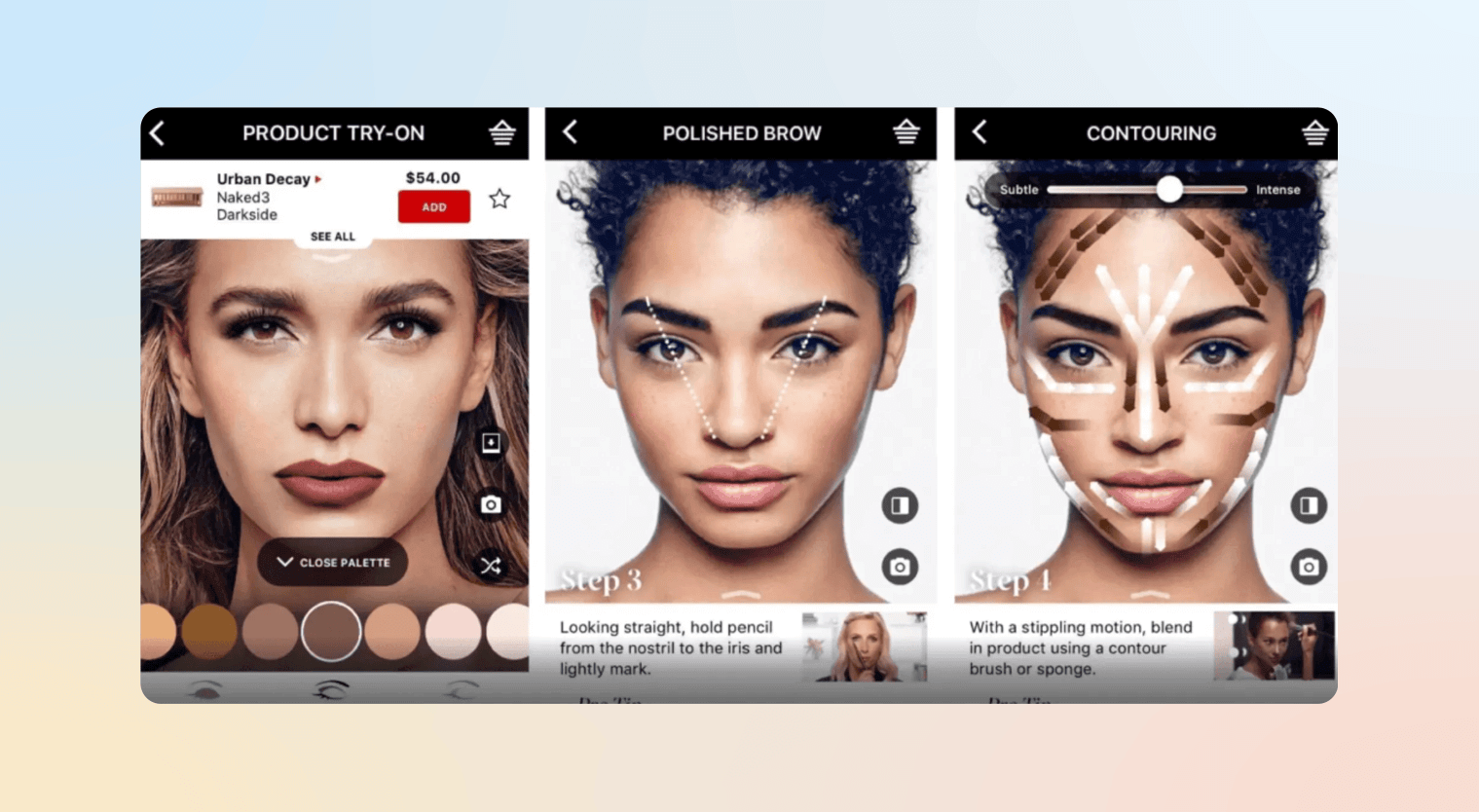
Sephora does omnichannel personalization well. It starts with an in-app quiz that personalizes product recommendations on the site. Those recommendations then show up in follow-up emails, along with SMS rewards or WhatsApp offers for loyalty members. The experience feels connected instead of scattered, which keeps customers engaged, encourages repeat visits, and builds loyalty in a highly competitive beauty market.
Explore 20 standout examples of personalization in marketing that drive conversions.
Seeing these examples, the next question becomes: where does your brand stand today? Not every company operates at the same level of AI maturity. That’s where a structured framework helps.
The AI Personalization in E-Commerce Maturity Model
Most e-commerce brands are stuck in the early stages, reacting rather than predicting. This four-level model maps your progress, with specific tools and data needs at each step to guide upgrades.

Level 1: Static Segmentation
At this foundational stage, brands rely on broad audience splits such as demographics or RFM (recency, frequency, monetary) analysis.
Segmentation is typically manual and batch-based, using historical purchase data and CRM attributes to create basic cohorts like “new buyers,” “high-value customers,” or “inactive users.”
Limitations:
- No real-time behavioral context
- No cross-channel orchestration
- No predictive intelligence
- Minimal lifecycle automation
Without unified customer profiles or live event tracking, personalization remains surface-level with missing high-intent signals like browsing behavior, session depth, or churn risk indicators.
Level 2: Rules-Based Personalization
At this stage, brands introduce event-triggered automation using “if-this-then-that” logic. Using behavioral event streams from web and mobile apps, marketers set up automated journeys such as:
- Cart abandonment reminders
- Price drop alerts
- Browse abandonment nudges
- Post-purchase cross-sell flows
With a platform like CleverTap, real-time event tracking combined with dynamic segmentation enables automated lifecycle campaigns across push notifications, email, SMS, WhatsApp, and in-app messaging.
What improves:
- Trigger-based engagement
- Omnichannel campaign execution
- Real-time segmentation
- Behavioral targeting
However, personalization is still reactive and rule-dependent. As scenarios grow more complex, managing static workflows becomes difficult. Manual logic cannot adapt dynamically to changing user intent or evolving preferences at scale.
Level 3: AI-Assisted Personalization
Here, AI augments marketing decisions. With unified first-party customer data stored in a purpose-built system like CleverTap’s TesseractDB™, brands can activate predictive intelligence through CleverAI. AI models begin to power:
- Predictive churn scores
- Purchase propensity models
- Next-best-action recommendations
- Intelligent product recommendations
- Send-time optimization
Marketers still maintain strategic oversight, but decisions are increasingly guided by AI-generated insights and dynamic audience creation.
Key capabilities at this stage:
- Auto-updating behavioral segments
- Real-time intent detection
- Predictive lifecycle campaigns
- Experimentation with AI-driven recommendations
This phase builds internal trust in AI while delivering measurable gains in engagement, conversion, and retention.
Level 4: Fully Autonomous AI Personalization
At the highest maturity level, personalization becomes predictive, adaptive, and autonomous, powered by agentic AI that plans, decides, creates, and executes campaigns with minimal manual input. With CleverAI™ Agents, AI orchestrates actions:
- Decision Agents determine the next-best offer, segment, or action for each user in real time.
- Creative Agents generate personalized messaging tailored to individual preferences and context.
- Action Agents dynamically build and optimize journeys across channels.
- A Strategy Agent translates business goals (e.g., reduce churn, increase repeat purchases) into coordinated lifecycle campaigns.
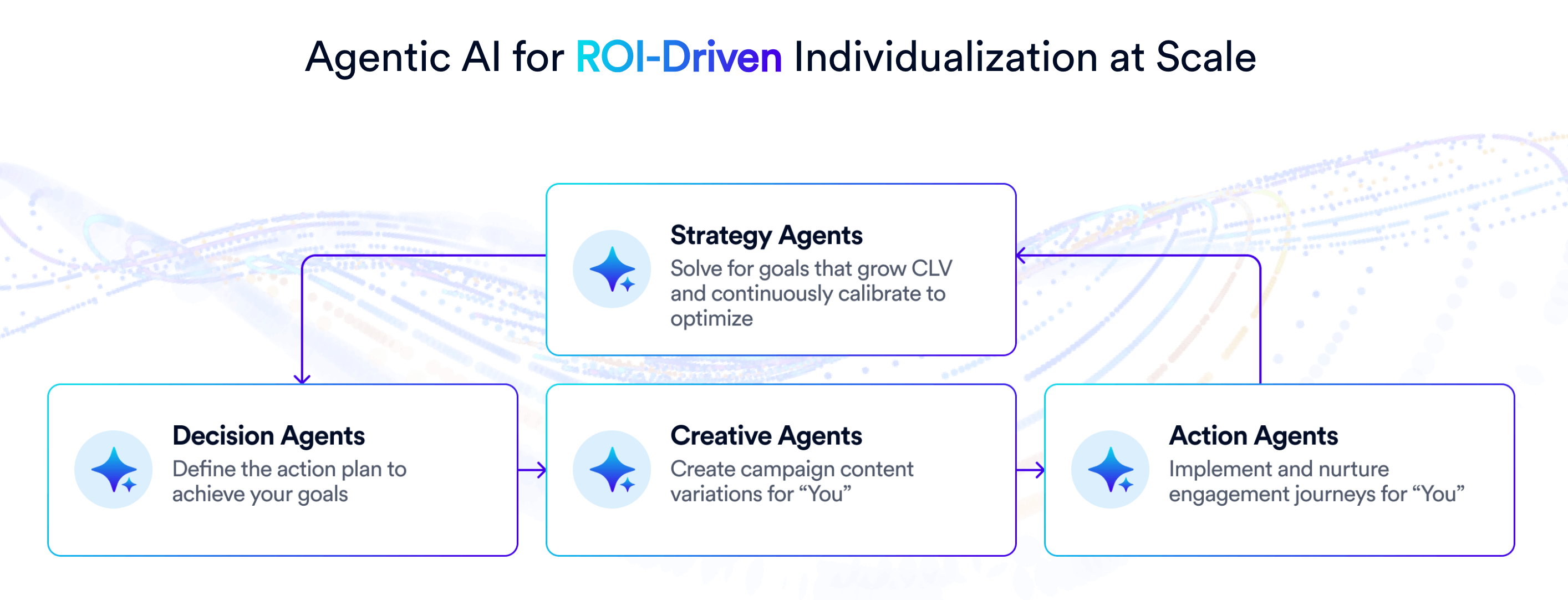
Instead of segment-based targeting, brands achieve true 1:1 personalization at scale, powered by unified first-party data. Journeys continuously self-optimize as AI learns from new behavioral signals, automatically adapting content, timing, and channel mix to maximize impact.
Marketers retain visibility and control through transparent workflows and approvals, combining AI autonomy with governance. The result is a continuous lifecycle optimization, stronger retention, higher conversions, and measurable lifts in customer lifetime value without the complexity of manual rule management.
Data You Need for AI Personalization (And What You Don’t)
One of the biggest misconceptions about AI personalization is that it requires enormous volumes of data before it can deliver value. In reality, success depends less on quantity and more on relevance, structure, and real-time accessibility.
Must-Have Data Sources
There are three foundational data types that power effective AI personalization.

- Behavioral data is the most important. This includes product views, search queries, clicks, add-to-cart actions, session frequency, and engagement depth. Behavioral signals reveal intent in the moment, which is what AI models rely on to predict what a customer is likely to do next.
- Transactional data adds purchasing context. Order history, average order value, purchase frequency, product affinities, and return patterns help models understand customer value and buying behavior. This data enables churn prediction, upsell opportunities, cross-sell recommendations, and CLV forecasting.
- Contextual data sharpens precision. Device type, location, time of day, channel preference, and acquisition source all influence how and when a message should be delivered. Context answers the engagement timing and channel question, not just the content question.
When these three layers are unified in real time, AI personalization becomes significantly more accurate and scalable.
Nice-to-Have vs. Overkill Data
Many e-commerce brands postpone AI adoption because they believe they need years of historical data or massive data infrastructure.
They don’t.
You don’t need petabyte-scale warehouses, endless third-party enrichment, or perfectly complete datasets. More data does not automatically improve personalization. In fact, excessive, unstructured data often slows execution.
What matters most is clean first-party data, unified customer identities, and live behavioral tracking. AI systems learn and improve continuously. Starting with focused, high-quality signals delivers faster impact than waiting for a “perfect” dataset that may never arrive.
How to Measure the Success of AI Personalization in E-Commerce
Business impact to track the success of AI personalization in e-commerce
- Conversion rate: Measure improvements in add-to-cart rate, checkout completion, and campaign-driven purchases. Comparing AI-driven journeys to control groups reveals true incremental lift.
- Revenue per visitor (RPV): RPV provides a more comprehensive indicator because it captures both conversion improvements and increases in average order value. It often surfaces the full economic impact of personalization.
- Long-term metrics: Improvements in retention, repeat purchase rate, and customer lifetime value signal that AI is influencing behavior beyond one-time conversions. In many cases, sustained retention gains deliver more revenue than short-term campaign lifts.
Common Mistakes E-Commerce Brands Make With AI Personalization
Even with AI tools in place, implementation often limits results.
- Over-personalizing too early. Brands sometimes attempt hyper-specific messaging before models have enough behavioral context, leading to irrelevant or even intrusive experiences. Personalization should evolve alongside data maturity.
- Ignoring cold-start users. New visitors lack purchase history, but they still generate real-time signals through browsing and engagement behavior. Session-based intent modeling and contextual personalization can drive relevance even without historical data.
- Treating AI as a black box. Without transparency, testing frameworks, and performance visibility, marketers can’t validate results or refine strategy. AI should operate within clear guardrails, supported by experimentation and measurable outcomes.
- Keeping personalization in siloes. An email may be tailored, but push notifications remain generic. Web experiences may be dynamic, while SMS stays static. True AI personalization requires coordinated orchestration across every touchpoint so customers experience continuity rather than fragmentation.
Why CleverTap for AI Personalization in E-Commerce
CleverTap’s e-commerce personalization tool combines unified customer data, predictive intelligence, and autonomous engagement within a single platform.
With TesseractDB™, brands gain purpose-built infrastructure designed specifically for high-velocity customer engagement data. Clever.AI activates predictive capabilities such as churn modeling, propensity scoring, next-best-action recommendations, and intelligent segmentation.
At the highest level, CleverAI™ Agents introduce agentic AI that not only predicts outcomes but also plans, creates, and orchestrates personalized journeys across channels. These agents continuously learn from real-time behavioral signals, optimizing engagement toward business goals while maintaining transparency and marketer oversight.
The result is true 1:1 personalization at scale, without the operational complexity of building and maintaining an AI system internally.
Discover why CleverTap is a Leader in the 2026 Gartner® Magic Quadrant™ for Personalization Engines. Get the full report.
Frequently Asked Questions (FAQs) About AI Personalization in E-Commerce
Q1. What is AI personalization in e-commerce?
AI personalization in e-commerce uses machine learning to tailor customer experiences based on real-time behavior, preferences, and purchase history. Instead of relying on static segments, AI predicts what each customer is likely to do next and dynamically adjusts recommendations, messaging, and journeys accordingly.
Q2. How is AI personalization different from traditional personalization?
Traditional personalization depends on predefined rules and static audience segments. AI personalization goes further by analyzing live behavioral signals to predict outcomes like purchase intent or churn risk, then automatically optimizing timing, channel, and content without manual rule creation.
Q3. What data do you need for AI personalization?
Most e-commerce brands can get started with three types of data: behavioral data (clicks, browsing activity, cart actions), transactional data (purchase history and order value), and contextual data (device, location, time of day). Clean, unified first-party data is far more important than massive datasets.
Q4. How do you measure the ROI of AI personalization?
The most reliable metrics include conversion rate lift, revenue per visitor, repeat purchase rate, churn reduction, and customer lifetime value (LTV). Running control groups or A/B tests helps measure the true incremental impact of AI-driven personalization.
Q5. How do you know if a personalization tool is truly AI-powered?
A genuinely AI-powered tool predicts outcomes (such as churn or purchase probability), continuously learns from new data, and dynamically optimizes customer journeys. If a platform relies primarily on manual rules and static segments, it’s likely automation, not true AI.
The Future of AI Personalization in E-Commerce
AI personalization is quickly becoming essential for e-commerce growth. The brands that win won’t be the ones with the most data, but the ones using real-time insights and predictive intelligence to deliver 1:1 experiences at scale. With platforms like CleverTap, personalization moves beyond rules into autonomous, lifecycle-driven engagement that boosts conversions, retention, and customer lifetime value.
Learn how CleverTap powers personalized marketing campaigns.

Subharun Mukherjee 
Heads Cross-Functional Marketing.Expert in SaaS Product Marketing, CX & GTM strategies.
Free Customer Engagement Guides
Join our newsletter for actionable tips and proven strategies to grow your business and engage your customers.