
















Table of Contents
Categories
Most Popular
Adobe Experience Cloud remains a robust enterprise platform. But the platform’s depth comes with trade-offs. Some organizations might see Adobe as too complex and expensive for their marketing needs.
Managing multiple Adobe products often means long implementations and ongoing dependence on agencies or IT teams. That reality clashes with how marketing teams operate today.
CMOs, growth leaders, and CX teams now prioritize speed, agility, and real-time execution. They want unified platforms that deliver hyper-personalization, orchestration, and analytics out of the box, without stitching together five tools or waiting quarters to see results.
Why Companies Look For Adobe Experience Cloud Competitors
Below are a few reasons businesses seek Adobe Experience Cloud competitors.
High Total Cost Of Ownership (TCO)
Adobe’s costs extend beyond licensing. Organizations routinely spend on:
- Implementation and integration
- Specialized developers and agencies
- Ongoing upgrades and maintenance
These hidden costs reduce ROI and make Adobe less practical for teams with constrained budgets.
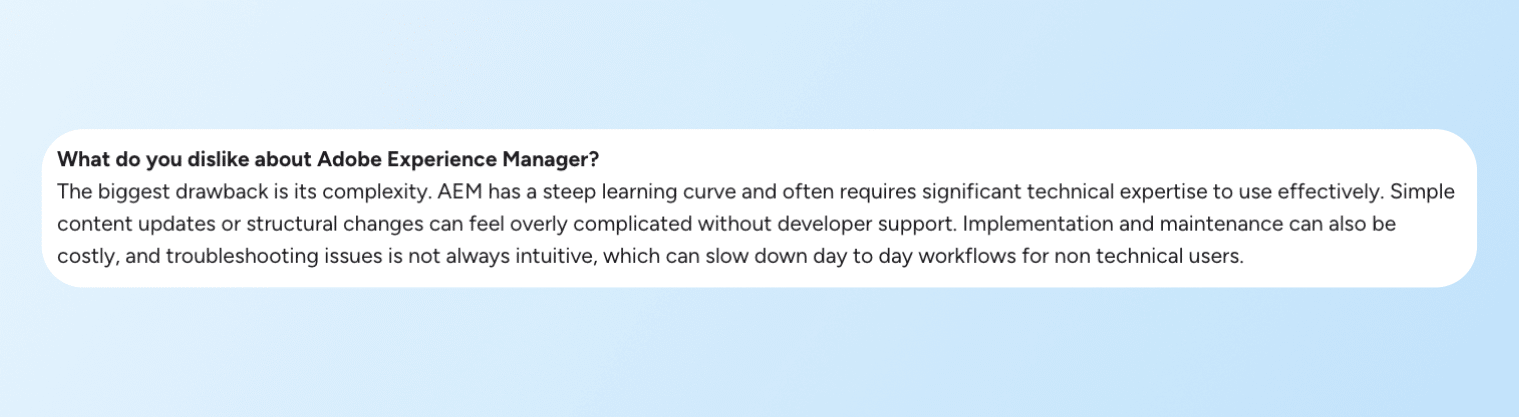
Slow Time-To-Value And Steep Learning Curve
Large deployments often take months before teams launch real campaigns. There are a lot of complexities to manage and deal with, requiring teams to go through a steep learning curve.
Limited Agility For Fast-Growing Teams
Adobe works best in structured enterprise environments with many dependencies. It might experience long change cycles. On the other hand, newer platforms offer plug-and-play integrations, with execution led by a marketer or a non-tech staff member.
How To Evaluate Adobe Experience Cloud Competitors
When evaluating Adobe alternatives, focus on platforms that deliver these capabilities natively:
- Real-Time Personalization: Experiences should update instantly based on real-time behavior, not hours later via batch processing.
- Journey Orchestration: Visual, event-driven journeys that coordinate email, push, SMS, in-app, and web in real time.
- Single Customer View: One unified profile that combines behavioral, transactional, and demographic data without manual stitching.
- Predictive Analytics and AI: Built-in predictions for churn, conversion, next-best action, and content relevance.
- True Omnichannel Execution: One interface to design, launch, and optimize campaigns across channels with consistent logic.
You should also consider pricing and the total cost of ownership to ensure your decision is financially sound. A realistic comparison should include direct, indirect costs, scaling economies, tool consolidation savings, and ROI timeline. Faster implementations generate value sooner.
The goal here isn’t to replace Adobe, but to reduce complexity and improve ROI across the entire lifecycle.
10 Best Adobe Experience Cloud Competitors and Alternatives
These platforms span from all-in-one customer engagement hubs to specialized marketing clouds, covering a range of use cases and company sizes.
1. CleverTap
CleverTap is an all-in-one customer engagement and retention platform designed to help brands build long-term customer relationships through real-time data, AI-driven insights, and personalized omnichannel experiences.
Instead of stitching together analytics, CDP, and multiple messaging tools, CleverTap brings everything into one platform. This reduces complexity and naturally speeds up execution. Compared to legacy marketing clouds, it delivers faster time-to-value at a lower total cost.
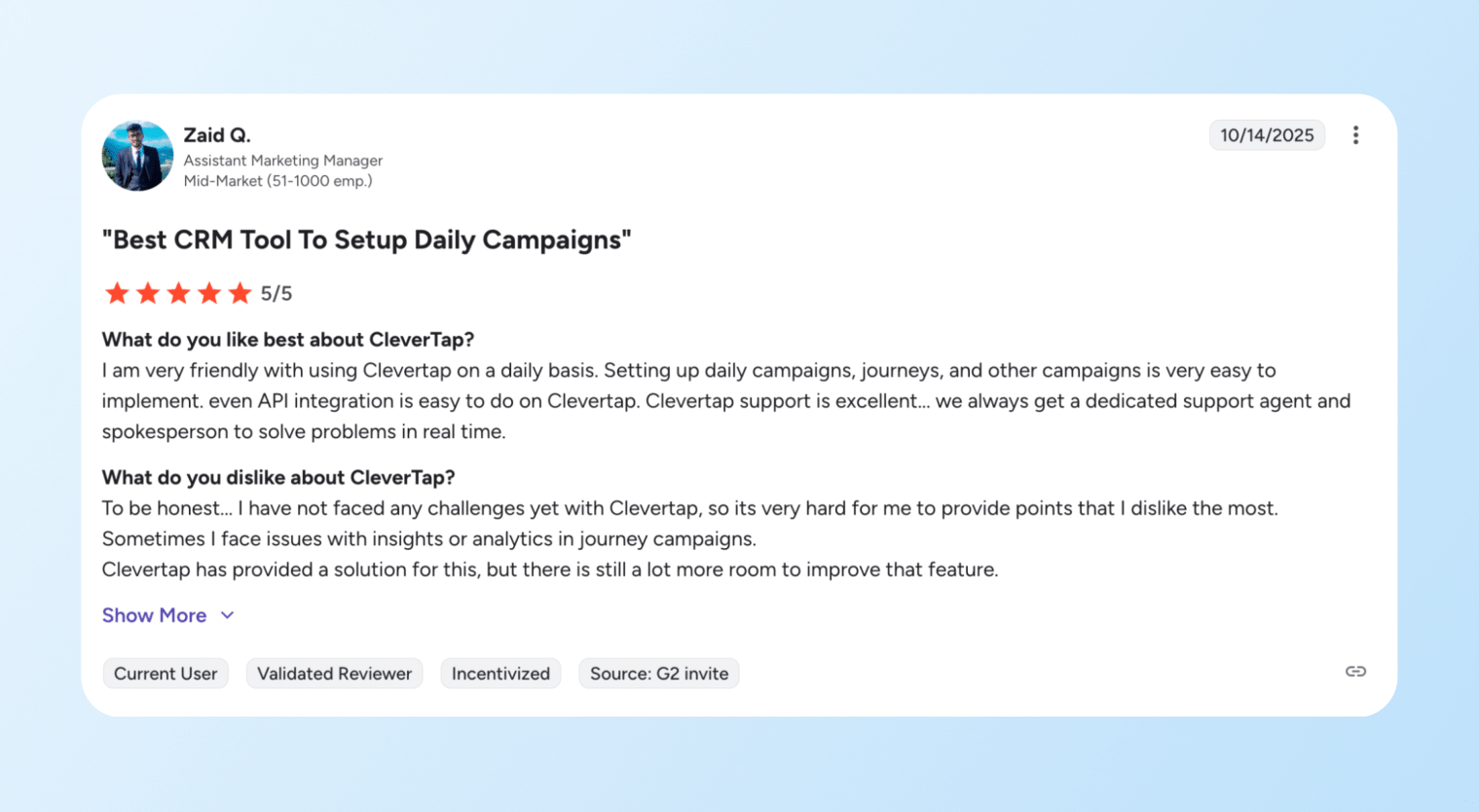
CleverTap is widely trusted by consumer brands. On G2, it holds an average rating of around 4.6/5, with strong feedback in mobile marketing and customer engagement categories. Here’s what a current user feels about CleverTap:
Core Capabilities & Features
CleverTap is built to support real-time, data-driven engagement across the entire customer lifecycle.
- Unified Customer Profiles: Aggregates data from multiple sources into a single, continuously updated customer view, enabling precise targeting and consistent personalization across channels.
- Advanced Segmentation: Uses AI-powered behavioral and predictive segmentation to identify and engage specific user cohorts based on actions, preferences, intent, and lifecycle stage.
- Real-Time Analytics: Provides instant insights into user behavior and campaign performance, allowing teams to react immediately rather than relying on delayed batch reporting.
- Omnichannel Campaign Orchestration: Enables marketers to design, automate, and deploy personalized campaigns across push notifications, in-app messages, email, SMS, and web, within one interface.
- Lifecycle Campaigns: Supports end-to-end journey orchestration, from onboarding and activation to retention, upsell, and reactivation.
- Personalization Engine: Delivers dynamic, context-aware content and recommendations tailored to individual user behavior and preferences.
- Built-In CDP & Scalability: CleverTap includes a native CDP powered by its proprietary database, eliminating the need for external data platforms while scaling effortlessly as data volumes and campaign complexity grow.
A key differentiator for CleverTap is TesseractDB, its purpose-built engagement database designed for real-time storage, processing, and querying of massive customer datasets.
- Analyzes 2,000+ data points per user per month
- Enables instant segmentation and activation
- Powers predictive models and hyper-personalized campaigns
- Supports historical analysis without slowing performance
This architecture allows CleverTap to deliver real-time personalization at scale, which often requires multiple tools and heavy integrations in traditional marketing clouds.
It’s a strong fit for:
- Fast-growing mobile-first companies
- Mid-market and enterprise brands that want one unified platform
- Marketers who rely on AI-driven personalization
- Consumer businesses such as e-commerce, fintech, media, and mobile apps
If real-time insights and quick campaign execution matter, CleverTap is a good fit. It comes with a variety of features such as advanced customer segmentation, behavioral analytics, omnichannel orchestration, and the most trending, CleverAI.
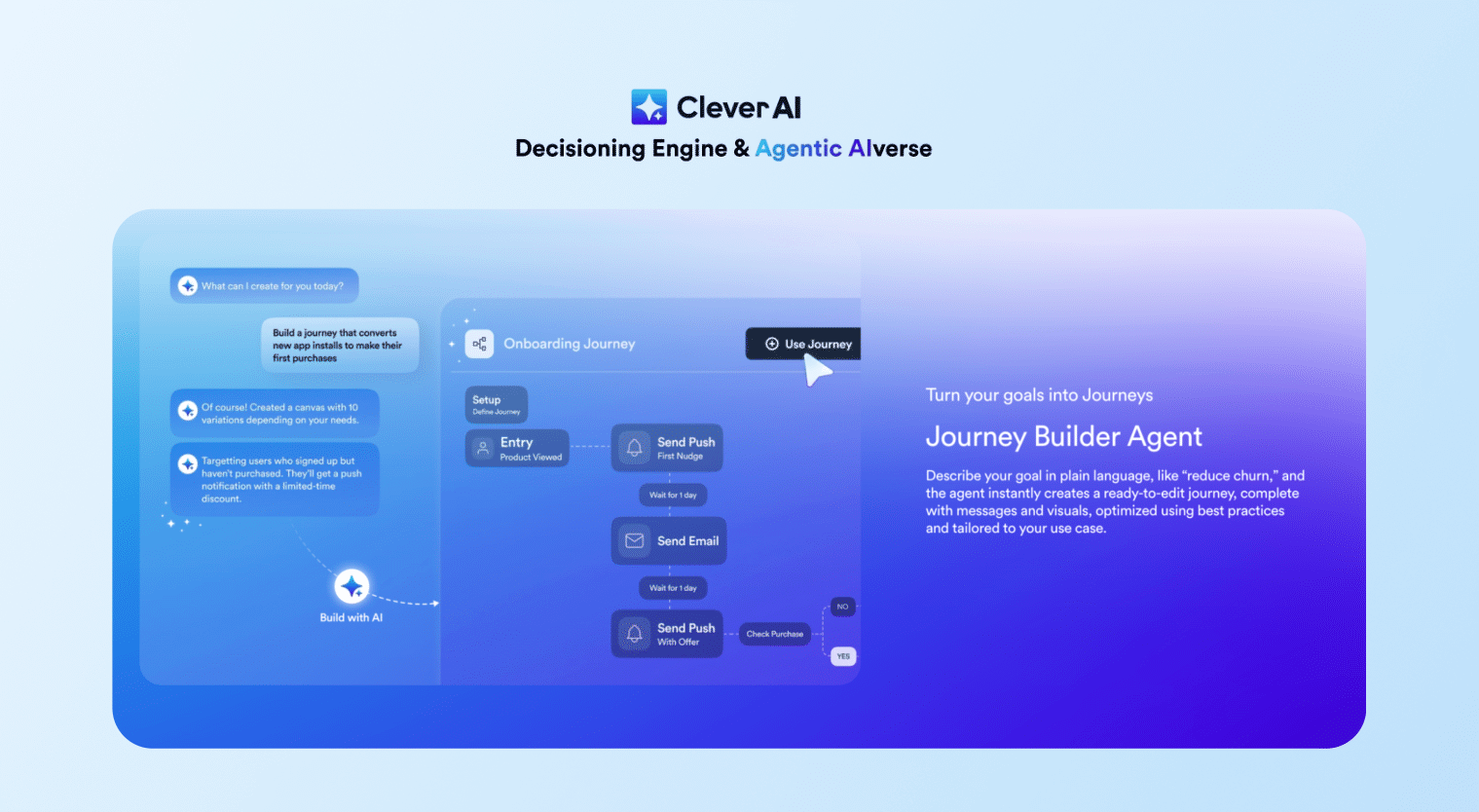
CleverAI: Agentic AI for Personalized Engagement at Scale
CleverAI is CleverTap’s agentic AI engine that goes beyond basic automation. Instead of only generating insights or content, it actively helps marketers decide what to do, when to do it, and who to engage, based on real-time data.
Key capabilities include:
- AI-driven behavioral and predictive segmentation
- Churn prediction and retention optimization
- Personalized product and content recommendations
- IntelliNODE, which runs AI-powered experimentation to determine the best experience paths in real time
- Generative AI-powered Scribe, which helps create emotionally resonant, personalized messaging at scale while improving marketer productivity
Together, these capabilities allow brands to anticipate customer needs, optimize journeys dynamically, and drive higher ROI from personalization efforts.
Below are the pros and cons you might see if you choose CleverTap.
Pros of CleverTap
Check out these advantages of using CleverTap:
- All-in-one engagement platform: Combines analytics, segmentation, personalization, and messaging in one system, reducing tool sprawl.
- Strong for app-first businesses: Excels in mobile and app-centric marketing, while still supporting web and email at scale.
- Fast implementation: G2 recognizes CleverTap with a Fastest Implementation badge, indicating quicker time-to-value.
- Built-in CDP: Stores all customer data in a purpose-built engagement database, enabling real-time segmentation and activation without external CDPs.
Cons of CleverTap
Here’s something to look out for:
- Learning curve for advanced features: Teams may need time to fully leverage advanced segmentation, orchestration, and AI capabilities.
CleverTap uses usage-based, customized pricing. Costs depend on the number of active users, message volume, and the features selected. For more minor use cases, pricing typically starts low. Enterprise plans scale with larger user bases.
Why CleverTap Is Better Than Adobe Experience Cloud
CleverTap often wins over Adobe Experience Cloud because it’s simpler to use and faster to launch. G2 reviewers consistently rate CleverTap higher for ease of use and setup, allowing teams to run campaigns and access insights quickly without long onboarding or heavy technical support.

CleverTap is also built for real-time engagement. Its live segmentation, triggered campaigns, and actionable analytics work especially well for mid-market and mobile-first businesses. Reviewers also note more responsive support, while Adobe’s enterprise-heavy setup often slows implementation and relies on external consultants.
2. HubSpot Marketing Hub
HubSpot Marketing Hub lets you quickly enter the campaign launch phase rather than waiting for setup and implementation. It bundles email, landing pages, forms, automation workflows, social, ads, and reporting into a single interface. It runs on the same database as HubSpot CRM.
Here’s what HubSpot does well:
- Ease of adoption: Marketers can build and ship without heavy ops support.
- CRM-native execution: fewer data sync headaches than Adobe-style stacks.
- Strong inbound workflow: content, SEO, lead capture, and nurture feel cohesive.
There are a few things you should look out for when choosing HubSpot Marketing Hub. For example, the costs rise quickly as contact and features scale. It trades flexibility for simplicity in advanced journey logic, which constrains complex B2C use cases.
3. Oracle Responsys
Oracle Responsys is an enterprise-grade campaign orchestration platform built for scale, reliability, and complex B2C execution. It focuses on high-volume email and coordinated cross-channel messaging across email, SMS, push, and in-app notifications.
This is not a lean-team tool. It assumes dedicated marketing ops and technical ownership.
Here’s what Responsys does well:
- Enterprise-Scale Email Delivery: Built to handle massive send volumes with consistent inbox placement.
- Complex Orchestration: Supports multi-brand, multi-region journeys with approvals and governance baked in.
- Oracle-Native Data Access: Reduces integration effort if your stack already runs on Oracle CX or data platforms.
There are a few things to look out for when choosing Oracle Responsys. The learning curve is steep, and most teams need training, consultants, or long-term ops support. Day-to-day execution might feel slower than on modern platforms with lighter UIs.
For SMBs or mid-market teams, it is usually overkill.
Discover the top Oracle marketing cloud competitors in the customer engagement space.
4. Braze
Braze is a modern customer engagement platform built for real-time, behavior-triggered messaging across push, in-app, email, SMS, web, and more. It treats engagement like a live system. Not a batch calendar. Everything reacts to what users do right now.
Braze fits mobile-first and digital product businesses where retention directly impacts revenue.
Here’s what Braze does well:
- Real-Time Orchestration: Journeys respond instantly to user behavior, not delayed batch jobs.
- Mobile And In-App Depth: Push and in-app are core channels, not secondary add-ons.
- Marketer and Developer Balance: Marketers get a usable UI. Developers keep control through SDKs and APIs.
There are a few things to consider before choosing Braze. Initial setup usually requires engineering support, especially for event design and SDK implementation. Costs skew the enterprise, which puts it out of reach for smaller teams. And it is not a full inbound suite.
Learn more about the top Braze competitors.
Compare Braze vs. MoEngage, Braze vs. Insider One, Braze vs. Salesforce Marketing Cloud, Braze vs. CleverTap, and Braze vs. Iterable to deep dive into Braze’s competitor landscape and choose the best tool for your needs.
5. Salesforce Marketing Cloud
Salesforce Marketing Cloud is built for large-scale email and lifecycle campaigns. Teams usually look at it when Salesforce CRM already runs their sales and service workflows. Marketing Cloud brings journeys, email, segmentation, and reporting into the same ecosystem, with add-ons for personalization and data management. This platform fits large teams that need structure and control.
Here’s what Salesforce Marketing Cloud does well:
- Salesforce-Native Execution: Campaigns use CRM and service data directly, which often reduces integration work.
- Journey-Based Automation: Built for long, rules-driven programs that run across teams and regions.
- Enterprise Controls: Permissions, roles, and approvals support large organizations with strict processes.
There are trade-offs to keep in mind. Salesforce Marketing Cloud is not simple to run. Many teams need specialists or agency support, especially for advanced targeting and content. The product also feels split into different studios rather than one single workspace.
As usage grows, costs and ongoing effort usually grow with it.
Check out the top Salesforce Marketing Cloud competitors.
6. MoEngage
MoEngage brings messaging, segmentation, and journey automation into one system. It shows up in conversations with consumer brands that need to move quickly. It becomes especially relevant when the mobile app is a primary channel, and campaigns need to react to user behavior without long setup cycles.
Here’s what MoEngage does well:
- Mobile-First Engagement: Push and in-app messaging sit at the center, not on the side.
- Unified Omnichannel Journeys: Teams orchestrate key channels from a single workflow layer.
Day-To-Day Usability: The product is often described as easy to operate once events are in place.
There are limits to be aware of. Like any engagement platform, MoEngage depends on clean event tracking and identity resolution. Some teams eventually push deeper analysis into a separate warehouse or BI tool. And if email is your only channel, the experience may feel adequate rather than exceptional.
Learn more about the top MoEngage alternatives.
Compare CleverTap vs. MoEngage and MoEngage vs. WebEngage customer engagement platforms.
7. Netcore Cloud
Netcore Cloud is a customer engagement platform with deep roots in email and messaging infrastructure. Over time, it has expanded into omnichannel journeys and product experience.
Here’s what Netcore Cloud does well:
- Email and SMS Deliverability: Built for high-volume and time-sensitive messaging.
- Tool Consolidation: Often replaces an ESP, an SMS gateway, and a basic engagement tool.
- Hands-On Support: Teams frequently point to active involvement during onboarding and optimization.
The interface feels more functional than modern, and speed tends to improve with familiarity. Additionally, the feature depth varies by channel, with messaging stronger than advanced analytics.
8. SAP Emarsys
SAP Emarsys combines customer data, automation, personalization, and reporting in one system. The focus is clear. It helps teams launch proven campaigns quickly, without building everything from scratch.
Here’s what SAP Emarsys does well:
- Fast Time To Value: Prebuilt tactics help teams launch common omnichannel programs quickly.
- Strong E-commerce Focus: Designed around B2C use cases like personalization, offers, and lifecycle messaging.
- Marketer-Operable Workflows: Day-to-day execution usually stays with marketers, assuming data is in good shape.
Emarsys is opinionated by design. It works best when your use cases align with lifecycle best practices. Highly custom enterprise workflows may need workarounds. And like any personalization platform, results depend heavily on identity resolution and event quality. Weak inputs limit targeting, no matter the tool.
9. Insider One
Insider One often comes up for digital-first B2C brands. It’s fit when growth depends on getting personalization right across channels, not just email. It tends to appeal to teams that want marketers to run experiments and experiences directly, without waiting for engineering for every minor change.
Here’s what Insider One does well:
- Unified Personalization And Journeys: Web and app experiences connect directly to lifecycle messaging.
- Marketer-Led Experimentation: Teams often test and iterate without constant developer involvement.
- Enterprise Scope Without Sprawl: Personalization and orchestration live in the same workflow layer.
There are limits to keep in mind. Insider One depends heavily on data quality. Identity resolution, event tracking, and catalog hygiene matter a lot. When those break down, personalization suffers.
And while marketers can do a lot on their own, technical help is still needed to implement SDKs, manage events, and keep data flows clean at scale.
Take a look at the top Insider One alternatives.
10. Acoustic Marketing Cloud
Acoustic Marketing Cloud, often referred to as Acoustic Campaign, is a marketing automation platform with a long history in enterprise email. It evolved from Silverpop and IBM Watson Campaign Automation. That background shows. The product focuses more on structured data, list management, and reliable execution than on modern interface design.
Here’s what Acoustic Marketing Cloud does well:
- Reliable Email Execution: Designed for high-stakes sends with mature operational controls.
- Structured Data Modeling: Relational tables support richer segmentation and targeting.
The interface and reporting feel dated compared to newer engagement platforms, and onboarding usually takes time. And if you need deep analytics or experience optimization, Acoustic does not replace Adobe-level tooling.
Switching to a Modern Adobe Experience Cloud Competitor
Migrating away from Adobe Experience Cloud looks risky mainly because Adobe sits across data, campaigns, and reporting. In reality, most successful migrations treat this as re-platforming, not a one-to-one tool swap. The objective is continuity first, then improvement.
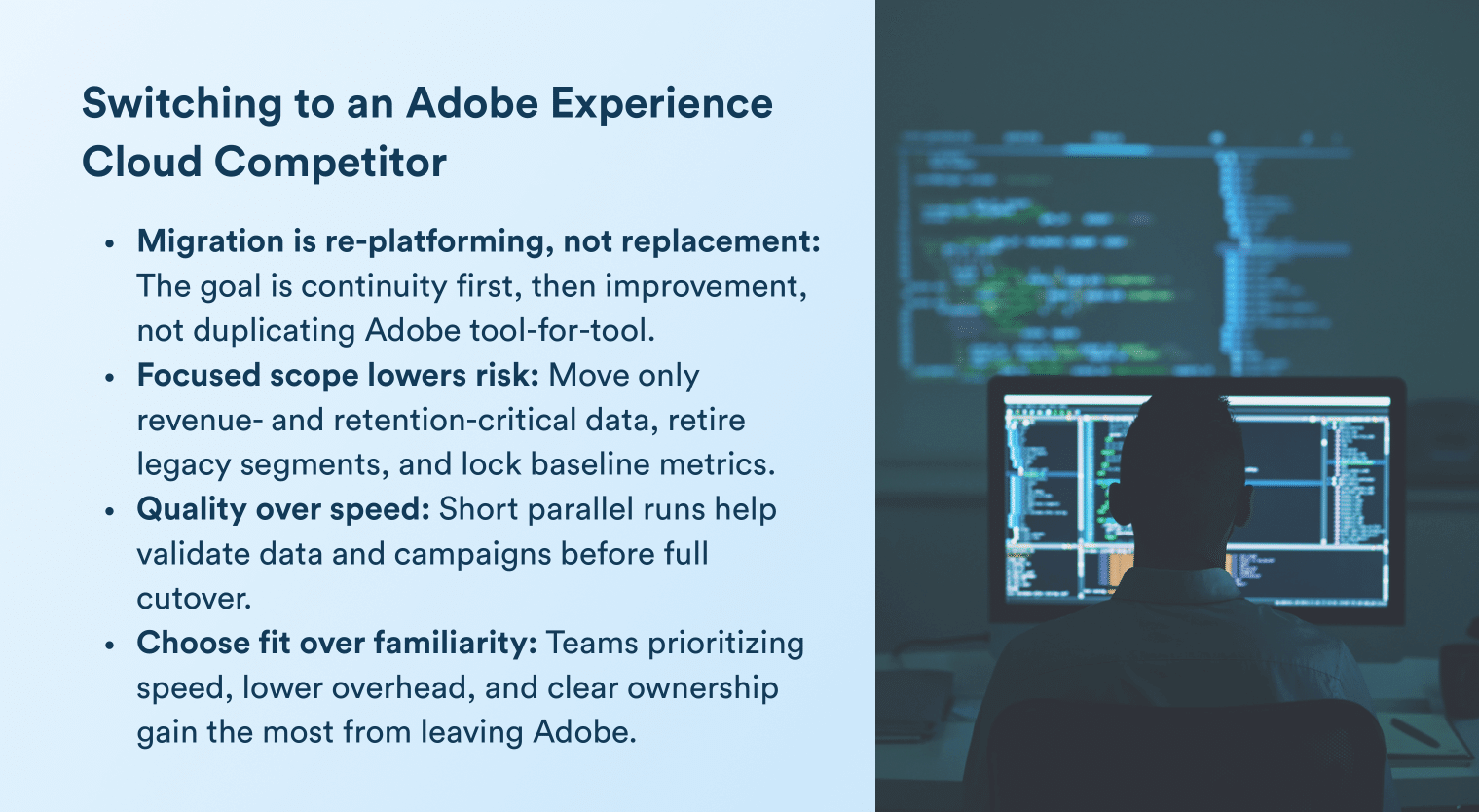
Low-risk migrations usually start with focus. Teams audit only revenue- and retention-driving data, retire unused segments and legacy campaigns, and lock baseline performance metrics before moving anything. This reduces migration scope and cost. Modern engagement platforms typically simplify segmentation and journey logic that required heavy configuration in Adobe.
Execution quality matters more than speed. Some organizations run short parallel periods to validate triggers and analytics before cutting over fully. Modern platforms often shorten this transition by design. CleverTap emphasizes SDK-based event capture, guided onboarding, and marketer-operable journey builders. This allows teams to replace Adobe’s modular stack with a single execution layer and see usable results in weeks rather than months. The core decision is fit, not familiarity.
Teams that prioritize speed, lower operational overhead, and clearer ownership typically benefit most from moving off Adobe.
Unlock a New Momentum In Marketing and CX With CleverTap
The right alternative doesn’t just replicate features; it removes friction and lets marketers act on insight instantly. For you, the next step is to shortlist 2–3 platforms and run real use cases in demos.
If your goal is faster and more effective execution with less complexity, platforms like CleverTap deserve serious consideration. The payoff isn’t cheaper software. It’s better marketing.
See how CleverTap can help boost customer engagement.

Agnishwar Banerjee 
Leads content and digital marketing.Expert in SaaS sales, marketing and GTM strategies.
Free Customer Engagement Guides
Join our newsletter for actionable tips and proven strategies to grow your business and engage your customers.