


















Table of Contents
Categories
Most Popular


Companies see an average return of $5.44 for every $1 spent on marketing automation. Besides the monetary gain, manually sending personalized and timely campaigns can be a hassle. The time spent here can be better utilized in strategizing marketing campaigns.
Modern audiences expect timely, relevant messages on email, mobile, and web, so AI-powered automation, like CleverTap’s customer engagement platform, is key to managing these interactions.
A marketing automation campaign ensures data-centric decision-making. It empowers brands to send welcome series, alerts, or promotions exactly when users need them, without manual effort. This translates into stronger engagement and better ROI, for example, over 30% of all e-commerce email orders come from automated email campaigns.
What is a Marketing Automation Campaign?
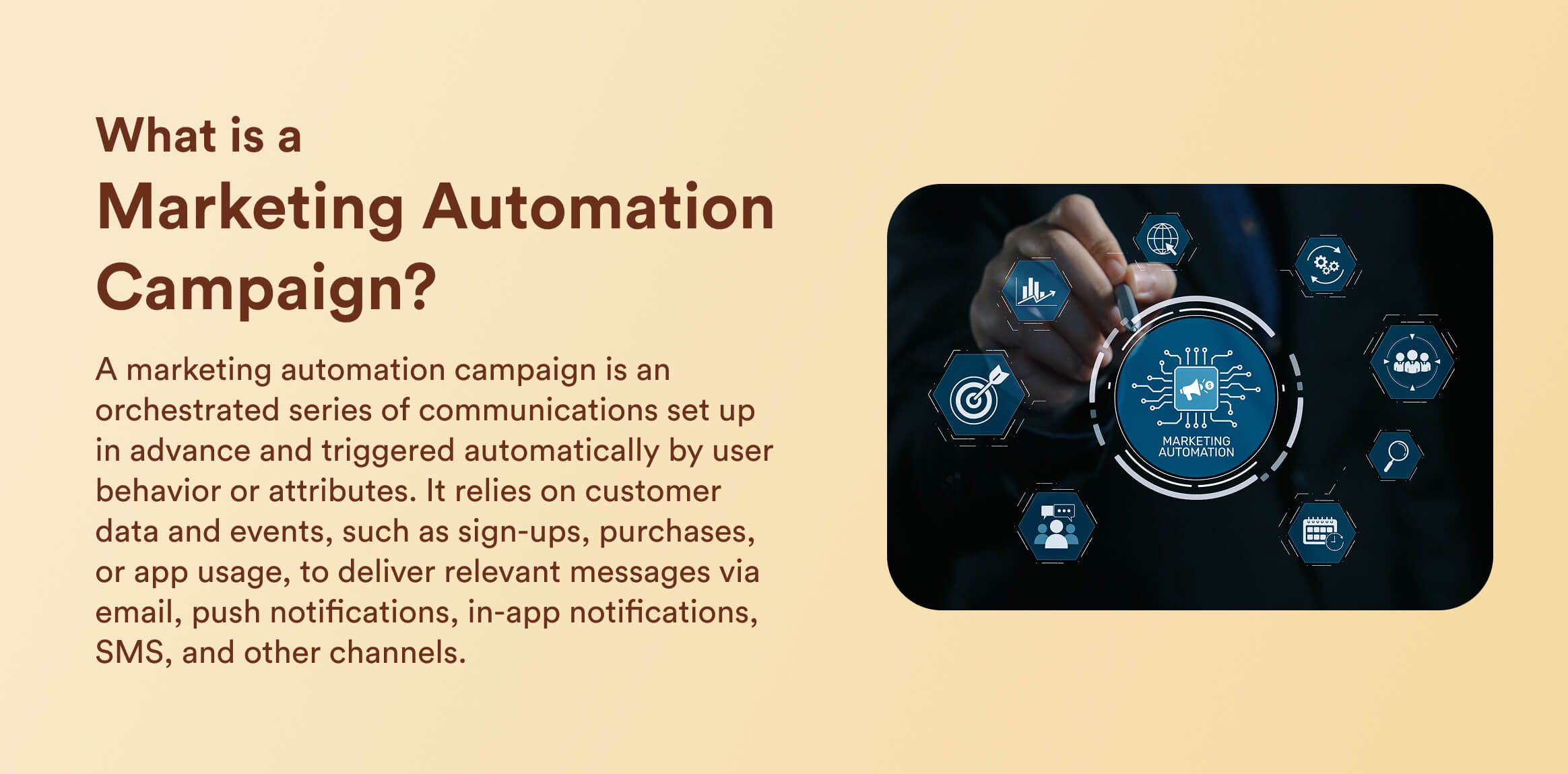
A marketing automation campaign is an orchestrated series of communications set up in advance and triggered automatically by user behavior or attributes. It relies on customer data and events, such as sign-ups, purchases, or app usage, to deliver relevant messages via email, push notifications, in-app notifications, SMS, and other channels.
For example, an onboarding flow might first send a welcome email; if that email isn’t opened within an hour, it can automatically send a push reminder, ensuring no targeted user is missed.
The difference between automated marketing and automated advertising is explained below.
- Automated advertising usually refers to programmatic or platform-driven ads, such as Facebook or Google Ads, that buy placements and target audiences based on data.
- Marketing automation focuses on owned channels and user journeys, sending emails, push notifications, or in-app messages based on user actions.
Both can complement each other. You might export a segment of cart abandoners to Facebook for an ad campaign, then use automated emails to bring those customers back to complete the sale.
How Does a Marketing Automation Campaign Help?
Marketing automation campaigns deliver consistency, scale, and speed that manual processes can’t match. The key benefits include:
- Consistent Messaging: Cohesiveness in branding is maintained as every customer gets the right sequence of emails, pushes, or texts without any missed steps.
- Real-Time Personalization at Scale: Messages adapt instantly to user behavior. For example, if a shopper views a product category frequently, the system can push tailored recommendations or offers on the fly.
- Better Engagement and ROI: Automated marketing helps 91% marketers achieve their goals. About 21% of revenue comes from automated email campaigns, and this often pays for itself, as companies recoup their investment in under six months.
- Improved Collaboration: Marketing automation campaigns generate better quality leads, which benefit the sales team. The marketing team, on the other hand, can gain insights from sales interactions.
- Smarter Resource Allocation: Performance data helps identify high-performing channels and optimize spend towards those strategies that drive results.
- Prolonged Engagement: These campaigns directly strengthen customer retention by keeping users engaged throughout their lifecycle instead of only during acquisition.
10 Proven Marketing Automation Campaign Examples
Below are 10 real-world marketing automation campaigns that demonstrate how businesses boost engagement, conversions, and retention across multiple channels.
1. Welcome/Onboarding Campaign – Duolingo
Language-learning app Duolingo uses automated welcome and onboarding flows to build a daily learning habit. New users get guided into their first lesson, then receive practice reminders and motivational notifications to keep the streak going. Duolingo lets users configure practice reminders at specific times via email and push notifications.
How it Works: This type of marketing automation campaign helps new users experience value in the first session and form a habit in the first 7–14 days. After signup, Duolingo walks users through a short placement test and first lesson, then schedules automated reminders (push + email) around the time the user chose, nudging them back into the app daily.
Campaign Trigger: New user sign-up / app install. There are also sub-triggers like:
- First lesson completed → send “Nice work, here’s what’s next” email.
- No lesson completed by day 1 or 2 → send “practice reminder” notification.
Channels Used:
- Email: Welcome email, “you’re on a streak” recaps, occasional nudges for lapses (especially on web).
- Push notifications: Highly visible daily practice reminders with different copy variants.
- In-App Messaging/UI: Progress bars, streak counters, and tooltips contextualize the next best action.
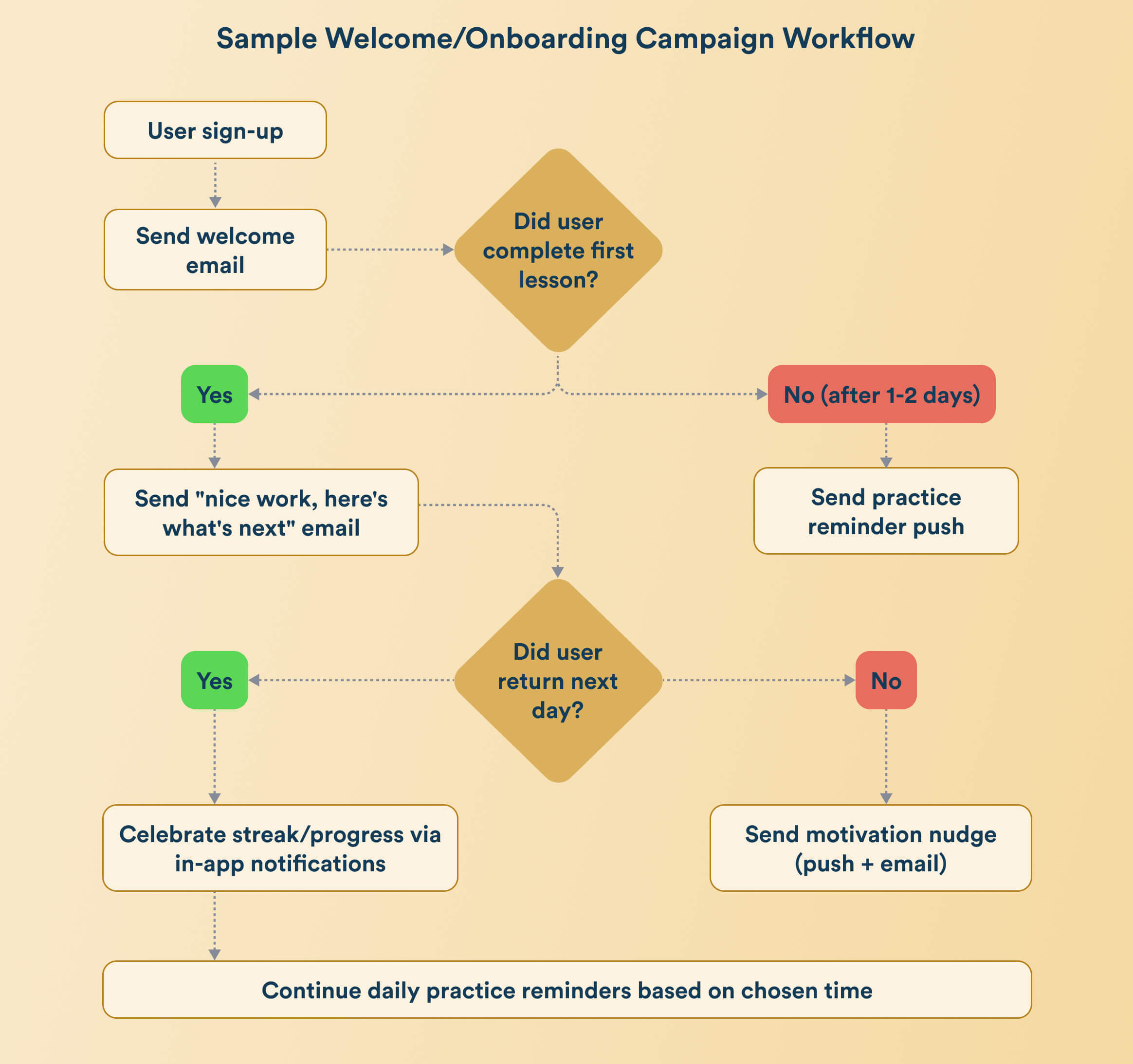
Using behavioral segmentation and flows, you can create segments such as “New users < 7 days”, “Completed 1 lesson but no second session”, “Has not enabled notifications”. Then build a welcome/onboarding flow that chains: sign-up → first session → practice reminders → milestone celebration (e.g., streak of 3, 7 days). Use journey-level A/B tests to optimize send-time and creative, as part of your marketing automation campaign management.
2. Abandoned Cart Recovery Marketing Automation Campaign – Nike
Retailer Nike uses automated cart recovery emails that showcase the items left behind, prominent visuals, and clear CTAs to complete the purchase. Email galleries and teardowns highlight how Nike’s cart-reminder emails focus on a single product, social proof, and urgency to nudge users back to checkout.
How it Works: This marketing automation campaign helps recover lost their revenue from shoppers who added items to cart but didn’t check out. Nike’s automated marketing campaign detects carts with products added but no completed order, then sends a branded reminder email with the product image, price, and a “Checkout now” CTA. Subsequent contacts can layer in scarcity (“selling fast”) or free shipping incentives.
Campaign Trigger: Cart created and item added, no purchase for 30 minutes (configurable). Follow-up triggers include:
No conversion after first reminder → send second touch with incentive or alternative product.
Channels Used:
- Email: Primary abandoned cart email reminder with product imagery and a deep link back to checkout.
- SMS (optional): Short reminder with a smart link for high-intent segments (e.g., cart value > threshold).
- Push Notifications: “You left your gear behind” push that opens directly to the cart.
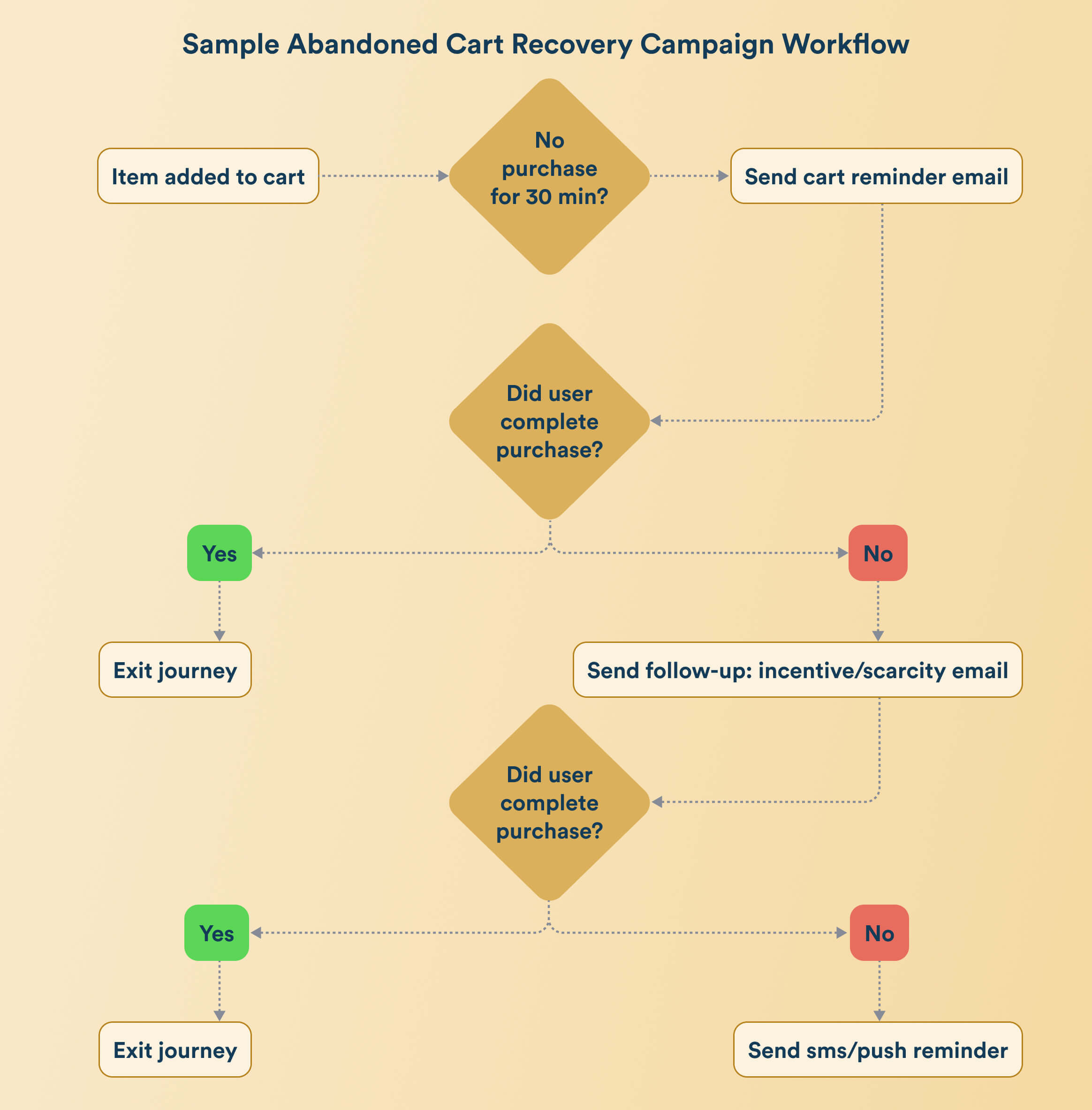
In your marketing automation platform, like CleverTap, you can set a cart abandon event and use it as a trigger in a journey. Create segments like “High-value abandoned cart”, “First-time customer vs. returning” for more granular marketing automation campaign management. Orchestrate Email → SMS → Push in a single flow, with exits for users who complete the purchase.
3. Post-Purchase Upsell or Cross-Sell Campaign – Amazon
Amazon is famous for AI-driven recommendations such as “Customers who bought this also bought…”. Its recommendation engine uses historical purchase and browsing data to suggest related products that drive cross-sell and upsell opportunities.
How it Works: This type of marketing automation campaign increases average order value (AOV) and repeat purchases by recommending complementary or higher-value items after checkout. Once a purchase is confirmed, Amazon’s system predicts the next-best product based on collaborative filtering and user behavior, then surfaces those items in order confirmation pages and follow-up emails.
Campaign Trigger: Purchase confirmation event (order placed). Follow-up triggers include:
- Shipment delivered → send “rate & review + recommended products” email.
- Specific product purchased → start category-specific cross-sell sequence.
Channels Used:
- Email: Order confirmation and follow-up recommendations (“You might also like”).
- On-site & in-app: Recommended product carousels on the order detail page and home screen.
- Push Notifications: Targeted alerts for “New arrivals in categories you buy from”.
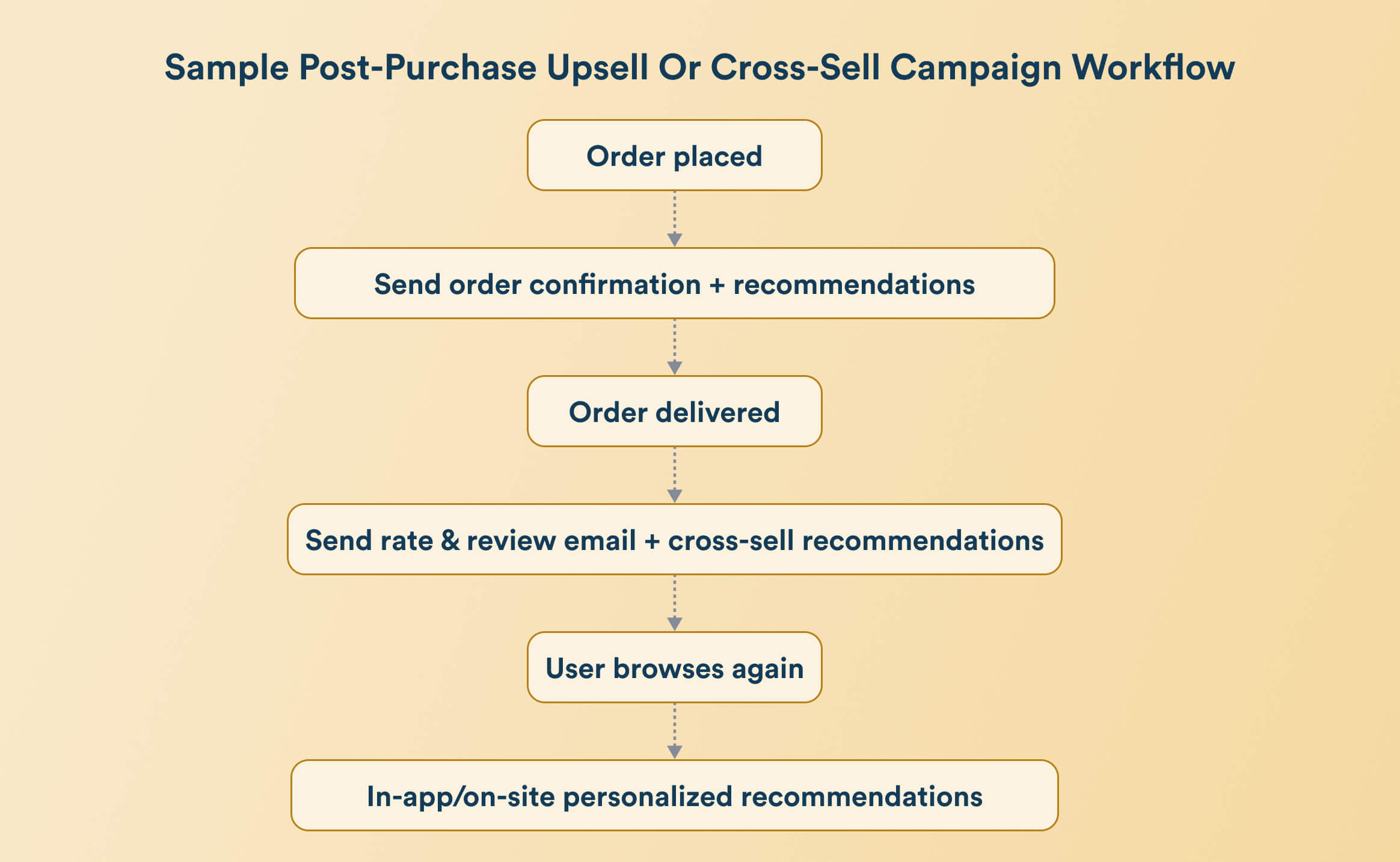
Use AI-based product recommendations to generate next-best items based on user events (purchases, views). Trigger an upsell push notification and an email sequence right after the purchase event. Personalize content with dynamic blocks, showing different SKUs for each user.
4. Marketing Automation Campaign for Re-Engagement of Dormant Users – Swan
Swan, one of the most trusted applications in the UAE for the delivery of groceries and a range of home services, wanted to bring back users who had become inactive, increase retention across cohorts, and generate incremental orders from dormant users. Swan achieved a 3% activation rate among targeted dormant users, 15% of incremental orders came from the reactivation campaigns, and a 40% boost in email view rates following content and creativity experimentation.

How it Works: Swan used CleverTap to enable smart segmentation to isolate dormant cohorts, A/B test messaging and creatives, personalize content at the individual level, and choose optimal timing & channel mix.
Campaign Trigger: Users who have not made a transaction for a specified period of time.
Channels Used: Email and push notifications.
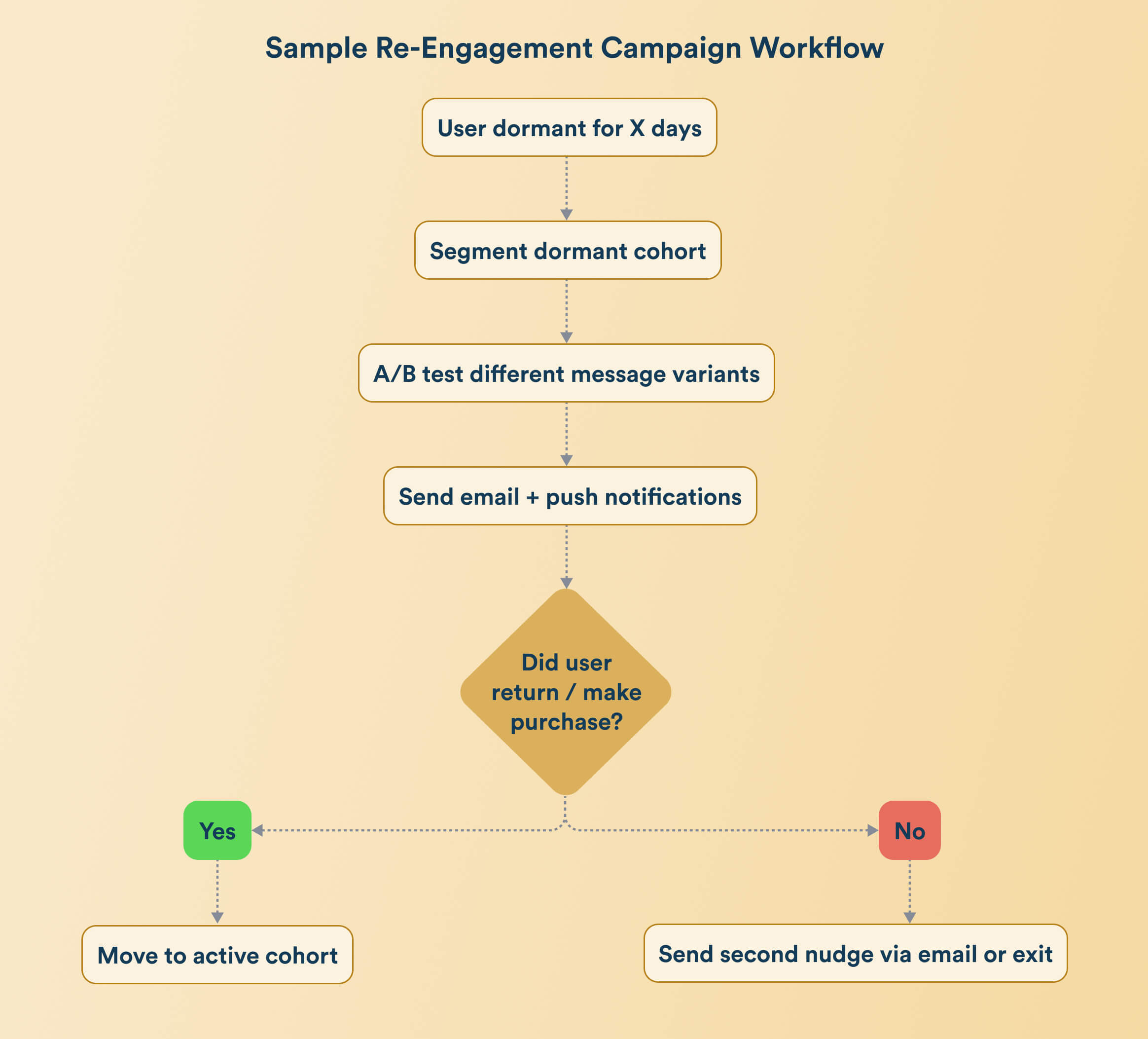
CleverTap enables cohort-based segmentation of dormant users, orchestration of automated push & email flows, analytics for cohort performance tracking, and experimentation support via A/B tests to optimize message yield.
5. Birthday or Milestone Campaign – Sephora Beauty Insider
Beauty retailer Sephora runs a well-known birthday program via its Beauty Insider loyalty scheme. Members get a free birthday gift or bonus points during their birthday month, often with exclusive product sets and tier-based perks (Insider, VIB, Rouge).
How it Works: Sephora’s automated marketing campaign increases loyalty and customer lifetime value by celebrating personal milestones with relevant offers. Sephora emails members around their birthday with a reminder to redeem a free gift in-store or with an online purchase. Video and news coverage highlight how members can pick from curated birthday sets and redeem via app or website.
Campaign Trigger: User’s date of birth (or loyalty sign-up anniversary) matches current month. Variants by tier (e.g., Rouge vs. Insider) with different gift choices or point bonuses.
Channels Used:
- Email: Primary birthday notification and reminder.
- App Push & In-App: Birthday banners, offer cards in the loyalty section.
- In-Store Messaging: POS and staff prompts to remind users to redeem their birthday gift.

Store birthday/anniversary as user properties in your marketing automation platform and fire an event-based journey around those dates. Use past purchase and browsing data to tailor which gift or offer is emphasized. Add follow-up nudges a few days before the birthday month ends if the offer hasn’t been redeemed.
6. Product Recommendations Based on Behavior – Eatigo
Eatigo, an online restaurant reservation platform, wanted to boost reservation conversions and user engagement by recommending relevant restaurant options based on user behavior. Customers who received personalized recommendations were 2X more likely to complete a reservation compared to those who didn’t. Behaviour-based recommendations significantly increased reservation conversions across markets.
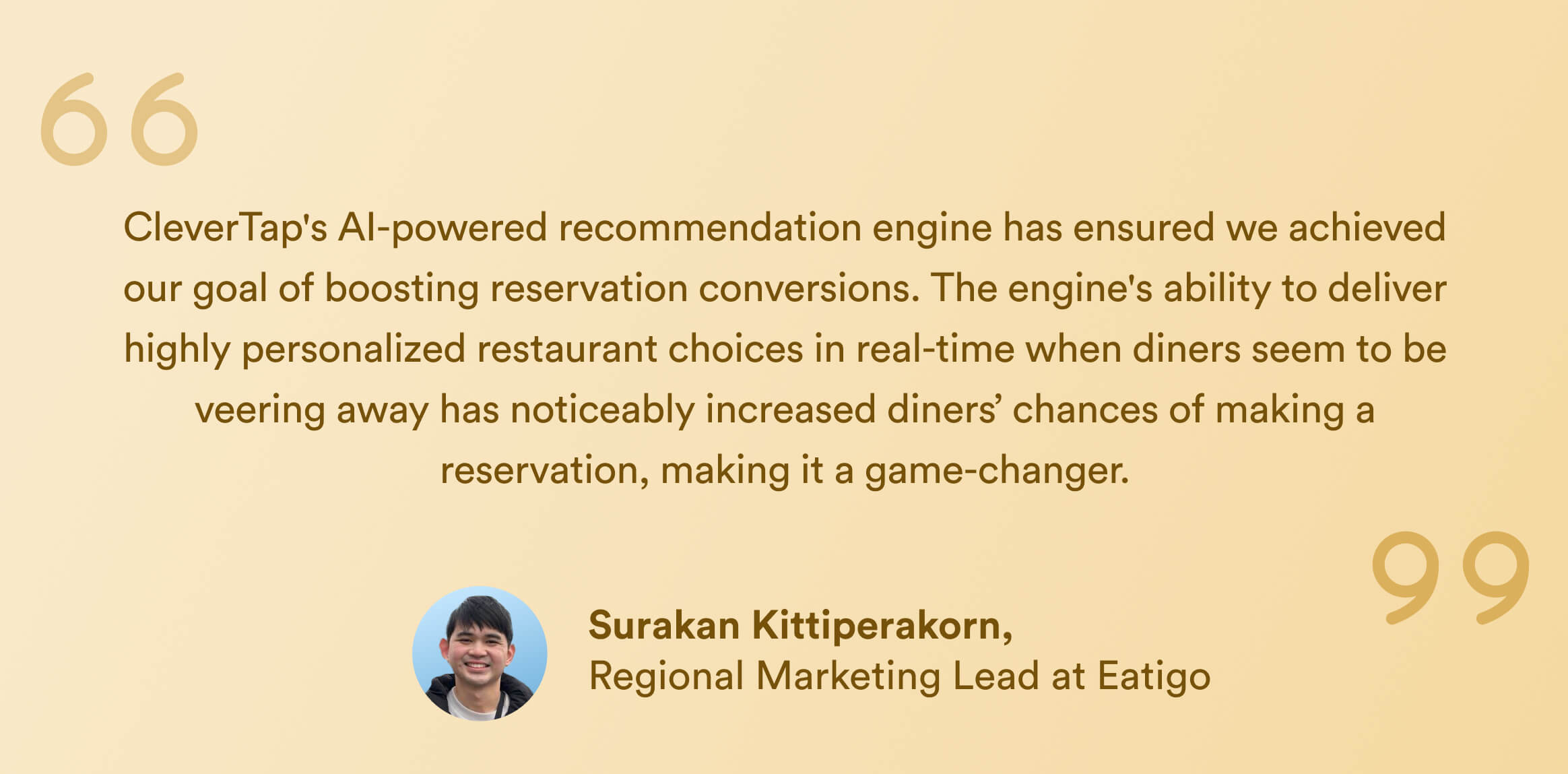
How it Works: With CleverTap, Eatigo used both recent and historical behavioral data to choose recommendations. It places suggestions when intent is high, especially after a browse, cancellation, or during re-engagement, and across channels.
Trigger: When a user browses restaurants but doesn’t make a reservation, and also when users cancel a reservation or go dormant for 30 days.
Channels Used: Push notifications, email, SMS with real-time AI-driven restaurant suggestions.
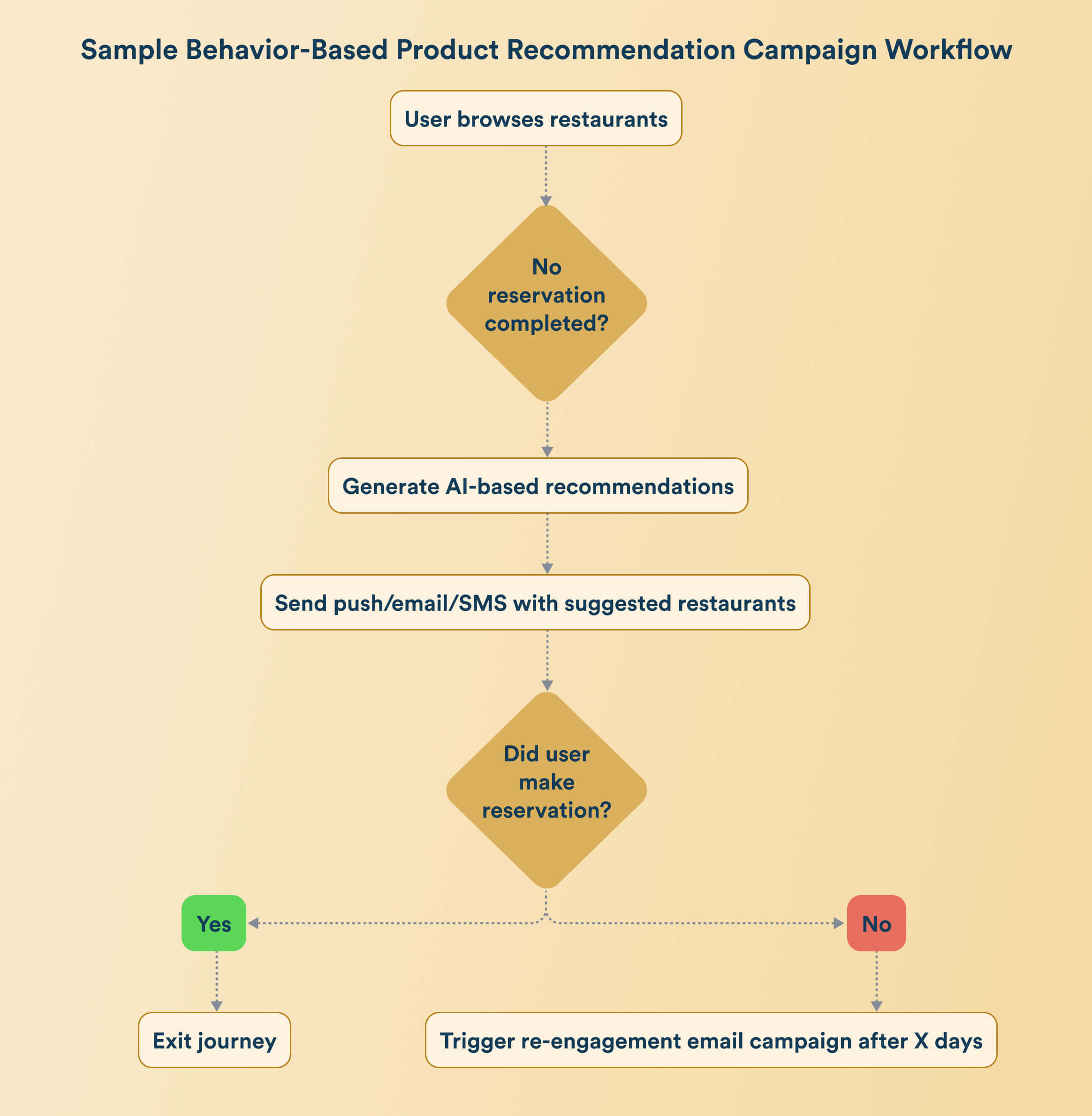
CleverTap’s Clever AI recommendation engine uses real-time and past behavior, a well-classified catalog, and predictive segmentation to deliver relevant suggestions, integrated in journeys and across channels.
7. Marketing Automation Campaign for Price Drop or Back-in-Stock Alert – Skyscanner
Travel search engine Skyscanner lets users set price alerts for flights; when the price changes, they automatically send an email informing users whether fares have gone up or down.
How it Works: Skyscanner’s marketing automation campaign helps users book at the best price and keeps them engaged with the platform without constant manual checking. When users click “Get Price Alerts” on a specific route/date, Skyscanner stores that watch list and sends email alerts whenever the price changes.
Campaign Trigger: Inventory or pricing update for watched routes (price up/down or seat availability changes).
Channels Used:
- Email: Primary channel for price alerts.
- Push Notifications: For app users, real-time notifications about price drops or limited-time deals.
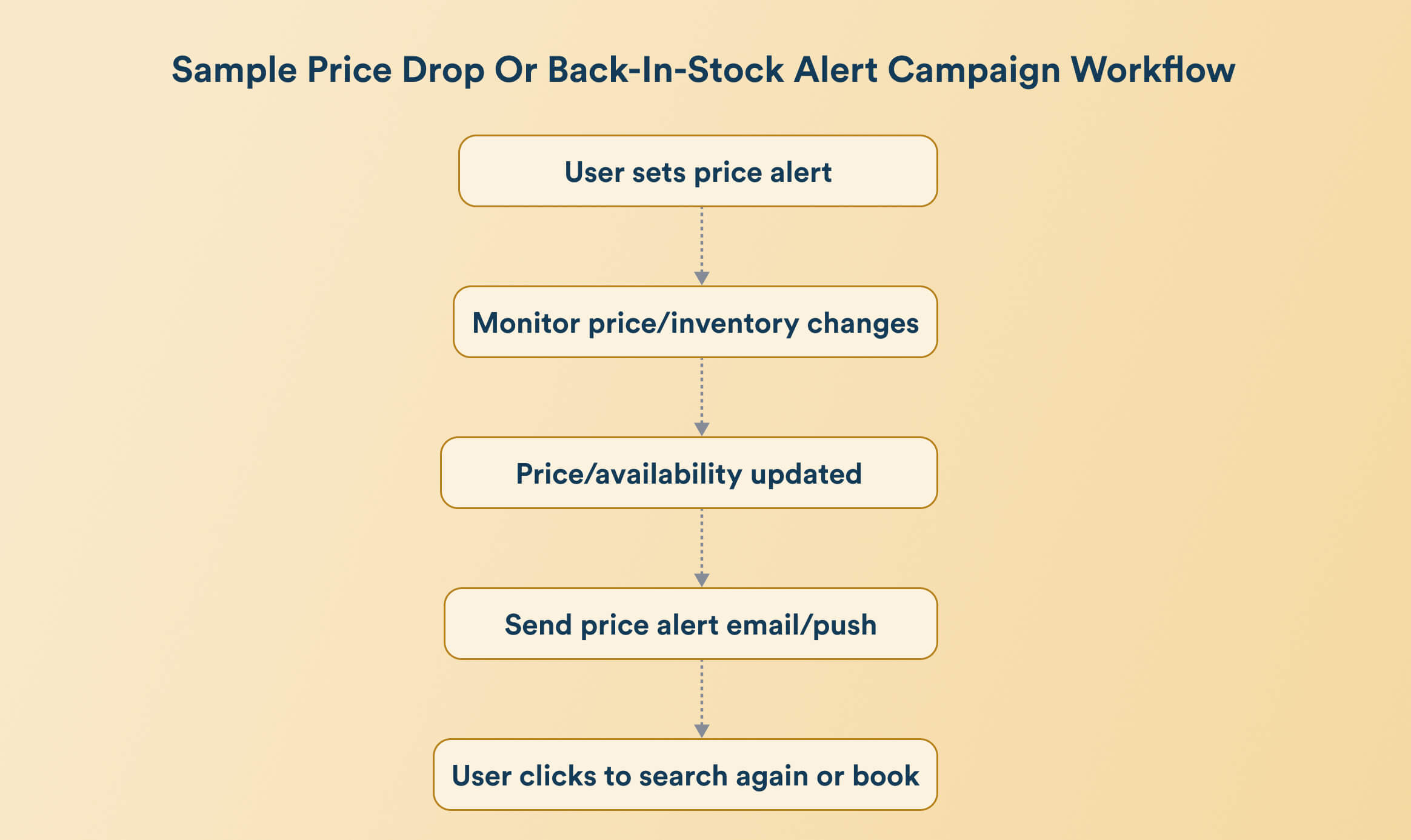
For ecommerce, you can trigger back-in-stock or price-drop alerts when product inventory or price changes. For travel apps, mirror Skyscanner’s approach for hotels, tours, or dynamic packages. Track “watchlist” events or “notify me” subscriptions. Use product/inventory events as triggers in journeys to send real-time alerts across email, push, and SMS.
8. Churn Prevention Campaign – Spotify Premium
Spotify regularly runs re-engagement offers for lapsed Premium subscribers. For example, they have a “Re-Engagement Offer” that is explicitly limited to users who previously subscribed, and they’ve promoted seasonal “come back to Premium” deals via email campaigns.
How it Works: Churn prevention marketing automation campaigns help win back users who downgraded or canceled, before they churn permanently. Spotify targets former Premium users with discounted offers (e.g., several months of Premium at a reduced price) communicated via email and web promos, encouraging them to come back to ad-free listening.
Campaign Trigger: Subscription canceled or downgraded; user meets eligibility criteria (e.g., previously subscribed before a certain date, not currently Premium). Secondary triggers include a drop in usage frequency from active subscribers, prompting pre-emptive offers or “we miss you” reminders.
Channels Used:
- Email: Targeted “come back to Premium” campaigns with time-bound discounts.
- In-App Banners: Prominent offers for free/discounted months when downgraded users sign in.
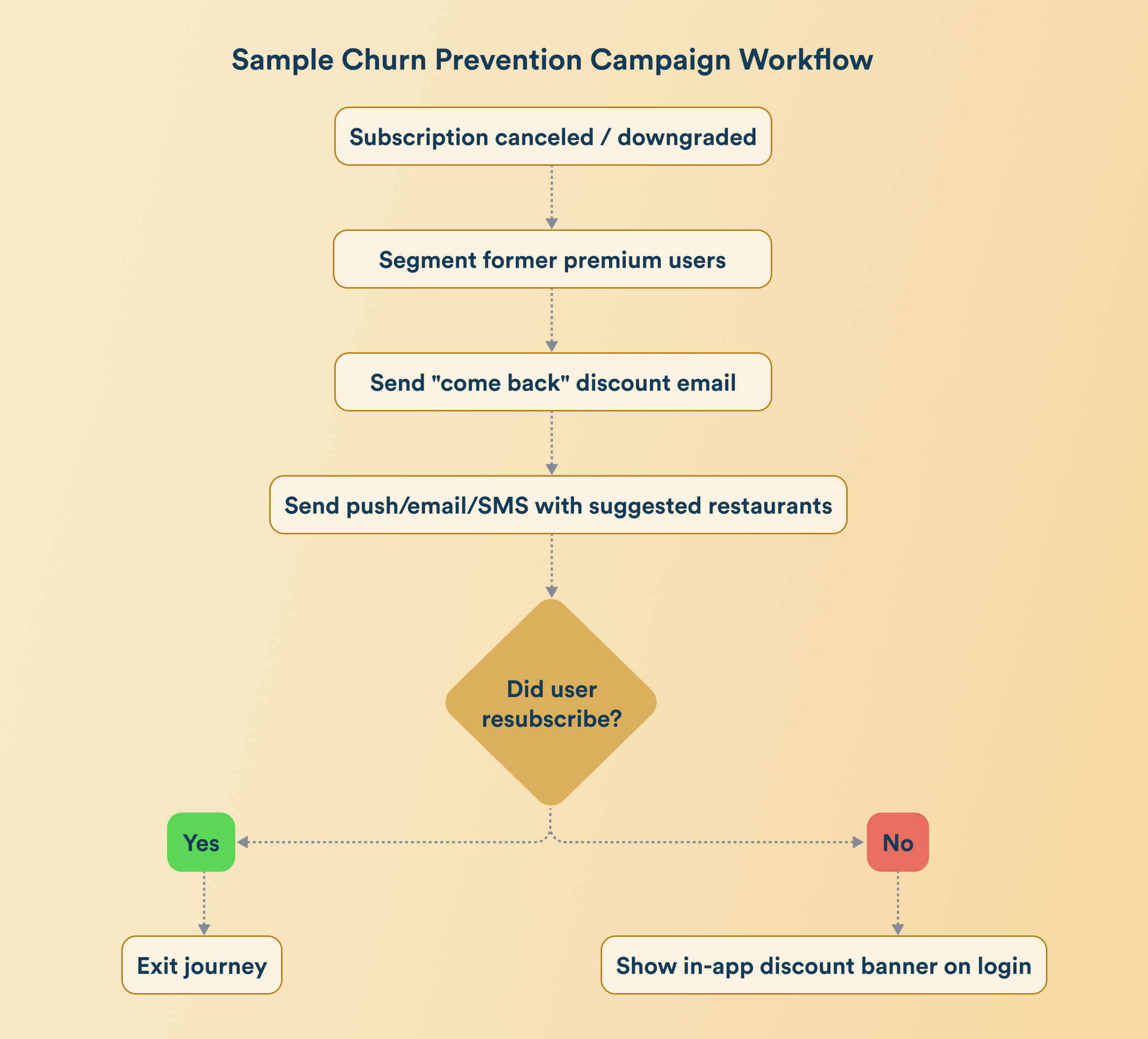
Combine drop in usage frequency (fewer sessions, shorter sessions) and billing events (cancellation, failed payment) as triggers. Include a short feedback survey (“What made you leave?”) plus a personalized incentive (discount, added benefits). This is a powerful marketing automation campaign to reduce churn and improve LTV.
9. Transactional Automation with Upsell CTA – Dick’s Sporting Goods
Dick’s Sporting Goods uses transactional emails not just to confirm orders but also to recommend related products and promote loyalty rewards.
How it Works: It leverages high open rates of transactional emails to drive repeat purchases and cross-sell. After a customer checks out, Dick’s sends a detailed order confirmation that includes delivery info plus product recommendations tailored to the purchase, effectively turning the receipt into a cross-sell touchpoint.
Campaign Trigger: Invoice/order confirmation or shipping confirmation event. Additional trigger includes: Delivery confirmation → invite users to review products and discover complementary gear.
Channels Used:
- Email: Core order confirmation and shipment updates with embedded recommendation blocks.
- SMS / Push: “Your order is on its way” notifications with a deep link to order tracking and featured upsell items in the app.
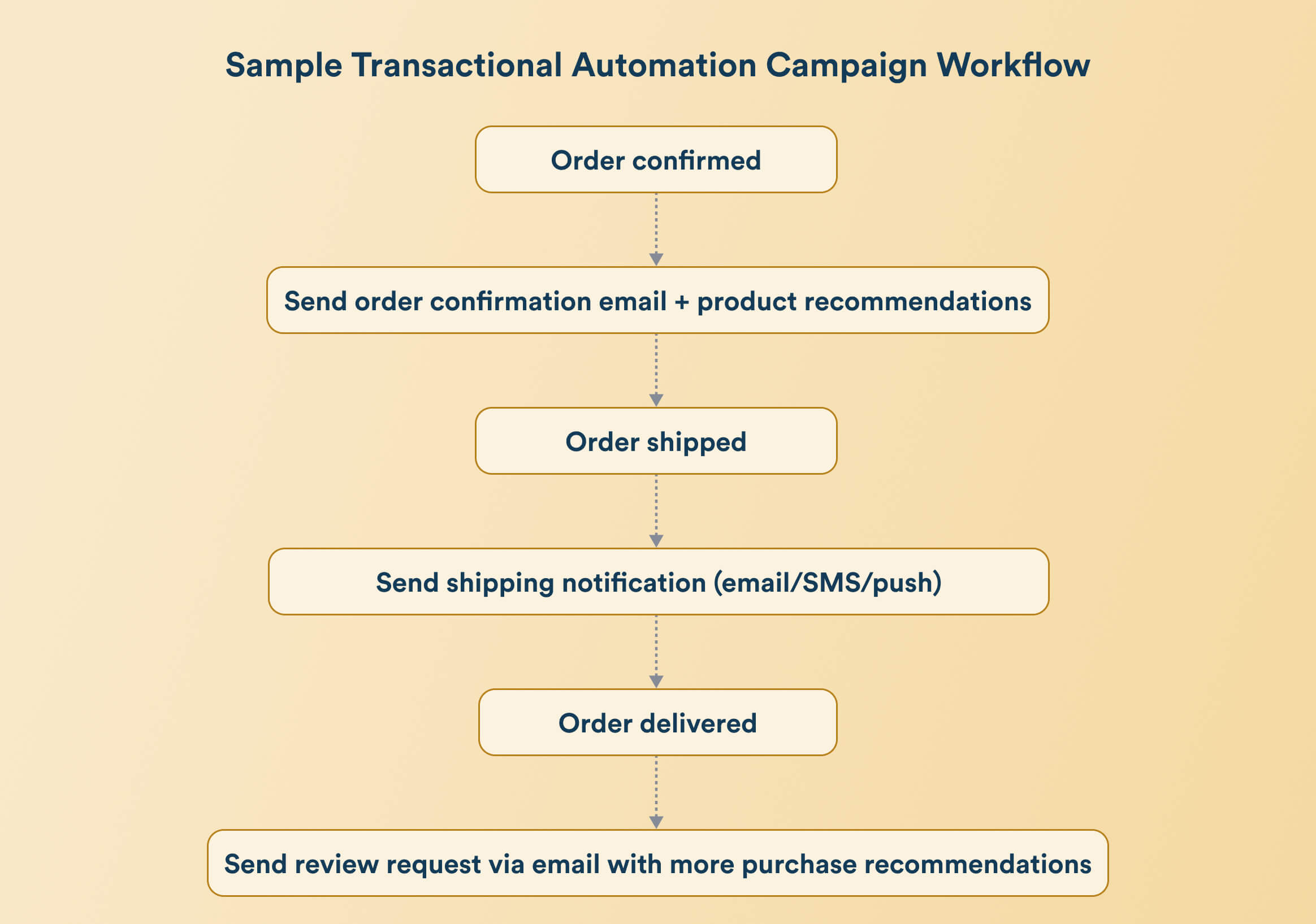
Ensure your marketing automation platform is allowed to add marketing content within transactional templates (and stay compliant with regulations). Use purchased items as inputs to a recommendation model that populates a “You may also like” section. This becomes a subtle, always-on marketing automation campaign embedded into transactional flows.
10. Automated Advertising Retargeting Campaign – Airbnb
Airbnb uses targeted digital ad campaigns to retarget users who have browsed listings but not yet booked. The company uses user behavior, preferences, and search history to serve personalized ads highlighting properties tailored to each user.
How it Works: Airbnb’s marketing automation campaign converts high-intent visitors who left without booking by reminding them of viewed or similar listings. It analyzes on-site behavior (destinations searched, listings viewed, dates entered) and then runs retargeting ads on platforms like Meta, showing customized listings and offers to those users.
Campaign Trigger: Website/app visit with search or listing views without conversion (no booking event). Segmentation logic includes destination, price range, stay dates, device type, and visit recency.
Channels Used:
- Paid Social & Display Ads: Dynamic retargeting on Facebook, Instagram, and other networks using custom audiences based on first-party data.
- Email (Complementary): Browse-abandon emails with similar or saved listings.
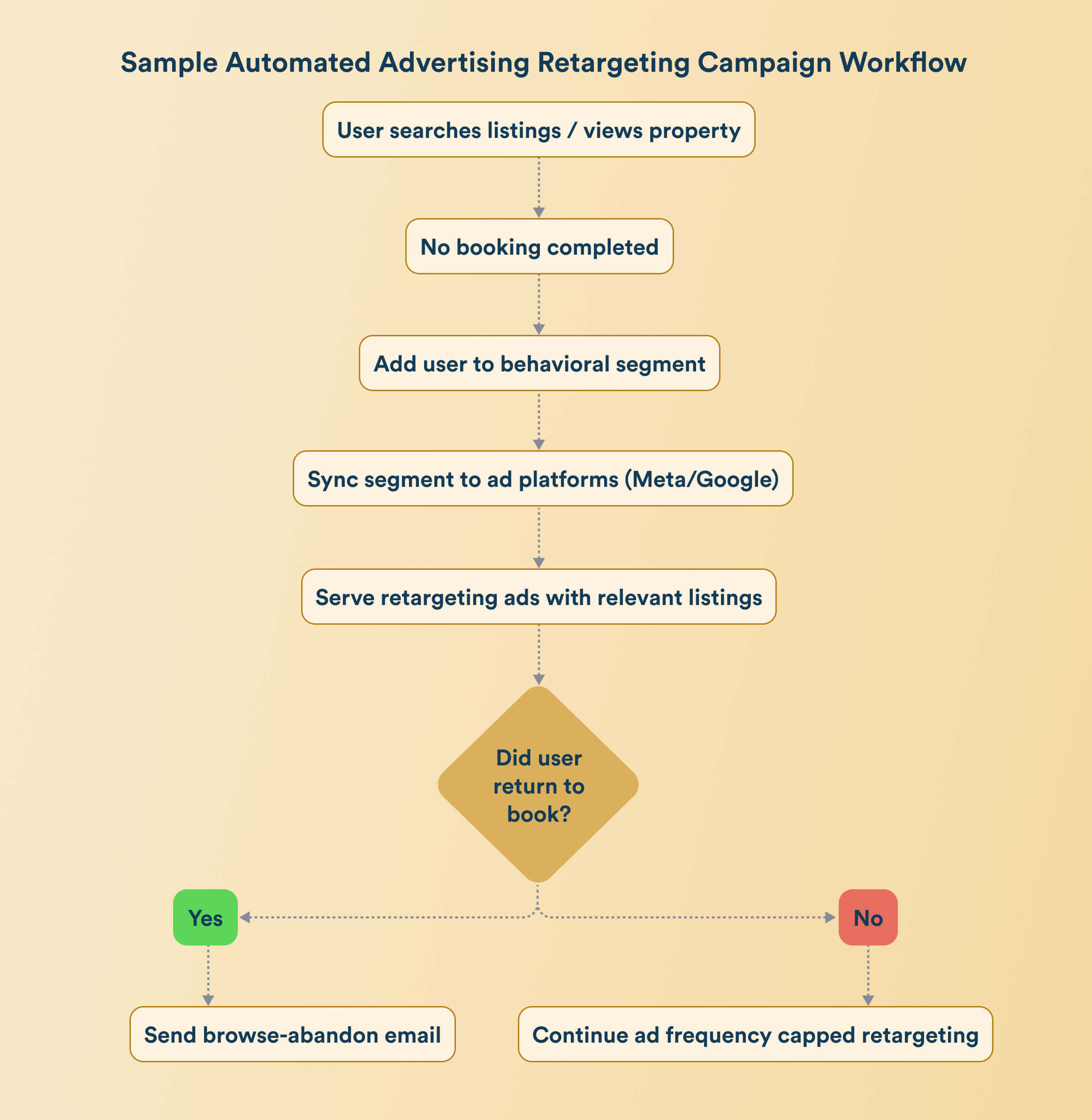
In your marketing automation platform, build behavioral segments such as “Visited product page but no checkout”, “Searched Category X but no purchase”. Sync these segments automatically to ad platforms (Meta, Google) for ad campaign automation and automated advertising. Close the loop by feeding conversions back into the platform, improving marketing automation campaign management over time.
Best Practices for Managing Marketing Automation Campaigns
Managing marketing automation campaigns requires thoughtful planning, testing, and optimization to ensure consistent results.
- Segment Intelligently: Combine behavior and demographic data for precise segments. For example, split users by purchase history and browsing patterns. CleverTap’s advanced segmentation builder handles complex filters so each journey targets exactly the right audience.
- Time Messages Wisely: Schedule the message according to user habits. Send welcome messages immediately, stagger reminders 1 day after inactivity, and honor user time zones. CleverTap can optimize send times per user and time zone so messages arrive when they’re most receptive.
- Leverage AI: Use AI and predictive insights to personalize in real time. AI can predict customer value or churn risk, then tailor messages. Many marketers use AI to optimize content and timing. CleverTap can automatically identify high-LTV or at-risk users and customize each message for them.
- A/B Test and Iterate: Continuously test campaign elements. Run A/B tests on subject lines, copy, or images, and let data choose the winner. For example, try a 10% vs. 20% discount in your cart recovery flow and compare performance. Always refine campaigns based on these insights.
- Integrate customer feedback loops: Embed surveys or micro-feedback forms within your campaigns to capture real user sentiments and identify friction points. For instance, after a re-engagement push or post-purchase journey, ask customers how helpful the message was to gain valuable insights.
- Keep Data Clean: Use accurate, first-party data for precise targeting. Remove unsubscribed or invalid contacts regularly. Dirty data leads to wasted sends and lower engagement. Clean segments ensure messages reach real prospects and maintain high deliverability.
- Maintain Brand Consistency: Ensure all automated content matches your brand voice. Build approvals for flows to prevent errors. Start with well-defined objectives and refine your flows continuously to achieve the best results.
- Lifecycle Alignment and Opt-Out Respect: Always remove users who opt out of communications. If a user converts or unsubscribes, ensure they exit all related journeys automatically. This avoids irrelevant messages.
How CleverTap Makes Marketing Automation Smarter
CleverTap’s engagement and customer journey orchestration platform provides intuitive tools for automation. It lets marketers design omnichannel flows visually by dragging triggers, branches, and messages to craft campaigns spanning email, push, in-app, SMS, and more.
- Real-Time Triggers: Campaigns fire immediately on user events, e.g., a product view or cart add, so you can act on behavior in the moment.
- AI-Powered Predictive Segmentation: CleverTap auto-segments users by behavior and predictive scores, identifying high-value or at-risk users. Segments update in real time as user data changes.
- Ad Audience Sync: It syncs segments to ad platforms with one click. CleverTap can push a segment to Facebook or Google as a custom audience automatically.
- Campaign Management Dashboard: All campaign metrics, such as opens, clicks, and conversions, appear on a single dashboard and make performance tracking easier. You get funnel reports and ROI metrics without juggling tools.
- Cross-Channel Personalization: The same journey can deliver different messages per user and channel. A/B testing and frequency capping ensure each user sees the most relevant content.
- Enterprise Scalability: CleverTap can handle millions of users and countless campaigns simultaneously. It also offers onboarding, templates, and support, helping teams deploy complex automations quickly.
By combining data, AI, and an easy interface, CleverTap turns complex automations into manageable, high-impact campaigns. Teams can build, run, and optimize journeys all in one place.
Unlocking Growth with Marketing Automation Campaigns
Marketing automation campaigns are essential for brands aiming to deliver personalized, timely, and consistent experiences at scale. From onboarding new users to re-engaging dormant ones, the examples above demonstrate how businesses across industries are leveraging CleverTap’s AI-powered platform to drive engagement, conversions, and retention.

Agnishwar Banerjee 
Leads content and digital marketing.Expert in SaaS sales, marketing and GTM strategies.
Free Customer Engagement Guides
Join our newsletter for actionable tips and proven strategies to grow your business and engage your customers.