







































Table of Contents
Categories
Most Popular


Linear funnel thinking is a legacy construct that no longer reflects how high-intent shoppers behave. In modern ecommerce, user journeys are fragmented, multi-device, and looped, making traditional top-to-bottom models increasingly outdated. Conversion-focused teams are investing in tools that interpret real-time behavior to identify intent signals, friction points, and purchase catalysts.
An e-commerce conversion funnel should be treated as a dynamic, behavior-first system rather than a static diagram. It must capture progression from product discovery to checkout and re-engagement, with every stage grounded in event data, cohort behavior, and performance segmentation. Yet many e-commerce marketing funnels still rely on averages and high-level reporting, missing granular opportunities to reduce drop-offs and increase customer lifetime value (CLTV).
This guide helps e-commerce marketers and product-led teams rethink funnel strategy as a continuous, measurable system. You’ll learn how to define funnel stages based on real user behavior, analyze drop-offs through event-driven signals, and connect funnel insights directly to lifecycle engagement, from first visit to repeat purchase. It’s a practical framework for turning behavioral visibility into sustained revenue impact.
What Is an E-commerce Funnel and Why Does It Matter
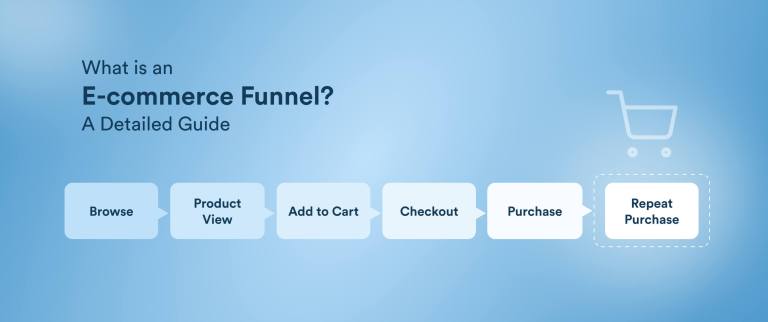
An e-commerce funnel is a behavioral system that maps how intent unfolds across the shopper journey. It is not a schematic or sequence of landing pages. Unlike generic purchase funnels that simplify customer progression into fixed stages, e-commerce funnels are grounded in actual user actions, such as viewing, comparing, carting, checking out, and returning post-purchase. Each of these actions reflects shifting levels of intent, and the funnel exists to make those shifts observable and optimizable.
What sets the e-commerce purchase funnel apart is its measurability. It ties funnel stages to event-level data, making it operationally relevant across marketing, product, and CRM teams. When configured correctly, it becomes the diagnostic layer for identifying where intent decays and where engagement efforts should be concentrated.

Why do e-commerce conversion funnels matter?
A well-instrumented e-commerce funnel enables:
- Conversion optimization by tying behavior directly to revenue outcomes, not just channel performance.
- Friction diagnosis by isolating drop-offs and understanding abandonment triggers, such as high cart adds but low checkout starts.
- Retention strategy by identifying what brings buyers back, whether through replenishment, re-engagement, or loyalty workflows
Unlike generic marketing funnels, which are often abstract and detached from real user interaction, the e-commerce funnel is built on event-level data. It captures specific actions users take onsite or in-app, such as viewing a product, applying a filter, starting checkout, or completing a transaction. This makes it measurable and segmentable across behaviors, cohorts, and devices.
It is also lifecycle-aware, extending well past purchase to include reactivation, replenishment, and loyalty behaviors, areas where long-term revenue and profitability are often concentrated.
Funnel visibility directly impacts growth decisions. Without it, teams default to top-line metrics like overall conversion rate, which often obscure underlying performance gaps. With transparency and visibility, marketers can optimize for progression, recover stalled intent, personalize engagement at the right stage, and build systems that compound user value over time.
You might like to read: How to Use AI for E-commerce Marketing
Stages of the E-commerce Funnel
E-commerce funnels are systems that reflect evolving user intent across interactions. Each stage corresponds to specific behaviors, decisions, and friction points that impact progression or drop-off. Understanding these stages through the lens of user action and not static models enables more accurate diagnosis and targeted optimization.
In this section, we describe these from top to bottom, aligning them with real user actions on the site or app.

1. Awareness and Discovery
At the top of the funnel, shoppers are first hearing about your brand or products. It may be through ads, search results, social media, or word-of-mouth. Each channel carries a different level of buyer intent. Visitors at this stage often land on a homepage or category page without clear purchasing momentum.
Key behaviors include bounce rates, entry page engagement, and scroll depth. While traffic acquisition is typically seen as a marketing function, its quality dictates how many users meaningfully enter the funnel. A mismatch between channel promise and landing experience, such as broad keyword targeting or generic ad creative, can often result in quick exits.
What matters at this stage is intent alignment. Teams should optimize for qualified discovery via audience segmentation, message-match between ad and landing experience, and upfront clarity on product value. Poor performance here does not necessarily indicate a traffic-related issue; it’s usually a positioning or targeting problem. Awareness-stage optimization starts with ensuring you’re earning attention from the right audience instead of a large one.
2. Product Exploration
Once a visitor lands on the site, they begin navigating through product categories, search filters, or personalized recommendations. This is the stage where passive interest evolves into active evaluation. Shoppers are browsing and assessing whether your offering fits their needs, budget, and expectations.
Behaviorally, this phase includes actions like clicking into product detail pages (PDPs), using filters, zooming in on product images, reading reviews, or comparing variants. These are intent signals as well as potential drop-off points. If product discovery feels overwhelming or if critical information is hard to access, users are likely to exit before taking the next step.
The product exploration stage often experiences drop-offs due to subtle user experience (UX) issues or content mismatches. Missing filters, poor image quality, vague descriptions, or slow page loads can all contribute to friction. Addressing these calls for decision support. That means designing PDPs that answer common questions, showcase differentiation, and build trust without requiring extra effort from the user.
This stage persuades the user and also provides resources to reduce uncertainty. When the exploration experience aligns with shopper expectations, it accelerates intent and increases the likelihood of progression into cart and checkout behavior.
3. Add to Cart and Intent Formation
Adding a product to the cart is a clear signal of intent. However, it’s only the midpoint of the decision journey and not the finish line. At this stage, users have moved from consideration to tentative commitment. They’ve seen enough to express interest but still hold back on final action. This behavioral shift is valuable but precarious.
What happens next often determines whether intent converts or decays. Users might adjust quantities, continue browsing, or leave the cart open across multiple sessions. Many use carts as placeholders while comparing products, checking shipping costs, or waiting for discounts. These behaviors reflect hesitation, not abandonment, and are essential to be interpreted in context.
This stage commonly sees high drop-off due to gaps in transparency or convenience. This can be in the form of hidden costs, limited delivery information, or friction in saving the cart across devices. Displaying total costs early, offering a seamless checkout process, and clearly communicating policies can help sustain momentum.
Smart re-engagement also begins here. Behavioral triggers, like a cart left idle for 15 minutes, can power reminders that recover intent while it’s still warm. Treating the cart as a strategic engagement point helps convert hesitation into progress.
4. Checkout and Purchase
Checkout is the most operationally sensitive point in the e-commerce conversion funnel. Users at this stage have strong intent, as they’ve selected products, reviewed their cart, and are ready to transact. But this is also where minor issues can create disproportionate fallout. Every extra click, delay, or unexpected cost becomes a potential exit trigger.
Behaviorally, users move through steps like entering shipping details, selecting payment methods, and reviewing totals. User drop-offs here typically reflect one of two things: friction or doubt. Friction arises from design flaws, such as long forms, account creation walls, or limited payment options. Doubt surfaces when trust is not reinforced. This can be through unclear return policies, missing security signals, or last-minute fees.
Optimizing checkout can be done by reducing resistance without compromising compliance or clarity. Streamlined flows, flexible payment options, and upfront cost breakdowns all contribute to a smoother path to conversion. This is also the stage where mobile experience matters most. A desktop-optimized checkout may fail users on smaller screens.
Teams that monitor this step in granular detail, by device, geography, or average order value, can pinpoint bottlenecks quickly. Users aren’t comparing in this stage; they’re deciding. Execution quality here directly correlates with revenue performance.
5. Post-Purchase and Repeat Buying
The e-commerce conversion funnel does not end with the purchase. It is a critical handoff point. What happens after the transaction shapes retention, repeat behavior, and long-term customer value. Yet many funnels stop tracking at conversion, missing a major opportunity to influence the next cycle of engagement.
Post-purchase behavior includes order tracking, delivery experience, product usage, and the first interaction with follow-up messaging. It also includes silent signals, such as how long until a user returns, whether they explore related products, or if they disengage altogether. This is where lifecycle momentum is either built or lost.
Repeat purchase behavior is rarely accidental. It’s driven by timing, relevance, and trust. Brands that automate personalized follow-ups with reminders, product education, and loyalty incentives create meaningful touchpoints that encourage the next transaction. These are extensions of the user experience.
Funnel maturity means treating retention as a continuation of conversion. Teams should operationalize post-purchase journeys based on product type, customer profile, and behavioral cues, instead of relying on one-size-fits-all campaigns. The most efficient revenue growth often comes from the customers you’ve already acquired, and if the funnel doesn’t end at checkout, neither should your strategy.
Related reads: E-Commerce Marketing Automation Strategies & How to Get Started
Real-World Ecommerce Funnel Examples
Funnel-stage interventions, when guided by behavioral signals, help marketers resolve friction and influence conversion across different points in the journey. Below are two clear examples:
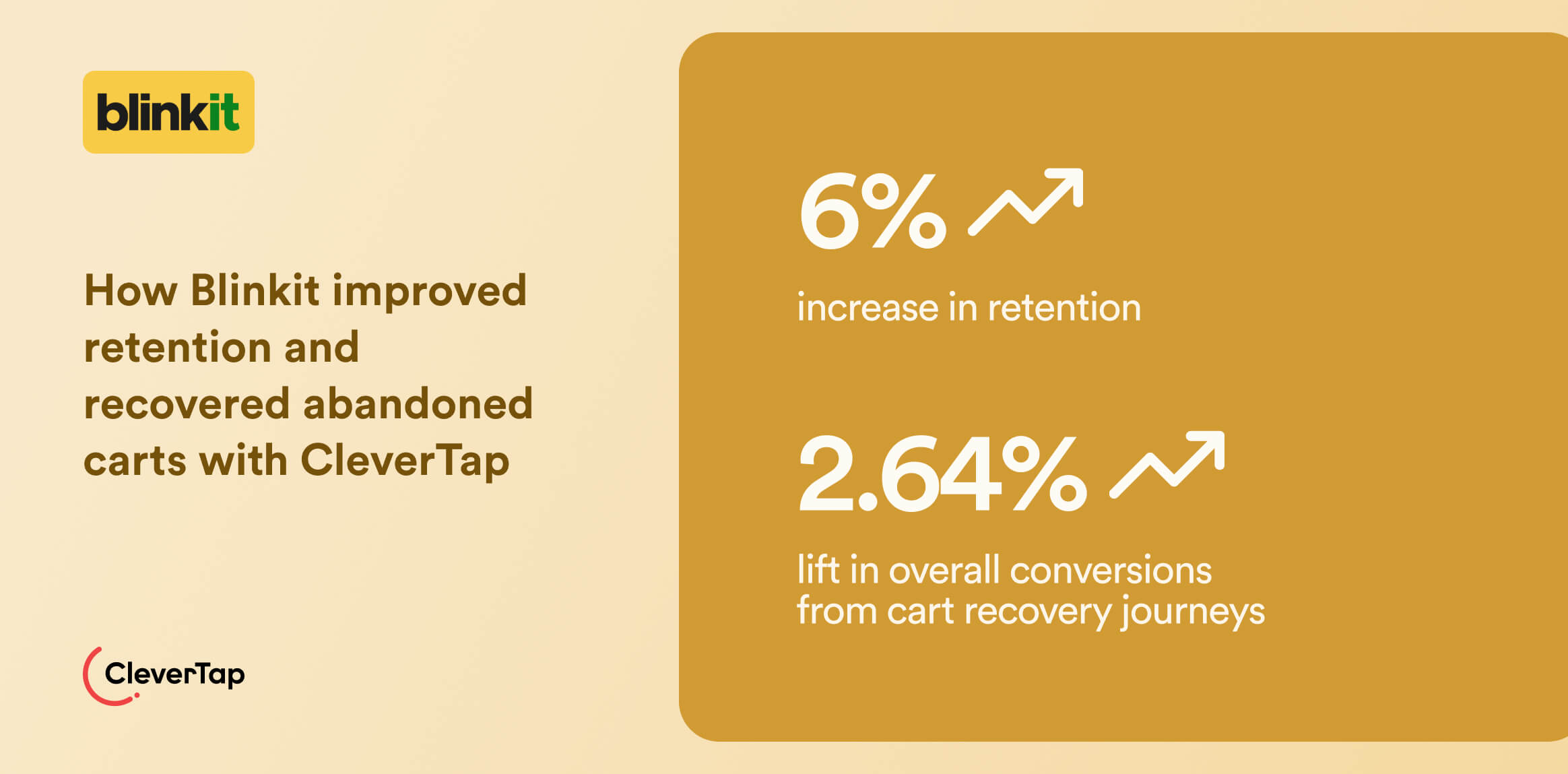
Example 1: Post-Purchase and Repeat Buying Optimization by Blinkit
The team observed low reorder rates and drop-offs after the first purchase. By analyzing transaction frequency, order value, and product affinity, Blinkit used CleverTap to segment users and trigger campaigns tied to reordering cycles and brand preferences. Real-time journeys were also used to recover abandoned carts. Retention rate improved by 6%, and cart abandonment journeys led to a 2.64% lift in overall conversions.
This example demonstrates how lifecycle segmentation and real-time funnel triggers improve retention when aligned with observed customer behavior.
Example 2: Product Exploration and Intent Formation by Flyrobe
Users arriving from Facebook campaigns were actively browsing and searching, with some adding items to their cart but not completing purchases. By segmenting these behaviors, such as viewing the same item multiple times or adding to cart, Flyrobe used CleverTap to retarget users with personalized product-specific messages. Conversions improved, and cost per transaction dropped 10x, driven by precise behavioral targeting.
This illustrates how customer segmentation based on search depth, product views, and cart adds increases ROI from paid traffic and re-engagement campaigns.

Key Metrics to Track Across the E-commerce Funnel
Different stages of the e-commerce marketing funnel demand different key performance indicators (KPIs). A one-size-fits-all metric like overall conversion rate often hides exactly where customers are dropping off.
Here’s a breakdown of different metrics you can track across the conversion funnel stages:
Awareness: Track traffic volume by channel, ad click-through rate (CTR), bounce rate on landing pages, and ad spend efficiency. These show if you’re attracting the right visitors.
Consideration: Measure product page views, time on site, search usage, and the add-to-cart rate. These gauge how compelling your product browsing experience is.
Conversion (Checkout): Monitor cart abandonment rate, checkout completion rate, and average order value. These pinpoint how well intent translates to sales and how much each order is worth.
Retention: Measure repeat purchase rate, customer lifetime value, net promoter score (NPS), satisfaction, and email open or click rates. These indicate how well you keep customers coming back.
Segment your metrics for deeper insight. For example, track these KPIs separately for new vs. returning customers, or by device type. Using CleverTap, you can compare funnels for different user segments, e.g., first-time vs. repeat shoppers, to reveal behaviors.
Always analyze these KPIs by segments or cohorts, such as high spenders vs. occasional browsers, to find deeper insights. This way, average metrics don’t hide underlying issues, and you can target improvements more precisely.
How Marketers Analyze E-commerce Funnels in Practice
E-commerce funnels are built from actual user interactions tracked as events. Each step, such as a product view, add to cart, or checkout initiation, reflects a change in intent. By capturing these behaviors, marketers can define funnels that map how users progress, where they stall, and what drives conversions.
The analysis starts with a clear funnel definition. Teams identify the key user paths that represent meaningful progression toward purchase or retention. Each step in that path must be instrumented with consistent event tracking so it can be measured reliably.
Crucially, funnel analysis must be segmented. Overall completion rates often obscure actionable insights. New users may behave very differently from returning buyers. Mobile visitors may show distinct drop-off patterns compared to desktop users. Segmenting by acquisition source, geography, or purchase history reveals performance gaps and opportunities.

Workflows can typically look like:
- Define Funnels: Identify critical user paths, e.g., viewing a product, adding it to cart, completing checkout.
- Collect Data: Use software development kits (SDKs) or tracking pixels to capture each event and relevant user properties in your analytics tool.
- Monitor Metrics: Set up dashboards or alerts to track conversion rates and drop-offs at each stage of the funnel.
- Analyze Segments: Break out funnels by cohorts, such as channel, geography, new vs. returning, etc., to see which groups convert best.
- Iterate and Test: Form hypotheses about friction, run experiments like redesigning a form or offering a discount, and re-measure to see the impact.
By cycling through this process, teams continuously improve the funnel. Each detected drop-off becomes a hypothesis to test, and data-driven insights guide targeted fixes.
Common E-commerce Funnel Drop-Offs and Why They Happen
Funnel drop-offs are indicators of friction that can quietly erode revenue if left unaddressed. Even well-optimized e-commerce funnels experience losses at key moments. Understanding where and why these drop-offs occur is essential for building targeted interventions that preserve user intent.

Here are the most common points of funnel abandonment and what typically causes them:
- Product page friction: Shoppers often leave if the product page does not immediately confirm relevance. This includes unclear messaging, missing product details, poor imagery, or a lack of trust signals such as reviews or guarantees. If the page fails to resolve questions or match the user’s expectation, the session ends early.
- Cart abandonment: Many times, users add items to their cart but never complete the purchase. This is often due to unexpected costs like shipping fees or taxes, mandatory account creation, or a confusing cart layout. If the experience feels effortful or opaque, users exit.
- Checkout friction: Users with high intent may still drop off during checkout due to technical or trust-related issues. These include limited payment options, form errors, long loading times, or missing security indicators. Even a minor glitch at this stage can result in a lost sale.
- Post-purchase disengagement: The customer journey does not end with a transaction. When there is no follow-up, such as a thank-you message, onboarding content, or replenishment reminder, buyers are less likely to return. Failing to engage after the sale leads to missed opportunities for repeat purchases.
Also read: 15 Powerful Use Cases & Examples of AI in E-commerce Marketing.
E-commerce Funnel vs Marketing Funnel vs Conversion Funnel
These three funnel terms are often used interchangeably, but they serve distinct purposes across different teams. Understanding the differences helps avoid misalignment in goals, measurement, and ownership.
| Funnel Type | Owner | Use Case |
| Marketing Funnel | Marketing and acquisition teams | Build awareness, generate traffic, capture leads |
| E-commerce Funnel | E-commerce, product, and growth teams | Convert traffic into purchases, drive repeat buying |
| Conversion Funnel | Shared: depends on the goal | Track user progression toward a defined action (e.g., purchase, signup) |
Marketing funnel: Designed to attract and nurture interest. Owned by marketing teams, a marketing funnel spans channels like paid media, content, and email. Its goal is to generate qualified traffic and early-stage engagement, such as visits, signups, or ad clicks.
E-commerce funnel: Owned by e-commerce, product, or CRM teams, this funnel starts once users land on-site or in-app. It maps behaviors like browsing, adding to cart, checking out, and re-engaging post-purchase. The focus here is conversion, retention, and revenue generation.
Conversion funnel: A flexible term used to describe the steps toward a specific outcome. A conversion funnel could be owned by any team, depending on the goal, which can be sales, marketing, product, or ecommerce. It is useful for analyzing drop-offs within a defined flow.

Confusion often arises when teams use these terms without aligning on scope. For example, marketing may report funnel success based on lead volume, while product teams track cart-to-checkout progression. Clear funnel definitions and shared ownership models reduce misalignment and ensure decisions are driven by the right data.
How CleverTap Helps Optimize the E-commerce Funnel
Once your e-commerce funnel is clearly defined, the next step is operationalizing it. CleverTap is a customer engagement and analytics platform that enables e-commerce teams to unify event-based funnel tracking, behavioral segmentation, and lifecycle orchestration in one system. This ensures that stage-level insights do not remain static reports but become measurable interventions across the funnel.

Stage-Level Funnel Tracking Built on Real Behavior
CleverTap allows teams to build funnels using actual user events such as product views, search usage, add-to-cart actions, checkout initiation, and completed purchases. Because each stage is grounded in tracked behavior rather than page assumptions, progression can be measured with precision.
Funnels can be broken down by cohort and compared side-by-side. Teams can analyze:
- Mobile versus desktop checkout completion
- Paid versus organic traffic progression
- First-time versus returning shopper behavior
- High-value versus occasional buyer conversion patterns
This stage-level visibility moves teams beyond overall conversion rate and into granular diagnosis of where and why intent decays.
Turning Drop-Offs into Dynamic Segments
Once friction points are identified, CleverTap enables dynamic behavioral segmentation. Teams can create real-time segments of users who:
- Repeatedly browse without adding to cart
- Add to cart but do not initiate checkout within a defined time window
- Initiate checkout but fail to complete purchase
- Complete a first purchase but do not return within a retention window
These segments update automatically as behavior changes, ensuring that recovery efforts are timely and relevant.
Real-Time Journey Triggers Across the Funnel
Behavioral signals within the funnel can trigger automated journeys immediately.
Cart abandonment events can activate reminders within minutes. Browse abandonment flows can highlight previously viewed products before interest fades. Post-purchase journeys can deliver onboarding guidance, replenishment prompts, cross-sell recommendations, or loyalty incentives based on product category and purchase behavior.
Because journeys operate across push notifications, email, SMS, in-app, web push, and WhatsApp, engagement aligns with both funnel stage and channel preference. The result is stage-aware communication rather than generic batch messaging.
Conversion Velocity and Optimization
Beyond identifying drop-offs, CleverTap enables teams to analyze conversion velocity, how long different segments take to move between funnel stages. If mobile users take longer to progress from cart to checkout, UX friction may be the issue. If returning buyers convert quickly, intervention windows can be shortened.
Teams can also run A/B tests on messaging sequences, checkout interventions, and timing strategies, measuring their impact directly against funnel progression metrics. This ensures optimization efforts are tied to measurable lift rather than isolated campaign performance.
Extending the Funnel into Retention
The e-commerce funnel does not end at purchase. CleverTap supports lifecycle automation that extends funnel logic into retention and repeat buying. Automated onboarding flows, replenishment campaigns, loyalty engagement, and win-back sequences are triggered by behavioral milestones and product usage patterns.
By unifying funnel analytics with real-time activation and measurement, CleverTap transforms funnel optimization from periodic analysis into continuous growth execution.
Try CleverTap to turn e-commerce funnel insights into higher conversions and repeat purchases.
Rethinking Funnels as Growth Systems
E-commerce funnels no longer follow a linear path. They are dynamic systems shaped by real user behavior. By measuring what customers actually do at each stage and responding with timely, personalized actions, teams can continuously refine the journey.
Funnels are most valuable when treated not as static diagrams but as engines of engagement and insight. From product discovery to post-purchase, every drop-off is an opportunity to optimize. With the right behavioral data and lifecycle tools, marketers can move beyond intuition and build systems that convert, retain, and scale. Funnel-led growth works when teams fuel momentum, stage by stage.
The real advantage comes from acting on behavioral signals as they happen. When insight and engagement work together, funnel optimization becomes continuous rather than reactive. Schedule a demo to see how CleverTap helps e-commerce teams put this approach into practice.

Agnishwar Banerjee 
Leads content and digital marketing.Expert in SaaS sales, marketing and GTM strategies.
Free Customer Engagement Guides
Join our newsletter for actionable tips and proven strategies to grow your business and engage your customers.