





















Table of Contents
Categories
Most Popular


Personalization is the gap between targeted, customer-centric marketing and a generic strategy that appears to work for everyone, but doesn’t. When marketing pushes for personalization, it generally faces the foundational question: “How to achieve it?” This is where the marketing stack does the talking, and personalization tools come into the picture.
The choice of the best personalization tools depends on several factors, such as use case, market segment, customer base, or simply budget. With several options on the market, finding the perfect one isn’t easy or quick, especially when you’re looking to onboard only the best personalization tool.
In this article, we’ll cover the 15 best personalization tools to give you options to choose from.
The 15 Best Personalization Tools in Marketing
Before we explore the top personalization tools, it’s essential to distinguish between a personalization tool and a platform. Tools are generally point solutions that personalize a channel or a moment in a customer’s journey.
They rely on rules and static segments. They work as point solutions, but break at scale. Instead, a personalization platform unifies customer data, decisioning, and orchestration across channels. A personalization platform wouldn’t ask you to define a rule for a specific scenario, but would use AI to find the next best action for each user.
The difference is practical, not semantic:
- Tools optimize individual campaigns
- Platforms optimize the entire customer lifecycle
You decide if you need only a personalization tool or the complete platform. This choice will help you realize what you actually want from the technology.
Enterprise Omnichannel Personalization Platforms
Using behavioral data in real time, these platforms execute decisions instantly across channels. They’re a valuable addition to the tech stacks of small and large B2C brands, personalizing CX across channels from a unified profile.
1. CleverTap: Best Overall Personalization Platform
CleverTap is a comprehensive personalization platform designed to help businesses deliver relevant experiences across mobile apps, websites, and messaging channels. Instead of relying only on static customer attributes, CleverTap uses real-time behavioral data, such as events, profile properties, and past interactions, to personalize user experiences at scale.
Every user interaction (such as product views, purchases, clicks, or in-app actions) feeds into a unified user profile. This allows marketers and product teams to trigger contextual messages, dynamic recommendations, and personalized experiences at the highest point of user intent.
CleverTap also integrates predictive analytics through CleverAI™, which analyzes behavioral patterns to identify signals like churn risk, conversion likelihood, and lifetime value. These insights allow brands to automatically tailor campaigns, journeys, and offers to each user segment without relying on manual rules alone.
Compared with traditional enterprise personalization suites that often require complex integrations, CleverTap is designed for faster implementation and quicker time-to-value, making it especially effective for mobile-first and digital-first brands.
Below are some of the key capabilities that make CleverTap a powerful personalization tool:
- Event-driven personalization: Trigger campaigns and journeys based on real-time user actions such as app opens, product views, or purchases. Event and profile data can dynamically personalize content across messages and experiences.
- AI-powered predictions (CleverAI™): Use built-in predictive models to identify churn risk, user intent, and high-value users, allowing marketers to automatically personalize campaigns and engagement strategies.
- Dynamic recommendations and catalog personalization: Deliver personalized product or content recommendations using catalogs and behavioral affinity data to display items most relevant to each user.
- Web and app personalization: Customize website or in-app experiences dynamically using user attributes, behavioral data, and event triggers. Visual editing tools enable marketers to modify content elements, such as text or images, without significant development effort.
- Unified user profiles and behavioral data: All user interactions, events, and attributes are stored in a centralized profile, enabling consistent personalization across channels and campaigns.
These capabilities make CleverTap particularly well suited for growth-focused digital brands, mobile-first companies, and businesses running omnichannel engagement strategies. If your goal is to combine real-time behavioral insights, predictive AI, and cross-channel messaging in a single platform, CleverTap provides a scalable and practical personalization solution.
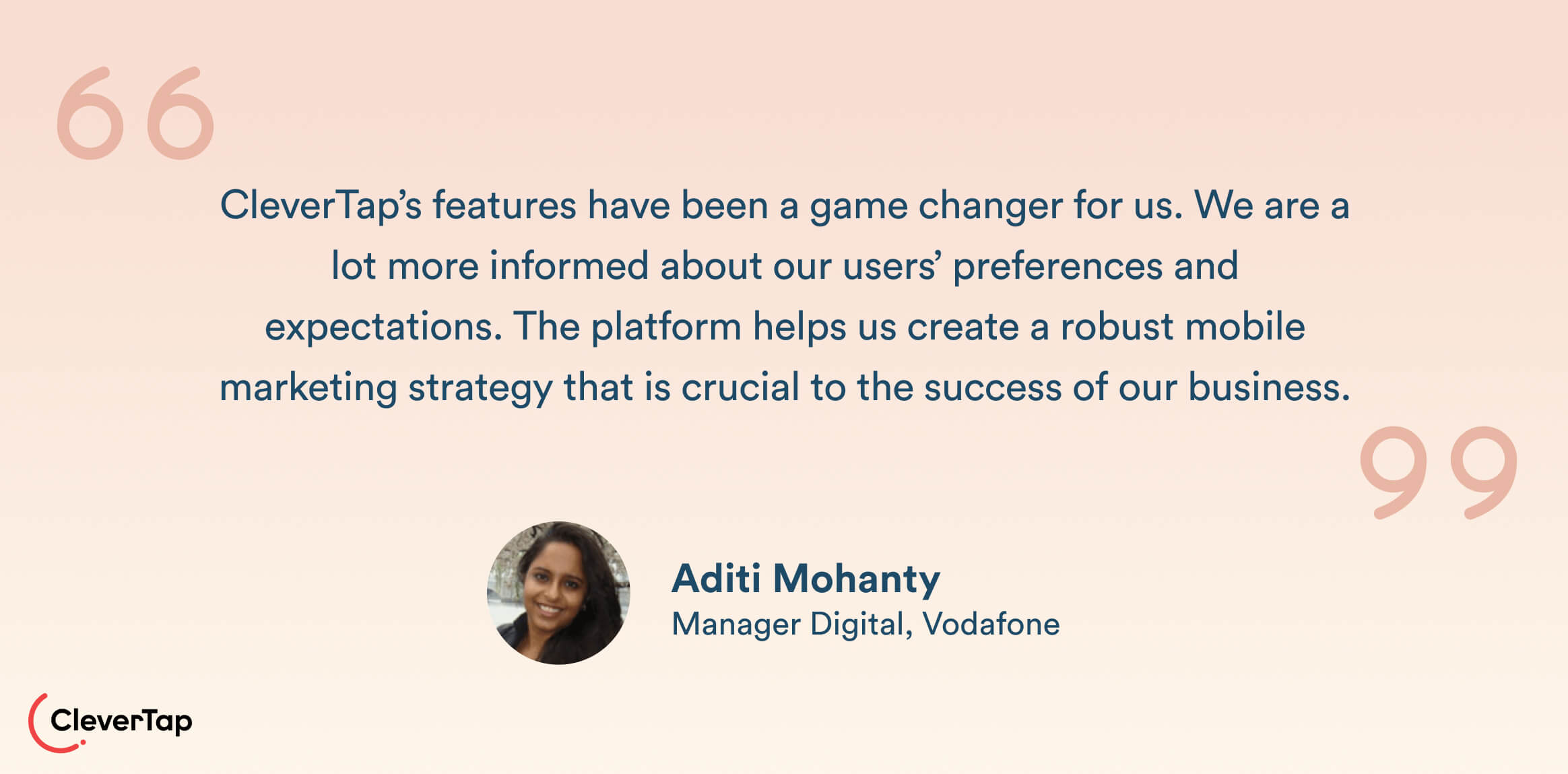
Take Vodafone, for example. After integrating with CleverTap, Vodafone achieved a 23.7% higher CTR in re-engagement campaigns. The platform identified when and how to message users based on real usage data rather than generic blasts.
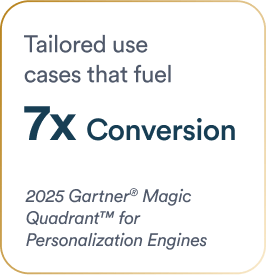
Discover why CleverTap is a Leader in the 2026 Gartner® Magic Quadrant™ for Personalization Engines. Get the full report.
2. Braze
Braze is a customer engagement and marketing automation platform built for teams that want real-time, cross-channel personalization and lifecycle orchestration at scale.
Below are some key strengths of Braze.
- Intuitive interface and drag-and-drop journey builder speed campaign setup.
- Strong segmentation and audience filters for targeted messaging.
- Solid customer support and onboarding resources.
- Visual Canvas view makes journey planning easier.
3. Insider One
Insider is built for marketers who want enterprise-grade personalization across web, app, email, and messaging. On review websites, it has a decent score in ease of use and setup compared to other peers.
Below are some of its key strengths.
- Cross-channel personalization and journey orchestration.
- Quick implementation and intuitive UI.
- Support for targeted merchandising and engagement
4. MoEngage
MoEngage blends user analytics, segmentation, and lifecycle campaigns to help teams create personalized messages based on real behaviour. It’s a practical choice for timely communication with strong tracking.
Professionals appreciate its key strengths, including:
- User-friendly interface and segmentation.
- Reliable event tracking and analytics.
- Responsive support and helpful onboarding.
- Support for multi-touch campaigns across channels.
5. WebEngage
WebEngage blends user analytics with real-time targeting and flexible engagement across web, email, push, and in-app. Marketers appreciate its contextual web interactions and behavioral targeting.
The key strengths include:
- Granular segmentation
- Real-time personalization on web and mobile.
- Built-in analytics for campaign performance.
- Ease of integration into existing stacks.
Enterprise Marketing Clouds and Experience Suites
These personalization tools work effectively inside broader enterprise stacks, but they often depend on upstream data platforms. They’re a suitable fit where an enterprise has already invested in a large ecosystem and is willing to trade speed for breadth.
6. Salesforce Marketing Cloud
Salesforce Marketing Cloud is a full-featured engagement suite built to run data-backed, multi-touch personalization at enterprise scale. It integrates deeply with Salesforce’s CRM, enabling teams to build journeys that reflect real customer behavior across email, web, SMS, social, and more.
For features, it has:
- Strong multi-channel campaign automation and journey building.
- Deep segmentation using CRM data for tailored messaging.
- Tight integration with the Salesforce ecosystem powers unified experiences.
- High personalization scores in user behavior and contextual targeting.
7. Adobe Target
Adobe Target optimizes digital experiences through experiments and targeted variations. It works as part of the Adobe Experience Cloud for teams focused on improving conversion and engagement onsite.
It’s well-known for its:
- Robust A/B and multivariate testing.
- Solid segmentation and audience targeting.
- Integrates well with broader Adobe analytics and data.
- Supports personalized content delivery based on user profiles.
Lifecycle and Cross-Channel Automation Personalization Tools
These personalization tools focus on campaign logic and orchestration. Here, the personalization is largely defined by marketer-defined rules rather than real-time decision engines. It’s best for SaaS and digital businesses that need strong lifecycle orchestration.
8. Iterable
Iterable allows teams to build lifecycle campaigns across email, SMS, push, and in-app messaging with strong personalization logic. User actions guide this logic, making it a platform that automates campaigns flexibly.
Users appreciate Iterable’s:
- Easy-to-use workflow builder for lifecycle journeys.
- Real-time data updates for timely triggers.
- Clear segmentation and audience creation.
- Reporting and campaign analytics.
9. Netcore Cloud
Netcore Cloud personalizes customer experience with AI-driven recommendations and a flexible campaign builder, supporting business-critical journeys. It allows easy setup of triggered campaigns and provides decent support for lifecycle automation.
You get support beyond basic channels to cover journeys that span WhatsApp and other instant messaging platforms.
CRM and Personalization Tools
These tools prioritize SKU-level personalization, recommendations, and revenue attribution over deep behavioral intelligence. It’s a suitable tool for retail and DTC brands, optimizing the purchase journey and product-led messaging.
10. Klaviyo
Klaviyo is widely used by retail brands for email and SMS personalization tied directly to purchasing behaviour and product data. It integrates deeply with platforms like Shopify and Magento, making it easy for marketers to connect user actions to messaging triggers.
Below are some of the key strengths of Klaviyo.
- Native e-commerce integrations with revenue tracking.
- Strong segmentation based on purchase and browsing behaviour.
- Easy-to-use campaign workflows.
- Good analytics tied to ROI.
11. Omnisend
Omnisend focuses on email, SMS, and messaging for e-commerce teams. It provides straightforward automation, such as cart recovery, order updates, and loyalty triggers, paired with product recommendations.
It delivers a simple setup for e-commerce automations with built-in templates and workflows. For small teams, it’s quite affordable. However, it might offer lesser depth compared to advanced personalization tools.
12. Bloomreach
Bloomreach brings search, merchandising, and personalization together on a single platform for e-commerce teams. Brands use it to show more relevant products and guide customers through better shopping journeys, driving higher conversions.
It’s well-known for:
- Strong search and product discovery tools.
- Customer-centric personalization tied to buying signals.
- Good support for commerce growth initiatives.
13. Nosto
Nosto is built specifically for e-commerce personalization. It helps online stores show relevant product recommendations, change on-site content, and target shoppers based on what they browse and buy.
Teams often choose Nosto when they want personalization that works out of the box, without heavy technical setup. Here are its key strengths:
- Easy to connect with popular e-commerce platforms like Shopify and Magento.
- Strong product recommendations and on-site widgets that support discovery and conversion.
- Effective cross-sell and upsell tools across the shopping journey.
Search, Discovery, and Recommendation Engines
These platforms specialize in decision-making around what to show, not when or how to message across channels. These tools fit in organizations where personalization starts with search relevance and content/product discovery.
14. Coveo
Coveo sits at the intersection of search, recommendations, and relevance. It’s not a full lifecycle marketing tool. Instead, it personalizes what users see when they search or browse, using intent signals and past behavior.
Coveo’s key strengths are:
- Strong AI-powered search and relevance tuning across product, content, and support portals.
- Personalized results based on intent and context, not just keywords.
- Well-suited for large catalogs and complex content structures.
15. Dynamic Yield
Dynamic Yield focuses on personalizing on-site and in-app experiences, with a strong emphasis on testing and recommendations.
It has the following features:
- Strong product and content recommendations for web and app experiences.
- Built-in A/B testing and experience optimization.
- Good fit for personalization tied to browsing behavior and affinity.
How to Choose the Right Personalization Tools
Choosing the right personalization tool comes down to how well it fits your current reality and how much friction it will add tomorrow. Use the points below as a practical checklist:
- Data readiness and identity resolution: Check whether the platform can unify users across apps, web, and channels into a single profile. Assess how much manual data stitching is required before personalization works.
- Real-time vs. batch personalization: Identify whether your key use cases depend on real-time or scheduled triggers. Look for real-time evaluation and execution based on live user actions. Avoid tools that rely mainly on nightly syncs or delayed updates.
- Channel coverage: List the channels where your customers actually engage, not just email. Ensure personalization logic is shared across channels, not duplicated per channel. Watch out for tools that add channels as add-ons without unified orchestration.
- AI and predictive capabilities: Evaluate whether predictions are built-in or require external models. Avoid platforms where AI is limited to scoring reports but not driving actions.
- Time-to-value and implementation effort: Estimate how long it takes to launch your first real personalized journey. Factor in engineering dependency and onboarding complexity.
- Reporting and attribution: Check if personalization decisions tie directly to business outcomes. Look beyond channel-level metrics to lifecycle impact.
If a platform performs well across most of these points, it’s likely a fit. If it struggles on two or more, personalization will feel harder than it should, and results will follow.
Frequently Asked Questions (FAQs) About Personalization Tools
Q1. What are personalization tools in marketing?
Personalization tools help businesses tailor customer experiences using data such as user behavior, preferences, and past interactions. They enable marketers to deliver relevant content, product recommendations, and messages across channels like websites, apps, email, and push notifications.
Q2. What is the difference between a personalization tool and a personalization platform?
A personalization tool usually focuses on a single channel or touchpoint, such as website recommendations or email campaigns. A personalization platform unifies customer data and uses AI or automation to personalize experiences across multiple channels throughout the customer lifecycle.
Q3. What features should you look for in a personalization platform?
Key features include unified customer profiles, real-time event tracking, AI-driven predictions, cross-channel messaging, recommendation engines, and advanced segmentation. These capabilities help deliver relevant experiences at scale.
Q4. How do personalization tools improve marketing performance?
Personalization tools increase engagement by delivering relevant messages and experiences. This often leads to higher conversion rates, better customer retention, and improved marketing ROI.
Q5. Which personalization platform is best for real-time marketing?
The best platform depends on your use case, but businesses that rely on behavioral data typically choose solutions with real-time triggers, AI predictions, and omnichannel engagement capabilities, such as CleverTap.
Stand Out In Personalization With CleverTap
Personalization fails long before it shows up in metrics. It fails when teams rely on static segments. It fails when campaigns are planned weeks in advance, while customer behavior changes by the minute. And it fails when tools optimize individual messages but never the full customer journey.
That’s the gap most marketing teams are still stuck in.
CleverTap stands out because it addresses this problem at the root. It doesn’t treat personalization as a set of rules or campaign tweaks. It treats it as a real-time decision problem across the entire lifecycle.
Most personalization tools still ask marketers to predict scenarios in advance: If a user does X, send Y. That approach breaks at scale. Users don’t move in clean funnels. Their intent shifts constantly. CleverTap removes this dependency on guesswork and acts on live behavioral signals.
Where CleverTap goes further is in prediction. Instead of waiting for churn or drop-off to happen, it identifies risk early. Additionally, it delivers a much faster time-to-value by bringing data ingestion, analytics, decisioning, and orchestration into a single platform. You can launch real-time journeys and automate personalization across channels without a deep engineering dependency.
Personalization is no longer about sending the right message. It’s about making the right decision, instantly, for every user.
Learn how CleverTap can help you achieve 1:1 personalization.

Agnishwar Banerjee 
Leads content and digital marketing.Expert in SaaS sales, marketing and GTM strategies.
Free Customer Engagement Guides
Join our newsletter for actionable tips and proven strategies to grow your business and engage your customers.