




























![10 Best AI Personalization Tools in Marketing [Maturity Framework + How to Choose]](https://clevertap.com/wp-content/uploads/2026/03/Best-AI-Personalization-Tools-_header.jpg?w=768)

Table of Contents
Categories
Most Popular


Most marketing still feels broken to customers.
They see emails that ignore what they just did. They get offers for products they already bought. Websites show the same content to first-time visitors and loyal users. This happens because most personalization still runs on static rules and slow segments.
Manual rules do not scale. Customers change intent fast. AI personalization tools fix this gap. Instead of forcing people into buckets, AI adapts to real intent. However, when decision-making is instantaneous, you need a platform you can trust throughout the customer’s journey.
In this article, we’ll look into the top AI personalization tools that several companies already trust for their unique use cases. See what fits yours.
What Are AI Personalization Tools?
AI personalization tools automatically tailor the customer experience based on demographics, behavior, and previous purchases. It ensures each user sees content as per their requirements and relevance.
An AI personalization engine acts like a real-time decision brain plugged into your marketing stack. It decides, for each individual user, which message or product to show, when to send a communication, and which channel to use. To deliver this, the platform uses predictive insights rather than static rules.
Earlier, this was rule-based. But it took a lot of labor to set up different scenarios. No matter how much you configure, customers don’t fit neatly into a segment. AI-driven personalization constantly finds patterns and predicts what a user might actually need. It personalizes accordingly.
There are different types of AI that find usage in personalization platforms, for example:
- Predictive analytics: Algorithms analyze historical data to predict future behavior or outcomes. For example, predictive models score which users are likely to churn, who is likely to purchase in the next 7 days, or what a customer’s lifetime value might be. Marketers use these predictions to target interventions.
- Intent modeling: AI infers customer intent in real time. It analyzes behavioral queues and predicts what a customer wants to achieve. In this way, a personalization platform surfaces a relevant category banner or FAQs.
- Generative AI: Some platforms use AI-driven content creation to tune product/email copy to each segment’s tone or preference. It also extends to visual personalization, enabling the platform to generate on-brand images for different audiences. For instance, CleverAI’s Creative Agents can create brand-aligned, personalized copy in seconds, optimized by insights from top-performing campaigns.
- Real-Time Decision Engines: Real-time engines rely on fast databases and on-device (or edge) models to score user behavior within milliseconds. The benefit is in-session personalization. For example, if a user is scrolling a website and lingers on category A, the AI immediately reorders content or recommends products in that category. Decision Agents in CleverAI™ use real-time data and context to automatically choose the best experience for each customer. They analyze behavior and intent to optimize segments, timing, channels, and recommendations.
However, not every company is ready to deploy self-learning AI on day one. You need to think in terms of an AI personalization maturity framework with levels of sophistication.
Below are more details on this framework that will help you understand what’s best for your use case
Maturity Framework to Deploy AI Personalization Tools
Below are different levels in AI personalization, for example:
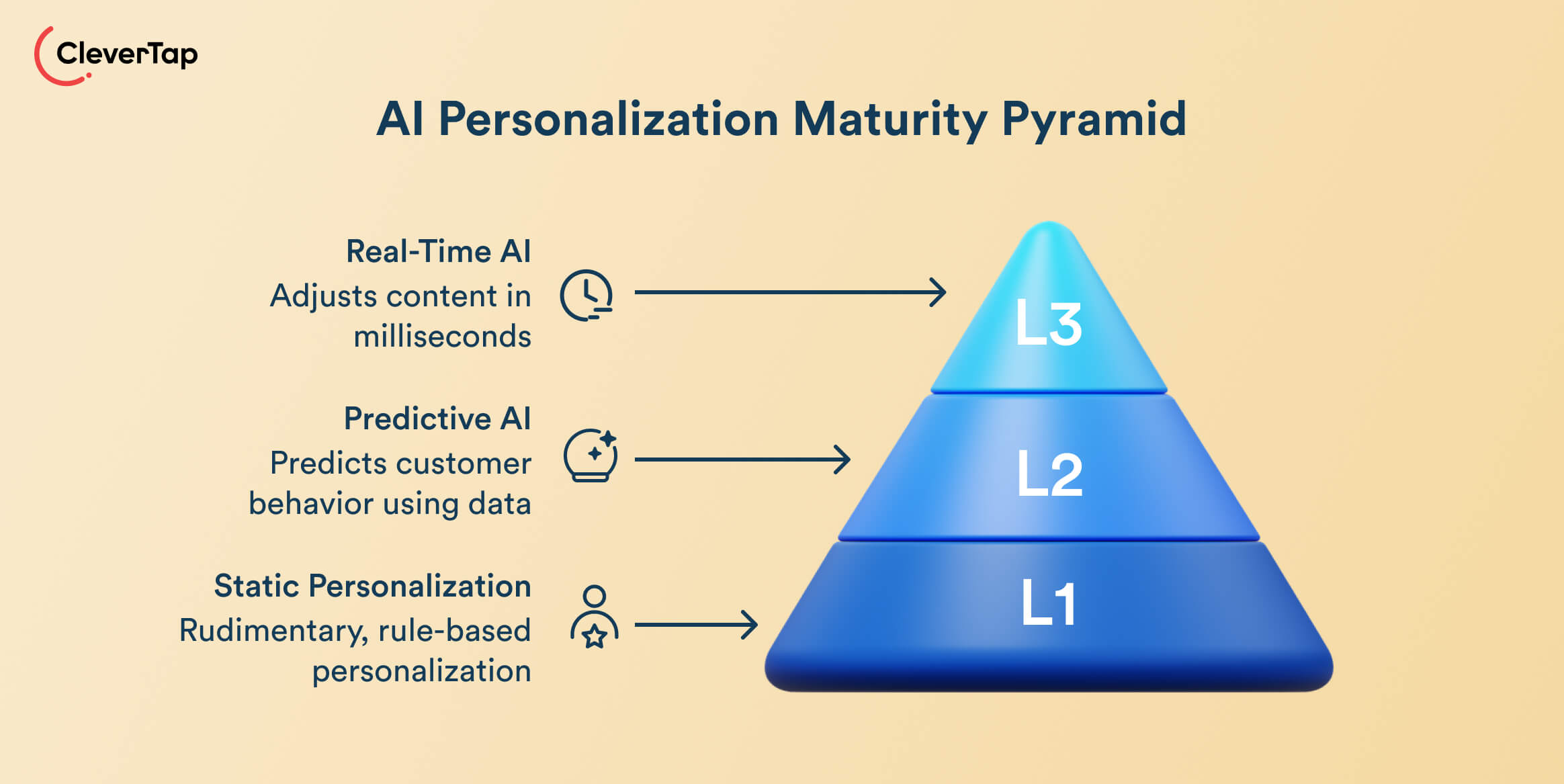
Level 1: Static and Rule-Based Personalization
At Level 1, personalization is present but rudimentary. Brands rely on static segmentation and manual rules on a per-channel basis. The strategy is largely one-size-fits-all across broad groups, and any personal touches are predefined by marketers rather than generated by AI.
The challenge with static personalization is scalability and relevance. Manual rules can’t cover the countless contexts in which a customer might find themselves.
Level 2: Predictive AI Personalization
At this level, the system crunches historical and behavioral data to predict customer propensities or segments. Then, the platform personalizes based on those insights. Data from multiple channels is brought together to fuel the AI models.
Here, personalization is often executed in batches rather than continuously. When users are segmented by conversion likelihood, each segment receives tailored product recommendations that replace generic bestsellers.
The only challenge is that the model requires reliable data to process, and users must trust the AI. Integrating data from different sources might help provide the model with a full context.
Level 3: Real-Time, Self-Learning AI Personalization
At this stage, personalization engines leverage streaming data and an on-the-fly model to adjust content and offers within milliseconds of a user action. Techniques like reinforcement learning improve decisions over time with minimal human input. The system learns for each interaction and gets smarter as more data flows in.
CleverTap operates at Level 3. It combines a fast, unified data layer (TesseractDB™) with AI models to deliver churn likelihood, conversion predictions, and more to support campaign execution. Brands using CleverTap’s AI personalization tools can deliver level 3 personalization from day one with AI-curated experiences that improve automatically over time.
10 Best AI Personalization Tools in Marketing
These are the top 10 AI personalization tools to make your marketing sound more personal:
1. CleverTap: Best AI Personalization Platform
CleverTap is an AI-powered customer engagement platform that combines a built-in customer data platform (CDP), real-time analytics, and omnichannel messaging to deliver personalized experiences across the entire customer lifecycle.
Unlike point solutions that focus on a single stage of the funnel, CleverTap unifies customer data, segmentation, experimentation, and campaign orchestration in one platform. Its proprietary database, TesseractDB, processes billions of behavioral events to maintain real-time customer profiles that power predictive models, segmentation, and personalized journeys.
This architecture allows brands to deliver AI-driven personalization across web, mobile apps, email, push notifications, SMS, and WhatsApp from a single platform.
Key AI Personalization Capabilities
Proprietary Predictive Models
CleverTap includes built-in AI models that predict behaviors such as churn risk, purchase intent, conversion likelihood, optimal channel, and best send time. Because these models are native to the platform, marketing teams can use predictive personalization without needing a data science team.
Real-Time Personalization Engine
CleverTap processes behavioral signals in real time and instantly updates user profiles. This allows brands to trigger contextual messages, recommendations, or journey changes the moment a user performs a high-intent action.
Its IntelliNODE technology continuously experiments with different campaign paths and automatically directs each user to the most effective experience. By testing multiple channels, timing variations, and content combinations, the platform learns which journey delivers the best outcome for each individual user.
CleverAI Agentic Personalization
CleverTap’s CleverAI layer introduces agentic AI designed to assist marketers across campaign creation, insights, and optimization.
The system includes several AI agents:
- Decision Agents determine the best message, channel, and timing based on user behavior.
- Creative Agents generate campaign copy and automate experimentation.
- Action Agents execute and optimize campaigns across channels in real time.
- Strategy Agents surface insights and recommendations through natural-language prompts.
Instead of manually building segments or journeys, marketers can describe a goal in plain language and allow CleverAI to automatically generate and optimize campaigns.
For example, Tata CLiQ, a major Indian e-commerce platform, used CleverTap’s real-time personalization and behavioral segmentation to trigger contextual campaigns based on user browsing activity. These personalized “inaction” campaigns delivered relevant product recommendations when users showed purchase intent but didn’t convert, resulting in a 4X increase in click-through rates (CTR).

Similarly, restaurant reservation platform Eatigo used CleverTap’s AI-powered recommendation engine to personalize restaurant suggestions and re-engagement campaigns. The platform orchestrated over 100 personalized journeys and more than 10 automated campaigns, making users 2X more likely to complete reservations.
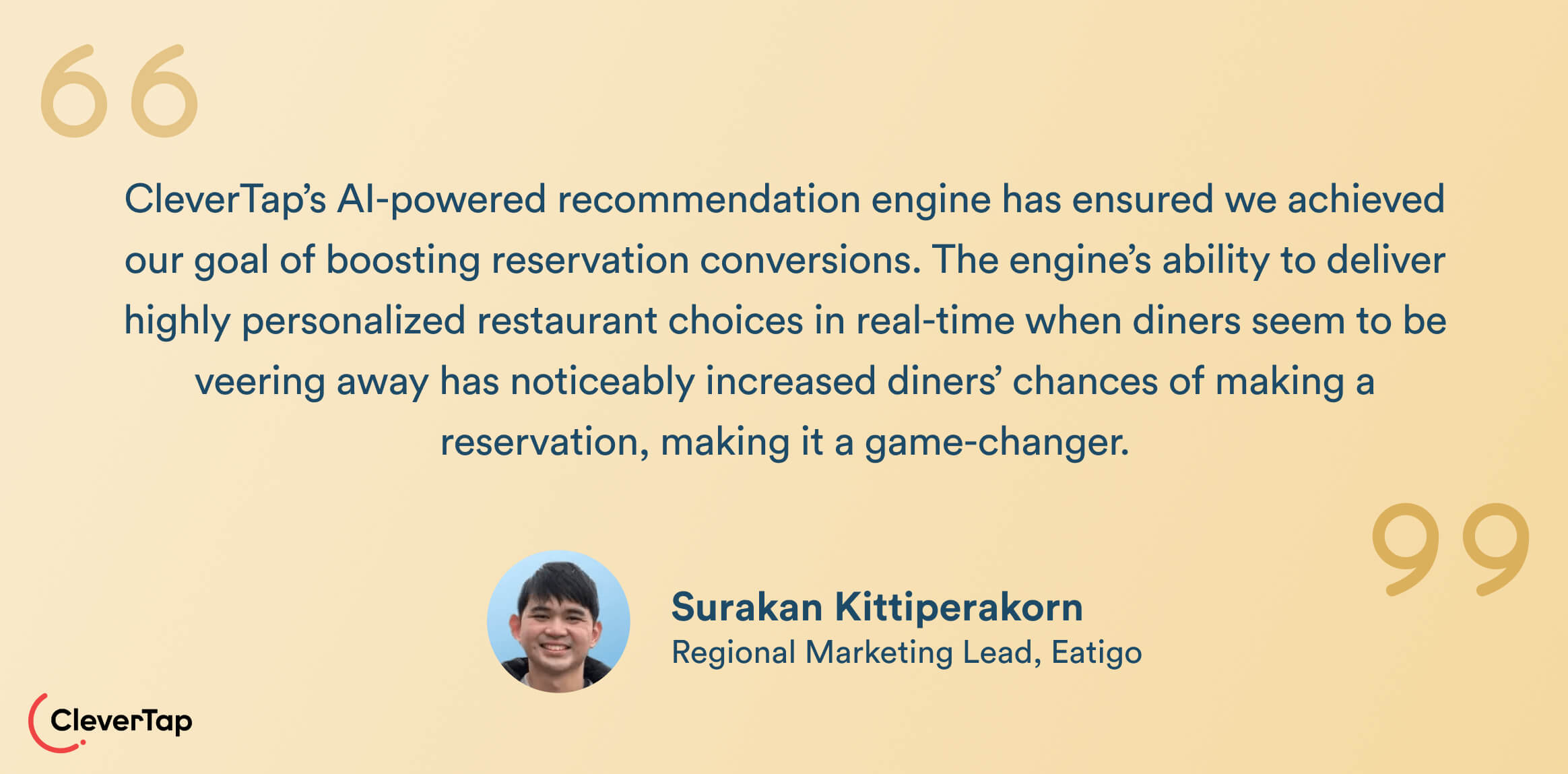
See how Eatigo doubled its conversion rate with CleverTap’s AI recommendations.
Why CleverTap Stands Out in the AI Personalization Tools Category
CleverTap embeds AI directly into its customer engagement platform rather than offering it as an add-on. This allows companies to combine predictive analytics, real-time decisioning, and omnichannel personalization in one system.
Key advantages include:
- Real-time decisioning based on live behavioral signals
- Built-in predictive AI models for lifecycle marketing
- Omnichannel execution across push, email, SMS, web, in-app, and WhatsApp
- Enterprise scalability for millions of users and billions of events
- Strong privacy and compliance controls
By combining unified customer data, predictive AI models, and automated journey orchestration, CleverTap enables brands to deliver true lifecycle personalization on a single AI-driven platform.
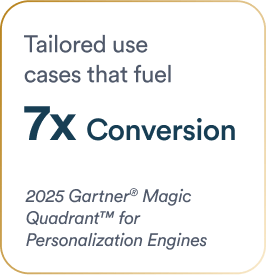
Discover why CleverTap is a Leader in the 2026 Gartner® Magic Quadrant™ for Personalization Engines. Get the full report.
2. Insider One
Insider One personalizes interaction across web, mobile apps, email, SMS, WhatsApp, and other channels. Using its intent-based AI, the platform allows teams to deliver coordinated and individualized experiences at scale.
Below are some key features that make Insider a suitable fit for AI personalization tools.
- Predictive intelligence: Insider analyzes billions of behavioral signals to score user intent and build predictive segments such as likelihood to purchase or churn, enabling differentiated treatment of high- and low-intent users in real time.
- Sirius AI for campaign creation. Sirius AI automates content generation and optimization, including subject lines, creative suggestions, and even end-to-end journey creation using simple text prompts.
- Journey orchestration (Architect). Insider’s drag-and-drop Architect builder supports complex and cross-channel journeys triggered by real-time events.
- Channel breadth and anonymous personalization. Insider supports personalization across web, app, and messaging channels, including real-time personalization for anonymous visitors.
3. Dynamic Yield
Dynamic Yield focuses on AI-driven personalization for web and mobile apps. Now part of Mastercard, it positions itself as an “Experience OS” that uses machine learning to adapt content and layouts in real time. It sees good adoption in e-commerce, finance, and media, where on-site experience directly impacts conversion and revenue.
Below are some key features that make Dynamic Yield a suitable fit in AI personalization tools.
- Real-time behavioral segmentation: Dynamic Yield builds affinity profiles on the fly using live behavioral data and personalizes content blocks and offers instantly.
- Automated testing and optimization. Built-in A/B and multivariate testing is paired with Auto Optimize. It uses machine learning to continuously serve the best-performing variation to each user.
- Omnichannel personalization layer. Dynamic Yield extends personalization logic to mobile apps and email, working as a flexible layer that integrates into existing CMS and commerce stacks.
4. Adobe Target
Adobe Target is the personalization and testing solution within Adobe Experience Cloud. It’s an enterprise-grade platform used by many large brands. It’s well-suited for companies already in the Adobe ecosystem, as it integrates seamlessly. It can also be used standalone for personalization across web and mobile.
Below are some of the key features of Adobe Target.
- Auto-Target: With Auto-Target, you can set up multiple experience variations, and the system will use machine learning to serve the best variation to each visitor. It’s based on behavioral and contextual data. Over time, it optimizes who sees what, essentially personalizing content or layout for each user to maximize conversions.
- Real-time data and segmentation: Adobe Target leverages real-time customer data from Adobe’s Real-Time CDP and Analytics. It supports both AI-driven personalization and manual targeting rules.
- Product recommendations: Adobe Target has a recommendations engine powered by Adobe Sensei, which can be used to display personalized product or content recommendations on web pages or in emails.
- Visual experience composer and testing: It lets non-technical users create and modify page variations visually (via a WYSIWYG interface). This makes setting up A/B tests or personalized experiences relatively easy without coding.
5. Salesforce Einstein
Salesforce Einstein refers to the broad set of AI features embedded across Salesforce’s CRM and marketing platforms. In the context of personalization and marketing, Einstein powers several tools in Salesforce Marketing Cloud and Commerce Cloud to individualize customer interactions.
If you’re not on Salesforce, Einstein by itself isn’t an outside tool you can plug in, it’s embedded in Salesforce’s platform.
Key AI personalization capabilities under Salesforce Einstein include:
- Personalization and engagement: Salesforce Marketing Cloud has Einstein Engagement Scores that predict how likely individual customers are to open emails, click, convert, or unsubscribe. Marketers use these scores to tailor their messaging frequency or content. Einstein also determines the best send time for each contact, and automates journey paths in Journey Builder.
- Product recommendations and search personalization: Einstein personalizes the order of products in category pages or search results for each shopper based on their profile. It also offers autocomplete suggestions tailored to the user.
- Continuous learning and AI Studio: Einstein GPT brings generative AI across the platform, while Enterprise Studio allows companies to bring their own AI models within the Salesforce ecosystem.
6. Braze
While known for mobile marketing, Braze’s AI personalization tools have evolved to offer strong features under its Braze AI suite. It combines a marketer-friendly interface with powerful under-the-hood technology to personalize at scale.
Notable AI personalization features of Braze include:
- Braze AI Suite: Braze offers a collection of AI/ML capabilities dubbed Braze AI. This includes automatically determining the best send time for messages to each and choosing the best channel to reach a user for a campaign. Predictive Churn and Conversion scores are embedded in the platform.
- Predictive and real-time personalization: Braze enables personalization of content based on real-time behavior, purchase patterns, and predictive signals.
- Journey orchestration and testing: Braze’s Canvas (journey builder) now supports what they call Experimentation at scale, which essentially is AI-assisted A/B testing within journeys.
7. Coveo
Coveo is an AI-powered relevance platform that specializes in personalized search and content discovery. If your goal is to make sure every customer or visitor finds the most relevant products or information, Coveo is a strong contender.
What makes Coveo stand out is its deep expertise in AI search and product discovery:
- AI-Powered search that personalizes results: Coveo’s search engine uses machine learning to adjust search results rankings for each user. It creates a vector representation of your content and products, and also of the user’s behavior.
- Product recommendations and merchandising: Coveo provides 1:1 product recommendations in real time across web and mobile. It continuously learns from each click and purchase and updates the user’s profile.
- Real-time, session-based personalization: Coveo’s engine updates recommendations and search results with each click in the session, adapting to what the shopper is interested in “right now”.
8. Nosto
Nosto is a commerce experience platform focused on AI-driven personalization for online retail. If you run an e-commerce site, Nosto provides a suite of features to personalize the shopping journey.
Key personalization capabilities of Nosto include:
- Product recommendations: Nosto started as a product recommendation engine and excels at it. It offers a variety of recommendation types (related products, trending, recently viewed, etc.) that you can slot into pages.
- Personalized content and pop-ups: Through Nosto’s Content Personalization module, you can dynamically change on-site content like banners, editorial blocks, or images based on segments. It also supports behavioral pop-ups, like an exit-intent offer or a tailored size-guide pop-up if the user seems to hesitate on a product page.
- Segmentation and insights: Nosto automatically creates customer segments based on patterns in the data. You can use these for targeting personalization campaigns.
9. Mutiny
Mutiny is relatively new in website personalization. It’s a no-code platform that allows marketers to create personalized versions of their website or landing pages for different audience segments.
Key features of Mutiny include:
- Account-based and segment-based personalization: Mutiny integrates with data sources such as Google Analytics, IP-to-company lookups, and your CRM to identify who a visitor is. You can then create personalized homepage headlines, banners, or entire landing pages for different segments.
- AI copywriting and content suggestions: Mutiny offers alternative headline text tailored to a specific vertical or use case, saving marketers from writing from scratch. It can even generate new value propositions or hero section text once you input a bit about the segment.
- No-code editor for web personalization: Mutiny offers a visual interface for editing your web pages. You can click on elements and change text, images, or style for the personalized variant, all without coding.
10. Evergage (Salesforce Interaction Studio)
Evergage is now known as Salesforce Marketing Cloud Personalization following its acquisition. It’s a platform built for real-time personalization and interaction management. The platform enables companies to collect behavioral data and contextual information in real time and act on it immediately to personalize web, mobile, email, and even in-app experiences.
Key features and strengths:
- 1:1 real-time personalization: Evergage was architected to react to individual behavior on websites or apps as it happens. For example, it can detect exit intent (such as a mouse move to close or an idle period) and instantly show a pop-up with a relevant message.
- Robust segmentation and targeting rules: Marketers can create very granular segments in Evergage based on a mix of demographics, behaviors, traffic sources, and more, and then target different experiences to those segments.
- Personalization campaigns and templates: Evergage provides a variety of pre-built personalization campaign types. It helps you quickly launch campaigns like the “Recommended for You” widget or “Continue where you left off” reminders without custom coding.
How to Choose The Right AI Personalization Tools
Focus on capabilities of AI personalization tools that support how your marketing will evolve, not just what you need today.

Start With Real-Time Needs
If your use cases require you to react instantly to user behavior, choose AI personalization tools built for real-time decision-making. This matters for in-session website changes, live app experiences, or stopping messages when a user converts. Platforms that process streaming events give you flexibility and reduce mistakes as expectations move toward immediacy.
Evaluate Scalability Early
Make sure the platform can grow with you. Ask vendors about:
- Data scale: events processed and user profiles supported
- Execution scale: messages or decisions delivered per second
Look for proof from customers operating at your scale and across regions. Test performance during peak loads in a trial or POC.
Check Data, AI, And Activation Fit
The best AI personalization tools unify data ingestion, AI decisioning, and multi-channel activation in one flow. If you use a modular stack, ensure integrations are fast and reliable.
The goal is simple: data comes in, AI decides, and actions trigger automatically.
Confirm Enterprise Readiness
For large teams, validate security, compliance, governance, and support. Look for certifications, role-based access, consent management, and strong post-sale support. Also, review the vendor’s roadmap.
AI moves fast, and the platform should too.
Strike The Best Balance
CleverTap is a complete package in AI-driven personalization. It helps marketers grow beyond fragmented tools or half-measures to personalize customer experience and engagement at scale, without risking security or compliance.
If you’re seeking reliable AI personalization tools to automate customer engagement and maximize customer lifetime value, CleverTap has what it takes. While it’s best known for its features, it doesn’t compromise on reliability, giving your customers a seamless experience in the store or with the product.
Learn how CleverTap can help you achieve 1:1 personalization.

Subharun Mukherjee 
Heads Cross-Functional Marketing.Expert in SaaS Product Marketing, CX & GTM strategies.
Free Customer Engagement Guides
Join our newsletter for actionable tips and proven strategies to grow your business and engage your customers.