





































Table of Contents
Categories
Most Popular


The conversation around AI in marketing has quickly shifted from “Will it change marketing?” to “How fast can we adapt?”
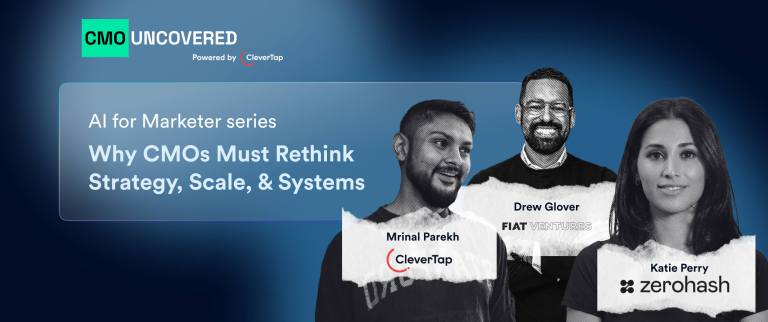
Drew Glover, Founding Partner at Fiat Growth & Fiat Ventures, and I recently kicked off the CMO Uncovered podcast series with Katie Perry, CMO of Zerohash, as our very first guest.
What emerged from our conversation wasn’t just a high-level discussion on AI or B2B growth tactics. It was a masterclass in how AI is redefining marketing at the grassroots level, and how the best marketers today think about intelligence: human intelligence, artificial intelligence, and the increasingly blurred line between the two.
Here’s what stayed with me.
Marketing Teams as the “Office of One”
Drew opened the discussion with one of the most debated ideas in marketing today: the CMO’s office is evolving into an “office of one.”
With agentic systems taking over routine execution and accelerating workflows end-to-end, we’re constantly exposed to bold narratives: “Fire your marketing team.” “Replace your agency.” Let AI handle everything.
Katie has lived this reality. During her time as a fractional CMO, AI was integral to scaling her business. She described how much she could accomplish as an individual person, from top-level brand positioning strategy right down to orchestrating a Google Adwords campaign end-to-end.
And yet, the idea of an “office of one,” while directionally true, is also dangerously incomplete.
As Katie pointed out, LLMs don’t operate in isolation. They need to be structured, guided, and architected.
This is where the human-in-the-loop becomes critical, specifically, where to use AI and when to use AI. I think that’s what’s the CMO’s role really going to be – determining where a human needs to be in the loop and not in the loop.
And yes, the path forward will be messy and even unpredictable – full of experiments, failures, and unexpected breakthroughs.
At CleverTap, we see this play out every day with the brands we work with. The most effective lifecycle marketers aren’t the ones who automate the most but the ones who know precisely which moments in the customer journey demand human intuition, and which can be scaled intelligently through AI.
The Technodrome Shift: You’re Not Doing More, But Operating at a Different Altitude
During our conversation, I was reminded of a concept I encountered during my master’s program: the technodrome. At its core, the idea is simple: as a technology paradigm shifts, it doesn’t just make existing tasks faster but fundamentally changes the level of abstraction at which we operate.
Katie illustrated this perfectly. She described using AI to produce a full 60-page book on stablecoins in under three weeks – something that would have previously taken months. But the key insight wasn’t the speed. It was how she did it: hours of structured conversations with internal experts, AI used to surface patterns and thematic links across that research, and then the writing itself flowing naturally from that synthesized intelligence.
That is a different abstraction level. She wasn’t just writing faster but orchestrating knowledge at a scale no single human could manage alone.
“With AI, you can build these brains, and you can make yourself 100x smarter. And, if you know how to coach it to know which synapses to fire off, it’s pretty cool,” said Katie.
This is the shift every CMO needs to internalize. The question is no longer “how do I do this task more efficiently?” It’s “at what level should I be operating, and what does AI free me up to think about?”
Failing Faster and Cheaper: How AI Accelerates the Learning Curve
Marketers, particularly those in the B2B space, are always looking for a directional sense of campaigns. Traditionally, that meant running 10–20 experiments, waiting weeks for results, and optimizing incrementally. Insight was valuable but slow.
AI changes that equation entirely. With agentic AI, the feedback loop between marketing action and business outcome is becoming exceptionally shorter. The reason is experimentation velocity.
Agentic systems enable marketers to run thousands of variations simultaneously – testing messaging, timing, channels, and audiences at a scale that was previously unimaginable. The result? The ability to fail faster, fail cheaper, and learn in near real time.
What’s even more powerful is that the same heuristic input – the strategic judgment that a marketer brings – can expand to tens of thousands of variations at the same cost. It’s the same single decision point, but a dramatically richer signal.
The best lifecycle marketing has always known this. The right message at the right moment to the right person isn’t a data problem; it’s an empathy problem that data helps solve. AI gives us more data, more speed, more scale. But the insight that drives meaningful engagement still comes from understanding people – their context, their intent, and their motivations.
At CleverTap, which sits at the intersection of engagement, lifecycle marketing, and AI-driven personalization, this is exactly where we see the industry heading. Not towards more automation for automation’s sake, but smarter experimentation that connects moments to measurable growth.
The “Hater”: Designing Systems That Challenge You
One of the most interesting ideas that came up during our conversation was something called the “Hater.” At first glance, it sounds almost counterintuitive. Why would you build a system designed to criticize your own ideas? But that’s precisely the point.
Katie uses GPT to stress-test her ideas, prompting it to think like a skeptical analyst or a tough lawyer having a bad day.
“I use it like – what would a hater say? It’s almost like holding yourself back in the right way and checking yourself, “ she said.
Drew one-upped her: Fiat Growth actually built an internal product called Hater, with 60 AI personas that tear apart every copy, idea, and campaign. You can even select the ICP you want roasting you – “I want these haters to be 18 to 22.”
What makes this powerful is that it flips a deeply ingrained marketing instinct. Most teams are wired to seek validation:
- Does this message resonate?
- Will this campaign perform?
- Does this look good?
But as Drew pointed out, the “hater” approach is inspired by inversion thinking – a principle used by investors like Warren Buffett and Charlie Munger. Instead of asking “Why will this work?”, they start with: “Why will this fail?”
This is where the role of the CMO evolves again. Because AI isn’t just a tool for generating ideas but can also be used for stress-testing them. The best marketers won’t just use AI to scale output; they’ll use it to improve judgment.
What This Means for the CMO in the Age of AI
Across the whole conversation, a clear picture emerged of what separates the CMOs who will thrive in this AI-native era from those who won’t.
It’s not technical fluency, though that helps. It’s not the size of their team or their budget. It’s the ability to think at the systems level: to know which problems belong to AI, which belong to humans, and how to build the connective tissue between them.
Katie called it “knowing how to orchestrate the tools” and “building the brain” through which an LLM can pull information. I’d frame it slightly differently: it’s the ability to design intelligence, not just deploy it.
That’s the CMO role in 2026 and beyond. Not a manager of campaigns. Not a director of content. A designer of intelligent systems – one who brings irreplaceable human judgment about customers, culture, and context, and uses AI to operate at a scale and depth that was previously unimaginable.
The office of one isn’t coming because AI is replacing marketers. It’s coming because the best marketers are learning to think like architects.
And the bar for what one person can build just got very, very high.
Watch the first episode of the CMO Uncovered, Powered By CleverTap podcast featuring Katie Perry, CMO of Zerohash.

Mrinal Parekh 
Leads Product Marketing & Analyst Relations.Expert in cross-channel marketing strategies & platforms.
Free Customer Engagement Guides
Join our newsletter for actionable tips and proven strategies to grow your business and engage your customers.