



















































Table of Contents
Categories
Most Popular


November 2022 marked a moment most of us didn’t realize would become a historic inflection point. The public rollout of ChatGPT wasn’t just the introduction of a powerful new tool; it essentially changed how humans interact with technology.
What began as a conversational, chat-based interface quickly evolved into something far more consequential. In just three years, generative AI has moved from answering questions to taking action. The rise of proactive, autonomous AI agents – systems that can reason, decide, and execute tasks on a user’s behalf – has created an entirely new paradigm.
We’ve since seen an explosion of generative AI platforms and tools: Google’s Gemini, xAI’s Grok, Claude, and countless enterprise-grade AI copilots. But the bigger shift lies beneath the surface. These systems are no longer passive; they are becoming agentic.
According to Gartner, 33% of organizations are expected to adopt agentic AI by 2028. And nowhere is this shift more disruptive or more transformative than in e-commerce.
Welcome to the era of agentic commerce.
The Evolution of E-Commerce
E-commerce has evolved in distinct waves. While one of the earliest e-commerce pioneers, CompuServe, was established as early as 1969, it was the 1990s that truly ignited the digital commerce revolution, with the launch of category-defining players like Amazon and eBay, along with PayPal as one of the first widely adopted online payment systems.
In the years that followed, the market expanded rapidly across geographies and categories. Search engines, on-site recommendations, and performance marketing became the primary engines of product discovery. The rise of smartphones and mobile apps around 2015 made shopping always accessible, pushing brands to rethink engagement strategies and invest heavily in personalization and lifecycle marketing to deliver more relevant experiences at scale.
Agentic commerce represents the next, and most transformative, phase of this evolution. In this new paradigm, discovery, comparison, and purchase are no longer driven directly by the shopper but by AI agents that act on the user’s behalf.
Consumer behavior is already signaling this shift. According to a recent study by Capgemini, 71% of consumers want Gen AI integrated into their shopping experiences, and 58% shoppers have already replaced traditional search engines with Gen AI tools for product/service recommendations.
What is Agentic Commerce?
Agentic commerce is the next phase in e-commerce’s evolution, in which AI agents act on behalf of users to search, evaluate, and purchase products or services. Think of these agents as always-on personal shopping assistants that:
- Understand preferences, budgets, and constraints
- Compare options across platforms
- Execute purchases securely with minimal human input
The shift needs to be looked at from the perspectives of both customers and brands. For customers, agentic commerce is about convenience and speed – they no longer need to browse endlessly, jump between tabs, or navigate checkout flows; instead, all they need to do is just delegate.
For brands, it signals a fundamental reordering of how commerce works. In this new paradigm, success depends on whether the brands are discoverable, interpretable, and actionable by AI agents.

How Agentic Commerce Works
At its core, agentic commerce replaces clicks with commands.
- Step 1: Delegation
A user assigns a task to an AI agent, such as: “Find me a warm jacket for an upcoming trip to a hill station under $200.” This task can be delegated to agents embedded within platforms like ChatGPT, Google Search, Shopify, or browser-based assistants.
- Step 2: Autonomous Decision-Making
The agent searches across multiple e-commerce platforms, evaluating options based on user-defined criteria such as price and discounts, reviews and ratings, delivery timelines, and brand preferences.
- Step 3: Execution
The agent presents the best options, explains the rationale, and, once approved, completes the purchase using secure, tokenized payment protocols.
The result? Frictionless commerce, with humans supervising decisions rather than executing them.
Recent Developments Powering Agentic Commerce
2025 marked the first serious wave of agentic commerce pilots, with tech giants moving quickly from experimentation to infrastructure-building.
- Google is embedding agentic capabilities into Chrome, enabling agents to handle routine errands like booking appointments or replenishing groceries.
- OpenAI’s Instant Checkout and Agentic Commerce Protocol will enable purchases directly within ChatGPT’s chat interface, bypassing traditional e-commerce flows entirely.
To support this ecosystem, major payment networks have already begun to lay the rails. PayPal, MasterCard, and Visa have launched agentic payment protocol initiatives that allow trusted AI agents to transact autonomously while preserving user consent and security.
According to McKinsey, agentic commerce could generate up to $1 trillion in orchestrated revenue in the US B2C retail market by 2030 and between $3-5 trillion globally.
Friction, Ethics, and the Growing Pains of Autonomy
As with every major shift, agentic commerce is also surfacing new ethical and operational challenges.
A recent lawsuit filed by Amazon against AI startup Perplexity – alleging that its agentic browsing capabilities disguised AI traffic as human – highlights the growing tension between legacy digital ecosystems and AI-native disruptors. While Perplexity has rejected the accusation, calling it a “bully tactic,” the case underscores a deeper issue: existing commerce and web frameworks were not designed for autonomous agents.
Questions around transparency, attribution, fair access, and platform governance will increasingly shape how agentic commerce evolves.
Agentic Commerce in 2026: What Changes Next?
By 2026, agentic commerce is expected to move from early pilots to mainstream adoption. Here’s what’s accelerating this transition:
1. Customer Adoption is Higher Than Ever
Customers have already become accustomed to AI-assisted decisioning:
- Recommendation engines tailor everything from playlists to products across platforms.
- Voice assistants handle tasks like setting reminders or reordering essentials with minimal friction.
- Autofill payments, digital wallets, and biometric authentication make online checkout faster and more seamless.
This cumulative familiarity is conditioning users to delegate more of their shopping journeys to machines, especially when those machines can not only suggest but also act. A recent survey indicates a growing comfort with AI-assisted commerce, with 57% of shoppers using AI because it saves time, and 79% of shoppers admitted that AI makes them more confident in their purchases.
2. AI Capabilities are Evolving Beyond Content
Large language models (LLMs) and AI agents are rapidly maturing in how they interpret context, intent, constraints, and trade-offs – far beyond static recommendation engines. They can now synthesize product comparisons across merchants, understand nuanced preferences like sustainability criteria, and execute purchases programmatically via APIs.
Brands have already started building “agent-ready” capabilities into their stacks so that agents can do more than just product discovery to actually make purchases. Shopify, for instance, has launched Agentic Storefronts, which will enable brands on its platform to be easily discovered by AI platforms, such as ChatGPT, Perplexity, and others.
3. Interoperable Standards and Secure Protocols are Emerging
For agentic commerce to reach scale, brands and platforms must speak a common language, and that’s where standards and interoperability come in.
Across the ecosystem, foundational layers are beginning to solidify. Commerce-focused initiatives such as the Universal Commerce Protocol (UCP) and the Agentic Commerce Protocol (ACP) aim to standardize how AI agents discover products, access structured catalogs, evaluate availability, and execute purchases across merchants. At the AI infrastructure level, protocols like Anthropic’s Model Context Protocol (MCP) and emerging Agent-to-Agent (A2A) frameworks are enabling agents to exchange context, intent, and task state reliably across systems.
Payments, long a bottleneck for autonomy, are also evolving. Industry-led efforts, such as Agent Payments Protocols (AP2), alongside initiatives from networks like Mastercard, Visa, and PayPal, are defining secure ways for trusted AI agents to transact on users’ behalf while preserving consent, controls, and human override.
Together, these protocols form the connective tissue of agentic commerce, providing the secure identity, context-sharing, and transaction rails that allow autonomous agents to operate at scale without compromising trust, safety, or governance.
Explore top trends for 2026! Download our eBook, What’s Next in Customer Engagement in North America: E-Commerce Edition.
What Agentic Commerce Means for Brands and Marketers
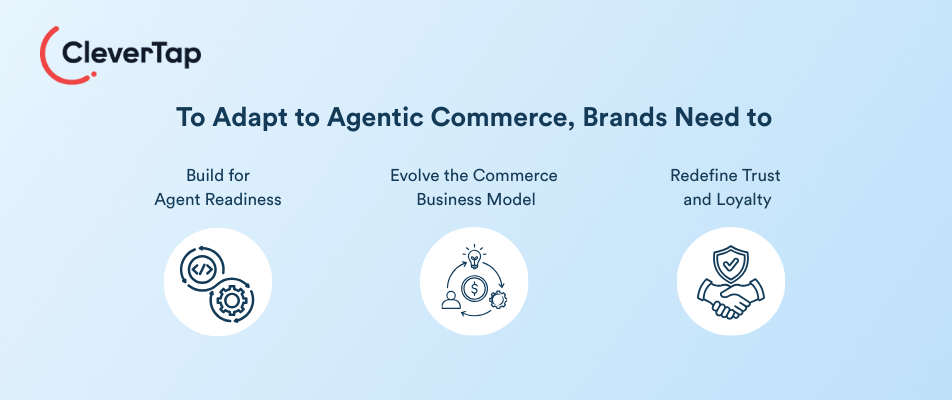
In an agentic world, the parameters of success have changed. Instead of trying to be the loudest brand in a search result or the highest bidder in an auction, brands need to strive to become agent-legible, agent-trusted, and agent-preferred. To achieve this, brands and marketers need to:
1. Build for Agent Readiness
Brands must redesign product catalogs, data schemas, APIs, and commerce systems so AI agents can easily discover products, compare value, and execute transactions. If your data isn’t machine-readable, you won’t be machine-recommended.
2. Redefine Trust and Loyalty for Delegated Buyers
When purchases are made by AI agents, loyalty shifts from emotional brand recall to measurable reliability – consistent quality, clear pricing, transparent policies, and predictable fulfillment. Marketers must rethink identity, consent, and loyalty programs for a world where the “buyer” is often an AI acting on human intent.
3. Evolve the Commerce Business Model
Agentic commerce weakens traditional ad-led discovery. Instead, value will increasingly come from orchestration and partnerships, data intelligence, and services and outcomes. The brands that win won’t just sell products; they’ll integrate seamlessly into autonomous decision systems.
How CleverAI Decisioning Engine and Agentic Universe Can Help
CleverTap’s CleverAI™ Decisioning Engine and Agentic Universe empowers marketers to navigate the agentic commerce era by combining autonomous intelligence with governance, personalization, and measurable outcomes. CleverAI agents alongside your team to analyze data, make decisions, and execute actions, while keeping you in control at all times.
With CleverAI, you benefit from:
- Autonomous intelligence: CleverAI powers a network of specialized agents that analyze, decide, and act on customer engagement goals – from segmentation to journey execution, reducing manual work and accelerating outcomes.
- True individualization at scale: Agents go beyond traditional personalization by tailoring interactions for every customer, enabling 1:1 individualization across channels in real time.
- Faster execution with governance: Marketers can prompt agents to build segments, journeys, creative assets, and more instantly – all while staying within user-defined guardrails.
- Real-time decisioning and context: The decisioning engine brings context from multiple data sources, powering predictive behavior insights and helping agents respond instantly to customer signals.
- Cross-functional orchestration: CleverAI agents coordinate across analytics, messaging, optimization, and content creation, enabling seamless orchestration of campaigns and engagement strategies.
Ultimately, as a platform-centric agentic AI ecosystem, CleverAI helps marketers focus on strategic priorities while improving performance metrics, operational efficiency, and overall business growth.
Want to see CleverAI agents in action? Request a personalized demo today!

Shravan Kavattur 
Content researcher for marketing tech, engagement & trends
Free Customer Engagement Guides
Join our newsletter for actionable tips and proven strategies to grow your business and engage your customers.