








































Table of Contents
Categories
Most Popular


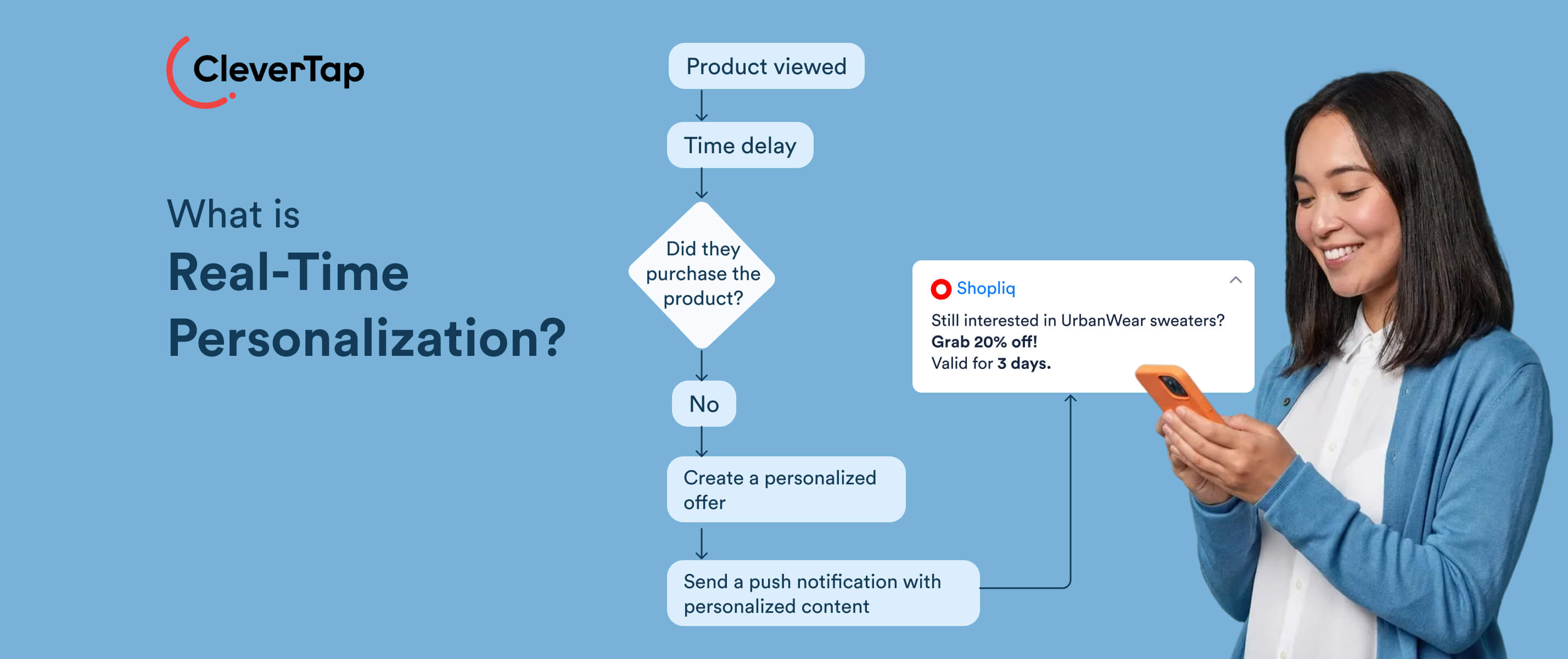
Shoppers move fast. One scans running shoes on your site, drops a premium pair into their cart, then hesitates, perhaps eyeing competitors. Traditional personalized marketing sticks to fixed segments and overnight batch jobs, serving yesterday’s relevance. Real-time personalization captures live behavior, context, and transaction data to deliver a targeted cart-recovery banner with current stock in under a second.
Companies that excel at personalization generate 40% more revenue from those activities than average players. This post covers the definition, step-by-step architecture, channel examples from web to push, a maturity model, latency trade-offs, required tech stack, and implementation roadmap with checklists.
What Is Real-Time Personalization?
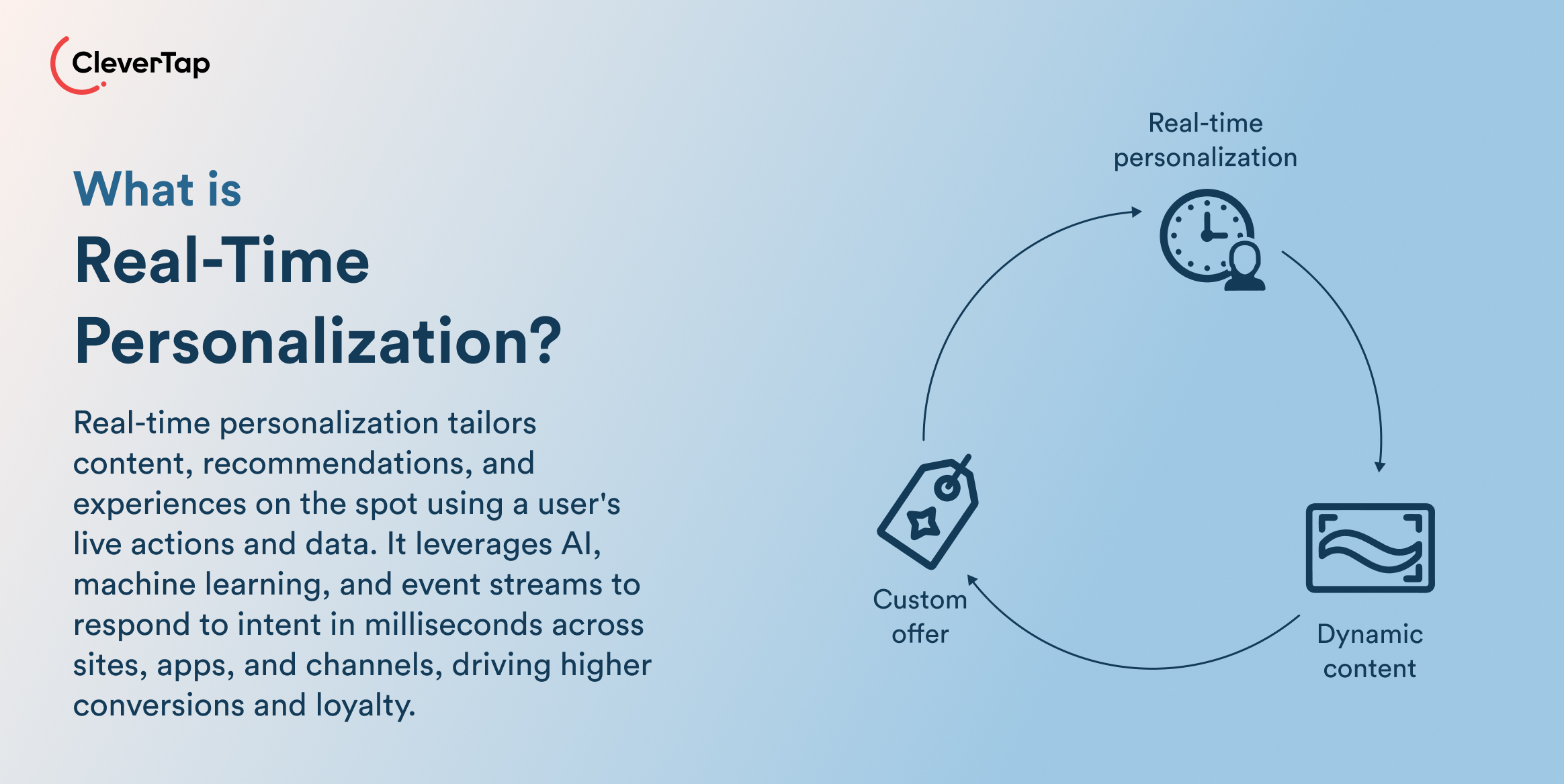
Real-time personalization tailors content, recommendations, and experiences on the spot using a user’s live actions and data. It leverages AI, machine learning, and event streams to respond to intent in milliseconds across sites, apps, and channels, driving higher conversions and loyalty.
Understanding Real-Time Personalization vs. Other Types
Unlike real-time personalization, which reacts to live data in milliseconds to capture intent as it forms, other approaches operate on delays that can cost you the moment.
- Near-real-time personalization: Updates in seconds to minutes via queued events. Fits email or app flows where slight delays are acceptable, but misses web micro-moments where intent is fleeting.
- Rule-based automation: Uses fixed if-then rules on existing profiles for quick execution. Rigid by nature, it requires manual updates to account for new behaviors, making it a common starting point for early-stage personalization programs.
- Batch segmentation: Groups users overnight based on historical data for broad targeting. Cost-effective at scale for re-engagement campaigns, but risks serving stale content by the time it reaches the user.
How Real-Time Personalization Works (Step-by-Step Architecture)
Real-time personalization powers dynamic experiences through a streamlined data pipeline that processes events in milliseconds.
1. Data collection: JavaScript tags and SDKs capture live events (clicks, page views, add-to-cart) across every touchpoint, enriched with session behavior, device type, and geolocation. Each signal carries intent data that batch systems would only catch hours later.
2. Unified customer profile: A CDP merges all streams into a single, continuously updated profile, deduplicating identities across devices and channels, and layering in historical context like past purchases, preferences, and churn risk scores. Without this, personalization is guesswork.
3. Decision engine: Rules handle condition-based logic (“User in Mumbai + cart > $5,000, show 10% off”). AI models go further, predicting next-best actions by matching real-time signals against historical patterns. Edge computing keeps decisions under 50ms.
4. Content & offer delivery: Personalized content fires via APIs the moment a decision is made, including dynamic web banners, emails with live content blocks that render at open time, and push notifications triggered by real behavior. The channel changes; the logic doesn’t.
5. Feedback loop: Every interaction (click, ignore, skip) becomes a new training signal, continuously refining models and decision logic. Over time, the engine stops just responding to behavior and starts anticipating it.
Together, these five steps turn raw behavioral signals into measurably better customer experiences.
Real-Time Personalization Examples Across Channels
Real-time personalization delivers value when matched to channel capabilities. These examples show how brands execute it, with measurable outcomes tied to live data signals.
Real-Time Website Personalization
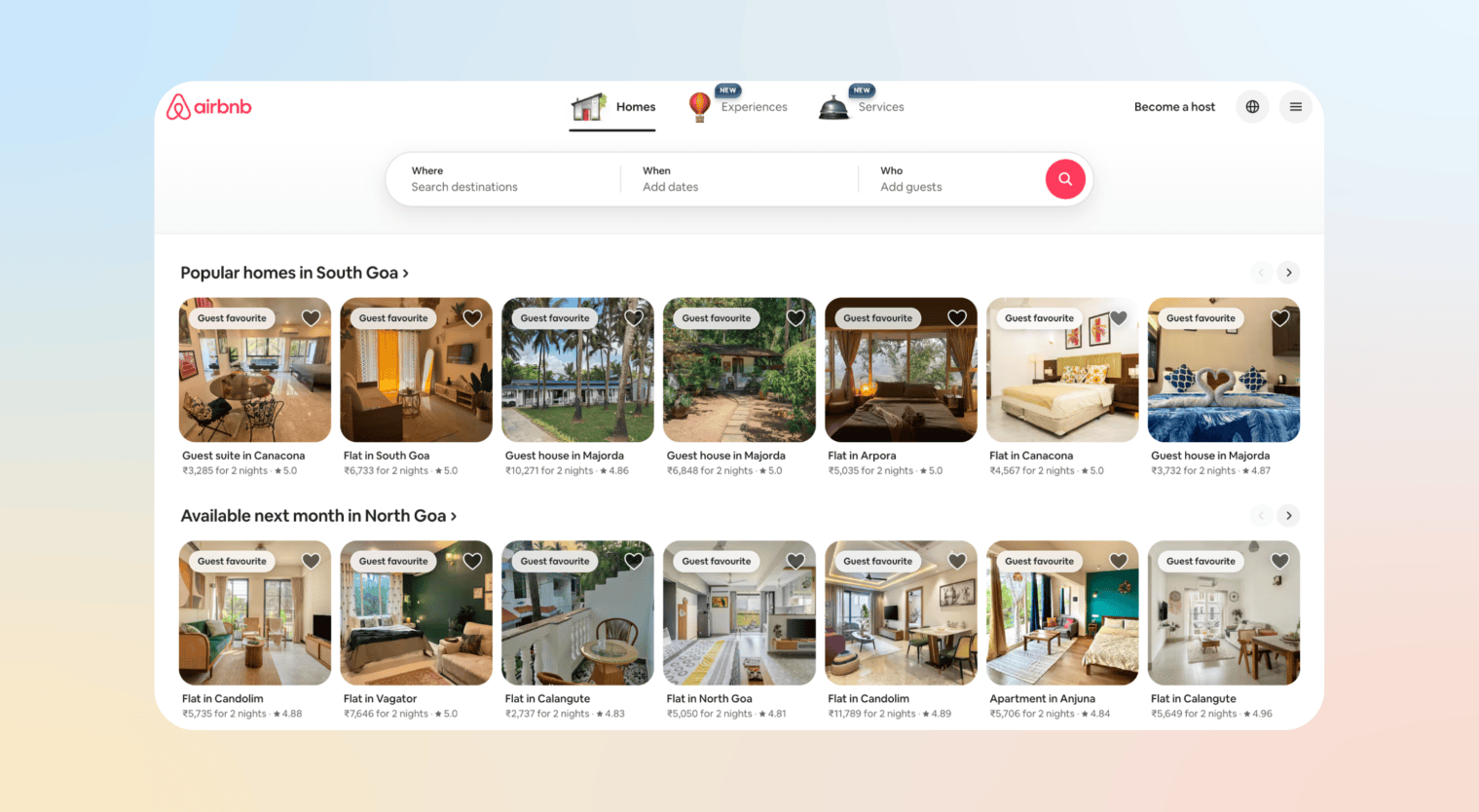
Airbnb’s homepage adapts to where you are before you’ve searched for anything. It detects your location via IP, surfaces nearby destinations, and displays pricing in your local currency by default. No filtering required, just an immediately relevant starting point that removes friction and moves users toward booking faster.
Search sharpens it further. A query like “Mumbai apartments next weekend” returns results filtered by live availability and past stay history, with amenities weighted for seasonal context. The experience compounds with every visit, narrowing the gap between landing and converting.
Get inspiration from the best website personalization examples from top brands.
Real-Time Search Personalization
YouTube personalizes search results using a hybrid approach. In-session signals like what you just watched, paused, or skipped are factored in alongside longer-term history like past searches, preferred topics, and watch time patterns. The result is a search experience that shifts with your behavior: two users searching the same term will often see meaningfully different results.
The real-time layer is most visible in recommendations (homepage, Up Next, Shorts feed), where the engine re-ranks content within milliseconds of each interaction. Search personalization draws more heavily on historical signals, making it closer to near-real-time. Together, they create a system that feels responsive without the user ever noticing the machinery behind it.
Real-Time Personalization Marketing in Mobile Apps
Fantasy sports run on urgency. When an IPL toss happens, every platform pushes notifications simultaneously, and the one that arrives first wins the conversion.
For MPL, campaigns took up to 8 minutes to compute, and notifications reached users 15 to 20 minutes after the trigger. In a window measured in seconds, that lag was handing conversions to faster competitors.
CleverTap’s mobile app personalization capabilities fixed this by pre-computing user segments before campaigns fire. MPL went from a 14-minute send process to delivering nearly 10 million messages within one minute of trigger. CTR rose 20 to 30%, and conversions climbed 5%.
Speed solved the delivery problem. Timing solved the relevance one. CleverTap’s “Best Time” feature sends notifications when each user is most active, not at a fixed broadcast slot.
Read the full case study here.
Real-Time Personalization Maturity Model
Most brands don’t lack personalization ambition. They lack a clear picture of where they actually stand. This model maps four levels of maturity, from basic segmentation to fully autonomous orchestration, so you can benchmark your current stack and identify the next meaningful upgrade.
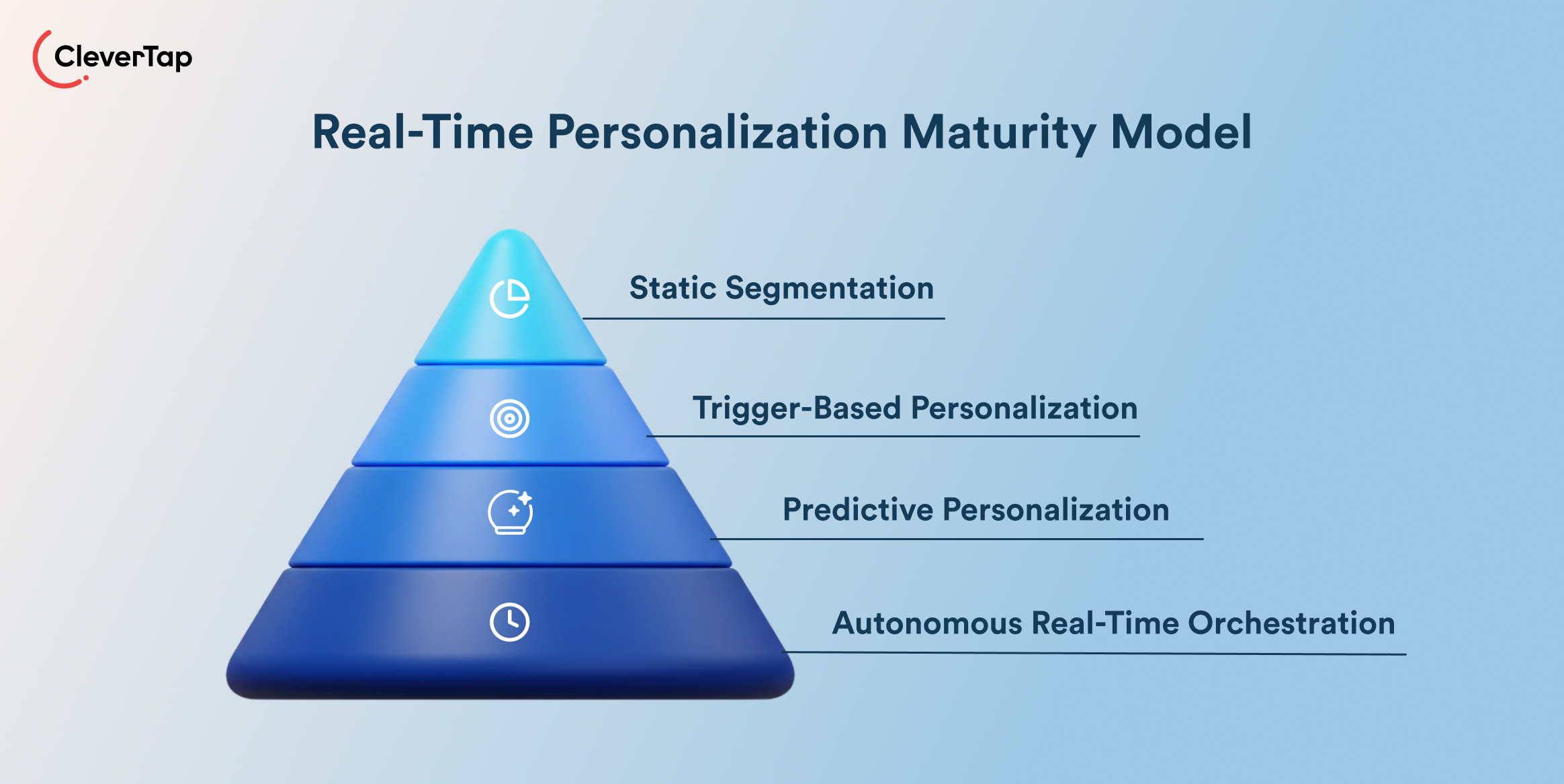
Level 1: Static Segmentation
Users are grouped by broad attributes like demographics or past purchases, and everyone in a bucket gets the same message. Campaigns are built manually, sent on a schedule, and measured in aggregate. There’s no feedback loop and no real-time signal.
This is personalization in name only. It works at small scale, but it doesn’t adapt, and it can’t.
Level 2: Trigger-Based Personalization
Campaigns fire in response to specific user actions: an abandoned cart, a completed sign-up, a lapse in activity. The experience feels more relevant because it is timed to behavior, but the logic is still rule-based and manually configured.
The improvement over Level 1 is timing. The limitation is that rules can only respond to what marketers anticipated in advance.
Level 3: Predictive Personalization
ML models score users on intent, churn risk, and likelihood to convert, and the system uses those scores to decide what to send and when. High-churn users receive win-back offers before they leave. High-intent users get nudged toward conversion at the right moment.
The shift here is from reacting to anticipating. Marketing starts working with data science, and the stack expands to include a CDP and behavioral scoring models.
Level 4: Autonomous Real-Time Orchestration
The system continuously ingests live signals, updates user profiles, and makes next-best-action decisions across channels without manual intervention. Geo-targeted offers, session-based recommendations, and cross-channel sequencing all run simultaneously and self-optimize over time.
At this level, personalization is no longer a campaign tactic. It is core product infrastructure, and the gap between brands operating here and those at Level 2 is compounding every day.
Real-Time vs. Near-Real-Time: Why Latency Matters
Real-time personalization processes data in milliseconds, aligned with live user actions. Near-real-time operates in seconds to minutes via micro-batches or queued updates. Fast enough for many flows, but too slow to capture intent at the moment it forms.
When near-real-time is enough: Email triggers, post-session recommendations, and inventory syncs can tolerate short lags without losing relevance. Abandoned cart recovery is forgiving too; the user is hesitating, not gone. Near-real-time handles the bulk of these scenarios well.
The infrastructure tradeoff: Real-time demands event streaming, in-memory CDPs, and edge-deployed decision engines, at a higher cost than near-real-time pipelines. On web and app channels, the investment pays off: faster personalization meaningfully outperforms delayed responses where split-second intent matters.
The deciding factor: Impulse-driven moments (a live game, an active browse session, a checkout page) demand real-time. Reflective ones (a weekly digest, a post-purchase follow-up) can afford to wait.
Measuring ROI of Real-Time Personalization
Speed and relevance are easy to sell internally. Proving their revenue impact is harder. These four measurement approaches separate genuine lift from correlation.
- Incrementality testing: Compare users who received a personalized experience against those who didn’t under controlled conditions. The right question isn’t “did this campaign perform well?” It’s “would these users have converted anyway?”
- Holdout groups: A holdout group is a slice of your audience deliberately excluded from a personalization treatment, giving you a clean baseline to measure attributable lift against. Resist the pressure to activate them during high-revenue periods. That’s precisely when the data is most valuable.
- Revenue per user: Aggregate revenue metrics obscure the true impact of personalization. Track revenue per user across segments and cohorts to see whether personalization is moving the needle for high-value users, at-risk users, or both.
- Customer lifetime value: Short-term conversion lifts are a useful signal, but CLV is the real scorecard. Personalization that reduces churn at key lifecycle moments and drives repeat behavior compounds over time. Measure it alongside campaign metrics to build the case for deeper investment.
- Engagement depth: Click rates tell you personalization is working at the surface. Session length, feature adoption, and return frequency tell you whether it’s building habits, and for subscription and gaming products, that’s a leading indicator of retention long before it shows up in revenue.
Technology Stack for Real-Time Personalization
Real-time personalization isn’t a single tool. It’s a coordinated stack of components that capture, process, decide, and deliver in milliseconds. Here’s what each layer does.
- Event streaming: Captures user actions as they happen and routes them to downstream systems without delay. This requires SDKs or tag-based instrumentation across web, mobile, and third-party sources feeding into a real-time ingestion layer.
- Customer data platform: Stitches behavioral, transactional, and contextual data into a unified profile, updated continuously as new signals arrive. Deduplicates identities across devices and maintains a single customer view across channels.
- Decision engine: Evaluates live signals against rules and predictive models to determine what experience to serve, fast enough to influence the current session. Can range from simple rule-based logic to AI-driven next-best-action recommendations.
- AI and ML models: Power churn prediction, propensity scoring, and product recommendations grounded in individual behavior, not broad segment assumptions. The closer these models sit to the unified profile, the more accurate they become.
- Channel connectors: Deliver personalization decisions across web, email, push, in-app, and SMS. Managing separate tools per channel introduces integration overhead and latency; a unified delivery layer removes both.
- Data warehouse integration: Enriches profiles with offline data and syncs campaign results back for reporting, keeping the personalization layer connected to the broader data infrastructure.
How CleverTap Powers Real-Time Personalization
CleverTap consolidates the entire stack into one platform and adds an agentic AI layer on top.
Linked Content pulls live data from external APIs at send time so campaigns always reflect current inventory and pricing. Real-time segmentation refreshes audiences the moment a profile property changes, and Linked Events trigger campaigns instantly when it does. On the delivery side, push, email, in-app, and web personalization all run natively from a single interface.
The agentic layer goes further. CleverAI Agents handle decisions that would otherwise require manual configuration: the Predictions Agent forecasts churn and conversions in real time, the Channel Optimizer selects the best delivery channel per user, the Send Time Optimizer schedules messages for peak engagement, and the Journey Builder constructs full cross-channel journeys from a plain-language goal. Teams spend less time configuring and more time acting on what the data is telling them.
Learn how CleverTap powers true 1:1 personalization.
The Brands That Win Are the Ones That Close the Gap
The brands winning on personalization aren’t necessarily the ones with the biggest budgets. They’re the ones that closed the gap between when user intent forms and when the experience reflects it.
Unify your data, tighten your decision loop, and build toward a stack that self-optimizes over time. The companies treating personalization as core infrastructure today are the ones compounding advantage tomorrow.

Subharun Mukherjee 
Heads Cross-Functional Marketing.Expert in SaaS Product Marketing, CX & GTM strategies.
Free Customer Engagement Guides
Join our newsletter for actionable tips and proven strategies to grow your business and engage your customers.